A look at how Brisbane Heat secured top spot in the Big Bash League earlier today and a large photo gallery.
Today’s Big Bash League Match saw Brisbane Heat take on Perth Scorchers. Heat came into the game knowing that a win would guarantee them a first place finish, while Scorchers knew that a win would ensure them qualification. I missed the Heat innings due to a morning commitment in town, but I listened to the Scorchers chase after I got back.
SCORCHERS PULL UP SHORT
At the halfway stage of the chase Scorchers were 80-3 chasing Heat’s total of 191, some way behind the required rate, but with Laurie Evans just starting his innings. Two overs later they were 103-3 and looking much better placed. It was at this point that they took their Power Surge, which was always likely to have a major impact on the outcome. I believe they were right to do so, with two batters both going well at the crease together. However, having picked a good moment to take the Power Surge you then have to make good use of it, and Scorchers did not. Spencer Johnson bowled the first over, and his six legal deliveries were good, but he also bowled three wides along the way, and was probably fortunate that a couple of others weren’t called. The second Power Surge over was better for Scorchers, and with six overs to go they were 122-4, needing 70 to win. Evans played a fine knock, reaching a half century off 28 balls, but no one else did enough (Ashton Agar who came in at number seven was especially culpable, scoring slowly and almost being run out when arguing with Evans over the merits of taking a single early in an over). Evans won the argument, and fortunately for Agar the bowler, Spencer Johnson, foozled the run out attempt. The next two balls after the spurned single saw Evans hit a four and then score three off the next, illustrating why he had not wanted to give up the strike so early in the over. Scorchers fell further and further behind, and by the time the 20th over came round they needed 30 from it to win with two tailenders together. The final margin was 23 runs, and Michael Neser secured Player of the Match, having placed a vital innings with the bat, fielded superbly and claimed two wickets with the ball.
PHOTOGRAPHS
My usual sign off…
My main errand this morning was being at a cheque presentation in this building, in my capacity as WNAG Secretary.
An account of a thrilling BBL encounter between Brisbane Heat and Hobart Hurricanes, plus a photo gallery.
At 8:15 this morning UK time the Big Bash League encounter between Brisbane Heat and Hobart Hurricanes got underway. This post looks back at the match.
THE BRISBANE HEAT INNINGS
Hobart Hurricanes won the bat flip and put Brisbane Heat into bat. Josh Brown and Colin Munro opened the batting for Heat, while Riley Meredith took the new ball for Hobart Hurricanes. A very fine over was marred by the last delivery, which was hit for four to make Heat 6-0. Corey Anderson bowled the second over, and it was a poor one – he bowled two wides, and conceded nine runs in total, four of them off the eighth delivery, necessitated by the bowling of the wides. Nathan Ellis, the Hurricanes captain, and veteran medium pacer Chris Jordan bowled the fourth over of the opening Power Play. Both bowled well, especially Jordan, and Heat were 22-0 after four overs. The fifth over, bowled by left arm wrist spinner Patrick Dooley, should have produced the first wicket but Tim David dropped an absolute sitter. Hurricanes continued to ring the changes, with the sixth over being bowled by a sixth different bowler, Nikhil Chaudhary. This over yielded eight runs including a four, but also a wicket of the sixth ball, Josh Brown, caught by Macallister Wright to make it 35-1. The seventh over finally saw someone bowl a second over, Riley Meredith. This over yielded a mere four runs and Heat were 39-1. Chaudhary bowled the eighth over, and it seemed to have ignited the Heat innings, Munro taking 20 from it, including two sixes and a four, 59-1. Dooley bowled the ninth over, and after five excellent deliveries he conceded a four off the last ball of it to make it 67-1. Ellis bowled the tenth over, conceding seven runs, but also trapping Heat’s number three, McSweeney, LBW. Heat were 74-2 at the halfway stage of their innings. Heat messed up the second half of their innings. They were overcautious about the Power Surge, and lost Munro for a well made half century before they got round to taking it. They then panicked and took it with two new batters together at the crease and made an utter hash of it, scoring 8-1 from those two overs. That left them at 112-5 from 17 overs. The last three overs were bowled by Jordan, Ellis, and then Jordan, and although Paul Walter made a brave effort to increase the total the two experienced bowlers restricted the damage from this last three overs to 20 runs, while two wickets fell. Ellis had 2-23 from his four overs, Jordan 3-19 from his four, and the most economical of all had been Meredith, conceding just 15 from his four.
THE HOBART HURRICANES INNINGS
With such a poor total to defend Heat needed early wickets to have any chance of success, and they got them, Michael Neser claiming one in the first over, and then Xavier Bartlett striking three times in quick succession to account for Wright, Sam Hain and Anderson. Hurricanes ended their four overs of Power Play reeling at 25-4. After 4.4 overs, two balls short of constituting a match, rain came down and the players left the field. The interruption was not a massive one, but enough to reduce the length of the Hurricanes innings to 16 overs, their target to 118 and their Power Surge from two overs to one. Hurricanes fought hard, with Chaudhary and David batting well. They like Heat were guilty of overcaution about the Power Surge, but fortune favoured them, and Chaudhary and David were still together when they finally took it. They may have mistimed taking it, but once they did take it they made decent use of their Power Surge, taking 12 runs off it. This left them needing 20 off the last two overs. In the next over David was dismissed, but Chaudhary did manage to get on strike for the start of the final over, with 13 needed to win. Paul Walter, the tall left arm medium pacer from Essex, bowled this over. Chaudhary hit the first ball for six to bring up a fine fifty, and when he added two more off the second ball the target was down to five off four balls. However, just when it seemed like he was set to be the matchwinner for his side Chaudhary then edged the next delivery through to Billings, and it was five needed off three balls with only tailenders left. Singles came off the next two deliveries, and Hurricanes needed three off one ball to win. They managed only one, with Dooley being run out going for a second. This meant that Heat had hung on to win by one run on the DLS method. Xavier Bartlett, whose three early wickets had given Heat the chance to defend a very modest total, was named Player of the Match, quite correctly in my view. Full scorecard here.
BRIEF FURTHER THOUGHTS
Neither side distinguished themselves when it came to the use of the Power Surge – Heat had two got opportunities to take it with Munro at the crease and going well and neglected both, allowing the perfect to be the enemy of the good, and ending up having to use those overs without Munro to exploit them, while Hurricanes left it at least one, possibly two overs longer than they should to claim theirs, and were rather fortunate after delaying like that to still have both Chaudhary and David at the crease to use it. Hurricanes dropped two easy chances in the field, and Chaudhary panicked just when it seemed that he was winning them the match. Heat finding a way to defend such a low total illustrated why they are ensconced at the top of the table.
An account of today’s BBL match between Melbourne Stars and Sydney Sixers. Also a photo gallery.
This morning UK time Melbourne Stars hosted Sydney Sixers in the Big Bash League. This post looks back at the match.
THE STARS INNINGS
Glenn Maxwell scored 31 off 14 balls, but no one else in the Stars line up came close to firing on all cylinders. Off spinner Todd Murphy bowled superbly and was rewarded with 2-15 from his four overs. Sean Abbott, the leading wicket taker in BBL history, would have been extremely disappointed to record 4-0-36-0 in a moderate opposition total. Stars finished with 156-4, the kind of total no team should ever record in a T20 innings – to bat through the whole 20 overs losing only four wickets and finish with a run rate of under eight an over is unacceptable, and I fully expected this total not to pose any great threat. Cricinfo’s ‘Win Predictor’ tool was slightly less scathing in its assessment than me, giving Sixers an initial 61% chance of a successful chase to Stars 39% chance of a successful defence.
THE SIXERS REPLY
Sixers started fairly slowly, but safely. The loss of Philippe to the penultimate ball of the opening Power Play made it 29-1, at which point Daniel Hughes joined James Vince. By the halfway point this pair were still together, though the required run rate had climbed to 8.90 per over. The 11th and 12th overs started to swing things firmly in Sixers favour, and then, with Vince and Hughes still together they took their Power Surge, very well timed in my estimation. Of course taking those two overs of Power Surge at a sensible time is only half the equation – you then still have to make full use of them. Sixers did exactly that, scoring 29-0 from the two overs in question, to be 122-1 after 14 overs. This meant that the RRR was below six an over, with the CRR up at 8.71, and barring a spectacular crash of wickets the game was as good as done – Sixers might conceivably have lost it from there, but Stars could not win it without the assistance of their opponents. In the event Sixers were icy cool, and by the time Vince was out for a superb 79 the target was down to 18 off 3.4 overs with seven wickets left. There were still seven wickets standing when Jordan Silk calmly turned the first ball of the 19th over into the leg side for the winning runs. A single would have been enough as scores were level by then, but the ball actually ran away for four. The only stage at which Sixers looked like they were other than in total control of the situation was when Maxwell was going well early in the Stars innings – even when they were significantly behind the required rate at the halfway stage of their innings they had nine wickets standing. The timing and use of the Power Surge were exemplary, realizing that they were superbly placed to take it at the end of the 12th over and not delaying in the hope of being even better placed later. Wickets can be lost in the Power Surge, but I have also seen wickets fall when a team delays the Power Surge and I would always prefer a team to be overbold about taking it than overcautious. Sixers are now very well placed to qualify for the KO stages, while Stars are very unlikely to do so – they would need to win all their remaining games and have a few other results go their way into the bargain. One other small point: in spite of the fact that most of the problems in both innings were caused by slower bowlers Stars opted to give Jonathan Merlo (right arm medium fast) his first over in this season’s competition, which worked out horrendously, costing 13 runs. Since Merlo was officially scheduled to bat at number nine, the fact that he hardly bowls, which today’s effort made only too easy to understand, this raised the question of just what he was doing in the XI.
A brief look at the opening day between Australia and Pakistan and a briefer mention of the extraordinary events at Newlands between South Africa and India.
The second test match of the series between Australia and Pakistan got underway at Sydney overnight UK time. This post looks at the opening day’s play.
PAKISTAN START POORLY
Pakistan won the toss and decided to bat first. By lunch time it was looking poor for them at 75-4. At 95-5 it looked even worse, but then came a fightback. Mohammad Rizwan (88) and Agha Salman (53) began the rescue act, but at 227-9 it still looked like Australia’s day. Pat Cummins had achieved his third straight five-for by then. However Mir Hamza, the Pakistan number 11, offered solid resistance, while Aamer Jamal played a magnificent innings. Jamal was eventually caught by Starc off Lyon for 82, having raised the Pakistan score to 313. There was time for one over of Australia’s first innings, which they ended on 6-0. This match looks like being a good one.
WICKETS CRASH AT NEWLANDS
I was only able to follow this one by way of cricinfo and various people’s twitter comments, but I must make mention of an extraordinary opening day between South Africa and India in Cape Town. South Africa won the toss and batted first, crashing to 55 all out, Mohammad Siraj 6-15. India were 153-4 in response at one point but lost their last six wickets without addition! South Africa lost three second innings wickets before the close, including a unique double of Elgar being out twice on the first day of his last test match and Stubbs being out twice on day one of his test debut. Stubbs is not the first to have been out twice on day one of his debut – aeons ago Harry Butt of England suffered the same fate.
Noting that the county championship is only 95 days away, by featuring Tom Soar’s career best. Also the first photo gallery of the new year.
Welcome to a new year. I have decided to make the main body of my first post of 2024 fit with the start of a new county championship season being 95 days away. I then have a photo gallery to share – today has been largely bright and sunny and I have been out and about.
TOM SOAR’S CAREER BEST
Tom Soar is not an illustrious name in the history of cricket, and fast bowling was his main occupation (323 FC wickets at 23.82 with a best of 8-38). His highest score with the bat was 95, and it came in a truly remarkable match.
Somerset had batted first and posted a total of 315, Ernie Robson top scoring with 74. Hampshire began poorly in reply and it would have been even worse for them had Somerset keeper Wickham pulled off a stumping chance against Major Robert Poore. Poore survived, which would have felt ominous to Somerset, given that at Portsmouth earlier that season he had already smashed them for two centuries in the match. Hampshire were 62-4 when Soar joined Poore. The pair put on 196 together before Soar was out for 95. Poore was now joined by another army officer, Captain Teddy Wynyard, and just over four hours this pair proceeded to hammer 411 runs, before Wynyard fell for 225. Poore was out a few balls, for precisely 300 runs more than he had scored at the time Wickham missed that stumping. Hampshire declared at 672-7, an advantage of 357. A dispirited Somerset could only manage 206 at the second time of asking and lost by an innings and 151 runs.
PHOTOGRAPHS
My usual sign off…
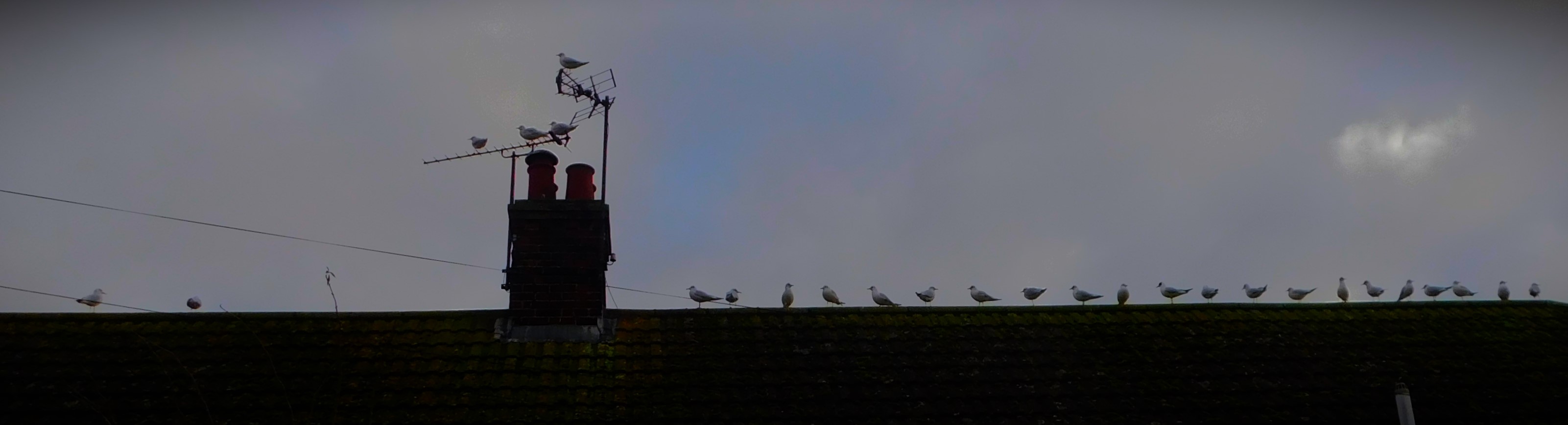
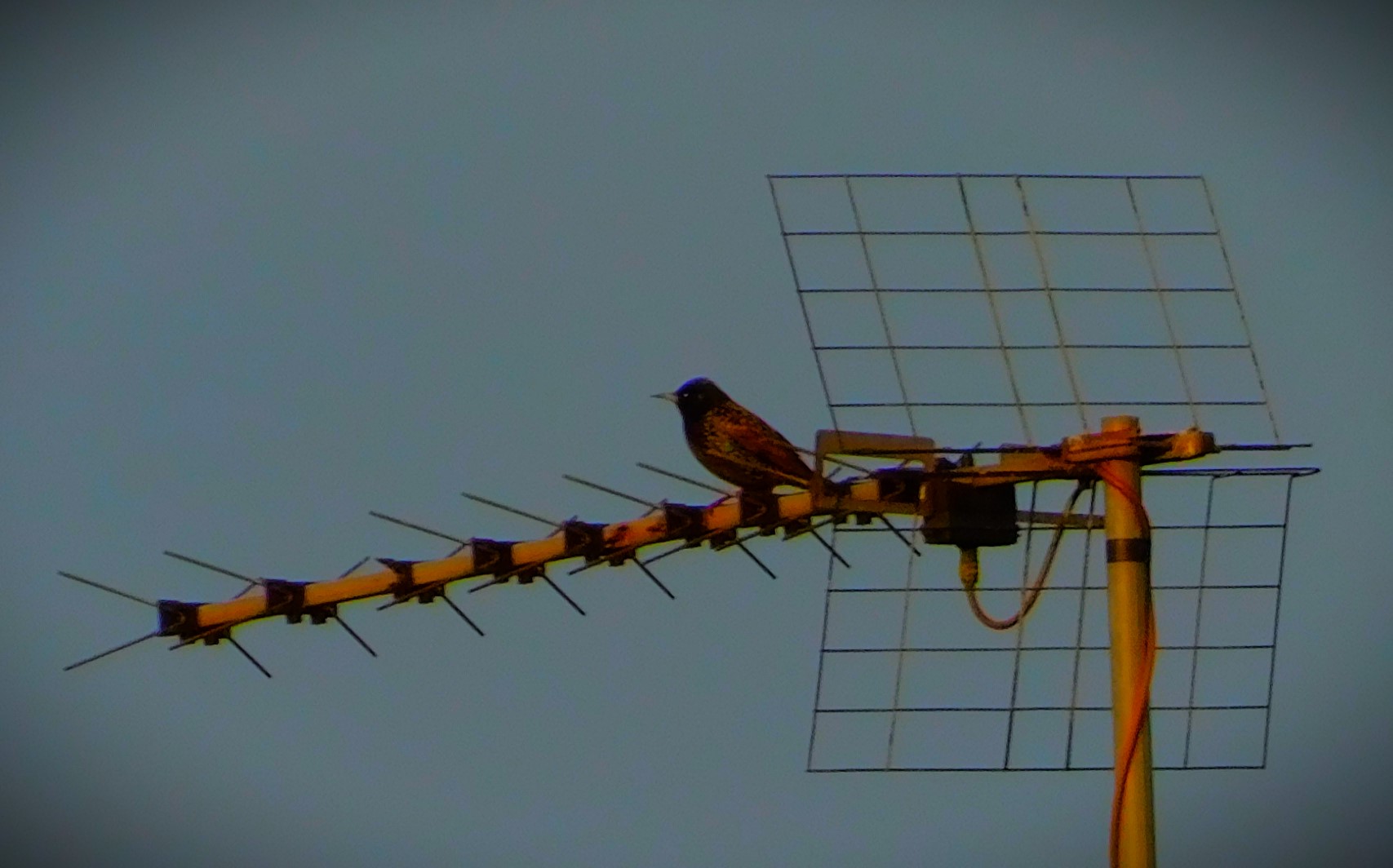
A gathering of gulls.MoorhenWhite duckSwansBlue tit.I think this was a skein of geese, going by the shapes of the birds.BlackbirdMy first starling of 2024JackdawsSparrows
A look back at the Boxing Day test between Australia and Pakistan, a brief comment on the Lamichhane case (some may find this distressing), a mention of the Panto at the Corn Exchange and a photo gallery.
Early yesterday morning the the Boxing Day test match between Australia and Pakistan ended a day ahead of schedule. The main part of this post looks back at that match. There is then a second section that some readers may find distressing, covering a piece of news that should not be overlooked. I end with my usual photo gallery.
A HARD FOUGHT BATTLE
I posted about developments earlier in this match here. Pakistan ended up 61 behind on first innings. They began the Australian second innings breathing fire, reducing their hosts to 16-4 at one point. They had a chance to make it 46-5, but it went to ground as more than one other did in the course of the match. The reprieved batter, Mitchell Marsh, went on to top score with 96 and Australia had 316 to defend in the end. The biggest ever successful chase at The G is 332, by England in 1928-9 in the match that won them that Ashes series, while Pakistan have a horrible record down under – last time they won a test match anywhere in Australia the side was captained by Imran Khan.
However, Pakistan did not surrender meekly, as their subcontinental neighbours had at Centurion in the other Boxing Day test (India 245, South Africa 406, India 131 – South Africa won by an innings and 30 runs), they had a real go at the target.
The got to within 100 of the target with the sixth wicket pairing of Mohammad Rizwan and Agha Salman together and going nicely. Cummins appealed for a catch behind against Rizwan, given not out on the field, with the TMS commentary team also certain that it wasn’t out and Rizwan indicating that it had hit his forearm on the way through. Australia sent it upstairs, and after about five minutes of using every piece of technology available to him the third umpire Richard Illingworth found what he believed was evidence to overturn the decision and instructed Michael Gough, the on field umpire, to do so. My belief is that having studied replays for that long there is no way the evidence Illingworth had could have been convincing enough to warrant an overturn.
The controversial breakthrough thus achieved, Australia did not take long to do the rest of the job, Pakistan being all out for 237 to lose by 79 runs. Pat Cummins in addition to captaining his side took five wickets in each Pakistan innings (5-48 and 5-49 respectively), and there was thus only one candidate for Player of the Match. Nevertheless, for me, the circumstances of Rizwan’s dismissal in the final innings means that this victory by Australia is somewhat tainted. A full scorecard can be seen here.
THE LAMICHHANE CASE
Yesterday it was announced that the a Nepalese jury had found Sandeep Lamichhane, the Nepali leg spinner, guilty of raping a minor, an offence that under Nepali law carries a possible 12 year jail term. In my view the ICC, as cricket’s world governing body, have a duty to respond to this news: Lamichhane should forthwith be banned outright from ever having anything more to do with organized cricket – no playing, no umpiring, no commentary gigs, no coaching (especially this latter given what he has been found guilty of) etc.
THE CHRISTMAS PANTO
This year’s Christmas Panto at the Corn Exchange, King’s Lynn was Dick Whittington, and on Thursday night the West Norfolk Autism Group had block booked seats. The fact that we were buying in bulk got us a substantial discount on the regular price, and members were only asked to pay £5 per ticket by us. It was an excellent production, well worth the minor inconvenience of the timing (a scheduled 5:30PM start, which meant all I had time to do at home between work and the performance was get changed out of my work clothes, and supper had to wait until I got home again at the end of the evening).
PHOTOGRAPHS
My usual sign off…
The Corn Exchange Advertising in the foyer of the Corn Exchange.
A look at the first two days play between Australia and Pakistan at the MCG and a splendid photo gallery.
The Boxing Day test match between Australia and Pakistan at Melbourne has now seen two days play, albeit one of them disrupted by the weather, and is beginning to take shape.
THE AUSTRALIAN INNINGS
Pakistan won the toss and elected to put Australia in to bat. A truncated opening day ended with the hosts 187-3 after a “curate’s egg” bowling and fielding effort by Pakistan. At 226-4 Australia still looked very well placed, but then Pakistan fought their way back into things, and Australia eventually tallied a mere 318, respectable after being sent in but by no means formidable. Marnus Labuschagne with 63 had the only half century off the bat in the innings, but Pakistan may well come to regret the fact that they allowed Extras to tally a half century as well (52, including 15 wides). Debutant Aamer Jamal claimed three wickets, while Shaheen Shah Afridi, Mir Hamza and Hasan Ali each had two, and Agha Salman, brought on to bowl the last over before lunch on day one, was gifted the wicket of David Warner.
THE PAKISTAN RESPONSE TO DATE
Pakistan began well, and at 124-1 it looked like things were going their way, but then came a passage of play that completely changed things. Pat Cummins removed Abdullah Shafique for 62, hanging on to a hard return chance. Then he widened the breach by bowling new batter Babar Azam for 1. Lyon got Shan Masood for 54, Hazlewood produced a beauty to get through the defences of Saud Shakeel for 9, and Pakistan were 151-5 and in a lot of trouble. Cummins claimed a third scalp of the innings when he got one to take the edge of Salman’s bat to make it 170-6. However Jamal defended stoutly, while wicketkeeper Mohammad Rizwan, who had performed better behind the stumps than 20 byes and 15 leg byes might suggest, batted well. When the cut off time arrived Pakistan were 194-6, with Rizwan 29*. Much rests on him on day three – it will largely by his further contribution or lack of it that decides whether Australia will have a really commanding lead or not. At the moment Australia are in the box seat, but many worse positions than the one Pakistan are currently in have seen sides emerge victorious.
PHOTOGRAPHS
Yesterday morning was bright and sunny, and I got out for a long walk while the weather was pleasant. I was well rewarded, including sightings of an egret and a couple of cormorants among other things…
An egret in the mud on the west side of the Great Ouse, opposite Hardings Pits (features in six pictures)Cormorants at one of their most regular perching spots (10 pictures)
A look back at the events that have unfolded in Mumbai over the last few days, a historic win for India Women in a test match over Australia women. Also a photo gallery.
Four days ago a test match between the Indian and Australian Women’s teams got underway in the city of Mumbai. I was only able to follow developments through cricinfo and some of my twitter and mastodon followers, so this post will be a bit sketchy, but you will see why I could not ignore it. India Women had never beaten Australia Women in a test match going into the game, but they had just won a test against England Women in Mumbai…
THE AUSTRALIAN FIRST INNINGS
The first hint that not all was going to the way of Australia came in the first innings of the match, when they managed only 219, with Pooja Vastrakar taking four wickets, Sneh Rana three and Deepti Sharma two. Vastrakar’s effort was especially significant – both because day one often sets the tone and because seamers should do well early in matches.
THE INDIAN FIRST INNINGS
India started impressively with the bat, with Smriti Mandhana, Richa Ghosh and Jemimah Rodrigues all making runs, and looked set for a massive lead when they passed 250 with only three wickets down. They then suffered a mid-innings collapse and at273-7 it looked like an opportunity to bury the match had been squandered. However, for the all their positions at numbers eight and nine in the order both Deepti Sharma and Pooja Vastrakar are competent batters, with Sharma being a genuine all rounder in any format save T20, where her relatively slow scoring rate counts against her. This pair reasserted India’s dominance, batting all the way through the final session of the second day and taking India’s lead past 150. India ultimately topped 400, finishing with 406 for a lead of 187. Sharma had the top score of the match with 78, and Vastrakar had set a new record for an Indian number nine in a test match with 47.
THE AUSTRALIAN SECOND INNINGS
Australia, as one would expect of such a strong and determined side fought hard in their second innings, but never really threatened to take the initiative away from India. Perry, McGrath, Healy and Sutherland all provided stiff resistance, but by the close of third day Australia were five down and only 46 to the the good. Had their lower order been able to conjure another 100 on the final day Indian nerves might have been jangling, but in the end they only managed a further 28, to give themselves just 74 to defend. Sneh Rana claimed four wickets with her off spin, and two other spinners, skipper Harmanpreet Kaur and Rajeshwari Gayakwad claimed two scalps a piece, while Vastrakar added another wicket to four first innings scalps. Tahlia McGrath had battled her way to 73.
THE INDIAN CHASE
Shafali Verma was out cheaply to make it 4-1, but Richa Ghosh offered Smriti Mandhana good support, and by the time she was out only a further 20 were needed for victory. Rodrigues joined Mandhana and this pair were still together when India completed an impressive win, Mnadhana 38*, Rodrigues 12*. Sneh Rana’s seven wicket match haul earned her the Player of the Match award, though both Vastrakar (five wickets across the two innings and a vital 47) and Sharma (the highest individual score of the match and two wickets) must have been close, especially the former. All credit to India for winning this one – Australia were unbeaten in the format since 2014 going into this match. A full scorecard can be seen here.
A look at how the Big Bash League is panning out and a photo gallery.
The Big Bash League is well underway. This edition of the tournament features only 10 group matches per side rather than 14 and also sensibly only allows the top four sides to qualify for the knockout stages as opposed to the ludicrously overgenerous situation previously whereby fifth was good enough.
HOBART HURRICANES v MELBOURNE RENEGADES
There was radio commentary on this match today for UK listeners. Renegades batted first and helped by a rare example of a reasonably well timed Power Surge (overs 16 and 17, making it a kick starter into the death overs rather than actually being part of the death overs, still an over or so later than I would like but the best timed one in any of the radio commentaries I have listened to so far) which they capitalized on, taking the two overs for a total of 34 runs, tallied an eminently respectable looking 185-5 from their 20 overs.
Unfortunately for them they bowled like drains, which in combination with some excellent Hurricanes batting, especially from Matthew Wade and Macallister Wright, saw the hosts home by six wickets with an over to spare.
HOW THE TABLE IS LOOKING
Three sides, Brisbane Heat, Sydney Sixers and Perth Scorchers, are looking very likely to progress. Another three, Adelaide Strikers, Sydney Thunder and Hobart Hurricanes would appear to be fighting for the fourth qualification slot, while the two Melbourne sides, as happened in the women’s version of this tournament, look like propping up the table.
POWER SURGE THOUGHTS
In the BBL the initial Power Play lasts for four overs rather than the usual six and the batting side then has a two over Power Surge which they have to take in the second half of their innings (this is to stop sides lazily using it for overs 5 and 6 and thereby having a standard Power Play). My feeling based on the games I have listened to so far this season is that most sides are very overcautious about taking the Power Surge which means it often happens later than it should. Personally the latest I would countenance those overs being taken is for overs 16 and 17 as happened today, but I would want to go earlier if possible. In one of the other games I listened to the side batting first had two well set batters together at the end of 12th over and still together at the end of the 13th, but they refused to take these golden opportunities to use the Power Surge, and lost a wicket in the 14th. They ended up using the Power Surge in the 18th and 19th overs of their innings, which I regard as plumb crazy. It depends on exact situations but I would always want to go fairly early. If the openers happened still to be together at the end of the 10th over I would seriously consider taking the Power Surge for overs 11 and 12 as a launch pad for the second half of the innings. The other time I might go that early as if a number of wickets have fallen and I want to use the surge while I still have two front line batters to capitalize on it. I would say that in intermediate situations between the two I have outlined above I would look at overs 13-14, overs 14-15, overs 15-16 and at the very outside overs 16-17 and would never allow the surge to unused going into the death overs.
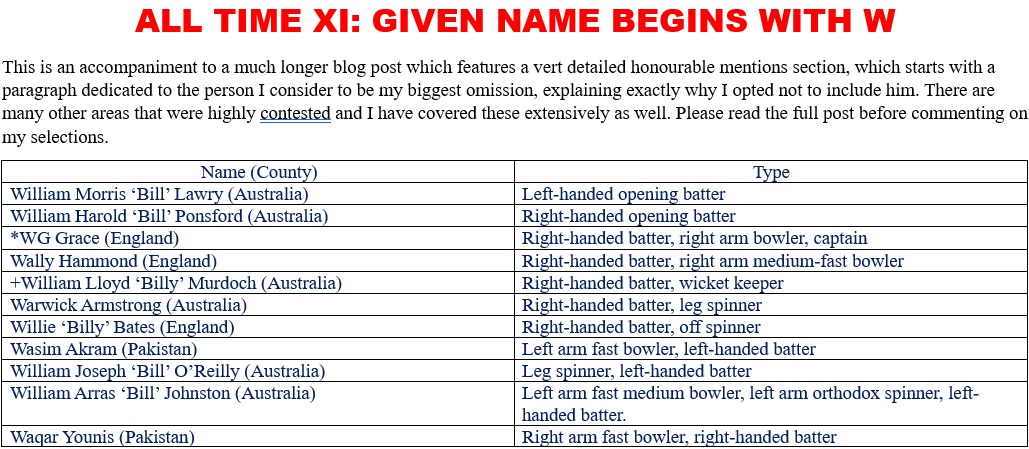
An all time XI of players whose given names begin with W, a very detailed honourable mentions section and a photo gallery.
Today I present an all time XI of players whose given names begin with W and a detailed honourable mentions section, as well as my usual photo gallery.
THE XI IN BATTING ORDER
William Morris ‘Bill’ Lawry (Australia, left handed opening batter). He averaged 47 with the bat in test cricket.
William Harold ‘Bill’ Ponsford (Australia, right handed opening batter). Until Brian Lara came along only one player had achieved two first class scores in excess of 400, Ponsford, with 429 against Tasmania in 1922 and 437 against Queensland in 1927. In December of 1927 he became the only player ever to score 1,000 first class runs in a calendar month outside of England, with a sequence of 1,146 runs in five innings. His test record was not quite so outstanding, but even at that level he averaged 48, which included centuries in each of his first two test matches and centuries in each of his last two.
*WG Grace (England, right handed batter, right arm bowler of various styles, captain). Cricket’s first superstar, and in his best decade, the 1870s, he averaged 49 with the bat at a time when the best of the rest were just about managing 25. Only one other person in cricket history ever sustained being twice as prolific as the best of the rest over a long period – Bradman.
Wally Hammond (England, right handed batter, right arm medium-fast bowler). He scored 7,249 runs at 58.45, including 905 at 113.125 in the 1928-9 Ashes.
+William Lloyd ‘Billy’ Murdoch (Australia, right handed batter, wicket keeper). Australia’s best batter in the earliest years of test cricket, and a fine enough keeper that FR Spofforth missed the first ever test match because he initially didn’t believe that any keeper other than Murdoch could handle his bowling.
Warwick Armstrong (Australia, right handed batter, leg spinner). A fine all round cricketer whose feats included scoring over 2,000 runs and taking over 100 wickets in first class matches on the 1905 tour of England. 16 years later he almost captained an undefeated side, the only loss they sustained on the tour coming at the hands of ‘an England XI’ assembled by AC MacLaren.
Willie ‘Billy’ Bates (England, right handed batter, off spinner). The first England bowler ever to take a test hat trick, part of a match performance in which he scored a 50 and took seven wickets in each Australian innings.
Wasim Akram (Pakistan, left arm fast bowler, left handed batter). One of the greatest ever.
William Joseph ‘Bill’ O’Reilly (Australia, leg spinner, left handed batter). Only one batter among those he came up against in the course of his career could truly claim to have his measure: Don Bradman.
William Arras ‘Bill’ Johnston (Australia, left arm fast medium bowler, left arm orthodox spinner, left handed batter). The third essential member of Australia’s immediate post WWII bowling attack after Lindwall and Miller, as well as being two types of bowler in one he was possessed of great stamina – it was not unknown for him to go straight from spinning the old ball to swinging the new one. Three times he was Australia’s leading wicket taker in Ashes series. In England in 1953, with the active connivance of some his team mates, who got themselves out in some of the later matches to help engineer the outcome, he became only the second player to average 100+ for an English first class season (17 innings, 16 not outs, 102 runs, average 102.00) after Bradman in 1938 (the Don achieved his average of 115.66 for that season without any such shenanigans going on).
Waqar Younis (Pakistan, right arm fast bowler, right handed batter). A superb practitioner, and one who regularly shared the new ball with Wasim Akram.
This side has a powerful batting line up, and a wealth of bowling options. The only regular type of bowling that is not featured is left arm wrist spin. The front five of Younis, Akram, Johnston, O’Reilly and Bates are formidable in their own right, and in the unlikely event that they prove insufficient there are Armstrong, Grace and Hammond as back up options.
HONOURABLE MENTIONS
I start this section with a paragraph devoted to my most notable omission…
WILFRED RHODES
One of the most extraordinary performers in the history of cricket, with a remarkable five-phase playing career – specialist left arm spinner, all rounder, specialist batter, all rounder, specialist left arm spinner. The trouble is that brilliant as he was as an all rounder at county level his England career was almost exclusively spent either as specialist bowler (early and late periods) or as a specialist batter (in the run up to WWI). His batting would not warrant selection as a specialist and if I pick him as a specialist bowler I would have to leave out Johnston, who offers me two bowling options in one and had an outstanding test record.
OTHER HONOURABLE MENTIONS
The opening slots were rich in potential candidates. Lawry’s only rival for the left handed openers slot was Warren Bardsley, the first batter ever to score twin centuries in a test match and possessor of a fine overall test record, as well as being Australia’s leading scorer of first class centuries until Bradman came along, more than half of those tons having come in England.
Ponsford was rivalled for the right handers opening slot by two other Williams who were generally known as Bill, WA Brown and WM Woodfull. Woodfull in particular is unlucky to miss out, while Brown also had a fine record.
I regard WG Grace as an essential pick and my reckoning is that he could handle first drop, though he did prefer to open. Two regular number threes who thus miss out are William Gunn, the Gunn of Gunn & Moore, whose test record did not live up to his superb first class record and William Scotton, also of Nottinghamshire, whose ability to bat for long periods of time came at the expense of run scoring. William John ‘Bill’ Edrich was another who might have had this slot, averaging 40 in test cricket in spite of losing six prime years to WWII. WG ‘Billy’ Quaife had a splendid record for Warwickshire but his seven tests were disappointing. Wajahatullah Wasti of Pakistan once scored twin tons in a test match but did little else at that level. William Yardley has a place in the record books – in 1870 he became the first player ever to score a century in the Varsity Match.
Among the all rounders I could not accommodate were Wasim Raja, WE ‘Bill’ Alley, Wanindu Hasaranga de Silva, Wilf Flowers and William ‘Billy’ Barnes.
My decision to entrust the gloves to Murdoch meant that three very accomplished keepers, Wriddhiman Saha of India, Wasim Bari of Pakistan, and Arthur Theodore Wallace ‘Wally’ Grout of Australia missed out.
WH ‘Bill’ Lockwood was a fine bowling all rounder, and possibly the pioneer of the slower ball, but not a serious rival to Akram for the number eight slot. A number of Williams, all known as Bill, were fine quick bowlers: Whitty, Voce, Bowes, Copson, Andrews and Bestwick among them. Two Williams known by their full first names, Lillywhite and Mycroft, were both great bowlers kept out by the immense strength in depth available for this squad. Wes Hall and Wayne Daniel were two of the many superb quicks to come from the coral island of Barbados, and both can be considered unlucky to miss out. Walter Mead, a bowler of mixed spin for Essex who claimed a 17 wicket match haul against the 1893 Australians and had a magnificent first class record was the biggest miss in the spin bowling department.
In a few years time there may be a second WG in the line up – WG Jacks of England, an attacking batter and a capable off spinner who is in the process of establishing himself in international cricket.


































































































































































































































































































































































































































































































































































































































































 aspiblog