Picking up where I left off yesterday, with my first team starting with a ‘w’.
INTRODUCTIONS
For today’s all time XI cricket post I am picking up where I left offyesterday, continuing the alphabetic progression, so our first XI begins with a player whose surname begins with W.
FRANK WORRELL’S XI
*Frank Worrell– right handed batter, left arm medium fast bowler, occasional left arm orthodox spinner, captain.
Xenophon Balaskas– leg spinner, drafted in here as ersatz opener as well. X is a very difficult letter, but I will attempt to find alternatives for the leg spinning all rounder in future posts of this type. He did average 28.68 with the bat in first class cricket.
Graham Yallop – left handed batter. He batted at no 3 in the 1978-9 Ashes and was the only player on either side to score two centuries in the series – it was only as captain that he was not up to the task.
Zaheer Abbas – right handed batter. Known on the county circuit as ‘Zed’, Z is another difficult letter.
+Leslie Ames – right handed batter, wicket keeper.
Ian Bell – right handed batter. Given the opening situation I felt an extra specialist batter was warranted, so Ian Botham missed out.
Percy Chapman – left handed batter. Extra batting depth needed.
Alan Davidson– left arm fast medium bowler, left handed batter.
Phil Edmonds – left arm spinner, right handed lower order batter.
James Iremonger – right handed opening batter. Played for Notts at the start of the 20th century, opened the innings in his first full season, and finished his long career with a batting average of 36. When his playing days were done he became a coach, still with Notts, and among the youngsters he ushered into first team cricket were Harold Larwood and Bill Voce.
Archie Jackson – right handed batter. A regular opener, batting at no 3 here.
*Heather Knight – right handed batter, occasional off spinner, captain. She has batted at no3, but no4 is nowadays her regular slot. World cup winning captain, given that role in this side.
Clive Lloyd– left handed batter. My second world cup winning captain, in this team he will be vice captain to Heather Knight.
Mushtaq Mohammad – right handed batter, leg spinner. The first of two all rounders in this side.
Mohammad Nabi – right handed batter, off spinner. Part of the first ever Afghanistan team, and still in the ranks when they attained test status. His role in the astonishing rise of his country as a cricketing force means that he has played against a wider range of sides than any other player in the game’s history.
Iqbal Qasim – left arm orthodox spinner. Q is a difficult letter, but he is worth is his place, and no9 is the right place in the order for him.
Andy Roberts – right arm fast bowler. No11 is very low in the order for him, but the pace bowling department needs strengthening. He was the leader of original fearsome foursome of fast bowlers deployed by Clive Lloyd.
This side has a good batting line up, and an excellent variety of bowlers. Admittedly the only seam back up to the two big guns, Roberts and Pollock is Jack Hobbs, but it is still a good side.
THE CONTEST
Both of these teams look pretty good, and both have excellent captains. I think the presence of Roberts and Pollock just about gives Heather Knight’s XI the edge, but it has all the makings of a fine contest.
LINK AND PHOTOGRAPHS
Just before my usual sign off, physics-astronomy.com have an excellent article about some new x-ray pictures of the sky. The image below, taken from the article, is formatted as a link.
Today’s all time XI cricket post follows a strict alphabetical progression.
INTRODUCTION
Welcome to another variation on the all-time XI cricket theme. Today each featured player has a surname beginning with a different letter of the alphabet, and each letter is used strictly in sequence, meaning that the second XI ends with a player whose surname begins with V.
RAY ILLINGWORTH’S XI
Bobby Abel – right handed opening batter. 744 test runs at 37.20, an excellent record for his period, over 30,000 first class runs.
Tammy Beaumont – right handed opening batter. Has fared magnificently as an opener since being given the role for England in 2015.
Belinda Clark – right handed batter. In the 1990s she had the same kind of reputation as a batter that her compatriot Meg Lanning does today. She averaged 45 in test cricket and 47 in ODIs, the latter figure including the first ODI double ton by anyone.
Emrys Davies – left handed batter, left arm orthodox spinner. He was usually to be found in this sort of place in the batting order, and played some fine innings from no4.
Ross Edwards– right handed batter. One of the better Aussie batters of the first half of the 1970s (he retired somewhat prematurely at the end of the 1975 series played after the inaugural men’s world cup). In the first match of that series at Edgbaston he was horrifically out of form but ground out a half century in four hours and ten minutes, while others scored quicker (notably Rod Marsh with the top score of 61) at the other end. Rick McCosker and Ian Chappell had also scored 50s, and Thommo down near the extras scored a test best 49 to boost the score to 359. England were then bowled out twice, with skipper Denness, who had won the toss an put Australia in, managing three and eight in his last two test innings. In the second test of that series Australia slumped to 81-7 in response to England’s first innings 315 (Greig 96, Knott 69, Steele 50) and it was that man Edwards, helped by DK Lillee, who dug Australia out of this king sized hole. Edwards made 99, Lillee a test best 73 not out, and in the end England led by just 47, and were unable to force victory.
Andrew Flintoff – right handed batter, right arm fast bowler. He took a while to establish himself at the top level before enjoying a couple of magnificent years, and occasionally reviving old memories thereafter.
Jack Gregory – left handed batter, right arm fast bowler. Injuries took their toll late in his career, but his record confirms his status as a genuine all rounder.
George Hirst – right handed batter, left arm fast medium bowler. His England record does not look that great, but his play for Yorkshire, over the course of three decades, places him firmly among the greatest of all time.
*Raymond Illingworth – off spinner, right handed batter. In 1970-1, with Australia holding the Ashes, and having done so since winning them in 1958-9, Illingworth captained England to a 2-0 series victory to regain the urn, the first to do so in Australia since Jardine 38 years previously, and only the sixth in all after Bligh in 1882-3, Stoddart in 1894-5, Warner in 1903-4 and Douglas in 1911-2 as well as Jardine. Subsequent to that tour England’s only successes down under have been when Brearley defended the urn in 1978-9, Gatting in 1986-7 defending the urn won back by Gower in 1985 and Strauss in 2010-11, defending the 2009 spoils. He was a quality player in his day as well.
+Eifion Jones – wicket keeper, right handed batter. He made more dismissals than any other Glamorgan keeper, 933 of them (840 caught, 93 stumped) in 405 matches.
Rashid Khan – leg spinner, right handed lower order batter. Although it is his bowling that has got him in (after four tests he has 23 wickets at 21.08 at that level – a more than promising start – while eight first class matches in total have yielded him 58 wickets at 17.44, and he is not quite 22 years old.
This team has a solid top five, three fine all rounders, a keeper, and two spinners who can both bat. It has no tail to speak of (even Rashid Khan averages 23 in FC cricket), and Gregory and Hirst will make a fine new ball pairing, with Flintoff as back up, while Khan, Illingworth and Davies provide fine spinning options (especially the first two). This team will take a lot of beating.
HONOURABLE MENTIONS
First of all, bear in mind my decision to pick players in positions they actually occupied. That means that Abel is virtually indisputable, although Mayank Agarwal will change that if he continues as he has started. Jack Brown of England, Bill Brown of Australia and Sidney George Barnes of Australia were all good options for the letter B, and I could accept any of them. Ian Chappell might have had the no 3 slot. I felt no 4 was a position too high for Basil D’Oliveira, and felt that Davies’ bowling gave him an edge of Joe Darling. No 5 was too low in the order for Bill Edrich (he either opened or batted no 3) or his cousin John (a specialist opener), while none of the other cricketing Edriches had a good enough record. George Emmett of Gloucestershire might have his advocates, although five was lower than he usually batted. Freddie Flintoff had no rivals. Jack Gregory’s slot might have gone to Tony Greig, but I felt that that the Aussie gave me three genuine pace bowlers. Hirst’s place might have gone to Schofield Haigh but I felt that his left arm bowling and superior batting clinched it in his favour. Illingworth’s two main rivals were Jack Iverson and Bert Ironmonger, but both were genuine no11s, so would have been two places too high, and in Ironmonger’s case I already had a left arm spinner in Davies. Some might think that Geraint Jones should have had the keeper’s slot, but his allegedly superior batting (I am not wholly convinced it actually was) does not make up for the fact that he was definitely a tad clumsy behind the stumps. Rashid Khan’s place could have gone to his compatriot the left arm wrist spinner Zahir Khan, while if I had wanted an extra pace bowling option Indian left armer Zaheer Khan could have been selected.
WALTER ROBINS’ XI
Justin Langer – left handed opening batter, averaged 45 in test cricket, with a best of 250 against England at the MCG.
Colin McDonald – right handed opening batter. The 1950s was a slow and low scoring decade, which makes McDonald’s test average of 39, batting at the top of the order particularly impressive. His best series was the 1958-9 Ashes when the he was the most successful batter on either side.
Scott Newman – left handed batter. When he first started it seemed that an England career beckoned, but he never quite kicked on, finishing with a first class average of 38.
Norman O’Neill– right handed batter. A fine stroke making batter for Australia. He averaged 45.55 in test cricket, making his debut in the 1958-9 Ashes series.
Kevin Pietersen – right handed batter, occasional off spinner.
+Quinton De Kock – left handed batter, wicket keeper. I could not come up with a cricketer whose surname began with Q who could play as high as no six, so I allowed myself to pick someone whose first name began with Q.
*Walter Robins – leg spinner, right handed batter, captain. A highly successful captain of Middlesex, well regarded by most of those who played under him. He averaged 26.39 with the bat and 23.30 with the ball, scoring 13,884 first class runs and capturing 969 wickets in his 379 games at that level.
George Simpson-Hayward – off spinner (under arm). 23 wickets at 18 in his five test matches, 503 first class wickets at 21.
Charles Turner – right arm medium fast bowler. One of the great bowlers of the early period of test history – took his 100th wicket in his 17th test match. Link two in an Australian chain through test history – Jack Blackham who kept wicket in the first 17 test matches ever played was a team mate of his, he gave Bill O’Reilly (3) some useful advice, who in turn gave Richie Benaud (4) some useful advice, and in his turn he passed on some advice to Shane Warne (5) – it only remains to provide a verifiable link from Warne to a current Aussie player to complete the chain.
Derek Underwood – left arm slow medium bowler. 297 test wickets for the Kent maestro. Economical on pitches that did not help him and a destroyer on any surface that did help him.
Vince Van Der Bijl – right arm fast medium bowler. The big South African took 767 wickets at 16.54 in first class cricket (his country were isolated due to apartheid, and he chose not to go down the route of qualifying to play for another country, so he played no official international cricket). Philippe-Henri Ednonds who played alongside Van Der Bijl for Middlesex said in “100 Greatest Bowlers” that Van Der Bijl would likely have had a test record in similar lines to Brian Statham’s had he played at that level.
This side has a powerful top five, an explosive batter/ keeper at six and a well balanced bowling attack. Turner and Van Der Bijl look every inch a quality new ball pair, while Underwood, Simpson-Hayward and Robins offer a fine variety of slower options.
HONOURABLE MENTIONS
No other L challenges Langer for the no1 slot. N was also a fairly barren letter, as was O. I did consider selecting Ellyse Perry in place of Kevin Pietersen, while no5 is too low for Graeme Pollock, who batted either at no3 or no4. I covered Q in that entry. I think Robins’ all round skills and captaincy make him a must pick – no 7 is definitely at least a position too high for Andy Roberts the . great fast bowler. Similarly, I felt no 8 was too high in the order for Fred Spofforth, so went for the highly individual skills of Simpson-Hayward. Jeff Thomson’s hell fire pace was an alternative to Turner. Underwood had no rival for the letter U. I could have gone for Chaminda Vaas in place of Van Der Bijl, but considered that the South African’s amazing first class record had to be acknowledged. Including Hedley Verity would have left me with only Turner as a recognized new ball bowler.
THE CONTEST
Robins’ XI has the stronger top batting, but more of a tail. Illingworth’s XI are better equipped in bowling, and they bat deeper, although their top batting is the weaker of the two sides. It is a tough call, but I think that Illingworth’s XI just about has the edge.
SOLUTION TO YESTERDAY’S TEASER
We are told that the runners in first and fourth told the truth and those in second and third lied. C’s statement has to be true, because it being a lie would put C in fourth and that is disallowed by the conditions. Since it is a true statement and C did not finish fourth there is only one place for C to finish, which is first, the other place who told the truth. A’s statement is thus proven true, so A came fourth. B thus lied and therefore finished second, making D the other liar and the third place finisher. Thus C was first and A was fourth, making them three places apart. The cause of the aggro when this problem appeared on brilliant is that two runners finished in between A and C and some therefore believed the answer to be two, but the number of places separating A and C is 4-1 = 3. Brilliant caved to the moaners, giving those who had selected two but explained their reasoning for doing so in the comments credit, and they added an explanatory note to the problem itself. However, having reasoned the problem out as I have explained above and then selected two is actually equivalent to arguing that 4-1 = 2, so I think they should have held firm on that one.
LINK AND PHOTOGRAPHS
Holly Gillibrand, a young Scottish environmental activist has an article titled “Cry for the Wild” in the Oban Times. Below is a screenshot of the first few paragraphs:
A nod to cricket’s most famous pairs of twins as an XI of Mark/Steves takes on an XI of Alec/Erics. Plus a mathematical teaser.
INTRODUCTION
Today’s all time XIcricket post honours cricket’s two most famous pairs of twins by pitting an XI whose names all feature Mark or Steve, or a variation thereof against an XI whose names all contain either Eric or Alec (or variations thereof).
THE MARK/STEVE XI
Mark Taylor – left handed opening batter. He announced his presence at the highest level by scoring 839 runs in the 1989 Ashes, the most in a series by any Aussie not named Bradman.
Stephen Moore– right handed opening batter. The Johannesburg born Worcestershire man was a little unlucky to miss out on international recognition in the course of his long career. He finished with a first class average of 36.
*Stephen Fleming – left handed batter, captain. Over 7,000 test runs at an average of just over 40 for the Kiwi. The only small question mark is that his conversion rate of 50s into 100s was very poor. I have named as captain in acknowledgement of his skilled handling of a New Zealand outfit that contained few stars.
Steve Smith – right handed batter, occasional leg spinner. One of the best batters ever seen, for all the unorthodoxies and unattractiveness of his method.
Steve Waugh – right handed batter, occasional medium pacer. Averaged over 50 in test cricket. He like Taylor really hit the headlines in the 1989 Ashes – he made two unbeaten 150+ scores in the first two matches, and at one stage, immediately before his second dismissal of the series his average for that series stood at 418. His most remarkable performance came later, in a match at Old Trafford in which 21 of the 22 players failed to make a major score between them and he chiselled out twin centuries.
Mark Waugh– right handed batter, occasional off spinner. Very different from his twin brother, but also had a marvellous record at the highest level.
+Steven Davies – wicket keeper, left handed batter. At one time he seemed nailed on for a long and distinguished England career, but it did not eventuate. He is a better red ball player than white ball, but the England selectors picked him only in white ball games, and thereby failed to see the best of him.
Greville Stevens – leg spinner, right handed batter. The only player in either team to have been slipped in by use of the surname. It was the only way I could give this side a front line spinning option, and Stevens had a significantly better bowling record than the other option, Vic Marks, with the added benefit that as a leg spinner he combines somewhat better with the next best spin option in the side, Mark Waugh, than Marks. Stevens played before limited overs cricket at the highest level was a thing, so the comparable parts of their records are: Marks six tests, batting average 27.66, bowling average 44.00, 342 first class games, batting average 30.29, bowling average 33.28 and Stevens 10 tests, batting average 15.47, bowling average 32.40, 243 first class games, batting average 29.56, bowling average 26.84. Stephens took 684 first class wickets at a rate 2.80 per game, Marks 859 at 2.52 per game, so on wickets per game Stevens was marginally more effective as well.
Mark Wood– right arm fast bowler. The first of two genuinely fast bowlers to feature in this XI, a current England regular.
Mark Davies – right arm medium fast bowler. He was plagued by injuries, otherwise he would have been an England regular. The 109 first class games he played when not crocked brought him 315 wickets at 22.42 each.
Steve Harmison – right arm fast bowler. A third successive Durham quick, one who was ranked number one the world in 2004, and also played a starring role in the 2005 Ashes.
This team has a good top six, a keeper who can bat and four fine bowlers. There is a shortage of spin options, but overall it looks a useful side.
NEAR MISSES
Glamorgan fast medium man Steve Watkin and Middlesex quick Steve Finn were close to selection for bowling spots, while two other notable wicket keeping Steves were messrs Rhodes and Marsh (for all that he played test cricket Steve Rixon was not a notable wicket keeper). Mark Butcher was close to a batting slot, but the team was strong in that area. Mark Adair of Ireland may in due course claim his place as an all rounder but he is not there yet. Finally, although he was not close to selection, some might think that Mark Lawson of Yorkshire could have solved the spin bowling issue – the trouble with that being that he paid over 40 runs a piece for his first class wickets.
THE ALEC/ERIC XI
Eric Rowan – right handed opening batter. A fine test record, including what was at the time the highest individual score by a South African, 236, a mark which stood until Graeme Pollock scored his 274 v Australia.
Alec Stewart – right handed opening batter. He averaged 45 for England in this specific role, and the combination of him and the combative Rowan looks like a strong start to the innings.
Alec Bowell– right handed batter. A stalwart for Hampshire in the 1920s, regularly batting in this position.
*Alex Blackwell– right handed batter, captain. A fine batter and captain of the Australian women’s team a few years ago, and not inappropriately for this post, one half of a pair of cricketing twins.
Alexander Webbe – right handed batter, occasional right arm fast bowler. A stylish batter of the 1870s.
Eric Bedser – right handed batter, right arm off spinner.
Alec Kennedy– right arm fast medium, right handed batter. The seventh leading first class wicket taker of all time (2,874 of them), and good enough with the willow to have done the double (1,000 first class runs and 100 wickets in a first class season) eight times in his long career.
Alec Bedser – right arm fast medium bowler, useful lower order batter.
+Eric Petrie – wicket keeper. A superb keeper, though a rather limited batter, the Kiwi gets in here because I need Stewart’s batting unencumbered by keeping duties.
Alex Hartley – left arm orthodox spinner. Part of England women’s 2017 World Cup winning squad.
Eric Hollies – leg spinner. Has the biggest negative balance between runs scored in first class cricket and wickets taken (-650 – 1,673 runs, 2,323 wickets) in history. He was the bowler in the most famous commentary moment of them all: “…Bradman bowled Hollies nought…”, which left the Don with 6,996 runs at 99.94 in test cricket.
This team has a decent top six, with Eric Bedser just about rating as an all rounder, a great keeper, and four excellent and well varied front line bowlers. It lacks genuine pace, but Bedser and Kennedy would be a fine new ball pairing, while the spin trio of Hollies, Hartley and Eric Bedser have the great merit as a combination that each does something different (LS, SLA, OS).
THE CONTEST
The Mark/Steve combination definitely looks the stronger, although a discreet hint to the groundsman to prepare a ‘bunsen’ would help to make it more of a contest!
A MATHEMATICAL CHALLENGE
This problem, set today on brilliant.org, has generated a large amount of controversy there due to the interpretation made by some of one part of the question. Click on tghe screenshot below to see it in it’s original setting:
On brilliant there is a statement of clarification as a sop to all of those who reasoned it out correctly but then misinterpreted the final part of the question, and there are multiple choice answers available. I think making it multi-choice makes it too easy, and I want to see if any of my readers make the mistake quite a number of solvers on brilliant apparently did – explanation tomorrow.
PHOTOGRAPHS
Just a few photographs today = the weather took an unpleasant turn yesterday afternoon and is only now showing signs of becoming pleasant again.
Today’s all time cricket post looks at cricketing families – an XI of siblings takes on an intergenerational XI. Please note the requirement that at least two members of each selected family feature in the team.
INTRODUCTION
For today’s all time XIcricket post we are looking at cricketing families. A team made up of groups of siblings do battle against an intergenerational XI. There are a number of famous cricketing families I could not include – I set myself a rule of including at least two members of each chosen family – not just select one and name their cricketing relations.
THE SIBLINGS XI
*WG Grace – right handed opening batter, right arm bowler of varying types through his career, captain. The way to get round 11 being an odd number when selecting a team of siblings is to pick one group of three siblings, and fortunately there is a darned good such grouping readily available. His test batting average was only 32.29, but he made his debut at the age 32 and played on at that level until he was almost 51 – had the first test in England been in 1870 rather than 1880 his record would have been considerably better. He won eight of his 13 tests as captain, and all 13 of those matches were against the oldest enemy.
EM Grace – right handed opening batter, lob bowler, fearless close fielder. Seven years WG’s senior, that inaugural test in England was his only one, and he shared an opening stand of 91 with his brother in the first innings thereof. England would probably have fared better in the 1882 match that inaugurated the Ashes had he been present in place of AN Hornby. Before WG’s rise overshadowed everyone else EM had been regarded as a phenomenon.
Andrew Flower – left handed batter, occasional wicket keeper. He averaged over 50 in test cricket (see my ‘Minor Nations’ post from Monday), and makes a good selection for the critical number three slot, especially since other considerations prevented the use of the only other sibling to have been a really good test no 3, ‘Chappelli’.
Mark Waugh – right handed batter, occasional off spinner, ace slip fielder. The first of two pairs of twins to make their appearances in this XI. He announced his presence at the highest level (selected in place of his brother!) with a scintillating 138 against England and went to establish a superb record.
Steve Waugh– right handed batter, occasional medium pace bowler. He was first picked in 1985 at the age of 20 as a ‘bowling all rounder’, but it is his batting that gets him in – he averaged over 50 at the highest level, and that after taking 27 matches to reach his first century (177 not out at Headingley, as Australia, put in by England skipper Gower cashed in on an ‘attack’ comprising four medium pacers to the tune of 601-7 declared). He would be vice captain of this side.
Grant Flower – right handed batter, occasional left arm orthodox spinner. Andrew’s younger brother, averaged just over 40 in test cricket.
Eric Bedser – right handed batter, off spinner. His averages are just the wrong way round – 24.00 with the bat, 24.95 with the ball (833 first class wickets in total), and he is the first of three members of the XI not to have played test cricket.
GF Grace– right handed batter, right arm medium pace bowler. In his case his sudden death from a freak illness prevented him from having a better record – he was 29 years old and just two weeks previously had played in the inaugural test in England, and had there been such a thing in 1880 his catch to dismiss George Bonnor would have been a shoo-in for the ‘Champagne Moment’. He averaged 25 with the bat and 20 with the ball, and the former figure puts him on a par with Richard Daft, rated no2 to WG Grace in the 1870s, GF’s decade.
Alec Bedser – right arm fast medium bowler, useful lower order batter. Eric’s identical twin brother – and they used to wear identical clothes as well apparently. Because they considered playing for separate counties unthinkable they tossed a coin for who would stick to medium pace, and who would work on batting and off spin, and Alec won. There is a story that once in a benefit match Eric finished an over that Alec had started, and no one noticed the substitution, which suggests that Eric remained quite useful as a medium pacer.
+Thomas Mycroft – wicket keeper, right handed batter. The most obscure of my choices, but he did average almost three dismissals a game in his brief first class career, and his presence enables me to give some much needed punch to the bowling by selecting his brother…
William Mycroft – left arm fast bowler. 138 first class matches, 863 wickets at 12.09 each, and hopefully a suitable new ball partner for Alec Bedser.
This team is strong in batting, and the three Graces plus Eric Bedser should between them be able to provide sufficient bowling back up to the new ball pairing of Mycroft and Eric Bedser.
OTHER POSSIBILITIES
I might have opted for a new ball pairing of half brothers, Fidel Edwards and Pedro Collins, with Alec Bedser coming on first change, but that could only have been done by giving Andrew Flower the gauntlets and dropping the Mycrofts, and I prefer my no3 not also have to keep wicket. Although both captained England neither Arthur nor Harold Gilligan had a record to merit inclusion, and I certainly could not accommodate both. The Pitheys of South Africa were good rather than great. John and Hugh Trumble and Richie and John Benaud were two pairings that each had one weak link and so could not be accommodated. Johnny and Ernest Tyldesley were also in the mix, but would you drop either the Flowers or the Waughs for them? Richard and Dayle Hadlee could also have been picked to share the new ball, using the same method as for Edwards and Collins.
INTERGENERATIONAL XI
Ron Headley – left handed opening batter. The Headleys provide three members of this side. He opened for Worcestershire for many years, although his two matches for the West Indies were not a great success.
Vic Richardson – right handed batter. He was not an absolutely regular opener, but he did do the job at test level. We shall meet one of his grandsons at no4 in this order.
George Headley – right handed batter. Averaged 60.83 in test cricket, and no3 was his regular position. The first of the family to play top level cricket.
*Greg Chappell – right handed batter, occasional right arm medium pace (started as a leg spinner), excellent slip fielder, captain. Averaged over 50 in test cricket, one of three grandsons of Vic Richardson who all played test cricket.
James H Parks – right handed batter, right arm bowler. The only player ever to have scored 3,000 runs and taken 100 wickets in the same first class season.
+James M Parks – right handed batter, wicket keeper. Son of James H Parks, a fine batter/ keeper for Sussex, and had today;s attitudes to selecting keepers existed in the 1960s he would have played many more times for England in that role than he did.
Maurice Tate – right arm fast medium bowler, right handed lower middle order batter. One of the greatest of all bowlers of cutters, and the first bowler to be able to use the sea fret at Hove to facilitate movement in the air.
James Lillywhite jnr– left hand batter, left arm orthodox spinner. England’s first test captain; 1,210 wickets at 15.12 in first class cricket. Nephew of…
William Lillywhite – right arm fast roundarm bowler. Known as the ‘nonpareil’ such was his superiority to other bowlers of his era.
Dean Headley– right arm fast medium bowler. The third of the Headley family trio, he played for England and would have had more success had he not been plagued by injuries.
Fred Tate – off spinner, good close fielder. His one test appearance, coming late in his long career, was undistinguished, but 1,331 first class wickets at 21.55 confirms that he is not just here to get his son into the side.
This side has a solid batting line up, and the bowling looks adequate, albeit that Fred Tate is the only front line spin option.
OTHER CRICKETING FAMILIES
Sussex have a grand tradition of cricketing families, as the above team shows – and I did not include the two members of the ruling family of Nawanagar, ‘Ranji’ and ‘Duleep’. The Tremletts produced three generations of first class cricketers, but accommodating all three would have been a challenge. Chris Broad would have been preferable to Ron Headley as opening batter, and Stuart preferable to Dean as a bowler, but if I had made that call I would have had to drop George Headley, and likewise dropping Vic Richardson would have necessitated dropping Greg Chappell. The Cowdreys are the only cricketing family to have produced four successive generations of first class cricketers, but of them all only Colin was truly top class. I would have liked to include the D’Oliveiras but to do so I would have to have found room for either Damian or Brett, so Basil missed out. Charles Townsend, the Gloucestershire leg spinning all rounder would have been useful, but I would have to had to find a place for either his father Frank or his son David, neither of whom were genuinely top class. I could have selected Jonny Bairstow as a batter and David as a keeper in place of the Parkses, but considered JH’s bowling to be a valuable asset. Perhaps the biggest miss caused by my criteria of demanding at least two members of each family feature was Denis Compton, but that would have necessitated finding space for his grandson Nick. The Gunns of Nottinghamshire also missed out. Billy Quaife would have been a solid opener, but I would have had to accommodate his son Bernard, less good, as well. The Quaife’s once faced up as opening batters to Billy and Robert Bestwick, likewise related, but again Robert Bestwick would not have been worth his place. Len Hutton would have strengthened the batting, but accommodating his son Richard would have been a challenge, while the same applies even more strongly to Herbert and Billy Sutcliffe. The great-grandfather/ great-grandson pairing of William Cooper and Paul Sheahan obviously appealed, but neither were really of the highest class. Richard Hadlee missed out because there was no way to accommodate his father Walter. Vinoo Mankad was another in this mix, but again his son Ashok was not good enough to warrant a place. Had I been willing to forego Greg Chappell I could have had an adhesive opening pair of Hanif and Shoaib Mohammad.
THE CONTEST
The contest for the ‘Cowdrey-Tremlett trophy’ (honouring two of the great cricket dynasties) would be a good one, with a splendid contest within a contest between Alec Bedser and Maurice Tate at the heart of it. I think the better balance of the intergenerational side just gives them the edge.
PHOTOGRAPHS
Time for my usual sign off:
Butterflies will soon be in evidence……a caterpillar dozing on a leaf
Two caterpillars visible in this shot……this one and…….this one.
A flower that lures……bugs like this one……to their dome – besides the one I was focussing on, which crawled in but was not going to be getting out any time soon you can two other bug bodies in there.This bee has a large load of pollen.
A flick of a dark coloured tail caught my attention, but it was merely an adventurous young cat……returning the the path shortly afterwards.
An all time XI cricket post with a public transport theme – my thanks to insidecroydon.com for providing the inspiration.
INTRODUCTION
Today’s all time XIs cricket post features players whose names link to London stations, and then leads on to something I came across yesterday and wanted to expand on today. Incidentally, three of the names featured here were suggested by a twitter correspondent in response to a previous post in this series, and none of my own station connections from that earlier post have been reused today.
HEATHER KNIGHT’S XI
Chris Broad – left handed opening batter. Various London stations have Broad in their name – Ealing, Fulham and Tooting Broadway to name three, while there used to be two termini at what is now Liverpool Street, the other one being Broad Street.
Victor Trumper – right handed opening batter. His given name forms the first six letters of Victoria, a massive transport hub. With all due respect to Mr Marks there are not many cricketers of distinction who have had the given name Victor.
Robin Smith – right handed batter. He gets in here via Hammersmith, terminus of the Hammersmith & City line, and now linked by a subway (it used to be a horrible surface level road crossing when I first did it) to the District and Piccadilly line station of the same name (the original western terminus of the Piccadilly), which of course contains his surname.
Clem Hill – left handed batter. There are several stations in London that have hill in their name. Tower Hill (District and Circle), Hillingdon (Piccadilly and Metropolitan), Harrow-on-the-Hill (Metropolitan), Sudbury Hill (Piccadilly) and others.
David Gower – left handed batter. When the Metropolitan Railway as it was then called opened for business in 1863 the station that is now Euston Square was named Gower Street after the major thoroughfare of that name.
*Heather Knight – right handed batter, off spinner, captain. The presence of Knightsbridge (Piccadilly line) enables me to give this side an excellent (indeed world cup winning) skipper.
+Tom New– wicket keeper, left handed batter. He averaged just over 30 with the bat in his Leicestershire career. New Cross and New Cross Gate, now part of the London Overground network, but once termini of London Underground’s East London line, get him in (New Barnet and New Southgate in north London would also do the trick, as would Newbury Park on the Central line).
Sydney Barnes – right arm fast medium bowler. Barnes and Barnes Bridge are suburban railway stations through which trains heading towards Richmond and Windsor head.
Shane Bond – right arm fast bowler. As the twitter correspondent mentioned in the introduction pointed out the presence of Bond Street (Central, Jubilee and in due course Elizabeth lines) creates an opportunity to include this brilliant but injury prone Kiwi quick.
Kate Cross – right arm fast medium bowler. King’s Cross and Charing Cross, as well as DLR station Crossharbour provide the links that get her into this team.
Phil Tufnell – left arm orthodox spinner. Tufnell Park on the Northern line is his link station (the second of my twitter correspondent’s three suggestions).
This team has a fine batting line up, and what looks like an adequate set of bowlers, although relying on Knight’s off spin as pretty much sole back up to the front four is a little chancy.
WG GRACE’S XI
Gordon Greenidge – right handed opening batter. There is a London Overground station called Gordon Hill, which I used to fill one opening berth in this team.
Harold Gimblett – right handed opening batter. Harold Wood is a station on what is currently a TFL Rail route, and will ultimately part of the route of the Elizabeth line when that is finally completed.
Dennis Brookes – right handed batter. The Northamptonshire stalwart gets the nod thanks to District line station Stamford Brook (Piccadilly trains run fast from Hammersmith to Acton Town, passing Ravenscourt Park and Turnham Green as well as this station).
Clive Lloyd – left handed batter. There is a Tramlink station called Lloyd Park, which enables me to include this scorer of 7,515 runs and also scorer of the first ever century in a world cup final.
*William Gilbert Grace – right handed batter, right arm bowler of various types through his career. My only usage of now closed station in this exercise. When the first deep level tube line, the City & South London Railway opened in 1890 (the origin of the Northern line), its northern terminus was King William Street. This terminus was abandoned when the line was extended in 1900, so only served as a station for 10 years.
Learie Constantine – right handed batter, right arm fast bowler. Thanks to his civil rights work Constantine became Baron Constantine of Nelson and Maraval, and there is a station served by the District and Piccadilly lines called Barons Court, which gets him in (neither the seventh Baron Hawke, nor the third Baron Tennyson have records that would justify using this link, although both did play for England).
+Arthur Bush – wicket keeper, left handed batter. There is a Tramlink station called Bush Hill Park, and a section of what is now railway but was once jointly served by railways and the Bakerloo line features a station called Bushey, while one of the potential names for the station between Hampstead and Golder’s Green that was excavated at platform level but never opened was Bull and Bush after a famous pub in the area.
Chris Old – right arm fast medium, useful left handed lower order batter. ‘Chilly’ as he was nicknamed (from C.Old – discredit allegedly due to Bob Willis for that one) was a fine player in his day, though injury prone – note that I have cunningly spread the risk by placing him and Shane Bond in opposite teams. He is the third of my twitter correspondent’s picks, from Old Street on the Bank branch of the Northern line.
Arnold Warren– right arm fast bowler. The Derbyshire man, who took five wickets on his only England appearance, in 1909, gets in courtesy of Warren Street on the Northern (Charing Cross branch) and Victoria lines, which is literally round the corner from Euston Square (Circle, Hammersmith & City, Metropolitan).
James Bridges – right arm fast medium bowler. He took his wickets at 25.8 each, often bowling in tandem with Robertson-Glasgow, subsequently to find fame as great writer about the game, and the only Somerset player of the time to regularly bat below Bridges. London Bridge (Northern Bank branch, Jubilee), Putney Bridge (District) and Redbridge (Central) are three stations with bridge in their name.
Amanda-Jade Wellington – leg spinner. My spin option comes courtesy of a piece of lateral thinking. She is a namesake of Wellington who won the battle of Waterloo, and London’s busiest station is also called Waterloo.
This team has a strong top six, a keeper, and four good bowlers. There is only one specialist spinner, but I think that can be coped with.
THE CONTEST
Both these teams are somewhat stronger in batting than bowling. I think that Heather Knight’s XI just have the edge because they have Syd Barnes, possibly the finest bowler there has ever been, and that in itself is enough for one to think they are more likely to take 20 wickets.
TRAMLINK AND PHOTOGRAPHS
Yesterday my attention was drawn to something on insidecroydon.com about Tramlink, and the role it could and should be playing in London Transport. They have drawn on the work of one Anthony Norris-Watson who has produced maps in the style of the legendary Harry Beck to show what might have been had every proposed scheme materialized. Some years ago in a post on my London Transport themed website I speculated about effectively combining the DLR, Tramlink and the Waterloo and City as an integrated network, and several of the Tramlink suggestions featured in the insidecroydon.com piece dovetail very well with that, while one branch that never materialized would have run through Streatham to Brixton, connecting to the Victoria line (as a former Streatham resident I particularly see the virtues of that one). I have used Tramlink and enjoyed it, and am also familiar with tram networks in Sheffield, Adelaide and Melbourne, all of which serve their purpose well, so why not give Tramlink a more central role in the transport infrastructure of the capital? It is certainly food for thought, and I may well revisit it in more detail later. For the moment please read the insidecroydon.com post – one of the maps from that post is below, formatted as a link and serving a segue to my usual sign off:
Today is ‘international Monday’ in my all time XI cricket series, and I honour some of the finest cricketers to hail from countries who do not dine at cricket’s top table.
INTRODUCTION
Today is Monday, and our ‘all time XI’ series of cricket posts usually covers an international set up on that day. Today varies the theme by acknowledging various countries who have produced the odd fine player but never a top ranking team. Some of the countries from whom I have selected players have or have had test match status, others aspire to such. I have included one player who actually did play for a major nation over a century before the land of his birth gained test status. The two XIs I have selected are named after their captains.
SHAKIB AL HASAN’S XI
Freddie Fane – right handed opening batter. He played for and captained England in the early part of the 20th century, his international highlight being an innings of 143 against South Africa during the 1905-6 series. He was born in Ireland and is proof that that country has been producing talented cricketers for a long time. He is part of the select group of people to have read their own obituary – his cousin Francis Luther Fane – same initials, middle name and surname, had died, and somebody dug out the wrong obituary. Other members of this club include Mark Twain (“reports of my death have been greatly exaggerated.”)
Tamim Iqbal – left handed opening batter. A man who currently averages 38.64 at test level, probably the classiest batter that Bangladesh have yet produced. Bangladesh’s elevation to test rank came too soon for them, and their record shows this only too clearly. They may eventually become a force to be reckoned with.
*Shakib Al Hasan – left handed batter, left arm orthodox spinner, captain. I have awarded him the no3 slot from where he had such a marvellous 2019 World Cup. He is currently serving a suspension for failing to report an unathorised approach from a bookmaker, but there is no suggestion that he has actually been involved in any sort of fixing, he appears to have accepted his punishment with good grace, and he had done enough before his fall from grace to earn his place.
Andrew Flower – right handed batter, occasional wicket keeper. The only Zimbabwean to ever be ranked world no 1 batter, he averaged over 50 in test cricket. He subsequently had a very successful career as coach, including guiding England to the world no 1 test ranking, a position they achieved in 2011.
Steve Tikolo – left handed batter, occasional off spinner. His country, Kenya, have never had test status, but they rank fairly high in ODI cricket. Tikolo’s first class average of 48 is far in excess of his record in short form cricket, and suggests someone with the class and the temperament to succeed at the highest level.
Alec O’Riordan – right handed batter, left arm fast medium bowler. His first class record looks modest, but his mere 25 appearances at that level were spread across 15 years. He was the first, and for many years, the only person to have both scored 2,000 runs and taken 200 wickets for Ireland. His finest hour came at Sion Mills in 1969, when he combined with his skipper Doug Goodwin to dismiss the West Indies for 25 (and 13 of those runs came for the last wicket!) Ireland overhauled this total for the loss of one wicket, declared later in the day and took a few more West Indies wickets, Goodwin finishing with match figures of 7-7. It was scheduled to be a one innings per side match, so the result appears in the book as Ireland beat West Indies by nine wickets – everything that happened after Ireland had reached 26 was merely to give the crowd their money’s worth.
+Mushfiqur Rahim – wicket keeper, right handed batter. He averages 36.77 in test cricket and is excellent behind the stumps. If a world XI of current test players was being picked he would be in the mix for the gloves – BJ Watling of New Zealand also has a good claim, and were he the incumbent Ben Foakes of England would be there as well.
Mehidy Hasan – off spinner, right handed batter. Another Bangladeshi, and provenly capable of match winning performances – just ask England.
Bart King – right arm fast bowler, right handed batter. The greatest cricketer ever produced by the US. His 415 first class wickets came at 15.66 each, and he also averaged 20 with the bat. He was one of the pioneers of swing bowling. At one time, thanks to the efforts of King and his fellow Philadelphians the US was not all that far from test match status. WG Grace toured North America in 1872-3 and was favourably impressed, though he expected bigger things from the Canadians than from the US.
Rashid Khan – leg spinner, useful lower order batter. He has already experienced some success in the test arena (23 wickets at 21 each in four matches) although most of the cricket he plays is short form – I would applaud any county who had the courage to offer him a contract as their official overseas player for a whole season. He is the finest talent to emerge from Afghanistan to date, although as we shall see not the only one.
Mashrafe Bin Mortaza– right arm fast medium bowler. He went on a little too long at the top, but in his prime he was decidedly sharp, and remains the best pace bowler to have come from Bangladesh.
This team has a solid batting line up, two genuine all rounders, a top keeper who can bat and lots of variety in the bowling: Right arm pace from King and Mortaza, left arm pace from O’Riordan, leg spin from Rashid Khan, off spin from Mehidy Hasan and left arm orthodox spin from Shakib Al Hasan.
MURRAY GOODWIN’S XI
Jeremy Bray– left handed opening batter. He was of that generation who put Ireland firmly on the cricketing map but for whom test cricket came just too late. Am average of 52 in first class cricket suggests that he would have fared well at test level.
Hazratullah Zazai – left handed opening batter. A first class average of 38, yet to get his chance in the test arena. His aggressive approach should complement the more old school approach of Bray nicely.
Dave Houghton – right handed batter. One of Zimbabwe’s best, he once scored 266 in a test match, and averaged 43 in that form of the game.
Mominul Haque – left handed batter. One of the few Bangladeshis to average over 40 in test cricket.
*Murray Goodwin – right handed batter, captain. He played for Zimbabwe, once scoring a century against England in a test match. He retired early from international cricket, and proceeded to churn out bucketloads of runs for Sussex, including a county record 335 not out which secured them their first county championship (a feat they repeated twice in the following three seasons).
Manjural Islam Rana – left handed batter, left arm orthodox spinner. He died in a road accident at the age of 23, but even at that young age he was averaging 36.26 with the bat and 25.97 with the ball in first class cricket – figures that suggest that had he survive Bangladesh may have had two Shakib Al Hasan type cricketers available to them.
+Niall O’Brien – wicket keeper, right handed batter. Ireland’s elevation to test status came too late for him, but a first class batting average of 35.51 and 540 dismissals in 176 matches are some testament to his skill.
Heath Streak – right arm fast medium bowler, useful lower order batter. Zimbabwe’s finest test bowler, with 216 wickets at 28 each at that level. He played county cricket for Warwickshire, once combining a half century with a 13 wicket match haul.
Dawlat Zadran – right arm fast medium bowler. So far the only pace bowler of indisputable class to have come out of Afghanistan.
Sandeep Lamichhane – leg spinner. Almost all his cricket has been played over limited overs, but his record in both List A and T20 is outstanding, and I would love to see him gain first class experience – I would applaud any county who signed him as their official overseas player. Nepal are not currently in the running for test status, and it takes a lot more than one player to make a case. Bangladesh and Ireland have both suffered from mistimed promotions – in Ireland’s case the promotion was confirmed just as the generation who had really earned it were bowing out, while Bangladesh’s came without sufficient scrutiny of their domestic structure. On overseas players I would add that is unlikely that a top player from really top ranking nation will be available for a whole season as they will have other commitments, and I would prefer a calculated gamble on a youngster who may well improve such as Rashid Khan, Sandeep Lamichhane or indeed the chap I will be mentioning next to the signing of someone who is established as not quite being top drawer. I would also say that an overseas player should not be signed just to tick that particular box – one should be certain they are bringing something to the squad that is not already available.
Zahir Khan – left arm wrist spinner. We end with another Afghan (not be confused with Zaheer Khan, the Indian former left arm quick bowler), and another who has had little exposure to long form cricket and is still well and truly young enough to learn. Afghanistan’s promotion to test status appears to have been managed very well, and they recorded a victory in their second game at that level, the earliest time of such an achievement since 1877, when Australia won the first ever test match and England the second. Although they were winless in the 2019 World Cup they had their moments along the way, and I shall not be unduly surprised if in years to come we see an Afghanistan side that is truly a force to be reckoned with.
This side has a solid top six including a genuine all rounder, a keeper who can bat and four varied bowlers. There is no front line off spin option, but there are three very distinctive and different styles of spin represented. Heath Streak and Dawlat Zadran should make a good new ball pairing.
LINK AND PHOTOGRAPHS
Richard Murphy of Tax Research UKhas produced a brilliant diagram comparing outdated beliefs about money with modern understandings of the same. I urge you to view the full post in its original setting by clicking on the screenshot below.
Now it is time for my usual sign off…
I ventured out for a walk today, taking good care to go nowhere that might be crowded, and got some good pics along the way.
A ladybird and……what I believe to a species of shieldbug
The lavender is in full bloom outside my bungalow, which means lots of bees..
…and other pollinators – this one from the wings and eyes is a tyoe of fly that has evolved to resemble a wasp.Back home, and the weather which had started cloudy cleared (I started today in trousers and jumper, and the clearing of the weather has seen that change into shorts and t-shirt).
Today’s all time XI cricket post pits a team of players with names linked to exploration against a team of players who found love while on their travels.
INTRODUCTION
Welcome to today’s all time XI cricket post. Today we have a team of players whose names offer links to people who have played a major role in explorations and a team of players who found love while on their travels.
THE EXPLORATION XI
Marcus Trescothick – left handed opening batter, occasional medium pacer. Averaged 43 in test cricket, and over the course of a lonh and illustrious Somerset career did everything short of win the county championship for them. I have allowed an element of flexibility here – his exploring counterpart is Marco Polo, who documented his experiences of global travel in a book “The Travels of Marco Polo”.
Alastair Cook – left handed opening batter. Scorer of almost 12,500 test runs. In 2010-11 he scored 766 runs in the Ashes series down under, representing the most successfull visit to Australia by anyone named Cook since the days of Captain James Cook and the Endeavour.
Percy Perrin – right handed batter. Scorer of 66 first class centuries. His full name was Percival Albert Perrin, and that connects to Percival Lowell, an enthusiast for space exploration.
Bryan Valentine– right handed batter. A stylish player for Kent for some years, never quite establishing himself at England level. Valentine is also a forename, and in some countries the specifically female version Valentina is used. The first woman in space was Valentina Tereshkova.
*Warwick Armstrong– right handed batter, leg spinner, captain. One of Australia’s finest ever all rounders. He first toured England with Joe Darling’s 1902 squad, and on the 1905 tour he scored over 2,000 runs and rook over 100 wickets in first class matches, also touring in 1909, missing the 1912 tour due to a dispute with the newly established Australian Board of Control (later the Australian Cricket Board and now Cricket Australia), but making a final visit as captain in 1921, by when he was 41 years old, weighed almost 22 stone and was still playing superbly. Gideon Haigh in his book on Armstrong “Big Ship” demonstrates that in those last two years (1920 and 1921) Armstrong scored more runs than Steve Waugh in a comparable period and did more bowling than Shane Warne. His exploration namesake is of course Neil Armstrong, the first person to set foot on a celestial body other than planet Earth.
Alonzo Drake – left handed batter, left arm orthodox spinner. My second all rounder, a man who was denied international status only by the outbreak of World War 1. His doppelganger for this purpose is of course Francis Drake who organized an expedition that circumnavigated the globe when that was a very difficult thing to do, although he himself did not quite complete the journey.
+Hanson Carter – wicket keeper, right handed batter. Australia’s first choice keeper between Jim Kelly and Bert Oldfield. In the second test of the 1907-8 Ashes at Melbourne he guided Australia to 397 in their second dig, setting England 282 for victory. When England lost their eighth second innings wicket at 208 it looked like his batting efforts had helped set Australia up for victory, but Syd Barnes chiselled out an unbeaten 38, batting first with England keeper Joe Humphries and then Arthur Fielder, Gerry Hazlitt panicked when a calm throw the the keeper would have secured test cricket’s first tie and England sneaked it by one wicket. His analogue is another H Carter, Howard, discoverer of the tomb of Tutankhamun.
Xenophon Constantine Balaskas – leg spinner, right handed batter. One could argue given the ‘Anabasis’ that the original Xenophon counts for this purpose, but I am actually using the Russian equivalent of his middle name, which gives us rocketry pioneer Konstantin Tsiolkovsky who played an important role in us taking our explorations beyond our own planet.
Don Shepherd – off spinner, taker of more first class wickets than anyone else who never played test cricket. His name is pronounced the same way as Shepard, as in Alan Shepard, the first USian in space.
‘Bull’ Alexander – right arm fast bowler. He was one of those Australia might have selected in the 1932-3 Ashes had they opted to meet fire with fire instead of aiming for the moral high ground (Laurie Nash, Jack Scott and Eddie Gilbert were also mentioned in this context). As well as his fast bowling he gets in here as a nod to the great German explorer Alexander Von Humboldt.
Stanley Christopherson – right arm fast bowler. An early England one cap wonder, he took his first class wickets at 21 a piece, though his career was massively shortened by an injury sustained in 1886. His analogue is explorer Henry Morton Stanley.
This is a well balanced team, with everyone down to Balaskas at eight capable of contributing with the bat, and a bowling attack that offers both pace and spin.
12TH MAN & HONOURABLE MENTION
I could have opted for Learie Constantine in place of Xenophon Constantine Balaskas for my link to Konstantin Tsiolkovsky, but preferred the spinner. However, as well as being a fast bowling all rounder Learie Constantine was an outstanding fielder, so rather than just giving him an honourable mention I name him as 12th man (though unfortunately there will be no Ponting in the opposition to provide fireworks in the event of a direct hit run out!). Alf Valentine, the West Indian left arm spinner who took the first eight wickets to fall in the first test innings in which he bowled would be argued by some to have a prior claim over Bryan Valentine, but I needed to strengthen the batting, and not even Alf Valentine’s most devoted fan could claim he would have helped with that.
TRAVELLING ROMANCE XI
Andrew Strauss – left handed opening batter. Born in South Africa, played for an captained England, and married an Australian.
Archie MacLaren – right handed opening batter. He had a tremendous time with the bat on the 1897-8 tour of Australia, and it was also in Australia that he met the woman who became Mrs MacLaren.
Wally Hammond – right handed batter, right arm medium fast bowler. He married his first wife for money, and that marriage did not work out well. The second Mrs Hammond was a South African beauty queen whose birth name was Sybil Ness-Harvey. The surprise given what is known of how Hammond conducted his personal life is that there were only the two Mrs Hammonds.
*Ivo Bligh – right handed batter, captain. After England’s dramatic loss at The Oval in 1882 and the subsequent mock obituary of English Cricket in The Sporting Times, Bligh assembled a team to travel to Australia and win back what he called ‘The Ashes of English Cricket.” While on this tour, which had a successul playing outcome, Bligh stayed at Rupertswood, a luxurious house owned by Victoria’s wealthiest family. Florence Rose Morphy, a young woman of Irish ancestry, was employed there as governess/ music tutor. She was one of a group of ladies who presented Bligh with the famous urn that England and Australia have fought over ever since (no one has ever established what the ashes actually are – there are conflicting claims). Ms Morphy evidently made a huge impression on Bligh because they ultimately married. The one time governess/ music tutor ended her life as Dowager Countess of Darnley. Although his playing record was not great his historical significance means that he has to be captain of this side.
Percy Chapman – left handed batter. The fifth successive batter in our order to have captained England, and he won his first eight matches as test captain (The Oval 1926, a 3-0 triumph in the West Indies first ever test series in 1928 and the first four matches of the 1928-9 Ashes). He married the sister of New Zealand batter Tom Lowry.
Gilbert Jessop – right handed batter, right arm fast bowler. Jessop was travelling to Australia for the 1901-2 Ashes when an allegedly errant throw by him during a deck game hit the handbag of a female passenger. There are those familiar with Jessop’s fielding who reckon that the throw must have been intentional. Whether it was intentional or not it worked well for Jessop, since he and the young woman, named Millicent, got talking, and ultimately they married.
+David Murray – wicket keeper, right handed batter. A West Indian keeper who married an Australian woman, a story mentioned by Rodney Marsh in “Inside Edge” while explaining why he was not going to play in South Africa at that time (then Aussie PM Malcolm Fraser had threatened Murray that if he went he would not be allowed back into Australia).
John Emburey – off spinner. He married an Australian – he missed a first class game on the 1986-7 Ashes tour in order to spend more time with her and her family in Melbourne.
Gladstone Small– right arm fast medium bowler. Noted for his apparent lack of a neck (actually he was born missing one of the vertebrae in his neck, which means that it looks like his head is resting on his chest), the Barbadian born England bowler married an Australian.
Frederick Spofforth – right arm fast bowler (developed variations later in his career). Australia’s first great bowler, he married an English woman (her father ran a tea trading company which passed in due time to Spofforth, who left an estate worth £164,000 – about £7,000,000 in today’s money).
Glenn McGrath – right arm fast medium bowler. The first Mrs McGrath, in whose memory the McGrath Foundation was established) was an English woman.
This is a respectable team, although the bowling lacks spin options, with only Emburey in that department. Only the top three are unquestionably of test standard with the bat, but a side with Emburey at no8 cannot be said to be hopelessly weak in that department.
THE CONTEST
This is a good contest, though I think the ‘Exploration XI’ have the edge – and if the surface offers any turn they will definitely be favourites, with Shepherd, Drake, Balaskas and Armstrong to exploit such a surface while the ‘Travelling Romance XI’ have only Emburey as a counter of their own.
PHOTOGRAPHS
Having introduced today’s contest and presented the two teams it remains only for me to apply my usual sign off…
This was a good tweet by the cricketmen, but it was mainly the bug that interested me in photographic terms…
Today’s all time XI cricket post features two teams assembled to fight out a STEM challenge.
INTRODUCTION
Welcome to the latest installment in my all time XIcricket series. Today the focus is on cricketers whose names link to STEM subjects.
MATHEMATICAL XI
Alec Stewart – right handed opening batter. As I have previously mentioned he averaged 45 for England in this specific role. Undoubtedly his greatest moment as opener came at Barbados in 1994. England had just lost the Trinidad test match, collapsing to 46 all out in pursuit of a target of 194, and nobody had beaten the West Indies at Barbados since 1935. Stewart responded to the challenge with 143 and 118, and England duly won the match.His analogue is Ian Stewart, author of a number of excellent books about mathematics.
Bobby Abel– right handed opening batter. The first ever to carry his bat through an England innings, and holds the record for carrying his bat through the largest first class innings (Surrey 811 all out v Somerset, Abel 357 not out). His alter ego for this purpose is Norwegian mathematicianNiels Henrik Abel.
Carole Hodges – right handed batter, off spinner. A fine all rounder whose regular batting position this was. Her alter ego is Andrew Hodges, author of a book titled ‘One to Nine’.
Stan McCabe – right handed batter, right arm medium fast bowler. An Aussie legend of the 1930s, author of three of the greatest test innings ever played – 187 at Sydney in the first match of the 1932-3 Ashes, 189 not out vs South Africa facing a target of over 400, and playing so brilliantly that the SA captain appealed against the light, and 232 not out at Trent Bridge in 1938, when Bradman called his team out on to the balcony on the grounds that they would probably never see anything like this again. George McCabe did some work on the mathematics of lottery wins.
Harry Graham – right handed batter. A century on test debut at Lords, a feat no repeated at that ground until John Hampshire in 1969. His alter ego is Ronald Graham, he worked out Graham’s number, which is so huge that it could never be written out in full. More about this number and its significance here.
*George Frederick Grace – the youngest Grace of WG’s generation, he was one of the leading all rounders of the 1870s. A freak illness killed him at the age of 29. I have given him his full name to set the stage for the explanation of an admittedly tenuous piece of linking. His middle name of Frederick is the English version of Friedrich and his surname begins with a G, which is just enough, given who I am linking to to give a nod to Carl Friedrich Gauss, one of the greatest of all mathematicians. Gauss showed his brilliance as a child, when his teacher set the class to add up all the numbers from 1 to 100. The teacher was expecting a long break while the students worked on this task, but Gauss realized that the problem could be viewed as 50 pairs of numbers which summed to 101, in otherwords 50 x 101 = 5,050, and was finished very quickly. Later in his life Gauss correctly calculated the orbit of Ceres and told astronomers where they needed to look with their telescopes to see it again.
+Mark Wallace – wicket keeper, left handed batter. A very fine player for Glamorgan who never quite managed to attract the attention of the England selectors. His alter ego is David Foster Wallace, author of a biography of Georg Cantor.
Graham Napier – right arm medium pace bowler, right handed batter. He was better at limited overs cricket than long form, but he did once hit 17 sixes in a first class innings against Surrey. His analogue is John Napier, pioneer of logarithms.
Jack Newman – right arm fast medium bowler, useful lower order batter. He abd Alec Kennedy carried the Hampshire bowling load together for many years. He is in here as analogue to James Newman who edited a book called ‘World of Mathematics‘.
Srinivas Venkataraghavan – off spinner. One of the great Indian spin quartet of the 1970s, and later a fine umpire. His analogue is Srinivasa Ramanujan, a great Indian mathematician of the early 20th century.
Sophie Ecclestone – left arm orthodox spinner. The women these days play very little test cricket, but she has had considerable success in the shorter forms, especially given how young she still is. She is here because she shares a first name with Sophie Germain, a great French mathematician who has a class of prime numbers named in her honour. A ‘Sophie Germain prime‘ is a prime number which when you double it and add one gives another prime. There are Sophie Germain prime sequences, where each number obtained by this process is a prime – one well known example goes 89, 179, 359, 719 and 1439 – 2,879 is not itself a Sophie Germain prime because 5759 is equal to 443 x 13.
This team has a good top five, an all rounder at six, a keeper who can bat, and four varied bowlers. There is a lack of genuine pace, but otherwise the bowling looks respectable.
AN HONOURABLE MENTION
I could also have got the Sophie Germain reference in by picking New Zealand pace bowling all rounder Sophie Devine. I reckoned that selecting the spinner made for a more balanced team.
THE SCIENCES XI
Alan Jones – right handed opening batter, more first class runs than anyone else who never played test cricket. His analogue is evolutionary biologist Steve Jones.
Mike Norman – right handed opening batter. Had a long career with first Northamptonshire and then Leciestershire. He owes his place here to David Norman, author of several paleontology books. He has a subversive streak, and carried out a thought experiment in evolution based on the dinosaurs not going extinct, arriving at the conclusion that one particular lineage of dinosaurs might have arrived at a large brained biped 40 million years ago.
KeplerWessels – left handed batter. The only player to have scored over 1,000 runs for each of two different countries. His scientific namesake is the one and only Johannes Kepler.
Arthur Ridley – right handed batter, occasional fast bowler. He shared the largest partnership of the 1878 match between MCC and Australia, 22 with AN Monkey Hornby. At 27-2 in the MCC first innings Frederick Robert Spofforth was called up for a bowl, and took 6-4, causing the last eight wickets to crash for six runs. In the second innings after Australia had eked out a lead of eight Spofforth and Boyle opened, Spofforth taking 4-16 and Boyle 6-3, as MCC crashed for 19, making 18 wickets for 25 runs. He has two namesakes from the world of biology, Matthew and Mark Ridley.
*Jack Mason – right handed batter, right arm fast medium bowler., captain. A fine record which would have been greater still had he not retired to concentrate on his career as a solicitor at the age of 28. Stephen Mason is the author of “A History of Science.”
+John Hubble – right handed batter, wicket keeper. Kept for Kent between Frederick Huish and Les Ames. His namesake is the legendary Edwin Powell Hubble.
Alonzo Drake – left handed batter, left arm orthodox spinner. A remarkable career, ended by World War 1 – in the last two months of his professional career he collected 85 wickets in first class matches and played some crucial innings. His namesake is Frank Drake, creator the Drake Equation, which may ultimately enable the calculation of the likelihood of extraterrestrial civilisations (at the moment the error bars on many of the terms are simply too large for it to of any real value).
Jack Gregory – right arm fast bowler, left handed batter. In first class cricket he averaged 36 with the bat and 20.99 with the ball, while in test cricket he paid 30 per wicket. He formed one half of test cricket’s first great fast bowling partnership, with Ted McDonald. Skipper Warwick Armstrong deployed them with such ruthlessness that Australia won eight straight matches in 1920 and 1921, before a combination of Phil Mead’s batting and some inclement English weather allowed the last two matches of that series to be drawn.His namesake is Andrew Gregory, author of “Eureka! the birth of science”, a title inspired by the great Archimedes of Syracuse.
Harry Boyle– right arm medium pace bowler. Yes, the self same Boyle who combined with Spofforth to dismiss MCC for 19 on that famous day in 1878. His namesake is Robert Boyle, famous for Boyle’s law.
Ken Higgs – right arm fast medium bowler. A successful bowler for first Lancashire and then Leciestershire, including playing for England at one point He gets in here as namFesake to Peter Higgs, of Higgs boson fame (incidentally the word boson for that class of particles derives from Indian scientist Satyendra Bose).
Bhagwath Chandrasekhar – leg spinner. Among bowlers who never played county championship cricket only Clarrie Grimmett, also a leg spinner, took more first class wickets. His namesake is Subrahmanyan Chandrasekhar, after whom the Chandrasekhar limit (the most mass a white dwarf can have before gravity causes to collapse an form a neutron star) is named.
This side has a respectable top order, genuine all rounders in Hubble, Drake and Gregory and three varied bowlers. Higgs, Gregory, Boyle, Chandrasekhar and Drake looks a good and well balanced bowling unit.
AN HONOURABLE MENTION
Folk whose vision is particular strong in the green and gold regions of the spectrum will be aware of Jim Higgs, a fine leg spinner of the 1970s, and a candidate for Peter Higgs’ namesake. I felt that with one leg spinner and absolutely blown in the glass no 11 already inked in for selection that fast medium bowler Ken was a better pick in terms of balance.
THE CONTEST
This should be a good contest – the general science XI has a slightly better balance to it, and in Jack Gregory the only serious pace available to either side, but the mathematical team is definitely stronger in batting. Also, the fact that Hodges (especially) and McCabe among the the mathematical team’s top batters are genuine bowling options partially makes up for their lack of pace, and at least with Venkataraghavan, Ecclestone and Hodges bowling varieties of spin it is not all going to be workaday medium pace.
LINK AND PHOTOGRAPHS
I have introduced my two teams for today’s STEM contest, but before I sign off, Richard Murphy of Tax Research UK has being running a ‘mythbuster‘ series of posts on his blog, and his latest such takes on the ‘National Debt‘. Now we have reached time for my usual sign off…
Today’s ‘all time’ XI circket themed posts focusses on players who batted and bowled with different hands. Also contains a couple of links and some photographs.
INTRODUCTION
Welcome to today’s variation on an all-time XIcricket theme. As hinted at yesterday, today we look at players who bat and bowl with different hands.
THAT WORD CHIRALITY
I have borrowed this from the realm of chemistry. Here is an official definition – screenshot below:
BATTED LEFT AND BOWLED RIGHT XI
Matthew Hayden – left handed opening batter, very occasional right arm medium pace bowler. He averaged 50 with the bat in test cricket with the bat. He did bowl at that level as well, but never picked up a wicket.
Alastair Cook – left handed opening batter, very occasional off spinner. Bizarrely has one of the most economical wicket taking averages of all in test cricket – his one visit to the bowling crease in his long career yielded him figures of 1-7, an average of 7.00. He scored nearly 12,500 runs at 45 as a batter, including a 50 and a century on debut against India, and the same double in his last match against the same opponents 12 years later.
Brian Lara– left handed batter, very occasional leg spinner. Holds world record individual scores at both test and first class level.
Graeme Pollock – left handed batter, very occasional leg spinner. Averaged 60.97 in his test career, before his country’s isolation brought the curtain down on it.
Shivnarine Chanderpaul– left handed batter, occasional leg spinner. Possessor of one of the most unusual of all batting stances – and opponents have been given plentiful opportunities to study it at length.
*Ben Stokes – left handed batter, right arm fast bowler. The ultimate big occasion player. I have named as captain of this team, a role he is due to assume later this year on a temporary basis, while Joe Root is with his wife for the birth of their child.
+Adam Gilchrist – left handed batter, wicket keeper, very occasional off spinner. He bowled two overs in all senior first team cricket across the formats, and they were classed as off spin.
Richard Hadlee – right arm fast bowler, left handed lower middle order batter. Quite simply his country’s G.O.A.T.
Bill O’Reilly – leg spinner, left handed lower order batter. One of the greatest of all bowlers, rated by Bradman as the best he ever saw or faced. His batting highlight was an unbeaten 30 in the third test of the 1930 Ashes, which prevented Australia from having to follow on, after his narrow failure to do the same at Lord’s had led to them suffering an innings defeat. Avoiding the follow on meant that Australia saved that match, and after a draw in the 4th match they won at The Oval to regain the Ashes.
Curtly Ambrose – right arm fast bowler, left handed tail end batter. One of the greatest of all fast bowlers, taking his wickets at under 21 a piece in test cricket, the most economical rate of anyone to have taken 400 or more.
James Anderson – right arm fast medium bowler, left handed tail end batter. England’s all time leading test wicket taker, currently on 584 and officially still counting.
This team has an excellent top five, the ultimate x factor all rounder, a keeper batter, and four excellent bowlers. There is only one genuine spin option, O’Reilly, but overall the bowling is pretty impressive.
THREE NEAR MISSES
Stuart Broad, right arm fast medium bowler and left handed lower order batter, came close, but I do not think one could seriously pick him ahead of Ambrose. Stan Nichols and Jack Gregory were both attacking left handed batters who regularly bowled right arm fast with the new ball, but they hardly challenge Stokes and Hadlee.
BATTED RIGHT AND BOWLED LEFT XI
Wilfred Rhodes – right handed opening batter, left arm orthodox spinner. 39,807 first class runs, 4,187 first class wickets. In one of the many phases of his extraordinary career he was effectively a specialist batter, opening for England with Jack Hobbs, and being number two in the batting averages as well.
Vinoo Mankad – right handed opening batter, left arm orthodox spinner. He once scored 184 and 72 either side of a five wicket haul. He amassed four double centuries in his test career, including what was then the Indian record of 231, when he and Pankaj Roy put on 413 for the first wicket.
*Frank Worrell– right handed batter, left arm medium fast bowler, occasional left arm orthodox spinner, captain. Averaged 49.48 in test cricket, was the first black captain of the West Indies.
Denis Compton– right handed batter, left arm wrist spinner. Averaged 50 in his test career, and fared respectably with his wrist spin, which he developed after a tour to Australia in which he noticed how many Aussies were good at more than one department. He chose left arm wrist spin because he was impressed by Chuck Fleetwood-Smith, a specialist bowler in that style.
Charlie Macartney – right handed batter, left arm orthodox spinner. Averaged 41.78 with the bat, including three successive centuries in the 1926 Ashes. Also had a ten wicket match haul with his left arm spin.
+Sarah Taylor – wicket keeper, right handed batter. I could not find a high class keeper who batted right handed and was an occasional left arm bowler, so I went for one who batted right handed and never bowled a ball in senior first team cricket (and who happens to be one of the two best English keepers I have ever seen in action).
George Hirst – right handed batter, left arm fast medium bowler. One of the greatest of all all rounders. When he and Rhodes, known as the ‘Kirkheaton twins’ because they both hailed from that village, were in the prime there was a famous joke quiz question “who is the world’s best all rounder?” The only definitive answer to which was “he comes from Kirkheaton, bats right handed and bowls left, and beyond that we cannot go.” Hirst was always inclined to award Rhodes the palm, while Rhodes, cagier (he was after all the original author of the definitive Yorkshire phrase “we doan’t play it for foon, tha knows”), always refused to be drawn.
Frank Foster – right handed batter, left arm fast medium bowler. He and Sydney Barnes (32 and 34 wickets respectively) were the bowling force behind arguably England’s greatest ever series performance in Australia, the 4-1 win in 1911-2 against a definitively full strength Aussie side, which held the Ashes going into that series. Foster was also a very fine batter, the first Warwickshire player to score a treble century, and captain of their first ever championship winning side.
Hedley Verity– left arm orthodox spinner, right handed lower order batter. 1,956 first class wickets at 14.90, 144 of them at 24 in test cricket. Although definitely not a genuine all rounder he did have some useful batting performances to his credit, including stepping in as emergency opener for England and seeing through a dangerous period. He never managed the season double of 1,000 runs and 100 wickets, tallying just over 800 in his best batting season.
Derek Underwood – left arm slow medium bowler, right handed tail end batter. A very economical bowler, rarely collared even on the flattest of pitches and a destroyer on a rain affected pitch (and also the match winner on the only documented fusarium affected pitch in test history, at Headingley in 1972). He did eventually register a first class ton, near the end of his long career, but there was never any serious chance of him being considered an all rounder.
William Mycroft – left arm fast bowler, right handed tail end batter. He flourished just before test cricket was a thing, but 138 first class matches brought him 863 wickets at 12.09 each. 791 runs at 5.34 over the same period makes him not so much a rabbit in that department as a ferret (the one who comes after the rabbits).
This team has a respectable opening pair, an excellent 3,4 and 5, a superb keeper batter, two of the greatest of all all rounders, and three excellent specialist bowler. It commands the full range of left arm bowling from outright pace (Mycroft) through fast medium (Hirst and Foster), medium fast (Worrell), slow medium (Underwood) and spin (Verity, Rhodes, Mankad and Macartney bowling the orthodox variety, Compton wrist spin).
A NEAR MISS
Chuck Fleetwood-Smith, a left arm wrist spinner, came very close to selection, but I felt that with Compton in the side, Underwood’s slow-medium craft and guile offered me an extra variation.
THE CONTEST
The contest would be a good one. I think that the bowling options possessed by the batted right, bowled left brigade just give them the edge, but it is a very close call.
SPORTING AMBIDEXTERITY
The first Dr Grace, WG’s father, was a moderate cricketer, but noted for one peculiarity – although he insisted on batting right handed, he bowled and threw with his left. There are stories of Hanif Mohammad bowling with both hands at club level, and even snagging a wicket left handed. Neil Harvey, a great left handed batter, was right handed for everything other than cricket. I have yet to locate a cricketer who actually had bowling styles with each arm at first class level, but ambidexterity is positively encouraged these days, so it is probably just a matter of time. In other sports golfer Phil Mickelson plays left handed while being right handed everywhere other than the golf course. Snooker legend ‘Rocket’ Ronnie O’Sullivan regularly plays left handed shots in championship matches, and has apparently made entirely left handed century breaks in less exalted settings. Moving back to cricket, the sideways on stance used by almost all batters means that a right handed batter sees the ball mainly with their left eye, while a left handed batter sees it mainly with their right eye (this is why the Nawab of Pataudi junior, aka Mansur Ali Khan, could return to top level cricket after losing his right eye in an accident but Colin Milburn, another attacking right handed batter, could not do so after losing his left.
LINKS AND PHOTOGRAPHS
The statue of slave trader Robert Milligan has recently been removed from its plinth in West India dock in response to public pressure. Now there is a petition for its place to be taken by a memorial honouring writer and abolitionist Olaudah Equiano, which you can sign and share here.
APF News Agency have produced this splendid infographic about Britain and the slave trade:
Now it is time for my usual sign off…
Radioactive clocks, from Dawkins’ “The Greatest Show on Earth”.The teams in tabulated form.
Today’s ‘all time XI’ cricket post sees a team of left handers take on a team of right handers.
INTRODUCTION
Welcome to today’s ‘all time XI‘ cricket themed post. Today we have a team who did everything right handed against a team who did everything left handed, and a guessing game – based on some of my explanations can you work out what tomorrow’s post will be?*
THE LEFT HANDED XI
Arthur Morris – left handed opening batter, very occasional left arm wrist spin. Rated by Bradman as the best left handed opener he ever saw. Morris the bowler was in action when Compton hit the four that won the 1953 Ashes.
Sanath Jayasuriya– left handed opening batter, left arm orthodox spinner.
Frank Woolley – left handed batter, left arm orthodox spinner.
Martin Donnelly – left handed batter, very occasional left arm orthodox spinner. He averaged 52.90 in his very brief test career, including 206 v England at Lord’s in 1949.
*Allan Border – left handed batter, occasional left arm orthodox spinner, captain. The guy who if the first three wickets fall quickly will dig the team out of the hole, while also being capable of playing very aggressively if circumstances warrant.
Garry Sobers – left handed batter, left arm bowler of every type known to cricket. The most complete all rounder ever to play the game. His 254 for Rest of the World v Australia in the series that replaced the 1971-2 Australia v South Africa series was rated by Bradman as the best innings he ever saw played in Australia.
+Steven Davies – wicket keeper, left handed batter. Once seen as England material he did not quite kick on. He has never bowled a ball of any kind in senior first team cricket.
Wasim Akram – left arm fast bowler, left handed lower middle order batter. An ideal number eight, who meets all the qualification criteria for this XI.
Mitchell Johnson – left arm fast bowler, useful left handed lower order batter. A cricketing version of the ‘little girl with the curl’ – when he was good he was very good indeed, when he was bad (e.g Brisbane, Melbourne and Sydney in the 2010-11 Ashes) he was awful. Having listened to a number of them I consider his good times to be good enough to warrant his inclusion.
Johnny Wardle – left arm orthodox spinner, left arm wrist spinner, left handed lower order batter. 102 test wickets at 20.39, in spite of often missing out to make way for Tony Lock, and his career ending early due to a fall out with authority.
Fred Morley – left arm fast bowler, left handed genuine number 11 batter. Took his first class wickets at 13 a piece, and his four test appearances netted him 16 wickets at 18.50 (he died at the age of 33, in 1884, hence the brevity of his test career).
This team has an excellent batting line up, and with Wasim Akram, Mitchell Johnson and Fred Morley to bowl fast and Sobers as fourth seamer, plus Wardle, Woolley, Sobers and Jayasuriya as front line spin options the bowling is none too shabby either.
NOT QUALIFIED
Among the specialist batters who did not qualify were Graeme Pollock, Brian Lara, Shivnarine Chanderpaul and Alastair Cook who all bowled their few deliveries with their right hands. Adam Gilchrist, keeper and left handed batter, bowled only a few balls in his career, but he did so with his right hand, officially described as ‘off spin’. Two of the greatest of left arm orthodox spinners batted right handed, Wilfred Rhodes and Hedley Verity, while the crafty left arm slow medium of Derek Underwood was paired with rather less crafty right handed batting. Left arm fast bowler William Mycroft, who took his first class wickets even more cheaply than Morley, and was a similarly genuine no11, did his batting right handed, and so did not qualify. This little list contains a clue to tomorrow’s post.
RIGHT HANDED XI
Jack Hobbs– right handed opening batter, occasional right arm medium pace bowler.
Herbert Sutcliffe – right handed opening batter, very occasional right arm medium pacer.
*Donald Bradman – right handed batter, occasional leg spinner, captain. The greatest batter of them all, to build on the foundation laid by the greatest of all opening pairs.
George Headley– right handed batter, occasional leg spinner. Averaged 60.83 in test cricket, converting 10 of his 15 50+ scores at that level into hundreds.
Walter Hammond – right handed batter, right arm medium fast bowler, ace fielder. Averaged 58.45 in test cricket, topping 200 seven times at that level, including twice hitting two in succession – 251 at Sydney and then 200 not out at Melbourne in 1928-9 and 227 and 336 not out in New Zealand on the way home from the 1932-3 Ashes.
WG Grace – right handed batter, right arm bowler of varying styles through his career.
+Les Ames – right handed batter, wicket keeper, very occasional leg spinner. Statistically the greatest of all wicket keeping all rounders, and ticks all the qualifying boxes for this team.
Malcolm Marshall– right arm fast bowler, useful right handed lower order batter.
Shane Warne – leg spinner, useful right handed lower batter.
Sydney Barnes– right arm fast medium bowler, right handed lower order batter. 189 wickets in just 27 test matches, 77 of them in 13 games down under.
Muttiah Muralitharan – off spinner, right handed tail end batter. 800 wickets in 133 test matches – an average of six per game.
This team contains a super strong top six, a great wicket keeping all rounder and four all time great bowlers. Hammond is not the worst as a fifth bowler, particularly behind that foursome, while Grace is also a genuine all rounder, and even Hobbs might take wickets with his medium pace. Because there have historically been many more pure right handers than pure left handers, people turning out not to be qualified is less of an issue for this team.
THE CONTEST
The Right Handed XI is stronger in batting, but not quite so formidably armed in the bowling department, although still mighty strong. Overall I would expect the right handers to win, but certainly would not entirely rule out the left handers.
LINKS AND PHOTOGRAPHS
I have introduced my two teams for today’s contest, set you a guessing game re tomorrow, and now just before signing off I have a couple of superb twitter threads to share:

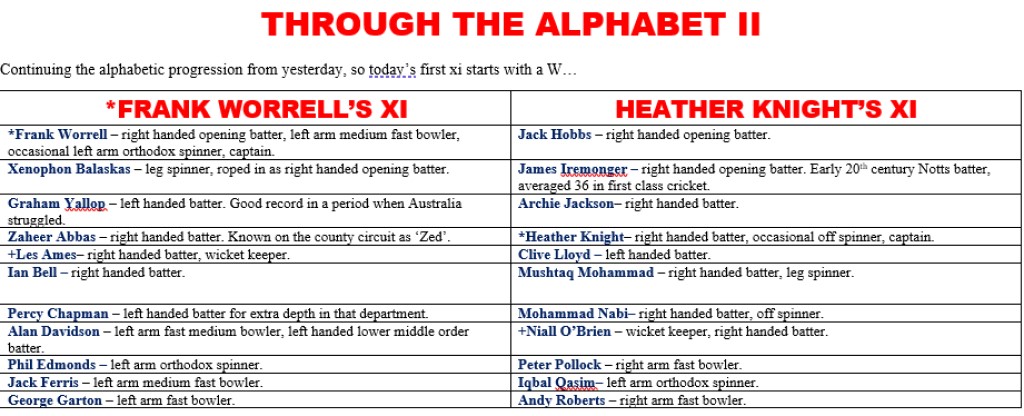






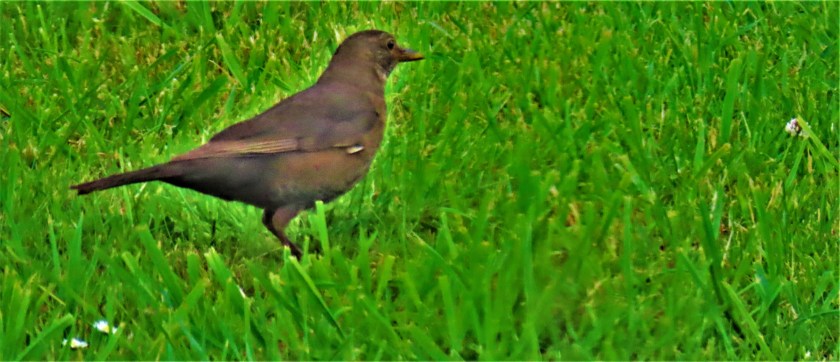

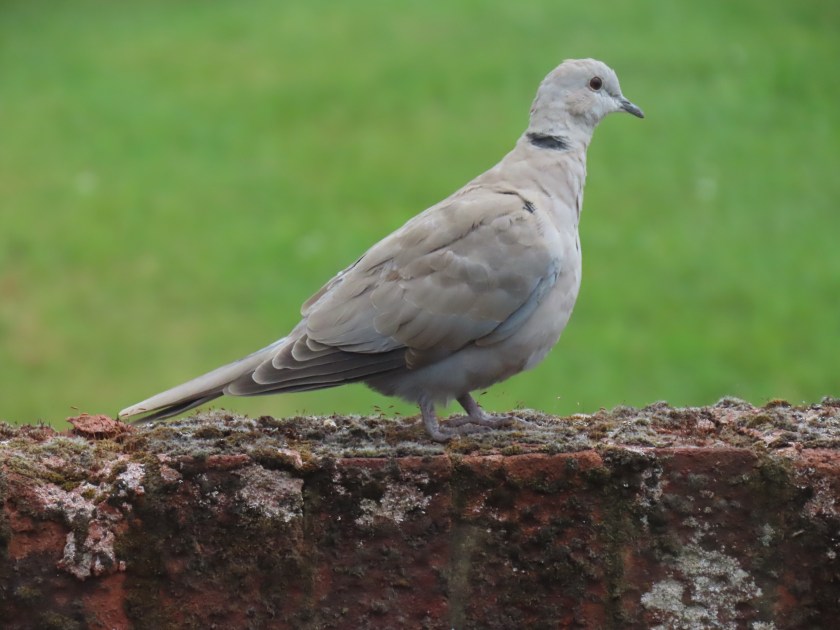
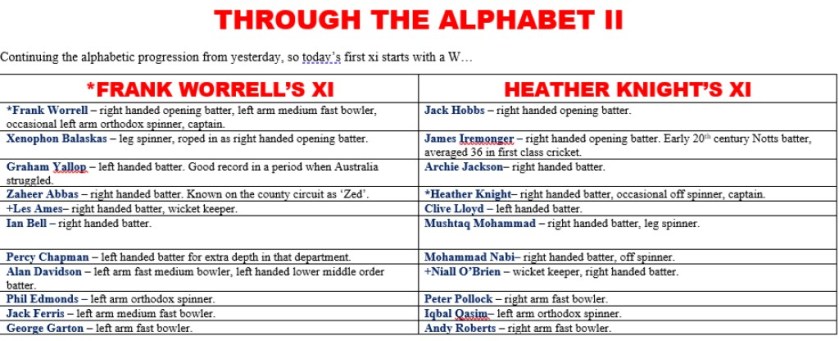

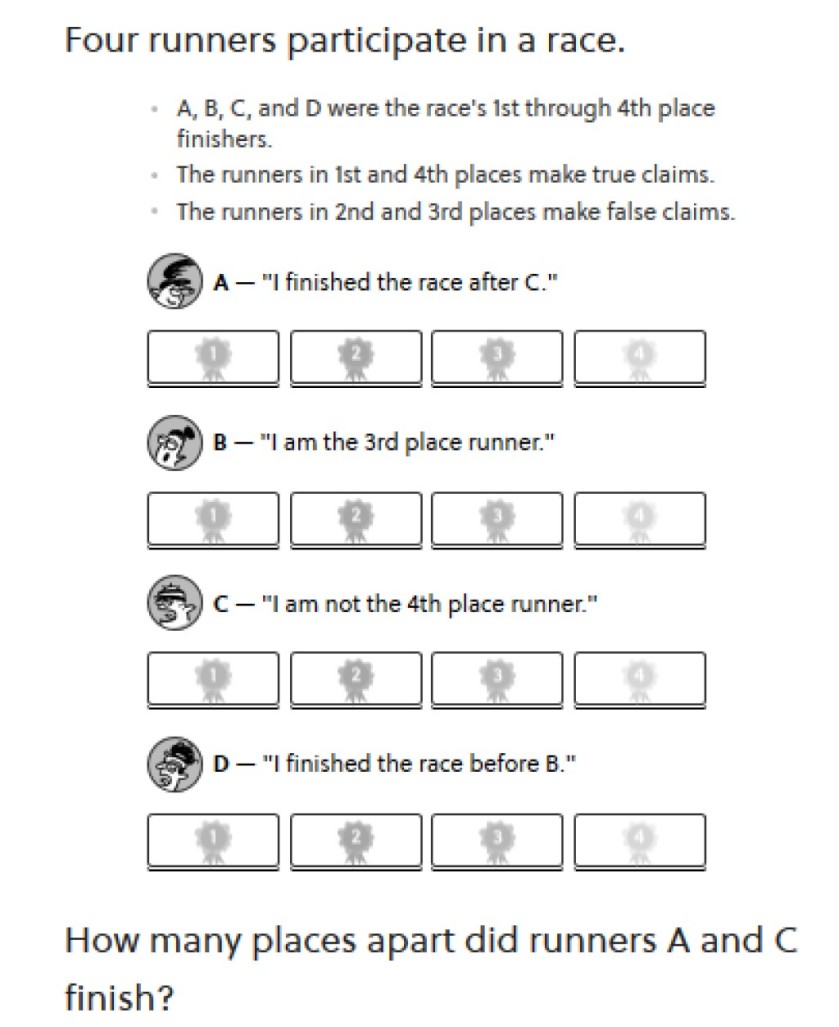




























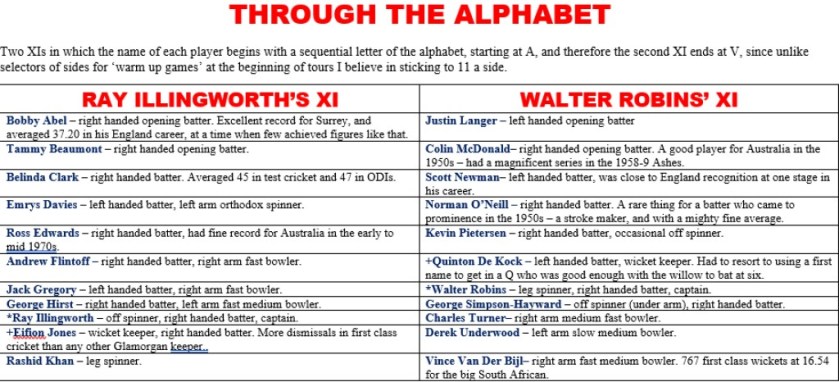
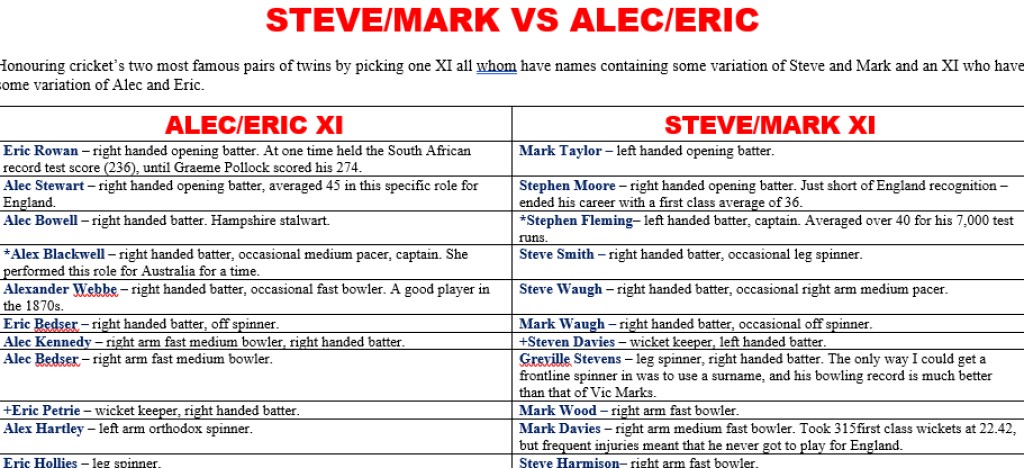

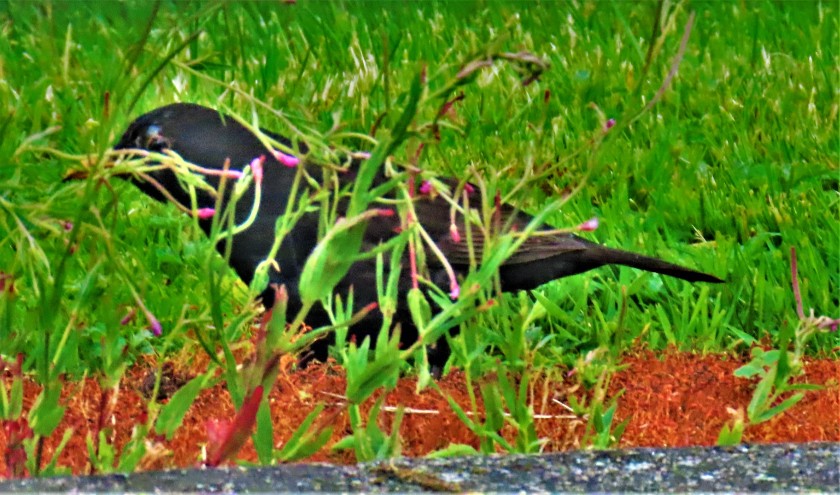

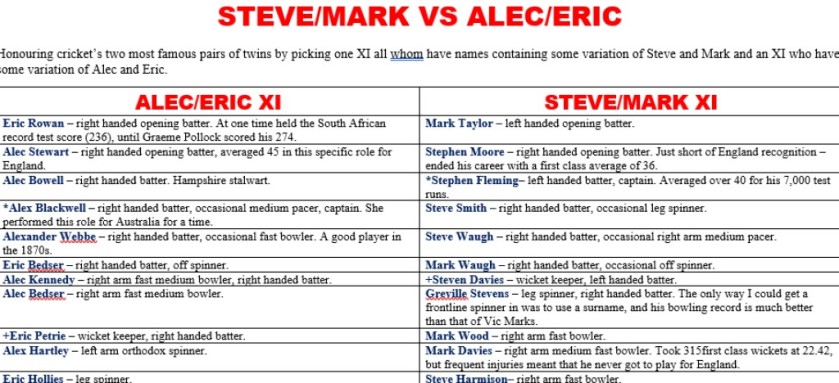
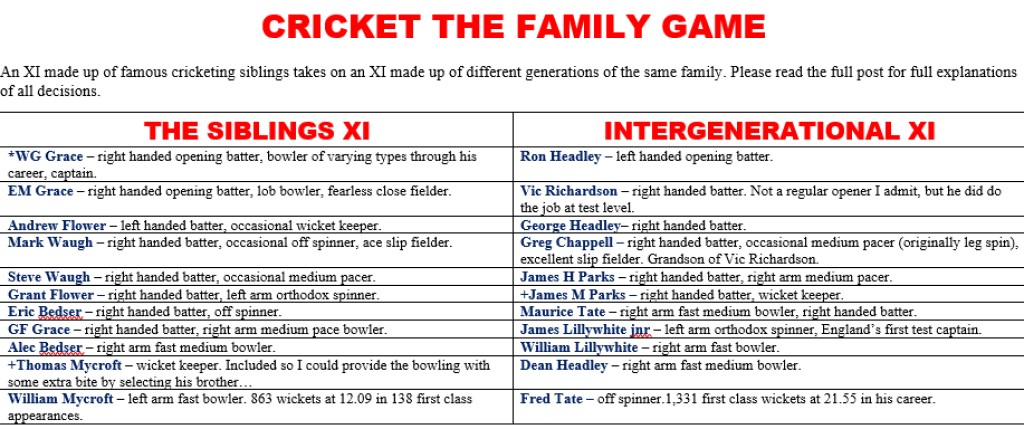









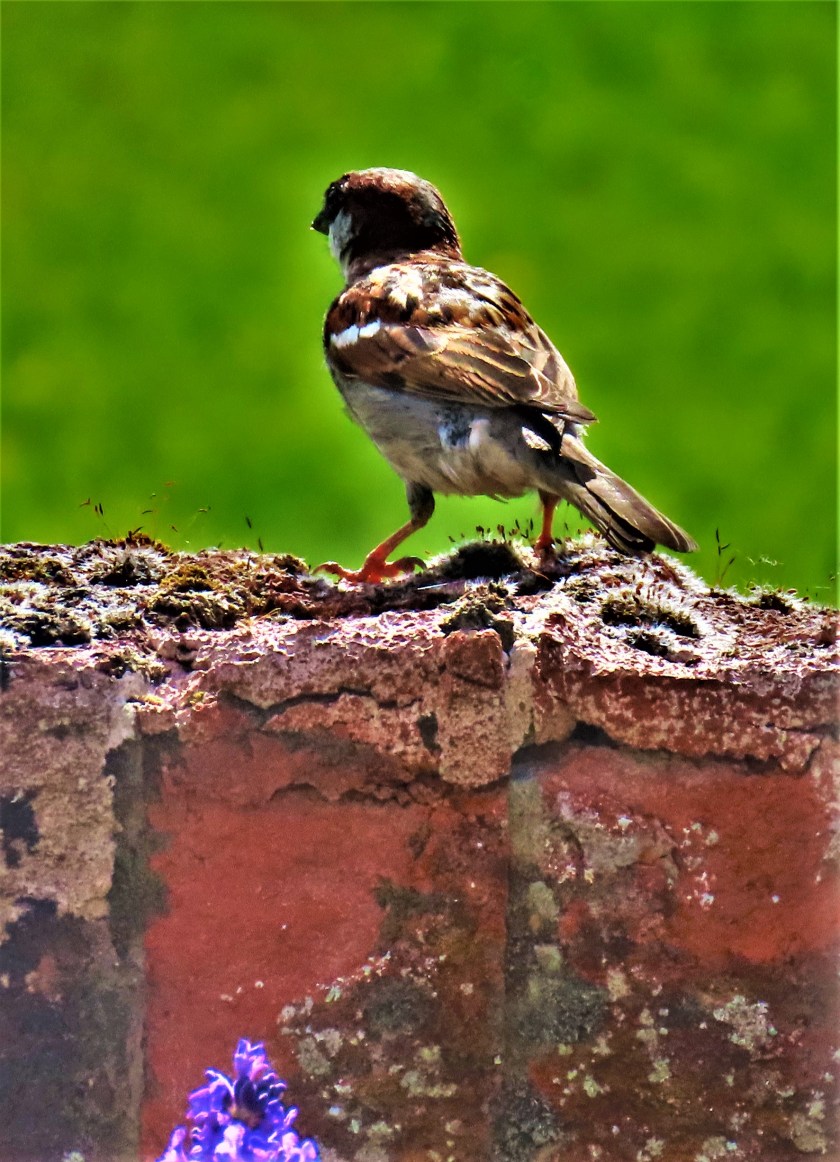
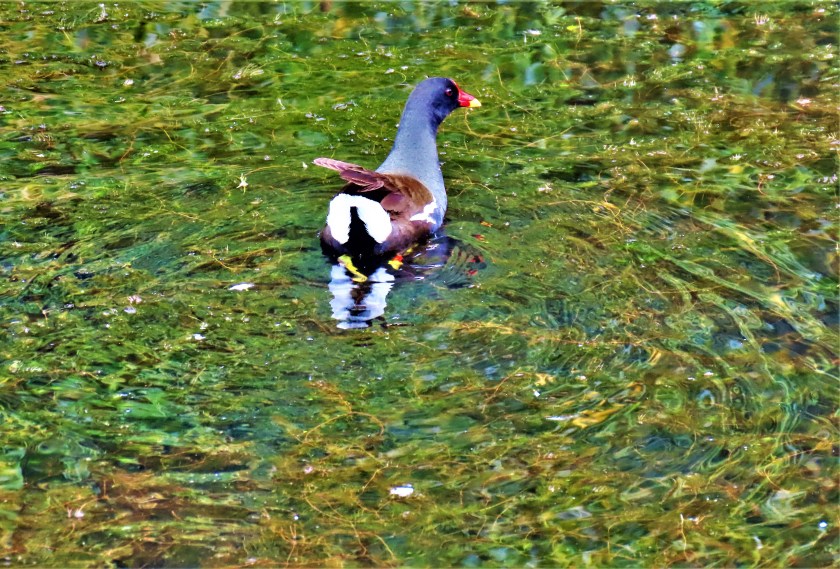
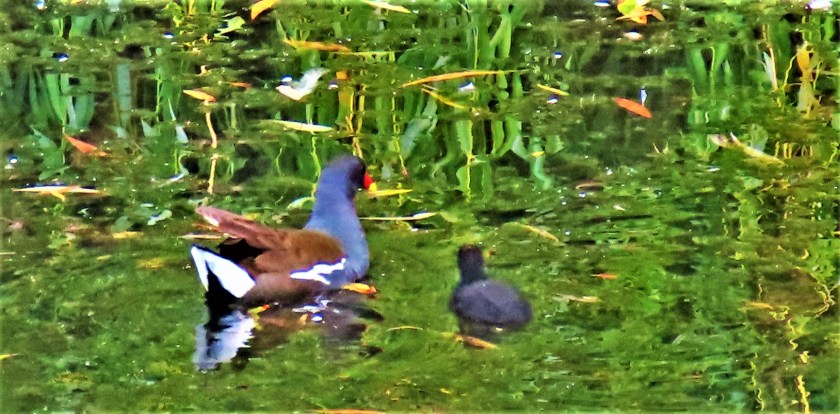
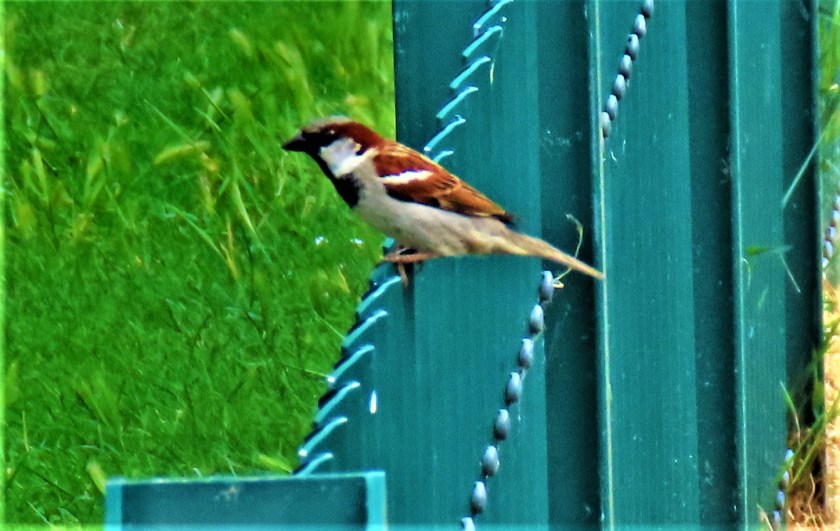













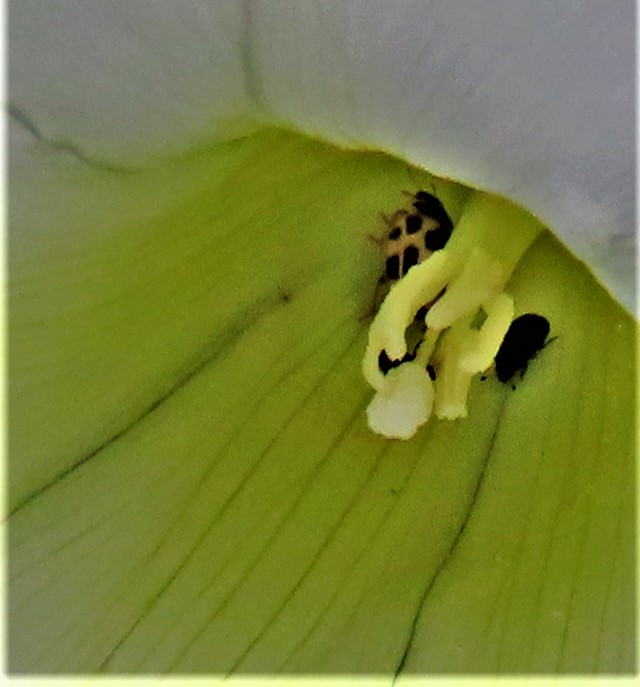

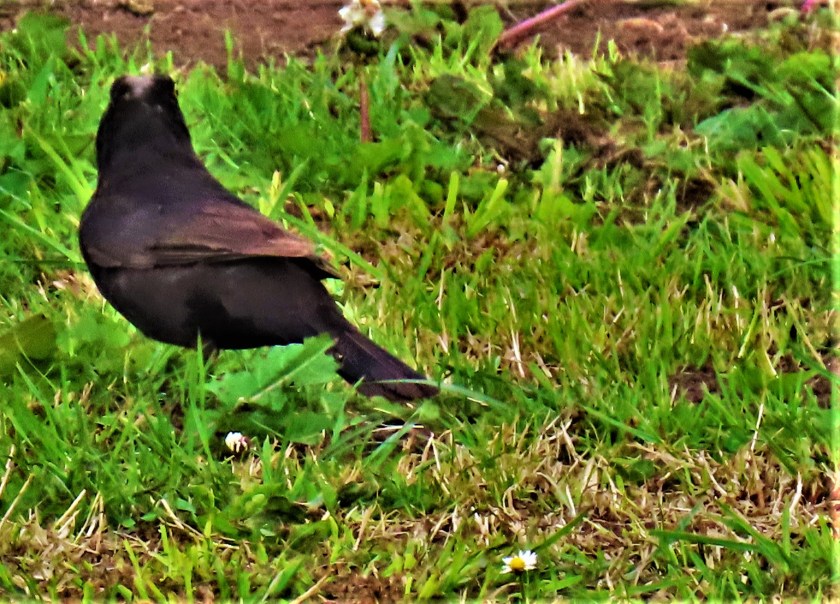

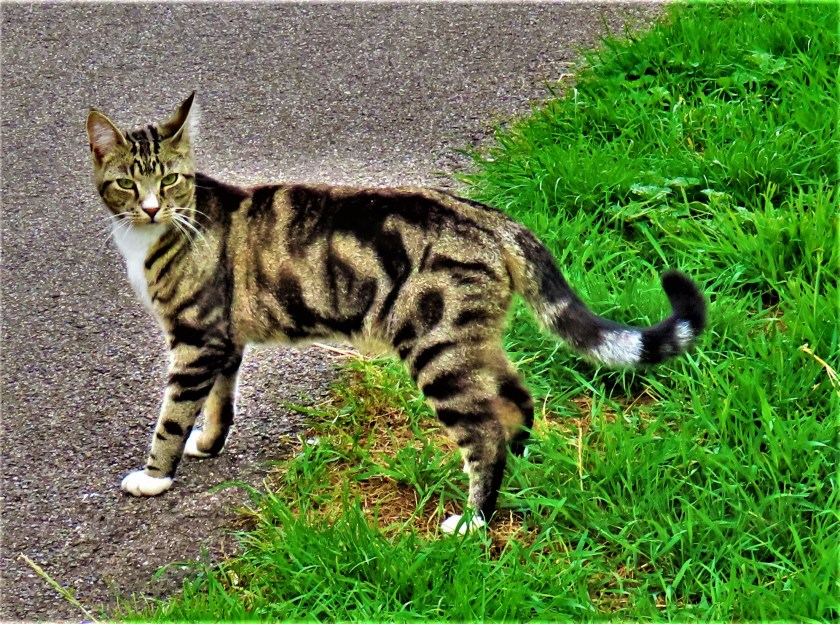












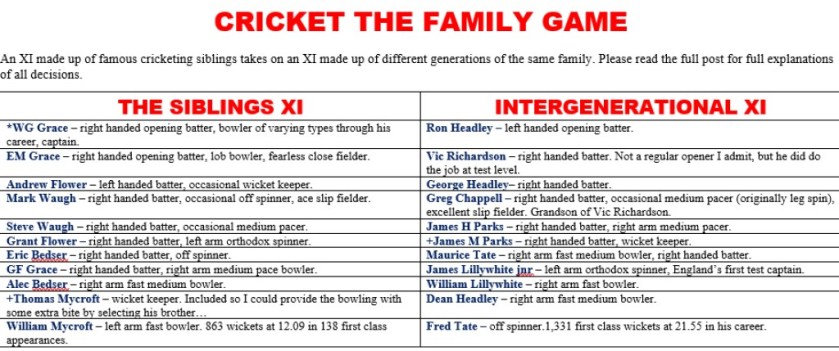
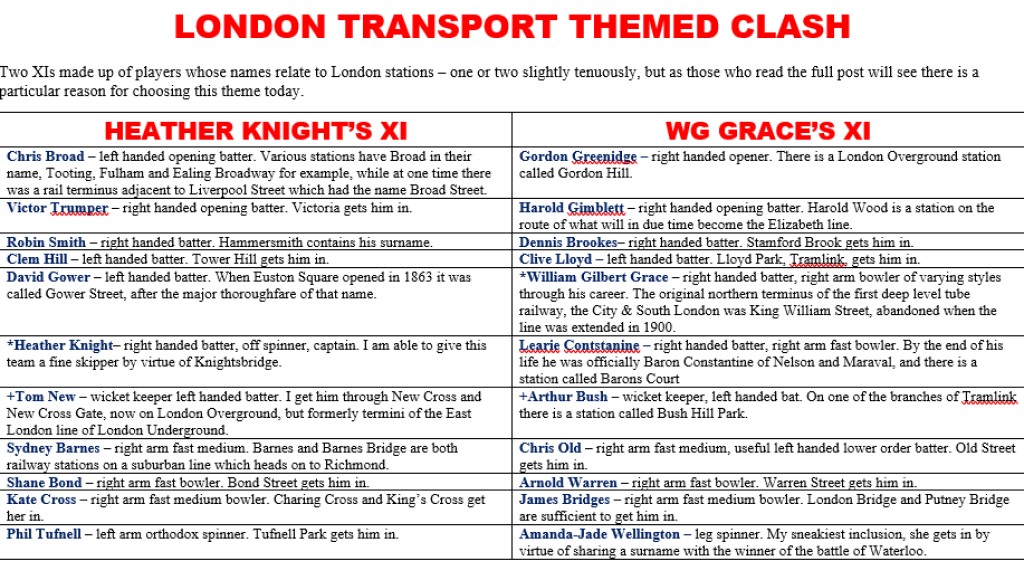
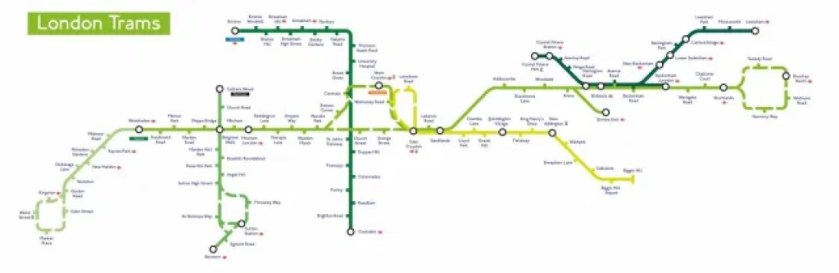

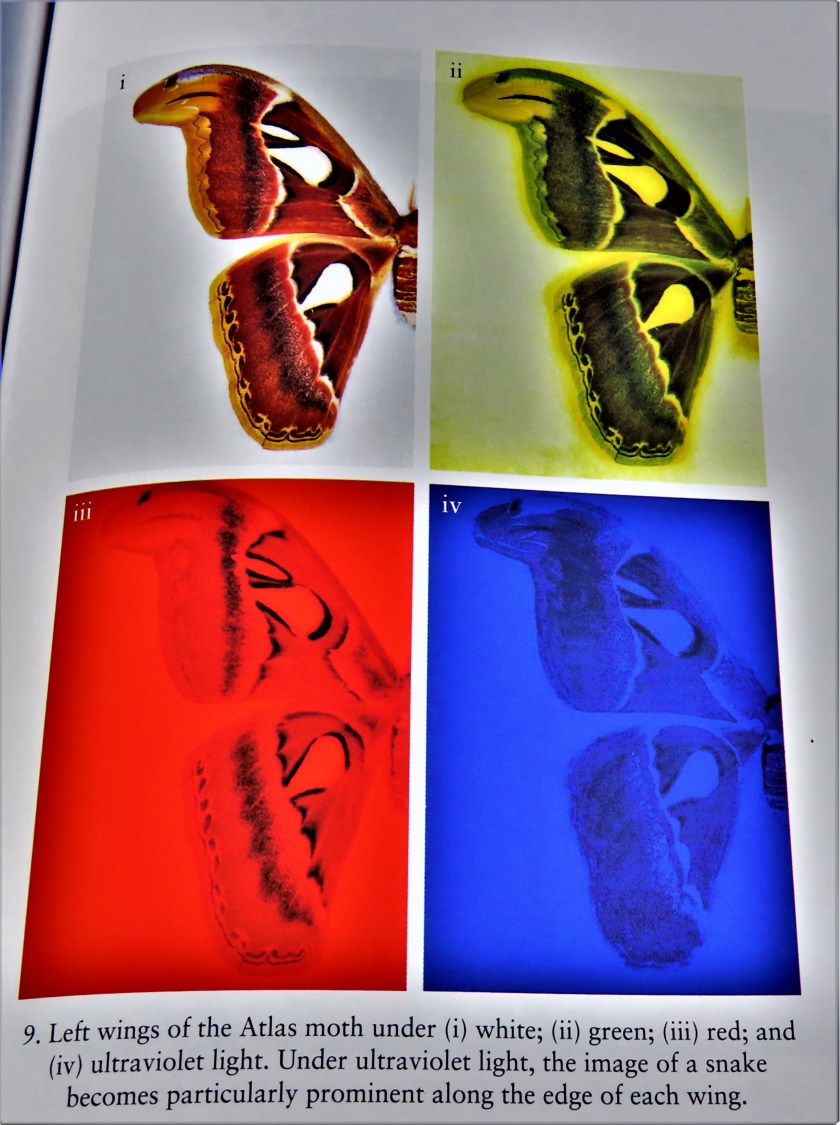












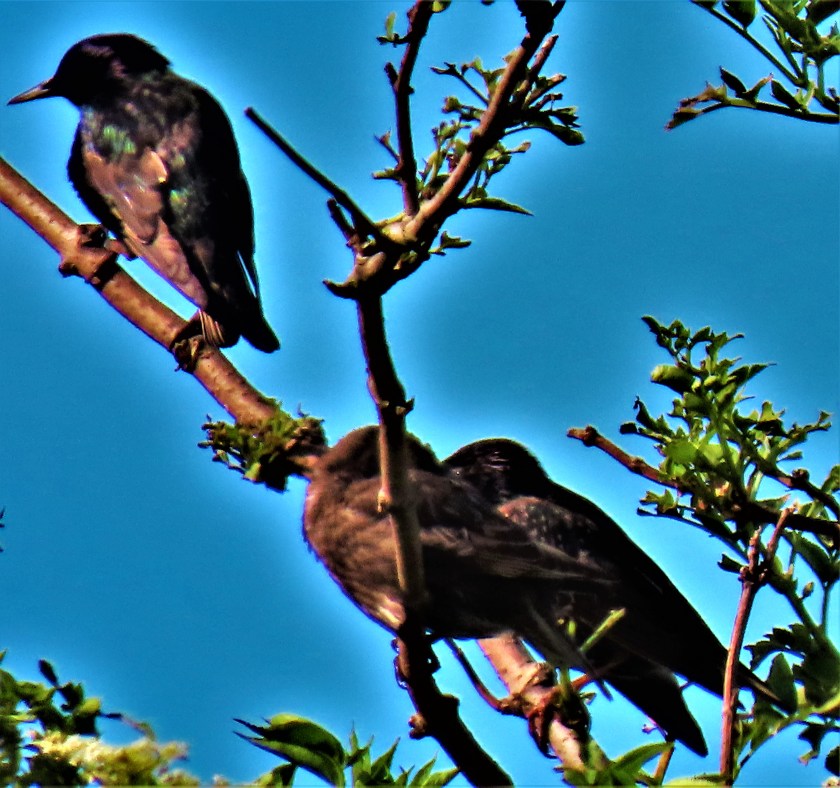















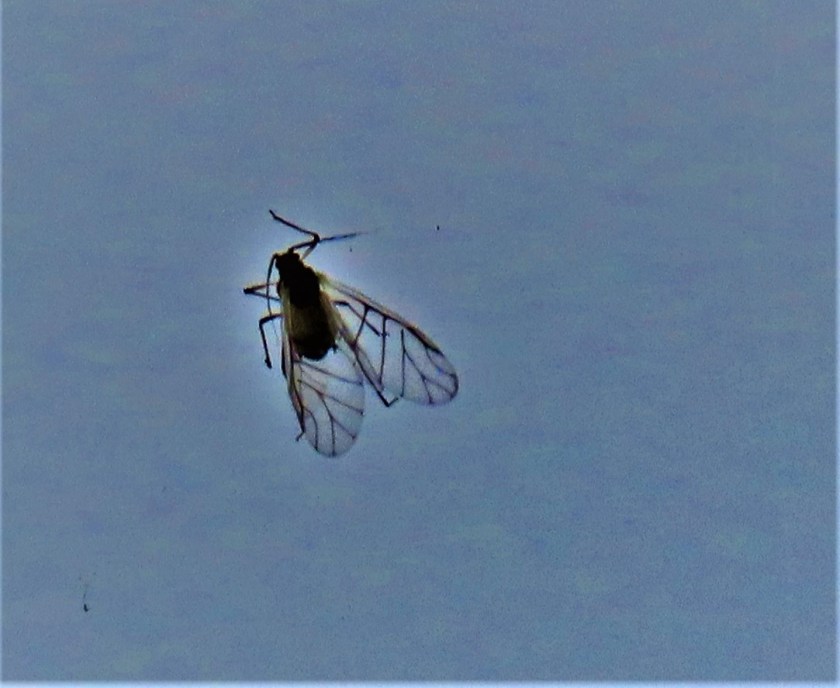

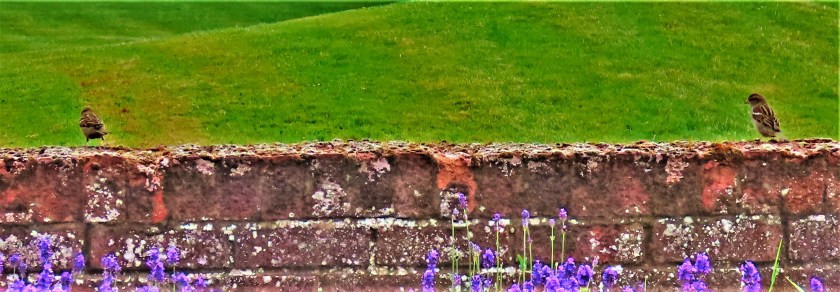
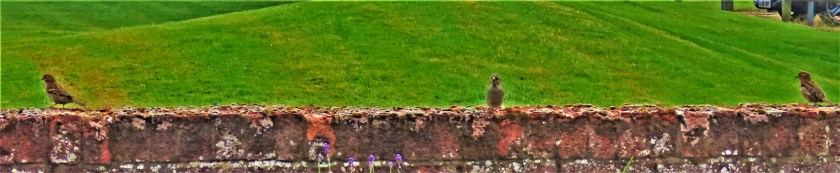
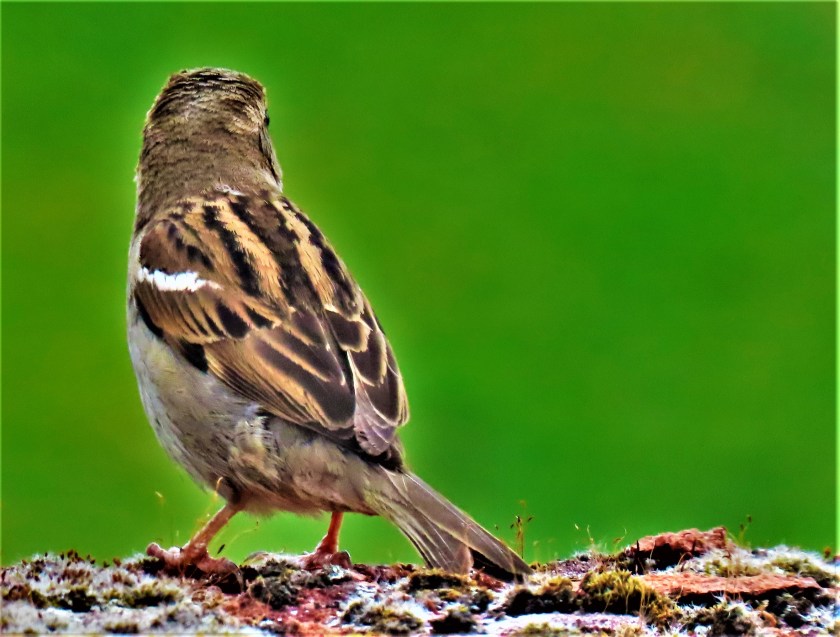

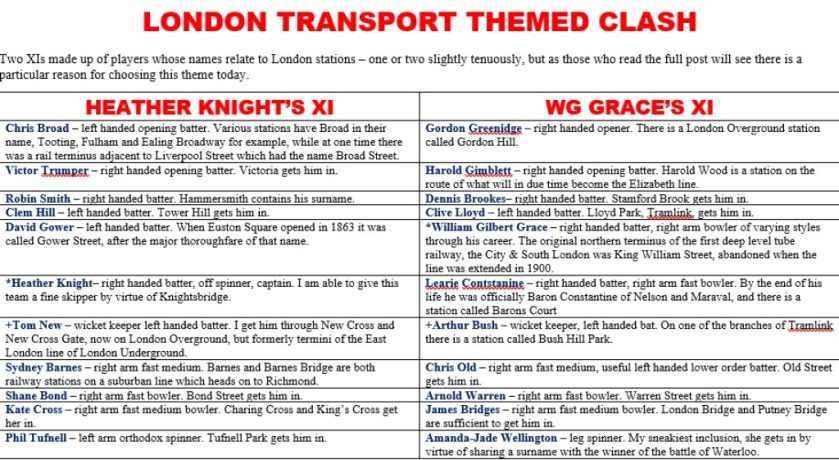
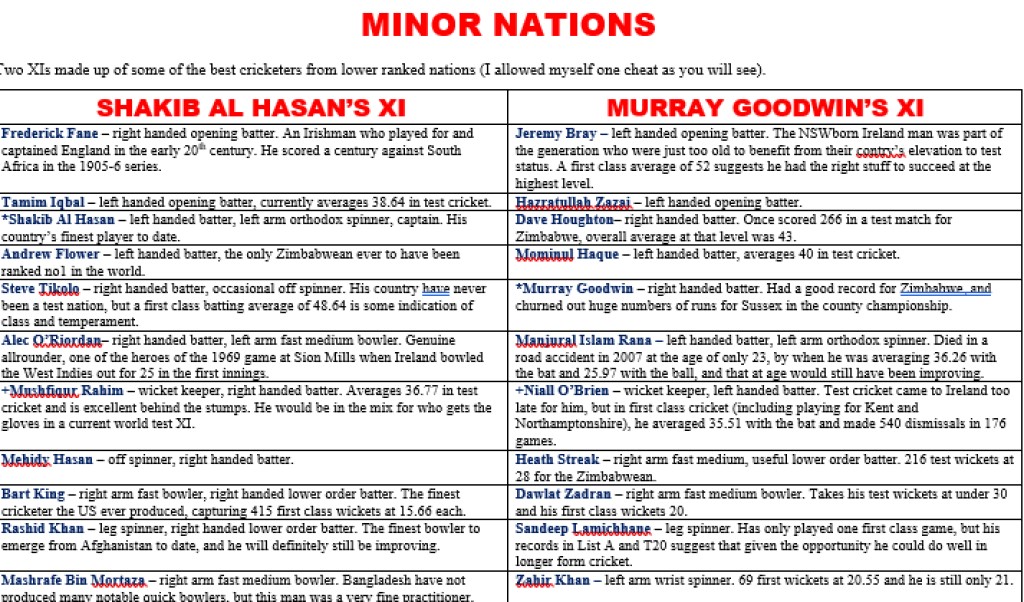
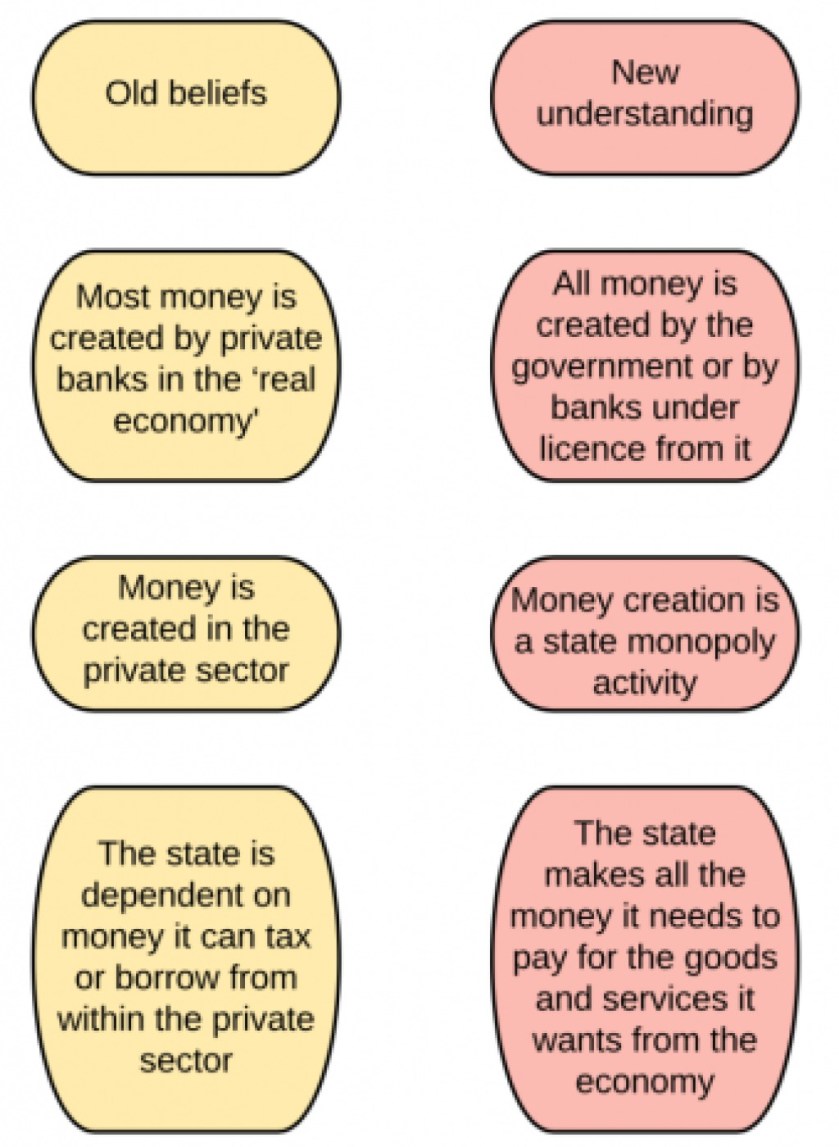
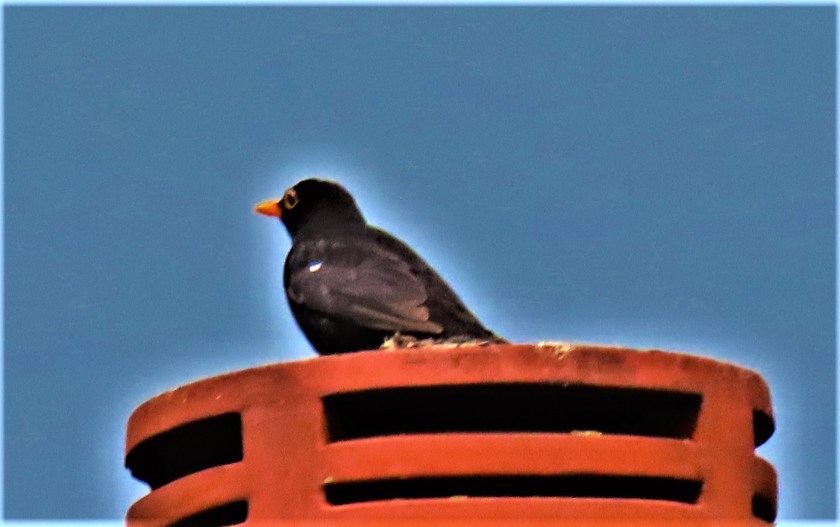




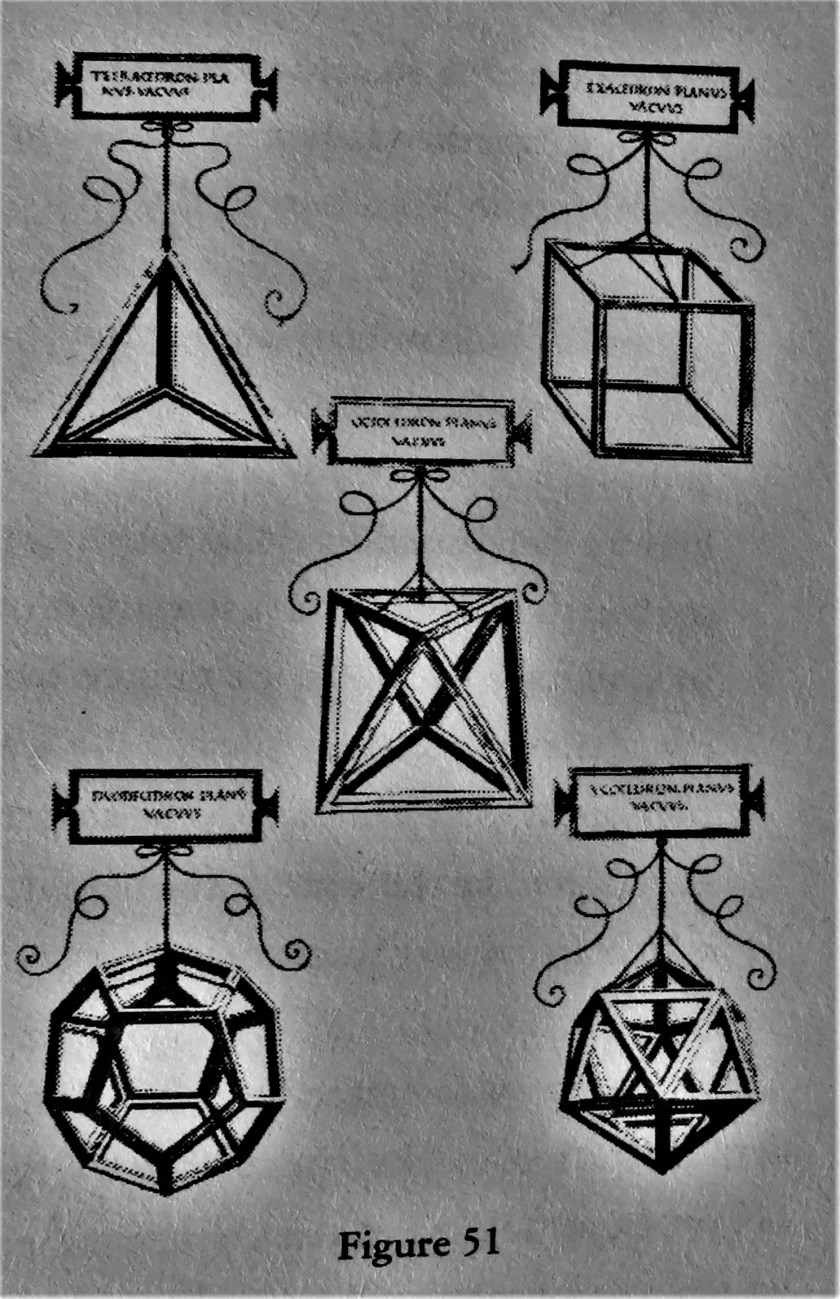

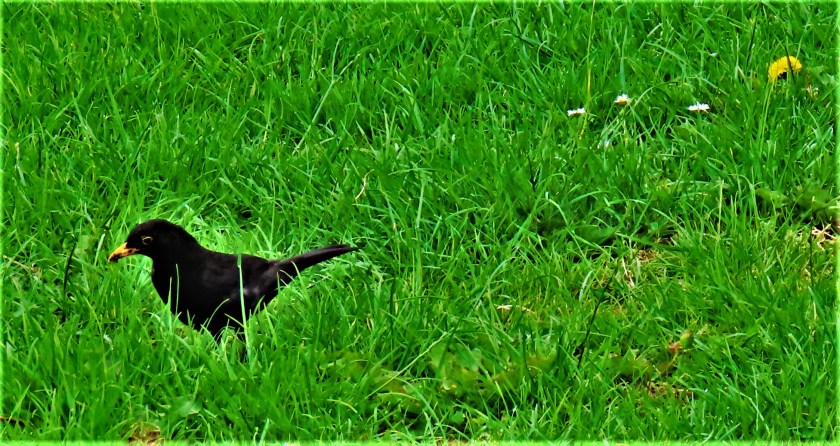












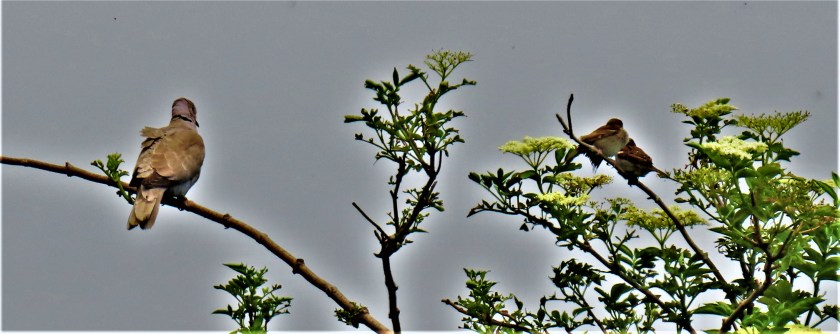

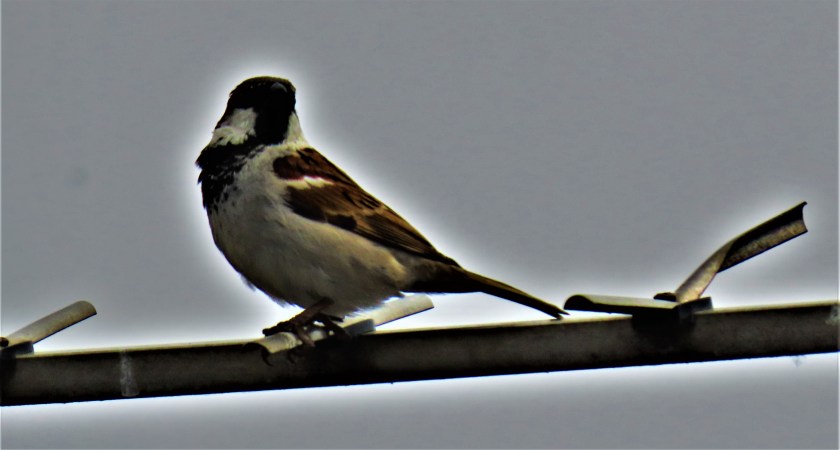
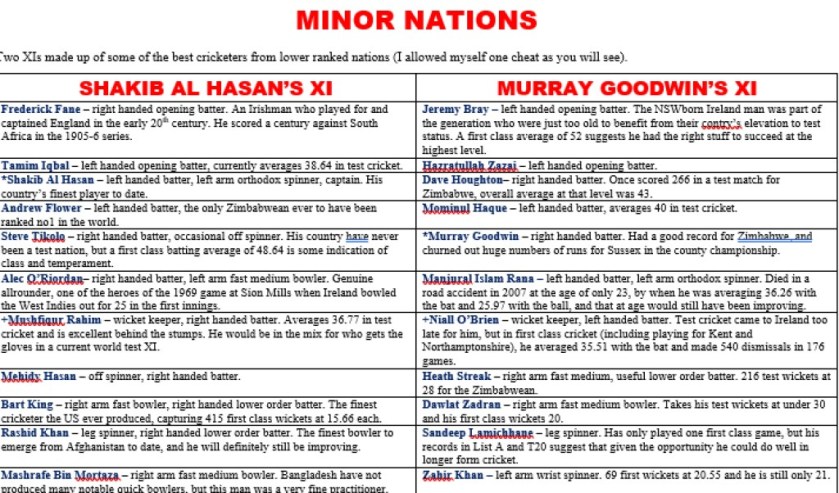
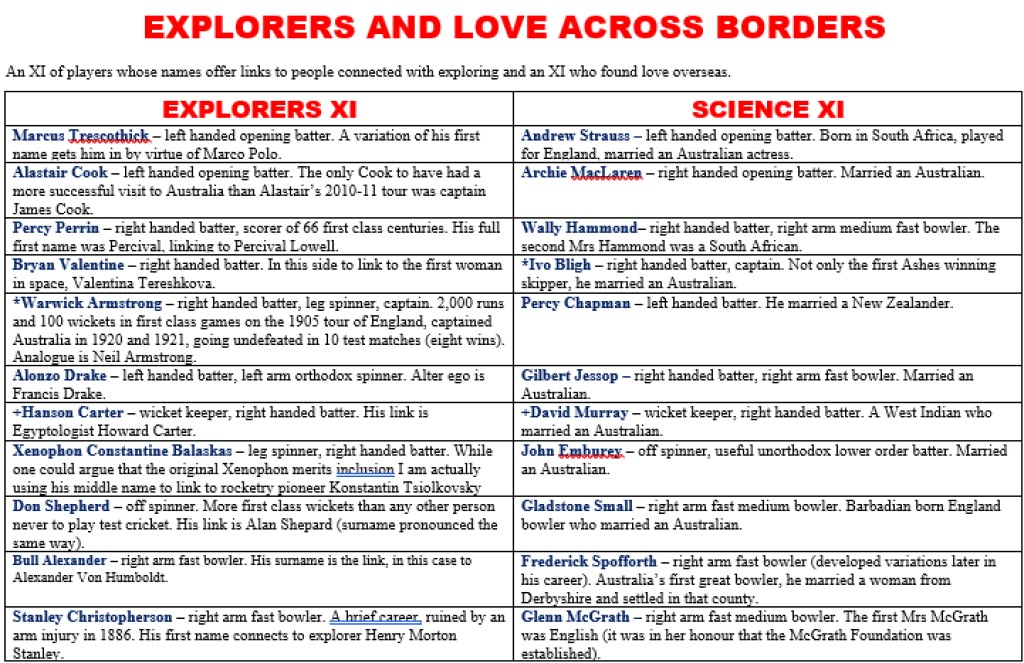


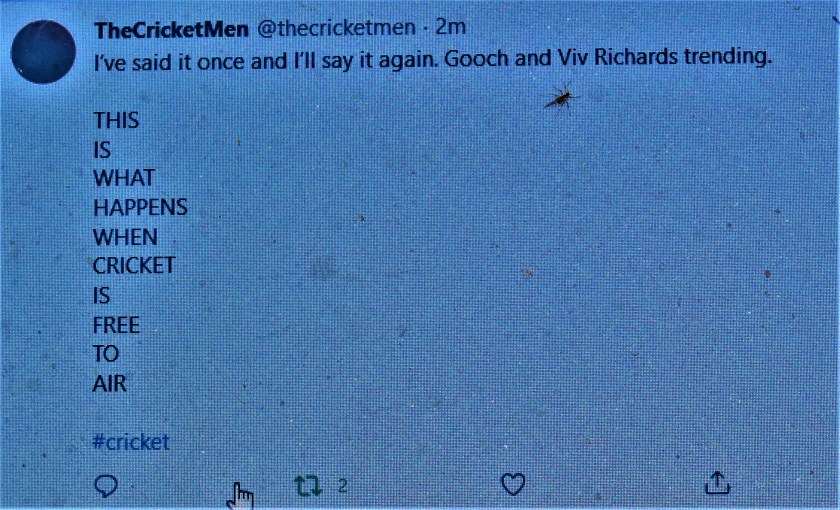











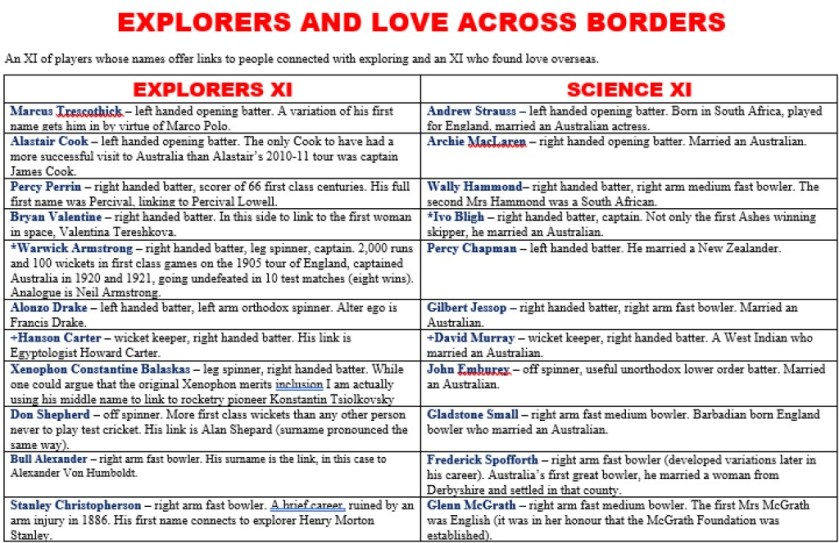
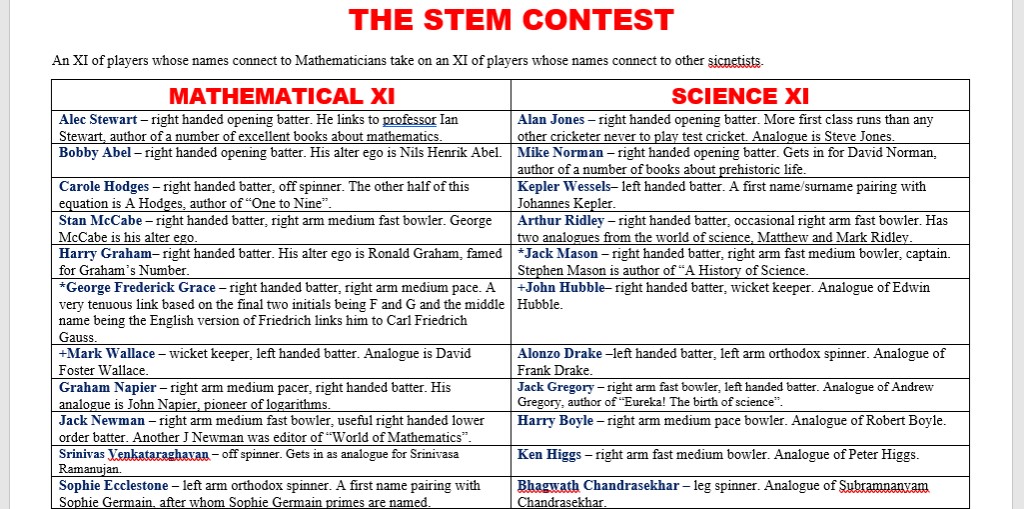






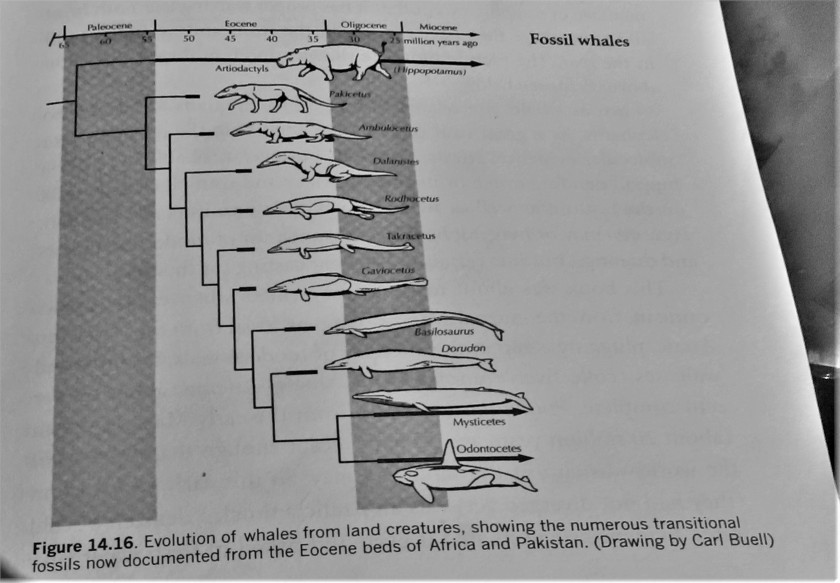


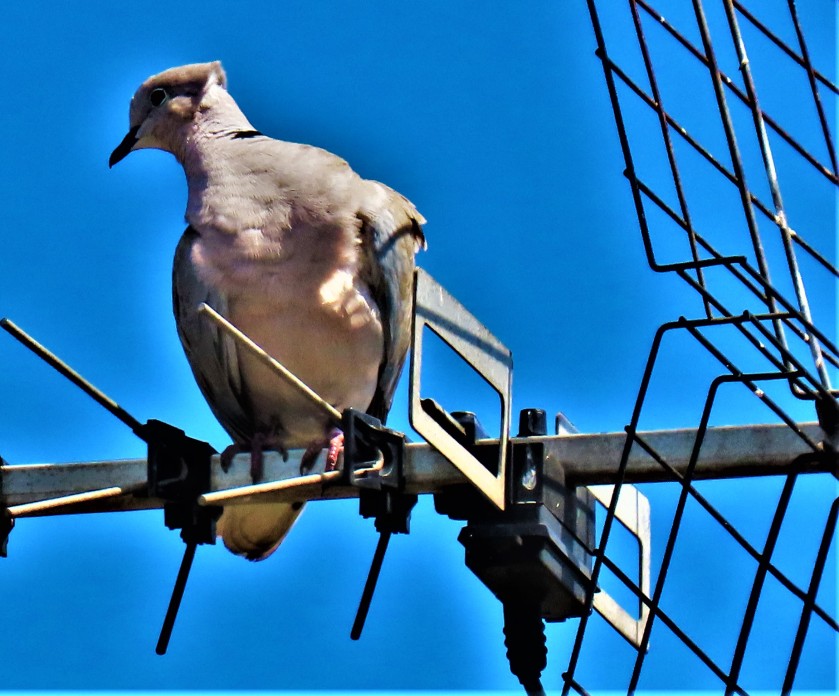



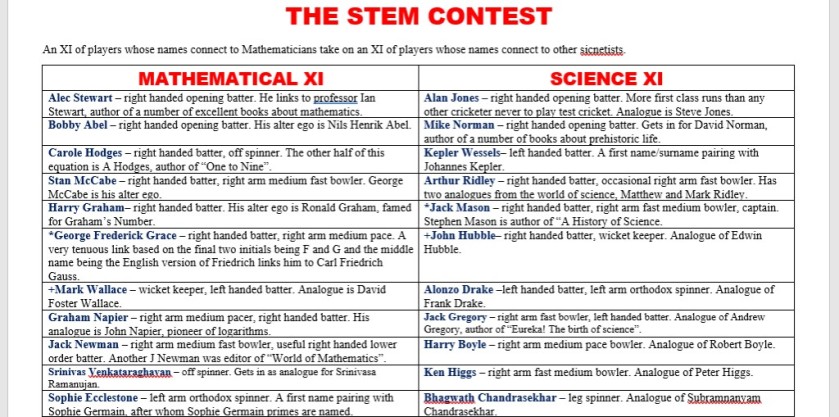


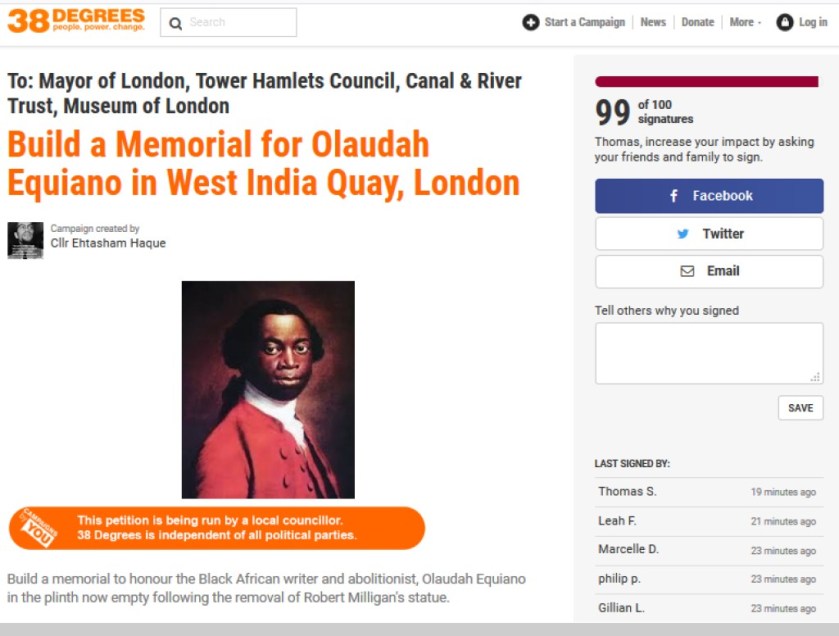
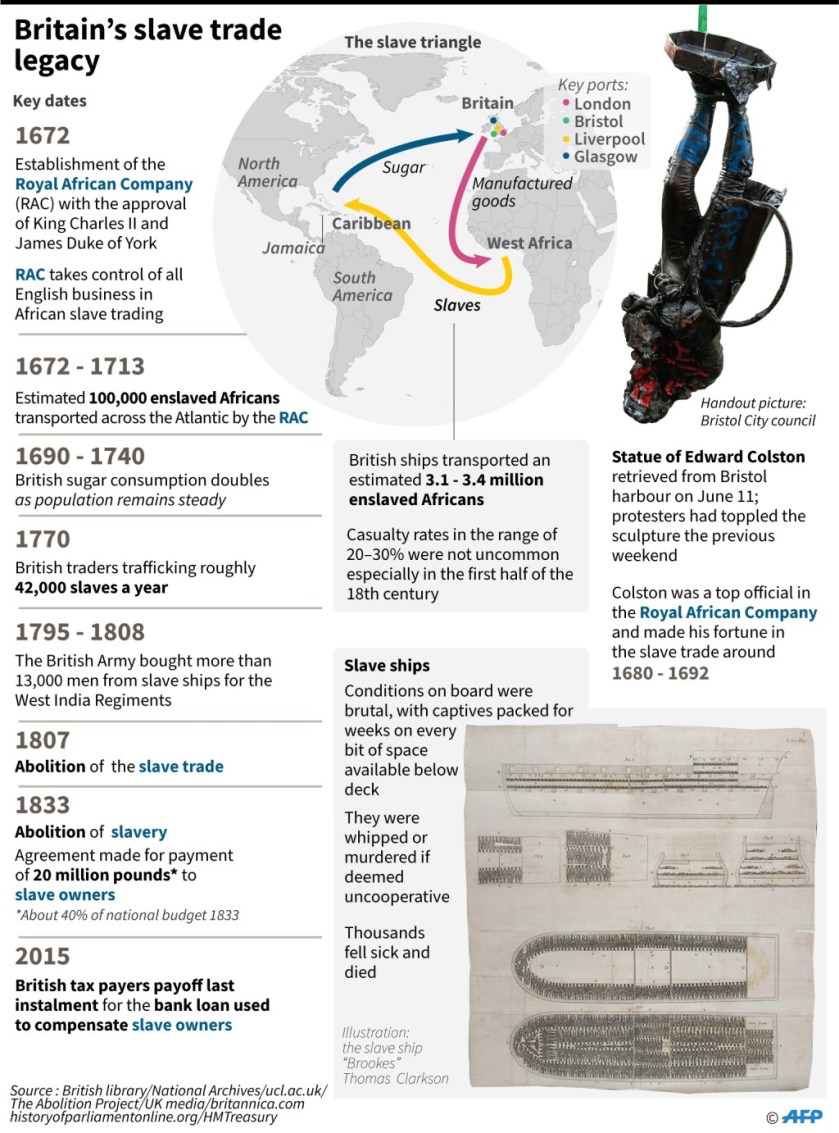















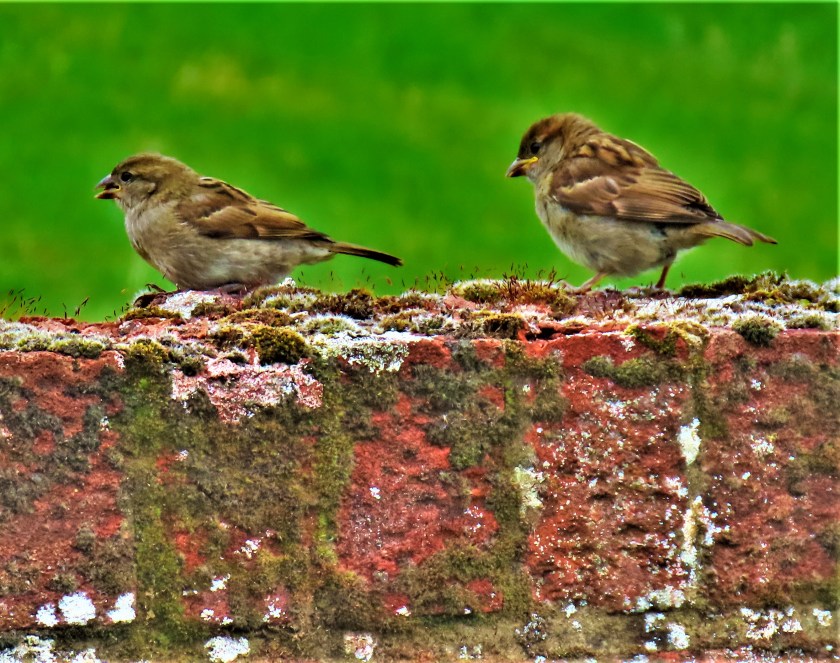









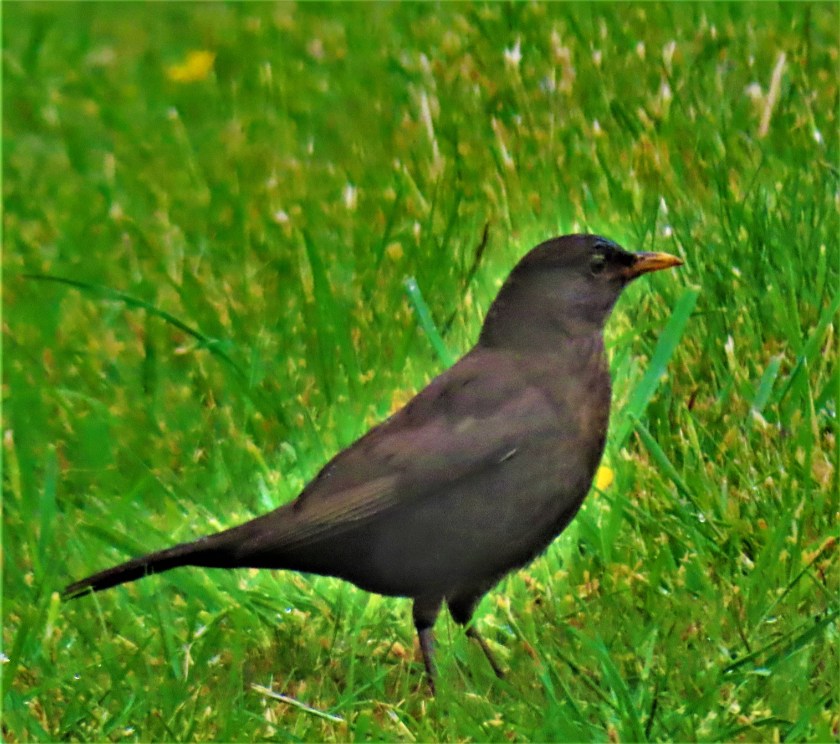

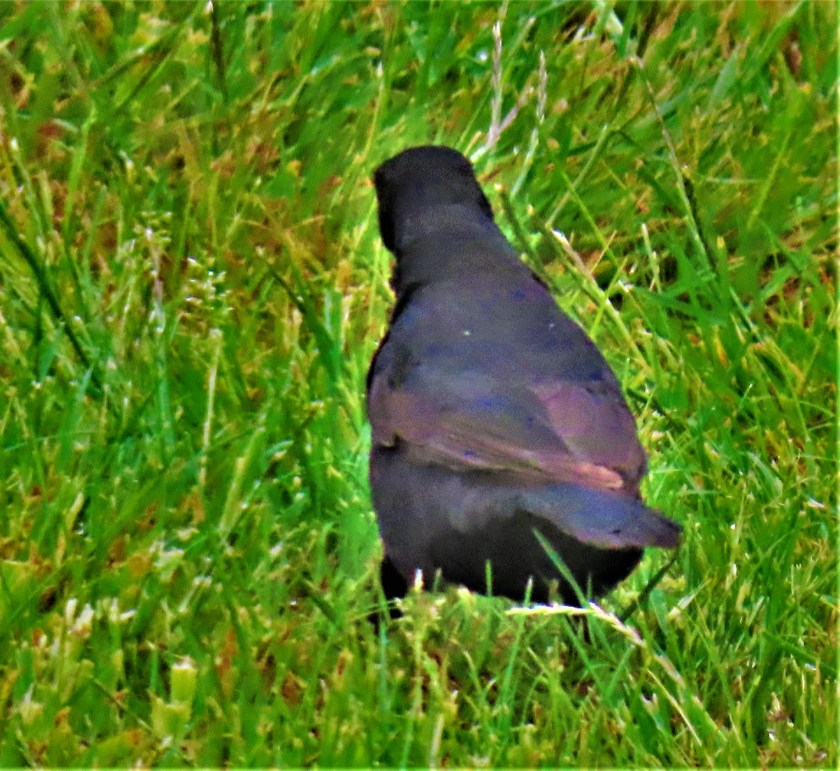


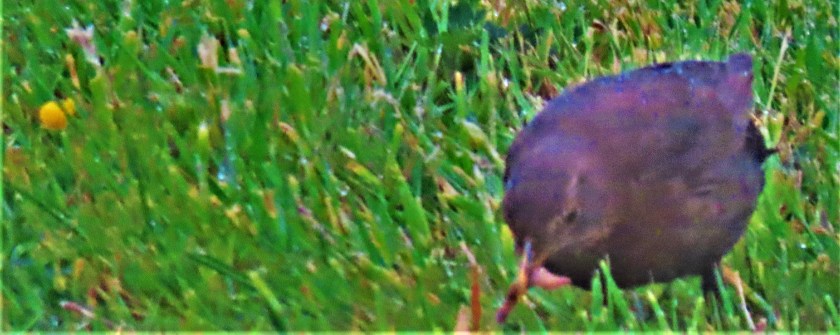

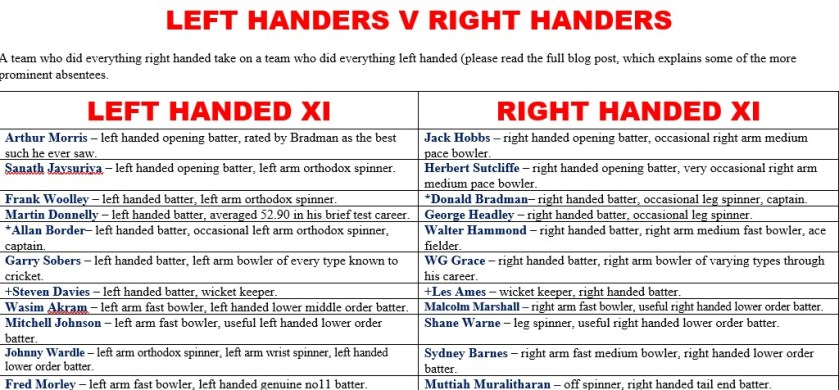
 aspiblog