Continuing my account of my long weekend in Cornwall with a look at my parents allotment.
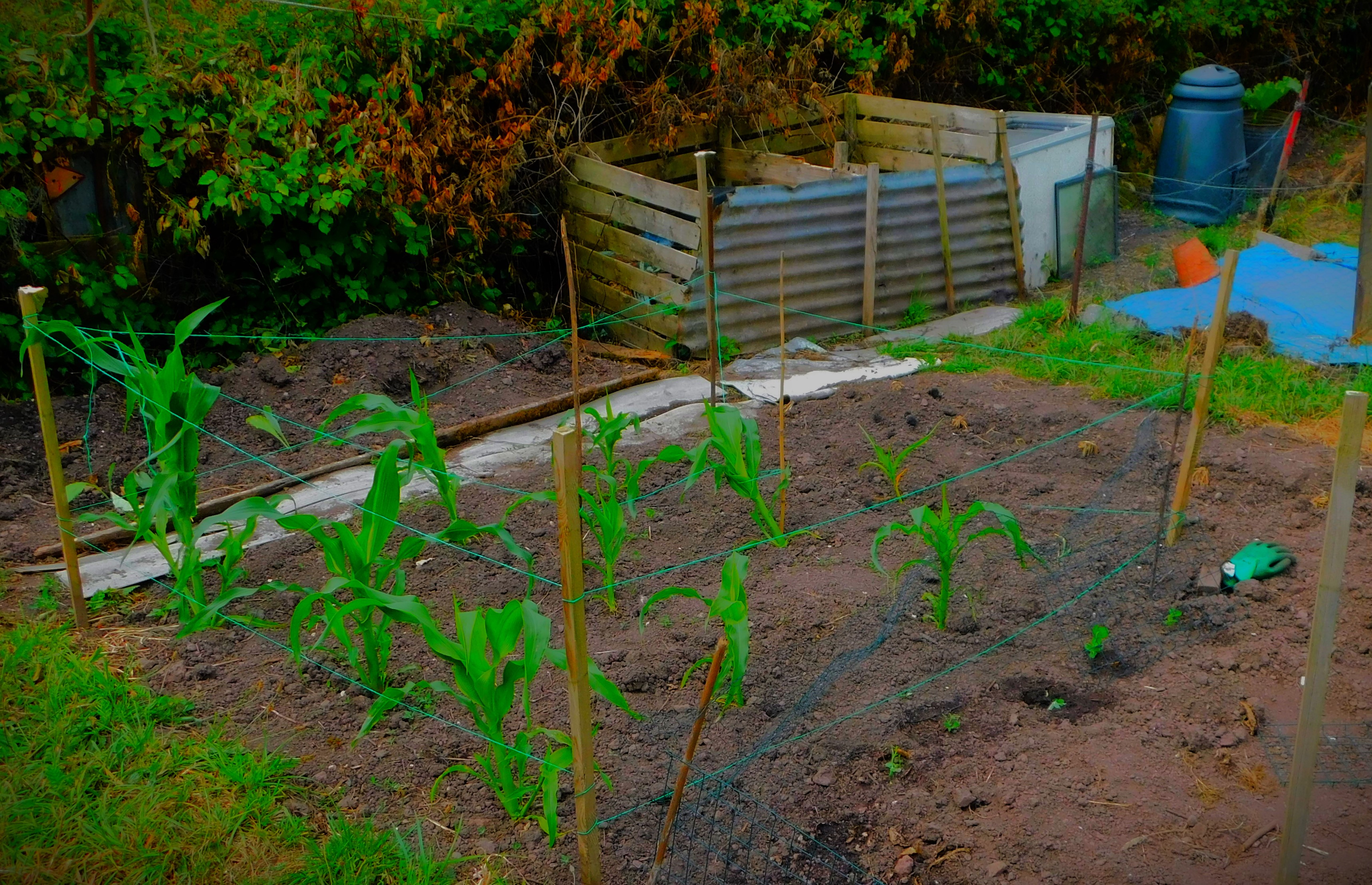
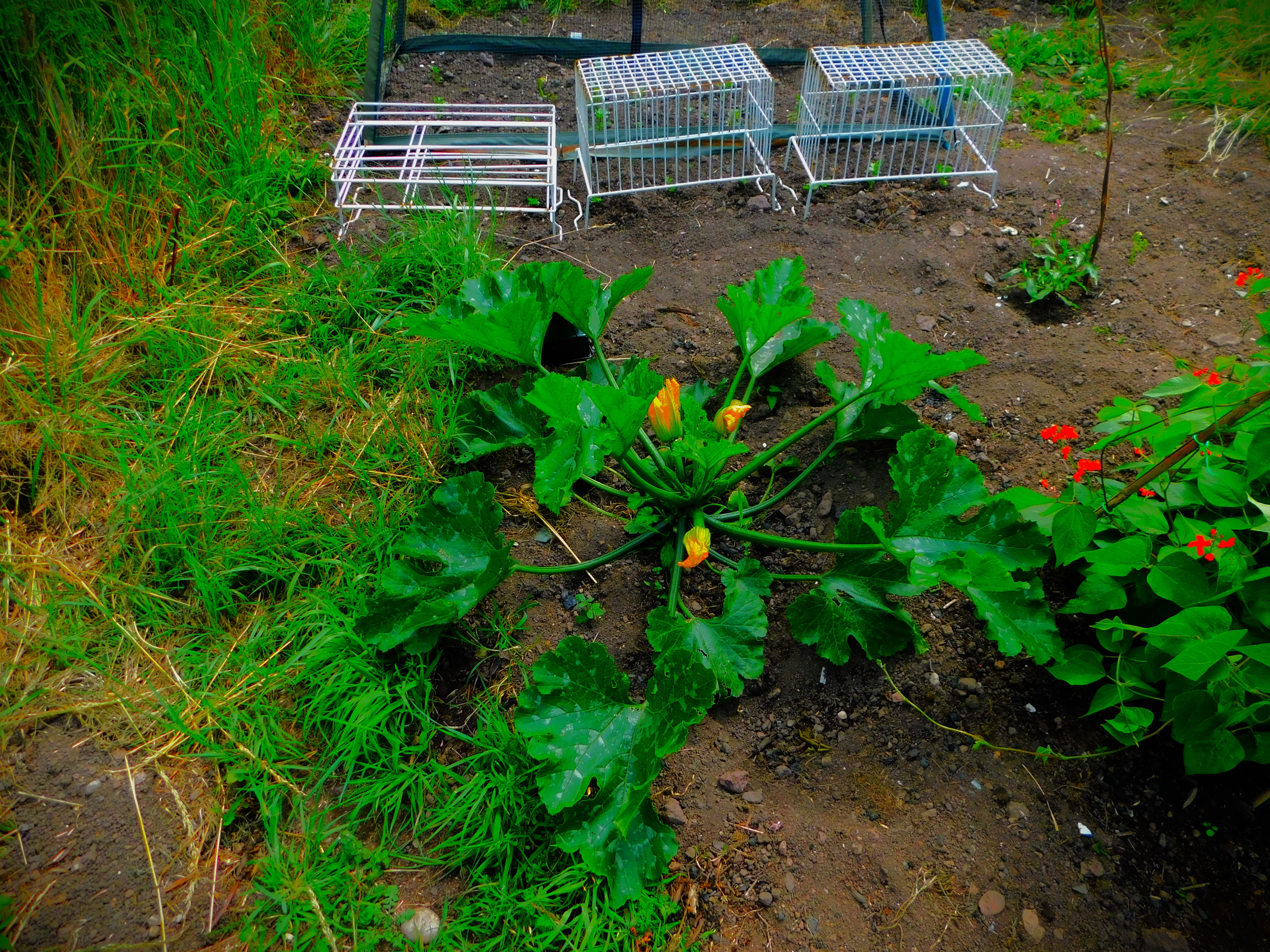
Welcome to the next post in my mini-series about my long weekend in Cornwall. This post is devoted to my parent’s allotment, which I saw twice, for an extended period on the Saturday and very briefly on the Sunday morning.
THE ALLOTMENT’S CONTRIBUTION TO MEALS
Save for the Sunday lunch, which was a large meal out, virtually every meal of the weekend featured something that had been grown in my parent’s allotment.
ACHIEVING A BALANCE
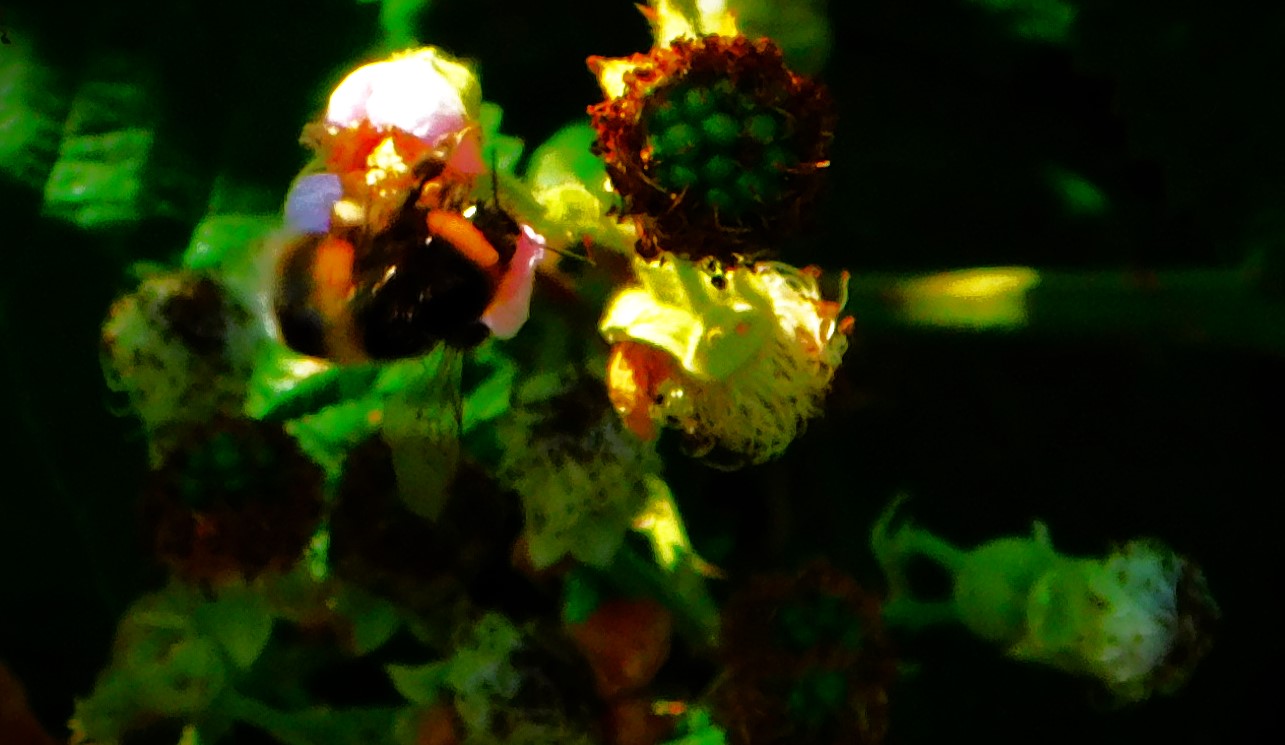
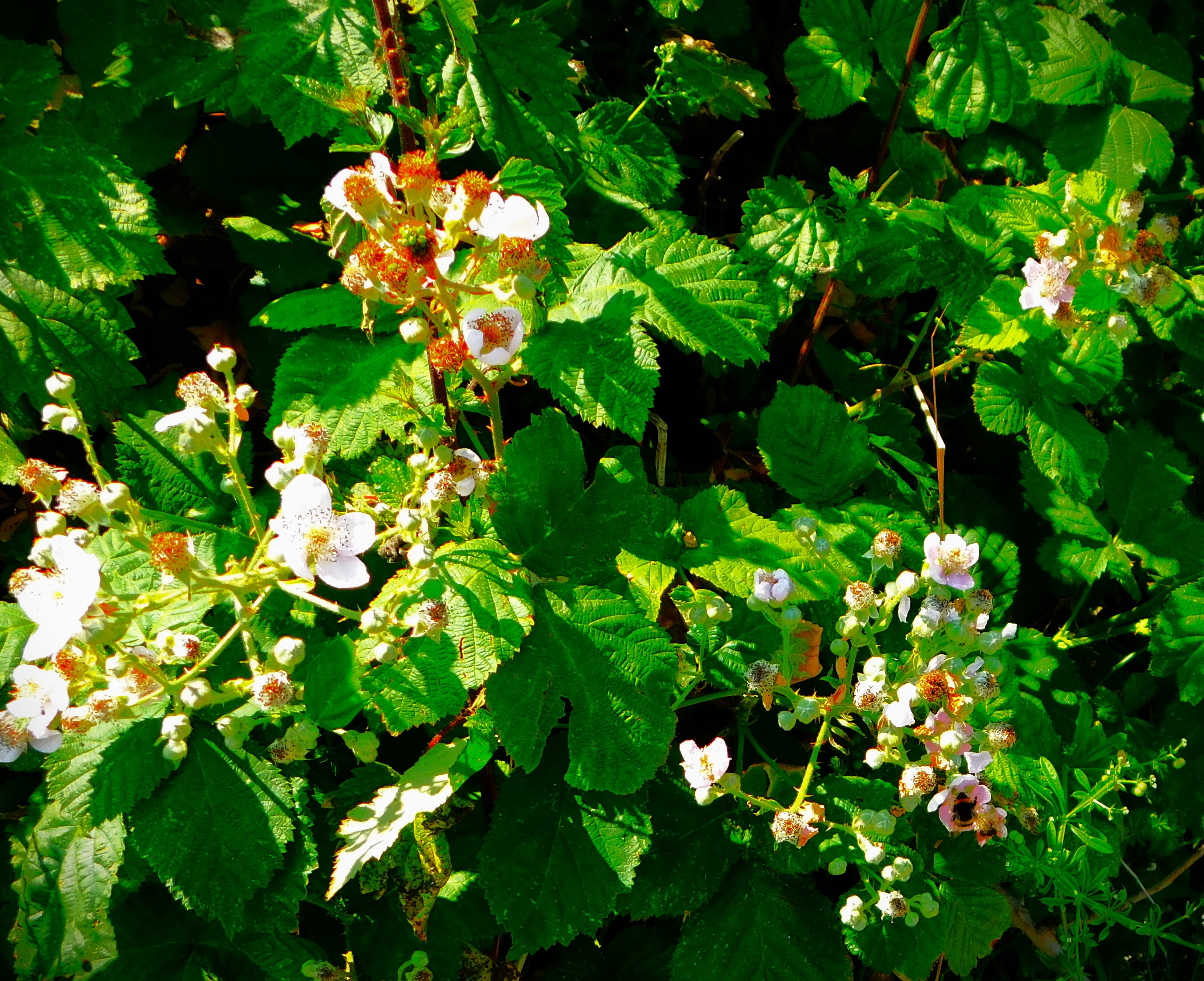
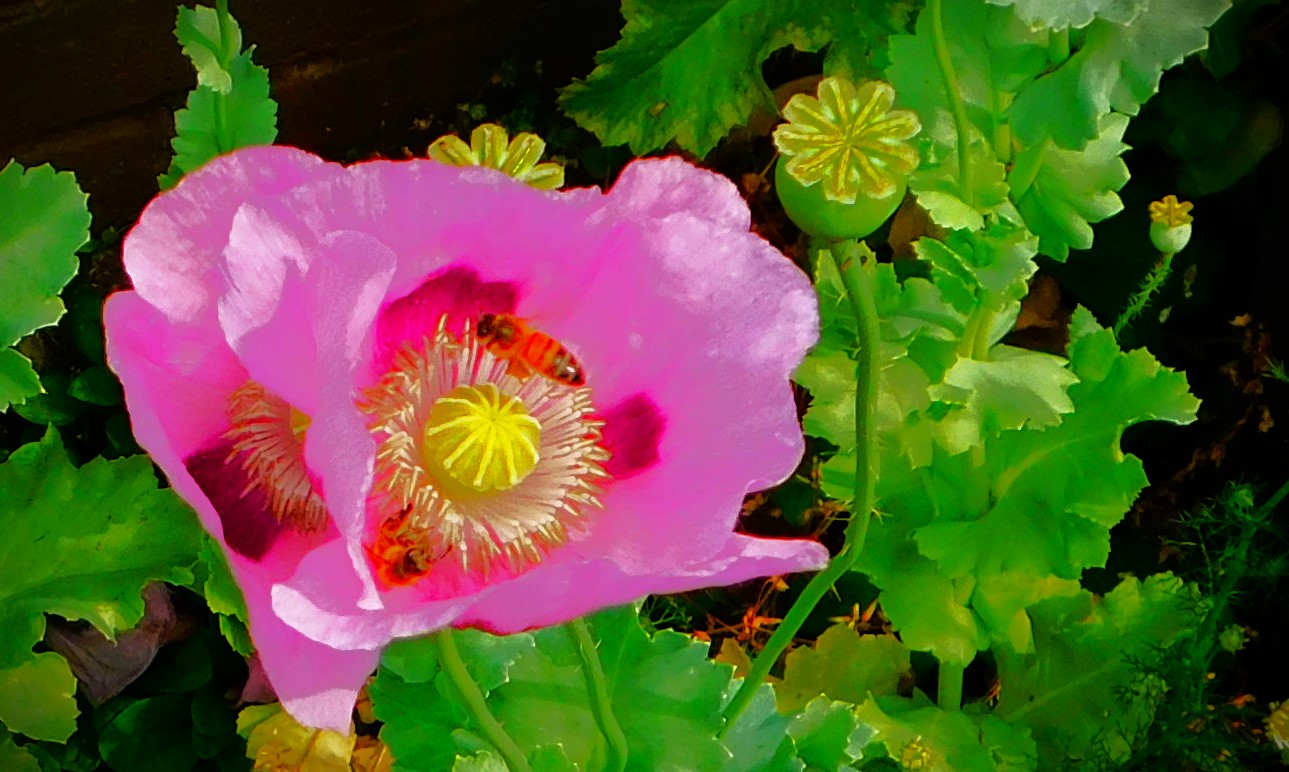
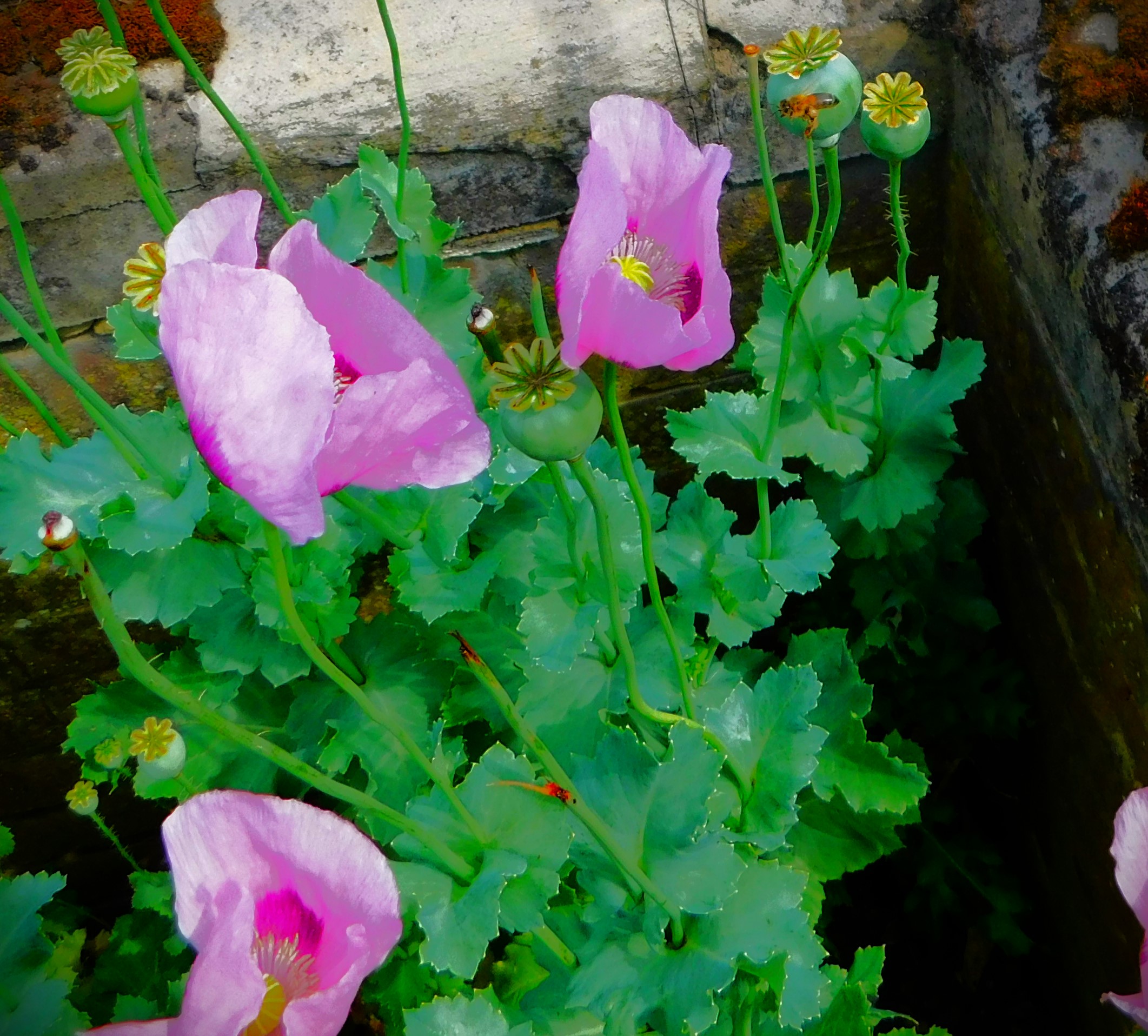
Although as already noted the allotment provides my parents with a lot of food it is not all food plants – wildflowers are also allowed to grow there, which means that bees and butterflies can make use of it, and the grass is not cut short, which is important as a number of butterflies rely on long grass for their caterpillars.
A BUTTERFLY RESCUE
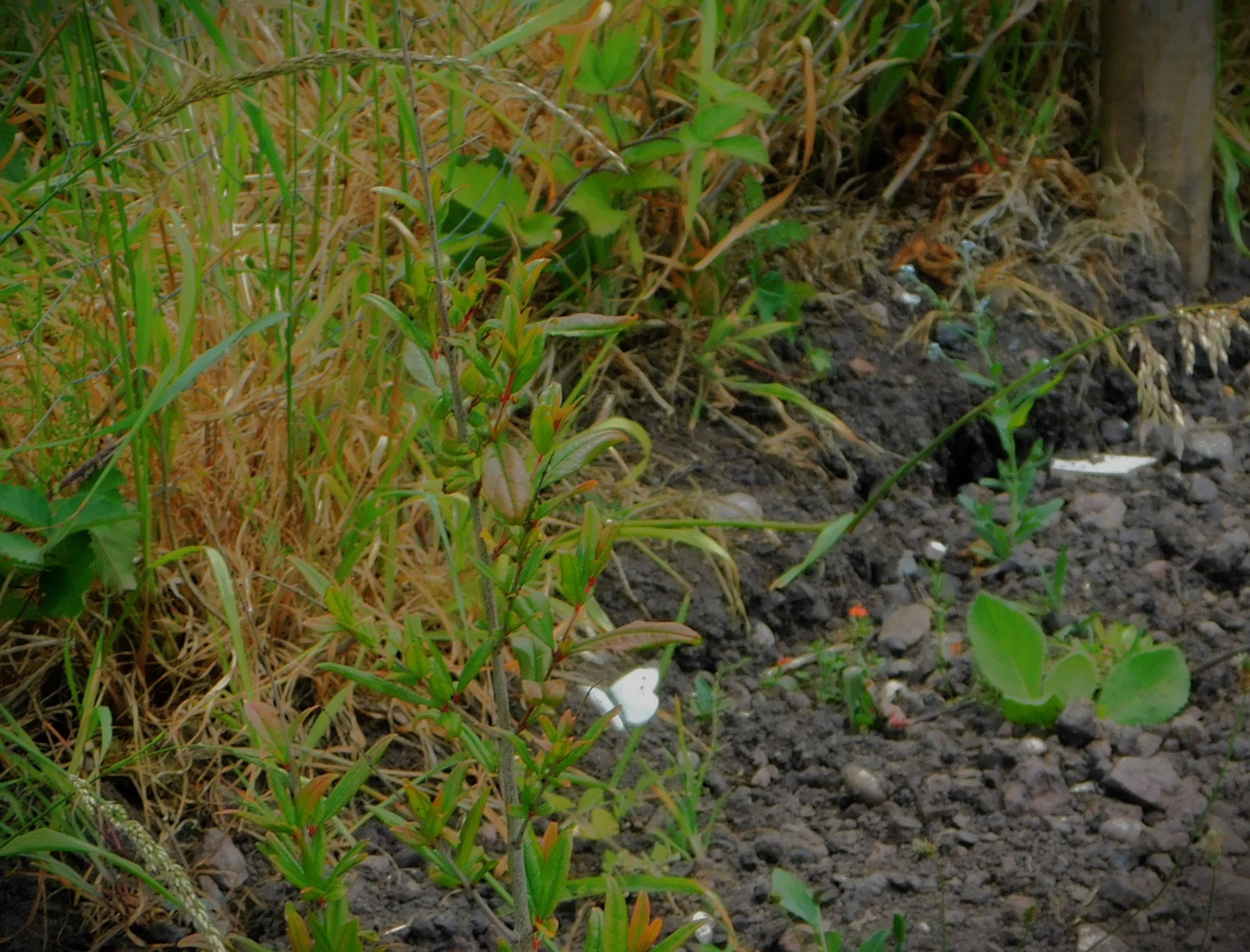
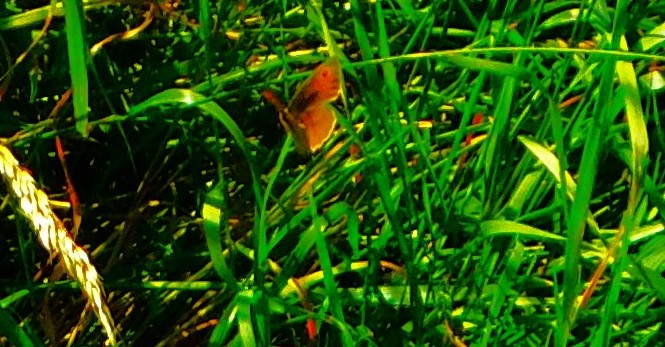
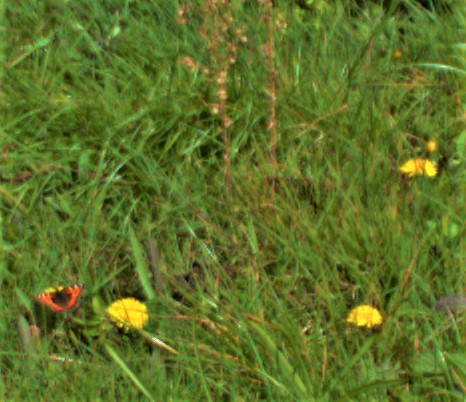
There was a butterfly in the shed when I was there on Saturday, and it failed to realize that there was no way out through the windows (they don’t open). My mother attempted to escort it to the open door but failed to do so. I eventually captured it in a flowerpot and managed to keep control of it just long enough to get it close enough to the open door of the shed that it flew away to freedom.
PHOTOGRAPHS
My usual sign off…
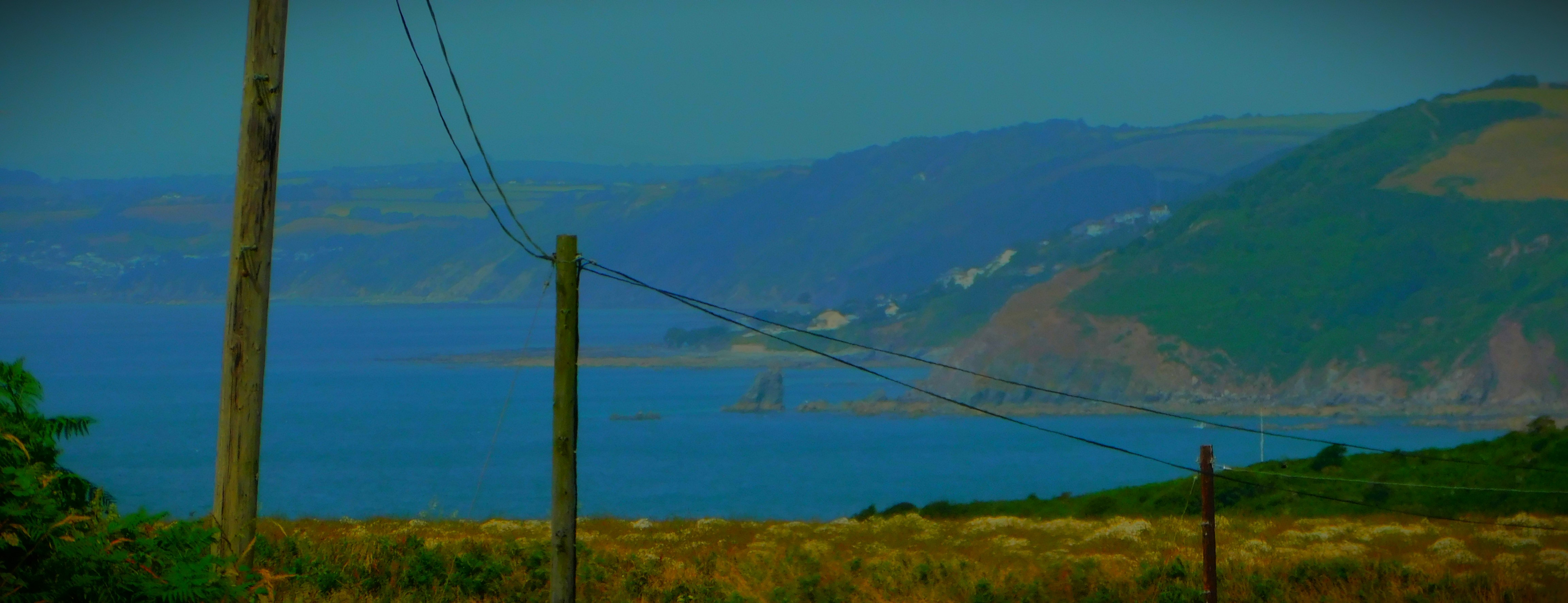
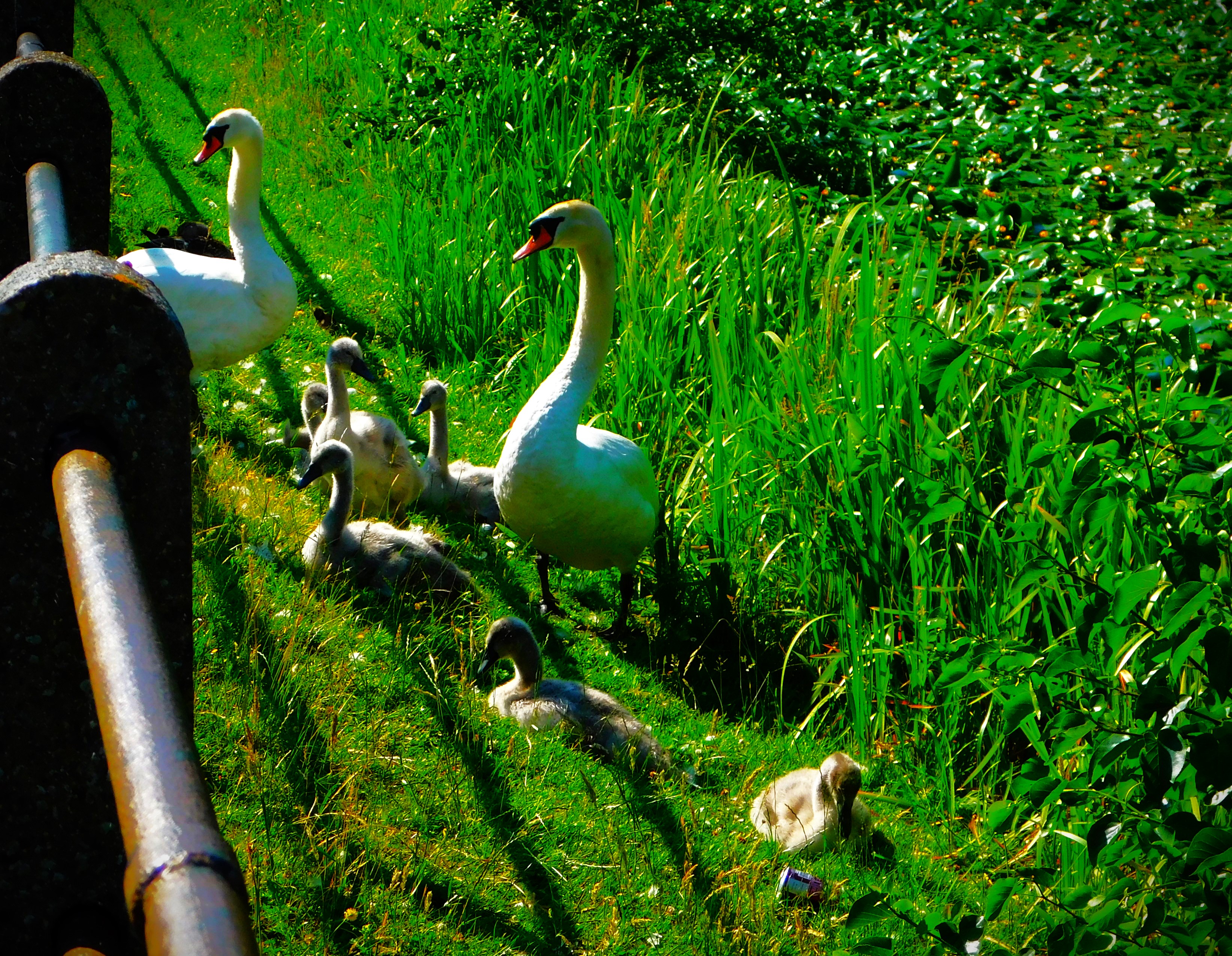
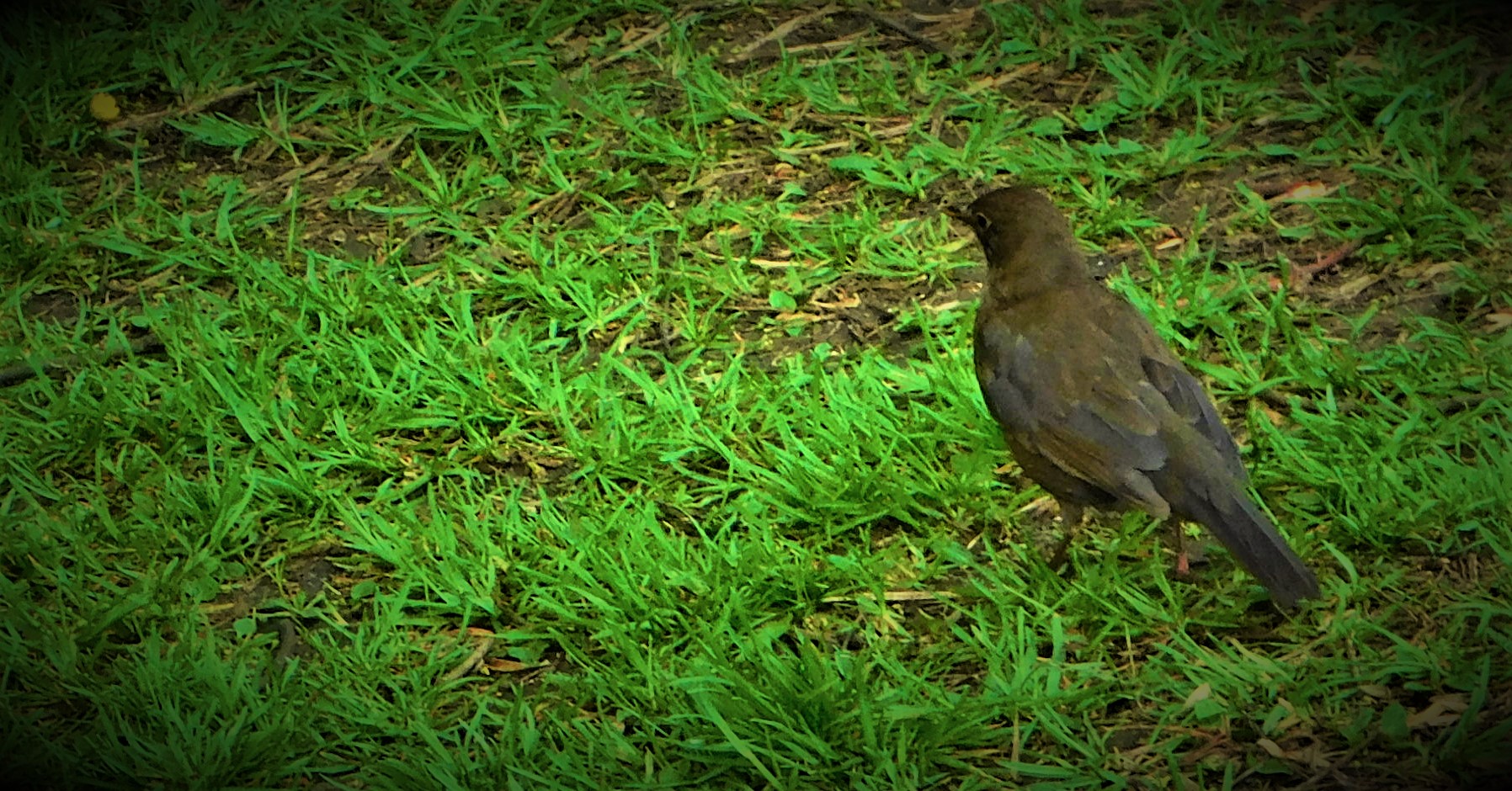
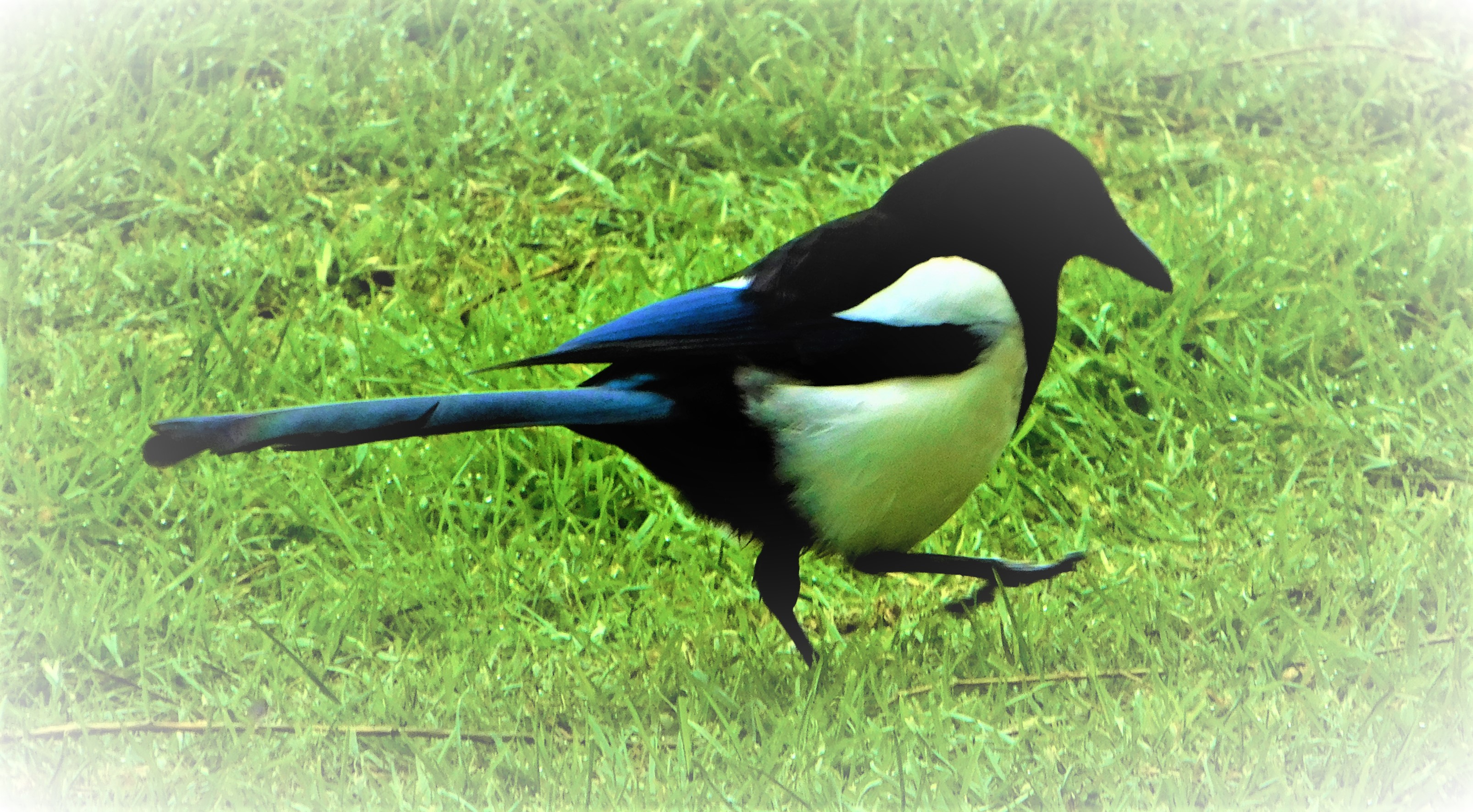
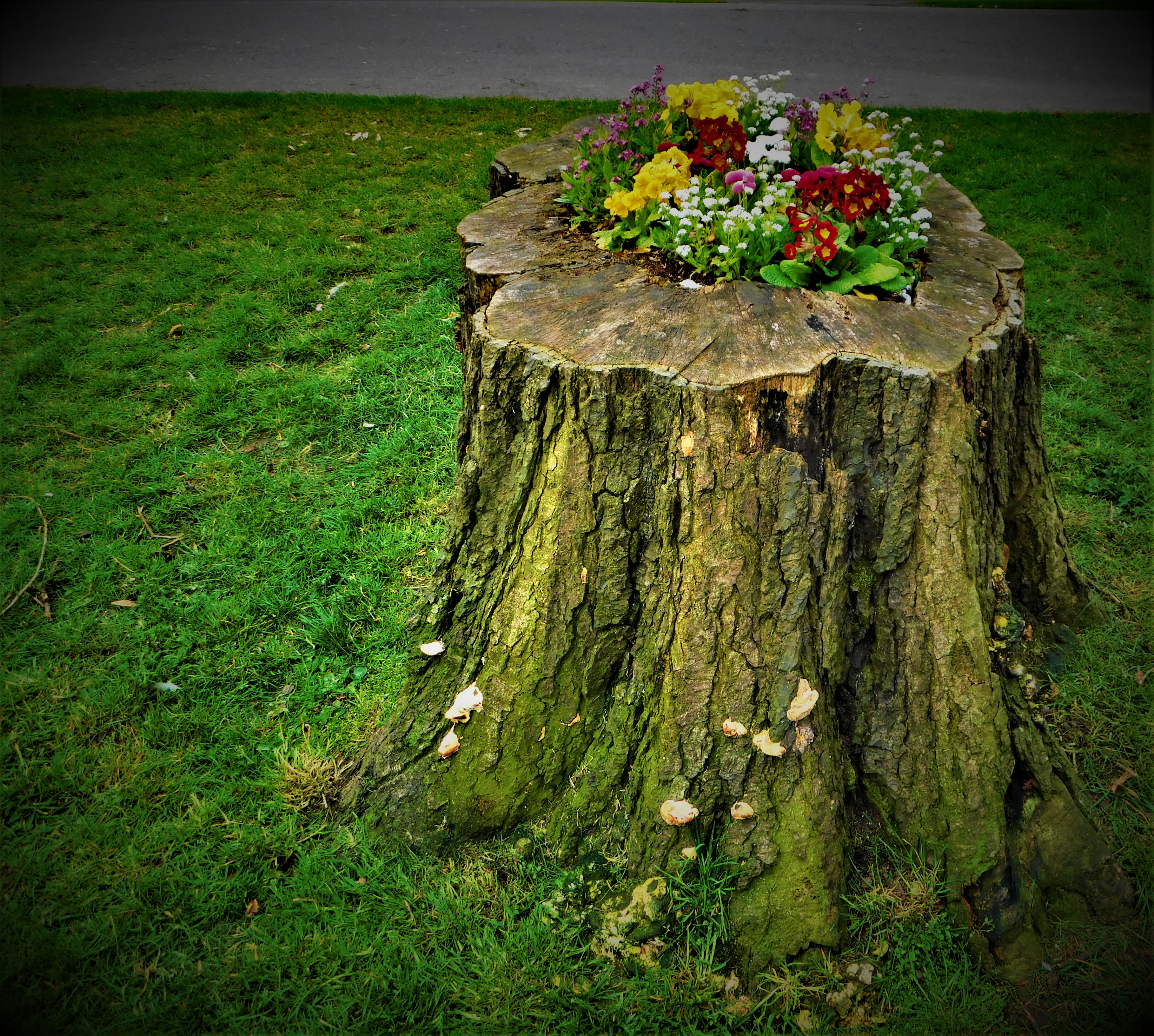
The last 12 photographs are of the butterfly that had to be rescued. Not strictly allotment related – one of a number of attempts to capture the view from Maker Heights.This picture and the next show the two plants that we returned to the allotment on the Sunday to put in.At the edge of the allotments on the way back to the car.The last three pics are of views spotted between the allotment and Looe.
A look at developments in the women’s test match at Trent Bridge and a photo gallery.
The Women’s Ashes test match at Trent Bridge is hotting up, as England bowlers get in among the wickets. This post looks at developments since yesterday.
THE REST OF YESTERDAY
During yesterday’s post I noted that Tammy Beaumont was hunting down records. She did break the Betty Snowball England record score that had stood since 1935, and she did complete her double century. She was finally last out for 208, the fifth highest score ever by a women’s test cricketer. England had tallied 463, a deficit of 10 on first innings. By the close Australia were 82-0 and it looked like they were in a very strong position.
TODAY
England bowled much better today, but Mooney and Litchfield pushed their opening stand up to 99 before the breakthrough occurred. Australia still looked in a very strong position at 178-3, but England have claimed four wickets in very quick time, and Australia are 198-7 with Alyssa Healy and Alana King batting together. For England Ecclestone has three wickets so far, giving her eight in the match, with veteran seamer Cross and young speedster Filer each claiming two scalps.
A look at developments so far in the women’s Ashes and a substantial photo gallery.
Yesterday morning the Women’s Ashes got underway with day one of a five day test match (this move being not before time – see here). This post looks at the action so far.
THE PRELIMINARIES
The warm up matches (England v Australia A and England A v Australia) both went better for England than Australia. England’s chosen XI included an international debutant in Lauren Filer and a test debutant in Danni Wyatt. Filer was part of seam/ pace trio alongside veteran Kate Cross and the tall swing bowler Lauren Bell, while the front line spinner was inevitably Sophie Ecclestone. In addition to these Natalie Sciver-Brunt’s medium pace, Sophia Dunkley’s leg spin and Heather Knight’s off spin were also available as back up options. Australia’s side included Ellyse Perry, adding to her many entries in the record books by taking part in a tenth Women’s Ashes series. They opted for two front line spinner, Ashleigh Gardner and Alana King. They also had such strength in the batting department that Annabel Sutherland, a regular number three in Australian domestic cricket and coming off the back of a century in her warm up game was at number eight (she is a seam bowling all rounder, and has a better record at the age of 21 than Perry did when she was that age. Australia won the toss and chose to bat.
DAY ONE
Yesterday was a work day for me, so I missed a lot of the action, but tuned in just in time to catch Sophie Ecclestone’s second wicket. Two balls later Aussie skipper Alyssa Healy was out for duck and it was 226-5. That was as good as it got for England, and by the end of the day Australia were 328-7, with Sutherland going well.
DAY TWO
The second morning definitely belonged to Australia. Bell claimed the wicket of Alana King, but Kim Garth has providing staunch support for the brilliant Sutherland since then. Australia have just reached 450, with Sutherland now on 121. Ecclestone has been by far the best of the England bowlers, and now has figures of 44-9-115-3, with the rest of the attack going at closer to five an over than four – rather a contrast to the men’s test, when England’s supposed front line spinner was the one getting smacked around while the seamers were significantly more economical (on a side note, the England men’s selectors seem to have realized that persisting with Ali is not on – Rehan Ahmed has just been added to their squad). Although Australia are in a very strong position England are themselves a powerful batting side, with an opener, Beaumont, coming off a double century in her warm up match and a few others in good form. As I type this Garth has just been given LBW to Ecclestone, though she has reviewed it, it has been confirmed as out and Australia are 457-9, Ecclestone has 4-120 in her 45th over of the innings. Darcie Brown, the sole member of this Aussie XI with no batting pedigree has joined Sutherland at the crease.
PHOTOGRAPHS
The first four pictures in today’s gallery were taken a few days earlier than any of the others, which all date from the last couple of days. To view a photo at full size just click on it.
A look at the victories recorded by Surrey and Somerset today and a splendid photo gallery.
The county championship is heading towards its break for the Vitality Blast, and all though today is only day three of four a lot of matches have reached their conclusions. This post looks at two that I followed on the radio.
KENT’S HORROR MORNING
Kent went into day three at The Oval trailing by three runs with six second innings wickets standing. Both overnight batters fell quickly, both to Tom Lawes who claimed his third and fourth wickets of the innings. Kent were still in arrears at that point. Lawes completed a maiden first class five-wicket haul with the seventh wicket of the innings. Sean Abbott claimed the eighth wicket of the innings, and Jordan Clark snapped up the last two. Kent had mustered a paltry 141, leaving Surrey needing 58 to win. Burns and Sibley saw Surrey home by ten wickets, just before the scheduled lunch interval. Surrey look wellnigh unstoppable – they were not by any means at their best this match and they still won it by 10 wickets.
SOMERSET END WINLESS RUN
Somerset came to Lord’s having not won any of their last six matches. Midway through day three of their encounter with Middlesex they had ended that unhappy sequence in some style, routing their opponents by an innings and 13 runs. Craig Overton claimed five second innings wickets, while the rout was completed by Jack Leach. Middlesex now look absolute certainties to be relegated back to division two. I am now following the action between Sussex and Glamorgan. Sussex had an enormous first innings lead (over 350), but Glamorgan are back in credit with only three wickets down, Labuschagne and Carlson in a partnership that is closing on the 3o0 mark. Carlson has had a curious season – this is his third century of it and all of his other innings have been under 20.
A look at the best players from before the official inauguration of the county championship, some comments on the selection of England test squad for the one off match against Ireland and a large photo gallery.
Today I create an XI of the best players most or all of whose careers took place before there was a county championship. Incidentally, there is a page from which all my posts about Saturday’s excursion to Pensthorpe can be accessed. Before I get into the main business of today’s post there is a brief section about…
ENGLAND TEST SELECTORS BLUNDER BIG TIME
The squad for the first test match of the home season, against Ireland is now out, and there are three areas of concern, two selections and an omission. Zak Crawley, a proven failure at test level, retains his slot at the top of the order. Far worse, Ben Foakes has been dropped to make way for the return to test action of Jonathan Bairstow. There may be a case for picking Bairstow, though in a test career which stretches back to 2012 he has blown hot and cold, and more often cold than hot, but there is not even the shadow of a case for dropping Foakes, the best current keeper by far, and someone who has been scoring big runs for Surrey in the championship this season, including a century at better than a run a ball when Surrey were looking for a declaration. Many people have posed this as being a challenge about how to accommodate Bairstow, and I have two options, listed in order of preference:
Opt for what C Auguste Dupin would call “the sagacious and comprehensive expedient of making no attempt to accommodate Bairstow”. England are coming off a very successful winter without Bairstow, and Bairstow’s overall test record is that of a mediocre middle order batter, certainly not sufficient to warrant discarding Foakes.
Have Bairstow open the innings as he does in white ball cricket and drop the proven failure Crawley (I would prefer to see a proper opener such as Ben Compton or Ali Orr picked in Crawley’s case, but at least Bairstow would probably be an improvement were he coming in in place of Crawley).
It is now time to get back to the main meat of the post…
THE XI IN BATTING ORDER
*WG Grace (right handed opening batter, right arm bowler of various types through his career, captain). Had a quarter of a century of first class experience by the time of the first official county championship, so even though he played his last first class game as late as 1908 he qualifies.
Arthur Shrewsbury (right handed opening batter). The man WG rated as the second best batter around (himself obviously no1), and since he played 15 years of FC before the inauguration of the Championship and 12 afterwards he just qualifies.
James Aylward (left handed batter). In 1777, just eight years after John Minshull had scored the first recorded century in any form of cricket, he hit the Hambledon record score of 167, which remained an all comers record for 43 years.
William ‘Silver Billy’ Beldham (right handed batter). In an era when centuries of any kind were rare he hit three in matches of indisputably first class status.
Fuller Pilch (right handed batter). Acknowledged as the best batter of the 1830s and 1840s, a period when scoring was very low.
Alfred Mynn (right handed batter, right arm fast bowler). “The Lion of Kent”, an absolute man mountain, and a great all rounder. He was quick enough that on one occasion someone fielding at long stop (directly behind the keeper) to his bowling once had to be hospitalized after being hit in the chest by several of his deliveries.
Vyell Walker (right handed batter, right arm slow underarm bowler). One of only two cricketers to have scored a century and taken an all-10 in the same first class fixture (the other, WG, is also in this XI). As an underarm bowler any turn he got would have been the equivalent of an overarm bowler bowling leg spin, which makes him a good slow bowling partner for the next guy in the order…
Billy Bates (right handed batter, off spinner). A massively impressive career record, probably equating in the modern era to averaging 32 with the bat and 25 the ball (actual averages were 21 and 17). He was even better in his brief test career, averaging 27 with bat and 16 with the ball, which probably equates to 41 and 24 in the modern era.
+Tom Box (wicket keeper, right handed batter). He appeared in every fixture that Sussex played for an unbroken 24 year period, and although his batting average looks very low to modern eyes it is about 60% of that of Fuller Pilch, rated the best batter of the era.
William Lillywhite (right arm fast roundarm bowler, right handed lower order batter). Rated the best bowler of his era (he was referred to as ‘the Nonpareil’, one half of my envisaged new ball pairing.
William Mycroft (left arm fast bowler, right handed tail end batter). 800 first class wickets at 12 a piece.
This side has a powerful batting line up, with everyone down to Bates at number eight definitely capable of playing a match winning innings. The bowling, with Mycroft, Lillywhite and Mynn to bowl pace, and Bates and Walker two contrasting types of slow bowler, plus of course the redoubtable WG is magnificent, having both depth and variety.
HONOURABLE MENTIONS
The two chief rivals to Shrewsbury for the position of Grace’s opening partner were John Small of Hambledon and EM Grace. Lambert, scorer of twin centuries in a match in 1817, a feat which stood alone for half a century until WG Grace emulated it might have had a middle order slot. George Osbaldeston was a fine fast bowling all rounder, but not I reckon the equal of Mynn. Had I been going to pick an overseas player it would have been Dr ME Pavri (India), who visited England in the 1890s and achieved remarkable things as a pace bowling all rounder (once in his native land he decided in advance that team mates weren’t needed, took on an XI on his unaided own, and beat them). Among the great bowlers who missed out were David Harris (Hambledon), the Notts duo of Alfred Shaw and Fred Morley, James Broadbridge and John Wisden both of Sussex and two Yorkshire speedsters, Tom Emmett (left arm) and George Freeman (right arm). Sam Redgate, John Jackson and George Tarrant would all also have their advocates.
An all time XI of great former test skippers and a huge photo gallery.
For today’s blog post I have selected an XI made up entirely of players who captained their country in test cricket. I required players with excellent playing records – no passengers for me, and also who had been successful as captains.
THE XI IN BATTING ORDER
Mark Taylor (Australia, left handed opening batter, ace slip fielder). Second link in a chain of four successive very successful Aussie skippers. He succeeded Allan Border who had inherited a rabble and passed on the best side in the world. Taylor kept Australia at the top of the world pecking order, in its own way as impressive an achievement as his predecessor’s feat of dragging them to the top in the first place.
*Frank Worrell (West Indies, right handed opening batter, left arm fast medium bowler, occasional left arm spinner). He averaged 49 with the bat, which confirms that he was worth his place as a player. I have named him as captain of this side of captains because as well as being a superbly successful skipper he was one of genuinely historic importance – his appointment represented the end of a particularly unpleasant captaincy fetish, since he was the first black man to be appointed West Indies captain.
Don Bradman (Australia, right handed batter, outstanding outfielder). The most prolific batter there has ever been, with a test average of 99.94, and a superb captain. In the 1936-7 Ashes he turned a 0-2 deficit after two matches into a 3-2 series win. In 1948 he led the Australians through an unbeaten tour of England.
Clive Lloyd (left handed batter, outstanding cover fielder and later a fine slip). The pioneer of the ‘four fast bowlers’ strategy that propelled West Indies back to the top of the world game after a difficult period in the late 1960s and early 1970s.
Steve Waugh (Australia, right handed batter, occasional right arm medium fast bowler). The third link in the chain of Aussie skippers I referred to earlier, and he built on the earlier achievements of Border and Taylor give an acknowledged best side in the world an aura of total invincibility.
Imran Khan (Pakistan, right handed batter, right arm fast bowler). A great all rounder and a great skipper. Maybe in a few years time Stokes will challenge him for this slot – he has made an outstanding start as skipper, and an Ashes triumph this summer would help to cement his reputation in that role, but as things stands he has no challenger.
+Rodney Marsh (Australia, wicket keeper, left handed batter). A bit of a cheat as he never actually captained his country, but keeper-captains in test cricket are few and far between, and successful keeper-captains at test level are in the ‘hens teeth’ category of rarity, and he would have been a better choice than Kim Hughes to skipper the 1981 Ashes touring party.
Wasim Akram (Pakistan, left arm fast bowler, left handed batter). His greatness as a player is unquestioned and he was a fine skipper as well. Not too much should be read into the acrimonious end to his tenure in the top job – Pakistan skippers rarely go gently into the night.
Richie Benaud (Australia, leg spinner, right handed batter). The first cricketer to achieve the test career double of 2,000 runs and 200 wickets. His captaincy highlights include regaining the Ashes in 1958-9, defending them in 1961 and again in 1962-3, and captaining Australia in the classic 1960-1 tied test series against the West Indies when his opposite number was Frank Worrell.
Bishan Singh Bedi (India, left arm orthodox spinner, left handed tail end batter). One of the greatest ever masters of his craft and a successful skipper in somewhat difficult circumstances.
Courtney Walsh (right arm fast bowler, right handed tail end batter). The first bowler ever to take 500 test wickets, and a respectable captaincy record in spite of the fact that the job is generally reckoned tough for specialist fast bowlers and the West Indies were on the way to crashing down from the heights of the Lloyd/ Richards eras by the time he got the job.
This side has a powerful batting line up, a great keeper, and Walsh, Wasim Akram and Imran Khan as front line bowlers, Benaud and Bedi as front line spinners and support bowling available from Worrell and Waugh. It is a side to be reckoned with in every department.
HONOURABLE MENTIONS
I regarded Frank Worrell as having the right handed openers slot under wraps, and I preferred my other opener to be left handed. Taylor’s chief rival for this slot was Andrew Strauss (England), who led his side to the top of the world rankings. Worrell’s presence also meant that I had to leave out WG Grace, a superb skipper as well as the best cricketer of the 19th century. I could not accommodate Border alongside Lloyd without having a huge surfeit of left handers, and I regarded the West Indian’s achievements as captain as being the greater. The fourth in that chain of successful Aussie skippers, Ricky Ponting, cannot be said to be unlucky – a) he was up against Bradman for the number three slot and b) when the greats he had inherited from his predecessors departed the scene he was shown up as a fairly ordinary skipper and one given to inappropriate outbursts – his rant on being run out by Gary Pratt and his infamous stand off with umpire Dar six years later being two examples. Another Aussie, Steve Smith, rendered himself ineligible by being caught up in a cheating scandal while captain. If you feel I have been unfair to your favourite feel free to comment. None of the England skippers I have witnessed in action have massively impressed me save Stokes, who I have mentioned as a potential future captain. Alec Stewart, who could have been used as a solution to the keeper-captain problem failed two grounds in my book: keeping was not his best role and he was a very poor skipper to boot.
A combined Surrey/ Hampshire XI for the ages and a substantial photo gallery.
With the match I am following between Surrey and Hampshire heading for a great finish I pick a combined Surrey/ Hampshire XI for the ages. Because I want to showcase both counties I have shown a little bias towards players associated with both. My XIs for each county individually can be seen here and here.
THE XI IN BATTING ORDER
Jack Hobbs (Surrey, right handed opening batter, occasional medium pacer). The Master has an irrefutable case for selection.
John Edrich (Surrey, left handed opening batter). Those who remember my original Hampshire XI (or who have followed the link in the introductory paragraph to check it out) will have noted that the opening slots were the toughest to fill for that county, whereas I was spoiled for choice in this area when it came to Surrey. Only Yorkshire, with Herbert Sutcliffe and Len Hutton, and possibly Gloucestershire with WG Grace in their historic ranks would be able to claim this slot in a combined XI with Surrey.
CB Fry (Hampshire, right handed top order batter). When I originally selected my county all time XIs I assigned him to Sussex, but after Sussex he spent a few years with Hampshire, and since his FC career began at Surrey and he was born in southwest London I felt it appropriate to include him here.
Phil Mead (Hampshire, left handed batter). He failed to impress Surrey, and moved south to Hampshire in consequence. He ended his career as the fourth leading scorer of both FC runs and hundreds, and the leading scorer of both for any one team.
Kevin Pietersen (Hampshire and Surrey, right handed batter, occasional off spinner). Had an outstanding record, though his departure from Hampshire was as acrimonious as his earlier departure from Nottinghamshire had been. The fact that he had associations with both counties got him the nod over Peter May who also had a formidable record.
+Ben Foakes (Surrey, wicket keeper, right handed batter). A shoo-in for this slot – a superb keeper and a genuine front line batter.
*Percy Fender (Surrey, leg spinner, right handed batter). His approach to batting would make him an ideal choice for number seven in an XI of this nature and he was a fine bowler and a very astute captain.
Malcolm Marshall (Hampshire, right arm fast bowler, right handed batter). Even at test level as he was almost good enough with the bat to be considered an all rounder, and Hampshire treated him as such. Probably the greatest fast bowler of the great age of West Indies fast bowling, and an obvious choice for the overseas slot.
Jim Laker (Surrey, off spinner, right handed batter). Possibly the greatest of all off spinners. His peak came in 1956 with 46 Ashes wickets at 9.60 in the five test series and an all-ten for Surrey v The Australians in a tour match.
Derek Shackleton (Hampshire, right arm medium fast, right handed batter). Only one bowler ever took at least 100 first class wickets in each of 20 successive seasons, and that bowler was Derek Shackleton. Only Wilfred Rhodes who achieved the feat 23 times in his extraordinary career has managed 100 wickets for the season more often than Shackleton. He played the inaugural season of the John Player League, and with in the year of his 45th birthday managed to bowl 80 overs for just 168 runs in this 40 overs per side tournament.
Tom Richardson (right arm fast bowler, right handed batter). Between the start of the 1894 season and the end of the 1897 season the fast bowler claimed 1,005 wickets, including a then season’s record tally of 290. The 88 wickets he claimed in 14 test appearances provide the proof that he could do it against the best opposition around.
This side has a formidably powerful batting line up, a great keeper and a very strong and well balanced bowling attack – there wouldn’t be many runs available against Marshall, Richardson, Shackleton, Laker and Fender on any surface.
HONOURABLE MENTIONS
I refer folks to my honourable mentions sections for each individual county for full detail, and add the following:
Ken Barrington, Robin Smith and Peter May were the unluckiest of the batters who I picked for their individual county XIs but not this one, with Graham Thorpe also worth a mention here.
No keeper for either county could challenge Foakes.
Among the seamers two giants of the game with the forename Alec were the biggest misses: Bedser of Surrey and Kennedy of Hampshire. Bill Lockwood and George Lohmann, both Surrey, were also huge names to leave out.
For the spinners two left armers, Tony Lock (Surrey) and Stuart Boyes (Hampshire) were the big misses. Laker was a lock for the off spinners place, and in view of my desire to have Fender captain and the fact that the best leg spinner to have played for either county, Shane Warne, was an overseas player and could not displace Marshall no leg spinner could be accommodated.
This Wednesday saw James and Sons’ April auction, the first of three auctions that are devoted entirely to an old client’s collection of stamps, postal history and first day covers (these auctions are interleaved with regular general sales, of which our next will be on May 18th). This post looks back at the day.
A GOOD AUCTION
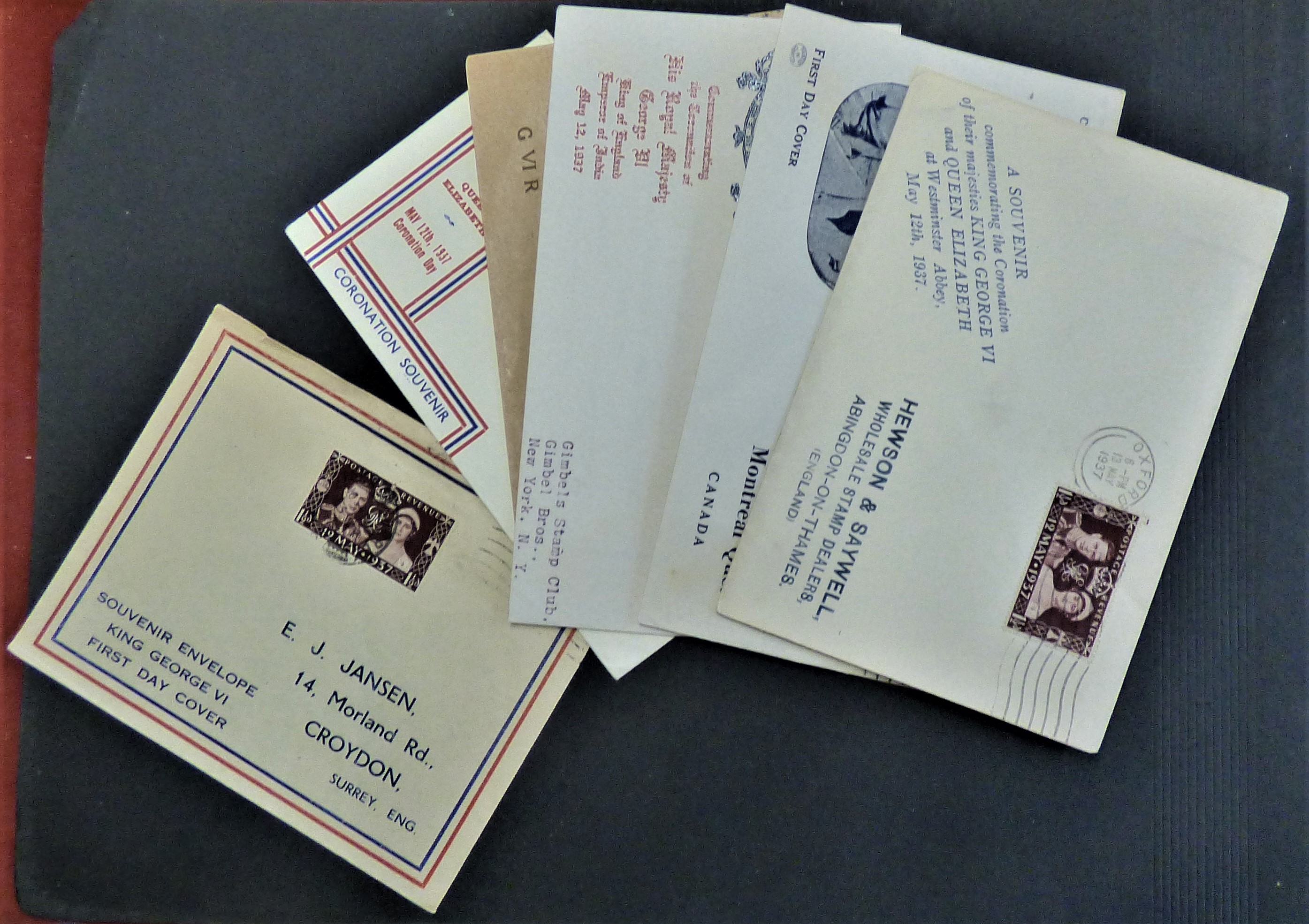
With a large number of bidders registered, many of them newcomers, we were hoping for a good sale, and we got it in spades. Lot 66 attracted some lively bidding and ended up fetching £80. Lot 85 went for £100
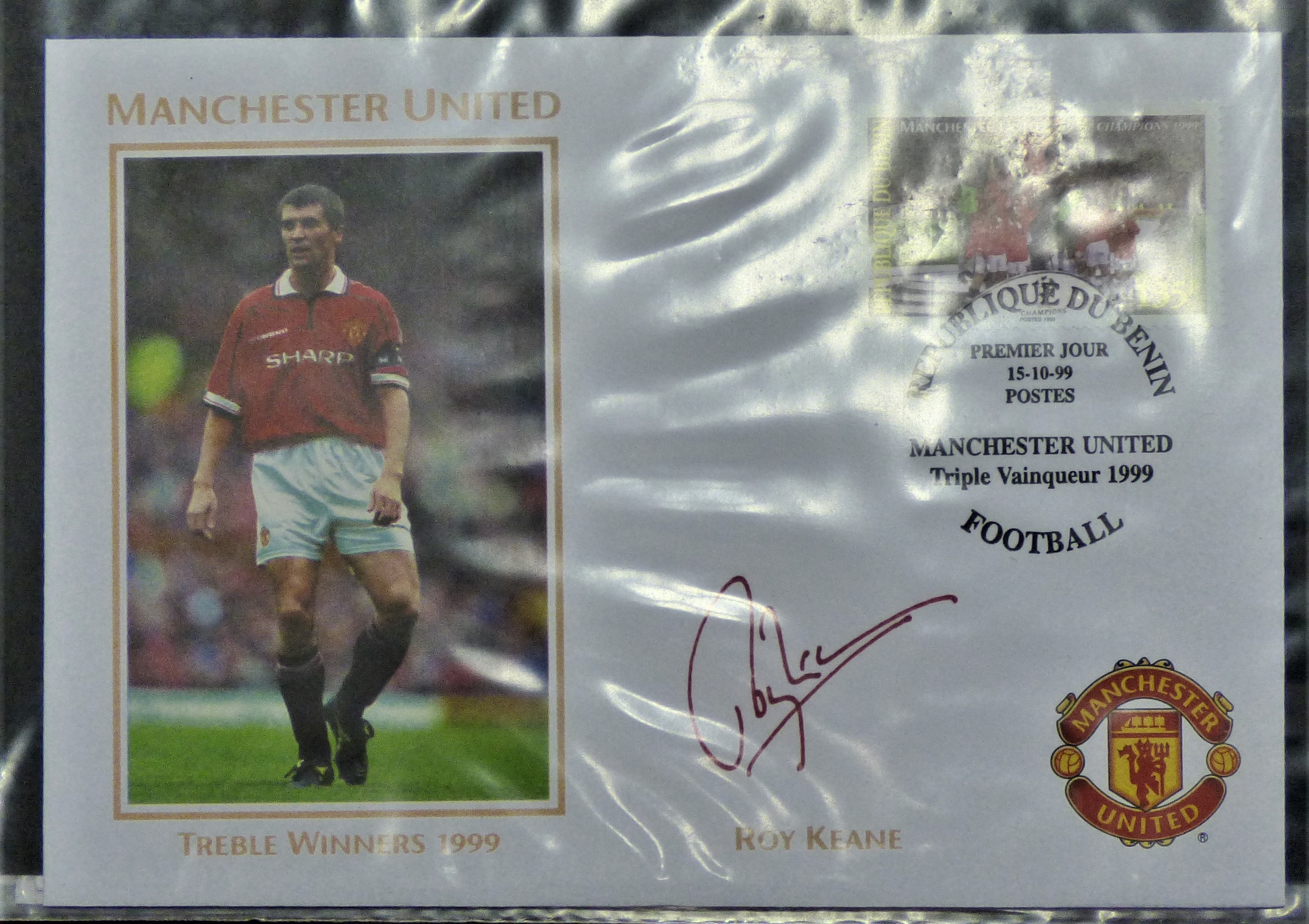
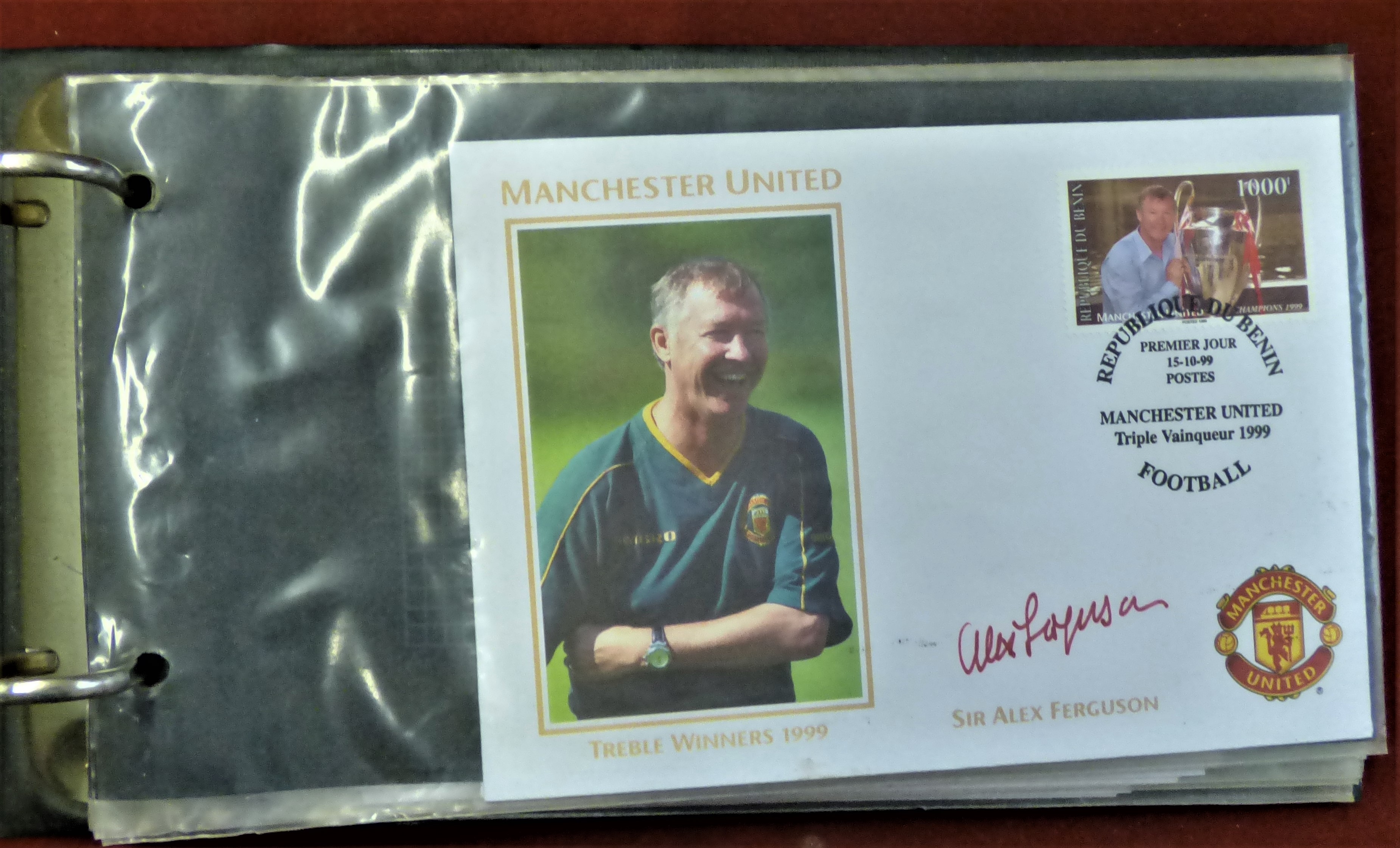
A complete set of FDCs depicting the 1999 Treble Winning Manchester United.
Lot 120 netted £150 after some brisk bidding.
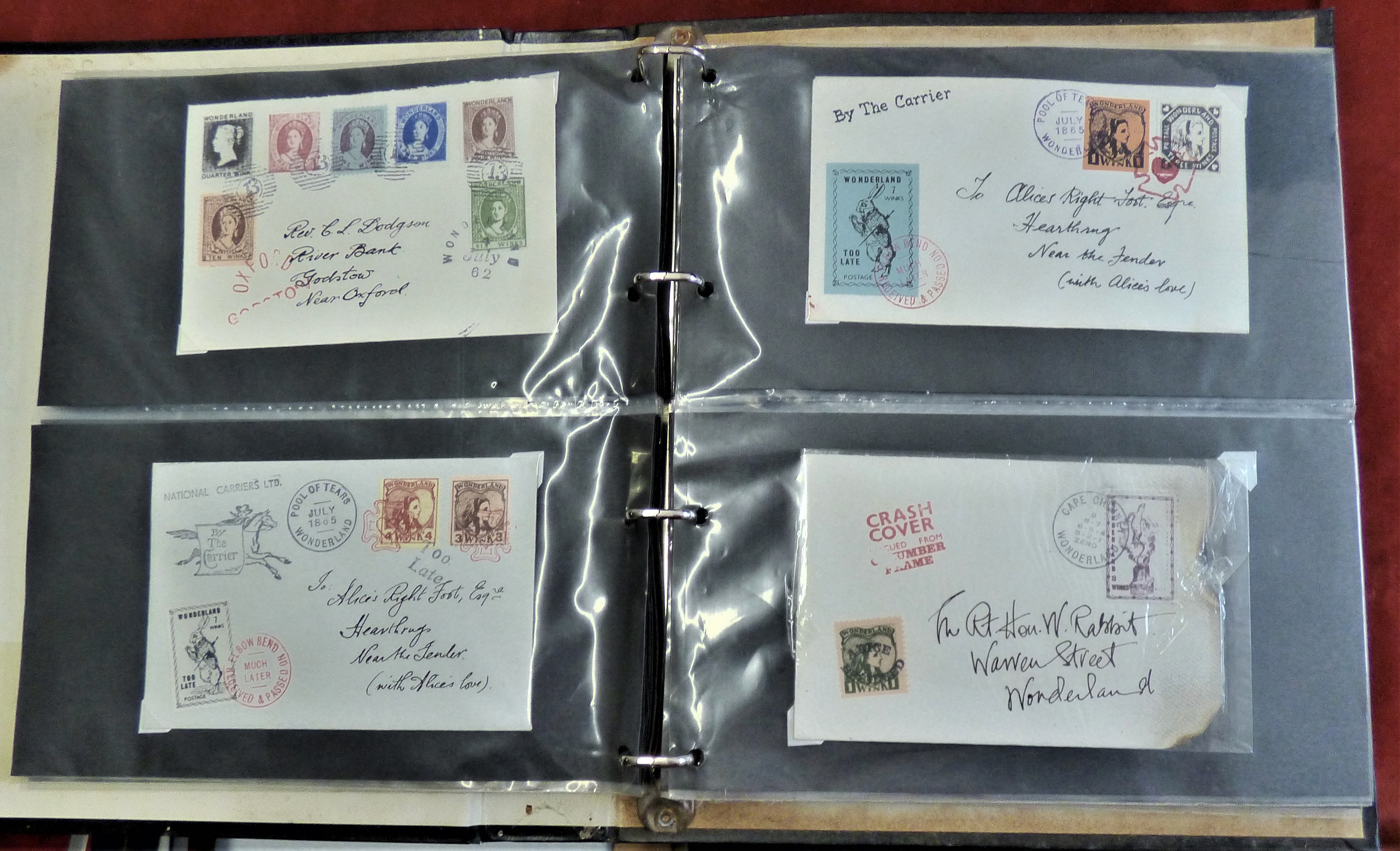
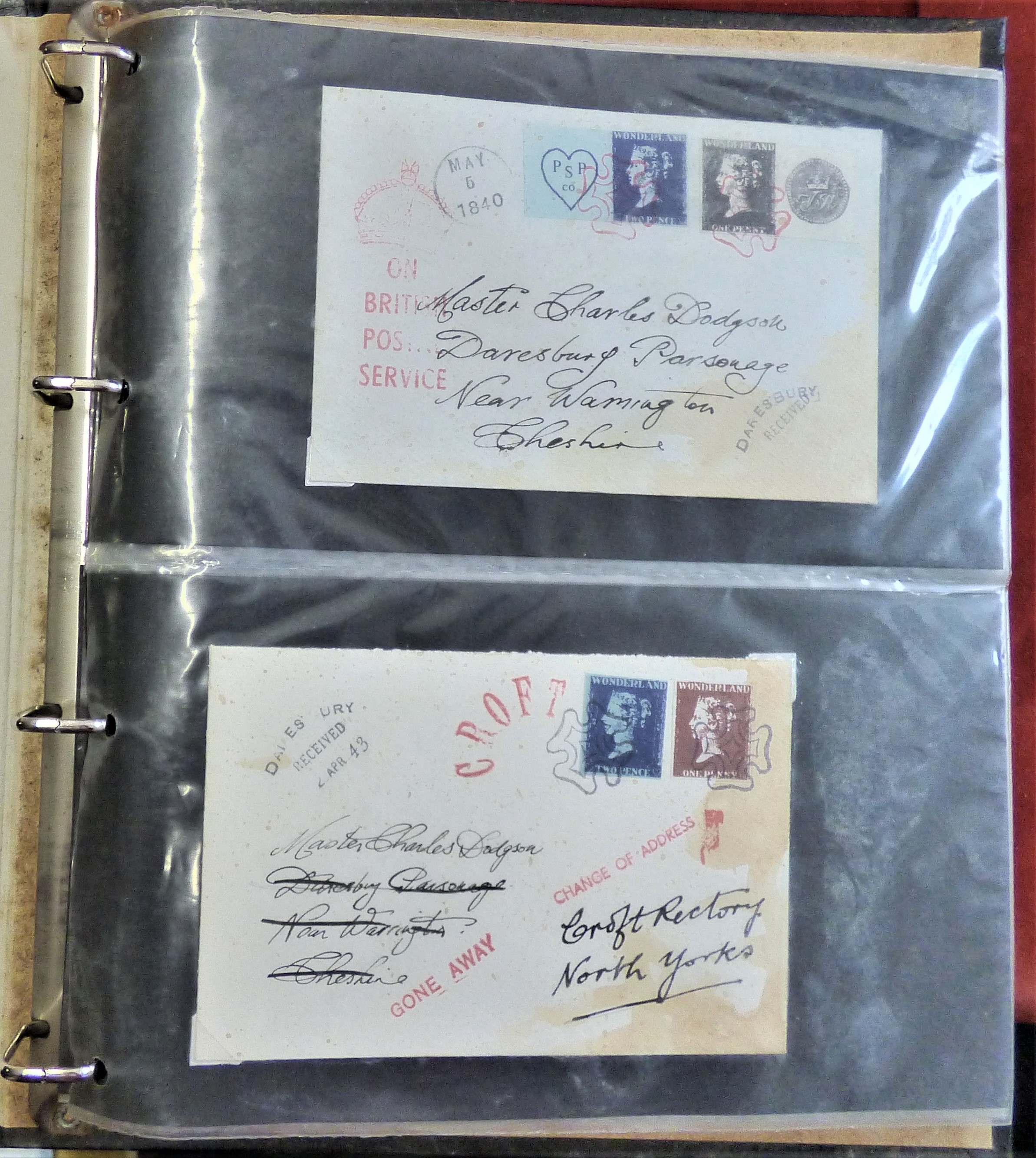
Lot 132 was the most remarkable story of the auction. It included some rare Wonderland stamps, and with the bidding starting at £30 an amazing stampede by online bidders pushed the final price up to an eye-popping £540!
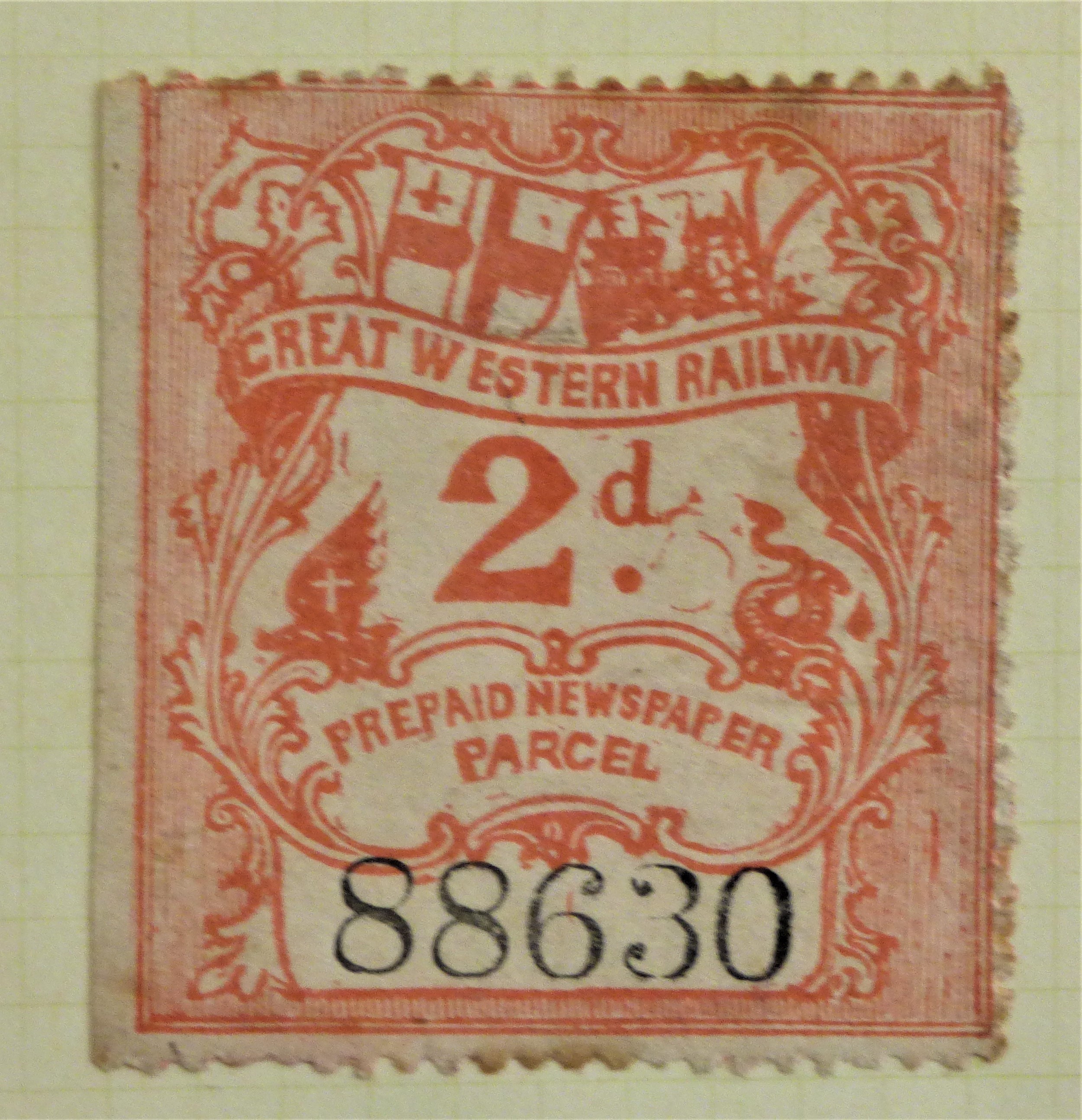
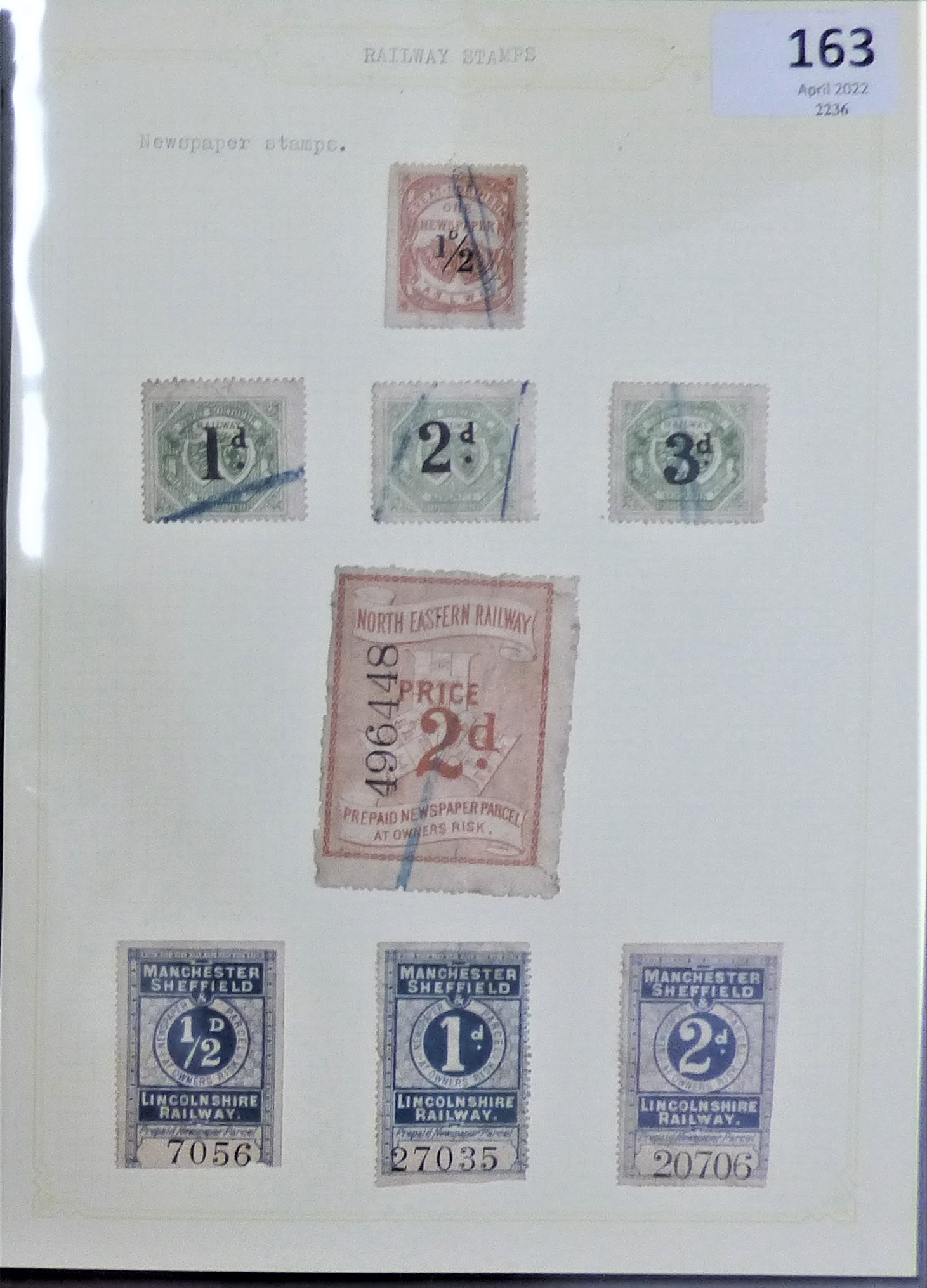
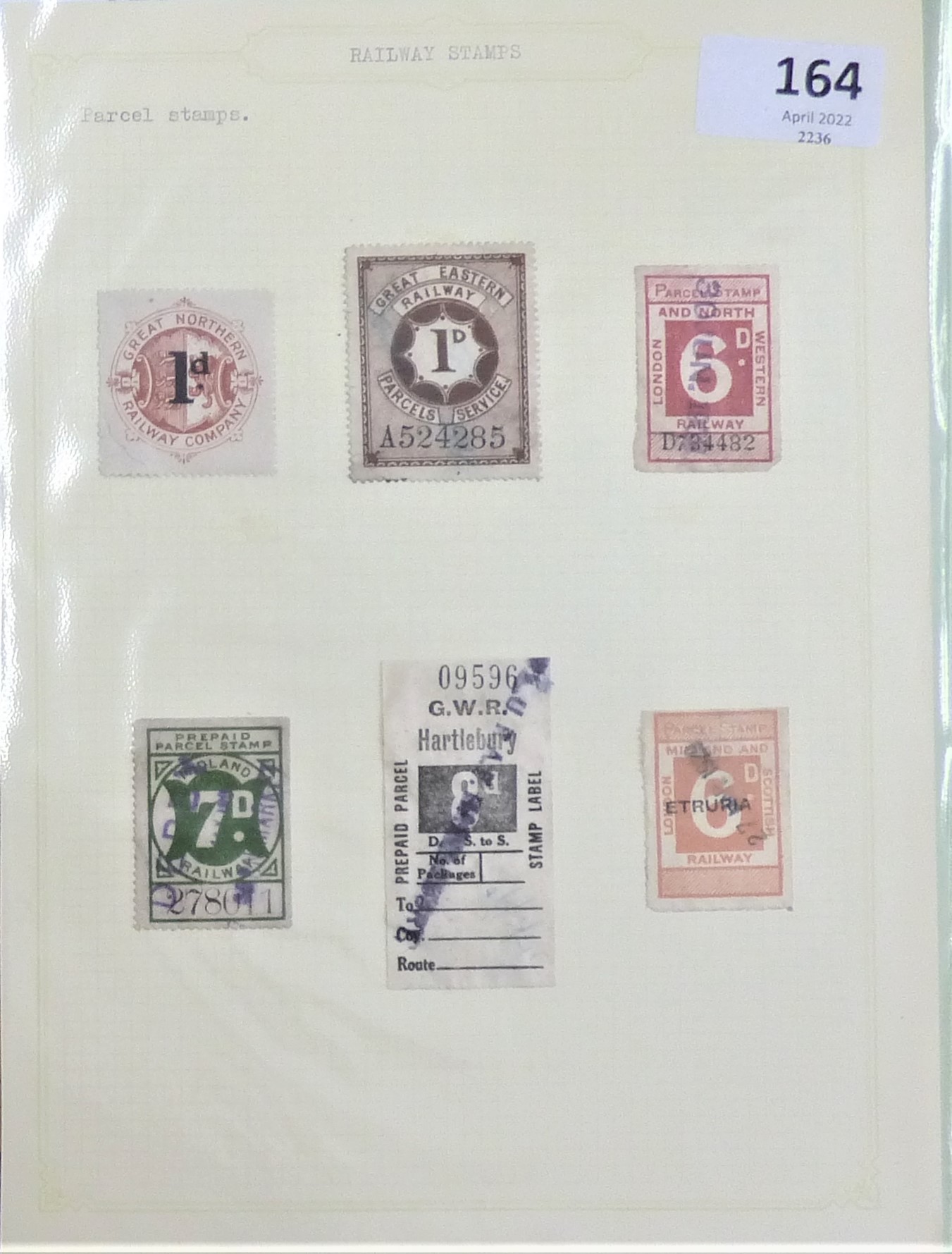
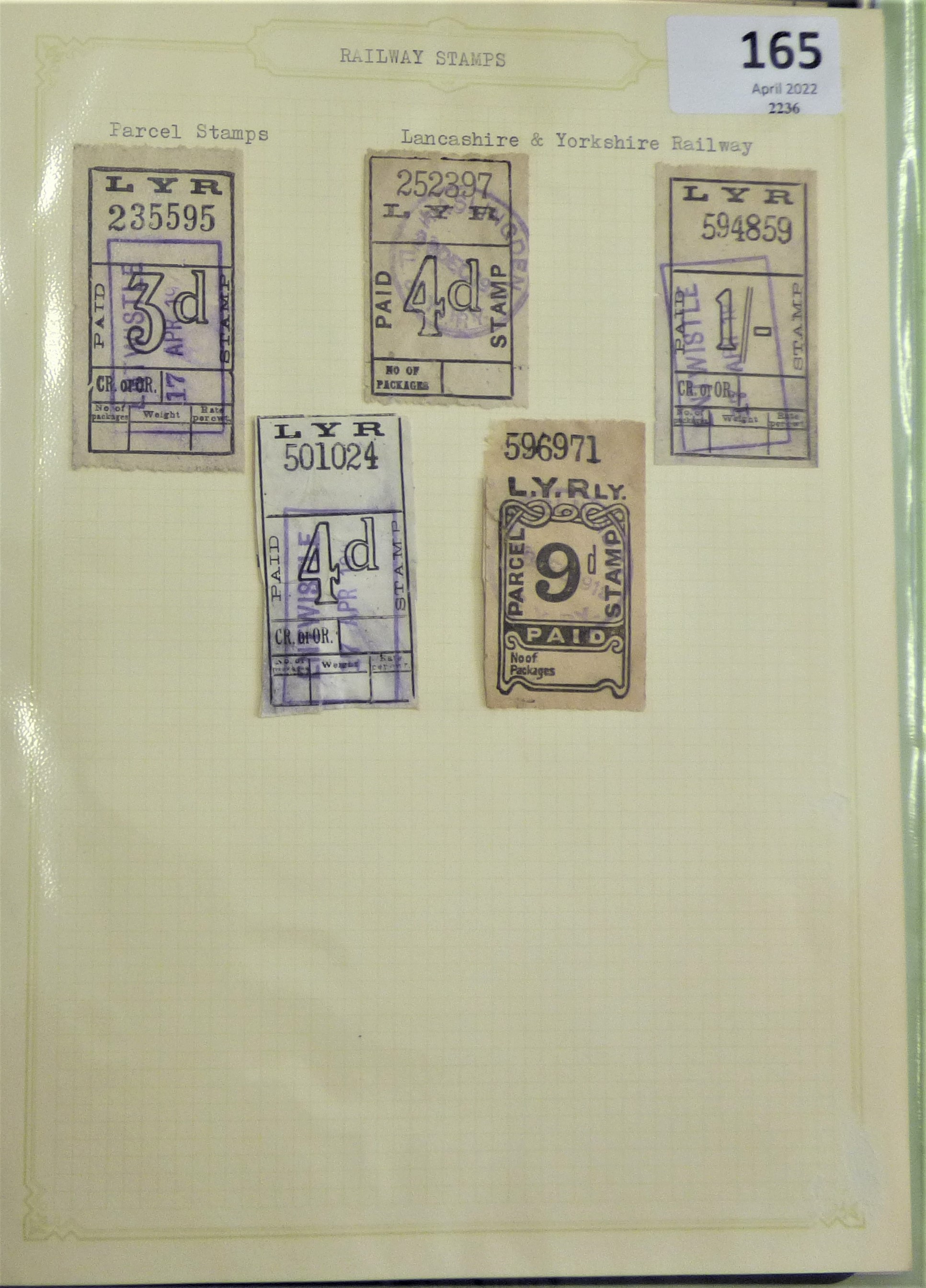
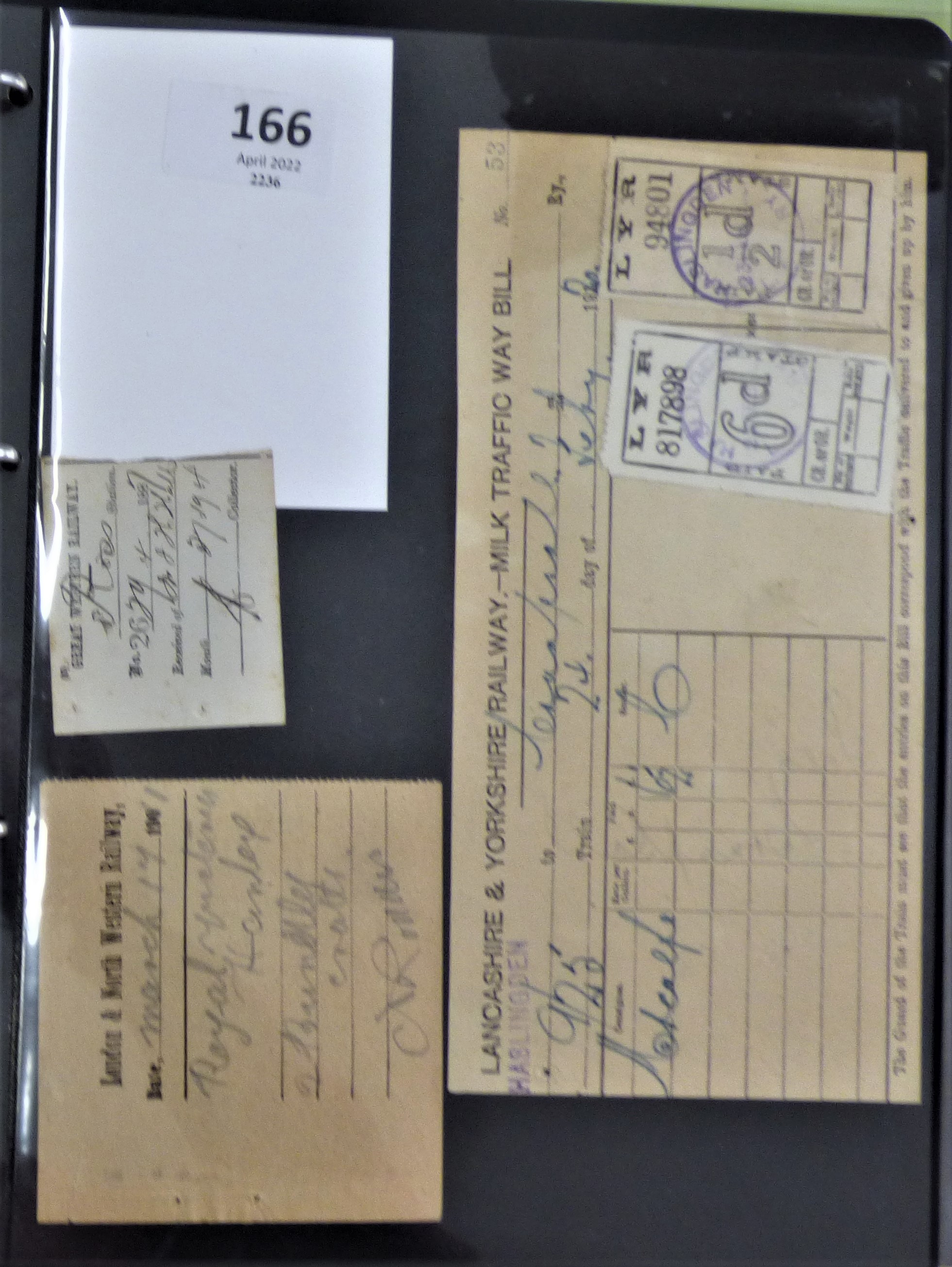
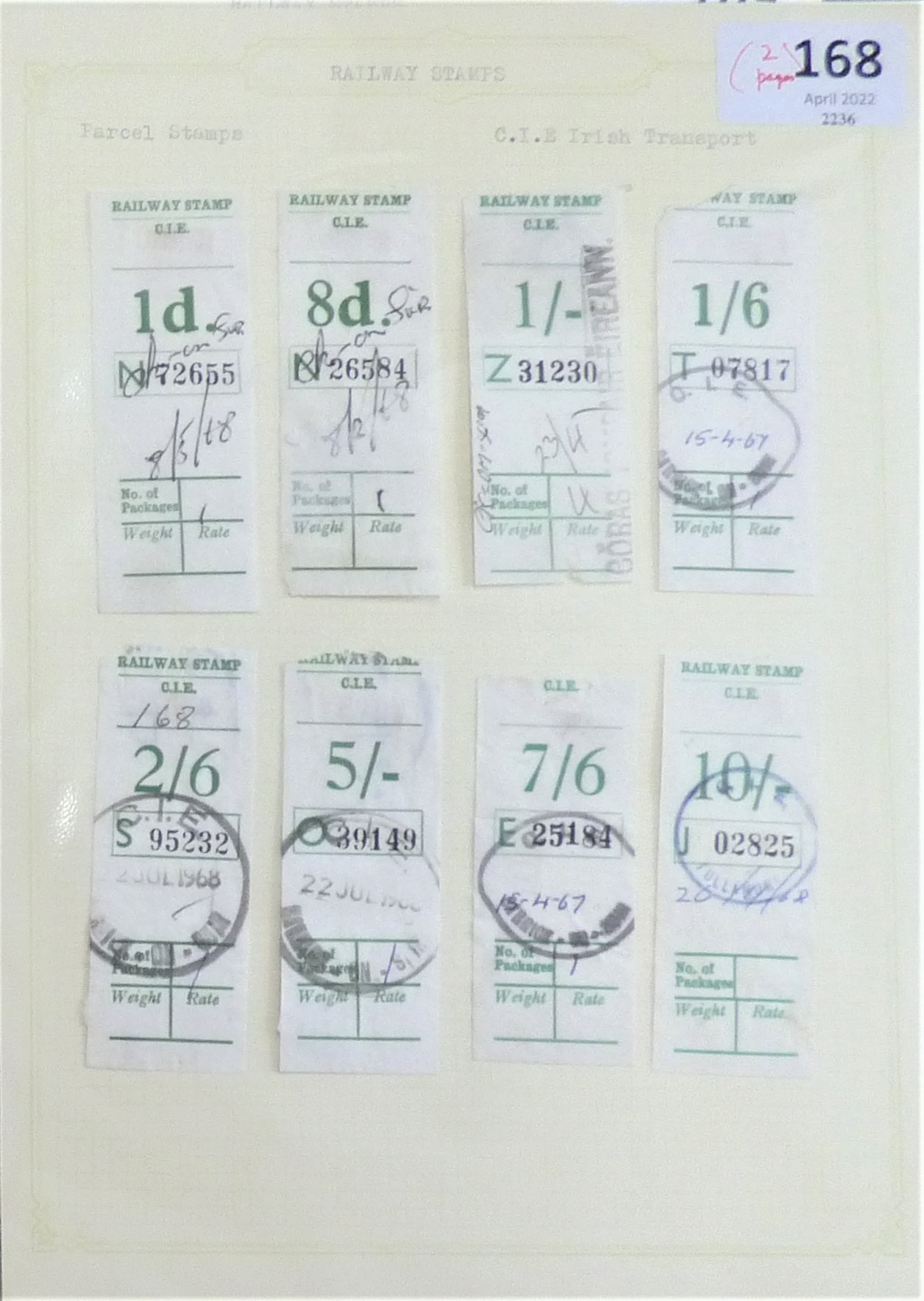
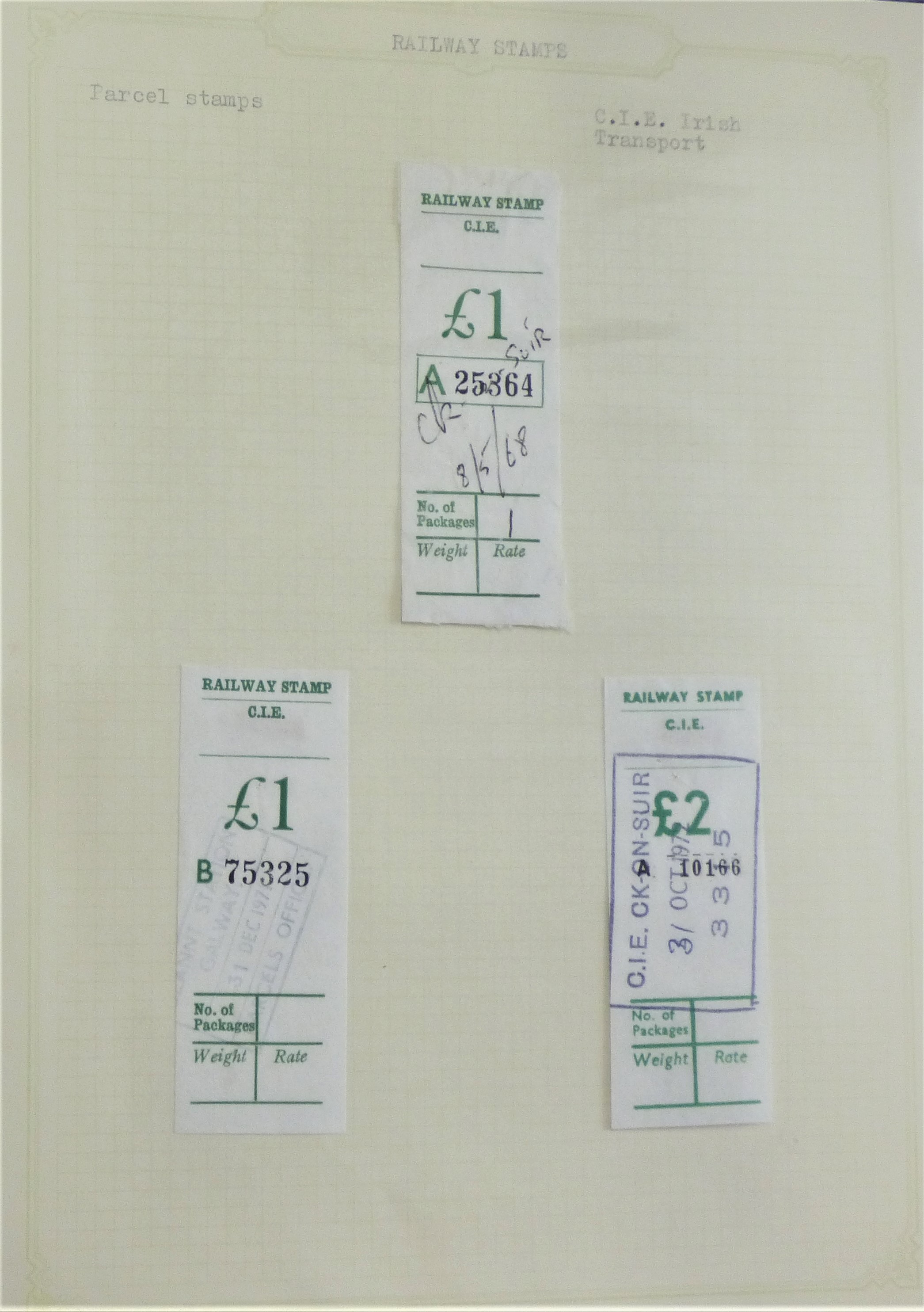
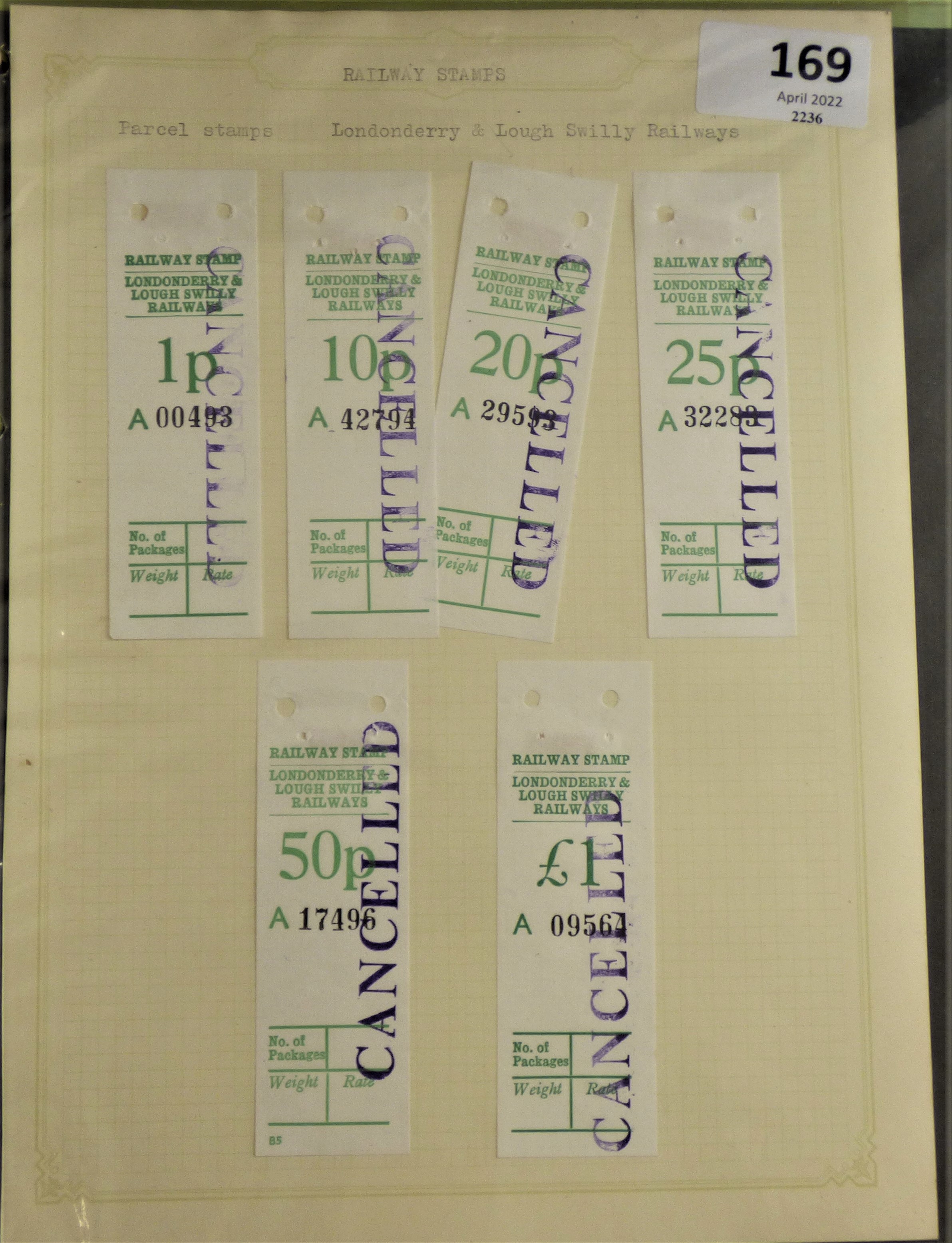
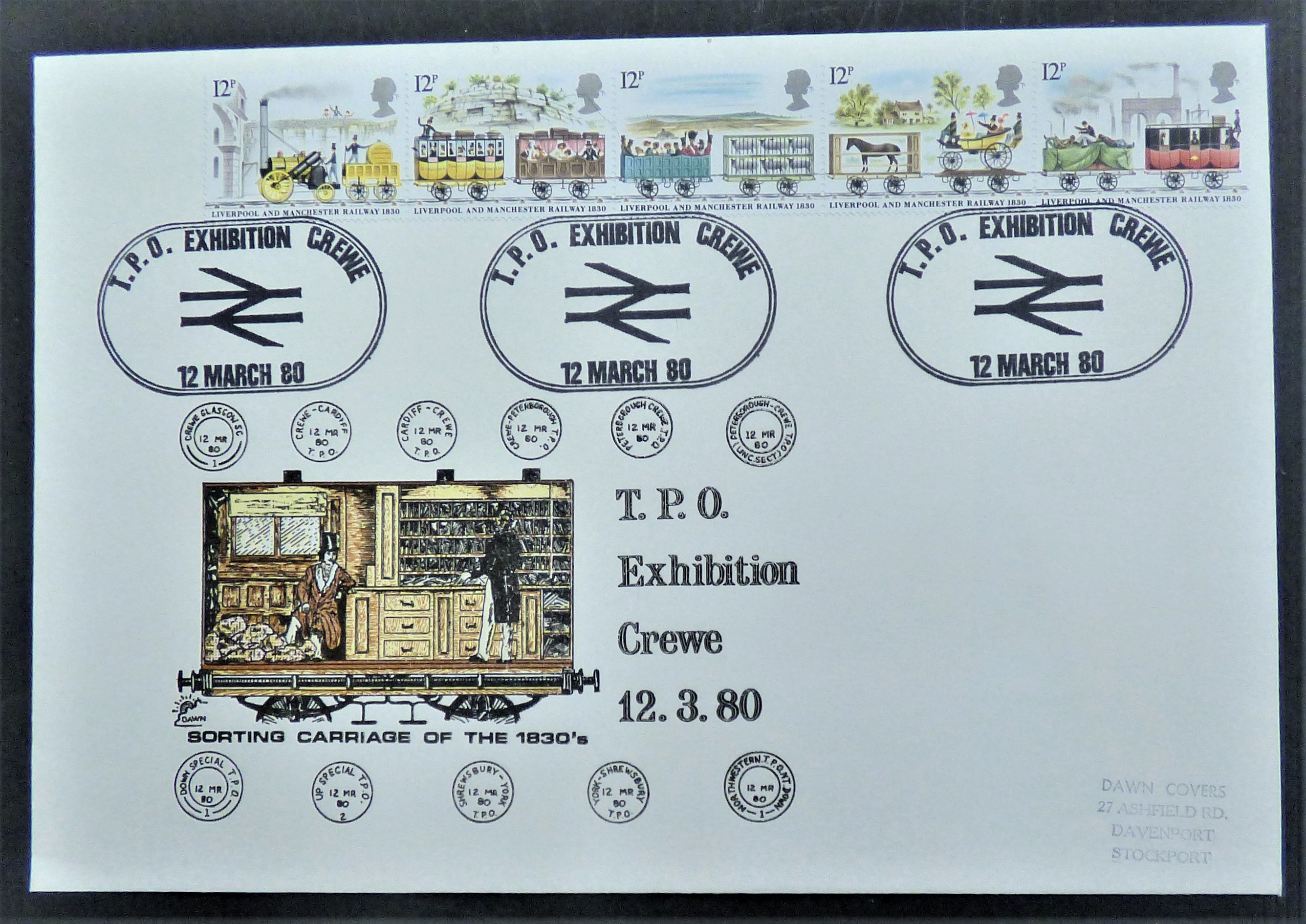
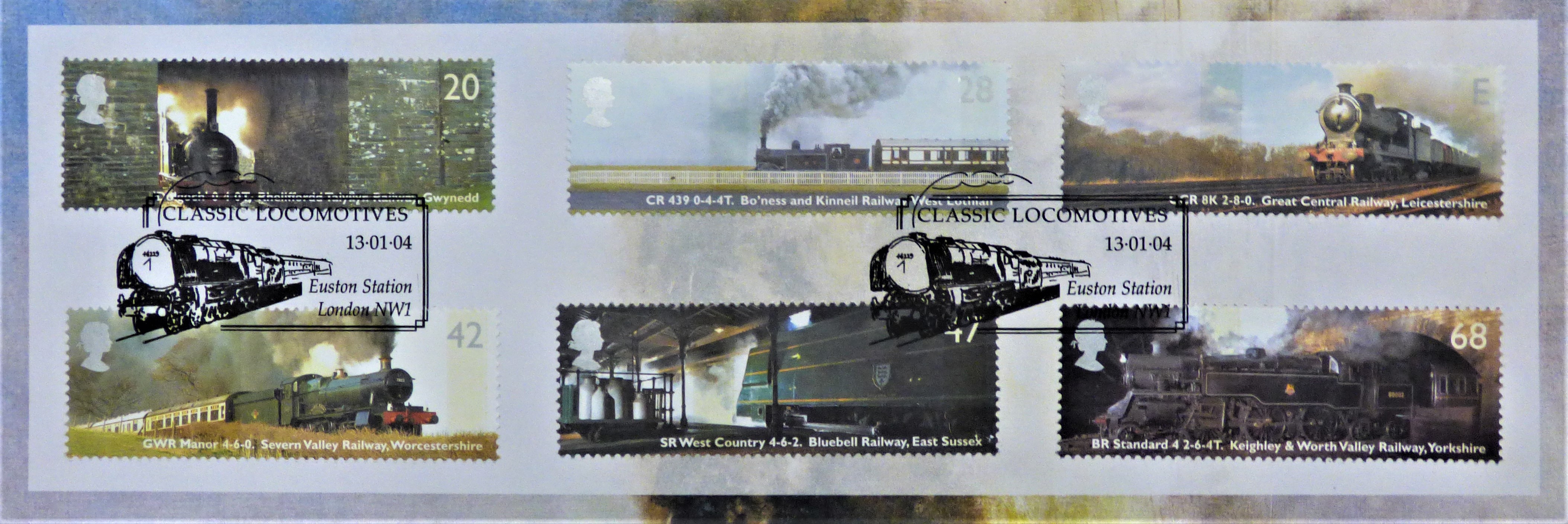
Lots 161-9 were sheets of railway stamps. Two of those lots had attracted my own attention, but I was outbid on them – professionally satisfying, while personally disappointing.
Lot 198 saw another bidding war, a starting price of £60 mushrooming to £200.
Lot 204 raised £65.
Lot 278 was a consolation prize after the railway stamps got away – my opening bid of £8 closed proceedings.
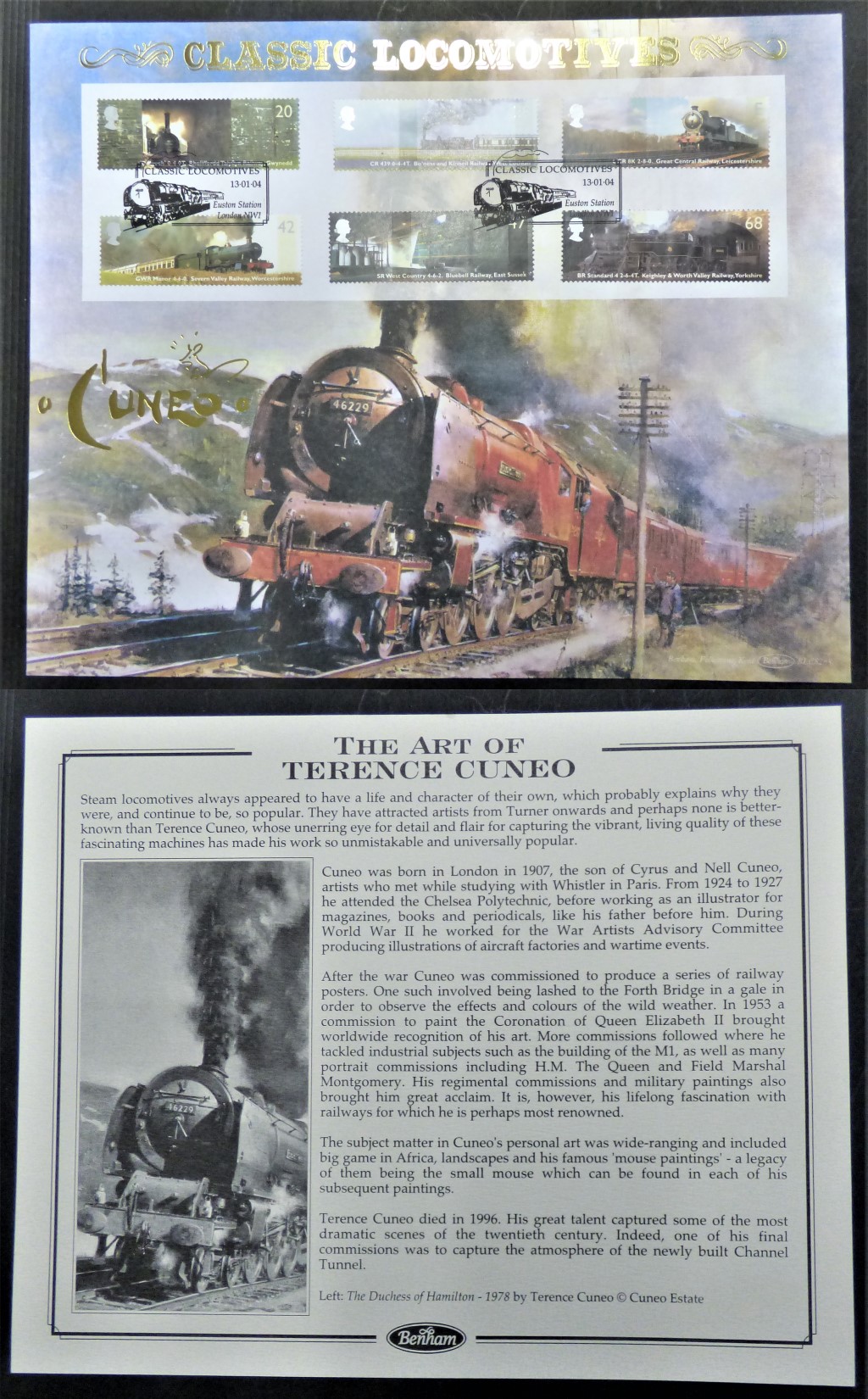
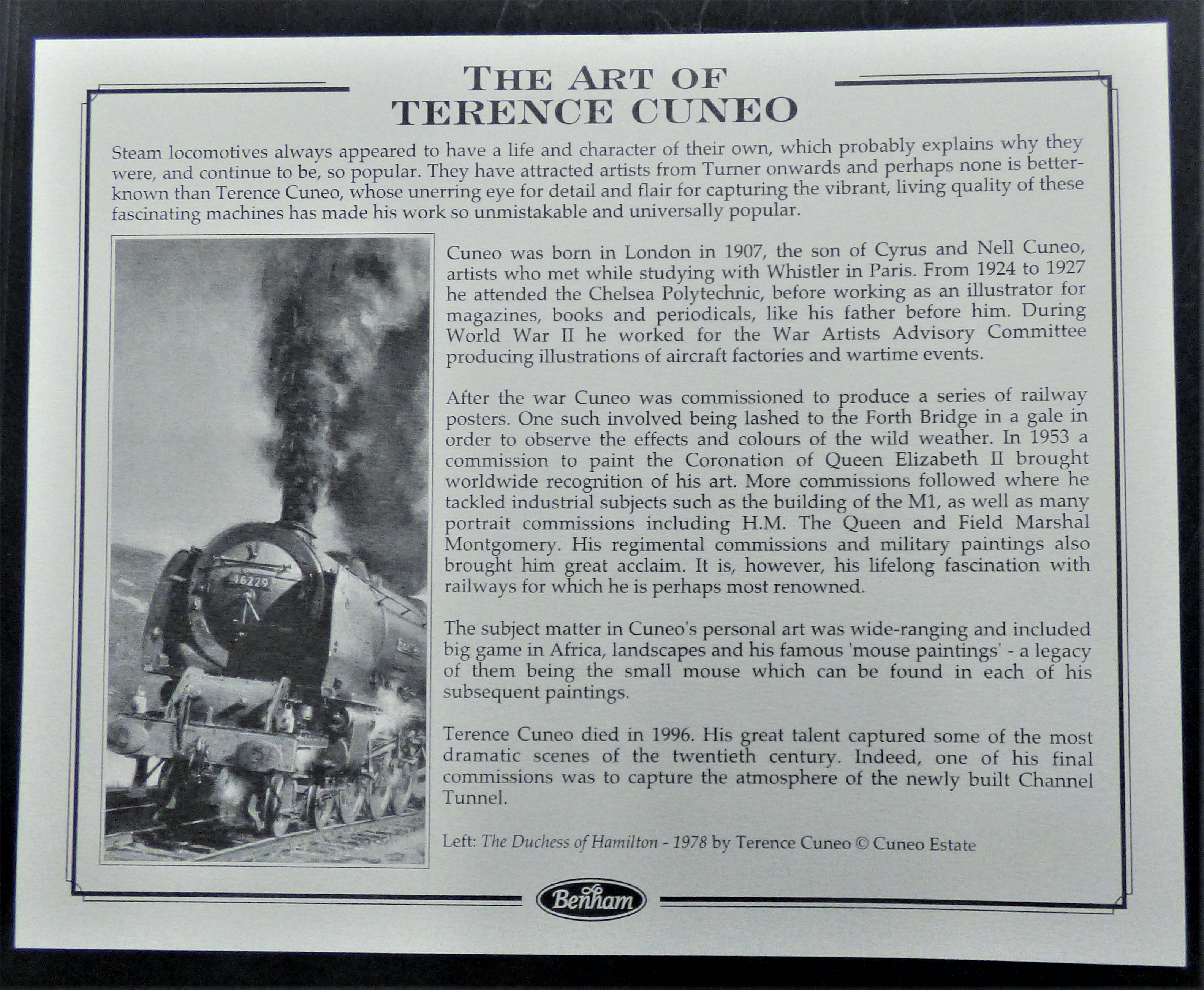
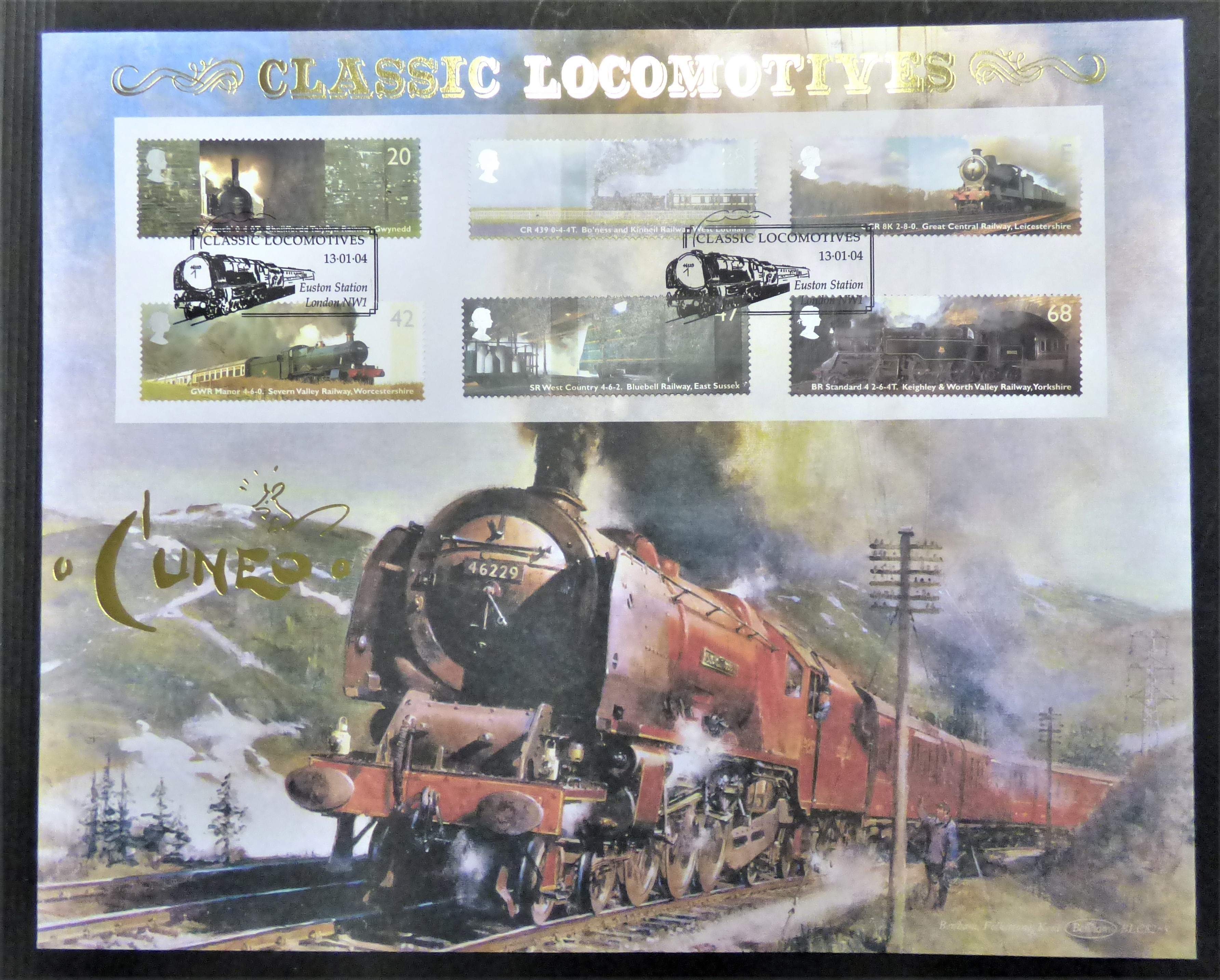
Lot 295 was another I might have been interested in, but the price went too high for me, not very surprisingly in view of Terence Cuneo’s status:
Lot 302 soared to £170.
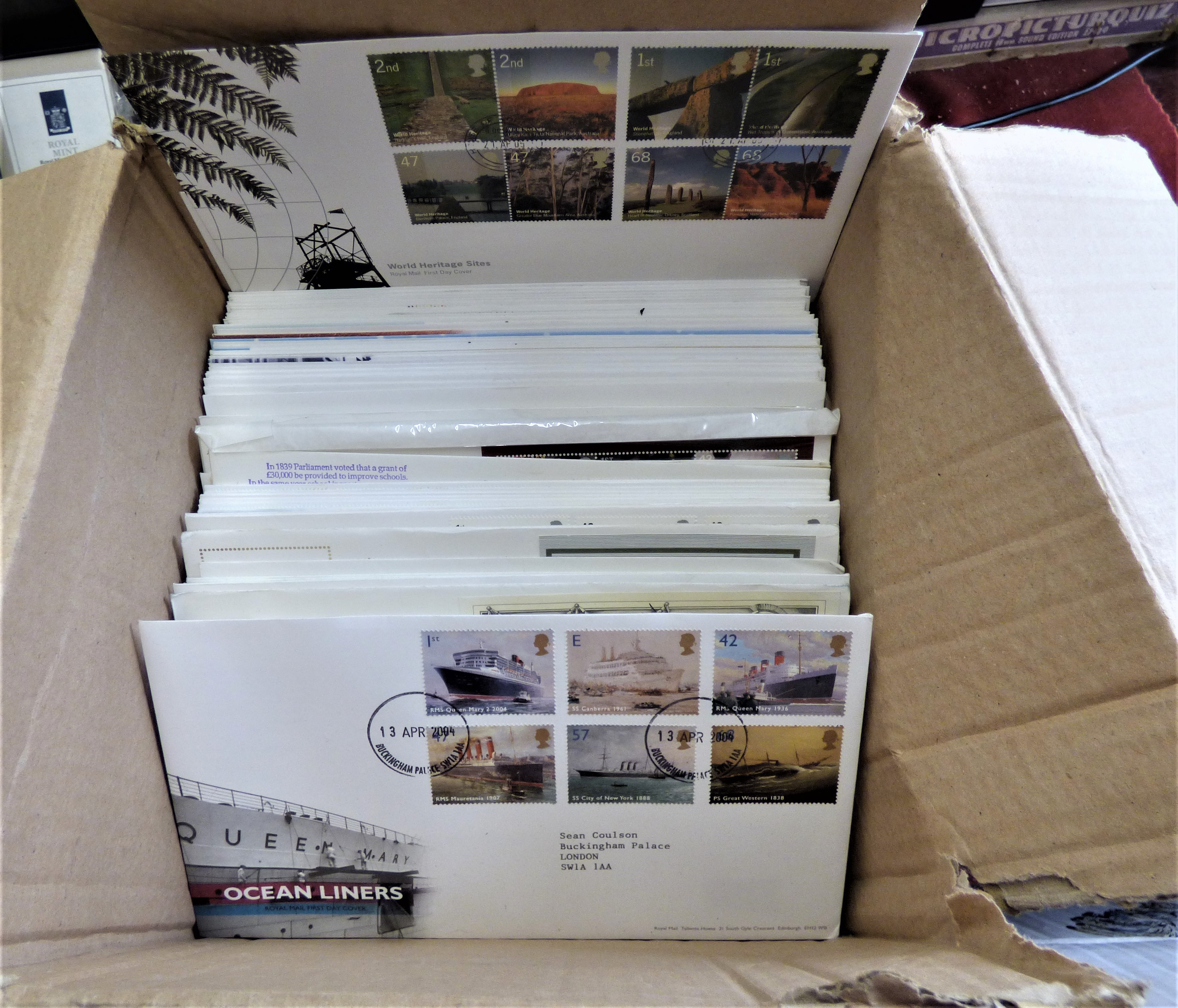
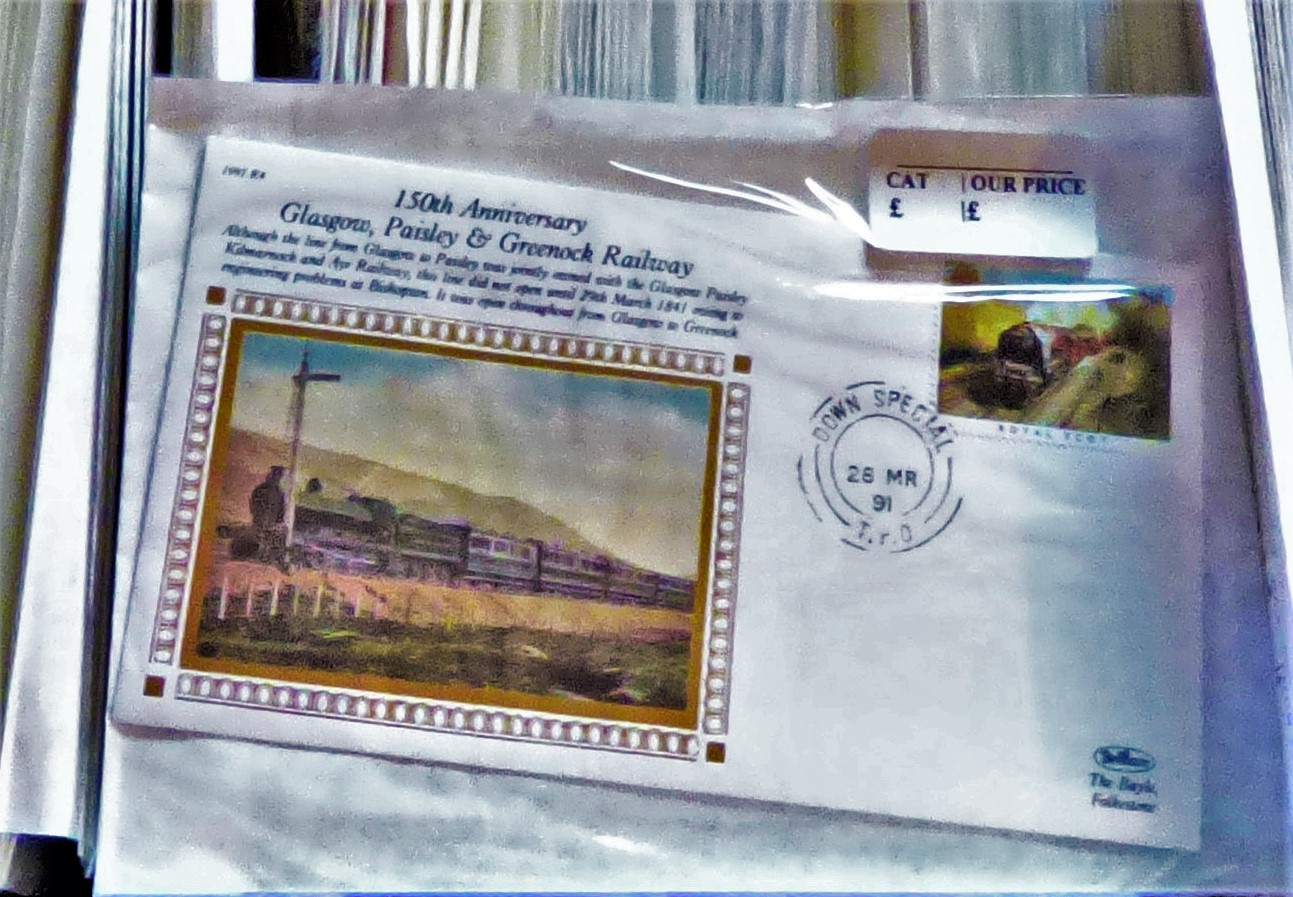
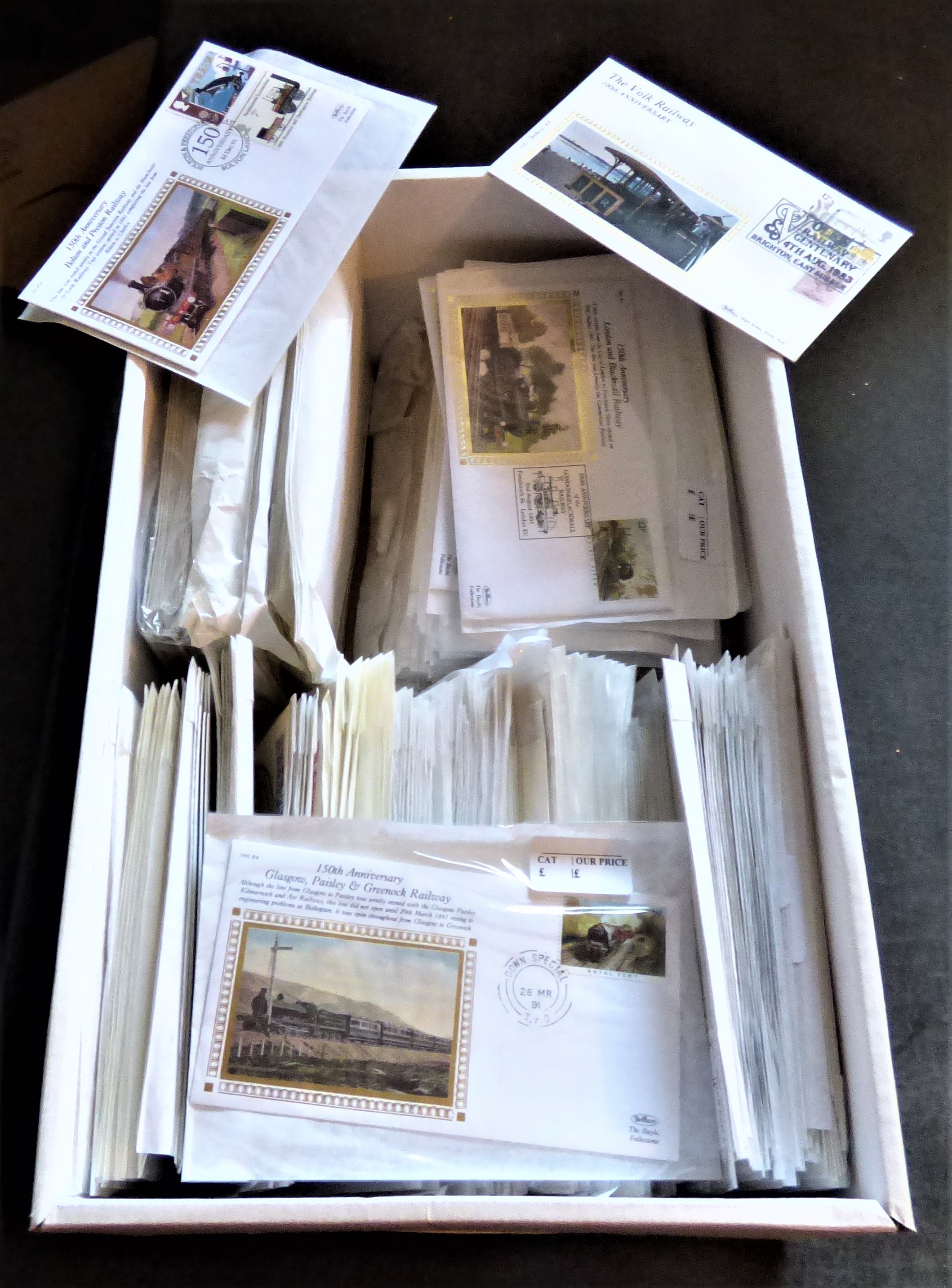
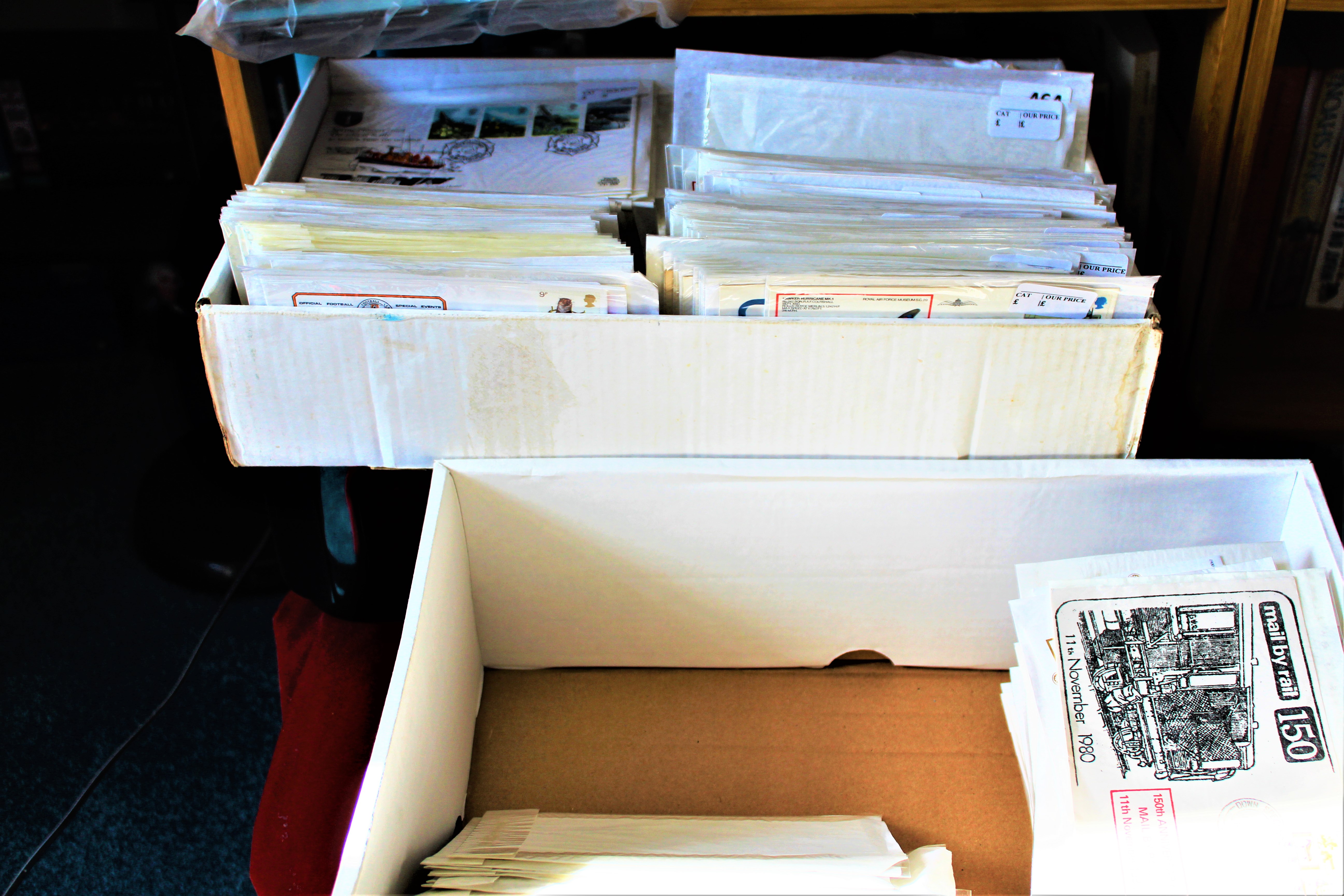
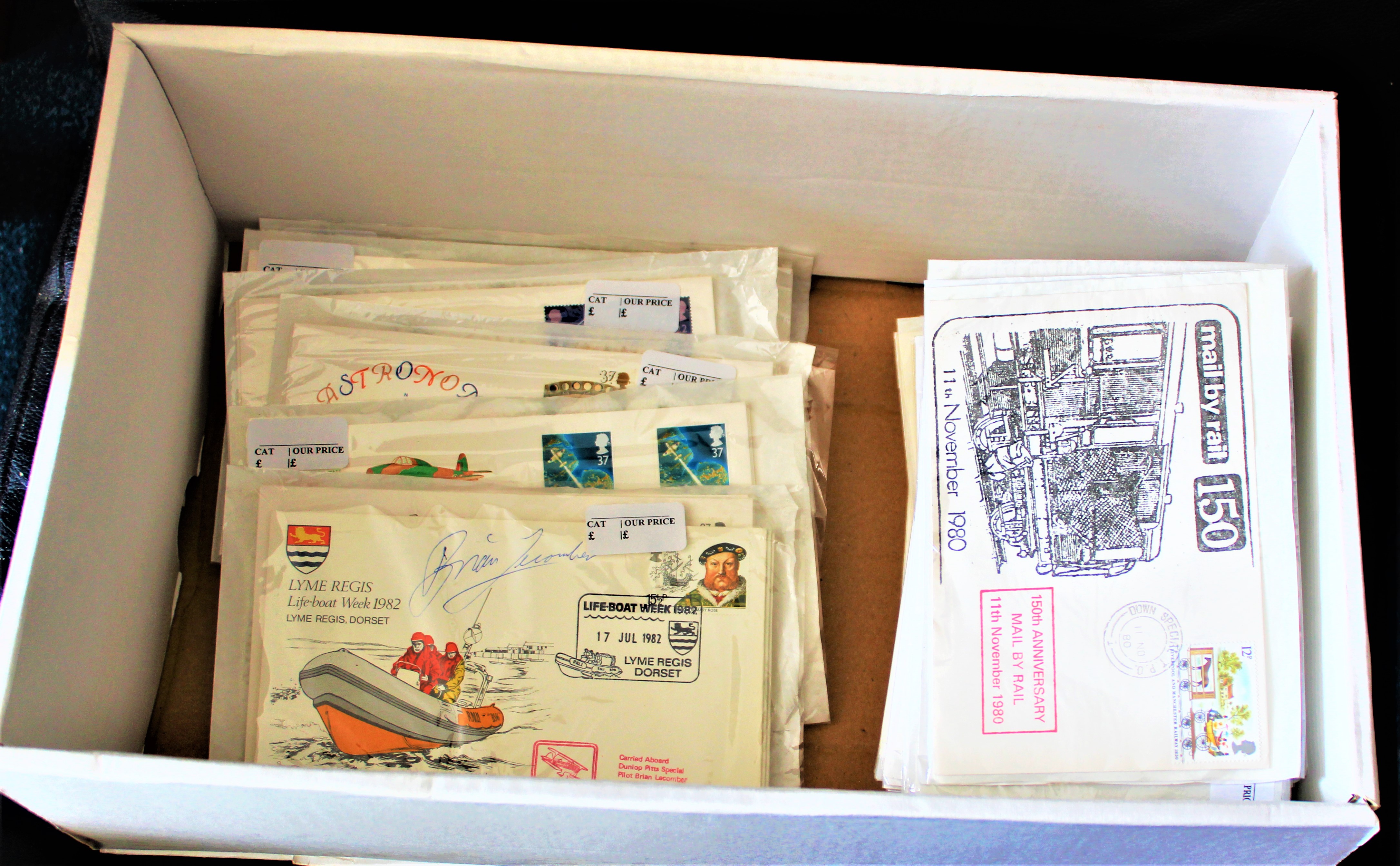
Lot 396 went to m5 for £55. If you are wondering about this price, which is more than I normally bid for a single lot, it was for a large box of FDCs which I knew to contain some quality railwayana and I was expecting it to comfortably pay for itself – I would select the stuff I wished to keep and would sell the rest. I have already split this lot into the stuff I intend to keep for myself and the stuff I wish to sell. The stuff I will be looking to sell includes some football FDCs and some military FDCs as well as some other stuff.
Here are some pictures showing the division of this lot as it stands currently…
The lid (at rear) contains the stuff I don’t want to keep, while the body of the box contains the stuff I am keeping.
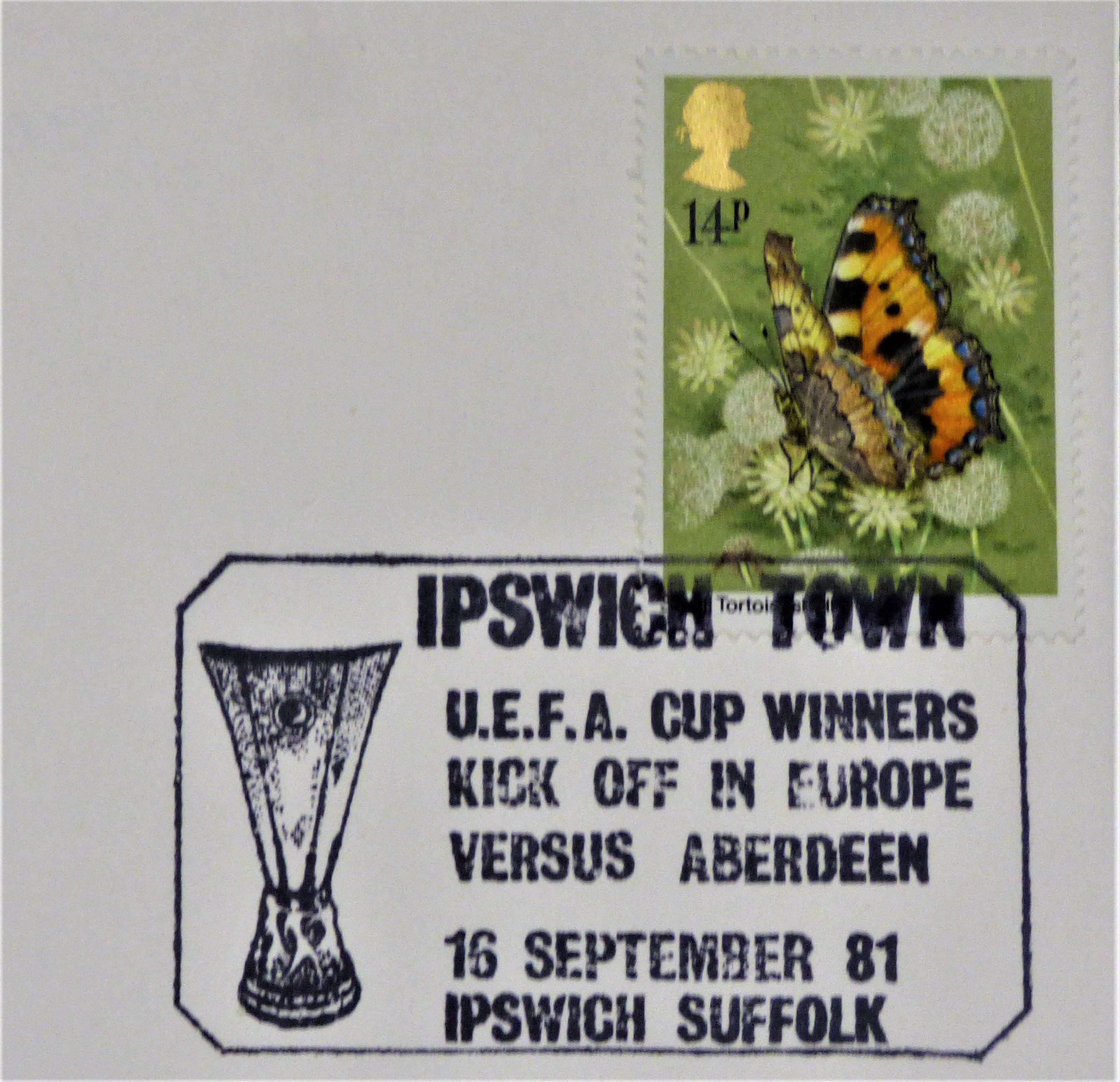
Lots 444 and 445 attracted plenty of bidders, going for £130 and £140 respectively, while lot 489 fetched £100. I have no images for these lots, but lot 462, which I snagged for £8 is below:
These images were taken at home yesterday evening.
The auction took almost five and a half hours (about half as long again as would be expected for a 500 lot auction), and I followed it from home via www.easyliveauction.com.
Resuming my coverage of my holiday to Guermsey and Alderney, setting the scene for what is to come in this series of posts.
I wasn’t entirely sure when I put the first post of this series about my holiday up as to when I would be able to post. There was no internet connection in Alderney, although I was able to edit plenty of photos ready for use. Yesterday we travelled back from Alderney to Guernsey, and then visited two places which both proved of huge interest, and left me with over 300 photos to edit to catch back up with that side of things. Between last night and this morning (I was underway before 7AM) I completed that job, meaning that at least until the end of today I am up to date in terms of photos. I am going to use the rest of this post to outline the rest of the series for you.
PLANNED POSTS
I will devote one post to the day we spent on Guernsey before we were able to travel across to Alderney.
The journey to Alderney will account for the next post.
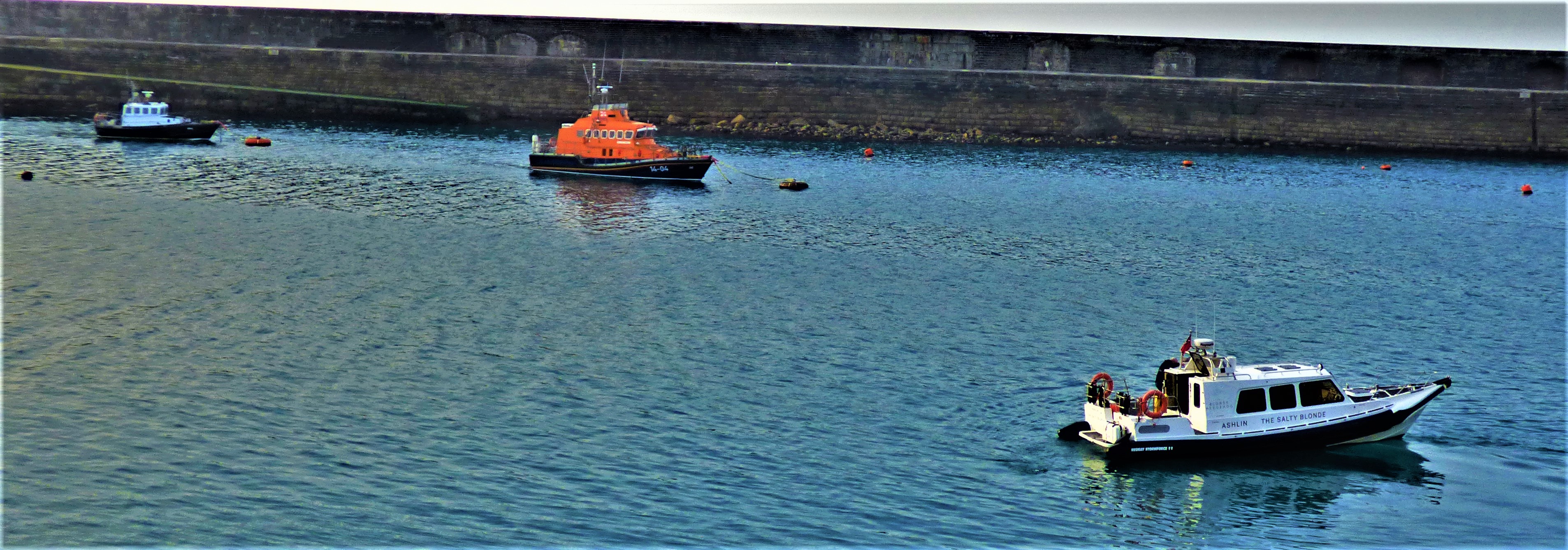
The Harbour at Braye, Alderney – the boat bottom right of shot is the one we travelled on from Guernsey to Alderney.
I will produce several posts about Alderney:
A cricket themed post in honour of John Arlott who spent his last years on Alderney – this will take the form of a two-fold journey, through a large amount of space and centuries in time as I cover cricketing links relating to my journey (two of them highly contrived, I admit), creating a spectacular XI in the process.
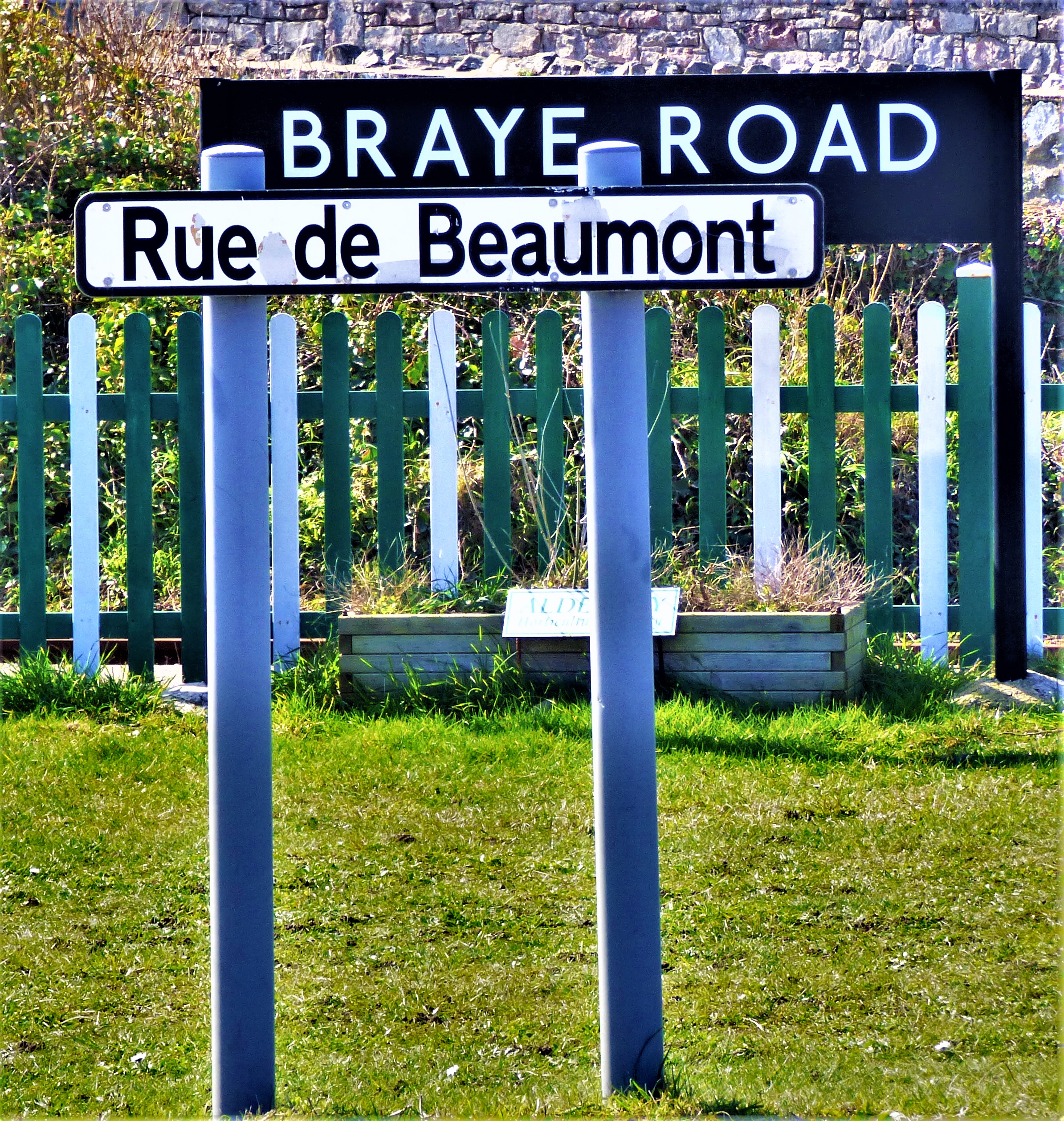
Students of the game will instantly realise how the road sign in this picture enabled me to sneakily fill one of the opener’s slots -the other was already filled fair and square.
A post about our first visit to St Anne, the sole town on the island.
Probably two posts about the walk we did on our second full day on the island.
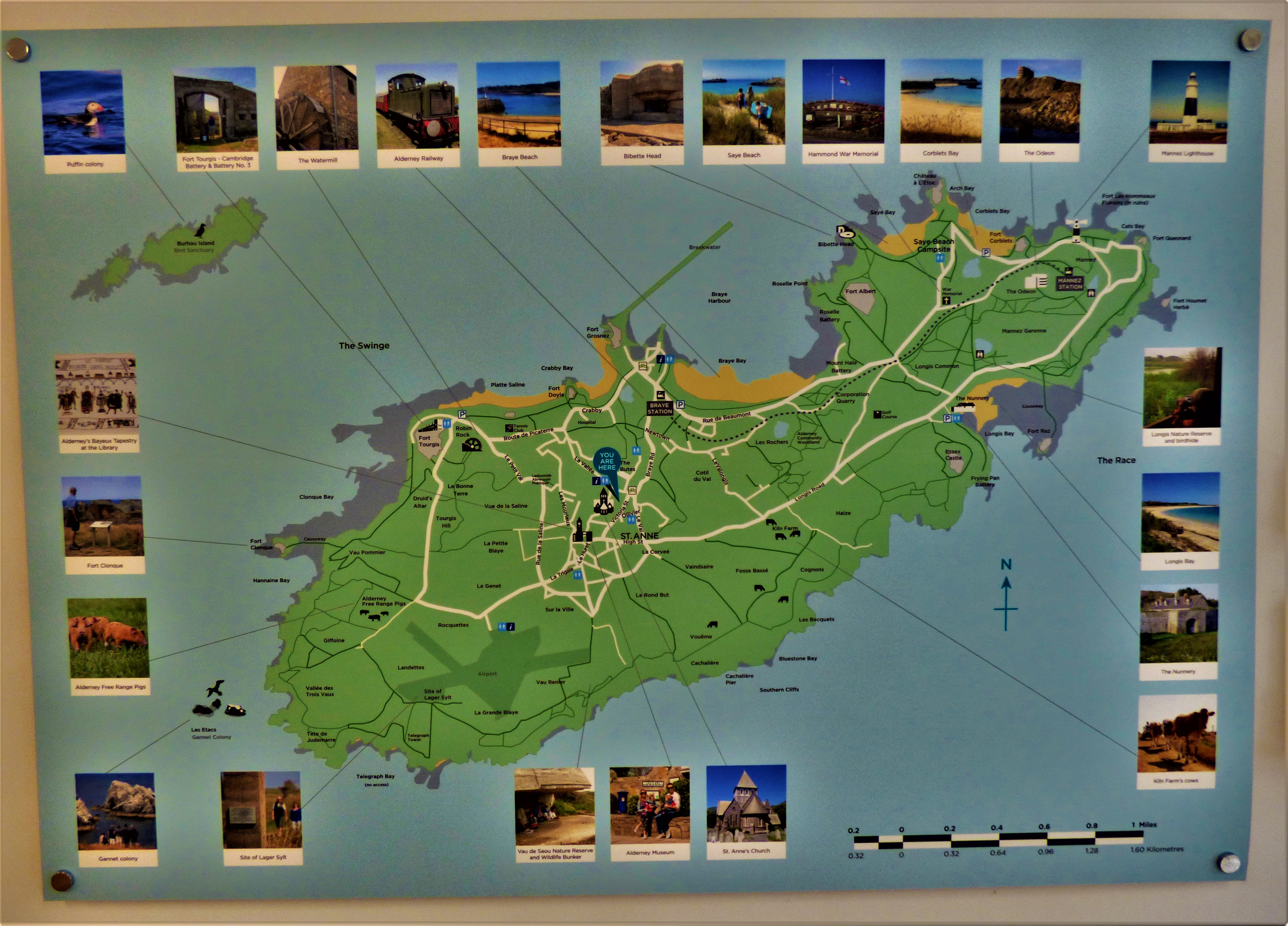
A special post featuring maps of Alderney and the Channel Islands, several great examples of which I saw:
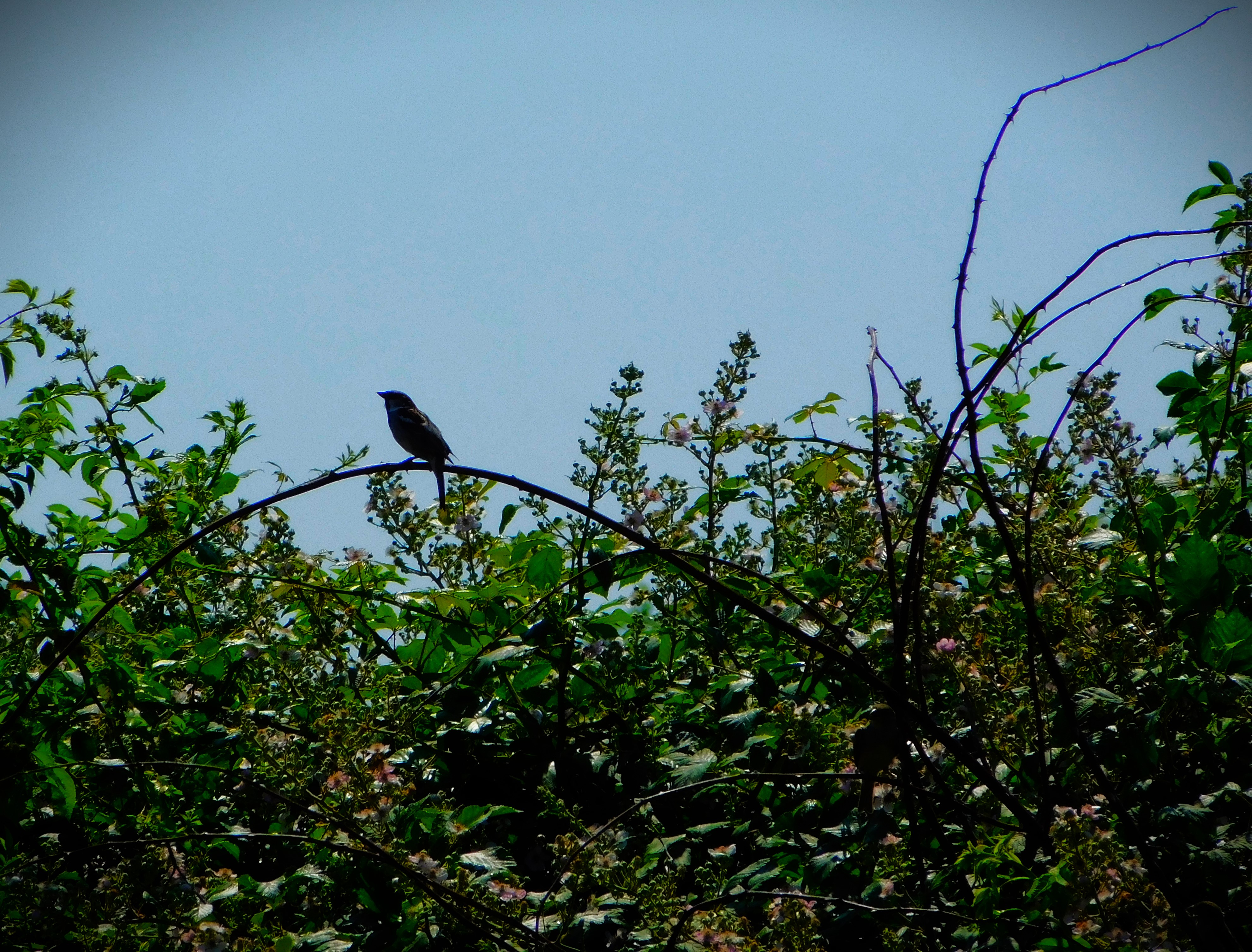
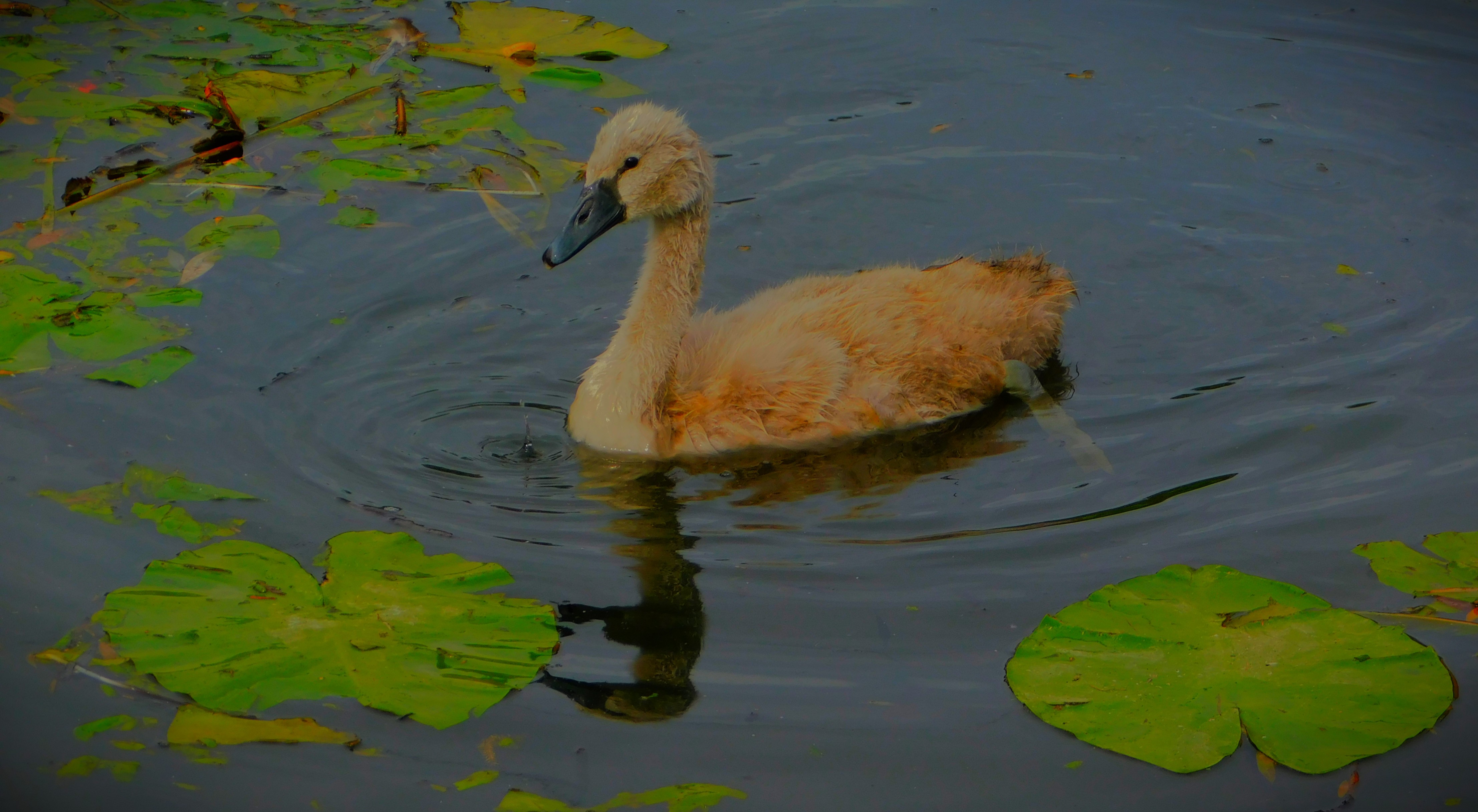
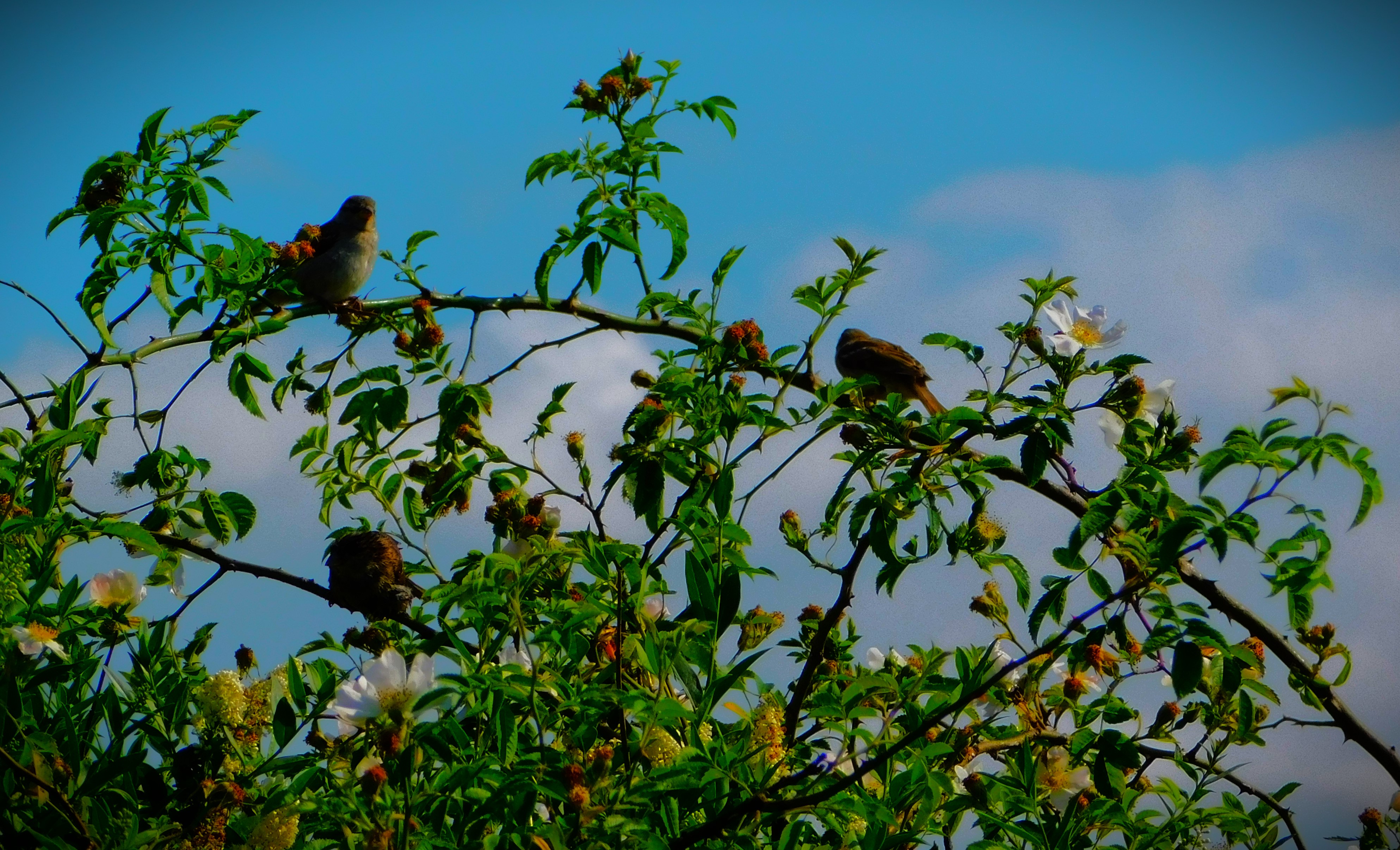
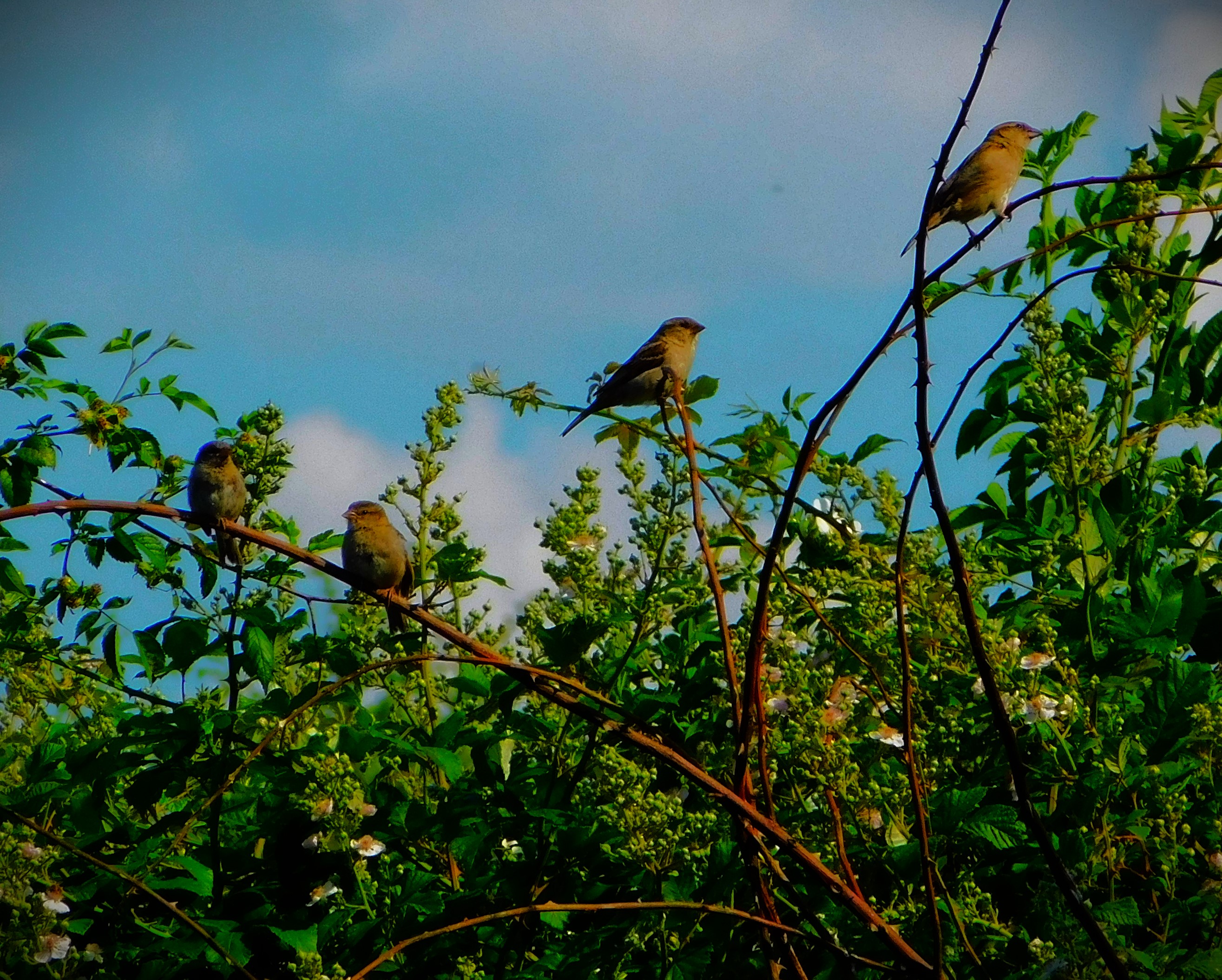
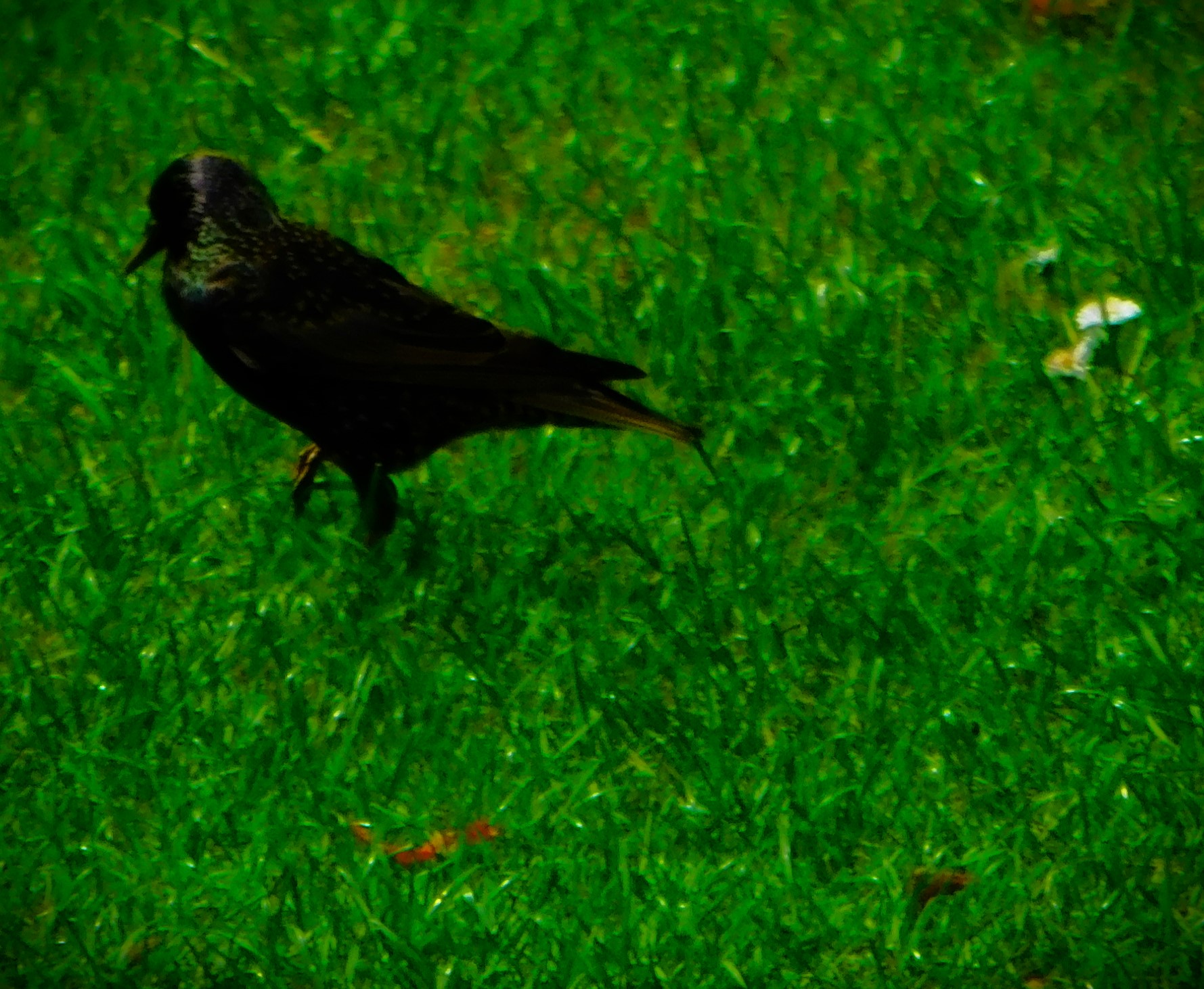
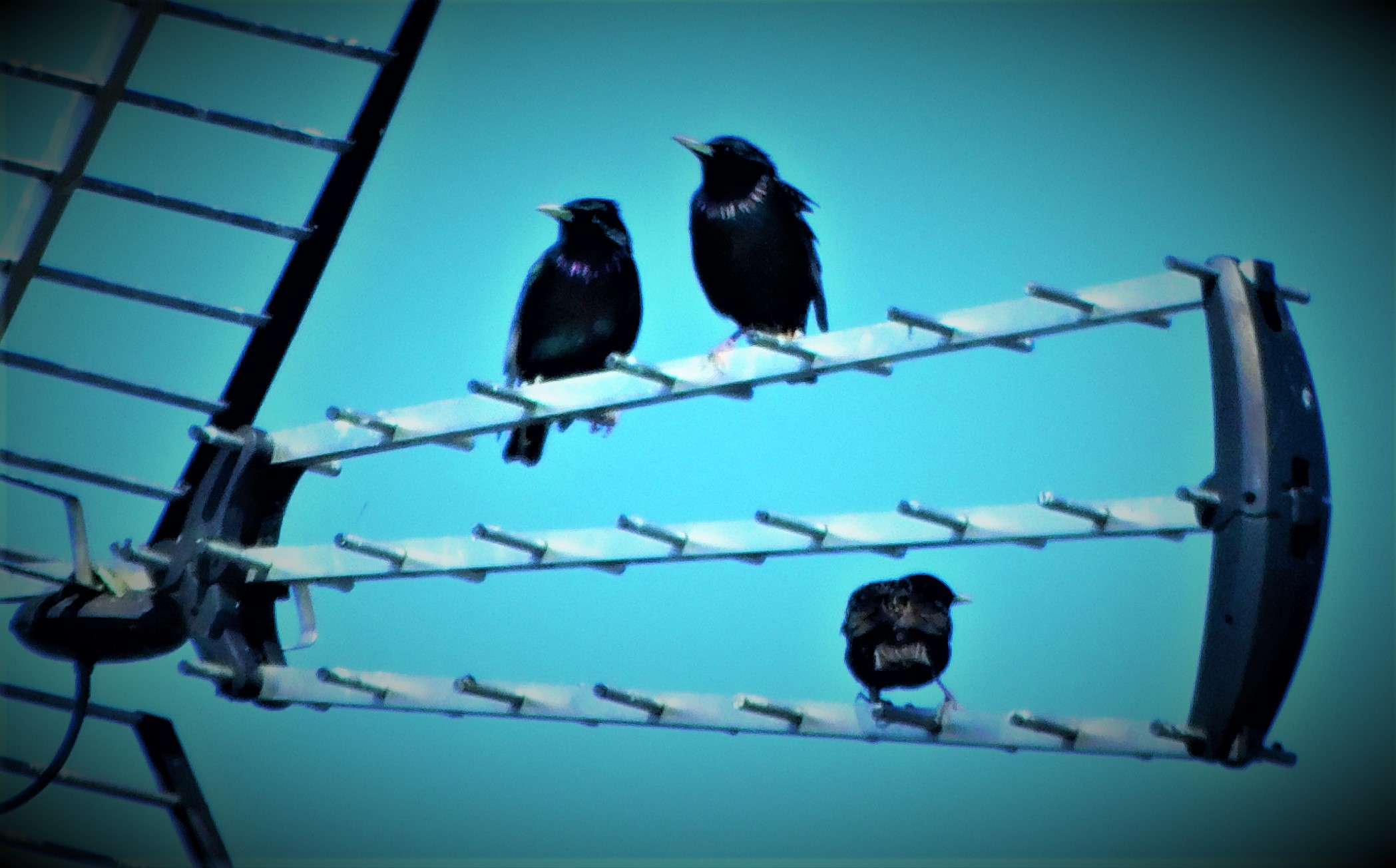
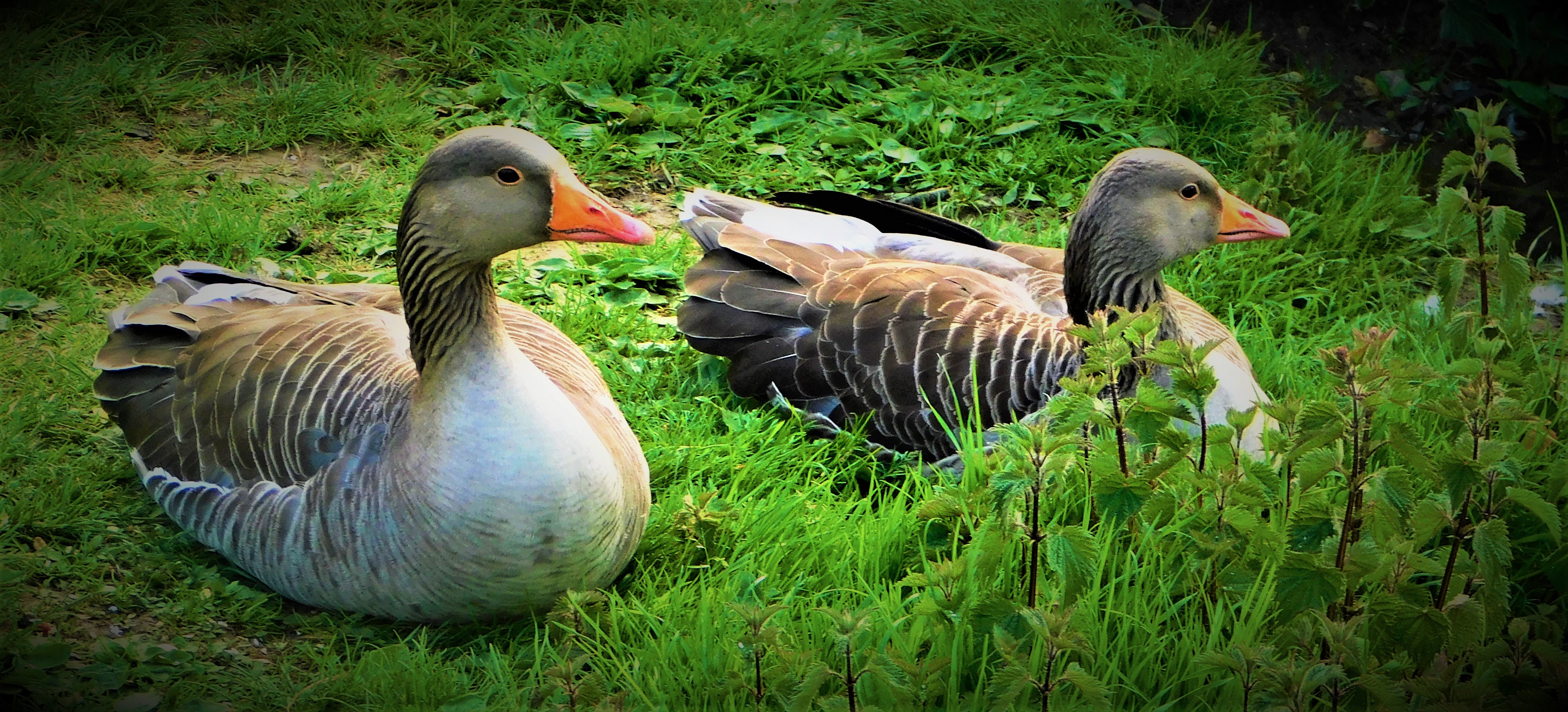
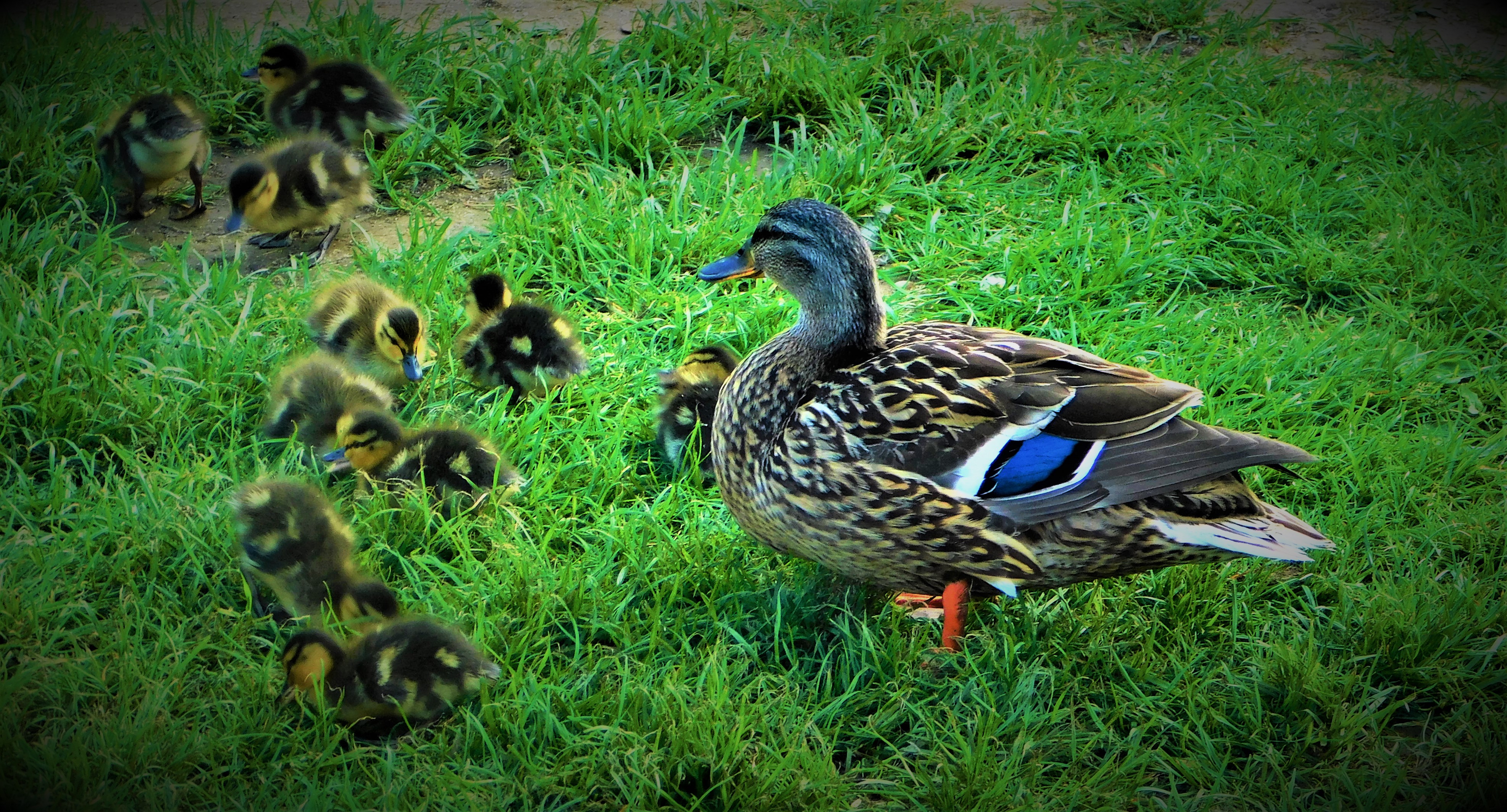
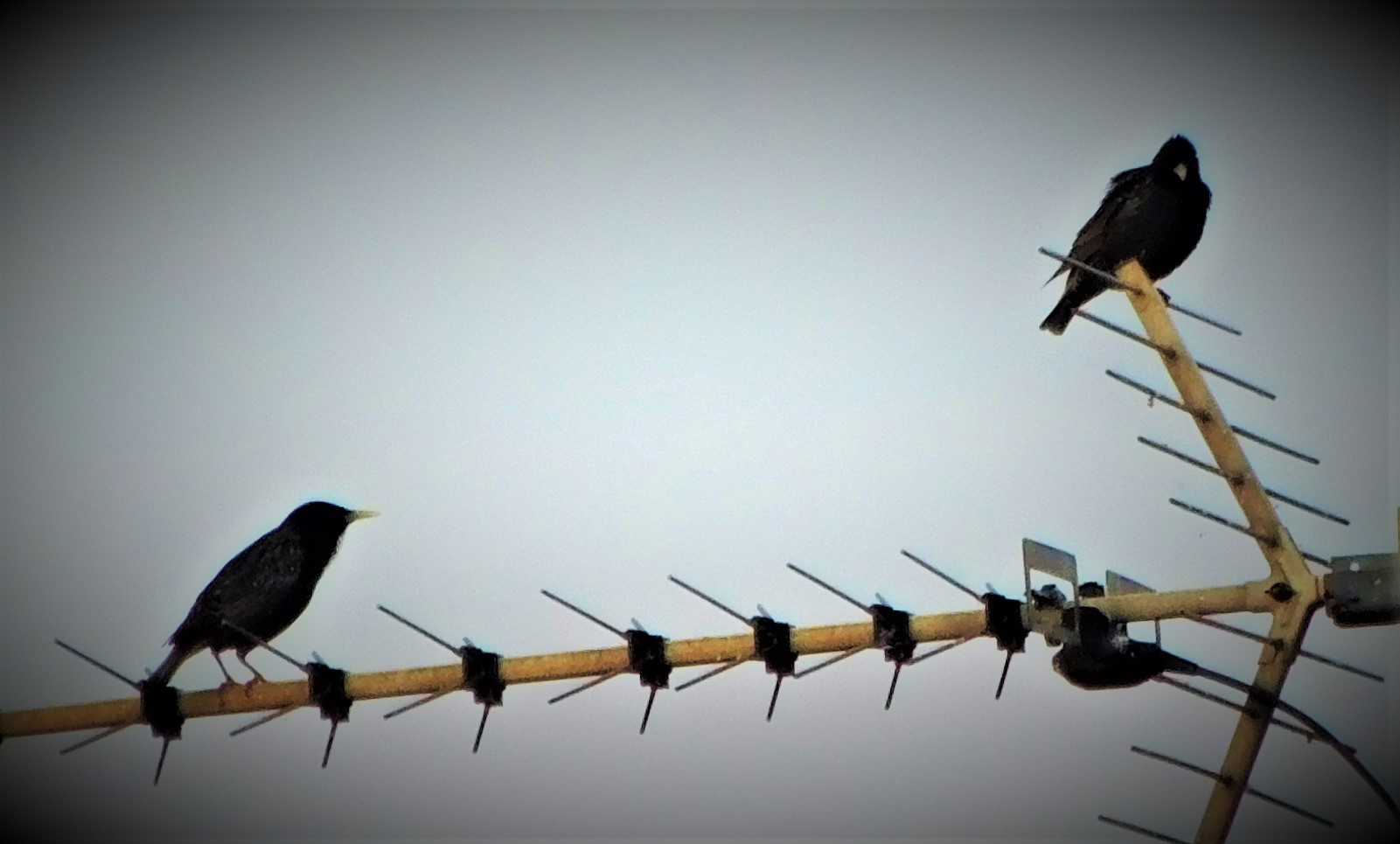
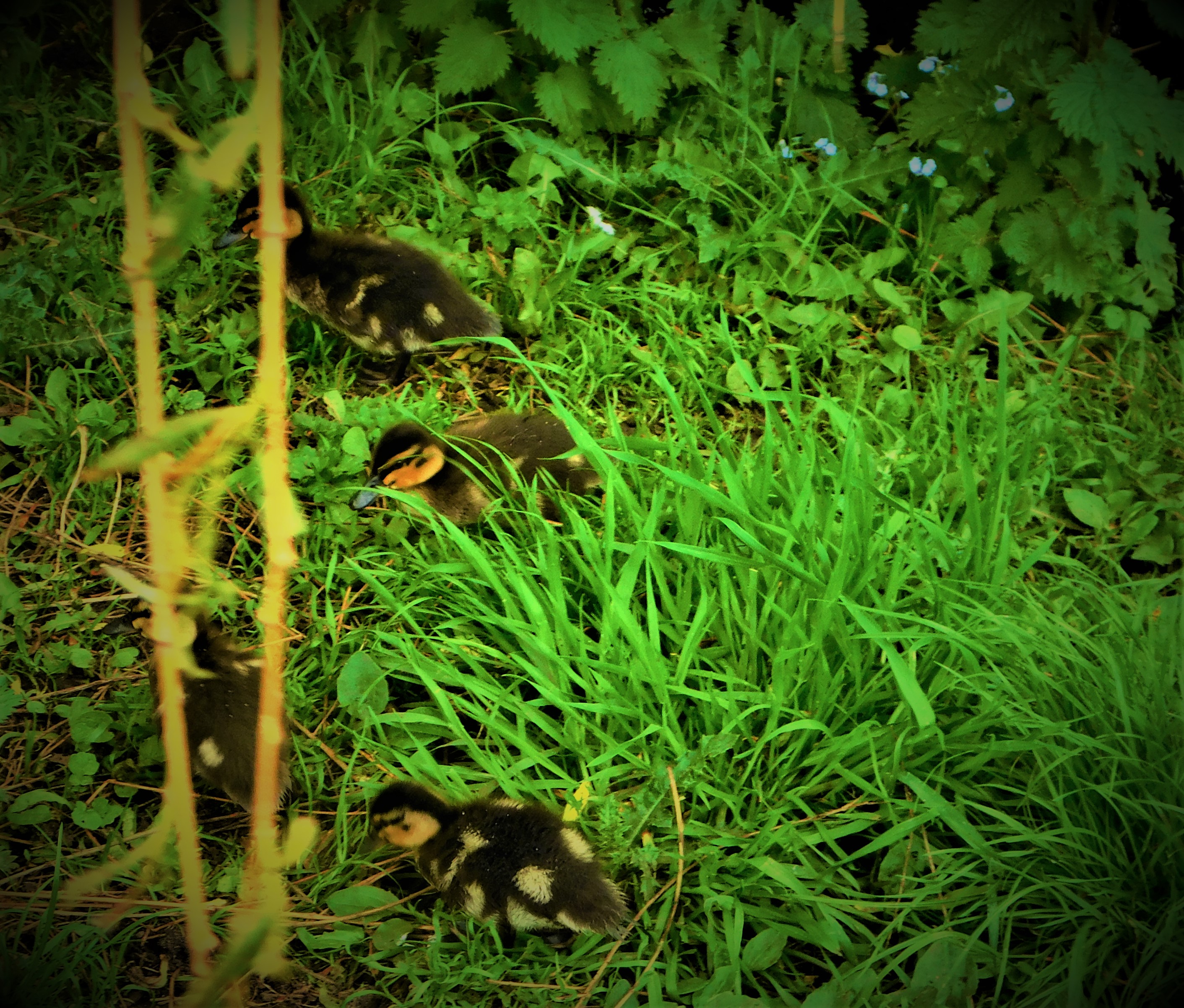
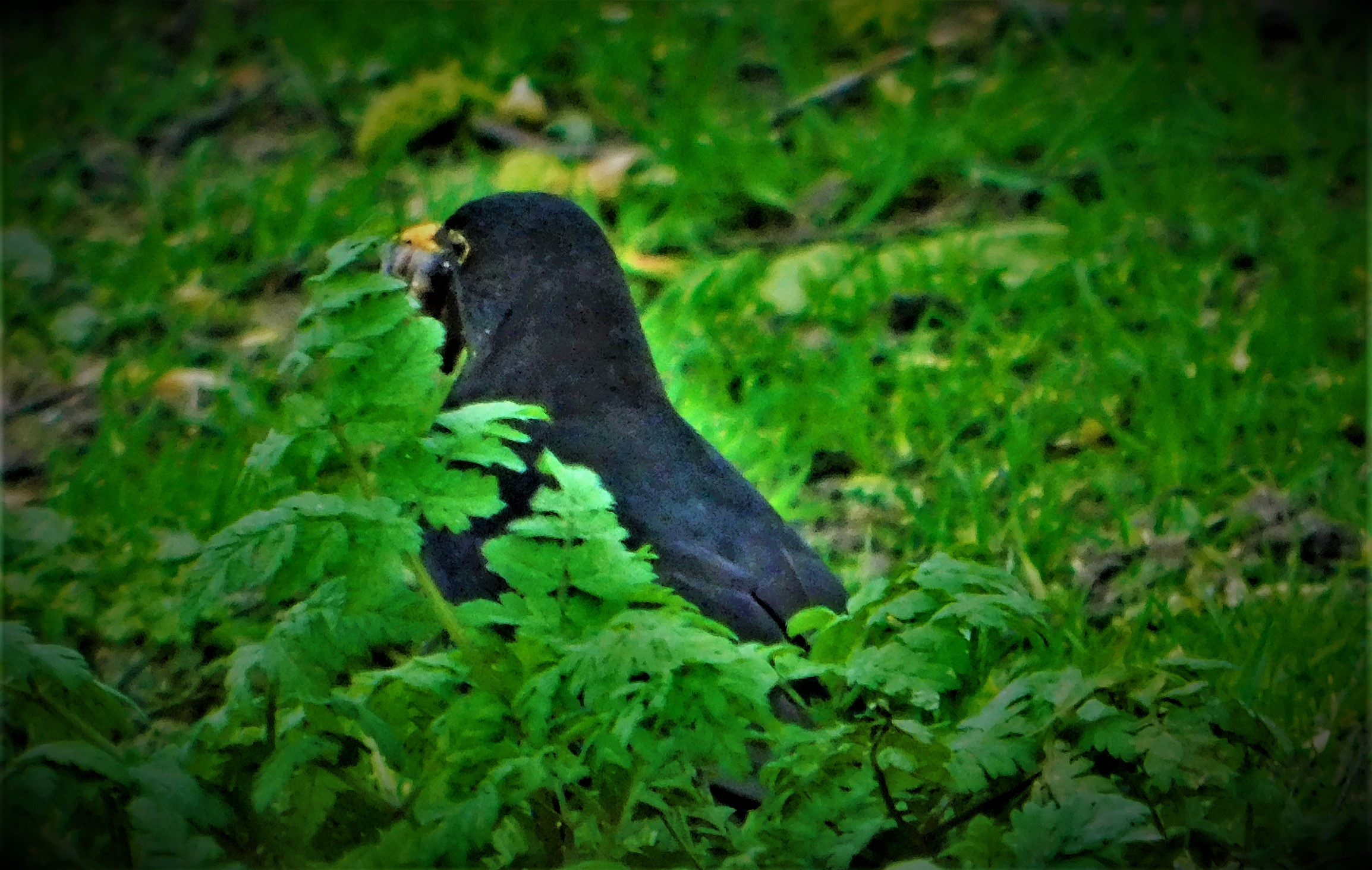
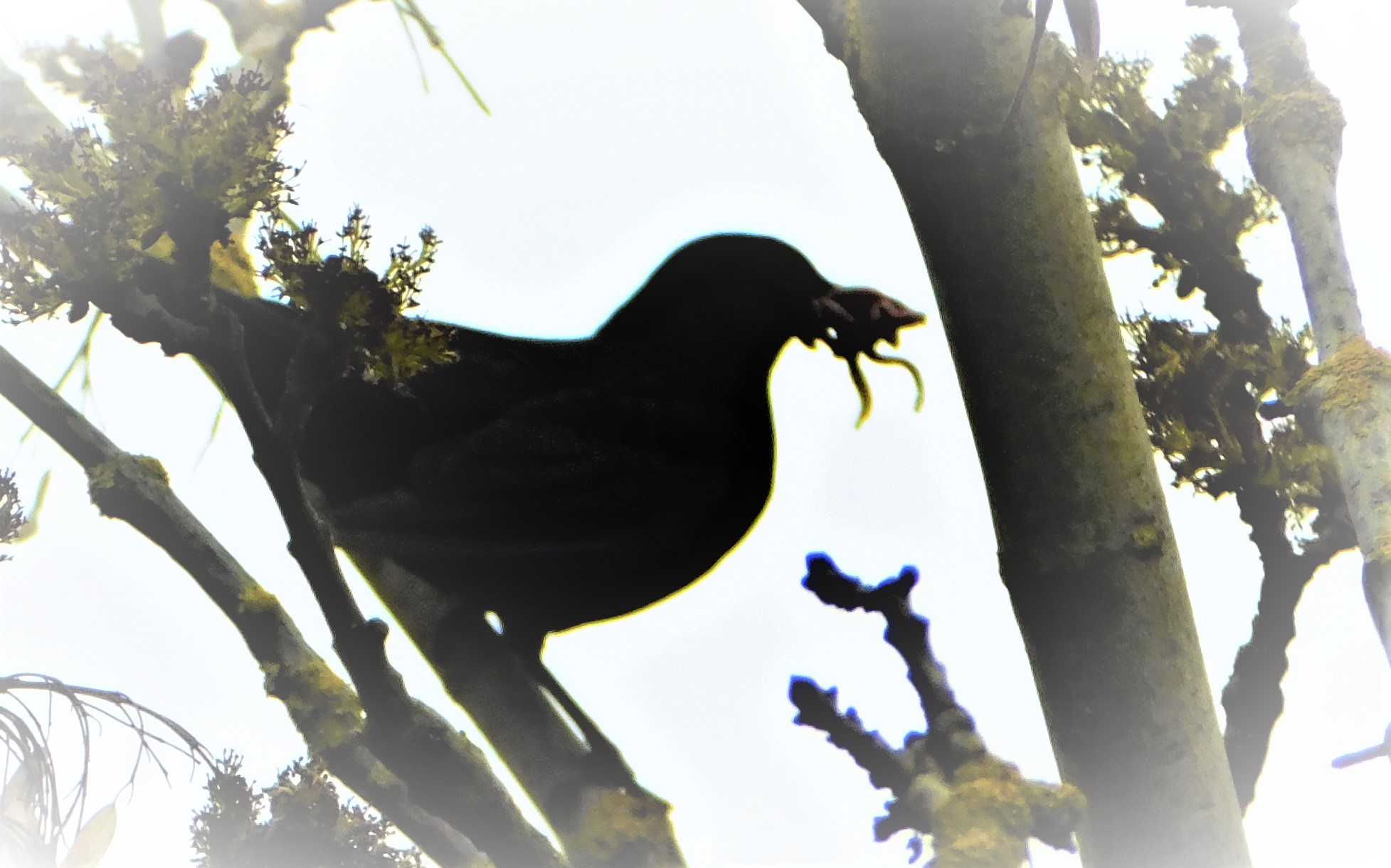
A special post dedicated to the birds of Alderney, of which I saw some fine specimens.
A post about the return journey to Guernsey.
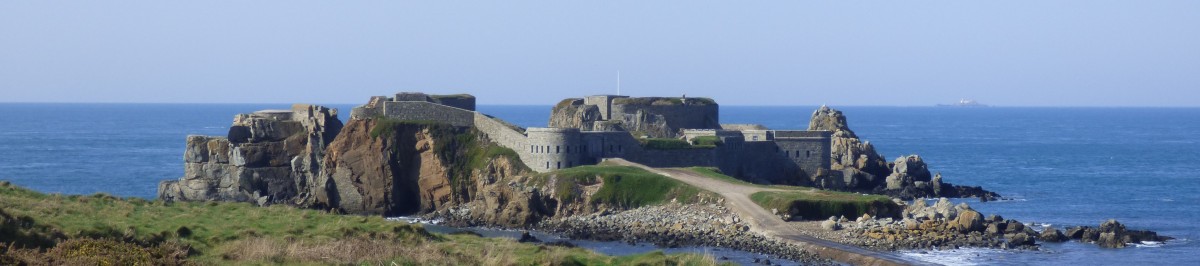
Every post relating to Alderney will feature a view of Fort Clonque, where we stayed.
A view of the fort taken from the far end of the causeway that links it to the rest of the island.
Events since arriving back on Guernsey warrant at least three posts already:
A post about the Little Chapel.
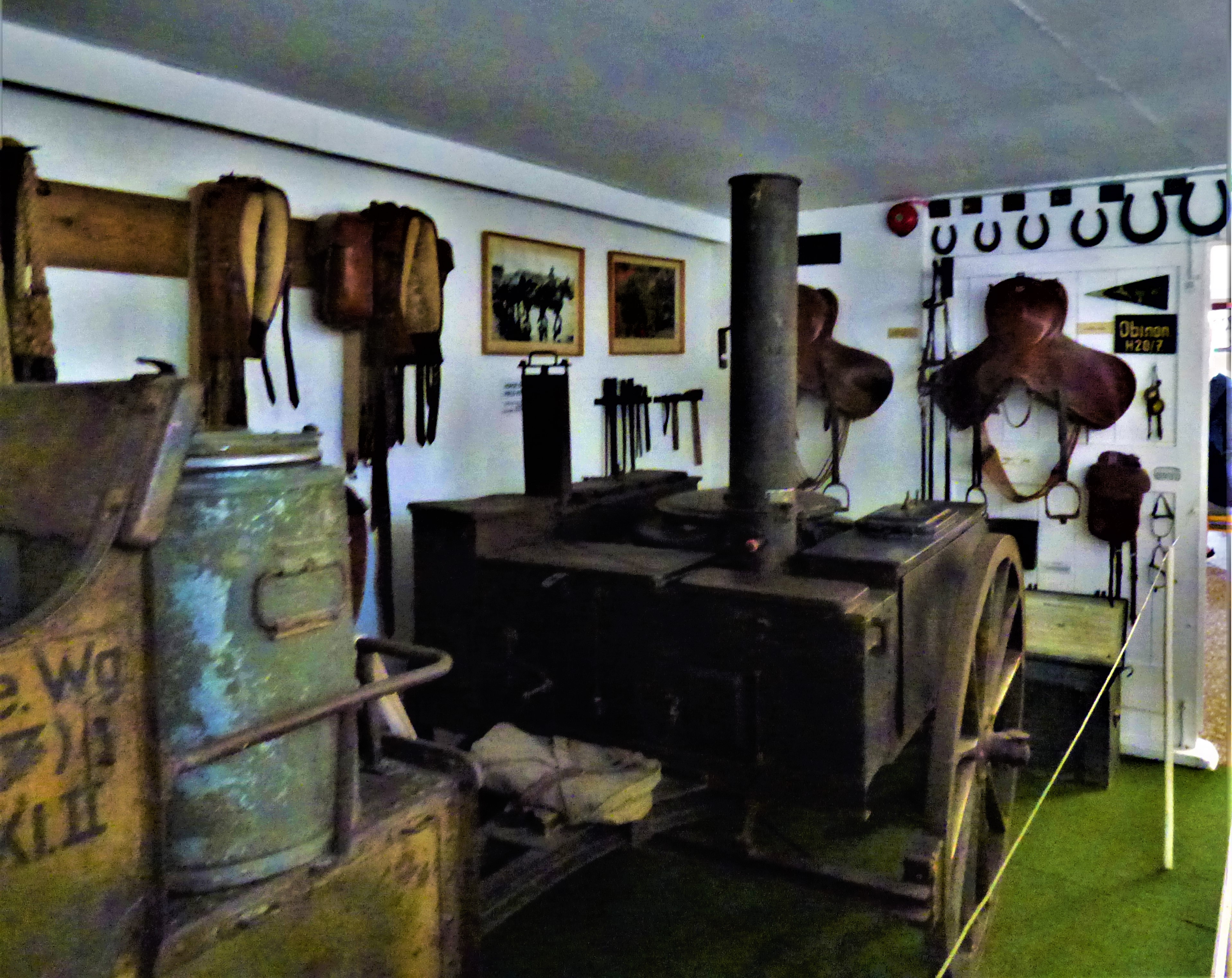
Two posts minimum about the Occupation Museum (Guernsey was occupied by the Germans from 1940-5).
I have no doubt that today’s events will be worth at least one further post, and then there is the return journey.





















































































































































































































































































































































































































 aspiblog