The story of a failed pair of spectacles, plus a few other bits.
INTRODUCTION
This post covers the new glasses in the title, a day at the races and a new badge.
THE GLASSES
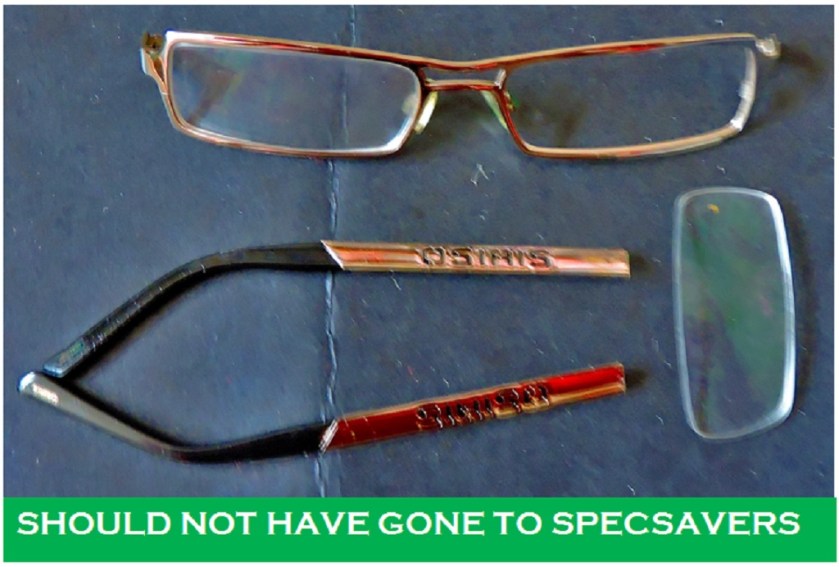
This is a story that spans some months. First one arm came off the frame (and as the picture at the end of this section will show, refixing it properly was an impossibility). Then the second arm detached itself in the same way. I visited the Eye Man, an independent optician in Fakenham, to see what he could do, and as a proper repair job was impossible he did a band-aid job for which he did not charge.
That band-aid job then ceased to function properly, so eight days ago I obtained my prescription from Specsavers and took it to the Eye Man to have a new pair made. The Eye Man had an unexpected delay receiving a delivery, so it was only yesterday that I was able to pick up the new glasses, which by the way are a great success. In the mean time, the old frame developed one final problem at the tail-end of its working life – the frame had slightly warped, so that the left lens was no longer tightly held – and fell out several times.
I conclude this section with a picture of the defunct pair of glasses…
A DAY AT THE RACES
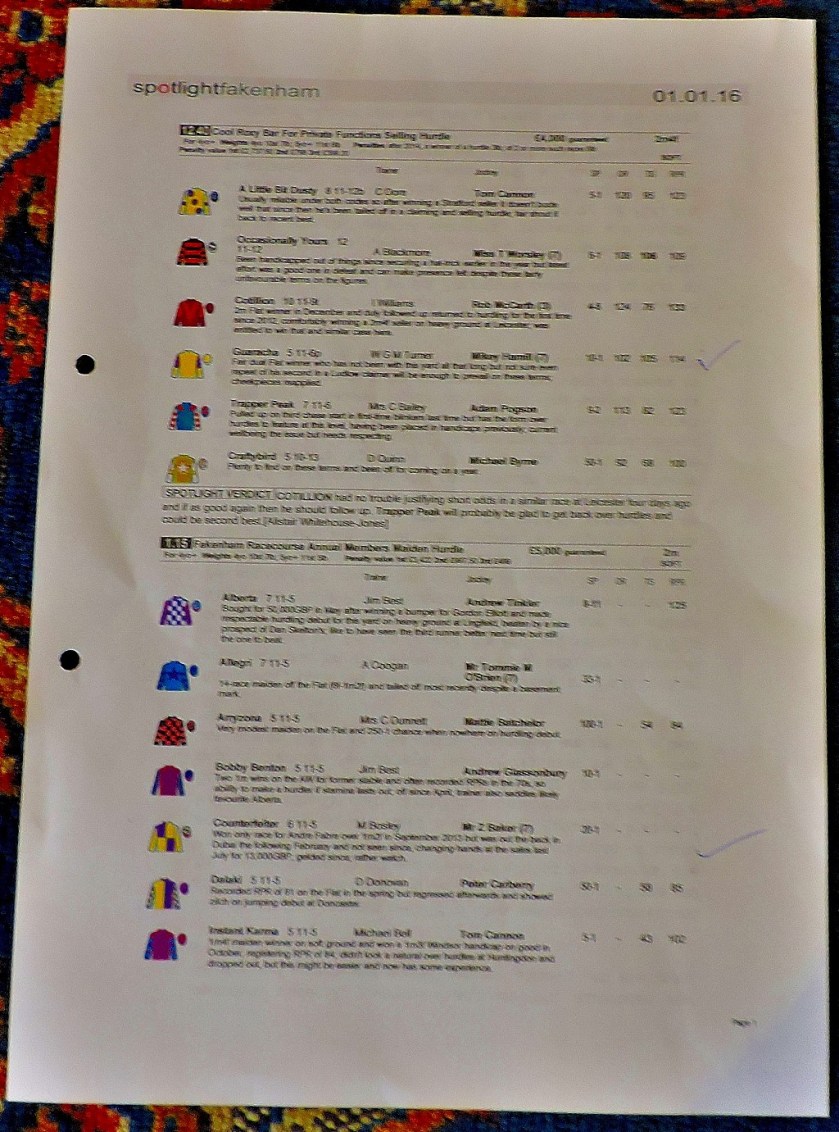
New Year’s Day was a race-day at Fakenham. I was staying at East Rudham, there being no buses, and attended along with several other family members. My mother had two huge wins, which between them left her some £200 in credit for the day (even though she paid for day memberships for all five of us), and all of us save one had a win somewhere along the way. I have some pictures from the day…
The Prince of Wales Suite (rather more crowded than for a James & Sons auction) and Tote tower.A packed house in the grandstand (we were watching from the other side of the course, having crossed early to save a bit of time getting out)Fakenham church tower in the distance.
That evening my nephew set off some sparklers in the courtyard…
THE BADGE
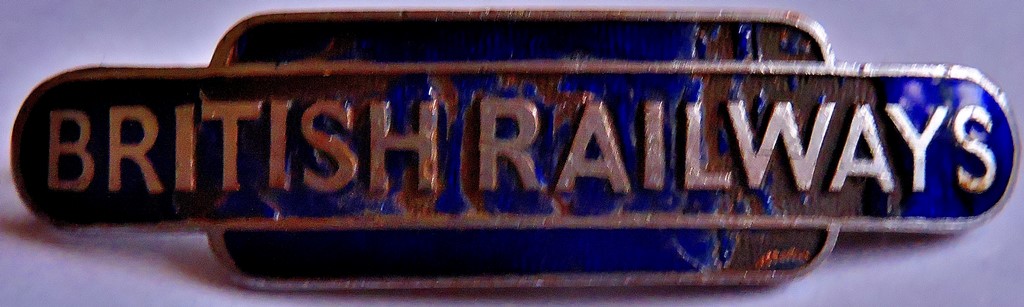
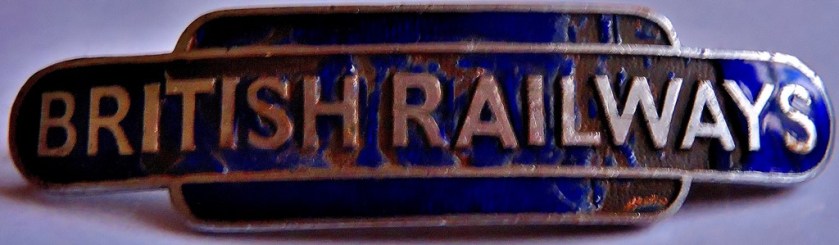
Yesterday was my first day at work in 2016, and a colleague gave me an old badge (I had earlier given him one of my calendars) which he had got hold of. As a public transport user and proud supporter of Bring Back British RailI was delighted with this…
Links to information about a wonderful idea concerning London transport put forward by Sian Berry and to a campaign being run by Which?
INTRODUCTION
I have today seen two public transport related items that I wish to share, one of which I have already pressed on to my Londontransport related website. I have also tweeted about both items.
SIAN’S SUPERB SUGGESTION
The Sian of this heading is Green Party candidate for London Mayor Sian Berry. The suggestion that I am so enthused by is that the entire area covered by London Transport should be a single fare zone, so that people who work in London but cannot afford premium property prices near the centre do not also get hit by higher fares. For more details I have two links for you:
Just a brief piece here pointing you in the direction of the Which? campaign to make it easier for customers who have been let down by rail companies to secure refunds (I still remember how much work I had to do when claiming a refund from Midland Mainline 12 years ago, which was so clear a case that they actually gave me more in compensation than I had asked for). To find out more, and hopefully sign up to this important campaign please follow the link below:
An account of how I gained deserved compensation from Stagecoach for unacceptable delays to their X8 service between King’s Lynn and Fakenham
INTRODUCTION
This post is mainly taklen up with an email exchange between myself and various people at Stagecoach, who since they took over Norfolk Green have run bus services ion my local area. Last week, after five successive journeys that were late, sometimes by very large margins I decided it was time to contact Stagecoach about the X8 route between King’s Lynn and Fakenham, which I use to get to and from work, at a cost of an hour’s wages per working day.
THE EMAIL EXCHANGE
This starts with my opening email, sent on Friday morning, 24 hours after the last of the five delayed journeys in question…
THOMAS’ OPENING GAMBIT
This is the text of my initial email, with the subject being “poor servcice on X8 between King’s Lynn and Fakenham”:
To whom it may concern
I use this service to travel to and from work, and it has been plagued by punctuality problems for some time. This week the situation has finally become so unacceptable that I have decided I have to write to you. My working days this week were Tuesday, Wednesday and yesterday, and in chronological order the experiences I had were:
Tuesday AM: bus was over 20 minutes late at King’s Lynn (it is supposed to leave at 8:45, and both 8:55 to Spalding and 9:05 to March which were running to time came and went before it).
Tuesday PM: bus was over half an hour late.
Wednesday AM: bus was 15 minutes late at King’s Lynn.
Wednesday PM: bus was over 10 minutes late
Thursday AM: bus was just under 10 minutes late at King’s Lynn (The 8:55 to Spalding was already standing in bay C, so this bus used bay B).
Thursday pm: Mirabile dictu this bus was actually on time.
Five buses out of six being not just late but significantly late cannot be considered acceptable by anyone. I also point out that as someone who is very conscientious about arriving in good time (especially given that this service runs hourly) I spent considerably more time waiting for this buses than documented above (5+ minutes for each journey). As a final point, this bus service is expensive enough that each journey swallows an hours wages. I would like to suggest that what has happened this week is sufficiently unacceptable to warrant financial compensation. My suggestion is that given an expenditure on my part of £20.70 compensation of £15 would be appropriate. If you agree, you could send a cheque to:
Thomas Sutcliffe 117E High Street King’s Lynn Norfolk PE30 1DD
As a final point, I have various press contacts with whom I could share this story, a well supported blog and an even better supported twitter account. Just how hostile to you my final write up of this story is depends on the speed and nature of your response to this communication.
Yours sincerely
Thomas Sutcliffe
THE FIRST RESPONSE
That afternoon I received this initial response:
Message Received: Dec 11 2015, 03:14 PM From: “Amy Fields” To: “Thomas Sutcliffe” Cc: Subject: Re: Poor service on X8 between King;s Lynn and Fakenham
Good Afternoon Mr Sutcliffe
I am sorry to hear the circumstances that have brought you to contact us. We will be looking further into the matter and I will be passing this over to the Assistant Operations Manager her attention who will be in contact in due course regarding this matter,
Would you be able to advise me if in the morning it is always the 8.45am bus you catch in the morning and would you be able to let me know what time you catch the bus home so that we can look at the correct journey.
Please accept my sincerest apologies for the delays you have been experiencing.
Kind Regards Amy Stagecoach in Norfolk Hamlin Way King’s Lynn Norfolk PE30 4NG
Yes – the 8:45Am is my regular morning bus, and the one that applies to all the journeys mentioned in the initial email. My regular bus home, and again the one that applies to all the journeys mentioned in my first email is the 17:38. I look forward to learning the final results of your investigations.
Thomas Sutcliffe
RESPONSE AND RESOLUTION
Finally, this afternoon (given that I sent my initial email on a Friday morning I considered Monday afternoon to be not unduly tardy), I received this message…
Message Received: Dec 14 2015, 04:06 PM From: “Lisa Addison”
To: thomas@thomassutcliffe.freeserve.co.uk Cc: Subject: X8 Service
Dear Thomas, I am writing in response to your email dated 11th December 2015 regarding service x8 Thank you for bringing this to my attention and I apologise for any inconvenience caused I have investigated your comments regarding the Kings Lynn and Fakenham departures due to depart at 08:55 and 1738 hours respectively. On investigation and after tracking the services via our Greenroad system, which is GPS based, I can confirm that unfortunately the journeys stated were indeed operating excessively later than scheduled. One of the reasons for this is due to traffic related issues in both arriving into Kings Lynn in the mornings but also the service departing from Norwich in the afternoon. The second is that the vehicle that operates both the AM and PM journeys operates a school service prior to the X8. This more than not incurs lateness primarily down to departing the school grounds and then in turn operating light to the relevant starting points thereafter i.e Kings Lynn and Norwich respectively. I appreciate that the above is not acceptable therefore and as a matter of course I have copied our commercial manager into this response in order that this ongoing reliability issue can be addressed. As a token of goodwill and part compensation I will post, via a postal order, the sum of £15 for inconvenience caused. May I take this opportunity to apologise for the inconvenience caused and you can be assured that further investigations will be forthcoming into the reliability of the X8 service. Yours sincerely Lisa Lisa Addison Assistant Operations Manager Stagecoach In Norfolk The Bus Station Vancouver Centre Kings Lynn PE30 1DS —————————————————————– Tel :- +44(0)1553776980 Email :- lisa.addison@stagecoachbus.com Web :- www.stagecoachbus.com
I concluded the exchange by sending this brief acknowledgement…
Dear Lisa
Many thanks for getting in contact with me regarding the problems I have highlighted and for agreeing to compensate me as per my request.
Thomas Sutcliffe
CONCLUSION
An acceptable resolution has been arrived at. I woulkd point that although I expressed myslef quite forcefully in the opening email there was no bad language on either side, and I cast no aspersions on the ability of anyone at Stagecoach to do their jobs. I do hope you have all enjoyed this post even though it includes no pictures.
Welcome to this post about James and Sons‘ November auction, which took place on Wednesday.
GETTING THERE
I managed to catch my intended bus, departing King’s Lynn at 6:50, and at that time of the morning it was no great surprise to enjoy a clear run to Fakenham, alighting at Oak Street at 7:30. Fifteen minutes later I arrived at the auction venue, the Prince of Wales Stand at Fakenham Racecourse. I was the first James and Sons employee to arrive at the venue. I took a few pictures of the auction lots out an display…
THE AUCTION
In spite of a few technical hitches we got underway at our scheduled start time of 10AM, and the last lot went under the hammer at approximately 2:30PM, a little behind schedule because some of the lots attracted very intense bidding (i.e for the right reason). I am going to cover a few of the truly outstanding highlights and a couple that were of personal interest…
LOT 34
This was a file of photographic negatives of 1940s vintage (approximately 800 pictures worth – I did a count in response to pre-auction query), estimated at a modest £10-20, it soared to an eye-popping £300, the result of an internet bidding war involving at least four people.
LOT 183 – CANADIAN TOKEN
This Prince Edward’s Island halfpenny token was valued at £15-25. We knew that it was a rare item, but obviously it was much rarer than even we had supposed. A frenzied internet battle pushed the price up to a barely believable £410. Appropriately enough the successful bidder proved to be a Canadian.
LOT 452
We had suffered a disappointment in the militaria section, with irrefutable proof that what should have been the star item of the whole auction was actually a clever fake rather than the real deal. However, a couple of items fared well. This item, a collection of Arabian/ Ottoman empire medals attractively displayed in a glass fronted box had been valued at £45-60, but internet interest pushed the hammer price up to £190
LOT 481
This German Luftwaffe Pattern officer’s Sword was valued at £90-100 and sold after some lively bidding for £240.
Our next auction, on December 9th, consists entirely of militaria, specifically badges and cloth patches collected over a lifetime by a Suffolk gentleman. Unusually for a James and Sons auction it will be taking place at our shop, 5 Norwich Street, Fakenham, NR21 9AF
LOT 504
This splendid Kelly’s Map of Bucks (actually Buckinghamshire and Oxfordshire) dating from 1920 sold to yours truly for £18. More can be found in this post on my London transport themed website where it has been given a whole post to itself.
LOT 577
Whereas the bid I put in on lot 504 was made more in hope than expectation, this item given its nature really had to end up in my possession, and duly did so. Like lot 504 it has a post to itself on my website.
THE CLEAR UP
A two stage process, beginning with getting the stock that was still at the racecourse (either unsold or sold to bidders who were not present to collect) back to the shop and concluding with transferring the rostrum and a few other items to our storage unit in Syderstone. This done, my colleague Andrew dropped me off in central Fakenham on his way home, and I had time for a well earned pint at the Bull Inn before catching the bus home, arriving back at my flat almost precisely twelve hours after having left in the morning.
A flag-up of the latest piece on my London Transport themed website.
The latest post on my London Transport themed website looks at the paucity of mentions of London Underground in the official canon of stories about the world’s most famous consulting detective (from whose rooms Baker Street station is visible vide The Adventure of the Beryl Coronet).
INTRODUCTION
Only one of the original canon of Sherlock Holmes stories features any action on what is now London Underground, the Adventure of the Bruce-Partington Plans, which features tracks on today’s Metropolitan, District, Circle and Hammersmith & City lines. In The Adventure of the Beryl Coronet mention is made of the fact that Baker Street station is visible from 221B. The rest of this post is going to examine that lacuna from the London Underground viewpoint.
An account of my latest visit to the Autism Research Centre in Cambridge, with a mention of my website, http://www.londontu.be and plenty of photographs from today.
INTRODUCTION
Today I paid a visit to the Autism Research Centre in Cambridge to participate in a study entitled “VISUAL AND SOCIAL RESPONSES IN PEOPLE WITH ASC”. Just in case anyone failed to work it out, ASC is shorthand for Autistic Spectrum Conditions. If you have an ASC, can get to Cambridge, and would be interested in participating you could email Jan Freyberg for more details.
GETTING THERE
I decided, in keeping my usual rule for such situations, to take the earlier of two possible trains and be certain barring a major incident of being able to be there in time. I was therefore at Cambridge train station before nine, the train having run like clockwork on this occasion. I took a slightly longer than necessary route to the Autism Research Centre, getting some interesting photos along the way…
The first of four pictures from the Roman Catholic Church.
Three pictures from this building, the Scott Polar Research Institute
The first of four pictures from the Chemical Laboratories. This stonework reminded me of a Matthew Reilly novel – probably a Jack West adventure with Lily decoding the symbols.Following on from the previous caption, the next book in the Jack West series should feature the number four in its title!
The device on the left as you look at this picture could a be the framework for “The Machine” in the Jack West novels.
The river alongside Trumpington Road (the Autism Research Centre in based in Douglas House, a.k.a 18 Trumpington Road) .
Ironwork on a bridge over the river.
THE STUDY
This study was monitoring electrical activity in the brain, which meant me wearing what was effectively a bathing cap with connections for 64 electrodes. After a preliminary which involved keeping the eyes open for a minute and then closed for a minute and repeating that process, the proper tests began. The first featured white and grey lines flashing across the centre of the screen while I kept my eye on a cross right at the heart of the screen. There was then a sequence of trials in which real pictures flashed up on the screen very fast, for a minute at a time. The final trial involved grey and white “gratings” once again, but this time the box in which they would appear had a solid black border.
There were also of course various bits of paperwork to fill out and sign.
Once I had finished everything, Jan showed be back into the main building and I headed to the exit, making a single stop en route due to something I had noticed on the way to the testing room…
WEBSITE FODDER
On the way to the testing room I had noticed an intriguing poster, which on closer inspection was entitled “Tastes of London” and was a very interesting variation on the classic London Underground Map. I photographed it, and made it the centrepiece of this post on www.londontu.be.
HOMEWARD BOUND
The journey back was uneventful, save for a small delay between Littleport and Downham Market. I conclude withe the photographs from the return journey…
The first of two picttures showing some of Douglas House’s external decor.
A new development near the train station in Cambridge, still not complete.Three pictures of silver plaques with ink faces on them that are set into the pavements at the bus station that adjoins Cambridge station.
Two samles (this and the next of deocrations at the train station).
Pictures taking through train windows are always difficult, but these last four all came out OK.
is now up and running (As you will see I still have a few gremlins to deal with in terms of their being an unwanted section of the home page, but if you click on the tabs at the top, you will see that it is shaping up quite well.
This is the story of Lot 51 at our last auction. I was immediately struck by it when imaging – no great surprise since I am an avid fan of both maps and railwayana.
IMAGING
This item was one of a number of railway themed lots that I imaged that day, but apart from lot 52, which also appealed none of the others caused me much pause. Here is the original image that I took then…
PUTTING A BID IN
When I checked the valuation of this and lot 52 I saw that both had a minimum estimate of £25, and realised that therefore I had to concentrate my attentions on just one of them, so went for lot 51. My parents are now registered with Air B and B, and a couple who had previously stayed there to house hunt were staying there again to view a property that they were particularly keen on. My mother arranged for the night’s rent to be paid to me in cash so that I would have the benefit of it (for which I am very grateful). Fortified by this knowledge I duly placed a bid of up to £30 on lot 51 (£30 plus Buyers Premium at 15% = £34.50 actual cost – and the nights rent was £35).
DISPLAYING AT THE VENUE
Although I had a personal interest as shown above, I was determined that this item should be on full view for all, and I believe that I positioned it well.
When it came to time for this lot to go under the hammer auctioneer David started the bidding at £25, and that was where it finished.
GETTING IT HOME
I looked after it with due care and attention, and when i got home I spread it out on the sitting room floor, anchoring the bottom end with a couple of weighty tomes…
THE FINAL LOCATION
I had decided that this item needed to be out on display, and this is how I chose to display it…
MORE ABOUT THE MAP
The map was created by John Bartholomew of the Edinburgh Geographical Institute, and the company whose advertisement appears at the top was incorporated in 1877. I also know from studying the London & Suburbs close up section that this particular map must be from before 1910 as it shows a connection that ceased operating that year. Don’t forget that in the not too distant future I will be launching the website londontu.be which will feature many pictures of maps and schematic disgrams. I end this post with a few more pics from the map…
I received an email from Tim Farron inviting me to join the Liberal Democrats. This post is my response.
INTRODUCTION
I have today received an email from Tim Farron suggesting that I might be interested in joining his party, the Liberal Democrats. What follows is my response…
THE OPEN LETTER
Dear Mr Farron,
I am responding to your email of this lunchtime inviting me to consider joining your party.
While it is true that I voted Liberal Democrat in the 2010 General Election this was for a very specific reason: The Labour Party candidate had made himself impossible to vote for by making as virtually his opening remark of the campaign a comment about Gordon Brown being Britain’s worst ever Prime Minister – which as a candidate standing on behalf of Mr Brown’s party was clearly unacceptable. I did not believe that anyone other than your party’s candidate had a chance of challenging the sitting MP Mr Bellingham (Con), so I voted Liberal Democrat as a desperate tactical measure.
A lot has happened since that General Election, including five years of your party acting as handmaidens to the Tories. In the General Election of earlier this year I was proud to vote for the Labour Party candidate, Jo Rust, and if she is the candidate again in 2020 I will vote for her again. At the same time of the same day I voted for both the Green Party candidates in the local elections.
While I agree wholeheartedly with your assessment of the Labour Party performance over the Welfare Bill, there has been a new leader elected since then, and I am liking what I see so far. I will refer to two recent happenings here:
On Friday, Mr Corbyn missed a rugby match to which he could have had free tickets because he was busy helping his constituents (a surgery that ended up running for seven hours). As far as I am concerned someone who puts his constituents ahead of a rugby match deserves applause. The second thing I wish to refer to is that Mr Corbyn has now revealed plans to renationalise the railways (these were mentioned in his manifesto in the leadership contest, which I read in detail). I offer you this infographic that I picked up on twitter:
On the question of how credible Mr Corbyn is: I do not think that the leader of a party who crashed from 62 MPs down to 8 or an ex-MP (Sir Vince Cable) are in the strongest position to raise such a question!
There is one other reason you might have thought I would be willing to join your party, which is that one of the many petitions which I have signed happens to have been created by a Liberal Democrat (it was calling for a worldwide ban on FGM). I signed the petition in question because I am in full agreement with its aims, not because of who created it.
To conclude, not only am I not remotely interested in joining your party, I am unable to see any circumstance in which I will ever again vote for them – reputations are hard earned and easily lost.
An account of the Metropolitan line with some bold and imaginative suggestions for the future.
INTRODUCTION
Welcome to the latest addition to my series “London Station by Station“. My post on the Hammersmith and City line enjoyed some success, and my second essay in covering a whole line in one post, Project Piccadilly, was even more successful, featuring in two online publications. So now I am producing a third post of that type, this time on the Metropolitan line.
ANOMALIES
Metropolitan by name, very unmetropolitan by nature. Also, it is classed as London Underground, but most of its length is in the open air. The only stretch of this line is currently constituted that follows the original Metropolitan Railway is from just west of Farringdon to just east of Baker Street (The original eastern terminus was at Farringdon Street, just south of the present station, and the Metropolitan platforms at Baker Street (nos 1-4) are not those used by the original line). Almost the entire length of the current line (and there was once a lot more of it as you will see in due course) developed from…
A SINGLE TRACK BRANCH FROM BAKER STREET TO SWISS COTTAGE
In 1868 a single track spur was opened from the Metropolitan Railway running north from Baker Street to St John’s Wood Road, Marlborough Road and terminating at Swiss Cottage. It was this little spur that caught the attention of Edward Watkin, who saw it as having a role to play in achieving his dream of a rail network linking Paris, London and Manchester, his three favourite cities (he would have managed this had he not been baulked over his version of the Channel Tunnel, which eventually opened a century later).
EXPANSION
That single track spur would be doubled, and from its next point north, Finchley Road, quadrupled and it would spread out into the hinterlands of Buckinghamshire, giving rise to a number of new branches. At its absolute height there were branches terminating at Uxbridge (sill present in its entirety), Stanmore (still served but not by the Met), Watford (still present as opened in 1925), Chesham (still as opened in 1889), Verney Junction (a place of no significance near modern day Milton Keynes) and Brill (at 51 miles from Baker Street the furthest point from London reached by any London Underground line). The latter two branches were closed in the middle 1930s, services terminating at Quainton Road just beyond Aylesbury for a time, until further paring back to Aylesbury (still served by mainline trains, with a new station at Aylesbury Vale Parkway just beyond Aylesbury itself) and finally Amersham, the current outlying point of the system, a mere 27 miles from Baker Street.
After the expansionism of Watkin, the third of the three great figures in the development of the Metropolitan took over, Robert Hope Selbie, creator of “Metroland”.
To help you orient yourself here are some maps…
Brill and Oxford.The Metropolitan Railway and its connecttions.“Metroland”The area around Verney Junction.
To finish this section, The Stanmore branch, along with the intermediate stations between Finchley Road and Wembley Park, and new tube-level intermediates between Baker Street and Finchley Road was taken over by the Bakerloo line in 1939, and then to ease congestion on the latter by the new Jubilee line (with brand spanking new stations at Bond Street, Green Park and Charing Cross as well).
SPECULATIVE SUGGESTIONS
Of the Metropolitan branches that are still served by that line, the Amersham and Watford branches would be subsumed into my plans for a London Orbital Railway (Rickmansworth would be the northwestern corner of the orbital network itself, with a spur running via Amersham and Aylesbury to form significant connections at Oxford and/ or Milton Keynes (see the section above, and also my post “Ongar”). The Chesham branch would then become one of just two Metropolitan branches, with a northward extension to Tring and another interchange with mainline railways. The Uxbridge branch would remain unchanged, though gaining a connection with the Orbital route. At the other end, Aldgate would be abandoned as a terminus, the track connection from Aldgate East to Shadwell be revived for the Metropolitan, and a connection via New Cross to South Eastern tracks and Metropolitan services running through to Sevenoaks would further increase the London Underground presence in Southeast London and West Kent (see Project Piccadilly for another envisaged connection to this part of the world). The reason for projecting this line over existing track rather than looking at a completely new route is that is one of the old lines, built to mainline specifications and its tunnels were built using the cut-and-cover method, which makes building new tunnel sections more problematic than for a deep-level tube line.
THE TRANSITION POINT
At this stage of proceedings, having seen the Metropolitan lines past, present and a possible vision for its future we are going to make a journey along the line as it is currently constituted, so fasten your seatbelts…
ALDGATE – BAKER STREET
This section has been covered in great detail in previous posts of mine:
This is the last underground segment of the Metropolitan line, and you can see the platforms and some of the signs of old stations which were closed when the Bakerloo line Stanmore branch opened in 1939. Just before emerging into the open air, the Metropolitan tracks diverge to make way for the emerging Jubilee (former Bakerloo) tracks. From the platform at Finchley Road one can see the 1939 tunnel end. As at other places where ‘tube’ and ‘subsurface’ trains enter tunnels close together there are protective mechanisms to prevent a subsurface level train that gets on the wrong tracks from reaching (and colliding with) the beginning of a tube tunnel.
FINCHLEY ROAD – WEMBLEY PARK
There are no fewer than five Jubilee line stations between these two, all originally served by the Metropolitan and hence with platforms at the ‘compromise’ height also seen where the Piccadilly shares tracks with the District and Metropolitan lines. The Metropolitan has four tracks between Finchley Road and Moor Park and this feature is used to enable trains to Amersham to skip stops – they go fast from Finchley Road to Harrow-on-the-Hill and then fast from Harrow-on-the-Hill to Moor Park. On the route used by Watford and Uxbridge trains (there are currently few through services to Chesham) the next stop is Wembley Park. Whichever route you are on this section features the highest speeds anywhere on London Underground, in the vicinity of 70mph.
Wembley Park is the local station for Wembley Stadium. Between those who think that England has no need for a single national football stadium and those who think that the national football stadium should be in the midlands Wembley has a lot of detractors. I have sympathy with both the camps mentioned in the previous paragraph – I would not have gone for a national football stadium but even accepting the need for such, the midlands would have been the place to build it. I did get to the original Wembley once, to attend a mass given by the then pope, John Paul II.
WEMBLEY PARK TO HARROW-ON-THE-HILL
There are two intermediate stations between these two, Preston Road, which has been served since 1908 and Northwick Park, which opened only in 1923.By comparison, Harrow-on-the-Hill opened in 1880. Harrow-on-the-Hill is the first stop on the line from Marylebone to Aylesbury and it is also the point at which the Uxbridge branch of the Metropolitan diverges from the rest.
THE UXBRIDGE BRANCH
For more detail on this branch please consult Project Piccadilly. Rayners Lane, where the two lines converge for the run to Uxbridge is one of only two direct interchanges between the Metropolitan and Piccadilly lines, the other being at that vast node point, King’s Cross St Pancras.
HARROW-ON-THE-HILL TO MOOR PARK
Amersham trains, as mentioned above, run non-stop between these two stations. Watford trains call on the way at North Harrow, Pinner, Northwood Hills (where Bodilsen UK had one of their shops when I worked for them as a data input clerk) and Northwood. Of these four stations, only Pinner (1885) dates from when the track was laid down, the others being later additions. Moor Park itself only opened in 1910, originally as Sandy Lodge, which became Moor Park & Sandy Lodge in 1923 and Moor Park in 1950. Moor Park marks the end of the section on which there is a division between slow and fast services. In the days before it was considered necessary to include all London Underground stations in travel card zones, Moor Park was the outermost station on the Metropolitan which could be legally visited on a travel card (the only other section of London Underground to be outside the travel card zones was the eastern end of the Central line, where the boundary station was Loughton). The other point of significance about Moor Park is that it is the divergence point for the…
WATFORD BRANCH
Just two stations, Croxley and Watford, both opened in 1925. Croxley is less than 200 yards from Croxley Green, terminus of a minor side branch of the mainline railway from Watford Junction. This has given rise to various proposals involving linking the Metropolitan to Watford Junction. My own speculative scheme is for this branch, and the Croxley Green branch to form part of the northern leg of the London Orbital Railway, along with the Amersham branch, making use of the Rickmansworth-Watford curve, and another underused branch line between Watford and St Albans. For more on this part of the world I recommend F W Goudie and Douglas Stuckey’s book “West of Watford: Watford Metropolitan & the L.M.S Croxley Green and Rickmansworth branches. Also, do check out my post on Watford and Watford Junction.
A fine account of public transport in the Watford area.
RICKMANSWORTH
Rickmansworth opened in 1887, and in 1925 link from Rickmansworth to Croxley on the Watford branch was opened, and subsequently closed in 1960. Rickmansworth is also the outermost station on the Metropolitan to have been shown on Henry C Beck’s first attempt at a schematic diagram of London Underground (one of the great design coups of the 20th century).
Henry C Beck’s first schematic diagram of London Underground.
RICKMANSWORTH – CHALFONT & LATIMER
This section opened in 1889, with one intermediate station at Chorleywood. These days Chalfont & Latimer has two services running from it: through services from Aldgate to Amersham and a shuttle service to and from Chesham. Ironically given that it now has the minor role, Chesham opened first in 1889. In 1989 to celebrate the centenary a steam service ran through to Chesham, starting from Baker Street.
THE CHESHAM SHUTTLE
It took 50 years from the idea first being mooted for Chesham to acquire a train service. Edward Watkin, under whose aegis the line was opened envisaged a further northern extension making use of a natural gap in the Chilterns to connect with London and North Western (as it was in those days) at Tring. Further information about the Chesham branch and its history can be found in Clive Foxell’s book “The Chesham Shuttle”. The journey from Chalfont & Latimer to Chesham is the longest single stop journey on the system at 3.89 miles (a mere 24.3 times the length of the shortest, from Leicester Square to Covent Garden).
AMERSHAM
This is the end of our journey along the current Metropolitan line. It is the highest point above sea level anywhere on the system, 500 feet up in the Chilterns. Beyond here, the current main line continues to Great Missenden, Wendover, Stoke Mandeville, Aylesbury and Aylesbury Vale Parkway.
AFTERWORD
I hope you have enjoyed the ride so far. I will finish this post by making one final reference to my future vision of public transport in and around London, and the role of the Metropolitan in it. Given the closeness of its integration with the London Orbital Railway Network, and the fact that my envisaged south eastern extension utilizes London Overground, and that it would make sense for the London Orbital Railway to form the outer limits of the London Overground network, I could see the Metropolitan line being subsumed completely into a greatly expanded London Overground network, meaning either that the Metropolitan line would disappear from London Underground maps or that the Hammersmith and City line, which contains the entire surviving portion of the original Metropolitan Railway should be renamed the Metropolitan in deference to its history. Here a couple of map pics to finish, one a heavily edited shot from the Diagrammatic History an one showing the current Metropolitan line’s connections.