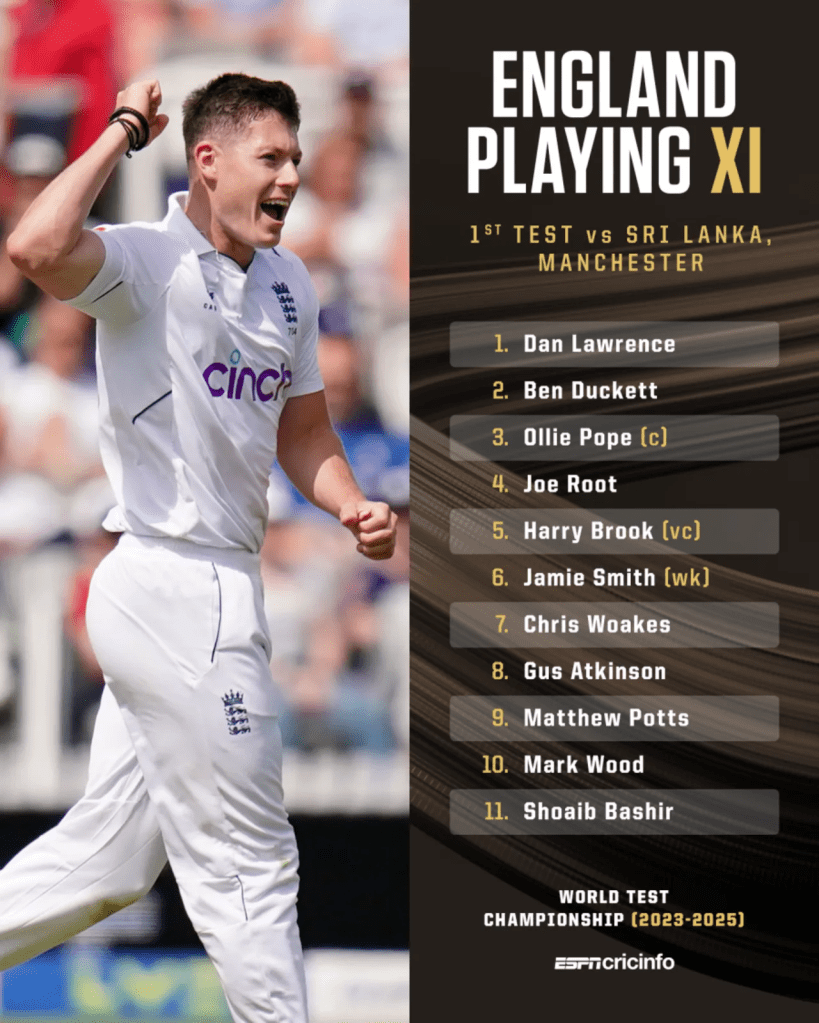
A quick look at the England XI for the first test against Sri Lanka, which starts on Wednesday and a huge photo gallery.
The second part of the England men’s test summer gets underway on Wednesday at Old Trafford, against Sri Lanka. The England XI for that game has just been announced and this post looks at the selections.
There are no absolute bolts from the blue here, which is a good thing. With Crawley and Stokes injured there had to be at least two changes. Having opted for Lawrence, although he has never done the job in red ball cricket before playing him as an opener was the least disruptive thing that England could have done in the circumstances. Some might notice that there is less batting depth than against the West indies, but I personally applaud the selections of Smith at six (he bats at number four for Surrey, so this no real gamble) and Woakes at seven, which gives the side five front line bowlers. With Potts, Woakes and Bashir there the two gun speedsters, Wood and Atkinson, can be used in short spells as would be preferable. Potts has a first class century to his name, and Atkinson can also handle a bat. Additionally, the Sri Lankan bowling attack is not exactly fearsome, and to win test matches one generally has to take 20 wickets, so again with Stokes’ absence forcing a decision between being light on bowling or somewhat lacking in batting depth it was better to go for the former. Although he would not have been my first choice pick for the role at the start of the season I am pleased to see Shoaib Bashir being given an extended run as first choice spinner – as someone who first started following England in the second half of the 1980s and witnessed the whole of the 1990s in their (in)glory I have developed a major dislike of ‘here today, gone tomorrow’ selections.
I think the selectors have done the best job possible in difficult circumstances, and I expect this side to fare well against Sri Lanka.
An account of England’s victory over West Indies at Edgbaston and resultant 3-0 series triumph, plus a photo gallery.
Yesterday I put up a post just as England were moving into a first innings lead over West Indies in the third test match of the series at Edgbaston. This post looks at the events that have unfolded since that one.
ENGLAND SURGE AHEAD
Jamie Smith and Chris Woakes extended England’s lead at a rapid rate. Smith just missed out on a maiden test century, but his 95 was a command performance, beginning with England still very much in jeopardy and ending with them in complete control. The scoring was not quite done even then – Gus Atkinson belted a couple of sixes coming it number ten, and England ended with a first innings lead of 94, and West Indies had an awkward mini-session to get through with the bat.
EARLY WICKETS FOR ENGLAND
West Indies did not make as much of a Horlicks of this mini-session of batting as the 1994 England side had in Trinidad, but the experienced Kraigg Brathwaite fell early, and Kirk McKenzie completed a truly miserable series (33 runs at 5.50 in six innings from a supposed number three) by doing likewise.
WOOD WASTES WEST INDIES
The West Indies had a respectable morning, though they needed far more. Mikyle Louis who had previously produced a succession of scores in the 20s completed a maiden test 50, and Kavem Hodge also reached 50. However, the lunch time score of 151-5, with da Silva batting in company with Hodge held out little hope for them, being a lead of only 57. The end of the West Indies innings was swift and brutal as the pace of Mark Wood was simply too much for them. Joshua da Silva had been somewhat fortunate to survive two LBW appeals from Wood when he was given out at the third time of asking and did not review it. Six runs later Alzarri Joseph had his stumps comprehensively shattered, and then at 171 came the killer blow for such hopes as West Indies retained, Hodge edging one through to Smith who made no mistake with the catch. Three balls later Jayden Seales’ off stump was sent cartwheeling. Number 11 Shamar Joseph creamed a four through the off side but the second ball of his innings was fast, full and straight, took the edge of his bat and flew to Brook in the slips. West Indies were all out for 175 and Wood had figures of 5-40 for the innings.
STOKES SLAMS HOME ENGLAND’S SUPREMACY
Zak Crawley was having a scan on an injured finger, which means that England needed someone else to open. However with a target of only 82 (three runs fewer than has ever been successfully defended in the fourth innings of a test match, and that match in 1882 was incredibly low scoring – the highest of the four individual innings was Australia’s second innings of 122) this was unliekly matter much. Rather than ask anyone else to do the necessary Stokes donned the pads himself and opened the innings with Duckett – two left handers answering to Ben opening the innings together. It was soon apparent that Stokes intended the match to be over before the tea interval – before the innings was two overs old he had struck four boundaries, and he continued in that vein, overshadowing Duckett, not generally noted for being a shrinking violet with the bat. Stokes reached 50 off just 24 balls, the quickest ever for England in test cricket (four balls quicker than Botham v India during the 1981-2 series), and two balls outside the all-comers record by Misbah-ul-Haq of Pakistan. Stokes finished things by belting the second ball of the eighth over for six to give England victory by ten wickets with two days and a little more than a session to spare. Wood’s blistering spell to terminate the West Indies second innings saw him named Player of the Match, while Gus Atkinson with 22 wickets at 16.22 each in the three matches was named Player of the Series. The West Indies have a promising bowling attack, but their batting is indubitably weak and lacking in depth. Playing Holder at six and da Silva at seven requires a much stronger top five than West Indies currently possess – Louis batted well today, Brathwaite is experienced but no ones idea of a great test opener and Hodge has been impressive, but Athanaze has played only one innings of note in this series, and I have already mentioned Kirk McKenzie’s shocking series. A full scorecard for this match can be seen here.
PHOTOGRAPHS
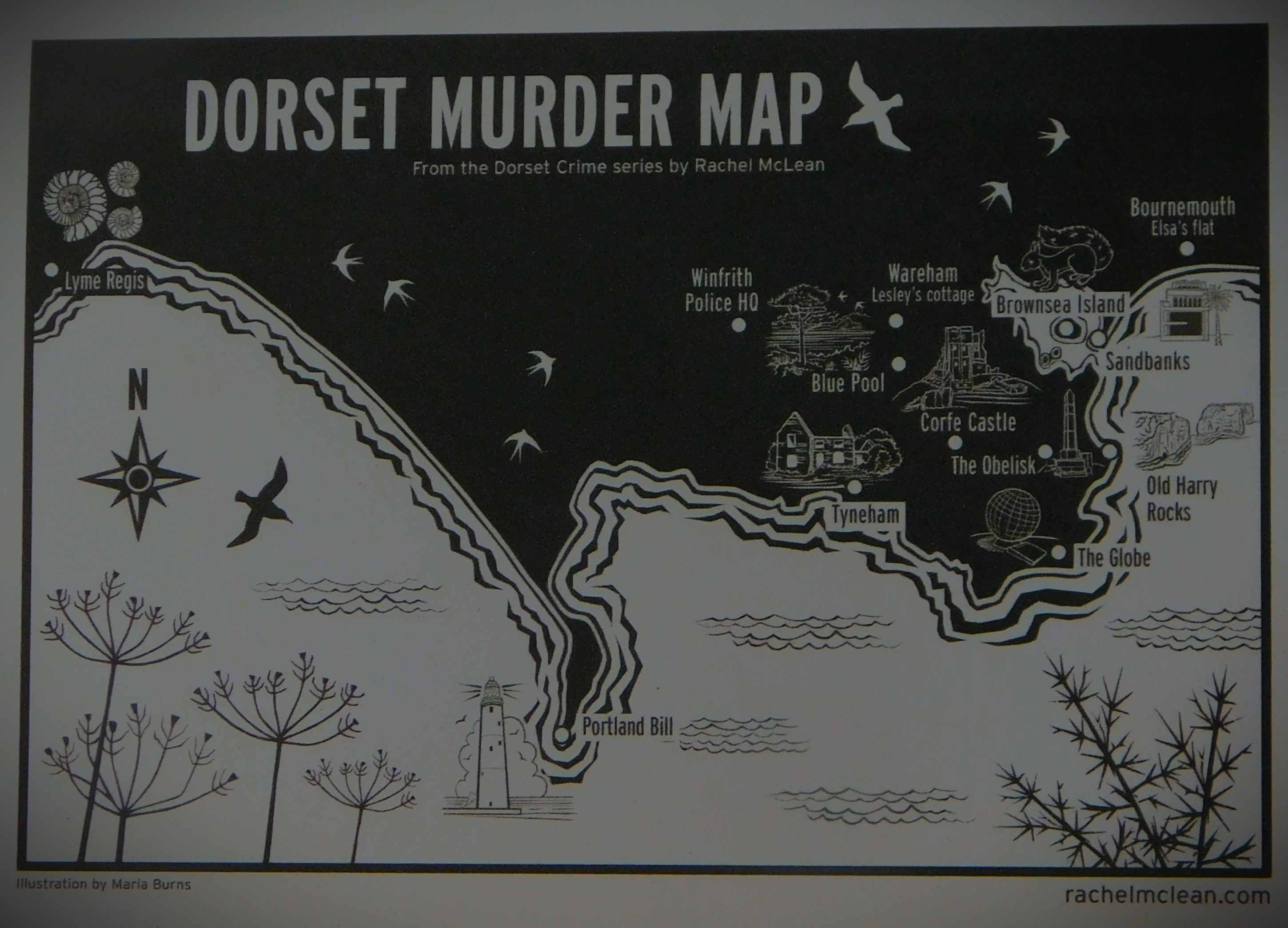
A little bit of a preamble to today’s gallery, relating to the first picture in it: one of my fairly recent library finds is Rachel McLean’s ‘Dorset Crime’ series, several volumes of which I have now read. I highly recommend this series, in which I have read books 1,3,4,5,6 and 7 to date. The seventh book, “The Blue Pool Murders” features a map showing all the locations (LJ Ross in her Northumbrian crime series does the same thing, as does Rebecca Tope in both her Lake District and Cotswold series). Preamble done here is my usual sign off…
A look back at the test match at Trent Bridge between England and West indies. and a fine photo gallery.
I did not actually get to follow a great deal of the match that unfolded at Trent Bridge between Thursday and Sunday (scheduled for five days, but four proved enough). Thursday was a work day, so I got only the closing stages of England’s 416, and as documented in my previous two tests I was busy over the weekend.
A HISTORIC MATCH
England amassed 416 on the opening day, but had, as opening batter Ben Duckett admitted, “left a few runs out there”. The West Indies response was led by two batters from the tiny island of Dominica (also birthplace of pace bowlers Norbert Philip of the West indies and Phillip DeFreitas of England) Alick Athenaze (82) and Kavem Hodge (120, the first test century by a Dominican), and at the end of day two they were 351-5 in response to that 416 by England. In the end, assisted by England trying to be too clever against the tailenders, West Indies led by 41. During the bit of listening I got in on the Saturday in between concerts Brook and Root batted beautifully after Pope had completed a 50 and then got out. Both players would get hundreds, but for the second time in the match England didn’t maximise their opportunity, suffering a collapse late on. They did however pass 400 for the second time in the match, the first England team to do so (though it has been done against them at least once – Headingley 1948, England 496 and 365-8 declared, Australia 458 and 404-3 to win by seven wickets). Part of the reason that occurrences are rare (there have been 12 in all of test history) is that sides putting up big totals used to expect only to bat once – declining to enforce the follow-on was much rarer than it has recently become. Also scoring rates were less rapid in test cricket in days gone by, which mean that topping 400 twice would almost certainly not have led to victory (the extraordinary Headingley 1948 match aside). West Indies thus need 385 to win – fewer than had been scored in any of the first three innings of the match. By the time I got to catch up on the action on Sunday after Norton Hill the West Indies second innings was already underway, and it did not initially look promising for England. However, with 61 on the board Woakes had Mikyle Louis caught behind and a dramatic collapse set in, including off spinner Shoaib Bashir entering the record books by taking wickets in each of his first three overs – before this only one spinner had taken wickets in each of their first two overs in a test innings at Trent Bridge – Shane Warne, when he almost bowled Australia to victory in 2005 with England needing only 129 to win. When Wood dismissed Sinclair courtesy of a catch by Crawley West Indies had tumbled to 93-6. They were still six down when I left for my evening engagement, but England, with the aid of the extra half hour got the job done that evening. West Indies were all out for 143 in the end, Bashir 5-41, including the final wicket, Shamar Joseph clean bowled for 8. Pope was named Player of the Match for his scores of 121 and 51. England had underachieved with the bat in the first innings on their own admission, had arguably done the same in the second, and had still emerged victorious by the huge margin of 241 runs.
PHOTOGRAPHS
My usual sign off…
A Red Admiral looking rather the worse for wear.In contrast this Comma looked in perfect health.
A look at developments so far on day one of the England v West Indies test match, dominated by an extraordinary debut performance from Gus Atkinson. Also a photo gallery.
Today is day one of the opening test match of the series between England and West Indies, which is happening at Lord’s. This post looks at the action so far.
THE PRELIMINARIES
Both playing XIs were known in advance, England’s on Monday, West Indies’ yesterday. England had gone for batting depth, with Woakes at number eight, while the West Indies had opted for extra bowling strength, and both Holder at number six and da Silva at number seven looked to be a place too high in their order for comfort. England won the toss and elected to field first.
THE MORNING SESSION
James Anderson in his final test match took the new ball in partnership with Woakes. West Indies got through 10 overs without losing a wicket, at which point Gus Atkinson came on for his first bowl in test cricket. Atkinson immediately showed the extra pace that had been the reason for his selection, and struck with his second ball, Kraigg Brathwaite dragging it on to his stumps. West Indies got through the rest of the over, but Atkinson avoided conceding any runs. Atkinson’s second over was also a maiden, and in his third he struck again, having Kirk McKenzie caught by Crawley. By the end of this over his figures were 3-3-0-2. Harry Brook held a sensational catch off Ben Stokes to get debutant opener Mikyle Louis, the first ever test cricketer to hail from St Kitts, although its sister island of Nevis has produced a few, for 27. That was 44-3, and Alick Athenaze and Kavem Hodge saw things through to lunch, with the score 61-3.
POST LUNCH
After the interval this pair advanced the score to 88 before Atkinson’s already impressive debut became a truly great one. He got Athenaze and Holder in successive deliveries, and although da Silva prevented the hat trick he was out second ball to make it three in four for Atkinson and a five-for in test debut. In the next over Kavem Hodge donated his wicket to an umimpressive Woakes, basically giving Pope catching practice, and that was 88-7 with four wickets having gone at the same score. Alzarri Joseph had a bit of fun before trying one aggressive shot too many and holing out to Woakes off Atkinson for the debutant’s sixth scalp. That was 106-8, and it was soon 106-9 as Shamar Joseph played the worst shot of the innings to give Pope his second catch. Atkinson at this point had 7-36 and was on for setting a record for the best bowling figures by an England debutant, but a combination of Gudakesh Motie scoring runs off him with a mix of luck and skill and James Anderson pinning Seales LBW to end the innings at 121 left him with 7-45, second best behind Dominic Cork’s 7-43 in 1995 (also against West Indies). However Cork’s effort had come in West Indies second innings, so Atkinson did have the best ever first innings figures by an England debutant. Ben Duckett has fallen cheaply, playing a loose shot at Seales and edging to keeper da Silva. However Crawley and Pope are going well together at the moment, with the score currently 58-1. While I have been preparing this for publication England have moved on to 71. An appeal for LBW against Pope has just been upheld, but has gone for review. However the replay shows the ball missing the wicket. England 71-1, already within 50 of first innings parity.
PHOTOGRAPHS
My usual sign off…
I wasn’t sure about the highlight of this gallery until while I was out walking during the lunch interval I saw this hedgehog near Kettlewell Lane.I got closer, while taking care not to cause stress.
A look a two of test cricket’s daftest dismissals, the second of which happened yesterday. Also a huge photo gallery, making the most of the arrival of spring.
In the recent test match between Bangladesh and Sri Lanka two Sri Lankan batters scored centuries in both innings, and a Bangladeshi batter suffered the dismissal that prompted this little squib. I offer two contenders only, starting with…
LITTON DAS’ BRAINFADE
You are facing your first ball, with your side already reeling at 37-4. What do you do? If you are Litton Das you have an almighty heave and hole out in the deep, turning 37-4 into 37-5. Sadly, although this particular dismissal stands out for its sheer awfulness Bangladesh have had far too many moments of lack of application/ lack of mental toughness in their 24 years as a test playing nation, and such progress as they have made in that time is barely measurable.
WHY DID HE DO THAT!!!
You are Shannon Gabriel, specialist fast bowler with zero pretensions as a batter, and your side, the West Indies are nine wickets down with seven possible deliveries left in the match. At the other end, waiting to bat out the last over and leave the pitch with the draw secured, is Roston Chase with 110 not out to his name. What do you do? Mr Gabriel had a wild yahoo and succeeded in losing his wicket, handing the match, and with it the series, to Pakistan. The West Indian commentator’s agonized shout of “WHY DID HE DO THAT???!!!” is only too understandable in the circumstances.
MY VERDICT
On the one hand Litton Das is a proper batter and Shannon Gabriel one of the more genuine of genuine tail enders, which would seem to militate against the Bangladeshi. On the other hand Bangladesh were miles from any hope of escape in the match, whereas Gabriel knew that if he simply kept out one ball it would Roston Chase’s task to survive the remaining over, and he knew that Chase had a ton to his name and would be seeing it like a watermelon. Thus on the ground that the end goal was in plain sight for Gabriel and not remotely visible for Das, while acknowledging that Das had an absolute shocker, and that no one should have got out like that in that situation I give the verdict to Gabriel.
PHOTOGRAPHS
I have a massive photo gallery to share…
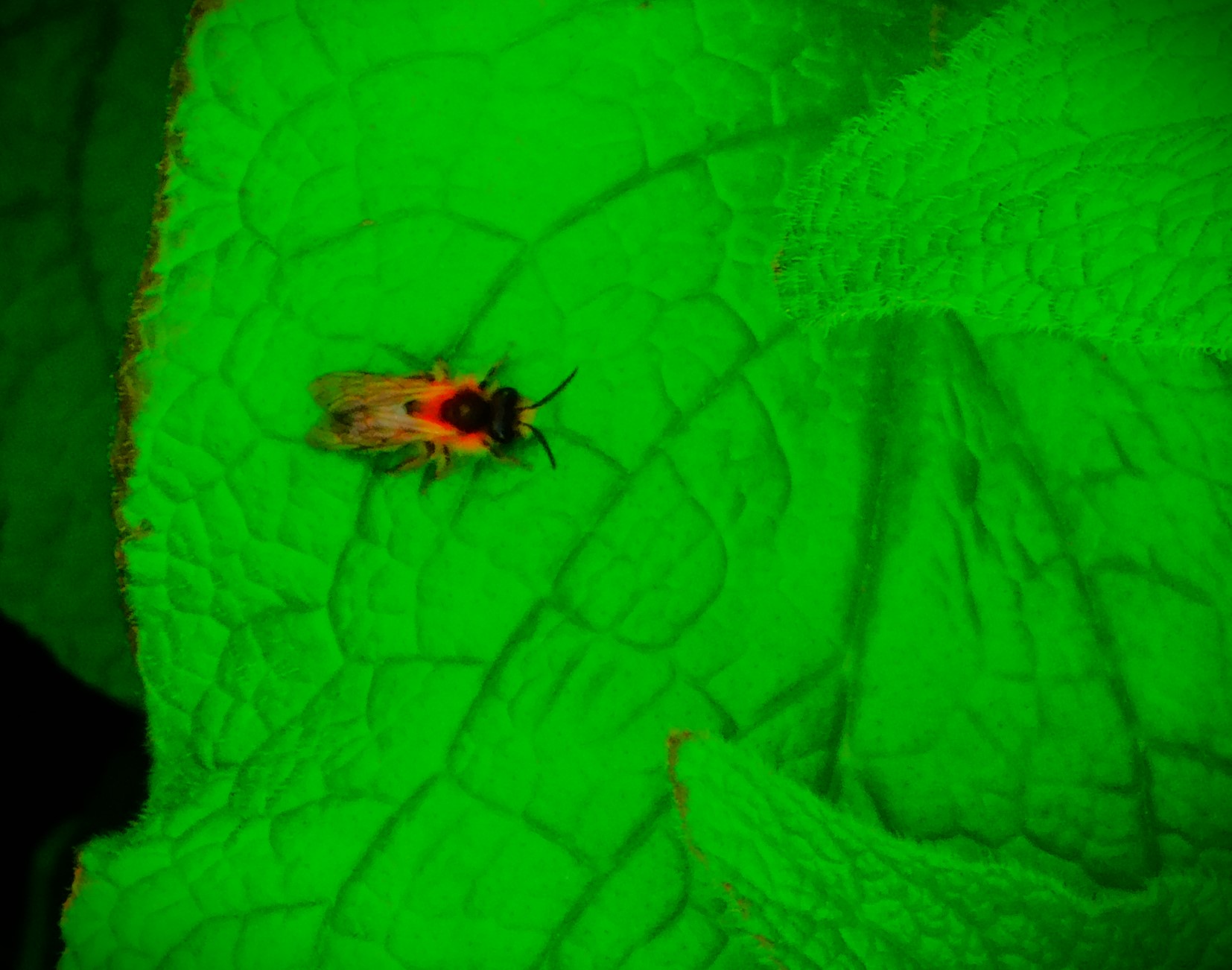
A large bee zeroes in on a nectar-rich flower head.A bee searching for flowers.
A look back at the test match in Dharamsala and at the India v England series as a whole, and a composite XI for the series. Also a huge photo gallery.
The final test match of the India v England series at Dharamsala ended earlier today after barely half the allotted playing time, with India winning by an innings and 64 runs to take the series 4-1. This post looks back at the match (I missed two major chunks of play – on day one because it was a work day and on day two because the West Norfolk Autism Group had a committee meeting, but still got enough of the action to have a decent idea of what went on) and at the series, including naming a composite XI for the series.
THE PRELIMINARIES
Ollie Robinson’s injury forced one change on England, and they opted to recall Mark Wood rather than give Gus Atkinson a game, a mistake IMO, but one that had zero effect on the outcome. This meant that Jonathan Bairstow became without doubt the least deserving ever recipient of 100 test caps. India dropped Patidar (I choose to consider the official line about getting an ankle injury during training to be absolute BS) and brought in Devdutt Paddikal for a test debut, while Bumrah returned after a one match rest. England won the toss and opted to bat first on a flat looking pitch.
DAY ONE
England started well, with Crawley playing nicely and Duckett helping to push the score into the 60s before the first wicket fell. Pope never looked at home and was out to the daftest dismissal of the series, when he gave Kuldeep Yadav the charge, playing for spin that wasn’t there and walking straight past the ball to be stumped by a ridiculous margin. Root and Crawley took the score to 134 before Crawley’s innings ended for 79. Bairstow and Root had taken things to 175-3 but then came an epic collapse, and moments later the score read 183-8. Foakes, left for the second successive innings to attempt to shepherd Bashir and Anderson, did enough that England reached 218, still an obviously inadequate total. I missed most of the start of the Indian innings, but they ended day 1 on 135-1, Jaiswal having gone after taking his series aggregate to 712 runs.
DAY TWO
Rohit Sharma and Shubman Gill batted superbly and India were in to the lead with only one wicket down. Both these batters notched centuries and got out shortly thereafter, but the debutant Paddikal and Sarfaraz Khan continued to good work and at one stage India looked set for a really mammoth total. However, they lost wickets while I was out, and by the end of the day were 473-8. Shoaib Bashir having conceded 100 in his first 20 overs had hauled things back and was on 4-170 by the close. Anderson had claimed his 699th test wicket.
THE FINAL HUMILIATION
Anderson got his 700th test wicket, and Bashir ended the Indian innings by claiming his fifth wicket, his second test five-for in his debut series. There was little else for England to enjoy. Duckett suffered a crazy bowled dismissal, trying to charge Ashwin who took the new ball alongside Bumrah. Crawley failed cheaply as well, turning one from Ashwin into the hands of Sarfaraz Khan, and Pope fell to catch by Jaiswal off Ashwin. That was 36-3. Bairstow flashed his way to 39 off 30 balls before falling LBW to Kuldeep Yadav and that was 92-4. Right on the stroke of lunch Stokes concluded a wretched series with the bat (and he only bowled at all in this match, taking a wicket with his first ball in nine months but otherwise doing nothing of note) by being bowled by Ashwin, against whom he seemed to have not a scooby, for 2. England at 103-5 needed 147 more just to avoid the innings defeat. Foakes fell for 8, also bowled by Ashwin and it was 113-6. Tom Hartley offered Root some support, but he and Wood were both pinned LBW by Bumrah in the space of three balls (and if Wood knew anything about the intermediate delivery I am a Dutchman) and that was 141-8. Shoaib Bashir offered Root support, and the prospect a century for the Yorkshireman appeared on the horizon. However with the partnership with 48 a delivery from Jadeja kept low and bowled Bashir to make it 189-9. With Anderson at the other end Root aimed a big shot against Kuldeep Yadav and succeeded only in picking out Jasprit Bumrah to fall for 84. England 195 all out, Root 84. Kuldeep Yadav was named Player of the Match for his seven wickets, five of them taken in the first innings, and Yashavsi Jaiswal was named Player of the Series.
ANALYSIS
This series was played on excellent cricket wickets – these were not at any stage of any match raging turners, and everyone had the chance to get in the game. India won 4-1, and are in truth not flattered by that margin, because they have the better cricketers, and they generally played somewhere close to their best. Crawley’s series was reminiscent of the one Shane Watson had in the 2010-11 Ashes – respectable aggregate and average, but no really major innings, and like Watson he was part of a well beaten side. Duckett had his moments, including a superb century, and he and Crawley usually have England a solid start, while not coming close to being a latter day Hobbs and Sutcliffe. Where England failed abysmally was in the number 3-6 positions in the order. The 40 innings played by those players across the series (four players, 10 innings each) yielded exactly three major innings – Pope’s 196 in the first match, Root 122* at Ranchi and Root 84 in the second innings at Dharamsala. When the engine room of the batting is failing to that extent one cannot really expect other than a hammering. In the 1924-5 Ashes Hobbs and Sutcliffe both had superb series, but were largely unsupported by the rest of the order and England lost 4-1. Here Crawley and Duckett were not as good as Hobbs and Sutcliffe had been 99 years ago, and the middle order failed even worse. Only Anderson, who became only the third ever bowler and first ever seamer to record 700 test scalps, was remotely effective among England’s pace bowlers, but India’s pacers were not brilliant either. Hartley and Bashir as front line spinners did more than anyone could have expected of them, and Bashir especially looks hugely promising, but they were unsurprisingly outclassed by their rather more experienced Indian counterparts. Foakes kept impeccably through the series, but Dhruv Jurel also did superbly once he replaced the underachieving Srikar Bharat, and Jurel was a clear cut matchwinner at Ranchi. Thus India were, thanks to Jaiswal, somewhat ahead when it came to openers, in a different league from England in slots 3-6, ahead on pace (Bumrah being better in the series than the veteran Anderson) and ahead on spin, though less one-sidedly so than might have been expected, equal on keeping, and probably equal on captaincy, though to make up for his shocking series as a player Stokes would have had to captain like peak Brearley, and he certainly did not do so. I do not think that either Wood (now 35 and unlike Anderson seriously injury prone) or Oliver Edward Robinson (too many fitness issues) should feature for England again, and it is long past time to confine Bairstow’s activities to white ball cricket. I also feel England need a genuine number three – barring his one great innings at Hyderabad Pope has looked further at sea than Captain Nemo and the Nautilus in this series. Josh Bohannon is the best number three currently playing county cricket, while Jamie Smith (Surrey) and James Rew (Somerset) must in the reckoning to replace Bairstow at number five. Bashir should keep his place as should Anderson for the present. Among younger pace options Matthew Potts, Josh Tongue, Gus Atkinson and Tom Lawes should all be considered in the immediate term, and I would have half an eye on the progress of James T Langridge of Somerset who showed signs of promise when thrust into One Day Cup action as a 17 year old last season.
In terms of the team approach, I am all for attacking cricket, but what we saw far too much in this series was brainless batting – large numbers of wickets simply thrown away. Also some of the players public utterances (Duckett’s comments about Jaiswal learning from England’s approach being an example – almost as ridiculous in their way as was Pope’s first innings dismissal at Dharamsala in its way).
COMPOSITE XI FOR THE SERIES
Yashavsi Jaiswal (India, left handed opening batter). Only one Asian opener has ever scored more in a series than his 712 in this one: Sunil Manohar Gavaskar against the West Indies in 1970.
*Rohit Sharma (India, right handed opening batter, captain). His century in the final test and the fact that his rival skipper was effectively un-selectable on any honest reckoning get him in – I have commented on the efforts of Crawley and Duckett earlier in this post.
Shubman Gill (India, right handed batter). He came good as this series progressed, and outside of his Hyderabad display Pope scraped up a mere 117 runs in nine innings.
Joe Root (England, right handed batter, occasion off/ leg spinner). He did well in the fourth and fifth matches, and number four was a problem position for India. Paddikal made 65 in his debut innings, but that was the only innings he played, and Patidar was never remotely convincing. However, he needs to stop trying to play fancy, and settle, as he did in these last two matches, for using the traditional test match methods that have brought him 11,000 runs at 50.
Sarfaraz Khan (India, right handed batter). Solid performances in all matches that he has played.
Ravindra Jadeja (India, left handed batter, left arm orthodox spinner). The veteran Indian all rounder has had a fine series, while Stokes had a wretched one.
+Dhruv Jurel (India, wicket keeper, right handed batter). Both he and Ben Foakes kept very well. The tiebreaker is Ranchi, where Jurel was India’s matchwinner.
R Ashwin (India, off spinner, right handed batter). The veteran bowled better as the series progressed.
Kuldeep Yadav (India, left arm wrist spinner, left handed batter). Has had a superb series with the ball since coming in for Axar Patel, and has played some useful supporting innings with the bat.
Jasprit Bumrah (India, right arm fast bowler, right handed batter). The best quick bowler on display in this series.
James Anderson (England, right arm fast medium bowler, left handed batter). Still fit and firing at the age of 41, though England struggled to find anyone to share the new ball with him – neither Robinson nor Wood distinguished themselves in this series. I reckon he would fare better in this XI, with Bumrah at the other end, than he had the opportunity to do for England in this series.
An account of the second half of a thoroughly absorbing test match between India and England at Ranchi, and a photo gallery.
This post deals with the second half of an extraordinary test match between India and England, the fourth of the series currently taking place between the two teams. I covered the first two days here, so the body of this post picks up the action on day three (yesterday).
DAY THREE – ENGLAND STUMBLE
Play resumed with India 219-7, 134 adrift. England’s first task was to take the last three Indian wickets as quickly as possible. Unfortunately they were baulked in contrasting styles by wicket keeper Dhruv Jurel who played a superb innings and left arm wrist spinner Kuldeep Yadav who resisted stoutly, comfortably completing a ‘Den-tury’ – 100 balls survived in an innings (look up the career of Joe Denly for the origin of this term). When Yadav was finally dislodged for a 131 ball 28 debutant Akash Deep continued the resistance, surviving a further 29 balls. Mohammed Siraj really is a genuine number 11, and it was in the Jurel who was last out, bowled by Tom Hartley for a splendid and spirited 90 off 149 balls. India has thus reached 307, a deficit of a mere 46. Shoaib Bashir recorded figures of 5-119 from 44 overs, becoming the fourth England bowler to take their maiden first class five-for in a test match. Christopher Heseltine (Hampshire, right arm fast) did so in 1896 in South Africa, in a series whose claim to test match status is decidedly dubious – visiting South African teams were not given test matches in England until 1907, while the other two members of this club are both part of the current England set up, and both principally batters – Joe Root who took 5-8 at Ahmedabad last time England were in India and Will Jacks who took a six-for in Pakistan.
Things still look good for England with an advantage of 46 and India having to bat last, but their second innings soon started going pear shaped. Crawley and Bairstow threatened a revival, and at 110-3 England looked comfortable. However Crawley fell for a fine 60, and then Stokes suffered his second failure of the match, and for the second time in the match England went into an interval, tea in this case, having just lost their skipper, and five down for not a huge amount. Soon after the interval a loose stroke spelt the end of Bairstow and it was 120-6. Hartley failed again with the bat, and Robinson was unable to repeat his first innings efforts. Foakes resisted gamely and did his best to shepherd the tail, but eventually he attempted to play one from Ashwin through midwicket and got a leading edge straight back to the bowler. Anderson lasted three balls, the last of which he nicked to the keeper, and England were all out for 145, leaving India 192 to get.
Stokes now opted to give the new ball to Root and Hartley. There was merit in the idea of giving a spinner the new ball, especially given that Robinson had been decidedly underwhelming with the ball, but James Anderson should have bowled at one end for the mini-session India faced at the end of this third day – this would have given England a measure of control, whereas in the event India were 40-0 off eight overs by the close, needing 152 more for victory.
THE DENOUEMENT
India advanced their score to 84 before a splendid catch by Anderson off Root accounted for Yashavsi Jaiswal, leaving the new India opener needing to tally 120 or more in the fifth match of the series to break a record that has stood to Sunil Gavaskar’s credit since 1970 for the most runs in a series by an Indian opener.
15 runs later Foakes achieved a double dismissal of Rohit Sharma – it was initially recorded as stumped, but replays showed that there had been an edge, and it now appears as caught Foakes bowled Hartley 55. One run later Rajat Patidar was on his way back for a five ball duck, courtesy of a good catch by Pope off Bashir, and I suspect that unless he intends to watch the match Patidar will not be in Dharamsala for the final match of the series. Ravindra Jadeja never looked comfortable, and with 120 on the board, and himself on 4 off 32 balls he hit a full toss from Bashir straight to Bairstow to end a tortured stay at the crease. The very next ball Sarfaraz Khan was snapped up Pope to make it 120-5, and Bashir had three wickets and was on a hat trick. At that point Jurel joined Gill, and these two players steered India home. Gill completed a 50, while Jurel was unbeaten on 39, and appropriately enough the winning runs came from his bat – he was deservedly named as Player of the Match, having kept very well in tricky conditions and scored 129 in the match for once out. India have an unassailable 3-1 lead in the series, but England have had moments in all four matches when things looked like going their way, and given the loss of Leach, the inexperience of the remaining spinners and the fact that no visiting side have laid a glove on India in the last decade this is very far from a humiliation. Bashir and Hartley, especially the former, look very promising for the future. Robinson, who finished the match off the field nursing a back problem, must be in jeopardy – when the force is with him he is a very good bowler indeed, but in this match he was consistently 10kph below his best pace, and given his previous injuries and fitness issues I think England have to say that enough is enough. Matthew Potts of Durham, Josh Tongue of Worcestershire and Gus Atkinson of Surrey are all fine bowlers, Tom Lawes of Surrey may be on the radar, and there are probably other younger seamers who could do a job for England as well. James Anderson’s bowling and fielding leads one to wonder whether he has a portrait hidden away somewhere that is ageing in his place!
This match was a thoroughly absorbing contest which commanded attention right to the end. Though it does scant justice to the events of the last four days a full scorecard can be viewed here.
PHOTOGRAPHS
I end with my usual sign off…
I thought that the arrangement of leaves on this plant made it look a bit like a very large green butterfly.
A look back at the first two days of the fourth test match of the India v England series and a substantial photo gallery.
The fourth match of the five match test series between India and England got underway in Ranchi at 4AM Friday morning UK time. This post looks at the action from the first two days of play.
THE PRELIMINARIES
India had gone one up in the series following a thumping victory in the third match of the series (I was unable due to my internet situation to follow that match). England were forced to make one change to their line up, Rehan Ahmed having flown home for personal reasons. This meant a recall for Shoaib Bashir. Mark Wood was rested, with Ollie Robinson taking his place in the XI, and the England selectors failed to take the opportunity to drop Bairstow who has a had a horrible series, meaning that Dan Lawrence is still yet to feature. India made only one change, resting Jasprit Bumrah in the name of workload management, and handing a debut cap to Akash Deep in his place. I would have thought it would be better to keep him in the side for this match, aiming to settle the series early and then rest him. England won the toss, and chose to bat (choosing to bowl first on that surface and with Ranchi’s history would have made Nasser Hussain’s Brisbane 2002 howler of a decision look positively Solomonic).
DAY ONE
England reached 47 without undue difficulty, at which point Zak Crawley got himself out. Shortly after this it was 57-3, with Pope gone for a duck and Duckett also back in the pavilion. Bairstow scored rapidly but never suggested permanence, and sure enough, just before lunch he essayed one outrageous stroke too many and was on his way back to the pavilion. The interval came early when Stokes got a horrible ball from Jadeja, which shot through virtually at ground level, and hit the bottom of his pad so obviously plumb in front that the England skipper was setting off for the pavilion before the umpire’s finger was fully raised. Thus England were looking decidedly shaky with score 112-5.
However, Joe Root and Ben Foakes batted through the afternoon session together, and England took tea feeling somewhat happier at 198-5.
Post tea England continued to prosper. Foakes after initially being very slow hammered two sixes and a four in quick succession to move to 47, but then he holed out to end a partnership that had over doubled England’s score. When Hartley fell it was 245-7, and things were still very much in the balance, but Ollie Robinson batted sensibly, while Root continued on imperturbably to reach a superb century, his 31st in all test cricket, a record 10th against India and also a record third against India in India. England reached 300 just before the close, and by the end of the day were far the happier side, finishing on 302-7.
DAY TWO
England continued their revival, with Ollie Robinson completing an invaluable maiden test fifty, and Root finally ending on 122 not out, with England all out for 353. James Anderson soon had test wicket number 697, that of Rohit Sharma to a catch by Foakes. Jaiswal batted beautifully, but Gill became Shoaib Bashir’s first victim for 38, and Patidar and Jadeja were both out cheaply. At 161 Jaiswal’s innings came to an end for 73, bowled by the impressive Bashir. Jaiswal had become only the second ever Indian opener to score over 600 runs in a series, though he has a bit to do to overhaul Gavaskar’s 774 against the West Indies in 1970. Sarfaraz Khan, hugely talented (he averages 70 in first class cricket) but also inexperienced, struggled, and at 171 a fine catch by Root off Hartley ended his innings with his score on 14. Ashwin, who had done little to distinguish himself in this match either with the ball or in the field, mustered a single before Hartley trapped him LBW. Kuldeep Yadav provided one of India’s few bright spots of the day by batting through to the close in the company of Dhruv Jurel who ended the day 30* in a score of 219-7. India need this pair to continue their good work tomorrow – if England end with a big first innings lead the match will be as good as settled. Shoaib Bashir produced an exemplary spell of bowling, 32-4-84-4, keeping it tight and taking wickets. Anderson was Anderson, Hartley had his moments but also bowled quite a few loose balls, and Ollie Robinson was accurate, but lacking in pace (he was not even hitting 80mph). Ben Stokes did some bowling warm ups in the innings break, but did not put himself on, while with Bashir bowling so well Root was not called on save for one over near the end of the day. At the moment a 2-2 scoreline going to Dharamsala for the final match seems likely. England deserve great credit for the character they have shown to come back from the humiliation of the previous match and their decidedly unimpressive start to this match. I would say that after the first session on day one was indisputably India’s session England have had the better of all other five we have had so far, notwithstanding the late defiance of Jurel and Yadav.
A look back at the last two days of the second test match of the five match series between India and England and some thoughts about the composition of the England XI. Also a photo gallery.
After many twists and turns India won the second test of the five match India v England series at Vizag when Jasprit Bumrah clean bowled Tom Hartley for 36, making England 292 all out, and India victors by 106 runs. This post looks back at the last couple of days.
THE INDIAN SECOND INNINGS
India started day three of a possible five 28-0 in their second innings, 171 runs ahead with all their wickets intact. Shubman Gill enjoyed a charmed life, surviving one LBW due to an edge that was as much news to him as it was to the rest of us and another on umpire’s call when not quite enough of the ball was deemed to be hitting the top of middle stump. He made the most of this, going on to a century which was instrumental in India getting to 255, a score that meant England would need the highest total of the match batting last to win. Their target of 399 was also over 100 more than any visiting side had ever scored in a fourth innings in India, though four previous tests elsewhere have been won after higher run chases, and in the 99th and last ‘timeless test’ at Durban in 1939 England scored 654-5 before weather and the arrangements for their journey home led to the match being abandoned as a draw with England 42 runs short of the target. However England under Stokes have produced so many surprises that no one was consigning them to defeat just yet.
THE ENGLAND SECOND INNINGS
England lost Duckett just before the close of day three, and Rehan Ahmed was sent in at number three (Pope is a nervous starter, so it makes sense to protect him from having to do so twice over, and Ahmed is good enough with the bat that the possibility of a major innings from him could not be entirely discounted). England closed on 67-1, needing 332 more to win.
The fourth morning (this morning) started with news that James Anderson had said England were in a very good position and that Shubman Gill had assessed India 70-30 favourites, an assessment that in itself spoke volumes for the approach of this England team compared to the last one to visit India in 2021, and the extent to which they have ripped up conventional test standards.
Ahmed was the second to fall, contributing 23 before he did so. Pope exactly matched this score, and his dismissal brough Root to the crease. Root played a frenetic, almost frantic, innings, wildly at variance with the methods that have brought him over 11,000 test runs at an average of 50, and was out for 16 off 10 balls. Crawley, who had batted impressively, then fell to a controversial LBW, which was sent upstairs. At the point the ball hit Crawley’s pad two stumps were exposed and part of the third was visible, which raised questions over whether the impact was truly in line with the stumps. However, the technology ruled that it was out, and England were 194-5. With the score still at 194 Bairstow was pinned by a beauty from Bumrah, LBW for 26. Stokes and Foakes played well for a while, until Foakes edged one behind the wicket but on the floor, Stokes judged that a run was on and was beaten by Shreyas Iyer’s direct hit throw to make it 220-7, this being Iyer’s most significant contribution to the match. Foakes and Tom Hartley then crafted a solid partnership for the eighth wicket, which ended when Foakes gave Bumrah a return catch. That was 275-8. Two landmarks were possible at this stage, Ashwin’s 500th test wicket and a 10-wicket match haul for Bumrah. However Bashir edged one from Mukesh Kumar through to keeper Bharat to make it 281-9 (this was Kumar’s only wicket of what was in truth a wretched match for him) and rule out Bumrah’s 10 wicket match haul. Bumrah then produced a superb delivery to get through Tom Hartley’s defences and end the match. That gave him nine wickets in the match (6-45 and 3-46), and 155 career test wickets at 20.19. Bumrah was named Player of the Match, his marvellous bowling being deemed even more crucial to India’s success than Jaiswal’s double century. I agree with this assessment, though I would have been inclined to give a shared award to both players. England though comfortably beaten in the end were in no way disgraced, though there were too many 20s and 30s in that fourth innings effort, and only Crawley’s 73 as a score of real substance. I think that the ‘three spinners and one seamer’ approach England have taken thus far needs changing – with Leach injured the remaining spinners are all very inexperienced and none are capable at the moment of providing control. I believe that England’s 8,9,10,11 for the third match of this series should read: R Ahmed, T Hartley, OE Robinson, JM Anderson, and if England want to increase the back up spin options available to them in the XI they can drop Bairstow, who has not been impressive this series, and select Dan Lawrence in his place, giving them two part time spin options (Root being the other).
An account of day two of India v England at Vizag, dominated, as the day’s play itself was by the brilliance of Jasprit Bumrah. Also my customary photo gallery.
Today was day two of the second test match of the five match series between India and England. This match is taking place at Vizag. I covered day one here.
THE CONCLUSION OF THE INDIAN INNINGS
Although it was a mere prologue to the main event of the day the end of the Indian innings was not devoid of significance. England appeared to have done reasonably well to keep India below 400, with the tenth wicket going at 396. Yashavsi Jaiswal who had dominated day one resumed on 179 not out. He completed his double century, but facing the risk of being stranded got out for 209, meaning that the highest score by an Indian opener against England remains the 221 that Sunil Gavaskar scored at the Oval in 1979. Anderson claimed his second and third wickets of the innings, and kept his economy rate below two an over, while young spinners (their combined age is less than that of Mr Anderson) Rehan Ahmed and Shoaib Bashir also finished the innings with three wicket hauls.
THE ENGLAND INNINGS
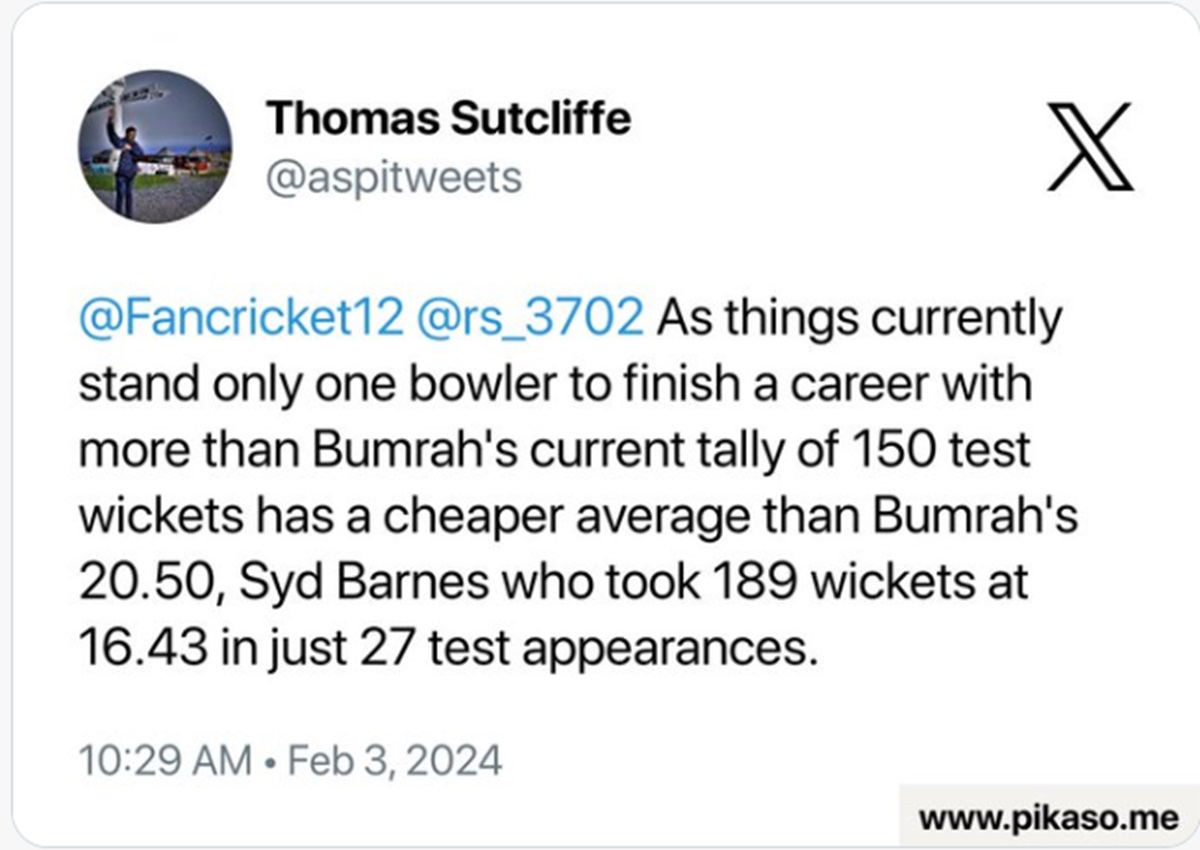
England began brightly, with Zak Crawley playing well. Mukesh Kumar did not at any stage resemble a genuine test match new ball bowler. Axar Patel, R Ashwin and left arm wrist spinner Kuldeep Yadav all took turns at the bowling crease. At high water mark England were 114-1, but then Crawley fell to catch by Iyer of Axar Patel. Bumrah was then called back into the attack to deal with Joe Root. Nine runs later Bumrah found the edge of Root’s bat, Gill took the catch and it was 123-3. Then Pope, who was just beginning to look settled after a typically nervous start had two of his stumps uprooted by an absolutely unplayable ball from Bumrah to make it 136-4. Bairstow and Stokes resisted for a time, but the unstoppable Bumrah found one to take the edge of Bairstow’s bat for another catch to Gill to make it 159-5. Kuldeep Yadav got Foakes with a good ball and Ahmed courtesy of a loose stroke which gave Gill his third catch of the innings and England were 182-7. Tom Hartley now joined Ben Stokes, and Stokes threatened to wrest the initiative back for England. However, with Stokes on the verge of a half century a superb delivery from Bumrah rattled his stumps to make it 229-8. That was Bumrah’s 150th test wicket, at an average of 20.50 a piece, a fact the significance of which I noted in the tweet reproduced in screenshot form below (follow the link highlighted in blue to note the exact time at which I posted it):
The day got better yet for Bumrah, as he induced Hartley to give Gill a fourth catch of the innings, which brought the debutant Shoaib Bashir in to join Anderson, given a one place promotion from his usual slot presumably on grounds of experience for the last wicket stand. Bumrah finished the innings by pinning Anderson LBW. England had just crept past 250, but a final score of 253 all out gave India a first innings advantage of 143. Bumrah had taken 6-45 from 15.5 overs on a pitch not offering much assistance, a truly great display of test match fast bowling, from one of the great masters of that art. This gives him an overall tally of 152 test wickets at 20.29 each, with Barnes ahead of him on 189 wickets at 16.43, and Alan Davidson the great Australian left armer having taken 186 at 20.53, with West Indians Ambrose, Garner and Marshall all also having finished with over 150 wickets at less than 21 a piece. Barnes and Bumrah were both in my all time Bs XI. I make one change to that XI in retrospect, Benaud being moved from being in the XI to fronting the TV commentary and Bishan Bedi taking his place giving an XI off: C Bannerman, SG Barnes, *DG Bradman, KF Barrington, AR Border, IT Botham, +Wasim Bari, W Bates, SF Barnes, BS Bedi, JJ Bumrah. I first noticed Bumrah when not long discharged from Addenbrooke’s after emergency cancer treatment, when he destroyed Australia in Australia (see here).
THE START OF THE INDIAN SECOND INNINGS
There was time for five overs of the Indian second innings, in the course of which they scored 28-0, meaning that they start day three with a lead of 171 and all their second innings wickets intact. Cricket is a game which regularly makes fools of those who make over-dogmatic statements about match situations, and this is never truer than when Stokes’ England are involved in the action, but it is at any rate not contentious to state that India are in a very strong position, especially given the tendency of Vizag pitches to break up as the match progresses (average innings scores there show a very straightforward pattern of declining from first to fourth innings of the match).