V for Victory

An all time XIU of players whose given names begin with V, some honourable mentions and a photo gallery.

Today I present an all time XI of players whose given names begin with V, plus some honourable mentions, including two players given whole paragraphs to themselves. I also have a photo gallery which includes pictures taken while travelling to and from Cambridge today. I am not going to publish an XI of players whose given names begin with U because such an XI owes more to cricinfo than it does to me, and is also far from great.

  1. Victor Trumper (Australia, right handed opening batter, occasional medium pacer). A great player and according to all available reports a great human being as well. His finest hours came on the 1902 tour of England, in an exceptionally wet season on uncovered pitches. In first class matches on that tour he scored 2,570 runs including 11 centuries. The highlight of this procession round England came in the fourth test match of the series at Old Trafford, when with England on a mission to ‘keep Victor quiet before lunch’ he proceeded to become the first player ever to reach a test ton on the first morning of the match.
  2. Vijay Merchant (India, right handed opening batter). Only ten test matches, spread over 18 years for him, in which he recorded a career batting average of 47. In all first class cricket he averaged 71.22, a figure which places him second only to Bradman among those who played enough matches to qualify (another Australian, Norman Calloway, played a solitary a first class match, scoring 207 in his only innings at that level, before going off to fight in WWI, where he was killed in action).
  3. Viv Richards (West Indies, right handed batter, occasional off spinner). One of the greatest of all time.
  4. Virat Kohli (India, right handed batter). Across formats the best batter of the current era.
  5. Vijay Hazare (India, right handed batter, right arm medium pacer). At a time when few Indians had great test records he averaged 47 with the bat at that level. In first class cricket he once scored 309 in a total of 387 all out, the lowest FC innings total to include a triple century.
  6. Vyell Walker (England, right handed batter, right arm slow bowler). One of only two players to have scored a century and taken all ten wickets an in innings of the same first class match, WG Grace being the other.
  7. Vallance Jupp (England, right handed batter, off spinner). Achieved the double of 1,000 runs and 100 wickets in first class matches in each of eight successive English seasons in the 1920s. In all he scored 23,296 first class runs at 29.41 and took 1,658 first class wickets at 23.01.
  8. +Victoria Lind (New Zealand, wicket keeper, right handed batter). Finding a wicket keeper for this XI was difficult, and I have selected someone who did not actually have the gloves when I saw her in action (she was playing as a specialist batter, with Katey Martin keeping wicket), but who was a recognized keeper.
  9. Vanburn Holder (West Indies, right arm fast medium bowler, right handed batter). Was part of the first WI pace quartet in 1976.
  10. Vernon Philander (South Africa, right arm fast medium bowler, right handed batter). In test cricket he claimed 224 wickets at 22.32 a piece, enough to underwrite his claim for a place in this XI.
  11. Vince van der Bijl (South Africa, right arm fast medium bowler, right handed batter). His entire career happened while South Africa were banned from the international arena, but 767 FC wickets at 16.54, taken at a rate of fractionally below five per match and the universally high opinion of all who encountered him are good enough for me.

This side has a powerful top five, two genuine all rounders of different style, a keeper who could bat and three excellent specialist bowlers. The bowling attack should be able to capture 20 opposition wickets in most conditions.

First of all…

Vangipurappu Venkata Sai Laxman, universally known by his initials VVS, had a test average of only just over a run per innings less than that of Hazare, and maintained over larger number of matches. That fine career record included a thunderous 281, at the time the individual record score for an Indian in test cricket, against the mighty Aussies in 2001. However my feeling was that Hazare offered a back up bowling option as well as his batting, and was part of a less strong batting order than Laxman had the luxury of belonging to. Had Laxman been a left hander, of whom there are none in this order, he would have had the nod, but I felt Hazare had the edge and selected accordingly.

Virender Sehwag was the first Indian ever to score a test triple century, and achieved that feat twice, but he did not do much outside Asia, and especially he did not do much against the swinging or seaming ball, whereas the attacking opener I did select, Trumper, was at his very finest on an overseas tour in conditions that would have been massively alien to a Sydneysider – one of the wettest English summers ever.

Vernon Ransford was the best left handed batting option available for this squad. Vic Wilson, the only other left hander worth mentioning was even further adrift, though he could be named as designated fielding substitute. With Richards and Kohli absolutely certain selections he could only have been accommodated at the expense of Hazare, and my feeling is that getting a left hander in isn’t worth sacrificing an average of ten runs per innings for. Vic Richardson, a legendary all round sportsperson and grandfather of two Aussie skippers, did not have a good enough record at test level to merit inclusion. Vikram Solanki was a good county batter, but such international success as came his way did so in limited overs cricket. Vic Jackson, an Aussie who bowled both medium pace and off spin, and played for Leicestershire as well as his native NSW was in the mix for an all rounders slot. Varun Aaron was a quicker bowler than any of three specialists I selected, but he was also much more erratic, and 18 test wickets at 52.61 hardly constitutes a strong basis for a challenge. Vinod Kambli was hugely talented, and was probably cast aside too soon by the Indian selectors, but unfortunately when up against Richards, Kohli and Hazare, with Laxman also deserving a mention a player who only gained 17 test caps, even one who averaged 54 with the bat at that level cannot be included.

My usual sign off…

Australia Prewar XI

A look at Australia’s best test cricketers of 1877-1914 and a large photo gallery.

Having just finished a brief look at England men’s test cricket through the ages I now turn England’s oldest adversaries in international cricket, Australia. I start with the best players of 1877-1914 inclusive.

THE XI IN BATTING ORDER

  1. Warren Bardsley (left handed opening batter). Until Don Bradman came along and blew all such records out of the water he had scored more FC centuries than any other Australian batter and more than half of those centuries were scored on tours of England (compare and contrast a left hander of much more recent vintage in David Warner). At the Oval in 1909 he became the first ever to score a century in each innings of a test match.
  2. Victor Trumper (right handed opening batter). One of cricket’s immortals. In the wet summer of 1902 he scored 2,570 FC runs for the tour including 11 centuries. In the Old Trafford test of that series, where an Australian win by three runs ensured that they kept the Ashes he reached a century before lunch on day one.
  3. *Billy Murdoch (right handed batter, captain). In 1880 at The Oval he won a sovereign from WG Grace by scoring 153* in Australia’s second innings to top the bearded Doctor’s 152 on the opening day of the match. Four years later at the same ground he scored test cricket’s first ever double century, 211.
  4. Clem Hill (left handed batter). Until Hobbs overhauled his tally he held the record for test career runs. He amassed eight test tons in total, including the only century of the only test ever played at Bramall Lane, Sheffield in 1902. He also had a unique sequence of near misses in the 1901-2 series, making 99, 98 and 97 in successive knocks.
  5. Charlie Macartney (right handed batter, left arm orthodox spinner). He had only just begun his rise to the top before WWI, but did enough, including taking his one and only match haul of ten wickets, to claim his spot in the XI.
  6. George Giffen (right handed batter, off spinner). Australia’s first great all rounder. In the 1894-5 Ashes he scored 475 runs and claimed 34 wickets.
  7. +Jack Blackham (wicket keeper, right handed batter). The ‘Prince of Wicket Keepers’, and enough of a batter to have been the first keeper to score two fifties in the same test match. He played in each of the first 17 test matches ever contested, before missing one due a dispute over pay, and then returning and playing on until the 1894-5 Ashes.
  8. Hugh Trumble (off spinner, right handed batter). Good enough in his secondary department to have done the season’s double on the 1899 tour of England and to have been Australia’s highest individual scorer at The Oval in 1902. He took 141 test wickets all against England, including doing the hat trick twice in his career. His 141 wickets against England remained a record for almost eight decades after his retirement, until Dennis Lillee overtook him at Headingley in 1981.
  9. Fred ‘Demon’ Spofforth (right arm medium-fast). A master of changes of pace, he took the first ever test hat trick, and it was his bowling that won the 1882 match at The Oval that led to the creation of the Ashes.
  10. Charlie ‘Terror’ Turner (right arm medium fast). He succeeded Spofforth as leader of Australia’s attack, and reached the milestone of 100 test wickets in just 17 matches.
  11. Ernest Jones (right arm fast). Australia’s first authentic test match quick bowler. He once sent a ball through WG Grace’s beard. Like the later Harold Larwood of England he was a miner before establishing himself as a cricketer.

This side has a powerful top five, an all rounder at six, a keeper who could bat and four formidable front bowlers. The bowling is also very powerful, though it lacks either a left arm seam option or a leg spin option.

HONOURABLE MENTIONS

Charles Bannerman missed out on an opening slot partly because of being right handed – Trumper had to be picked and I felt that left handed Warren Bardsley was a better foil for him than Bannerman. Two other specialist batters who could not be accommodated were Joe Darling and Syd Gregory, the latter playing more test matches than anyone else whose entire career happened before WWI.

I could have got around the leg spin problem by naming Warwick Armstrong as the all rounder, but I felt that Giffen’s case was unanswerable. Monty Noble was the other candidate for the all rounder’s role and would have been a natural for the captaincy had I gone for him. Frank Tarrant never played test cricket, otherwise he would have been a shoo-in (England toyed with the idea of picking him based on his years at Middlesex but felt that such a move would cause problems with the Aussies, who don’t appear to have ever considered picking him).

There were two other keepers of the era of something approaching comparable stature to Blackham, Jim Kelly and Hanson Carter.

The nearest any left arm bowler who actually played for Australia came to claiming a place were Jack Ferris, Turner’s regular new ball partner, and Jack Saunders, but neither quite did enough.

Frank Laver and Albert ‘Tibby’ Cotter were right arm seam/ pace bowlers who came close.

Australia only had one specialist leg spinner of note before WWI, Herbert Hordern, and his career was brief.

PHOTOGRAPHS

My usual sign off…
All Time XIs – Match Ups 55

Continuing my extended analysis of how the all time XIs I created for each letter of the alphabet. Also a couple og bonus features in addition to the regular photo gallery.

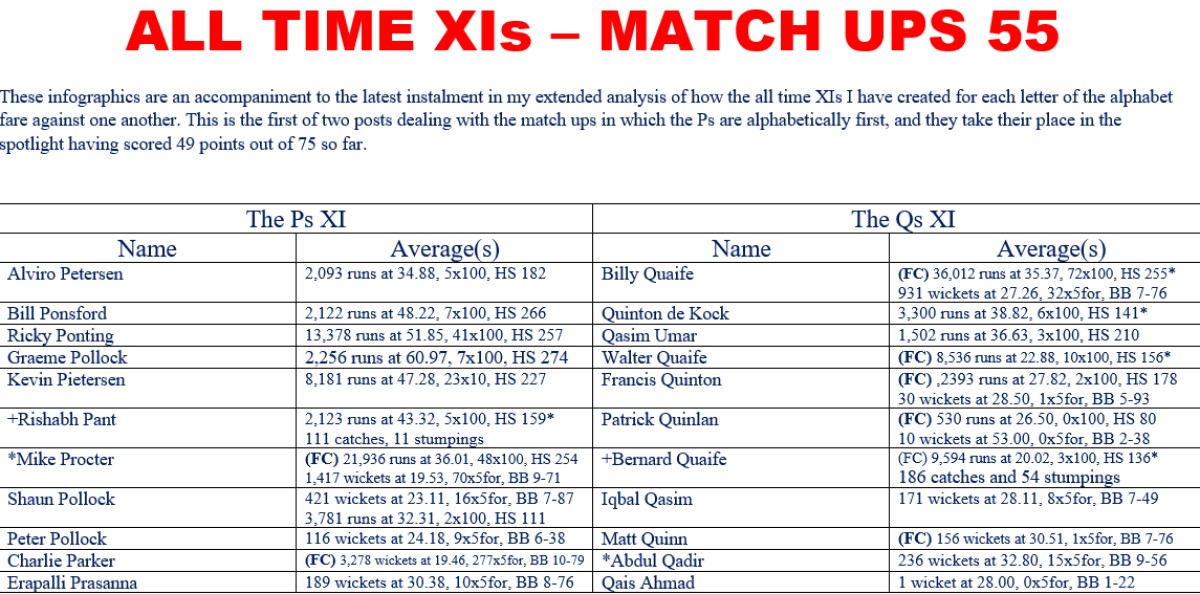
Welcome to the latest instalment in my extended analysis of how my all time XIs fare against one another. This is the first of two posts which between them will cover every match up in which the Ps come alphabetically first. They have 49 out of 75 points coming into the spotlight. There are also a couple of bonus features, after the main body of the post and before the final photograph gallery.

THE Ps V THE Qs

Close contests involving the Qs have been rare in this series, and this one does not buck that trend in any way. The Ps absolutely boss the batting, have the better captain, the better keeper and a far better pace attack. Only in spin bowling are the Qs possibly ahead, and if they do have an advantage there it is not enough to alter the scoreline: Ps 5, Qs 0.

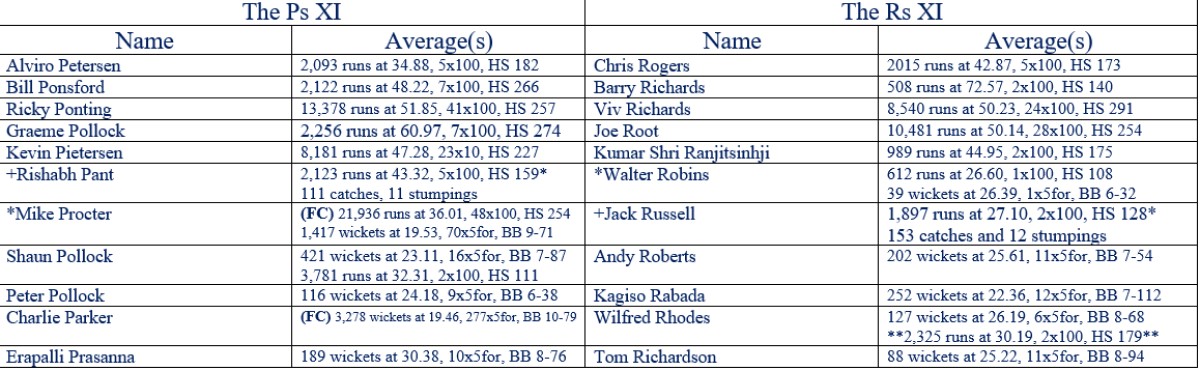
THE Ps V THE Rs

The Rs have the better opening partnership – Rogers clearly outranks Petersen, while no lesser person than Sir Donald Bradman, an Aussie team mat of Ponsford to boot, rated Barry Richards ahead of Ponsford. Ponting outranks Viv Richards, though not by much, while Root’s larger sample size does not wipe out a 10.83 run per innings gap in batting averages between him and G Pollock. Pietersen would seem to outrank Ranjitsinhji, but the latter played in an era when batting was more difficult, with pitches often treacherous, and Ranji got no easy opponents to cash in on (all his tests were played against Australia). Pant outranks Robins with the bat, while the latter is on a par with Procter as a skipper and outranks Prasanna as a bowler. Procter outbats Russell, while the latter was a finer keeper than Pant, and Procter is up there with any of the Rs fast bowlers, as great as they are. S Pollock outranks Roberts in both departments, while Rabada marginally outranks P Pollock as a bowler. Rhodes undoubtedly outranks Parker as a left arm spinner. The Rs are ahead in batting and keeping and about even in fast bowling, the Ps have an advantage in spin bowling. This is close, but I think that the the Rs are just winning it: Ps 2, Rs 3.

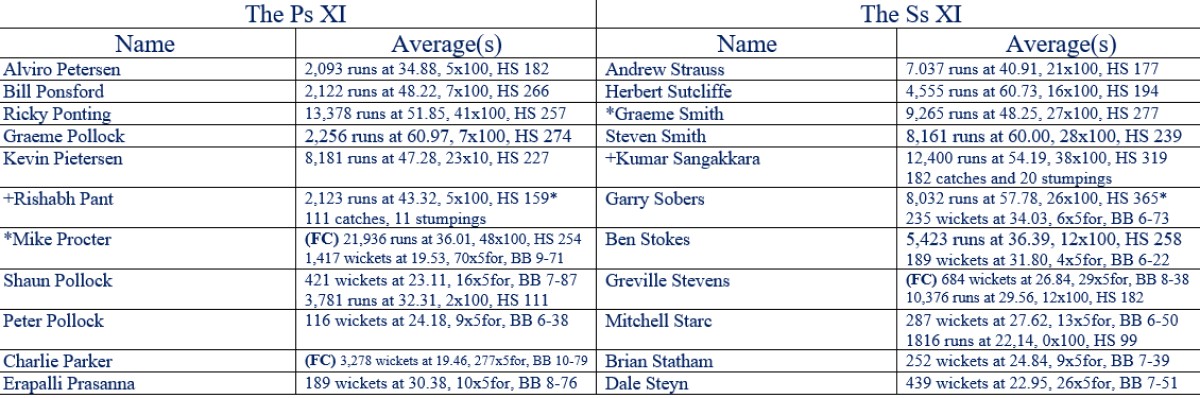
THE Ps V THE Ss

The Ss have the better opening pair – Sutcliffe was a near contemporary of Ponsford and outdid him at the highest level, while Strauss definitely outranks Petersen. Ponting wins the number three slot, bu G Pollock outranks S Smith – all evidence points to Pollock being on an upward trajectory when the curtain came down on SA’s first period as a test playing nation. Sangakkara outranks Pietersen with the bat, but Pant rates higher than him with the gloves. Sobers wins his batting match up with Pant, and has no bowling equivalent in the Ps ranks, though Parker was a finer exponent of left arm orthodox spin. Stokes wins the batting match up with Procter, but the Saffa was a much greater bowler than Stokes. Stevens outranks S Pollock as a batter, and marginally loses the nearest bowling match up for him, against Prasanna. The pace bowling is quite close in terms of the front liners – the Rs are a little better on averages, but the Ss have Starc’s left arm to add variety. Also, the Ss have back up in that department in the form of Stokes and the quicker versions of Sobers the bowler, which tips the scales in their favour in that department. The Ss thus win on batting and pace/ seam bowling, tie on captaincy, lose narrowly on spin bowling and heavily on keeping. I think the Ss are winning, and score this Ps 2, Ss 3.

THE Ps V THE Ts

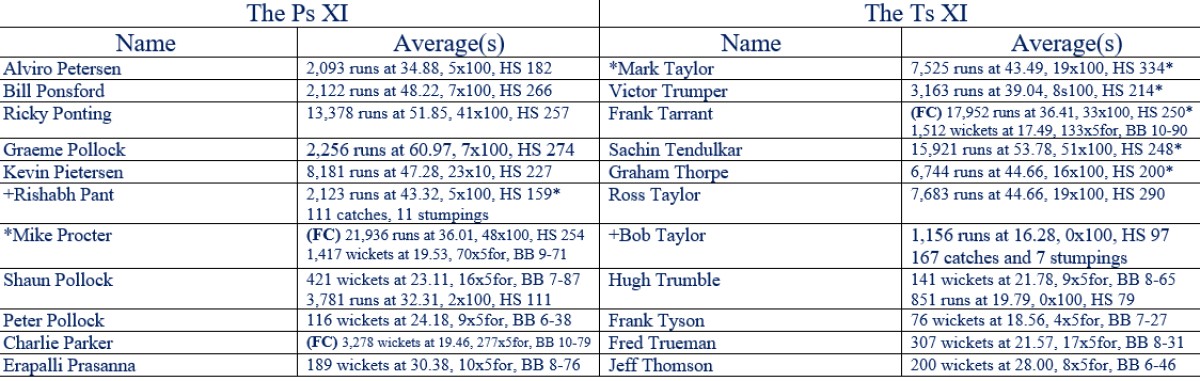
The Ts have the better opening pair – Trumper’s average of 39.04 on Victorian and Edwardian pitches is a more impressive achievement than Ponsford’s 48.22 on the shirtfronts of the interwar era, and ‘tubs’ Taylor clearly outranks Petersen. Ponting wins the batting match up at three, but Tarrant offers a bowling option comparable to Parker in quality. The number four batting match up is a draw, featuring two all time greats of the game. Superficially Pietersen seems to have Thorpe beaten in the number five slot, but Pietersen had a lot more support from the rest of the order than Thorpe, so I am giving Thorpe the verdict. Ross Taylor outranks Pant with the bat, while Bob Taylor was much better keeper. Procter outranks Bob Taylor with the bat, and also wins the bowling match up against Thomson. S Pollock outranks Trumble with the bat, but is outranked by Trueman with the ball, Peter Pollock just loses his match up against the even quicker Frank Tyson, and Trumble comfortably outpoints Prasanna in the battle of the off spinners. It is close with the bat, and in the fast bowling department, both sides are well captained, but the Ts have clear advantages in keeping and spin bowling, so I give them a narrow win in the contest: Ps 2, Ts 3.

THE Ps V THE Us

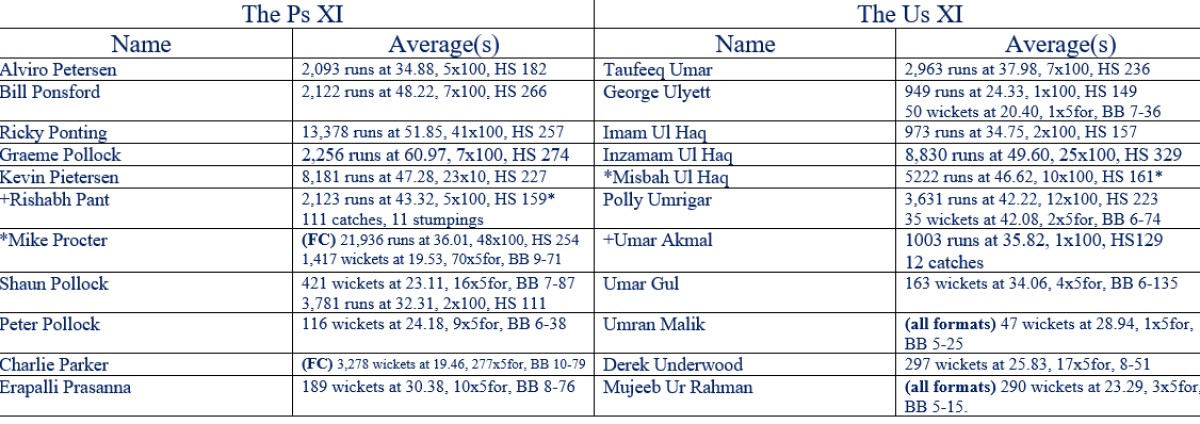
The Ps have an overwhelming superiority in batting and fast bowling, the better keeper and a captain at least the equal of his opposite number in that role. Underwood outranks Parker with the ball and it maybe that in time Ur Rahman will end up outranking Prasanna, but at the moment he is unproven. Nevertheless, I will concede that the Us win the spin bowling department, and allow them one big day out: Ps 4, Us 1.

THE Ps PROGRESS REPORT

The Ps have scored 15 points out of 25 today and move up to 64 points out of 100, 64%.

A BOOK REVIEW

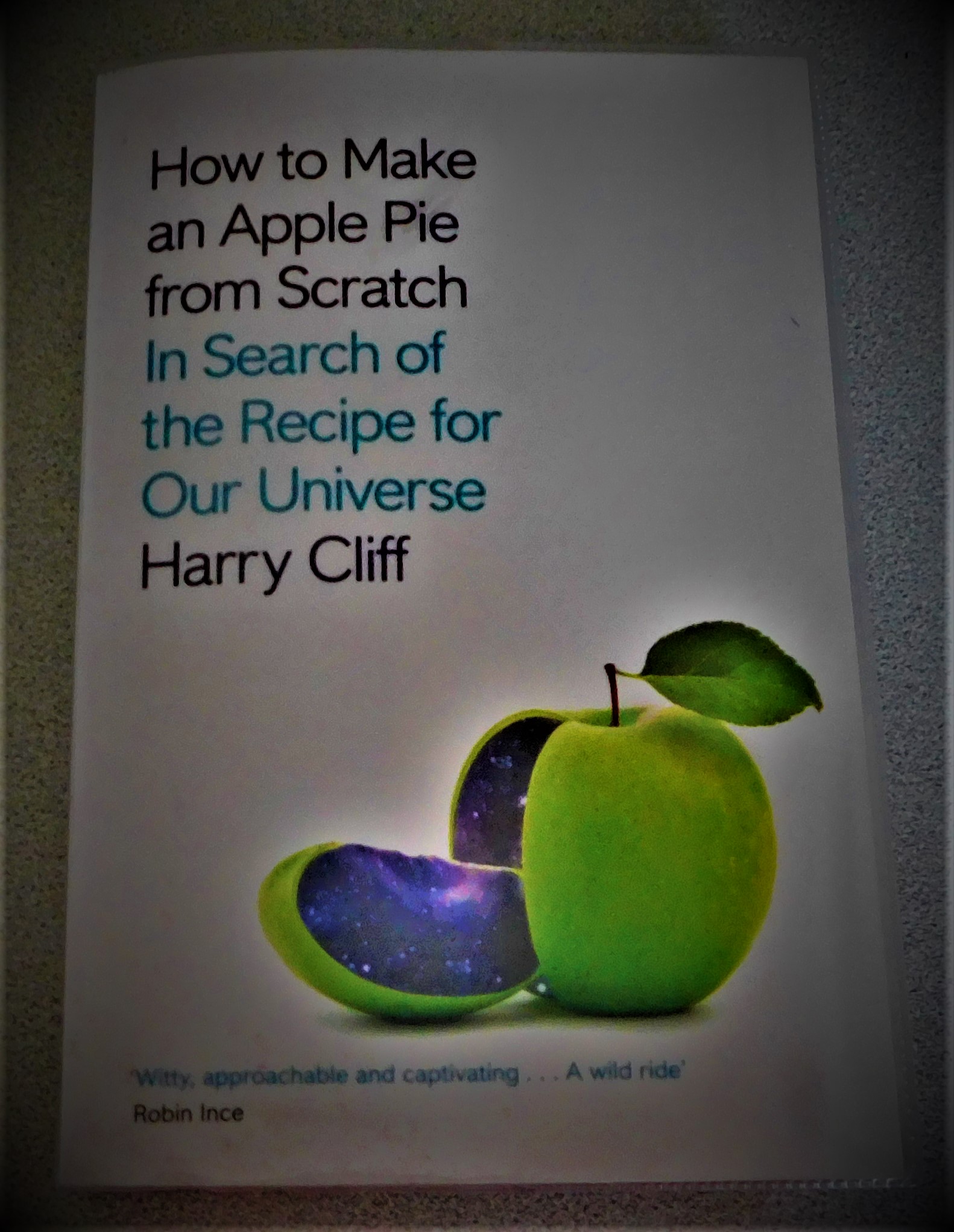
I have just finished reading “How to Make an Apple Pie from Scratch: In Search of the Recipe for Our Universe” by Harry Cliff, a quirky account of the current state of play in Particle Physics and Cosmology. I thoroughly enjoyed reading it and heartily recommend it.

CLIMATE CHANGE AT WORK

Bear in mind as you read this section that we are in the middle of November, and my home is roughly 100 miles north of London. This morning I walked into town by way of Bawsey Drain, and back by the route I use most frequently for this trip. On the outbound trip I saw a red admiral butterfly in a patch of nettles – a creature I have never previously seen in Norfolk any later than September. Then, on the homeward journey I saw a ruddy darter, a species of damselfly and hence even more out of place in Norfolk at this time of year, sunning itself (yes, a damselfly sunning itself in an English November, you read that right) on a brick wall.

PHOTOGRAPHS

Time for my usual sign off…

All Time XIs – Match Ups 49

Continuing my extended analysis of how the all time XIs I created for each letter of the alphabet fare against one another.

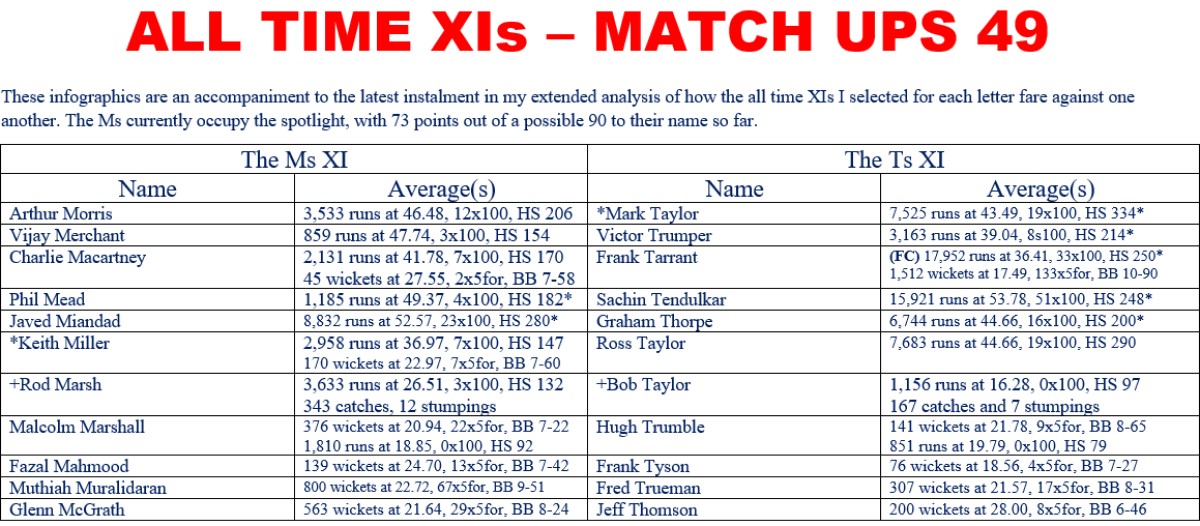
Welcome to the latest installment in my extended analysis of how the all time XIs I created for each letter fare against one another. The Ms continue to occupy the spotlight, starting today with 73 of a possible 90 points to their name.

THE Ms V THE Ts

Both these sides have strong opening pairs (Trumper played in the late Victorian and Edwardian eras, when pitches were often rough – that average of 39 is worth at least 50 in the modern era). Macartney wins the batting match up at number three, but Tarrant ranks as the greater bowler. The Ts comfortably win the number four slot, while the Ms win the number five slot. Ross Taylor outranks Miller as a batter, but unlike the Aussie he does not offer a bowling option). Marsh was a finer batter than Bob Taylor, but the Pom was the finer keeper. The Ts three specialist quicks are certainly faster than the Ms pace/ seam attack, though both sides are superbly equipped in this department. Murali outranks Trumble. The two sides are both strong in batting, strong in pace bowling, well captained and equipped with great keepers. I think Murali, Mahmood’s leg cutters and Macartney offer more variation between them than Trumble and Tarrant, though the latter two were both great bowlers, and this may be the factor that splits the sides, so I score this one: Ms 3, Ts 2.

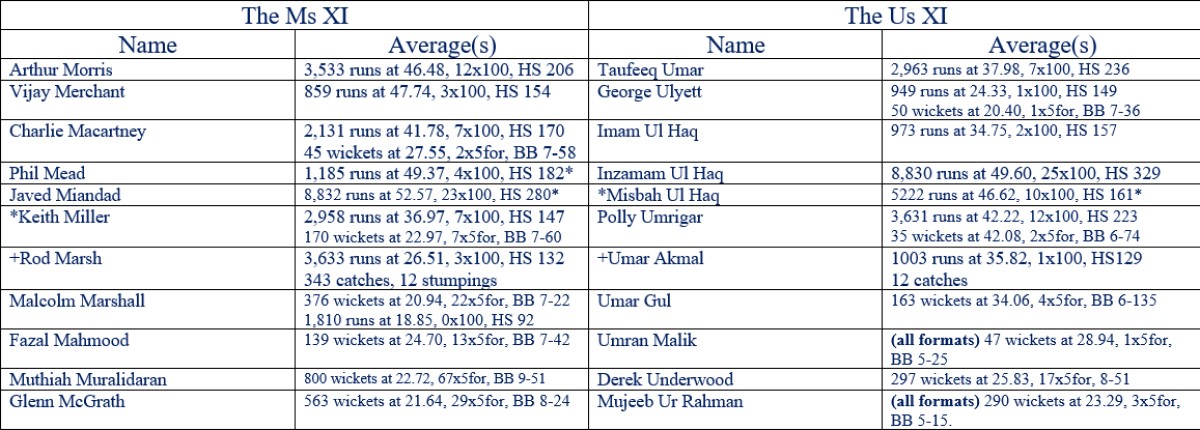
THE Ms V THE Us

The Ms are utterly dominant batting wise, with only Inzamam Ul Haq and Umar Akmal winning batting match ups for the Us, and Umar Akmal’s is negated by his being so inferior to Marsh as a keeper. Although Umran Malik is the quickest bowler in this match up he is as yet unproven, which means that all of Marshall, McGrath and Miller have to outrank him, as they equally clearly do Umar Gul and Ulyett. Murali likewise outranks Ur Rahman, though Underwood’s left arm slow medium may be considered more useful than Mahmood’s leg cutters. I cannot see the Us doing anything against the Ms and accordingly score this one Ms 5, Us 0.

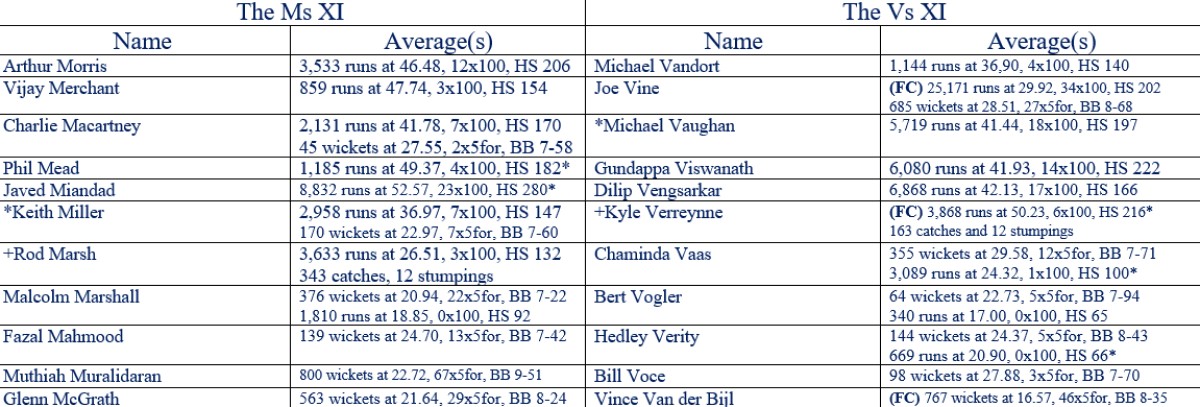
THE Ms V THE Vs

The Ms dominate the batting, with only Verreynne winning a batting match up for the Vs, and that is negated by Marsh being the superior keeper. The Vs have a pace bowling line up that is pretty much on a par with the Ms, given that a) Vaas would fare better as part of strong attack than he actually did as part of a moderate one, and b)Vaas and Voce were both left armers, whereas all three of the Ms outright fast bowlers were right armers. Verity outranks Murali as a finger spinner, while Vogler’s leg spin would probably be more dangerous than Mahmood’s leg cutters, while Macartney’s left arm spin and Vine’s leg spin are much of a muchness. On all except a spinning surface I would expect the Ms powerful batting to carry the day and accordingly score this one Ms 4, Vs 1.

THE Ms V THE Ws

The Ms have the better opening pair, though Woolley offers a bowling option comparable to Macartney and Worrell offers a bowling option not mirrored in the Ms ranks. Weekes and Walcott each comfortably win their batting match ups, and S Waugh v Miandad is a dead heat. Watling slightly outranks Miller with the bat, but Marsh outranks him as a keeper. Woods outranks Marsh with the bat (Woods played in the 1890s and 1900s, and mainly in England, where pitches were often hard to bat on) and is on a par with Miller as a bowler. Whitty, Willis and Woods are pretty close to Marshall, McGrath and Miller as a pace trio, Wardle is at least a match for Murali, Warne is clearly ahead of Mahmood. I think the Ws have this, though not by a vast amount: Ms 2, Ws 3.

THE Ms V THE Xs

The Xs arguably win two batting match ups (DeXter over Macartney, though the latter offered more with the ball, and Xenophon Balaskas over Marsh) and the wicket keeping match up. The bowling is even more strongly stacked in the Ms favour, leading to an inevitable scoreline of Ms 5, Xs 0.

THE Ms PROGRESS REPORT

The Ms have scored 19 of a possible 25 points today, moving them on to 92 out of 115, exactly 80% so far.

PHOTOGRAPHS

My usual sign off…

All Time XIs – Match Ups 34

Continuing my extended analysis of how the all time XIs I created for each letter of the alphabet fare against one another.

Welcome to the latest instalment in my extended analysis of how the all time XIs I selected for each letter fare against each other. The Hs occupy the spotlight and have so far accrued 55 out of a possible 90 points. The Men’s T20 World Cup is just underway, and we have already seen two major upsets – yesterday Namibia beat current Asia Cup holders Sri Lanka by 55 runs, while early this morning UK time Scotland beat twice former winners the West Indies by 42 runs.

THE Hs V THE Ts

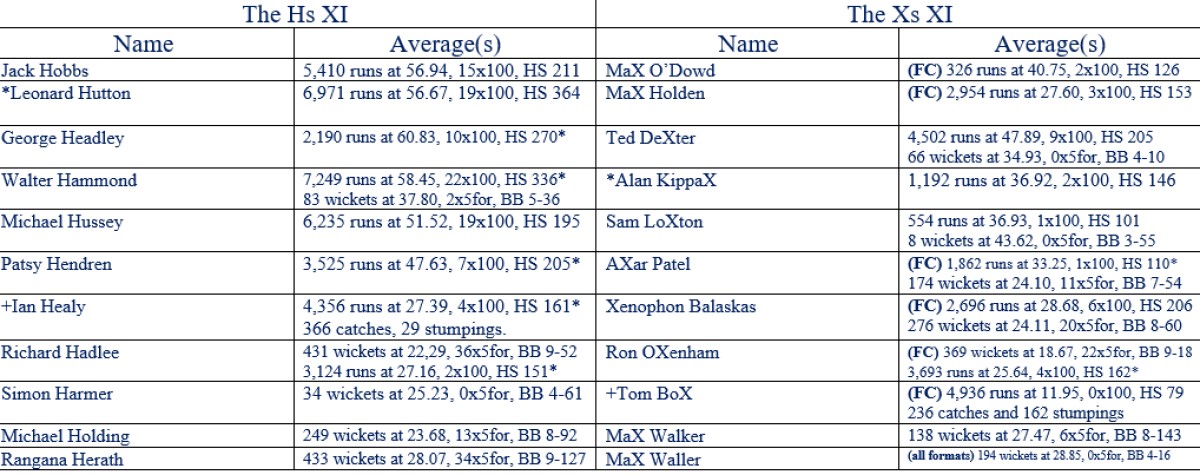
The Hs as usual dominate batting wise, though there are several factors that lessen that dominance. Taylor and Trumper are a right/ left opening combo whereas Hobbs and Hutton were both right handed, and in addition Trumper played on poorer pitches than any of the others. Second is that Tarrant offers a genuine top line bowling option, unlike any of the Hs top six. Tyson and Trueman are at least a match for Hadlee and Holding as a new ball pairing, while Thomson is miles clear of Hammond as third seamer. Trumble outranks Harmer, and for my money Tarrant outranks Herath as a bowler, though that contest is a close one. The Ts also have the better keeper. I don’t reckon that the Hs advantage in batting is enough to make up for their deficit in bowling and score this Hs 2, Ts 3.

THE Hs V THE Us

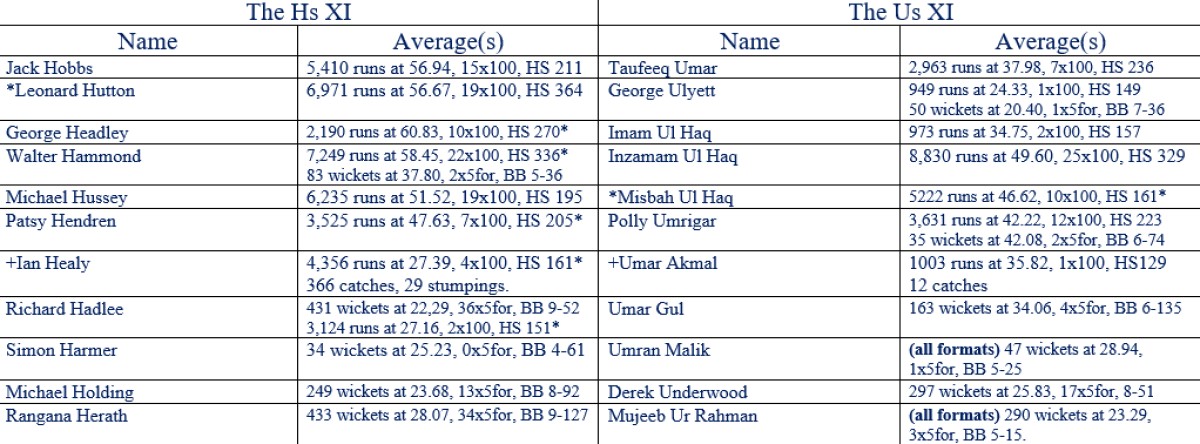
This one is not a contest at all – the Hs comfortably outrank the Us in all areas, leading to an inevitable scoreline of Hs 5, Us 0.

THE Hs V THE Vs

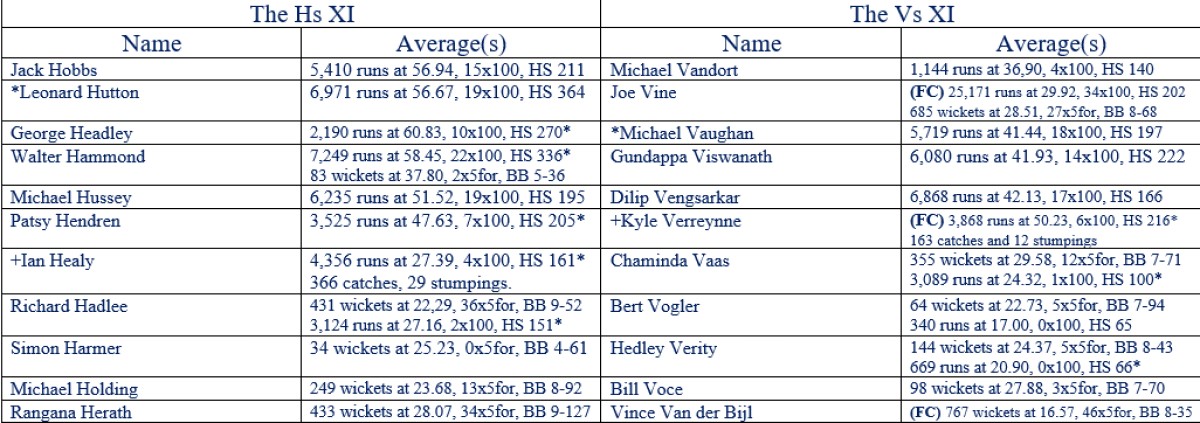
The Hs dominate the batting, and have the better keeper. Bowling wise is a very different story – Voce and Van der Bijl have to be considered at least the equal of Holding and Hadlee as a new ball pair, and Vaas far outranks Hammond as third seamer, especially given that he would be likely to fare even better as third seamer in a strong attack than he actually did as new ball bowler in a moderate one. Verity far outranks Herath, and for my money Vogler outranks Harmer. I think the Vs bowling advantage outweighs the Hs batting advantage: Hs 2, Vs 3

THE Hs V THE Ws

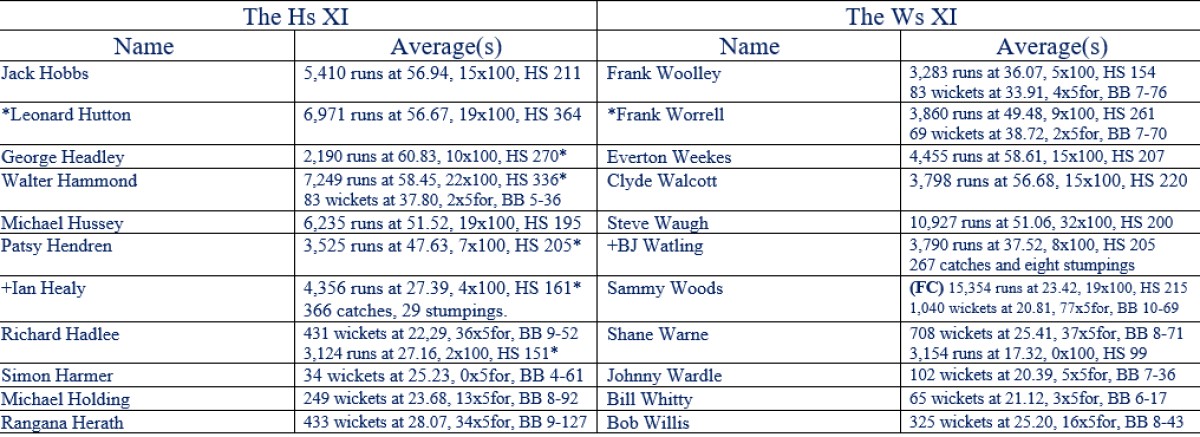
The gap between the opening pairs is reduced by the fact that the Ws have a left/ right opening combination as against two right handers. Nos 3-5 feature three titanic clashes, while Hendren wins the batting element of his match up at six and Healy wins the keeping element but loses the batting element of his match up to Woods (Woods played on the rough and ready pitches of England before WWI and would have averaged more playing today). Whitty and Willis would be at least as potent a new ball pair as Holding and Hadlee, and Woods comfortably outranks Hammond as third seamer. Warne far outranks Harmer, while Wardle is clear of Herath, and there is also Woolley to bowl left arm spin. The Hs have a small advantage in batting and a massive deficit in bowling: Hs 1, Ws 4.

THE Hs V THE Xs

The Hs are massively ahead overall, though the Xs do have decent spin bowling and they do have the better keeper. Still, the Hs superiority is so marked that there can only be one scoreline: Hs 5, Xs 0.

THE Hs PROGRESS REPORT

The Hs have scored 15 out of 25 today, putting them on 70 out of 115, 60.87% (yesterday’s percentage was incorrect – should have read 61.11%, not 55.56%).

PHOTOGRAPHS

My usual sign off…

Drama in Dhaka and a Photographic Walk

A personal account of the opening day’s play in Dhaka, and a photographic walk concentrating on trees. Some interesting links at the end.

INTRODUCTION

As well as my view on the opening day’s play in Dhaka which I listened to earlier this morning this post contains details of a walk around King’s Lynn that I took after play had finished and some interesting links.

DRAMA IN DHAKA

A wonderful opening day in the second Test Match between Bangladesh and England in Dhaka has finished with England 50-3 in response to Bangladesh’s first innings 220. When Tamim Iqbal and Monimul Haque were speeding along at four an over Bangladesh seemed to be headed for much for than 220, but Tamim’s dismissal shortly after completing a sparkling century triggered a collapse from the high water mark of 171-1 to 220 all out, Moeen Ali picking up five cheap wickets. The loss of Cook (captaining the England test team for record equalling 54th time), Duckett (just starting his international career) and Ballance (who has not been batting long enough lately for anyone to see what kind of form he is in) meant that by the close Moeen Ali was batting, and with some assistance from the weather he and Joe Root managed to hang on.

In some ways this match has similarities with Old Trafford 1902, when a lightning century from Victor Trumper (who reached the landmark before lunch on the first day) gave Australia a strong start which was then hauled back. Australia had a brief mid innings revival on that occasion and reached 299. England lost early wickets but then two middle order batsman, Len Braund and Stanley Jackson steadied the ship, the latter reaching one of his five test hundreds (all scored against Australia in England), and England were a mere 37 behind. A magnificent second innings bowling performance from England saw Australia all out for 86, and when England in pursuit of their target of 124 reached 92-3 the game appeared to be done and dusted, but then England panicked and started losing wickets, Clem Hill took a spectacular catch along the way, and suddenly debutant Fred Tate found himself going out to bat at 116-9 – he snicked one four, survived two further deliveries and was then comprehensively bowled to give Australia victory by three runs. If this match is as close I will be delighted, and as I stated in an earlier post, I will be particularly delighted if said close result goes against England because I believe that a victory against top table opposition for Bangladesh will be good for cricket as a whole.

To finish this section, although Bangladesh are pretty new to international cricket, Dhaka under its old name of Dacca has a much longer connection to the game, being one of the few cities to have hosted home games for two different countries. Going back further still, Bransby Beauchamp Cooper who played for Australia in the first ever test match in 1877 was born in Dacca.

A WALK FEATURING TREES

I got the idea for doing a walk in which I focussed mainly on trees at this transitional time of year from Anna, who put this post up recently (I recommend that you check the comments as well!). This then is my version of a tree walk…

SETTING OUT

As this first set of pictures, taken from my outside space show I don’t have far to go to be able to see trees:

dscn6889dscn6890dscn6891dscn6892

Heading across Baker Lane Car Park towards the Purfleet which I was then going to follow the Great Ouse provided these pictures:

dscn6893dscn6894dscn6895

A SOUPCON OF HISTORY AND ALONG THE RIVER

Since I wanted to be in  that vicinity to photograph trees on the other side of the river anyway I took one non-tree related photograph before heading along the river, and this set of pictures actually features a second. This stretch ended with a brief diversion from the river front to skirt Bole Quay.

dscn6896dscn6897dscn6898

dscn6899
The second non-tree related photo.

dscn6900
The view along Millfleet

dscn6902dscn6903dscn6904dscn6905

SKIRTING BOLE QUAY AND LEAVING THE RIVER

After skirting Bole Quay I briefly rejoined the river front, before leaving it by way of a path through Harding’s Pits.

dscn6905dscn6906dscn6908dscn6909dscn6910dscn6911dscn6912dscn6913dscn6916

HARDINGS PITS TO SEVEN SISTERS

From Hardings Pits I headed by way of the South Gate to Seven Sisters where I entered the parkland area.

dscn6917dscn6918dscn6919dscn6920dscn6921dscn6922dscn6923dscn6924dscn6925dscn6926dscn6927dscn6928dscn6929dscn6930dscn6931

THE PARKLAND

I headed from Seven Sisters to the Band Stand, and the from the Band Stand to St John’s Walk, which I followed until I left the parkland heading in the direction of the train station:

dscn6932dscn6933dscn6934dscn6935dscn6936dscn6937dscn6938dscn6939dscn6940dscn6941dscn6942dscn6943dscn6944dscn6945dscn6946dscn6947dscn6949

HOMEWARD BOUND

Even after leaving the parkland there were a few more photographs:

dscn6950dscn6951dscn6952dscn6953

dscn6954
Decorative brickwork above a pair of shops on Norfolk Street.

dscn6955
The upstairs portion of the building that houses an imaging business – I have never used it, but you can get digital photos printed here among other things.

LINKS

My first is a little gem from travel vibes on twitter, introducing the word thalassophile (not all readers of this blog are on twitter, and this is a goodie).

First the definition: Thalassophile (n): Lover of the sea, ocean. Here are the real reasons for posting this, the accompanying pictures:


Next come two autism related links:

  • As NAS West Norfolk Branch Secretary I am delighted to publicise NAS’s latest campaign “Close the autism employment gap”.
  • My second concerns the Kevin Healey petition calling on Brentwood County High School to expel a gang of bullies who have been preying on an autistic student. Since I put up a link to this petition in a previous post details have emerged of a second shocking case of bullying at the same school. For more details, please click here. As a coda it is sadly abundantly clear from the comments that bullying has been a major problem at this establishment for a long time and that the head teacher in particular and other senior staff have been taking the ‘ostrich’ approach to the problem.

My next link is to a campaign to secure better working conditions for Uber drivers (and now is a particularly good time to pile on the pressure as Uber have just taken a hit in court). Click here for more details and to support the campaign.

I give the final word to Britain’s youngest MP, Mhairi Black, here hammering Concentrix – and managing to be very funny in the process: