All Time XIs – Four Fast Bowlers v Balanced

A team with an attack of four fast bowlers is pitted against a fully balanced team. Also a solution to yesterday’s teaser and a link to an autism related thread, and of course some photographs.

INTRODUCTION

Welcome to my latest variation on an ‘all time XI‘ cricket theme. Today’s post owes its genesis to three twitter correspondents who raised valid points in response to yesterday’s piece. Rather than change yesterday’s XIs I have decided to acknowledge the validity of the comments by selecting two teams that enable to me to devote coverage to the issues raised.

THE FOUR FAST BOWLERS XI

When I covered the West Indies I named an attack of four fast bowlers in the West Indies team from my lifetime, as a tribute to the great West Indies teams of my childhood, which were based precisely on that type of attack. I now name an all-time team with the same type of bowling attack.

  1. Barry Richards – right handed opening batter, named by Don Bradman in his all-time XI (see “Bradman’s Best” by Roland Perry). The four tests that he played before South Africa’s enforced isolation (four more than any of his non-white compatriots in the period concerned save for Basil D’Oliveira, who managed to get to England) yielded him 508 runs at 72.57, with two centuries. He was subsequently one of the stars of Kerry Packer’s World Series Cricket.
  2. Herbert Sutcliffe – right handed opening batter. Statistically the most successful opener among those to have played 20 or more tests, with 4,555 runs at 60.73 at that level, including 2,741 at 66.85 in Ashes cricket. This upward progression of averages as the cricket he played got tougher bore out his famous response to being congratulated by Pelham Warner on a good rearguard action: “Ah, Mr Warner, I love a dogfight.”
  3. George Headley – right handed batter. Averaged 60.83 in test cricket, converting 10 of his 15 fifty-plus scores at that level into hundreds. I decided that to give either side Don Bradman would give them too big an edge, so he is not present today – instead we have ;the black Bradman’.
  4. Graeme Pollock – left handed batter. Averaged 60.97 at test level, a figure exceeded among thos to have played 20+ games only by Don Bradman and Adam Voges, the latter of whom was lucky in his opponents – his sole Ashes series was a poor one. A twitter correspondent yesterday suggested that he should have been in my non-county XI, and very constructively suggested I drop George Giffen to make way for him. I acknowledge the validity of the comments by naming him here.
  5. *Clive Lloyd – left handed batter and captain. 7,515 test runs, a century in the first men’s world cup final in 1975. He was the man behind the West Indies ‘four fast bowlers’ strategy that propelled them to the top of the cricket world and kept them there for a long time. As such there could be no better captain for an ‘all time’ squad whose chief feature is an attack of four fast bowlers. A twitter correspondent suggested that I could have found a place for him in yesterday’s best overseas county player team, again a perfectly valid suggestion, and I hope his presence here in the role he played so successfully IRL will be taken as a suitable acknowledgement.
  6. Steve Waugh – right handed batter. Probably the finest ever to be a regular no 6. He played 168 test matches, and in spite of not reaching three figures until the 27th of those he ended up with a batting average of over 50. His twin tons at Old Trafford in conditions with which none of the 21 other batters in that match came to terms were a particularly outstanding example of his toughness and determination.
  7. +Adam Gilchrist – left handed batter, wicket keeper. Statistically the greatest keeper batter ever to play test cricket.
  8. Wasim Akram – left arm fast bowler, left handed lower middle order batter. His record speaks for itself.
  9. Malcolm Marshall – right arm fast bowler, right handed lower middle order batter. Probably the greatest fast bowler of the golden age of West Indies fast bowling.
  10. Curtly Ambrose – right arm fast bowler. The lowest bowling average of any bowler to have taken over 400 test wickets. A twitter correspondent yesterday queried the absence of Joel Garner from my overseas county stars team, and suggested that perhaps I was placing too much stress on balance: “with Macko and Bird bowling together do you need balance?” While not wholly agreeing I acknowledge that the objection had weight (after all, I did include Garner in my Somerset team), and the selection of this side is an acknowledgement that one can rely exclusively on fast bowling. Rather than ‘big bird’ I opted for another extra tall fast bowler whose record was even better.
  11. Waqar Younis – right arm fast bowler. His ability to produce greased lightning yorkers seemingly on demand led cricket journalist Martin Johnson to write “when a pitch does not favour him, Waqar Younis does not bother to use it.” At one time he was probably the fastest in the world, and his great record stands as testament to his overall effectiveness.

This side has an awesome top six, a fabulous keeper batter and four awesome specialist fast bowlers. In Clive Lloyd they have the perfect captain to handle an attack thus constituted, and their opponents will need to be on their mettle to have a chance.

THE BALANCED XI

  1. Jack Hobbs – right handed opening batter. Known universally as ‘The Master’, he tallied 61,237 first class runs with 197 centuries, both all time records. He still holds the England records for Ashes runs and centuries, with 3,636 and 12 respectively, the last made at the age of 46 making him test cricket’s oldest ever centurion.
  2. Bert Sutcliffe – left handed opening batter. The Kiwi’s most astounding performance came for Otago versus Canterbury, when he scored 385 in an all out tally of 500, and Canterbury in their two innings combined managed 382 off the bat all told! On the 1949 tour of England he aggregated more first class runs than any other tourist save only for Bradman. Given his left handedness and the challenge posed by pairs comprise one left and one right handed batters, and his outstanding skill there is every reason to believe that this Hobbs/Sutcliffe opening pair would be every bit as effective as the original.
  3. Frank Woolley – left handed batter, left arm orthodox spinner, brilliant close fielder. The only cricketer to have achieved the career first class treble of 10,000 runs, 1,000 wickets and 1,000 catches, and indeed the only outfielder ever to have taken 1,000 catches.
  4. *Frank Worrell – right handed batter, occasional left arm medium fast. The first black captain of the West Indies, and he led them to the top of the cricket world. Before his time success had been something of a rarity for the West Indies. CLR James contributed a chapter on him to “Cricket: The Great Captains”, and also gives him extensive coverage in “Beyond a Boundary”, and the name Worrell occurs again and again in the pages of the collection of CLR James writings titled simply “Cricket”.
  5. Walter Hammond – right handed batter, right arm medium fast, ace slipper. The first ever to reach 7,000 test runs (7,249 at 58.45), the first fielder to pouch 100 test catches and sometimes useful with his bowling as well. He scored seven test match double centuries, four of them against the oldest enemy – 251 and 200 not out in successive matches in 1928-9, 231 not out in 1936-7 and 240 at Lord’s in 1938, which stood for 52 years as the highest score by an England captain.
  6. Garry Sobersleft handed batter, every kind of left arm bowler known to cricket, brilliant fielder. The most complete all rounder there has ever been. He is the fulcrum of this side, enabling it to have a vast range of options.
  7. +Leslie Ames – wicket keeper, right handed batter. The only recognized keeper to have scored 100 first class hundreds, holds the record for most career stumpings (over 400 of them, to go with 700 catches). In two of the first three years in which the Lawrence trophy for the fastest first class hundred of the season Ames won it (the intervening time it went to another Kent legend Frank Woolley).
  8. Frank Tyson – right arm fast bowler. I covered him in my Northamptonshire piece. Suffice to say that he was probably the quickest there has ever been.
  9. Sydney Francis Barnes – right arm fast medium bowler. Probably the greatest of all bowlers. 27 test matches yielded him 189 wickets at 16.43 each. His special weapon was a leg break delivered at fast medium pace, beautifully described by Ian Peebles, himself a former test bowler, in a piece titled “Barnes The Pioneer” which appears in “The Faber Book of Cricket”.
  10. Muttiah Muralitharan – off spinner. The all time leading taker of test wickets, with 800 of them at a rate of just about six per game (Barnes had he played the same number of tests and maintained his wicket taking rate would have had approximately 930 test wickets). His 16 wickets on a plumb Oval pitch in 1998 (England batted first, Sri Lnaka scored nearly 600 in between the two England efforts) remains the greatest match performance I have ever seen by bowler. Two years before that he had been one of the heroes of the Sri Lankam world cup winning side, which relied as much on its phalanx of spinners not getting collared as it did on its dazzling batting line up. 
  11. William Mycroft – left arm fast bowler. He never got to play test cricket, his prime years coming just too early for that (and I mean just – in 1876 he took 17 wickets in a match against Hampshire, which Hampshire sneaked by one wicket). I note that he played for a county who have always been unfashionable (Derbyshire), and that 138 first class games yielded him 863 first class wickets at 12.09 each. I believe he would be even more devastating as part of the attack I have created here than he actually was. His brother Thomas was a wicket keeper, and this combination and the Nottinghamshire pair of fast bowler Frank Shacklock and keeper Mordecai Sherwin may well have been the inspiration for the names of Sherlock and Mycroft Holmes (Arthur Conan Doyle was a cricket fanatic, and a very useful cricketer, some times turning out for MCC, and at least once accounting for WG Grace, albeit his bowling was not required until that worthy had 110 to his name). His presence alongside Tyson means that this side have some heavy weaponry of their own to counter the pace onslaught, as India did not in 1975-6, nor England in 1976, 1980 or 1984.

This side has a strong and varied top five, the greatest of all all rounders at six, a legendary keeper batter at seven and four superbly varied bowlers. The bowling, with Mycroft, Tyson, Barnes and Muralitharan backed up by Sobers, Woolley, Hammond and Worrell has pretty much every base covered.

THE CONTEST

This would be an epic contest. The toss would hardly be needed, since Lloyd would probably want to bowl first and Worrell would definitely want to bat first. Although I acknowledge that as exemplified by the West Indies under Lloyd a team with four fast bowlers can be well nigh unbeatable I am going to predict that it is Frank Worrell’s side who would emerge victorious.

SOLUTION TO TEASER

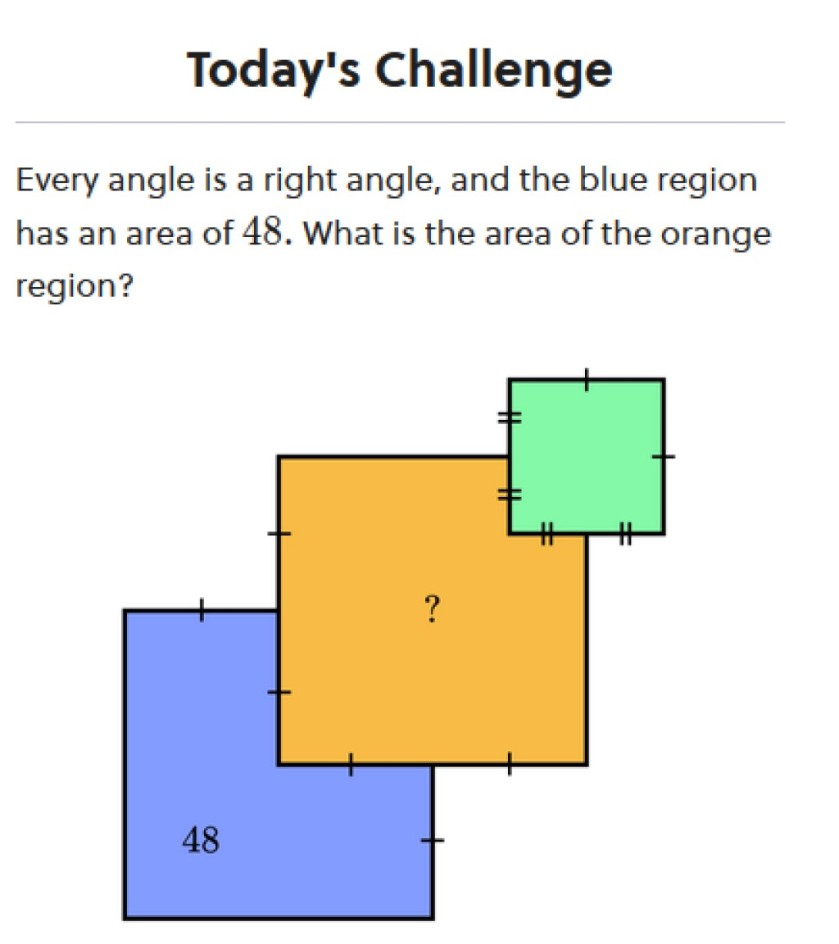
Yesterday I offered up the following from brilliant:

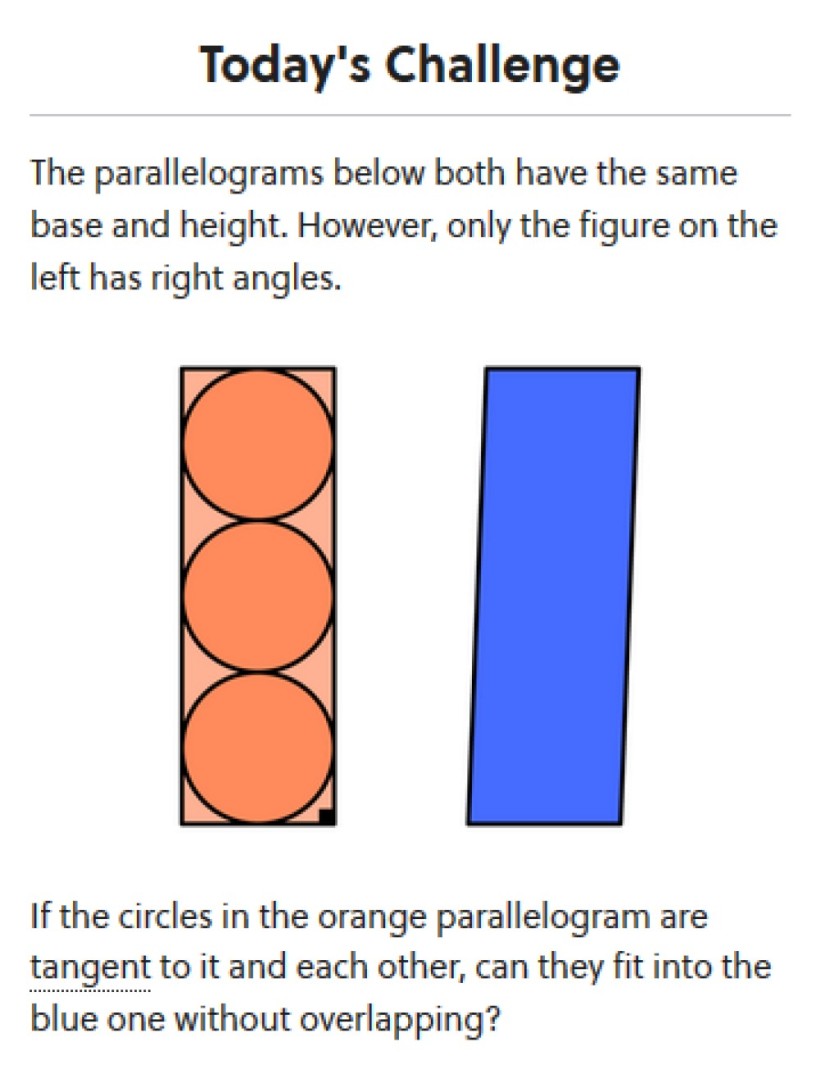
I got the the correct answer by first identifying the size of the large square from which the ‘L’ section comes – it is 16 by 16. I then counted backwards round the spiral to arrive at the size of the next largest square in the relevant segment – 12 X 12. So the answer we are looking for, for the area of the ‘L’ section is (16 x 16) – (12 x 12), which is equal to 256 – 144 = 112 units. NB – it took me less long to do the actual working out, which I did in my head, than it has to type this explanation.

A LINK AND PHOTOGRAPHS

Our two contending XIs have been introduced, I have provided a solution to the teaser I posed yesterday, which leaves on one thing to do before applying my usual sign off. Pete Wharmby has produced a superb thread about ‘functioning labels’ in relation to autism. His advice is the autism equivalent of Darwin’s famous note to himself about evolutionary biology: “avoid the words higher and lower.” I urge you to read his piece in full, which you can do here. Now for my usual sign off…
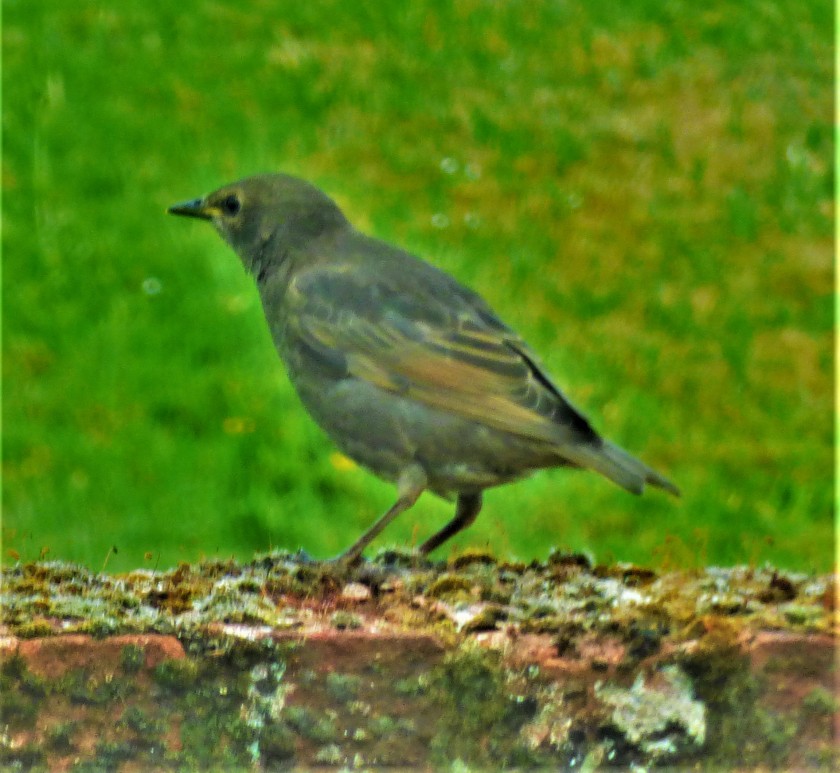
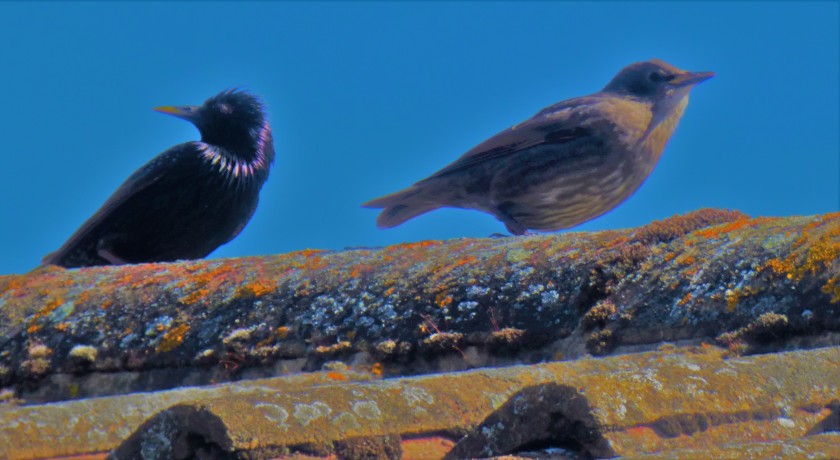
P1320719 (2)P1320722 (2)P1320723 (2)P1320727 (2)P1320728 (2)P1320729 (2)P1320731 (2)P1320732 (2)P1320734 (2)P1320736 (2)P1320736 (3)P1320737 (2)P1320738 (2)P1320739 (2)P1320740 (2)P1320741 (2)P1320742 (3)P1320743 (2)P1320744 (2)P1320745 (2)P1320746 (2)P1320747 (2)P1320749 (2)P1320750 (2)P1320751 (2)P1320752 (2)P1320754 (2)P1320755 (2)P1320755 (3)P1320756 (2)

P1320757 (2)
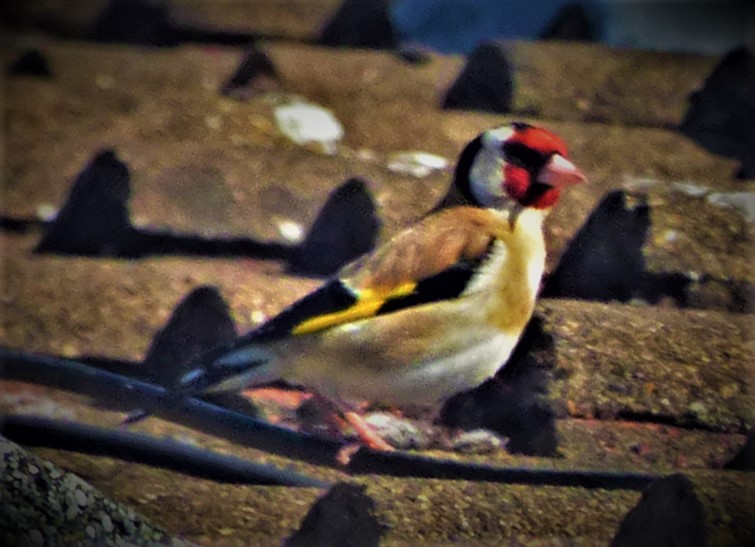
A Black Headed gull.
P1320758 (2)
The beak is a slightly darker maroon than a well looked after West Indies cap.

P1320759 (2)

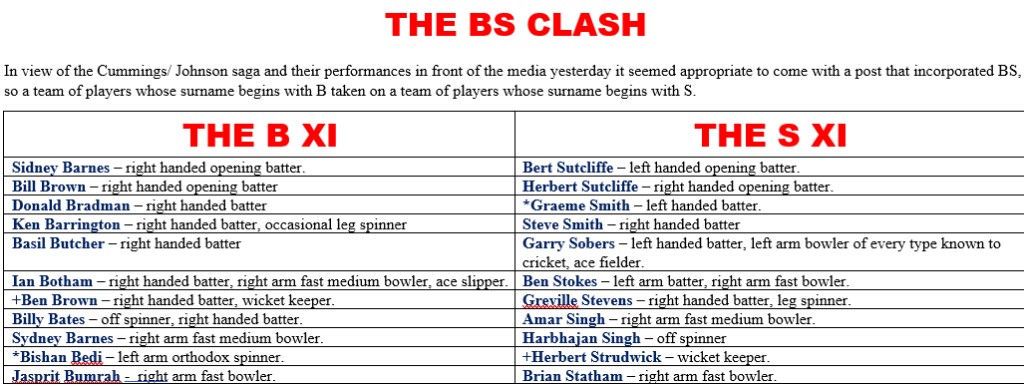
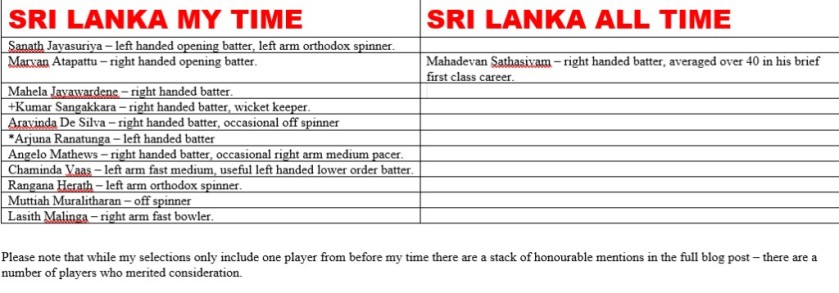
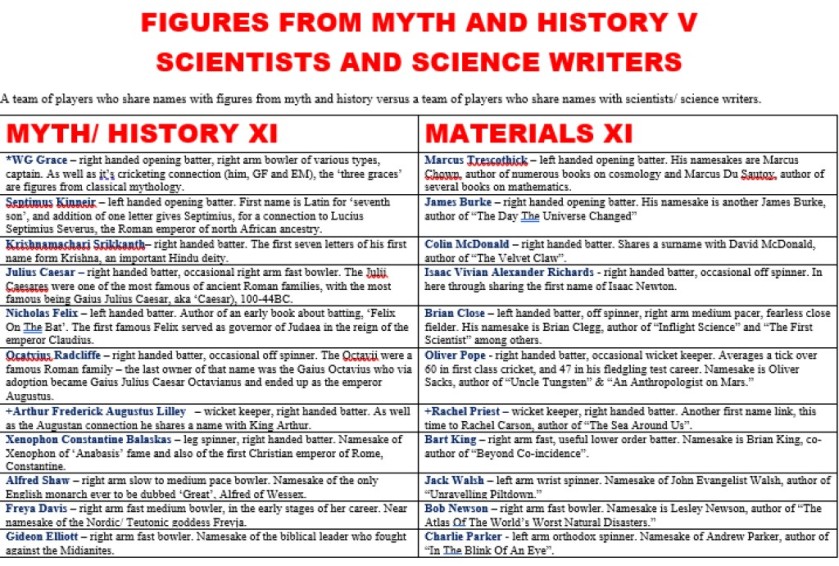
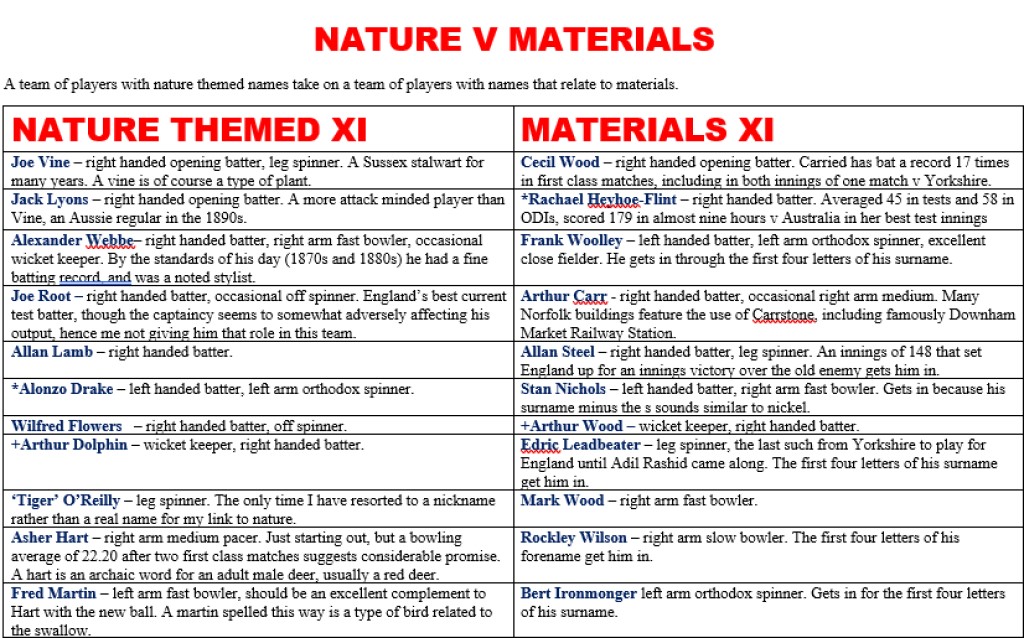
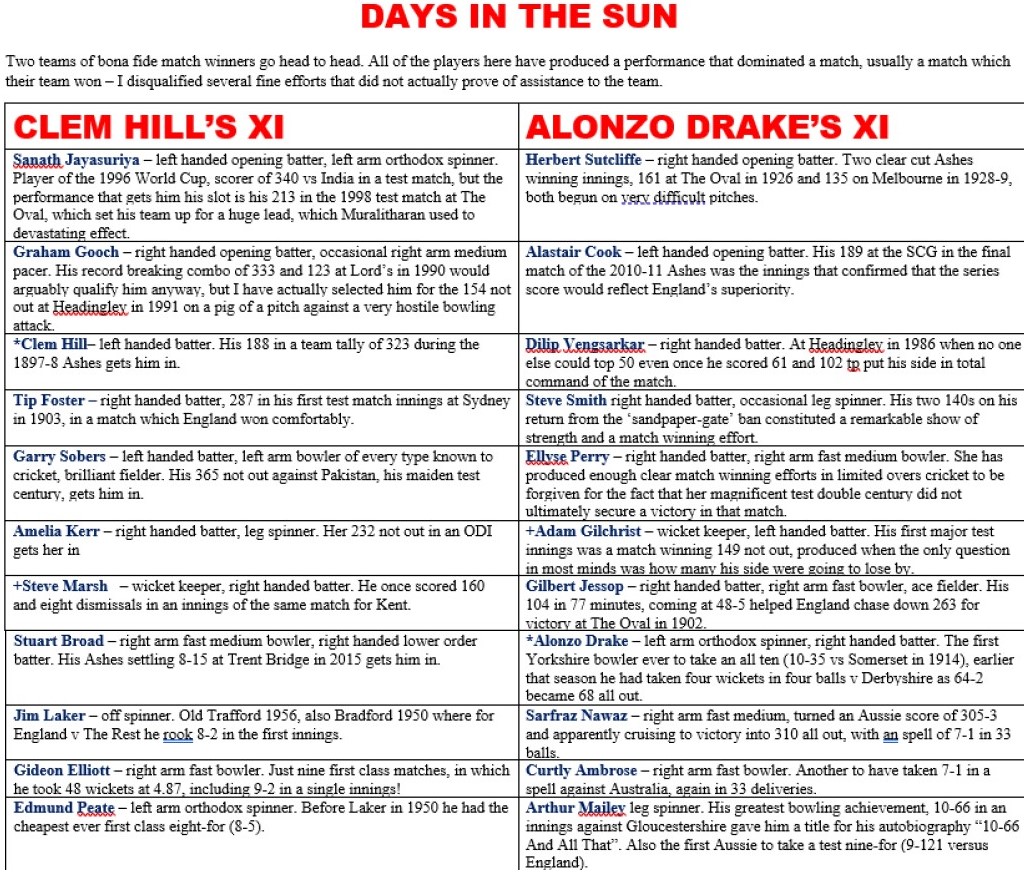
Pace v Balanced
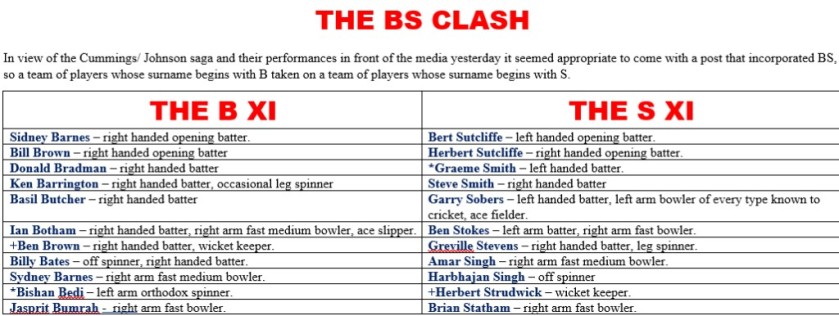
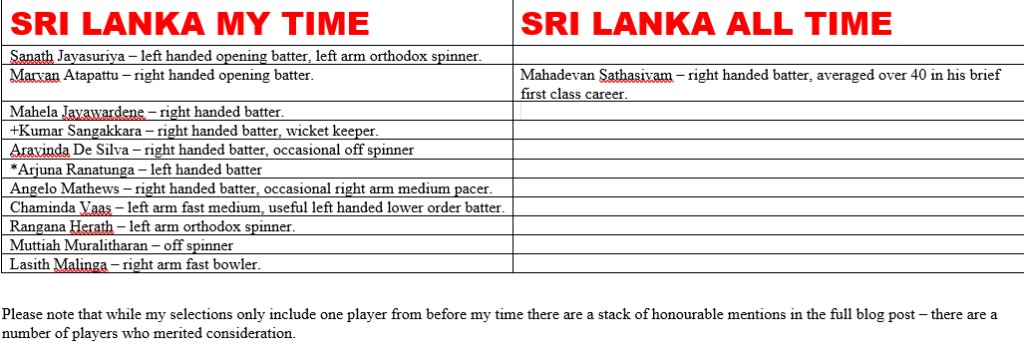
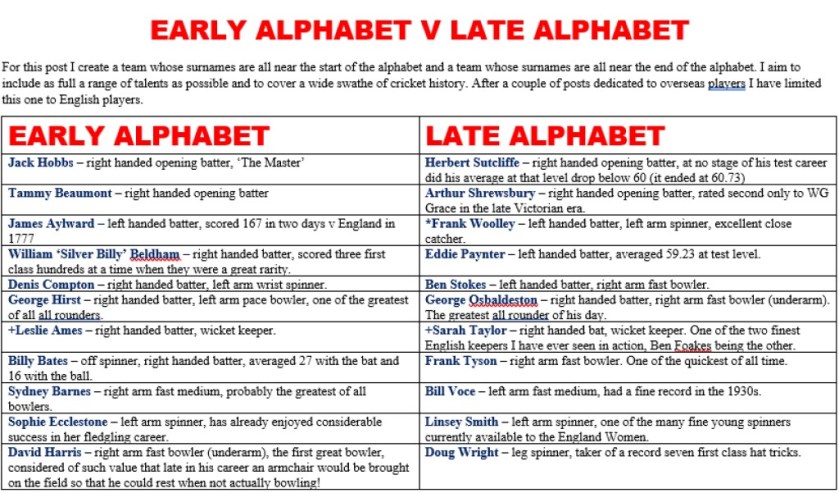
The team in tabulated form.


All Time XIs – Overseas Stars

Today is overseas players day as an XI of the best county overseas players to on an XI of the best overseas players not to play for counties. Also features a very important petition, a measure of mathematics and some very interesting links, as well as my usual photographs.

INTRODUCTION

Welcome to my latest variation on the All Time XI cricket theme. Today overseas players have the floor, as I pit a team of the best county overseas players against a team of overseas stars who were not county players.

THE COUNTY OVERSEAS PLAYERS

  1. Barry Richards – right handed opening batter. Played for Hampshire for many years, producing a number of extraordinary performances. See my recent South Africa post for more about him.
  2. Roy Marshall – right handed opening batter, occasional off spinner. The Barbadian scored a huge number of runs for Hampshire, and the speed with which he scored them was a crucial factor in Hampshire’s first ever County Championship, when he several times led successful run chases.
  3. Brian Lara – left handed batter. The holder of the highest individual scores in both test and first class cricket, the latter made for Warwickshire against Durham in his and their record breaking 1994 season.
  4. Viv Richards – right handed batter, occasional off spinner. An all-time great who featured in my West Indies team but had to make do with an honourable mention in the Somerset post due to my selection policies regarding overseas players.
  5. *Allan Border – left handed batter, occasional left arm orthodox spinner. The Aussie was as respected for Essex as he was in native land.
  6. Garry Sobers – left handed batter, left arm bowler of every kind known to cricket, brilliant fielder. The most complete all rounder ever to play the game, he played for Nottinghamshire for a number of years.
  7. +Stewart Dempster – right handed batter, wicket keeper. One of the most talented cricketers ever to come from New Zealand, he averaged 65.72 in his brief test career before signing up to play for Leicestershire, whom he served well for a number of years.
  8. Richard Hadlee – right arm fast bowler, left handed attacking middle order bat. The Kiwi legend was also outstanding for Nottinghamshire over a number of years. In 1984 he achieved the double of 1,000 runs and 100 wickets in the first class season, the first time it had been done since the reduction of first class fixtures to make space for the John Player League in 1969. Could such a ‘double’ be achieved in a 14 game first class season such as has been the case in England in recent years? Yes – WG Grace once had a run of 11 matches in 1874 in which he achieved the feat, but anyone who does manage it will achieve a feat comparable to the great George Hirst’s 1906 season when he scored 2,385 first class runs and took 208 wickets, the only ever season’s ‘double double’.
  9. Malcolm Marshall – right arm fast bowler, right handed lower order batter. The biggest haul of wickets in a first class season since the reduction of fixtures referred to above is 134, taken by Marshall for Hampshire, for whom he played over the course of a number of years.
  10. Shane Warne – leg spinner, right handed lower order batter. Our fourth player with a Hampshire connection and the greatest leg spinner of the modern era.
  11. Ted McDonald – right arm fast bowler. One half of the first great pair of fast bowlers in test history along with Jack Gregory, and the first truly great player to come from Tasmania (with due respect to Charles Eady who once took a seven-for and then scored 566 in a club final, and to Kenny Burn, selected for an England tour as reserve keeper after a misunderstanding – he was a specialist batter, and his brother was a keeper), he then signed up to play as a Lancashire League pro and ultimately signed for the county, and was fast bowling spearhead for them during their greatest ever period, the second half of the 1920s. In 1930 when Bradman was taking all the headlines McDonald greeted the boy wonder by rolling back the years, posting five slips, making the ball fly and dismissing him for nine.

This XI features a stellar top five, the greatest of all all rounders, a keeper-batter and four fabulous and varied bowlers. The batting is very deep with Shane Warne due to come in at no 10, and the three fast bowlers, Hadlee, Marshall and McDonald backed by Warne and Sobers with Roy Marshall, Richards and Border in reserve looks like a superb bowling attack as well.

THE NON-COUNTY XI

  1. Arthur Morris – left handed opening batter, named by Bradman as the best he ever saw.
  2. George Headley – right handed batter. He was known as ‘the black Bradman’, and his average at test level was 60.83. He usually batted three, but the West Indies so often lost an early wicket that he was effectively opening anyway,  so I have promoted him to do that job, making way for…
  3. *Donald Bradman – right handed batter, the best ever.
  4. Everton Weekes – right handed batter. He averaged 58 in test cricket, including five successive centuries. He also played Bridge for his native Barbados.
  5. George Giffen – right handed batter, right arm medium/ off spin. An all-rounder whose deeds saw him dubbed ‘the WG Grace of Australia’, his most astounding match performance came at the expense of Victoria when he hit 271 and then took 7-70 and 9-96. In the 1894-5 Ashes he scored 475 runs and took 34 wickets, still finishing on the losing side. I decided that my top four here were so strong that I could afford to start the all rounders at no 5, naming two as compensation for the presence of Sobers in the ranks of the opposition.
  6. Keith Miller – right handed batter, right arm fast bowler. Australia’s greatest ever all rounder. 2,958 test runs at 36.97 and 170 wickets at 22.97 at that level.
  7. +Adam Gilchrist – left handed batter, wicket keeper. Statistically the best keeper batter in test history.
  8. Fazal Mahmood – right arm fast medium bowler. His size and build combined with his mastery of the leg cutter led to him being labelled ‘the Bedser of Pakistan’. He took 12 wickets in the match when Pakistan achieved their first test victory. His test average per wicket was 24 for 139 wickets, while his fast class wickets came at 18.96 each.
  9. Dennis Lillee – right arm fast bowler. He did play a few games for Northamptonshire, but he was not a regular county cricketer. He took a then record 355 test wickets from 71 appearances at that level, 167 of them against England.
  10. Palwankar Baloo – left arm orthodox spinner. I wrote about him in my piece on India. I consider his 179 wickets in 33 first class games at a mere 15.21 each doubly outstanding because he contended against caste prejudice all his life (he was one of three ‘untouchables’ who negotiated the pact that ended Gandhi’s fast against separate electorates for depressed castes) and because Indian cricket was chiefly known for tall scoring rather than for any sort of bowling success.
  11. Clarrie Grimmett – leg spinner. He crossed the Tasman from his native New Zealand, and then twice moved states in his new adopted home before establishing himself as a first class cricketer. In consequence of this circuitous route to the top he was 33 years old when he finally got to don the baggy green. He took 11-82 on test debut v England and never looked back. In all he played 37 test matches and took 216 wickets, his career at that level ending when he was passed over for the 1938 tour of England, but he was still taking big first class wicket hauls two seasons later than that. In all first class cricket he captured 1,424 wickets, a record for anyone who never played county cricket (we met no2 on this list yesterday), from 248 appearances, averaging over 5.7 wickets per match.

This team has a top four with a combined average of approximately 267 at test level, two quality all rounders at five and six, a great keeper batter at seven and four excellent and varied bowlers. The bowling, with Lillee and Miller as outright fast bowlers, Fazal Mahmood’s cutters, Baloo and Grimmett as specialist spinners plus Giffen also looks highly impressive.

THE CONTEST

These are two awesomely strong and well balanced sides, and the only thing I can say for sure about the contest is that it would be an absolute humdinger.

A SOLUTION AND A NEW PROBLEM

Yesterday I offered you a little teaser from brilliant.org

This is how I resolved this:

  • The bottom shape is a right angled triangle and we are told that all angles of the same colour are identical. This means that 180-90 = 3x yellow angle, so yellow angle = 90/3 = 30 degrees.
  • The four top left triangles together form an angle of 180 degrees, and three of the four contain the blue angle, while the other contains the yellow angle, established at 30 degrees, so (180-30)/3 = blue angle, this simplifies to 150/3 = blue angle = 50 degrees.
  • The big central triangle is a right angled triangle with a blue angle and the green angle. Since the internal angles of a triangle sum up to 180, 90 + 50 + green =180, which means that the green angle that we are looking for is 180 – (90 + 50) which equals 40 degrees.

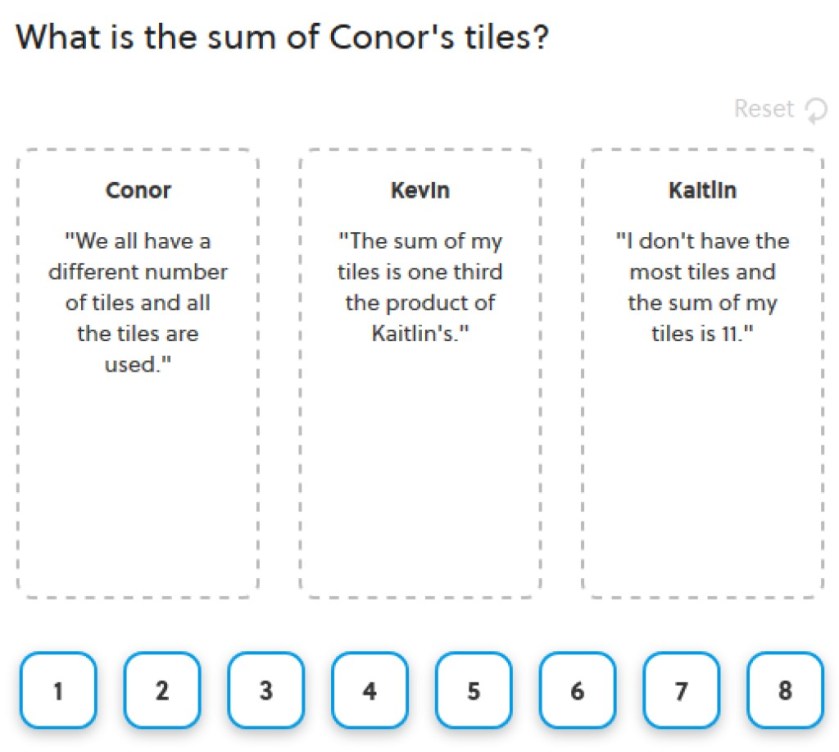
From the same source comes another teaser, this time on the theme of pattern recognition:

Square spiral

As with the previous one this was originally multiple choice but I am just leaving you to work out the answer.

AN IMPORTANT PETITION

A petition seeking justice for Belly Mujinga, a transport worker who died after being spat at by someone who knew they had covid-19, is running on change.org. There was a second victim of this despicable assault who did not die, so when the perpetrator is found they should face a charge of attempted murder as well as one of murder. Please sign and share the petition by clicking on the screenshot below.

Mujinga

LINKS AND PHOTOGRAPHS

Just a few links before it is time for my usual sign off:

  • Marina Hyde hits top form on the subject of Johnson apparently needing a baying mob behind him to be able to handle Prime Ministers Questions, with this splendid piece in The Guardian.
  • Elizabeth Dale who runs a blog called Cornish Bird which is devoted to revealing some of the less well known parts of her home county has a splendid post up at the moment about St Loy Cove, Penwith.
  • National Geographic have a post up at the moment introducing the guina, a tiny South American wild cat weighing just six pounds and in danger of extinction.
  • Finishing these links where we started, with The Guardian, Lucy Jones has a piece titled “Noticing nature is the greatest gift you can get from lockdown“, which is both an excellent read, and an appropriate place from which to provide my usual sign off..

P1320698 (2)P1320700 (2)P1320701 (2)P1320702 (2)P1320704 (2)P1320705 (2)P1320706 (2)P1320707 (2)P1320708 (2)P1320709 (2)P1320710 (2)P1320711 (2)P1320712 (2)P1320714 (2)P1320715 (2)P1320716 (2)P1320717 (2)P1320718 (2)

Overseas
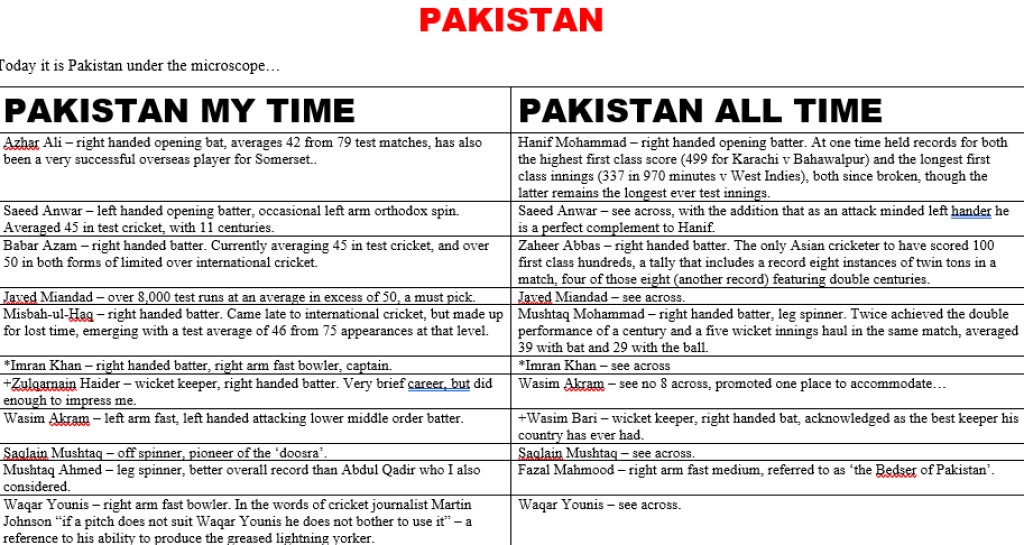
The teams in tabulated form.


All Time XIs – Scientists v Novelists

My latest variation on the all time XI cricket theme pits a team of cricketers who share names with famous scientists against a team who share names with famous writers of fiction.

INTRODUCTION

Another day sees another variation on the all time XI cricket theme. Today we pit a team of cricketers who share names with famous scientists against a team of cricketers who share names with famous novelists. In all bar two cases the shared name is a surname. As per usual I have not selected anyone purely because their name fits. I am well aware that some very eminent scientists also wrote novels – Carl Sagan’s “Contact” is on my shelves to name but one.

THE SCIENTISTS XI

  1. John Rutherford – right handed opening batter. He was the first Western Australian to be selected for his country, being picked for the 1956 tour of England. Although he failed, in common with most of his team mates, on that tour he had a very respectable first class record, and probably should have been given the opportunity to perform on home soil. His scientific namesake is Ernest Rutherford, born on the other side of the Tasman, and justly famous for his work on the atomic nucleus, and having the element Rutherfordium named in his honour.
  2. Navjot Singh Sidhu – right handed opening batter. At a time when his country found it hard to find anyone to go in against the new ball Sidhu did so and recorded a very respectable average. Although he was better against the quicks he could give mediocre spin and absolute walloping, as John Emburey and Ian Salisbury discovered to their cost on the 1992-3 tour of India. The scientist with whom he shares a name is Simon Singh, author of books that include “Fermat’s Last Theorem”  and “Big Bang”.
  3. Geoff Marsh – right handed batter. A first class triple centurion, and a fine test record as well. Among the many humiliations the 1989 Aussies inflicted on the disorganized and inadequate rabble masquerading as “England” that year Marsh and his left handed partner Taylor became only the second opening pair in Ashes history (after Hobbs and Sutcliffe who did so at Melbourne in 1924 in response to a total of 600) to bat through a whole day’s play – by tea on day 2 England had captured precisely two wickets in five uninterrupted sessions of bowling, before Australia did lose some wickets after that interval as they hustled to a declaration at 602-6, enough to win by an innings and plenty. Two sons, Shaun and Mitchell Marsh have also represented Australia with some success, although neither have a record to place them in the very top bracket. The scientist to whom Geoff owes his selection in this XI is palaeontologist Othniel Charles Marsh, who identified and catalogued a vast number of fossil species in the course of his long and distinguished career.
  4. Derek Randall – right handed batter, brilliant fielder. The heavy scoring Nottinghamshire batter was often made to bat right up at the top of the order for England, a role to which he was not best suited, though he did deliver one Ashes winning innings at no3, a nine and a half hour 150 in scorching heat at Sydney in the 1978-9 series. His speed around the field earned him the nickname ‘Arkle’ in honour of one the most famous racehorses of the time. His scientific namesake is cosmologist Lisa Randall, who I first came across in a wonderful little book by another cosmologist, Janna Levin, titled “How The Universe Got Its Spots”.
  5. Ian Bell – right handed batter. A superb timer of the ball, it often did not look like he had really hit the ball until one saw it speeding to the boundary. He overcame an early reputation for being somewhat soft to become for a period one of the most respected middle order batters in world cricket. His matching scientist is Jocelyn Bell, later Jocelyn Bell Burnell, who discovered the first pulsar. She was scandalously deprived of the Nobel Prize this warranted as the committee decided to give sole credit to her supervisor Anthony Hewish, when at best he deserved a share of the award, though I personally would have limited him to an honourable mention in the citation.
  6. +John Hubble – wicket keeper, right handed batter. One of a succession of top drawer keepers that Kent have had down the years, he initially got into the side as a batter, while Fred Huish retained the gloves, but after World War 1 and before the rise of Ames who continued the sequence (which runs on through Evans and Alan Knott to Oliver Graham Robinson of today) he was keeper as of right. His scientific alter ego is of course Edwin Powell Hubble, discoverer of the red shift phenomenon and prover that ours is not the only galaxy in the universe, after whom the Hubble constant and the Hubble space telescope are named. Hubble was able to achieve what he did in no small part due to the hard and largely unheralded work of human ‘computer’ Henrietta Swan Leavitt.
  7. James Franklin – left handed batter, left arm medium fast bowler. The Kiwi who played for Middlesex for a number of years, fully merits his place as all rounder – at his best he was a very fine cricketer indeed. As befits the all rounder of the side he has two eminent scientific namesakes – Rosalind Franklin whose x-ray diffraction photographs helped to reveal the structure of DNA, though she got none of the credit, as her work was shown to Francis Crick and James Watson without her even being consulted and neither of those two saw fit to even mention her in connection with their claimed discovery and Benjamin Franklin, late 18th century polymath.
  8. Frank Tyson – right arm fast bowler. The Northamptonshire and England man destroyed Australia in their own backyard in the 1954-5 Ashes. A shooting star in cricket’s skies, his brief spell at the top left him with a test bowling average of 18.56. His scientific alter ego is Neil De Grasse Tyson, astrophysicist, cosmologist and planetary scientist.
  9. Srinivas Venkataraghavan – off spinner. The Indian, one of four specialist spinners who flourished for that country in the 1970s, was an off spinner more noted for accuracy than big turn. After his playing days were finished he went on to a very distinguished career as an umpire. His scientific namesake, slightly sneakily, is Srinivasa Ramanujan, the great Indian mathematician. Ramanujan was brought to England by the eminent Cambridge mathematician Godfrey Harold Hardy, and made serious waves in the few years he had before health problems overcame him. Hardy, in “A Mathematician’s Apology” tells a story of Ramanujan in his final illness: Hardy attempting to make conversation mentioned the number of the cab that had brought him there, 1729, and expressed the opinion that it was a rather dull number, to which Ramanujan said: “No Hardy, it is the smallest number that can be expressed as the sum of two cubes in two different ways.”
  10. Jeff Thomson – right arm fast bowler. Terrifyingly fast in his prime, when he teamed up with Dennis Lillee to lay waste to opposition batting orders. One of the things that gave Clive Lloyd the idea for the ‘four fast bowlers’ strategy he used to such devastating effect for the West Indies was the experience the men from the Caribbean suffered when beaten 5-1 in Australia in 1975, and they struggled badly against Lillee and Thomson, backed up by left arm pace bowler Gary Gilmour and right arm fast medium swing specialist Max Walker. His scientist alter ego is William Thomson, first Baron Kelvin, after whom the absolute temperature scale, and Marcus Chown’s book “We Need To Talk About Kelvin” are both named. There used to be a pub called the Lord Kelvin near King’s Lynn bus station, but it closed a while back, and the building has been slowly but visibly decaying ever since.
  11. *Bhagwath Chandrasakehar – leg spinner. One of the most individual bowlers in cricket’s long history, his right arm was withered from polio suffered as a child, and that was the arm he bowled with. He managed with the aid of the whippy, withered limb to be quick through the air and achieve sharp turn. He is second in the list of first class wicket takers who did not ever bowl in the County Championship behind another very different leg spinner, Clarrie Grimmett. I have gambled by naming him as captain, a role actually performed IRL by his fellow specialist spinner Bishan Bedi.  His scientific namesake is Subrahmanyan Chandrasakehar, a physicist and cosmologist who shared a Nobel Prize with Willy Fowler for work that explained the later evolutionary stages of massive stars. The Chandrasakehar limit, which relates to the collapse of stars after they have gone supernova (it is the greatest mass that a white dwarf can reach before it in it’s own turn collapses further to become a neutron star) is named in his honour.

The ‘scientists XI’ has a respectable top five, a good wicket keeper who can bat at six, an all rounder and four varied specialist bowlers. The bowling, with Tyson, Thomson, Franklin as third seamer, Chandrasakehar and Venkataraghavan should not struggle to take 20 wickets in a match either.

THE NOVELISTS XI

  1. Charlie Harris – right handed opening batter. Like his great Nottinghamshire predecessor George Gunn, Harris was an eccentric. Once when chided for slow scoring by a spectator he pointed his bat handle first towards the culprit and mimed shooting! His fiction writing alter ego for my purposes is Robert Harris, a writer of historical novels, including a trilogy about the life of Marcus Tullius Cicero, “Imperium”, “Lustrum” and “Dictator” and a novel about the selection of a new Pope, “Conclave”.
  2. MJK Smith – right handed opening batter. The Warwickshire and England man was a big scorer who never quite established himself at test level, partly because when he was in his prime Boycott and Edrich were normally first choice openers. He has two namesakes I choose to mention: Denis O Smith, a writer of new Sherlock Holmes stories, and Dodie Smith, author of “101 Dalmatians” and “Starlight Barking”, both of which I read and enjoyed as a child.
  3. *WG Grace – right handed batter, right arm bowler of various types. Cricket’s first superstar, used in my “CLR James Trophy” post to introduce the man he was named after, royal physician to Elizabeth I William Gilbert. This time he gets in to highlight action/ adventure novelist Tom Grace.
  4. Adrian Rollins – right handed batter, occasional wicket keeper. The Derbyshire man who could not have been far short of an England call up at his best gets in on account of the novels of James Rollins. The first Rollins novel that I read was “The Judas Strain”, which was set largely in the Angkor temple complex in Cambodia, and featured a bacteria that turned all the bacteria in the human body against their host. It is an excellent read, and I have found that to apply to many other Rollins books.
  5. Stanley Jackson – right handed batter, right arm medium fast bowler. A Yorkshire stalwart whose England appearances were limited to home matches against Australia (he scored five test centuries nevertheless). His fiction writing analogue is Douglas Jackson, a writer of historical fiction whose first book was “Caligula”, and who then moved forwards in time through the reigns of Claudius and Nero. This is a popular period with novelists, with Robert Graves’ classics “I, Claudius” and “Claudius The God” overlapping it, along with Roberto Fabbri’s “Vespasian” series and Simon Scarrow’s “Eagles” series.
  6. Dai Davies – right handed batter, right arm medium pacer, right arm off spin. Glamorgan’s first great home grown talent of their first class period (they became a first class county in 1921, he made his debut in 1923, retiring in 1939). He was umpiring in the game at Bournemouth in which Glamorgan sealed their first County Championship in 1948, and is alleged to have responded to the final appeal with “that’s out and we’ve won.”. His fiction writing analogue is David Stuart Davies, a highly skilled Holmesian writer whose credits include “Sherlock Holmes and The Ripper Legacy”, “The Veiled Detective” and many others.
  7. Ellyse Perry – right handed batter, right arm fast medium bowler. Her colossal list of cricketing credits include a test double century and a seven-for in an ODI. Her fiction writing namesake is Anne Perry, author of historical detective novels. Her two main series feature lead characters named Thomas Pitt and William Monk respectively.
  8. +Kycia Knight – wicket keeper, left handed batter. An excellent keeper with a very respectable batting record. Her sister Kyshona also plays for the West Indies. Her fiction writing alter ego is Bernard Knight, creator of the “Crowner John” series of historical detective novels.
  9. Bill O’Reilly – leg spinner. Rated by many as the best bowler of any type to play in the inter-war years, his achievements include topping 25 wickets in each of four successive series. His fiction writing counterpart is Matthew Reilly, a bit of a stretch, but worth it for his extraordinary action adventure novels. Whether it be his Jack West series, the Scarecrow series (these two were effectively amalgamated by “The Four Legendary Kingdoms”, which has been followed by “The Three Secret Cities”, leaving two volumes, the last of which I suspect will be titled “The Omega Event”, to complete that series, or his various stand alone efforts, such as “Temple”, “Tournament” and “The Great Zoo of China” the books are universally excellent. I put up a post about his novels a while back, and recommend you visit it by clicking here.
  10. Craig McDermott – right arm fast bowler. The red headed Queenslander was an excellent fast bowler in his day, though a trifle injury prone. His literary alter ego is Andy McDermott, author of a series of adventure novels featuring archaeologist Nina Wilde and her ex-SAS husband Eddie Chase. The most recent novel in the series is “The Spear of Atlantis”, but you will not be disappointed whichever of these novels you happen to pick up.
  11. Matthew Dunn – right arm fast bowler. At one stage, before injuries started to take their toll he seemed destined for an England call up. As it is he only gets in because he has two literary alter egos: Carola Dunn, author of two excellent series of detective novels, the “Daisy Dalrymple” series and the “Cornish Mysteries”, which feature DS Megan Pencarrow, and Suzannah Dunn, author of historical novels including “Confessions of Katherine Howard” and “Sixth Wife”.

This team has great batting depth, with everyone down to Knight at no8 recognized in that department, and the bowling is well stocked, with Dunn, McDermott and O’Reilly the specialists, and Perry, Grace, Davies and Jackson as more than handy back up options. The spin department is a little light, but even so it looks a good bowling unit.

THE CONTEST

The contest for what I have decided to call the ‘CP Snow Trophy’ looks an absolute cracker. The ‘scientists’ have a somewhat less strong batting line up, but a quite awesome bowling attack, while the ‘novelists’ have a better batting line up, but are less formidable as a bowling unit. It will probably come down to the contributions of WG Grace and Ellyse Perry, and it is hard not to see those two each producing a match winning performance somewhere, so in a five match series the ‘novelists’ are not faring any worse than a 3-2 defeat. Equally it is hard to see Tyson and Thomson not being match winners, so we arrive at 2-2 for four of the five matches – it will go down to the wire.

MATHEMATICAL TEASER

Here, linking both of today’s XIs, is a mathematical problem involving a bit of detective work, courtesy of brilliant.org:

Angle Detective

The original question was officially a multiple choice one, but I solved it in seconds and without reference to the available choices, so I am not making it multiple choice here.

A LINK AND PHOTOGRAPHS

The two sides contending for the ‘CP Snow Trophy’ have been introduced, and I have offered up a mathematical teaser for your attention. I offer one solitary link before my usual sign off: to a piece at gazetteseries calling for an ambitious approach to the reintroduction of beavers to the UK.

P1320680 (2)P1320681 (2)P1320682 (2)P1320683 (2)P1320684 (2)

P1320686 (2)
The nest five pictures are all the same shot edited in different ways.

P1320686 (6)P1320686 (3)P1320686 (4)P1320686 (5)P1320687 (2)P1320688 (2)P1320692 (2)P1320694 (2)P1320696 (2)P1320697 (2)

Scientists v Novelists
The teams in tabulated form.

All Time XIs – The Left Handed Ashes

Today’s twist on the ‘all time XI’ theme hands the stage over to the ‘southpaws’, while there is a solution to yesterday’s mathematical teaser and a first audition for some of the potential stars of the aspi.blog 2021 wall calendar.

INTRODUCTION

Welcome to my latest twist on the all-time XI cricket theme. Today we set up an all left handed Ashes contest.

THE BRIEF

I followed two rules in my selection of these teams: obviously I was only pick players of quality, and I required that their main speciality be performed left handed. After I have introduced the teams I will explain a number of cases where this latter requirement made itself felt. Some of my selected bowlers did bat right handed, but in none of the cases concerned would the player have been selected purely as a batter. The Times, then the UK’s official ‘paper of record’ rather than the Murdoch rag we know it as today, carried an article calling for the elimination of left handers from top level cricket in the 1920s, and it is only very recently that left handed batters stopped being regarded as exotic and an exception to the rule.

ENGLAND LEFT HANDED XI

  1. Andrew Strauss – left handed opening batter. Centuries at the first time of asking against three different countries, and only a dreadful call by Nasser Hussain prevented him from scoring twin tons on test debut. He won the Compton-Miller trophy in the 2009 Ashes, his 161 in the Lord’s match of that series setting England up for their first triumph over Australia there since 1934.
  2. Alastair Cook – left handed opening batter. England’s all time leading scorer of test runs and test hundreds. See ‘The Away Ashes‘, ‘Essex‘ and ‘Functional Left Handers v Elegant Right Handers‘ earlier in this series for more on him.
  3. *Frank Woolley – left handed batter, left arm orthodox spinner, excellent close fielder. He has featured regularly through this series, making his first appearance when Kent were under the microscope. I have named in as captain, a role he never actually held, in spite of the presence of three actual captains in the ranks – I have reservations about the captaincy of Strauss, Cook and Gower and believe that Woolley would have been good at the job.
  4. Eddie Paynter – left handed batter. The little chap from Oswaldtwistle, Lancashire had the highest average of any England left hander to have played enough matches to qualify – 59.23 per innings. He scored test double centuries against Australia and South Africa.
  5. David Gower – left handed batter. He averaged 44.25 from 117 test appearances. He scored two test double centuries, both at Edgbaston. His maiden Ashes century came at Perth in 1978, while Boycott was at the other end en route to a 77 that included an all run four but no boundaries. In his last visit to Australia he played an innings of 123 that Don Bradman rated as one of five best innings he ever saw played in that country. His first appearance in this series of posts came when I looked at Leicestershire.
  6. Maurice Leyland – left handed batter, left arm wrist spinner. England’s Ashes record partnership for any wicket is the 382 he and Len Hutton put on together at The Oval in 1938. Cricinfo describes his bowling as slow left arm orthodox, but Bill Bowes who was a Yorkshire and England team mate of his stated in the chapter on Jardine that he contributed to “Cricket: The Great Captains” that Leyland bowled ‘chinamen’ and I will go with the primary source, in this case Bowes.
  7. +Jack Russell – left handed batter, wicket keeper. He appeared in the second post in this series, when Gloucestershire were the subject.
  8. Hedley Verity – left arm orthodox spinner, right handed lower order batter. 1956 first class wickets at 14.90. His test average was 24 per wicket, due to the presence in opposition ranks of Don Bradman. Bradman himself held Verity in considerable esteem.
  9. Bill Voce – left arm fast medium bowler, right handed lower order batter. Larwood’s sidekick on the 1932-3 Ashes tour, he also made the 1936-7 trip, and a third visit down under in 1946-7 by when he was past his best.
  10. Derek Underwood – left arm slow medium bowler, right handed lower order batter. No bowler of below medium pace has more test wickets for England than his 297. His main weapon was cut rather than conventional spin, and his chief variation was a ball fired through at genuine speed (he started as a fast bowler before slowing down). On batting friendly pitches he was accurate enough to avoid being collared, and on a surface that he could exploit he earned his nickname ‘Deadly’ with some astonishing sets of figures, including a 7-11 at Folkestone as late as 1986, at the age of 42.
  11. Nobby Clark – left arm fast, left handed genuine no11. There were two other options for my left arm out and out speedster, Fred Morley of Nottinghamshire and William Mycroft of Derbyshire, but the last named never got to play test cricket, and Morley only when he was past his absolute best. Thus the Northamptonshire man gets the nod.

This team has an excellent top six, a great keeper and four varied specialist bowlers. The bowling, with Clark and Voce to share the new ball and various types of craft and guile from Underwood, Verity, Woolley and Leyland also looks impressive.

RULED OUT

Ben Stokes bats left handed, but his right arm fast bowling cannot be dismissed as a secondary part of his game, since he would not be selected without it. The ‘Kirkheaton twins’, George Hirst and Wilfred Rhodes both batted right handed, and as with Stokes’ bowling their contributions in this department cannot be dismissed. Similarly Frank Foster, a fine left arm quick for Warwickshire and England, batted right handed, and since his career highlights include a triple century he too had to be ruled out. Stan Nichols of Essex, like Stokes, batted left handed, but his right arm fast bowling was a huge factor in his selection for both county and country. While sharp eyed observers will have noted that Verity, Voce and Underwood all scored first class centuries none were ever selected specifically for their batting.

AUSTRALIA LEFT HANDED XI

  1. Matthew Hayden – left handed opening batter.
  2. Arthur Morris – left handed opening batter. See the ‘Arthurians vs the Bills‘ ost for more detail about him.
  3. Joe Darling – left handed batter. His first major innings came at school. When he was selected to play for Prince Alfred College in their annual grudge match against St Peter’s College he lashed 252 not out, which remains the highest individual score in the history of the fixture. During the 1897-8 Ashes he became the first batter ever to hit three centuries in the same series. He was also the first the reach a test century by hitting a six, which in his day meant sending the ball clean out of the ground.
  4. Neil Harvey – left handed batter, brilliant fielder. 6,149 test runs at 48 an innings, including 19 centuries.
  5. *Allan Border – left handed batter, captain. Border took of the captaincy of an Australian side that had forgotten how to win,and by the time he passed the job on to Mark Taylor the side he was leaving were established at the top of the game. He scored over 11,000 test runs at 50.56. Losing the 1986-7 Ashes to an England who had played 11 test matches without victory since The Oval in 1985 was a bitter pill for Border, but in 1989 he finally captained his team to an Ashes victory, a feat he then repeated twice before retiring.
  6. +Adam Gilchrist – left handed batter, wicket keeper. He preferred no 7, but I have put him at six for reasons that will soon become clear. See my T20 post for more on him.
  7. Alan Davidson – left handed batter, left arm fast medium. The all rounder of the side (see yesterday’s post).
  8. Mitchell Johnson – left arm fast, left handed lower middle order bat. See my Australia post for more on him.
  9. Jack Ferris – left arm medium fast. Regular partner of Charles ‘Terror’ Turner. He also featured in my ‘Cricketing United Nations‘ post.
  10. Chuck Fleetwood-Smith – left arm wrist spinner. A brilliant but erratic bowler, sadly best known for his 1-298 on Bosser Martin’s 1938 Oval featherbed. Australia went into that match with an ill equipped and poorly balanced bowling attack – the only genuine pace bowler in the party, Ernie McCormick, was having terrible trouble with no balls and did not play in the game, neither did Frank Ward, bizarrely selected for the tour in preference to Clarrie Grimmett. Mervyn Waite, allegedly played for his bowling skills, did take his only test wicket in that match, but his new ball partner for the game was Stan McCabe, a brilliant batter but nobody’s idea of a test match opening bowler. The truth about a bowler of the Fleetwood-Smith type is that to play them you need five frontline bowlers available to you so that you have an out if things don’t go to plan.
  11. Bert Ironmonger – left arm orthodox spinner. The second oldest ever to play test cricket, being 51 years old when he took his final bow at that level. He featured in my ‘Workers’ post.

This team has a superb front five, the best batter-keeper Australia have ever had and a well varied line up of bowlers, with likely new ball pair Johnson and Davidson having medium paced back up from Ferris, finger spin from Ironmonger and wrist spine from Fleetwood-Smith. Border might also take a turn at the bowling crease with his variety of left arm spin.

RULED OUT

The biggest rule out was Jack Gregory, a splendid all rounder in the early 1920s, who batted left handed, but bowled right arm fast (and he would never have been picked as a specialist batter). Charles Macartney, ‘the governor general’, did win a test match with his left arm tweakers, but it was his batting that got him selected and he did that with his right hand.

THE CONTEST

Unlike in rather too many real life Ashes series both sides look strong and well balanced. However, I think that England just have the edge – especially if they win the toss and bat first (which is the decision that Woolley would be likely to make – read his thoughts on this in the relevant section of “King of Games”), since Underwood, Verity and Woolley on a wearing pitch would be a well nigh unplayable combination.

ANSWER TO YESTERDAY’S TEASER

I included this from brilliant.org in yesterday’s post:

The question was which is the smallest fish. The answer is Thursday’s fish is the smallest. Clue 1 tells us that Saturday’s fish is the average size of the two previous day’s fishes, clue two that Thursday’s fish was smaller than Wednesday’s. Clue three tells that Saturday is the smallest fish to be larger than Wednesday’s. Clue four tells us that Sunday’s fish is between Friday’s and Saturday’s in size. All of this when fully reasoned out tells that the actual ranking order of fish from biggest downward is Friday, Sunday, Saturday, Wednesday, Thursday, so the smallest fish is Thursday’s.

PHOTOGRAPHS

I have introduced today’s XI, answered yesterday’s teasers, so now it is time for my usual sign off, with a twist. I have only a very few new photos ready to use, so before I display them I am going to share the photos that I am currently considering for inclusion in the aspi.blog 2021 wall calendar (a tradition that will be entering its fifth year).

P1280066 (2)
This water vole poking its head of its hole is a definite – taken in October 2019
P1280348 (2)
One of these three hedgehog pics, again from later 2019 will be there as well.

P1280349 (2)P1280350 (2)

P1320101 (2)
One of these five brimstone bitterfly pics will probably feature.

P1320102 (2)P1320107 (2)P1320115 (2)P1320131 (2)

P1320221 (2)
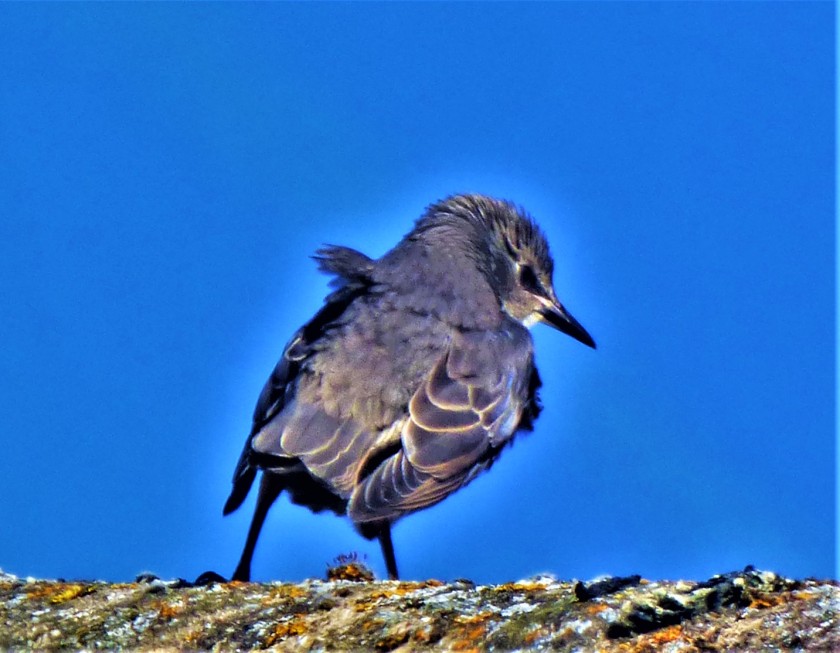
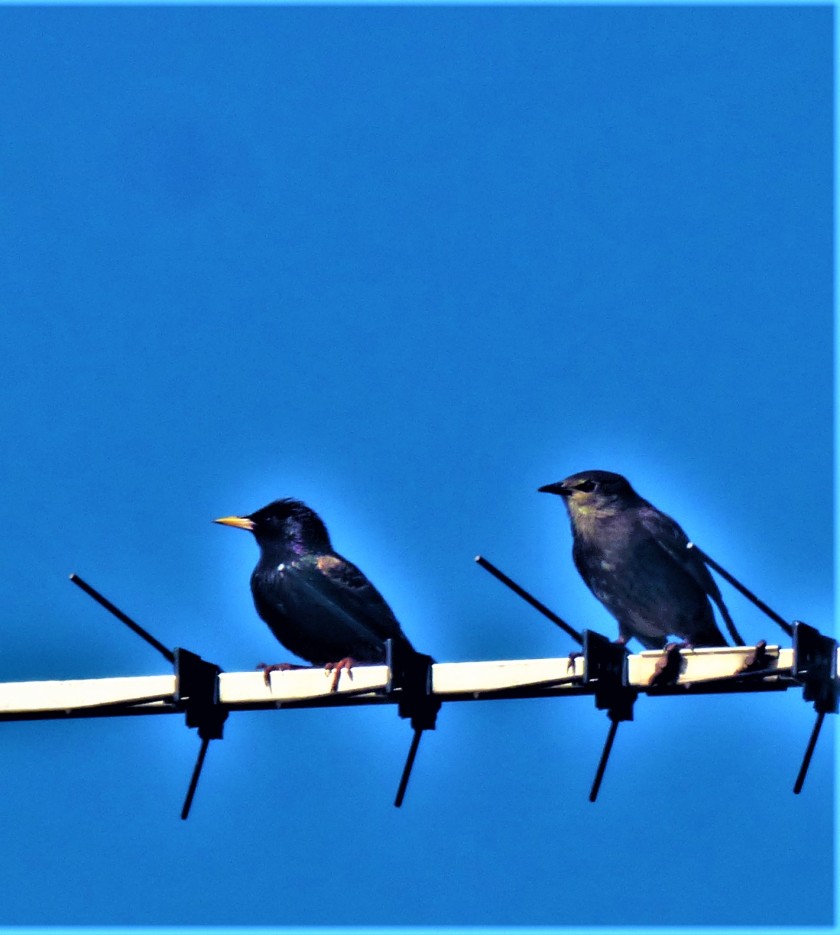
This is one of the starling possibilities.
P1320230 (2)
One of these three shieldbug pics is a possibility

P1320231 (2)P1320233 (2)

P1320588 (2)
I like this one.
P1320641 (2)
One of these two goldfinch pics will be there.

P1320641 (3)

P1320655 (2)
these four starlings mar get in…
P1320667 (2)
…as may one of these last two pics but not both.

P1320668 (2)

I await your views on these and other possible calendar pictures with interest, and finish with these…

P1320677 (2)P1320678 (2)

P1320679 (2)
The fuchsia is really flourishing.
Left Handed Ashes
The teams in tabulated form.

All Time XIs – Firsts and Onlies

Today’s variation on an all time XI theme looks at firsts and a few onlies, plus a couple of bonus cricket links and a measure of mathematics, and of course photographs.

INTRODUCTION

Welcome to another variation on the all-time XI theme. Today we look at people who were the first to achieve certain landmarks, generally though not exclusively related to test cricket. Our two teams are named in honour of their designated captains and as usual due consideration has been given to the balance of each side.

THE BAKEWELL XI

  1. Warren Bardsley – left handed opening batter. He entered the test record books at The Oval in 1909, when he scored 136 and 130, the first time the double feat had been performed in a test match. Ironically, having hit two in one match, in a reverse of the usual bus situation, he would then wait ages for his next Ashes ton, which finally came almost 17 years later, at Lord’s in 1926 when he scored 193 not out in all out total of 389. England on that latter occasion batted the game to a stalemate, as each of their top five passed 50, and they amassed 475-3. The 1909 game at The Oval also ended in draw, which was enough for Australia to keep The Ashes. Bardsley was Australia’s leading scorer of first class centuries at the end of his career, at which time a young chap named Bradman was just beginning to make his presence felt in the batting record books that by the time he had finished would bear his seemingly indelible stamp.
  2. CAG Russell – right handed opening batter. Charles Albert George ‘Jack’ Russell, who I introduced by his initials was no relation of the later wicket keeper Robert Charles ‘Jack’ Russell who has featured elsewhere in this series, though the first ‘Jack’ Russell was the son of a county wicket keeper. At Durban in 1923 he scored 140 and 111, the first Englishman to achieve the double feat and test level, and the only person to date to have done so in their final appearance at that level! He was a casualty of the emergence of Herbert Sutcliffe, who made his test debut the following home season, had a record breaking Ashes tour in 1924-5 (see yesterday’s post) and never looked back. Russell’s test career lasted 10 matches, in which he played 18 innings, two of them not outs and scored 910 runs for an average of 56.87, or 50.56 if you discount the not outs. He passed fifty a total of seven times in those innings and converted five of the seven into hundreds.
  3. George Headley – right handed batter. The great West Indian, referred to by some as ‘the black Bradman’ (though in the Caribbean folk preferred to talk of ‘the white Headley’) was the first ever to score twin centuries in a test match at Lord’s, the home of cricket. He also holds the record for the highest individual score in the 4th innings of a test match, 223 at Kingston in 1930.
  4. Walter Hammond – right handed batter, occasional right arm medium fast, ace slip catcher. He was the first to score back to back test match double centuries, 251 at Sydney and 200 not out at Melbourne in the second and third matches of the 1928-9 Ashes, and was also the second to do so, when on the way home from the 1932-3 Ashes he scored 227 and 336 not out in New Zealand. He was also the first non-wicket keeper to take 100 catches at test level.
  5. Frank Woolley – left handed batter, left arm orthodox spinner, excellent close catcher. He was the first to play in as many as 50 successive test matches. A combination of the infrequency of tests in his day and World War I meant that the great sequence began in 1909 and did not end until 1928, when he was passed over for the 1928-9 Ashes in favour of Phil Mead.
  6. *Enid Bakewell – right handed batter, left arm orthodox spinner. She was the first player to score a century and record a ten wicket match haul in the same test match. Between 1968 and 1979 she played 12 test matches, scoring 1078 runs at 59.88 and taking 50 wickets at 16.62. I have awarded her the captaincy, and with it her name in the title of the XI.
  7. +Leslie Ames – wicket keeper, right handed batter. He was the first regular wicket keeper to play at least 20 test matches and finish with a batting average of over 40. He scored 120 at Lord’s in 1934, matching left hander Maurice Leyland’s century and helping England to a total of 440, after which a combination of rain juicing up the pitch and the left arm spin of Hedley Verity (15-104 in the match) saw England to their only win in an Ashes match at headquarters in the entire 20th century.
  8. Alan Davidson – left arm pace bowler, left handed lower order batter, brilliant fielder (known as ‘the Claw’ for his ability to grasp catches that tested credulity). At the Gabba in 1960 Davidson became the first cricketer in test history to combine a match aggregate of 100 runs (44 and 80) and 10 wickets (5-135 and 6-87). His endeavours in that game were not quite in vain, but nor did they bring the desired result for his team – the match, for the first time in 83 years of test cricket, finished in an exact tie – WI 453 and 284, Aus 505 and 232. Two direct hit run outs from Joe Solomon, the first to account for Davidson when he seemed to be winning the match for Australia, and the second to bring about the tie were key, and Conrad Hunte produced a tremendous long throw to run out Meckiff when that worthy was going for a third that would have settled the issue in Australia’s favour. Davidson has the lowest average of bowlers to have played post war, taken at least 150 test wickets and finished their careers, his 186 wickets at the highest level costing 20.53 each.
  9. Billy Bates – off spinner, useful lower middle order bat. At Melbourne in 1882-3, en route to helping Ivo Bligh achieve his goal of bringing back ‘The Ashes of English Cricket’, following the 1882 Oval test match and subsequent mock obituary in The Sporting Times, Bates took seven wickets in each innings, while also scoring 55 for England. His bowling performance included the first hat trick by an English bowler in test cricket, the first hat trick by someone who scored 50 in the same test and the first test combination of ten wickets and a fifty. His career was ended early when he lost the use of an eye after being injured at net practice. His 15 tests yielded 656 runs at 27.33 and 50 wickets at 16.42. He was the first of a remarkable sporting dynasty – his son WE Bates played for Yorkshire and Glamorgan, while grandson Ted Bates was involved with Southampton Football Club in various capacities for upwards of six decades.
  10. Frederick Spofforth – right arm fast bowler (later added variations). Spofforth was the first bowler to take a test match hat trick, the first bowler to take three wickets in four balls at test level and the bowler responsible for the victory that created The Ashes.
  11. Jimmy Matthews – leg spinner. How does a bowler who took a mere 16 test wickets, and never more than four in a test innings get into a team like this? Simple, six of those wickets, his only ones of the match in question, and all captured without the assistance of fielders, came in the form of the only ever incidence of a bowler taking a hat trick in each innings of a test match. His great moment came in the Triangular Tournament of 1912, for Australia against South Africa, at Old Trafford. His victims were Beaumont, Pegler and Ward in the first innings, and Taylor, Schwarz and Ward in the second, giving Ward his place in the record books as the scorer a king pair and hat trick victim in each innings. Ward by the way was a wicket keeper, and he did actually score two test fifties in his career. The modes of dismissal were bowled, LBW, LBW in the first innings and bowled, caught and bowled, caught and bowled in the second.

This team has an excellent top five, two of whom could contribute as bowlers, a great all rounder at six, a splendid keeper batter at seven and four varied bowlers of whom three definitely deserve to be described as great. The bowling has Davidson and Spofforth to take the new ball, Hammond as third seamer if needed, Bakewell, Bates and Matthews to bowl three different varieties of spin and Woolley as seventh bowler – 20 wickets won’t be a problem for this combo.

THE WARNE XI

  1. Arthur Morris – left handed opening batter. The first ever to score twin centuries on first class debut. Against Gloucestershire in 1948 he accepted responsibility for ensuring that off spinner Tom Goddard did not get an England call up, and proceeded to belt 290 in five hours, leaving Goddard nursing a very sick looking bowling analysis, and well and truly out of test contention. I have written about elsewhere.
  2. George Gunn – right handed opening batter. The Accidental Test Tourist – he was in Australia on health grounds when he got the emergency call up to join England’s ranks during the 1907-8 Ashes, the first time an English tour party had adopted such an approach. He responded by scoring 119 and 74.
  3. Lawrence Rowe – right handed batter. The first to score a double century and a century on test debut, 214 and 100 not out vs New Zealand. He subsequently took a triple century off England as well, but eye problems truncated his career.
  4. Tip Foster – the first to score a double century on test debut, the only person to captain England at cricket and football. I have covered him elsewhere.
  5. Garry Sobers – left handed batter, every kind of left arm bowler known to cricket, brilliant fielder. The first to hit six sixes in an over in first class cricket. I have written about him elsewhere.
  6. Basil D’Oliveira – right handed bat, right arm medium fast bowler. The first non-white South African to play test cricket. As mentioned in my South Africa post he had to move countries to be able to achieve this, and was lucky to find backers to help him do so. The 158 he scored against Australia at The Oval immediately before the selectors of that winter’s tour party to South Africa sat down to deliberate took his test record to 972 runs at 48.60, an average bettered only by Barrington among those then playing for England. The subsequent ramifications of his non-selection and then selection as replacement for someone picked as a bowler shook the sporting world, and ultimately led to South Africa being isolated from world cricket for over 20 years.
  7. Ian Botham – right handed batter, right arm fast medium bowler, ace slipper. Ian Botham was the first male test cricketer to score a hundred and take a ten wicket match haul, against India in 1979. He was also the first to combine a century with a five wicket innings haul on more than two occasions (v New Zealand at Christchurch, 103, 30, 5 first innings wickets, three second innings wickets, v Pakistan at Lord’s, 108 and 8-34, the first century and eight-for combo at that level, v India in 1979 – 114, 6-58, 7-48, v Australia at Headingley 6-95, 50, 149 not out, one second innings wicket and v New Zealand on the 1983-4 tour, 138 and 5-59, before New Zealand were inspired by Martin Crowe’s maiden test hundred to save the game with a fighting second innings display), and the first to the career triple double at test level (3,000 runs and 300 wickets, achieved in his 72nd match).
  8. +Jack Blackham – wicket keeper, right handed batter. The first keeper to regularly do without a long stop, and the first keeper to score twin fifties in a test match.
  9. *Shane Warne – leg spinner, right handed lower order bat. First bowler to take 100 test wickets in a country other than his own – he reached the mark for matches in England in 2005. He is the leading wicket taker in Anglo-Australian tests and second to Muralitharan in the all-time list. He is the designated captain of this XI.
  10. Jim Laker – off spinner. Only one bowler in first class history has taken more than 17 wickets in a first class match, and he did in an Ashes test. James Charles Laker took 19-90 (9-37, followed by 10-53) at Old Trafford in 1956 to retain the Ashes for England. In a tour match for Surrey against Australia on a good Oval pitch he took 10-88 from 46 overs in the first innings of the match, settling for 2-42 at the second attempt, when his spinning partner Tony Lock took 7-49, Surrey becoming the first county to beat the Aussies since 1912. England made 459 in the first innings of the Manchester match, Peter Richardson and David Sheppard (then bishop of Woolwich, later bishop of Liverpool) making centuries, Sheppard’s 113 being the highest individual innings of the series. Australia then sank for 84, before determined resistance by Colin McDonald (89 in 337 minutes, highest Aussie score of the series) saw them to 205 second time round. Four front line spinners operated in this match, and three of them (Ian Johnson, Richie Benaud and Tony Lock) had combined match figures of 7-380 (an average of 54.43 per wicket). In 1950 Laker had taken 8-2 for England v The Rest at Bradford as The Rest limped to 27 all out. In 1954 he was involved in one cricket’s most remarkable fixtures, when Surrey sealed their third straight County Championship (a sequence they would extend to seven under first Surridge, five of them, and then Peter May, two more). Worcestershire were rolled for 25 in their first innings, and Surrey had reached 92-3 when Surridge decided that he fancied another go at Worcestershire that evening and declared! Not bothering with conventional new ball bowling he threw the cherry straight to his spin twins, who each produced an unplayable ball before the close. The following morning Worcetsreshire were blown away for 40, to lose by an innings and 27 runs. Laker, not required in the first innings rout of Worcestershire, took a hat trick in the second. That aggregate of 157 runs for 23 wickets remains the lowest ever for a completed County Championship game, and the victory that Surridge conjured out of nothing was as mentioned enough to secure that year’s title for Surrey.
  11. Jasprit Bumrah – right arm fast bowler. The first Indian fast bowler to rattle Australia in their own backyard. His 6-33 in Australia’s first innings at the MCG in 2018 effectively settled the destination of the Border-Gavaskar Trophy. Neither of the two great quicks of the 1930s, Amar Singh and Mahomed Nissar ever got to pit their wits against Australia, and basically between them and Bumrah India never had a really fast bowler of top quality.

This team has a splendid top four, three all rounders of differing types, a top of the range keeper and three fine specialist bowlers. Bumrah would share the new ball with either Botham or Sobers, with the other third seamer, while the spin options are provided by Warne, Laker and Sobers, and there is medium pace back up if required available from D’Oliveira.

THE CONTEST

These are two strong and formidably well balanced sides. Obviously, with all due respect to the only person ever to bag a hat trick in each innings of a test match the Warne XI have an advantage in the leg spin department. However, Bates vs Laker is a good match up, while Sobers’ talents are counterbalanced by those of Davidson, Bakewell and Woolley. The Warne XI have an edge in the pace bowling department, but not much of one. There is also no doubt in my mind that the Bakewell XI have greater strength and depth in batting. I reckon this one goes down to the wire and I cannot even attempt to call a winner.

A COUPLE OF CRICKET LINKS

The pinchhitter has produced an excellent post today, looking back 17 years ago to the highest successful run chase in test history, when the West Indies chased down 418 in Antigua.

The full toss blog have a post up comparing Strauss’ 2011 England with Vaughan’s 2005 England – and coming as far as I am concerned to the right conclusion as to which was the better unit.

A MEASURE OF MATHEMATICS

Another one from brilliant.org:

Fish Fiction

Your task is to use the above information to identify the smallest fish – and if you enjoy the task establish a complete ranking order of the five fish.

PHOTOGRAPHS

Today’s teams have put in their appearance, I have served up a couple of bonus cricket links and a mathematical teaser, so I now hand over to you for your comments with my usual sign off…
P1320664 (2)P1320666 (2)

P1320667 (2)
The first of two particularly satsifying starling pics

P1320668 (2)P1320669 (2)P1320670 (2)P1320673 (2)

P1320674 (2)
Mars mapping, from Dava Sobel’s “Planets”

P1320675 (2)P1320676 (2)

Firsts and Onlies
The teams in tabulated form.


All Time XIs – The Away Ashes

Today’s variation on the all-time XI theme is a paradoxical one – it features two teams of players whose finest hours occurred in enemy territory.

INTRODUCTION

Welcome to the latest installment in my ‘all time XIs‘ series. Today we look at players who enjoyed their finest hours when doing battle in enemy territory, with The Away Ashes. Before getting to the main body of this post however, there is a matter to be attended to, in my usual ‘reverse tabloid’ style so that it cannot be missed:

CORRECTION/ APOLOGY

In yesterday’s South Africa post I failed to mention Dale Steyn when looking at players from my lifetime. I still stick to my chosen pair of specialist speedsters Kagiso Rabada and Allan Donald, but I should have included Steyn in the honourable mentions as a candidate for one of those spots. My apologies to Mr Steyn for the oversight.

THE AWAY ASHES – ENGLAND

Just before I start going through the players, a quick warning about an easy trap that people might fall into: that these players greatest achievements came away from home does not imply that they were not also successful at home – the majority of my choices had their successes at home as well.

  1. Herbert Sutcliffe – right handed opening batter. The Yorkshireman scored 734 runs at 81.67 with four centuries in the 1924-5 series, which his side still lost 4-1. At the time both the runs aggregate and the century tally were records for a single series. In 1928-9 he played the single most crucial innings of the series when his 135, begun on a vicious sticky, underpinned England’s successful chase of 332 which put them into an invulnerable 3-0 with two matches to play lead. In 1932-3 he was joint leading run scorer of the series, with 440 at 55.00, something of an underachievement by his own stellar standards in Ashes cricket (overall average 66.85) as England ran out out 4-1 winners. That was third and last trip down under meaning that even after that 1924-5 series England had won nine and lost six in Australia with him in the side (1-4, 4-1, 4-1). His home Ashes highlights included a match and Ashes winning 161 at The Oval in 1926, and the same score at the same ground in a different outcome four years later.
  2. Alastair Cook – left handed opening batter. A career that spanned 12 years, saw him score over 12,000 test runs and set an all time record for consecutive test match appearances naturally included many highlights. However, one particular achievement shone out more brightly than anything else he did over the period: his 766 runs at 127.67 in the 2010-11 Ashes as England won down under for the first time in 24 years. In total in that series he spent just over 36 hours at the crease, 15 of them in his two innings at The Gabba, when his second innings 235 not out prevented England from going 1-0 down. His 148 at Adelaide, alongside Pietersen’s test best 227 enabled England to fully capitalise on a fantastic start to that match – Australia, having won the toss and batted lost their first three wickets on the opening day for two runs, two to slip catches off Anderson and a run out. In the final game at Sydney, with England 2-1 up he batted 488 minutes scoring 189, setting England up for a monster total after which Australia’s batting folded to give England a 3-1 series victory. At Melbourne in 2017 on a strip devoid of any hint of life he produced his final major Ashes knock, 244 not out, the highest ever Ashes score by someone carrying their bat through a completed innings.
  3. Douglas Jardine – right handed batter. He made two tours of Australia, in 1928-9 and 1932-3, and England won both series 4-1, the second under his captaincy. In the fourth match of the 1928-9 series at Adelaide he made his highest Ashes score, 98, sharing a third wicket stand of 262 with Hammond (177 not out), which put England in total control of the match. Though he did not manage any really major scores as captain in the 1932-3 series he did on some occasions soak up considerable amounts of time, putting more miles into the legs of the Aussie bowlers.
  4. Walter Hammond – right handed batter, occasional medium pacer, expert slip fielder. In his first Ashes series, in 1928-9, he announced his presence in cricket’s oldest international rivalry by scoring 905 runs at 113.125, including the first ever incidence of successive test double centuries, 251 at Sydney in the second game and then 200 not out in the first innings of the third match at Melbourne, before then hitting 119 and 177 not out in the fourth match at Adelaide. In 1932-3 he was joint top scorer for the series with 440 runs at 55.00, including the first half a record sequence – in the final match he hit 101 and 75 not out, and then in New Zealand he thumped 227 and 336 not out, the only four innings test sequence to top 700 runs. In 1936-37 he scored 231 not out in the second match of the series, but was overshadowed by Bradman for the rest of the series. He unwisely agreed to skipper England in a ‘goodwill’ tour of Australia in 1946-7, by when he was 43 years old and unable to summon up former glories, averaging only 21 in the series. Of his three home Ashes series 1930 and 1934 were both failures, while 1938 was a success.
  5. *Percy Chapman – left handed batter, occasional slow bowler, superlative close fielder, captain. Chapman was asked to captain England at The Oval in 1926 after the first four matches of the series had been drawn and the selectors had concluded that Arthur Carr was not the man for the job. He led them to victory and The Ashes. In 1928-9 he was made captain of the tour party and led England to a 4-1 triumph. His own batting contributions were minimal, but his captaincy attracted universal praise. He was a casualty of Bradman’s explosive vengeance in 1930, dropped from the captaincy after Lord’s that year, where the Don scored 254 (ended by Chapman holding a near miraculous catch – Bradman was to confirm that the ball had gone precisely where he intended to hit it and that he had not believed the catch was possible) in a total of 729-6 declared, and even though Chapman hit a defiant 121 in England’s second innings they went down by seven wickets.
  6. Bernard Bosanquet – right handed batter, leg spinner. The pioneer of the googly took his new weapon with him to Australia as part of Warner’s 1903-4 Ashes party, and played a major role in the winning of that series, including taking his best ever test figures of 8-107 in an innings.
  7. +Jack Richards – wicket keeper, right handed batter. Kept on the 1986-7 tour, when England won the series down under, scored 133 at Perth in second test thereof.
  8. Harold Larwood – right arm fast bowler, useful lower order batter. Two ashes tours, 1928-9 and 1932-3, and two 4-1 series wins in Australia, in the second of which he was the undoubted star.
  9. Farmer White – left arm orthodox spinner. His accuracy and stamina were vital to England’s 1928-9 triumph – he bowled 542 overs in the five matches of that series. In the Adelaide match of that series his total figures across the two innings were 124.5 overs, 37 maidens, 256 runs, 13 wickets.
  10. Frank Tyson – right arm fast bowler. If fast bowlers ever came quicker than the 1932-3 version of Larwood, then the 1954-5 version of Tyson was one of the few to do so. England lost the first match of that series at The Gabba by an innings and plenty, Tyson taking 1-160. However, he also listened to and acted on some shrewd advice from former fast bowler Alf Gover, shortened his overly long run considerably to conserve on energy in the Australian heat, and in matches 2,3 and 4 of that series was simply too hot for the Aussies to handle, being the key ingredient in a turnaround that saw 0-1 and likely loss of the urn become 3-1 and retention of the urn.
  11. Sydney Barnes – right arm fast medium. Archie MacLaren selected Barnes for the 1901-2 tour of Australia after a being impressed by him in the nets. Barnes won the first match of that series for his side, bagged another five for in the second, but was then rendered hors de combat by injury, an Australia ran out 4-1 winners. Barnes missed the 1903-4 series which England won. The 1907-8 tour party was poorly chosen and lost badly, but Barnes played a key role in the one test that England won in that series – his 38 not out in the final innings guided England home when they needed 73 from their last two wickets. His greatest Ashes moments came in the 1911-12 tour, when England won 4-1, and he took 34 wickets, backed him left arm pace bowler Frank Foster with 32, while the batting was dominated the opening pair of Jack Hobbs and Wilfred Rhodes. In all Barnes took 77 wickets in 13 test matches in Australia, as compared to 29 wickets in home Ashes matches.

This team has a magnificent looking opening pair, two good and one great batter in the 3-5 slots, an all rounder, a keeper who can bat and four splendid bowlers. The bowling has blitz men Larwood and Tyson, the extraordinary Barnes, and two contrasting spin options in White and Bosanquet, plus Hammond as a possible sixth bowler.

THE AWAY ASHES: AUSTRALIA

  1. Mark Taylor – left handed opening batter, fine slip fielder. Taylor had a fine record at the top of the Aussie order, was the second in a sequence of long serving Aussie captains after Border, and probably ranked third of the four (Steve Waugh and Ricky Ponting followed Taylor) as a captain – my own reckoning makes the four skippers who spanned the ‘green and golden age’ rank as follows as captains: Border (unarguable – he taught an Australia who had forgotten the art exactly how to win and guided them from also-rans to top dogs), Waugh (who made a dominant side even better), Taylor (who consolidated Border’s work and kept Australia at the top) and Ponting (who inherited the captaincy of a team of champions and left a collection of ‘also rans’ for his successor). His greatest moments as a batter were in England in 1989 when he cashed in on the organization of what turned out to be the last of the rebel tours and general selectorial incompetence by the English to score 839 runs in the series, a record for any Aussie not named Bradman. Eight years later England was the scene of a display of massive character from Taylor, who was going through a run of dreadful form with the bat ans was under fire from his detractors. Australia were rolled in the first innings of the series at Edgbaston for 118, and had looked like not even managing 100 for large parts of the innings, and England spearheaded by Hussain with a double hundred and Thorpe with a century built a huge lead. Taylor opened the Australian second innings knowing that a second failure in the match could easily see the axe descend on him, and proceeded to chisel out a determined century, which could not save the match for his side, but did save his career. Australia bounced back to win the series, although England gained another victory in the final match at The Oval.
  2. Bill Ponsford – right handed opening batter. In 1934 the chunky opener achieved the rare feat of finishing with a better series batting average than Don Bradman. Ponsford averaged 94.83 for that series, while Bradman had to settle for a figure of 94.75. In the fourth match of the series at Leeds he scored 181, sharing a 4th wicket partnership of 388 with Bradman (304). Then, at The Oval in a match played to a finish because the series was not settled, as was tradition in England at the time (all test matches in Australia were played to a finish back then), he scored 266 in the first innings, sharing a second wicket stand of 451 with Bradman (244). Australia won the test match by 562 runs and regained the Ashes, the victory coming, as it had four years previously, on skipper Woodfull’s birthday. Ponsford retired from the game at the end of that series, the only player to date to score hundreds in his first two tests and hundreds in his last two tests.
  3. *Don Bradman – right handed batter. He played in four of the five tests of the 1928-9 Ashes, scoring one century for a badly beaten side. In 1930 he came to England, with a number of critics predicting that he would fail there. He reached his thousand first class runs for the season before May was done, the first non-English player to do so (and he would repeat the feat in 1938, the only player to achieve it twice), and he began his test performances comparatively quietly, with 131 in the second innings of the first match at Trent Bridge, when Australia were beaten. In the second at Lord’s he hit 254 in the first innings, and was one of the three Aussies dismissed in the second as they chased down 76. At Headingley in the third match he hit 334, 309 of them on the first day. After a quiet match in Manchester it was time for the final match of the series at The Oval, where in the tour match v Surrey he had scored 252 not out in a tally of 379-5 in a rain ruined affair. He racked up 232 this time round in a score of 695 as Australia won by a huge margin. In all in that series Bradman played eight innings, one of them a not out, and amassed 974 runs at 139.14. In 1934 he averaged 94.75, and in 1938 it was over a hundred again, helped by unbeaten centuries is the Trent Bridge runfest that opened the series (seven individual centuries and over 1,500 runs for less than 30 wickets in the game) and in the low scoring game at Headingley that saw Australia retain the Ashes. In 1948 he was outscored by opener Arthur Morris, but helped by 173 not out at his favourite Headingley he had a higher average for the series.
  4. Billy Murdoch – right handed batter, sometimes wicket keeper. Twice in his test career he scored over 150, 153 not out at The Oval in 1880 in an ultimately losing cause (England after largely dominating the game had an attack of collywobbles in the final innings, contriving to surrender five wickets while chasing down 57) and 211 in a drawn game at the same ground four years later, the first double century in test cricket, and the second in the sequence of record individual scores at that level that in full reads: 165 by Bannerman at Melbourne in 1877, 211 by Murdoch at The Oval in 1884, 287 by Foster at Sydney in 1903-4, 325 by Sandham at Kingston in 1930, 334 by Bradman at Headingley in 1930, 336 not out by Hammond at Christchurch in 1933, 364 by Hutton at The Oval in 1938, 365 not out by Sobers at Kinsgton in 1957, 375 by Lara at Antigua in 1994, 380 by Hayden at Perth in 2000 and 400 not out by Lara at Antigua in 2004.
  5. Charlie Macartney – right handed batter, left arm orthodox spinner. Macartney started his career as a blocker and ended it as one of the most highly regarded stroke makers of all time. In 1926 he became the first ever to score centuries in three successive test matches, although the weather saw it that all ended in draws.
  6. Harry Graham – right handed batter. He scored a century on test debut at Lord’s in 1893.
  7. +Graham Manou – wicket keeper, right handed batter. A rare Aussie ‘one cap wonder’, that appearance coming in England in 2009.
  8. Shane Warne – leg spinner, right handed lower order batter. Only one person has ever captured 100 test wickets in a country other than their own: Shane Keith Warne, who reached the landmark in England in 2005, in the course of the only Ashes series in which he finished on the losing side. He announced his presence in Ashes contests with the ‘Gatting ball’ at Old Trafford in 1993, his first delivery in an Ashes match, which drifted in the air to land well wide of leg stump and then spun back so sharply that it brushed the outside of the off stump just enough to dislodge the bail, to the stupefaction of the batter. Robin Smith who since making his own debut four years earlier had built a hugely impressive record was made to look a novice in that series, and Alec Stewart, deployed in the middle order in that series, fine player of fast bowlers that he was, never looked anything close to comfortable against Warne either. Even in the 2005 triumph Warne retained full mastery over the England batting, collecting 40 wickets in the series.
  9. Bob Massie – right arm fast medium bowler. Australia, captained by Ian Chappell, brought a largely young and unknown side to England in 1972. The first match was lost to Ashes holders England, and then the sides reconvened at Lord’s. Massie took 8-84 in England’s first innings 272, a sensational debut effort. Australia, with a century from Greg Chappell to help them led by 36, and skipper Ian Chappell gathered his team together and said he wanted a wicket before that deficit was knocked off, well rather as with Bill Bowes and his leg side field for Vic Richardson in 1932, ‘Chapelli’ did not get one, he got five! England recovered somewhat from that catastrophic beginning to their second innings, but only enough to reach 116, Massie 8-53 to give him 16-137 on debut. A victory target of 81 did not unduly trouble Australia, opener Keith Stackpole taking the opportunity to record an unbeaten half century. That was over half of Massie’s tally of test wickets. In the end England retained the Ashes, courtesy of a victory at Headingley, although Australia levelled the series by winning the final game at The Oval, both Chappells notching first innings centuries.
  10. Charles Turner – right arm medium fast bowler. A rare example of an Aussie great who never won an Ashes series – it was his misfortune to be in his prime at a time when his only reliable bowling support came from Jack Ferris, and Australia were riven by dissension. During one of his tours (1886, I think), there was an occasion when the train carriage in which the Aussie team had been travelling was marked by blood spatters! Nevertheless, he was an even more difficult proposition in England than back at home.
  11. Terry Alderman – right arm medium fast bowler. Meet the man who should have been the first bowler to 100 test wickets in a country other than this own (although a case could actually be made on Barnes’ behalf, since had been picked for the 1903-4 tour he would surely have done it in Australia). Terence Michael Alderman took an Australian ashes series record 42 wickets in a losing cause in the 1981 series. Eight years later he took 41 in a winning cause (both these series were of six matches, whereas the England ashes record, Laker’s 46 in 1956 came in a five match series), to bring his tally in England to 83 in 12 matches. Terry Alderman should have been part of the 1985 tour party as well, but he foolishly went on a rebel tour to apartheid South Africa instead, which netted him a three year ban from international cricket. The 1989 haul included a sequence of four successive innings in which he trapped opener Graham Gooch LBW, with the Essex man’s highest score in that little patch of torment being 13. Alderman may actually have contributed to the 1985 Ashes as well, since he was for a time a Kent team mate of Richard Ellison, who as a bowler of a similar type probably benefitted from the presence of an international practitioner. In the last two matches of that series Ellison captured 17 wickets, including the prize scalp of Border in three of the four innings.

This team has a decent top six, a splendid keeper, and four excellent and varied specialist bowlers (and Macartney had a 10 wicket haul in a test match with his left arm spin as well).

THE CONTEST

This looks an absolute ripper of a contest. Perhaps the trick would be to stage it on neutral territory, though not India, as that would spike Warne’s guns, so that both sides could treat as an away contest and thereby bring the best out of themselves.

ANSWER TO YESTERDAY’S PROBLEM

Yesterday’s post included the following teaser:

Brilliant

The available answers were 9, 15, 21 and 27.

The correct answer is nine, the speed of ball nine after collision being 511 m/s.

A LINK AND PHOTOGRAPHS

The scene has been set for the ‘Away Ashes’, with our players introduced and explained, yesterday’s teaser has been answered, but just before signing off there are some links to share, from the Guardian, where actor Rory Kinnear has a tribute to his sister who has just died of covid-19, in which he takes the “died with it, not of it” brigade sternly to task. Please read and share. A site which I discovered today, doodlemaths, has a number of posts about “Mathematicians who changed the world“, the example which drew me in, and which I offer as an introduction being about Florence Nightingale. Now it is finally time for my usual sign off…

P1320637 (2)P1320638 (2)P1320639 (2)P1320640 (2)

P1320641 (2)
Goldfinch (two pics)

P1320641 (3)P1320643 (2)P1320644 (2)P1320645 (2)P1320646 (2)P1320651 (2)P1320652 (2)P1320653 (2)P1320654 (2)

P1320655 (2)
Four starlings all perfectly positioned for the camera at one time.

P1320658 (2)P1320659 (2)

P1320660 (2)
A double-page spread illustration in Dava Sobel’s “Planets”

P1320661 (2)

Away Ashes
The teams, in tabulated form with abridged comments.

All Time XIs – South Africa

My latest variation on the all-time XI theme takes me on a wander through the minefield of South African cricket – did I manage it without blowing metaphorically blowing myself to smithereens en route? Probably not!

INTRODUCTION

Welcome to the most difficult and controversial in this series of all-time XI themed posts. I am starting this post on Monday May 11 2020, and will finish when circumstances permit (see my previous post for why this is). I am looking at the most controversial of all international outfits, South Africa, and am well aware that in doing so I venture into a particularly densely populated minefield.

THE PARTICULAR DIFFICULTIES
AROUND SOUTH AFRICA

Peter Oborne in his biography of Basil D’Oliveira points out that no official South African side of their first period as a test nation, 1889-1971, can be regarded as in any way a representative XI as the vast majority of that country’s population were simply excluded from consideration. However, I will not disregard players from that era. I give due consideration to the white South Africans who had their international careers nipped in the bud by their country’s (IMO) long overdue international isolation, but I also make no secret of the fact I am rather more concerned about the non-white South Africans who with a few shining exceptions were airbrushed for many decades from cricket’s history, and they too feature in my thinking. Finally, there is one player in the team from my lifetime who has abandoned his native country after playing five tests for it, and I endeavour to explain and justify that inclusion. Also, I do not in my selection process acknowledge any kind of quota system, though I understand and accept the reasons why today’s South Africa continues to have one, and anyone thinking of using my approach to justify opposition to said quota system kindly take this as a preemptive ‘cease and desist’ notice. There are some goodies at the end of what will be a long post which should appeal to some of you.

SOUTH AFRICA IN MY LIFE

The readmission of South Africa, cleansed of apartheid, in the early 1990s, when I was in mid teens provides a natural cut off point for the start of my selections for this XI, and with due apology to some of the fine players from that country who showed what they could do at levels below full international, including against rebel tour sides some of whom were fairly strong I make it so.

  1. *Graeme Smith – left handed opening batter, captain. A magnificent record, including scores of 259 and 277 in successive matches against England, and he was also a very successful captain. My fellow blogger the pinchhitter has described his appointments in his current role running the SA national team as ‘getting the band back together’ in tribute to that fine film “The Blues Brothers”, as he has surrounded himself with a coterie of former team mates.
  2. Herschelle Gibbs – right handed opening batter. There were several possibilities for this role, but my choice of Gibbs is made because I think he is a perfect counterpoint to Smith.
  3. Hashim Amla – right handed batter. His record as the rock at no3 makes its own case for his selection. I remember his triple hundred against England when he never looked like getting out.
  4. Jacques Kallis – right handed batter, right arm fast medium. Another with an irrefutable case for selection. Had he been more enthusiastic about his bowling he would be a genuine challenger to Sobers’ title as the greatest of all all rounders, but as it is I have him as fourth seamer in this side.
  5. AB De Villiers – right handed batter, sometimes wicket keeper, occasional medium pacer. He is the X factor player in this eleven – and if the front four give him a really good start to cash in on hard hats for the spectators might well be advisable!
  6. Jonty Rhodes – right handed batter, brilliant fielder. Rhodes was the finest fielder I ever saw in action, and I have no hesitation in believing that like Gilbert Jessop of old he was worth 30 an innings to his side in that department, which is why I have given him the nod for this slot over others whose batting may suggest that they are more worthy and over Brian McMillan whose all rounder status might impress others.
  7. +Mark Boucher – wicket keeper, right handed bat. His amazing record as a keeper over the course of 147 test matches and his very handy middle order batting make him an easy pick.
  8. Shaun Pollock – right arm fast medium bowler, useful lower order batter. For this role he rates fourth out of all cricketers I have seen in my lifetime, with Wasim Akram, Malcolm Marshall and Richard Hadlee ahead of him.
  9. Simon Harmer – right arm off spinner, useful lower order batter. He played five times for his native land and had some success before decamping for England, for whom he may yet also get to play (although I personally think it would be a mistake to select him at this juncture for reasons I have discussed elsewhere). I acknowledge the frustrations that caused him to take the course he did, because I have very little doubt that if you are selecting only one front line spinner he is a better bowler than Keshav Maharaj. I also get why South Africa took the approach they did, so this selection is simply an endorsement of Harmer, NOT a criticism of anyone.
  10. Kagiso Rabada – right arm fast bowler. His record commands inclusion, and he is one of two ‘warheads’ I have given this South African attack along with…
  11. Allan Donald – right arm fast bowler. The fact that he chose to wait for his home country to be readmitted rather than qualifying for England  meant that he was a little later into the test arena than he might have been, which makes his magnificent record once the opportunity arrived even more outstanding

It is a reflection of South Africa’s cricketing strengths in my lifetime that I have given them an attack featuring only one front line spinner, but I do not think that manipulating an attack of Donald, Rabada, S Pollock an Harmer backed by Kallis to capture 20 wickets in a match would be considered unduly taxing by most captains! While I could see the appeal and in some circumstances recognize the necessity of going for a quick and decisive breakthrough by opening up with Donald and Rabada at full bore I could also see using one of Donald and Rabada in conjunction with Pollock as a new ball pairing and bring the other super speedster on first change, especially at a ground such as Headingley, where a less quick bowler who can run up the slight slope from the football stand end and use a wind blowing towards them to move the ball about is often extremely useful, and you could then give both speedsters a burst with the ball newish even at the end of the second one’s spell from the Kirkstall Lane end.

THE NEW PLAYERS IN THE ALL TIME XI

  • Barry Richards – right handed opening batter. One of those whose test career was ended by South Africa’s isolation. The word of Sir Donald Bradman (in Roland Perry’s “Bradman’s Best” that Richards was the finest opener he ever saw in action is good enough for me.
  • Herby Taylor – right handed opening batter. In 1913-14 when Syd Barnes tore South Africa to pieces with 49 wickets in four matches at 10 a piece before missing the fifth due to a dispute over terms and conditions there was one shining exception to the tale of South African batting woe: Herbert William Taylor emerged from the series with 508 runs at 50.80. In one of the early innings of that series 10 South Africans plus extras scraped up 73 between them, yet the all out total was a semi-respectable 182 because Taylor made 109 – and even at the end it was not Barnes but Johnny Douglas who actually dislodged him. Louis Duffus in a short piece titled “Herby Taylor Masters Barnes”, which appears in “The Faber Book of Cricket” describes Taylor’s performance in that innings thus: “with machine like precision he reduced Barnes to the ranks of the mortals.”
  • Graeme Pollock – left handed batter. His test average of 60.97 is only exceeded among those who have completed their careers and played 20 or more matches by Adam Voges who was lucky with his opponents (the one Ashes series he played was distinctly unimpressive, featuring only two fifties) and Bradman.
  • *Aubrey Faulkner – right handed batter, leg spinner. 25 test matches brought him 1,754 runs at 40.79 and 82 wickets at 26.58, the only person to have played over 20 test matches and achieved the double feat of averaging over 40 with the bat and under 30 with the ball. He was part of quartet who bowled googlies, along with Albert Vogler, Reggie Schwarz and Gordon White, the latter primarily a batter. It was the fact that two of the four were worth places as batters that enabled all four to be picked and pace bowling not totally neglected as it was by Indian teams in the 1970s when none of Venkataraghavan, Prasanna, Bedi or Chandrasakehar, the game’s other great spinning quartet, were remotely close to being front line batters. In line with my thinking about slow bowling all rounders being well equipped for the role I have named as captain of this side. Faulkner was part of the only team to defeat the 1921 Australians, an assemblage raised by former England skipper Archie MacLaren. After MacLaren’s XI were rolled for 43 in their first dig and the Aussies scored 174 in reply, MacLaren himself fell cheaply, but Faulkner made 153, supported by Hubert Ashton with 75, and then Faulkner, Michael Falcon and Clem Gibson bowled Australia out to fulfill MacLaren’s prophecy that “I could put together a side to beat Armstrong’s lot” (The 1921 Aussies were captained by Warwick Armstrong, then 6’3″ and 22 stone, probably the largest ever international cricketer).
  • Krom Hendricks – right arm fast bowler, could also bat. The first South African to miss out on international cricket due to his skin colour. He had many advocates for selection in the tour party being picked to go to England in 1894 (not a test tour, but who is to say that given the opportunity he would not still have been playing by the time of the 1907 tour). One attempt was made to include him by taking him along as scorer and baggage handler, a suggested arrangement to which Hendricks responded with outrage. Augustus Tancred, one the leading white South African cricketers of the day made an equally outraged counter response to Hendricks’ claims for equality, recorded in full in the Oborne book, and which basically amounted to ‘how dare a black man not know his place?’. I select Hendricks both for his own merits, which for the controversy in which he was involved to have arisen must have been very considerable and also as a kind of tribute to ‘the unknown black South African cricketer’ so many of whom performed over the years with poor/ no equipment and on the patches of wasteland with barely a blade of grass in sight that were the only ‘grounds’ and ‘pitches’ on which they were permitted to play. I considered Eric Petersen, a contemporary of Basil D’Oliveira for this position but opted for the more historic example of Hendricks.
  • Hugh Tayfield – off spinner. He was the leading wicket taker for the first incarnation of South Africa as a test playing nation, given his chance after injury brought Athol Rowan’s career to an end largely on the strength of a hunch by then springbok skipper Jack Cheetham (detailed by Louis Duffus in the chapter he contributed on Cheetham to “Cricket: The Great Captains”

With these players assigned their places in the batting order, and the necessary deselections to enable that to happen the All Time South Africa XI reads in batting order: Barry Richards, Herby Taylor, Hashim Amla, Graeme Pollock, Jacques Kallis, *Aubrey Faulkner, +Mark Boucher, Krom Hendricks, Hugh Tayfield, Kagiso Rabada and Allan Donald. This line up has a power packed top five, a genuine all rounder at six, a keeper who can bat st seven and four quality front line bowlers. The bowling attack with three genuine fast men in Donald, Hendricks and Rabada, an off spinner in Tayfield and a leg spinner in Faulkner backed up by Kallis if needed is both strong and well balanced. The southpaws are underrepresented with only Pollock among the front line batters featuring, and no left arm bowler of any kind. However, it looks every inch a serious force to be reckoned with.

HONOURABLE MENTIONS

There is one very notable omission from this section because I am featuring him in a section to himself and one famous SA cricket name which I am deliberately not mentioning anywhere in this post for reasons readers should be able to work out, one of two such. Among the other recognized openers I could have named were Bruce Mitchell, Alan Melville, the adhesive Trevor Goddard, Jimmy Cook, the best South African opener of their period of isolation and good enough to at least increase the number of contenders for the title of best opener named Cook to two (Sir Alastair of course being the other) and Gary Kirsten. Eddie Barlow, Clive Rice, Ken McEwan (who did remarkable things for Essex in the 1970s and early 1980s) and Darryl Cullinan would all have their advocates for middle order spots. The considerable pool of fast bowling talents available for selection included JJ Kotze, ‘the timber shiverer’ who terrorized England in 1907 when the spinners did not have wet conditions to exploit, Neil Adcock, Peter Heine, Peter Pollock, Vintcent Van Der Bijl (Edmonds, a Middlesex colleague, in “100 Greatest Bowlers” suggests that Van Der Bijl’s test record had he got to play at that level would have looked quite similar to Brian Statham’s) and Garth Le Roux. More recently, without yet having enough of a record to merit consideration Anrich Nortje has been making waves. The spin department is easier to deal with, as with acknowledgement to Athol Rowan and Faulkner’s fellow googly bowlers (Reggie Schwarz learned the trick from its pioneer Bosanquet while at Middlesex and taught the others) the only other two who might merit consideration were Denys Hobson, a 1970s leg spinner, and Imran Tahir, one of those who were seen by Harmer as blocking his progress. Other than Boucher only two other wicket keepers were in the mix, Denis Lindsay and John Waite.

MIKE PROCTER

Mike Procter was unquestionably a great all rounder, a genuinely fast bowler who could also turn his hands to off breaks at need and an attacking middle order batter who no opponent dared treat lightly. However, with Donald, Hendricks and Rabada all nailed down for places, and Kallis also there to bowl fast medium I felt that the genuine all rounder of the side needed to be a spinner for the sake of balance, and I defy anyone to challenge my categorization of Faulkner as the most genuine of genuine all rounders.

BASIL D’OLIVEIRA

Given what he achieved when he got to don the blue cap of England at an age well past cricketing prime, what I have read about his deeds in coloured cricket in South Africa and for the SACBOC XI, the nearest thing South Africa had to a truly representative team before 1992 (there were no whites involved, but not because they were excluded but because none chose to participate – had any done so and been good enough to get selected it would have been fully representative, and it was in any case far more so than the teams that were openly drawn from only a tiny minority of that country’s population) I am going to go right out on a limb and say that had D’Oliveira’s test career started in his early twenties for South Africa he would stand not merely as one of the finest cricketers of his generation but as one of the game of cricket’s greatest ever players. The first stage of SA’s isolation began when the MCC, in an attempt to avoid an awkward situation declined to name D’Oliveira in the 1968-9 tour party to South Africa, but then when Tom Cartwright, primarily a bowler, pulled out citing injury (but actually because he was not prepared to go to South Africa) they then named D’Oliveira as his replacement, knowing from the reaction to his initial non-selection that anything else would have been unacceptable. The then South African leader John Vorster decided this gave him the opportunity for a spot of jingoistic posturing and declared that D’Oliveira would not be allowed into South Africa. The MCC responded in the only way they could by cancelling the tour forthwith, although they tried to continue with the 1970 series in England, but soon found that that was not going to be possible either. The final curtain rang down on South Africa’s first incarnation as a test nation when they were due to tour Australia in 1971-2. Anti-apartheid protesters in Australia did not want this tour to go ahead, but others, initially including Bradman who would ultimately make the final call. Bradman made contact with protest organizers, as documented by Roland Perry, including Meredith Burgmann with whom he had an exchange of letters, in which to Burgmann’s own surprise she found Bradman coming round to her way of thinking. Then Bradman bearded the dragon in its den – he went to South Africa and had a private meeting with Vorster. Vorster, making the same kind of misjudgement about Bradman that Burgmann had when she assumed that he was ‘one of them’ assumed that Bradman was ‘one of us’ and during that private discussion gave vent to some unvarnished and apparently exceedingly crass racism and it was that that finally settled the issue for Bradman, and he not only cancelled the tour, but made a famous statement that “We will not play them again until they select their team on a non-racist basis.” From then until readmission post apartheid in 1992 South Africa did not play another official test match. Vorster who like certain hard right racists of more recent vintage (recognize anyone, USian followers?) did not take kindly to being crossed and had a tendency to throw tantrums proceeded to produce a classic in which he publicly berated Bradman because the Aussie had proved not be ‘one of us’ or ‘one of them’, but his own person, making decisions based on the evidence presented to him. While I could not name D’Oliveira in the squad because of his long association with England and English cricket I felt that a section about him was appropriate and I end with the little note that test series between England and South Africa are now played for the D’Oliveira trophy, which at the time of writing is in English hands.

A SUMMATION

When I set out on this little expedition through South African cricket I viewed it rather akin to strolling through a densely planted minefield because of the controversial nature of the subject matter. Feel free to comment if you so wish on how many times I metaphorically blew myself to pieces during the journey, but bear in mind that at least I made the journey myself rather than sending a minion, or recording video footage with the mines safely deactivated! I hope I have done justice to my subject matter, and that my selections are at least intelligible, and I conclude the cricket part of this post by repeating a point made in an earlier post in this series that with these international side selections no two people would be likely to arrive at the same set of answers.

A SOUPCON OF SCIENCE AND A MEASURE OF MATHEMATICS

For those interested in astronomy, a piece about the mapping of the surface of a Neutron Star from physics-astronomy.com,  accompanied by this video:

The ‘measure of mathematics’ comes from brilliant.org, from where I present the following problem:

Brilliant

I am feeling generous, perhaps because of the continued improvement in my health, and perhaps because this post has been such fun to create, so I will give the four available answers: a)9 b)15 c)21 or d)27. I will reveal all tomorrow.

PHOTOGRAPHS

Well, our African Adventure (yes, many years ago in my youth, I did read the series of books by Willard Price that included one with that title) is done, and we have seen a soupcon of science and a measure of mathematics, so all that remains is the final photographic flourish:

P1320599 (2)

P1320600 (2)
The Fuchsia.

P1320601 (2)P1320602 (2)P1320602 (3)P1320603 (2)P1320604 (2)

P1320605 (2)
Deep geological time (from “The Ancestor’s Tale” by Richard Dawkins)
P1320606 (2)
Ernst Haeckl anticipating modern evolutionary biology in the mid 19th century by placing hippos as the closest relatives of whales (same book).

P1320608 (2)P1320609 (2)P1320610 (2)P1320611 (2)

P1320612 (2)
This curious bug is not pictured in my bug book.

P1320615 (2)

P1320616 (2)
This one (five pics in total)…
P1320617 (2)
…is probably by a Western Honeybee…
P1320618 (2)
…although European Hornet is a possible…
P1320619 (2)
…there are two arguments against the latter: 1) the hornet usuall has some red in its head (cephalon technically)…
P1320619 (3)
…and 2) hornets of whatever type are normally aggressive or at least have that reputation, where as this critter was docile – after photographing I was able to open a large window in front of it and it gratefully flew off into the open air where it belonged.

P1320620 (2)P1320623 (2)P1320624 (2)P1320625 (2)P1320627 (2)P1320629 (2)P1320630 (2)P1320636 (2)

SA
The teams in tabulated form with abbreviated comments.

PS I have spaced the construction of this post out over most of a day, with breaks when needed, and I am feeling fine and only a little tired – for all the size of this post in total starting from 10AM I have probably given four hours to it, meaning that closer to five have been spent doing other things.

All Time XIs – Niners v Party Themed

This latest variation on the #all time XI’ cricket theme marks an aspi.blog landmark that you will have to read the full post to find out about!

INTRODUCTION

Welcome to the latest variation on the ‘all time’ XI cricket theme. The current still slightly iffy state of my health precludes a serious attempt at doing a full blog post in one go, so I am aiming at publishing this one day after starting it, for a reason that I will make clear later in the post.

THE BRIEF

This post has a central aim celebrating a landmark which will be revealed later, and to that end I have created two XIs, one of whom have associations with the number nine and one of whom have associations with parties. As always class is by no means discounted even in these circumstances. The day on which I started work on this post, May 9th, was the day in 1895 on which WG Grace launched the first successful assault on 1,000 first class runs in the month of May, but I deemed that connection a tad too tenuous to include him.

THE NINERS XI

  1. David Lloyd – left handed opening batter, occasional left arm orthodox spinner. He played nine test matches, in one of which he scored 214 not out, his only 50 plus score at that level (the record holder in this curious department is Karun Nair of India whose 303 not v England last time England toured there accounts for over four fifths of his tally of test runs).
  2. Herbert Sutcliffe – right handed opening batter, excellent outfielder. Nine of his 149 first class hundreds were amassed in Roses matches – at one stage big scores in such fixtures were so common with Sutcliffe that Neville Cardus of the Manchester Guardian took ro describing him as “keeping his appointment with a century”. .
  3. *Frank Worrell – right handed batter, left arm medium fast, occasional left arm orthodox spin. He scored nine test centuries (his conversion rate from 50s to hundreds was not especially good) in the course of a distinguished career that saw him become the West Indies first ever black captain.
  4. Clem Hill – left handed batter, brilliant fielder. In the 1901-2 Ashes series Hill had a unique series of test innings, 99, 98 and 97 in succession (he did amass eight centuries in his test career, and was at one point until overhauled by Hobbs the leading career run scorer at that level).
  5. Jess Jonassen – left handed part, left arm orthodox spinner. Scored 99 in a recent test match, which is her highest international score to date.
  6. Arthur Chipperfield – right handed bat, leg spinner. He scored 99 on test debut. Unlike Jonassen who has yet to do so he did eventually score a test hundred.
  7. Richard Hadlee – right arm fast bowler, left handed attacking middle order bat. He has the best innings figures ever recorded by a fast bowler at test level, 9-52 vs Australia in the 1984-5 series.
  8. +Gil Langley – wicket keeper, right handed bat. He was the first keeper ever to make nine dismissals in a single test match – he tallied 98 overall in 26 test matches (83 catches and 15 stumpings).
  9. George Lohmann – right arm medium pacer, attacking right handed lower order bat. He has the cheapest nine-for in test history, 9-28 versus South Africa (in another match in that same series he took 8-7 as SA were rolled for 30, the joint second lowest innings total in test history, shared by the 1924 South Africans who were dismissed by Tate and Arthur Gilligan for that same score). He has the lowest average of any taker of 100 or more test wickets, 10.75, the best strike rate, a wicket every 34 balls and was joint quickest to 100 wickets in 17 matches). He once played an innings of 62 not out in a test match that only included one single!
  10. Arthur Mailey – leg spinner. He took 99 test wickets in all, including the first ever nine wicket innings haul by an Aussie, 9-121 in the 1920-1 Ashes series won 5-0 by Australia (Mailey took 36 wickets in that series, a record at the time). He is one place above his regular batting slot, but I deemed a more worthy candidate for promotion than…
  11. Devon Malcolm – right arm fast bowler and genuine no11. He has the best test innings figures ever recorded by an England fast bowler, 9-57 vs South Africa at The Oval in 1994.

This team contains a solid looking opening pair, a good 3 and 4, all rounders at 5,6 and 7, a great wicket keeper who was no mug with the bat, and three quality specialist bowlers. The bowling, with a front four of Hadlee, Malcolm, Lohmann and Mailey backed up by Jonassen, Chipperfield and if needed Frank Worrell looks even more impressive than the batting (sorry, Bumble, you are definitely eighth choice bowler). Even with my decidedly unusual selection criteria it is unquestionably a strong and balanced unit that should give a good account of itself.

THE PARTY XI

  1. Jack Lyons – right handed attack minded opening batter. The Aussie had some remarkable high speed knocks to his credit, often opening the batting with Harry Trott. He is here courtesy of the ice cream makers Lyons.
  2. Tim Robinson – right handed opening batter. The Nottinghamshire opener made an extraordinary start to his test career against India away and then Australia at home, before being found out in the West Indies in 1986, an experience from which Robinson the batter never fully recovered. His international involvement ended for good in 1989 when he signed up for what turned about the last of the rebel tours of South Africa. He is in this team courtesy of Robinson’s Barley Water.
  3. Alf Dipper – right handed batter. A regular opener for Gloucestershire I have moved him one place down here.
  4. Kevin Pietersen – right handed batter, occasional off spinner. He is here not just for his likely contribution with the willow, but also because his nickname, ‘KP’, is the name of manufacturer of snack foods.
  5. Andrew Symonds – right han ded batter, occasional right arm medium pacer. He is here courtesy of Symonds Scrumpy Jack, a brand of cider that is not actually a genuine scrumpy – it is fizzy, but a less sweet than most such, as well as for his big hitting batting and fine fielding.
  6. Ellyse Perry – right handed bat, right arm fast medium, brilliant fielder. The most complete all rounder currently playing the game in my book. In addition to her immense cricketing merit, perry is of course a variant of cider made from pears rather than apples.
  7. *FHB Champain – right handed batter, right arm slow bowler. Full name Francis Henry Bateman Champain, sometimes shown as hyphenated but I have seen scorecards from the period with it not hyphenated. His first class career began in 1895 and ended in 1914, and he amassed 4677 runs at 24.61 with five hundreds and took 17 wickets at 24.58, the latter figure suggesting that his bowling was underused. I have named as captain as none of this team are full time captains, and I think that his performances are least likely to be adversely affected by the captaincy.
  8. Will Beer – leg spinner, capable lower order batter. Although left arm spinner Michael Beer has a test cap and Will does not I remember how impotent Beer was in that match – other than Collingwood who holed out to ‘raging against the dying of the light’ type smear down the ground essayed when two metres from the pitch of the ball he got no other wickets, and I never sympathise with bowlers of no balls, especially slow ones, so for me his ‘denied wicket’ of Alastair Cook is an irrelevance, mentioned only to dismiss it. Will Beer, our chosen Beer, has played for Sussex for a number of years, and during the 2019 championship season they used him up the order when they were lacking options in that area.
  9. Robert Crisp – right arm fast bowler, right handed batter. The only bowler to have twice captured four wickets in four balls in first class matches (the second instance occurring in an innings haul of 9-64). He was a very adventurous type, and a multiply decorated war hero as well as a top level cricketer.
  10. +’Punch’ Phillipson – wicket keeper, right handed bat. Played for Middlesex and England the 1890s. Played the last four matches of the 1894-5 Ashes after Leslie Gay had a disaster in the first at Sydney.
  11. Doug Bollinger – left arm fast medium, genuine no11. Had it arisen it would have been rather harder to decide who got the promotion out of him and Malcolm than it was in the actual case of Malcolm and Mailey. He had his moments at test level before his unqualified disastrous performance at Adelaide in 2010 when he was lacking in pace or threat and quite blatantly obviously not fully fit.

This team has a fine top five, a magnificent all rounder at six, Champain at seven is admittedly something of a punt, but the the keeper and the three guys selected as bowlers all have fine records. The big decision is whether your trust ‘Doug the rug’ with the new ball or open up with Crisp and Perry (my inclination would be the latter).

THE CONTEST

I would say that the ‘Niners’ are not quite as strong in batting as the ‘Party Themed’ XI but their bowling is unquestionably stronger. The ‘Party Themed’ XI would probably need Perry to ‘come to the party’ in a big way to have a serious chance, but of course that cannot be ruled out. My prediction, borne out by the evidence of cricket’s long history that sides with better bowling and somewhat less good batting are more likely to win (see Yorkshire in the 1900s and the 1930s and Surrey in the 1950s as positive examples and the bowler-light but batter-heavy and never close to winning Sussex of the 1900s as a negative example of this), is that ‘The Niners’ would win a five match series, with the most likely margins for such being in my book 3-2, 3-1 with one draw, 2-1 with two draws and 4-1 in that order.

EPILOGUE

What was this little exercise all about (apart from obviously some fun)? Well today, my envisaged day for publishing this post is a landmark in aspi.blog’s history. It is my ninth ‘blogiversary’ (hence the team with the associations with the number nine). Click here to view the first post that ever appeared on this site way back in 2011. Since then this blog has truly gone global, which as an internationalist I am delighted by, with a follower count just topping the thousand, and visitors from the majority of our planet’s 192 recognized countries, as the map below shows – only the completely unshaded countries have yet to provide this sit with a visitor:

ABMap

Incidentally for a real life example of XIs marking a special occasion I refer you to David Kynaston’s book “W.G.’s Birthday Party”, referring to the scheduling of the 1898 Gentlemen versus Players match so that its third and final day coincided with “The Champion’s” 50th birthday. On that day, WG, carrying an injury, took part in a last ditch resistance with Charles Kortright ‘the Demon of Leyton’ which almost saved the game for the Gentlemen. Precisely eight years later in 1906 WG playing in the same fixture marked his 58th birthday was last major innings in top level cricket, a match saving 74.

Finally, although I have avoided honourable mentions I must explain one omission: Mohammed Azharruddin played 99 test matches which I could have used to include him, but I took note of the reason why his tally of test caps did not reach the century: he was embroiled in a match fixing scandal.

PHOTOGRAPHS

Our two ‘blogiversary’ XIs have been introduced, the topped and tailed by explanations of the brief and the reason for the choice of theme. There is of course one last ingredient needed to complete an aspi.blog post – the signing off flourish…

P1320574 (2)P1320575 (2)

P1320576 (2)
Multiple birds, multiple species of bird.
P1320578 (2)
A prowling on garage roofs across the private and hence rather poorly maintained road behind my bungalow (it is an unisgned turning off Raby Avenue and leads to nowehre other than the garages and the backs of the bungalows).

P1320579 (2)P1320580 (2)

P1320581 (2)
My Fuchsia holding out the promise of glories to come.

P1320583 (2)

P1320586 (2)
A rather splendid little bug crawling on my outside table.

P1320587 (2)P1320588 (2)P1320589 (2)

P1320590 (2)
This world map, included by Patricia Fara in “Science: A Four Thousand Year History”, is designed to challenge northern hemisphere chauvinism by reversing the conventional polarity. In doing so, it shows New Zealand where it deserves to be ranked for its response to Covid-19: on top of the world.

P1320593 (2)P1320594 (2)P1320595 (2)P1320596 (2)P1320598 (2)

Blogiversary
The two teams in tabulated form with abbreviated comments.


All Time XIs – Teams of the Talents

My latest variation on the all-time XI theme.

INTRODUCTION

Welcome to today’s piece of whimsy on the theme of ‘all time XIs‘. I will set out the brief in full detail before launching into the main body of the post.

TEAMS OF THE TALENTS EXPLAINED

The two teams consist of one chosen from players who I have witnessed in action, and one chosen from players I have only read about but would dearly love to see in action. While class has most emphatically not been ignored my two principal criteria for creating these teams was to encompass the maximum breadth of skills within 11 players and that the teams should be jam packed with entertainment value. Of course no two cricket fans would arrive at similar conclusions following this brief – indeed I would probably not come up with the same set of teams twice. Please feel free to comment with your own views on my creations!

TEAM OF THE TALENTS – HISTORIC XI

  1. Victor Trumper – right handed opening bat. This is the man who at Old Trafford in 1902, with England’s primary aim as stated by skipper MacLaren being to ‘keep Victor quiet before lunch’ was 103 not out by lunch on that first morning, having absolutely splattered MacLaren’s carefully set fields. On another occasion against South Africa he taunted the Saffer skipper Percy Sherwell as follows: every time Sherwell rearranged his field Trumper would hit the next ball somewhere a fielder had just been moved away from! Later, when commiserated on over being made to look foolish while Trumper hit 214 not out Sherwell responded “don’t worry, we have seen batting today”.
  2. *WG Grace – right handed opening batter, right arm bowler of varying type. I could name no one else as captain of this team. He once said of his own approach to batting “I never liked defensive shots – you can only get three for them.”
  3. Frank Woolley – left handed batter, left arm orthodox spinner, brilliant close catcher. The “Pride of Kent” as Peebles subtitled his biography of Woolley. ‘Crusoe’ Robertson-Glasgow once wrote of Woolley that he was “Easy to watch, difficult to bowl to and impossible to write about” before going on to make a noble effort at doing the latter.
  4. Denis Compton – right handed batter, left arm wrist spinner. A running theme through his book “Playing for England” and demonstrated in practice by the way he played cricket is that cricket is a game and should be fun.
  5. Charles Townsend – right handed bat, right arm leg spinner. My choice from various options for the leg spinning all rounder – he was the second after WG to achieve the season double of 2,000 runs and 100 wickets in first class matches.
  6. Garry Sobers – left handed batter, left arm bowler of every type known to cricket, brilliant fielder. The most complete cricketer there has ever been and incapable of being other than highly entertaining.
  7. Gilbert Jessop – right handed batter, right arm fast bowler, brilliant fielder. The sort of cricketer for whom the phrase ‘worth the admission money on his own’ was invented, and a shoo-in for a team of this nature.
  8. +Jack Blackham – wicket keeper, right handed lower order bat. The game;s first great keeper.
  9. George Simpson-Hayward – right arm off spinner (under arm). 23 wickets at 18 in five test matches. The notion of him foxing international batters with his methods is irresistible to me.
  10. FR Spofforth – right arm fast bowler (later added considerable variations). The ‘Demon’ must have been seriously compelling to watch.
  11. Sydney Barnes – right arm fast medium bowler. My pick for the greatest bowler ever. A new ball pairing of him and Spofforth would test anyone.

This team features a splenid opening pair, a wonderfully entertaining and contrasting pair at 3 and 4, three genuine all rounders at 5,6 and 7, with Townsend and Jessop flanking the incomparable Sobers, a great wicket keeper who could bat, and a splendidly varied trio of specialist bowlers. The bowling also looks rich in depth and variety, with nine of XI recognized bowlers, commanding between them a minimum of 11 styles (eight plus Sobers’ three).

TEAM OF THE TALENTS MODERN XI

  1. Sanath Jayasuriya – left handed opening batter, left arm orthodox spinner. The Sri Lankan was the star of the 1996 ODI World Cup, but also did the business plenty of times at test level.
  2. Virender Sehwag – right handed opening batter, occasional off spinner. The only cricketer ever to have scored over 100 runs in each session of a day’s test cricket (nb Don Bradman at Headingley was 220 not out at tea, but only added 89 in the final session of that day).
  3. Brian Lara – left handed batter.
  4. Sachin Tendulkar – right handed batter, holder of a raft of records at test and ODI level.
  5. Viv Richards – right handed batter, occasional off spinner.
  6. Ben Stokes – left handed batter, right arm fast bowler.
  7. +Adam Gilchrist – left handed batter, wicket keeper.
  8. Wasim Akram – left arm fast bowler, left handed lower middler order batter.
  9. *Shane Warne – leg spinner, right handed lower order bat. I have chosen him as captain of this side. His arrival in the scene, commencing with the ‘Gatting ball’ at Old Trafford in 1993 was the trigger for an international revival of spin bowling.
  10. Malcolm Marshall – right arm fast bowler, right handed lower order batter.
  11. Muttiah Muralitharan – right arm off spinner. I watched transfixed as he destroyed England at The Oval in 1998, taking 16 wickets in the match either side of a huge Sri Lankan total. 

This team has an excellent top five, x factor players at six and seven and a suoerb quartet of front line bowlers. With Stokes and Jayasuriya also significant as bowlers this team has most bases covered bowling wise, although there is no left arm wrist spinner, and of course no under arm option.

THE CONTEST

The XI from my lifetime have a stronger batting line up, with Marshall listed at no10, but the historic XI have greater depth and variety in bowling. This contest would be a spectacular one, and I cannot call a winner.

PHOTOGRAPHS

This post was interrupted by illness, and I am still by no means well – we shall see whether I can manage another tomorrow or whether it has to be wait until Sunday, when I will come up with something. Now for my usual sign off…
P1320534 (2)P1320535 (2)P1320536 (2)P1320540 (2)P1320541 (2)P1320543 (2)P1320546 (2)P1320546 (3)P1320547 (2)P1320549 (2)P1320550 (2)P1320551 (2)P1320552 (2)P1320553 (2)P1320554 (2)P1320555 (2)P1320557 (2)P1320559 (2)P1320560 (2)P1320561 (2)P1320564 (2)P1320566 (2)P1320567 (2)P1320568 (2)P1320569 (2)P1320569 (3)P1320570 (2)P1320571 (2)P1320572 (2)P1320573 (2)

Teams of the talents
The teams in tabulated form.

All Time XIs – The Cricketing United Nations

A whimsical look at cricket as a world game, as two multinational sides are pitted against each other in an imagined battle for The Midwinter Trophy.

INTRODUCTION

Welcome to another variation on the ‘all time XI‘ cricketing theme. Today we look at two teams of cricketers with multinational connections. For our first side we focus on people who play for or in a different country to that which their surname points to, while our second side features players whose stories take in multiple countries. After I have introduced the teams there will be some honourable mentions.

THE FOREIGN NAMES XI

  1. Andrew Strauss – left handed opening batter. The opener and former England captain was a perfect fit for the three lions except for his surname, which is of Austrian origin. Famous Strausses include the two Waltz Kings Johann Strauss I and II, light opera composer Richard Strauss and a few other musical figures of varying significance. Strauss made 112 and 83 on his debut, falling victim to a dreadful call by Nasser Hussain in the second innings, and never really looked back. As a skipper, although he is one the select band to have guided England to a series victory down under he was sometimes overly defensive in approach which is why I have not awarded him that role in this team.
  2. Thomas Klose – right handed opening batter (for South Australia). The least impressive record of any cricketer I have included thus far in this series of posts, partly because of World War II. He did once share a century opening stand with Ken Ridings, who was killed in that war, which set the stage for his captain and no3, Don Bradman, to utterly dominate the rest of proceedings with 267 not out. That Kl start to a surname is of Polish origin – German footballer Miroslav Klose, the best known possessor of this particular surname being of Polish ancestry.
  3. Mike Veletta – right handed batter. He did on occasion don the wicket keeping gauntlets as well but I have thought it best to draw a veil over his efforts in that department. Though his test record was unimpressive, the Westralian had a fine first class record. That surname is of Italian origin.
  4. Kevin Pietersen – right handed batter, occasional off spinner. One of England’s finest in their greatest period of the 21st century. The surname is of Danish or possibly northern German origin (more on this -sen name ending to come later).
  5. Scott Styris – right handed batter, occasional medium pacer. The Kiwi, who also played county cricket for Middlesex, has a surname of Greek origin.
  6. Marcus Stoinis – right handed batter, right arm medium fast bowler. Best known for his deeds in limited overs cricket where his figures are outstanding. Stoinis is another surname of Greek origin.
  7. +Ricardo Vasconcelos – left handed batter, wicket keeper. The Northamptonshire man was born in South Africa but is of Portuguese descent and his possession of a passport from that country enables him to play as a non-overseas player. He has a double century to his credit, albeit in a match in which 19 wickets fell for over 1,300 runs. England may have a decision coming up as to whether or not they wish to make space for him at international level. Personally with a relative abundance of batter/keepers already available I would not do so, but England selectors have rarely seen eye to eye with me on such matters!
  8. Ray Lindwall – right arm fast,right handed attacking lower order batter. That surname is anglicized from a Swedish original – Lindvall – with the v changed to a w. Briefly, before being overhauled by Benaud, Lindwall was Australia’s leading test wicket taker. Don Bradman picked him in his all-time World XI.
  9. *Xenophon Balaskas – leg spinner, useful lower order batter. I wrote about him in detail yesterday. Both surname and given name are of Greek origin, though he was actually born in South Africa.
  10. Buster Nupen – right arm fast medium bowler. Rated as one of the best ever on matting wickets (various countries over the years have used matting pitches, the South African version involved a base of hard packed rubble over which coir matting was stretched tight, a surface that gave a uniform bounce somewhat higher than standard on a turf pitch, but could also allow large amounts of sideways movement – the three most destructive operators ever on these pitches in South Africa, Briggs, Lohmann and Barnes all relied on generating such movement in one way or another, as did Fazal Mahmood who did brilliantly on jute matting when such surfaces were in vogue in Pakistan). Eiulf Peter Nupen to give him his full name does not merely have a name of Norwegian origin, he was actually born in Norway, near a place called Alesund (I have visited Norway, a very beautiful country, but I do not recollect seeing Alesund – a search of google maps reveals that it is southwest of Trondheim).
  11. Jack Iverson – right arm wrist spinner whose stock delivery was the off break! A genuine no11 and hopeless in the field, but 21 wickets at 15 each in the one test series he played. Gideon Haigh has written a biography of him titled “Mystery Spinner”. Iverson;s grandfather, a northern German musician named Ludwig Iversen emigrated to Australia hoping to improve his fortunes, and in the years running up to World War I he anglicized his name to Louis Iverson, making the change just before a law banning such practices was passed! Anti-German sentiment was so strong for a time that to give just one example Matilda Rockstroh, a postmistress with 33 years of unblemished service to her credit was dismissed from her job purely on account of that surname. John Monash was targetted at this time by enemies who were wont to render his name as ‘Monasch’, inventing a German connection that was not there. A quarter of a century later our Iverson fought in another World War, suffered serious illness while serving, and found himself accused of cowardice once when recuperating – he was wont to visit the beach near his home, and one occasion found a white flag planted at his usual spot.

Selection criteria notwithstanding, we have an opening pair, one of whom can definitely by described as top class, a respectable 3,4 and 5, one of whom is authentically a great player, a good keeper/batter and four excellent front line bowlers. Lindwall and Nuoen, backed by the spin twins Balaskas and Iverson and with Stoinis as fifth bowler looks a decent attack. It is now time to meet the opposition…

THE MULTINATIONAL LINKS XI

  1. Charles Bannerman – right handed opening batter. Born in Woolwich, then in Kent, now in Greater London, scored 165 for Australia in the inaugural test match.
  2. Bransby Cooper -right handed opening batter. Born in what is now Dhaka, Bangladesh, was then Dacca, India, raised in England and opened the batting in that inaugural test match alongside Bannerman for Australia.
  3. *Douglas Jardine – right handed batter, captain. Jardine was born in India to Scottish parents, and played for and captained England. His grandfather and father had both lived and worked in India, and only a Raj tradition that no more than two successive generations of any given family could do so prevented Jardine from following in their footsteps. This tradition was based on explicit fears that continual presence of a family in India might cause them to develop native customs and habits, and an unstated but definitely felt fear that it might cause them to develop darker skin. Jardine did visit India a year after the 1932-3 Ashes tour, with another England team. This trip marked the end of Jardine;s involvement with international cricket.
  4. Kepler Wesselsleft handed batter. In general I have avoided products of South Africa’s period of international isolation for this squad, but I make an exception for the only person to have scored over 1,000 test runs for two different countries. Wessels made a career for himself in Australia during the period of isolation, and subsequently returned to his native land in time to play for them when they gained readmission.
  5. Billy Murdoch – right handed batter, wicket keeper. Australia’s second ever test skipper after Ned Gregory, he later played county cricket for Sussex and was also involved with the brief and unsuccessful London County experiment, captained by WG Grace with whom he became friends. In 1891-2 when Grace captained Lord Sheffiekd’s team to Australia, Murdoch travelled to South Africa in another England tour party, his last involvement in international cricket. In the inaugural test on English soil in 1880 he topped Grace’s 152 with 153 not out in the Aussie second innings, not quite enough to save his side, but enough to win him a sovereign from Grace, a trophy he had put on chain which he wore round his neck for the rest of his life. Betting on cricket is as old as organized cricket itself by the way – there are stories from the 18th century that make Cronje look a model of probity!
  6. Sammy Woods – right handed batter, right arm fast bowler. Born in Sydney, settled in Somerset. He played a couple of times for Australia against England and later turned for England against South Africa.
  7. Albert Trott – right handed bat, right arm spin bowler. I covered him in my ‘what might have been XI’ and in the ‘under-appreciated ashes’. He played two tests for Australia against England and later turned our for England against South Africa.
  8. +Sammy Guillen – wicket keeper, right handed batter. Born in Trinidad, went on tour of New Zealand with the West Indies, stayed there and ultimately turned out for his new home country as wicket keeper, the only person to play for this particular combination of countries.
  9. Jack Ferris – left arm medium fast bowler. Part of the second great Australian bowling partnership, with ‘Terror’ Turner, he also went on the 1891-2 tour of South Africa for England.
  10. Clarrie Grimmett – leg spinner. He was born in New Zealand, crossed the Tasman in search of cricketing fulfilment, finally established himself in the third state he sought to make home, South Australia, after being baulked in both NSW and Victoria. 33 when called up his test debut, he played 37 times at that level, capturing 216 wickets, and it could have been more except for Bradman developing a mistrust of him. Grimmett, a keen experimenter, was believed by Bradman to have lost his leg break because he spent so much time on his latest creation, a new variation of the googly. Then, in a joint benefit game for himself and Vic Richardson, Grimmett produced a classic leg break that cleaned Bradman up just before the lunch interval. Grimmett was delighted to have proved his point, Richardson aware of the effect that Bradman’s dismissal would have on attendance was less so. Such was Grimmett’s obsession with his craft that when his mate Bill O’Reilly was part of a group on HMS Victory who were shown the musket ball that killed Nelson that worthy said “for goodness sake don’t show it to Clarrie – he’ll try to bowl it.” His cunning was reflected in some of his nicknames, notably ‘Fox’ and ‘Scarl’. the latter derived from “The Scarlet Pimpernel”, and giving rise to the chapter heading “Pimpernel of Spin” for the chapter about him in Roland Perry’s “Bradman’s Best Ashes Teams”
  11. Athanasios John Traicos – off spinner. This man is the champion of cricketing multinationalism. He was born in Egypt, to parents of Greek ancestry and played for South Africa immediately before their isolation, and then, after a test record hiatus of 22 years and 222 days he turned out for Zimbabwe in that country’s first four official test matches!

This team has a pair who opened together in test cricket, a solid 3,4 and 5, two genuine all rounders in Woods and Trott, a good keeper and three varied specialist bowlers. The attack of Woods and Ferris with the new ball and Grimmett, Traicos and Trott to follow also looks pretty impressive.

HONOURABLE MENTIONS

Billy Midwinter, the only player to have played for both England against Australia and Australia against England is the most obvious miss. Philippe-Henri Edmonds, half-Belgian, born in Zambia and an England regular at one time was another to merit consideration. Among others were two South Australians with the surname Nitschke, Jack and Shelley, separated by about 70 years. Shelley in particular might have been accommodated at the expense of Stoinis. Albert Hartkopf, a one-cap wonder for Australia in the 1920s (he made 80, but the leg spin for which he got the honour proved expensive at test level) was another, while more recently Ben Hilfenhaus (Dutch) and Nathan Hauritz (German) have surnames that reflect ancestry far removed from their own countries. Finally, just failing to qualify because the ancestry is on the wrong side to be reflected in his surname, Shane Keith Warne’s mother was born in Germany – Warne and Iverson as spin twins would be one for the connoisseurs.

CONTEST FOR THE MIDWINTER TROPHY

Though I could not get him into either side I have honoured Midwinter’s unique status by provisionally naming the trophy for this contest in his honour. It is a fine looking contest, but my money would be on the ‘Multinational Links’ team to emerge victorious.

PHOTOGRAPHS IN TWO PARTS

We have met the contenders and a few honourable mentions in the battle for The Midwinter Trophy, and now it is time for my usual sign off, but on this occasion it comes in two parts:

PART ONE: THE MOON AS DAY FADES

Yesterday I had a glorious sight of the moon through my front windows as evening moved towards night, and I thought the series of photographs I captured over the course of approximately an hour warramted a bit of extra showcasing, so here we are:

P1320509 (2)
A first glimpse in a still light sky.
P1320510 (2)
The tree featured in these pictures is the same tree all the way through – in this one the moon is off to one side…
P1320515 (2)
…as it his here
P1320516 (2)
While here the branches partially obscure it.

P1320517 (2)

P1320518 (2)
Here it is just separated from the branches.
P1320519 (2)
By now it has moved to a position above the tree.
P1320520 (2)
Overlapping with the highest part of the tree.
P1320521 (2)
Fully separated from the tree,
P1320525 (2)
A final close-up as the sky was darkening.

PART TWO – THE REST

Finally, we these:

P1320490 (2)P1320491 (2)P1320494 (2)P1320495 (2)P1320496 (2)P1320497 (2)P1320498 (2)P1320500 (2)P1320501 (2)P1320502 (2)P1320503 (2)P1320504 (2)P1320505 (2)P1320507 (2)P1320526 (2)

P1320528 (2)
A bug running across the pages of my book (Hugh Aldersey-Williams’ “Periodic Tales”).

P1320530 (2)

P1320530 (3)
A close up of the bug.

Cricket UN