All Time XIs – Somerset/ Northamptonshire Composite XI

Picking a composite all time team for the two ‘Cinderella’ counties. Also features a photo gallery.

The new county championship season is only just over a month away, and of the 18 first class counties only two, Somerset and Northamptonshire have never won a county championship or been named Champion County (Gloucestershire have not won a championship since it was put on an organized footing in 1890, but were three times named Champion County in the 1870s). For this XI showcasing the talent that the two ‘Cinderella’ counties have produced I have deliberately avoided choosing any overseas players.

12 players are named here with the final choice dependent on conditions…

  1. Marcus Trescothick (Somerset, left handed opening batter, occasional right arm medium pacer). A stalwart of Somerset for many years, and a fine England career until mental health issues forced him to abandon international cricket.
  2. Colin Milburn (Northamptonshire, right handed opening batter). His career was ended early by a car accident which cost him his left eye, which for a right hand dominant player is the really important one (Mansur Ali Khan, the last Nawab of Pataudi, played on after the loss of an eye, but it was his right eye which is why he, also right hand dominant, was able to cope with the loss). He did enough before the accident to earn his place.
  3. David Steele (Northamptonshire, right handed batter, occasional left arm orthodox spinner). An adhesive number three who earned enduring fame as ‘the bank clerk who went to war’. when Tony Greig having sought opinions on which county players were hardest to dislodge had him called in to the England side in the 1975 Ashes and he responded with 365 runs in three test matches, which he followed up with another successful series against the West Indies with their first four pronged pace battery before being dropped for the tour of India due to suspicions about his ability to play spin on turning pitches.
  4. James Hildreth (Somerset, right handed batter, occasional right arm medium pacer). He never quite gained international recognition, but 18,000 first class runs at an average of 44 more than justify his inclusion here.
  5. Dennis Brookes (Northamptonshire, right handed batter). One of Northamptonshire’s finest middle order batters.
  6. Len Braund (Somerset, right handed batter, leg spinner). A genuine all rounder, one of three in this order including the captain, successful at international as well as county level.
  7. Vallance Jupp (Northamptonshire, right handed batter, off spinner). In the 1920s he achieved the double of 1,000 runs and 100 wickets in first class matches in each of eight successive seasons, a record of unbroken consistency in both departments beaten only by George Hirst of Yorkshire (1902-12 inclusive).
  8. *Sammy Woods (Somerset, right handed batter, right arm fast bowler, captain). Born in Sydney, but he settled in Somerset, and save for one series for England in South Africa which was only retrospectively granted test status he gave up test cricket having played a couple of matches for his native land. As a captain he was handicapped by Somerset’s heavy dependence on amateurs, which meant that the players at his disposal changed constantly, but still had his great moments, including leading the county to victories over Yorkshire, then the dominant force in county cricket, in each of three successive seasons.
  9. Frank Tyson (Northamptonshire, right arm fast bowler, right handed batter). One of the quickest ever – in the 1954-5 Ashes he joined Larwood in the club of England fast bowlers to have blitzed the Aussies in their own backyard, a club expanded when John Snow did likewise in 1970-1.
  10. +Wally Luckes (Somerset, wicket keeper, right handed batter). For a quarter of a century he was a stalwart of Somerset sides, noted in particular for leg side stumpings. His lowly position in the order was forced on him by medical advice that batting was not good for his health – his doctor only allowed him to keep playing if he agreed to bat low in the order. He once scored 121* from number five, but his usual role with the bat was helping Somerset to last gasp victories, like against Gloucestershire in 1938 when hit the third and fourth balls for the last possible over for fours to give his side a one wicket win.
  11. This is the position that has two possibilities:
    a) Ted ‘Nobby’ Clark (Northamptoinshire, left arm fast bowler, left handed batter). In the 1930s he was probably as quick as anyone not named Larwood, and after the 1932-3 Ashes when England rewarded the bowling star of that series by making him persona non grata Clark did get to play for England, notably on the 1933-4 tour of India which was Jardine’s last international outing.
    b)Jack ‘Farmer’ White (Somerset, left arm orthodox spinner, right handed batter). An excellent FC record (2,355 wickets at 18.58 including an all-ten), and he was a crucial part of England’s 4-1 win in the 1928-9 Ashes, when his unremitting accuracy and stamina meant that the faster bowlers had a bit of breathing space – at Adelaide he bowled 124 overs in the match, taking 13-256. If White were to get the nod Luckes would bat at 11, and Tyson would also drop a place in the order – White was a competent lower order batter, whereas Clark was not.

This side has a powerful top five, three genuine all rounders, a great keeper who would have batted higher in the order had his health permitted, and according to circumstances either two specialist quicks to back up Woods or Frank Tyson and a great left arm spinner. Neither possible attack – Tyson, Woods, Clark, Jupp and Braund, or Tyson, Woods, White, Jupp and Braund – would be likely to struggle to take 20 wickets.

Harold Gimblett (Somerset, right handed opening batter) is designated as reserve opener, and I would not argue with anyone who picked him in the XI. Woods’ slot might have gone to Ian Botham or Arthur Wellard, though the former would have made the side more batting dominant than I would like. I wanted Woods’ captaincy which is what settled it for him. Both counties have had decent spinners over the years, but I wanted the all round skills of Braund and Jupp, and considered White a cut above the other specialist spinners.

My usual sign off…

Batting Order = Alphabetical Order

A variation on my all-time XI theme and a large photo gallery.

This is a variation on my all-time XI theme. Today I pick an XI starting with my first choice opener and moving down the order in strict alphabetical fashion, each player with a surname starting exactly one letter ahead of the person immediately above them in the order. Each player will be introduced with an outline of their role. There will also be a brief honourable mentions section.

  1. *WG Grace (England, right handed opening batter, right arm bowler of various styles through his career, captain). A natural choice for this role, as the first great superstar of cricket. He was captain my of all time Gs XI and you can read more about him in that post.
  2. JB Hobbs (England, right handed opening batter, brilliant cover fielder, occasional medium pacer). The Master, the all time leading scorer of first class runs and first class hundreds. He was in my Hs XI.
  3. Yashavsi Jaiswal (India, left handed top order batter). The only player in this XI not to have featured in my cricketing journey through the alphabet, he has come to the fore in no uncertain terms since then, and has a chance of breaking an all time Indian record for runs in a series in the fifth and final test match of the current series. As it is, only one cricketer has ever had more test runs to their name after eight appearances at that level, a certain Donald George Bradman. The Js are very strong in batting, but even if I did not feel able to fit him in there I would indulge in a quibble cook and drop Martin Young from the Ys so that he could open for that XI.
  4. Virat Kohli (India, right handed batter). The Indian maestro has missed this series for personal reasons, but his record is enough to guarantee selection. He occupies this same slot in my Ks XI.
  5. Brian Lara (West Indies, left handed batter). Lower in the order than he would usually be, but I reckon he could handle this slot. He featured in my Ls XI.
  6. Keith Miller (Australia, right handed batter, right arm fast bowler). One of the greatest of all all rounders, in the same slot he had in my Ms XI.
  7. +Paul Nixon (Leicestershire, wicket keeper, left handed batter). The only non-test cricketer in the XI, but his outstanding service for an unfashionable county over the course of many years deserves recognition, and he occupies the same slot as the one I gave him for the Ns.
  8. Chris Old (England, right arm fast medium bowler, left handed batter). A little higher in the batting order than one might like, but he did have his moments with the bat. He was in the Os XI.
  9. Peter Pollock (South Africa, right arm fast bowler, right handed batter). A fearsome fast bowler whose test career was shortened by his country being banished from international cricket. He had this same slot in my Ps XI.
  10. Abdul Qadir (Pakistan, leg spinner, right handed batter). The art of leg spin bowling almost died out in the 1980s as teams became more and more inclined to rely on pace and seam, with maybe a finger spinner or two being used to tie up an end. There was however one leggie of undisputed top class in that decade who kept the torch burning, this man, the star of my Qs XI.
  11. Wilfred Rhodes (England, left arm orthodox spinner, right handed batter). I have remarked before, notably in my Rs XI, where he is one place higher than in this one on Rhodes’ extraordinary five-phase career, which started and finished with him in the side as a specialist left arm spinner. He was number 11 at The Oval in 1902 when he and Hirst saw England to a one-wicket win, and at the SCG in 1903 when he scored 40*, helping RE Foster (287, at the time an all comers record, and still a debut record) add 130 for the last wicket.

This side has a powerful top five, a great all rounder, a quality keeper/batter and four excellent and well varied bowlers. I do not anticipate P Pollock, Old, Miller, Rhodes and Qadir having any great difficulty in taking 20 wickets, especially with the skipper in reserve.

I will deal with these in batting order:

Grace was the chosen opener, but I acknowledge that Gavaskar, Gambhir, Gayle and Greenidge would all have their advocates.

I also regarded ‘The Master’ as sacrosanct, though George Headley (West Indies), Len Hutton (England) and possibly Matthew Hayden (Australia) could all make cases for inclusion.

The number three pick was controversial, with two Sri Lankans, Jayasuriya and Jayawardene (whose regular slot this was) firmly in the mix, and a couple of tough and competitive antipodeans, Andrew Jones (NZ) and Dean Jones (Aus) also worthy of mention. However, my feeling is that Jaiswal is not just a flash in the pan.

I would have annoyed over 1 billion of the game’s most avid fans had I named anyone else at number four, though there was also a case for Jacques Kallis.

Lara’s major challenger was another West Indian, but I don’t think even ‘big Hubert’ would think himself hard done by, especially given that with Grace in the side he was never getting the captaincy.

Of the two main challengers for Miller’s slot one, Mushtaq Mohammad could not be accommodated given that the self set rules of this exercise virtually mandated the selection of Qadir. The other, Mulvantrai ‘Vinoo’ Mankad certainly could, but I decided in Miller’s favour (Mankad, a left arm spinner with the ball, could be got in by dropping Rhodes and bringing in one of Kagiso Rabada, Tom Richardson or Andy Roberts, though the last named would be out of position at no11).

Nixon had no serious challenger, and neither did Old.

Although there are two other notable fast bowlers with surnames beginning with P both (Mike Procter and Shaun Pollock) would have been absurdly out of place at number nine, and I was not prepared to bend the rules to that extent.

Qadir had no challenger.

Had I opted for only one front line spinner then Rhodes as described above could have been replaced, but it seemed appropriate given these two colossi bestrode the cricketing scene for 65 years between them (Grace’s FC debut happened in 1865, Rhodes retired in 1930) for an order that began with Grace to end with Rhodes.

My usual sign off…

A Test XI From My Lifetime

A test match XI made up of players some or all of whose prime years were in my lifetime, a few honourable mentions and a photo gallery.

In this post I select an all time XI intended to be perfectly balanced, and made up exclusively of players at least some of whose peak years have been in my lifetime. I also look at some of the players I omitted and explain my reasoning- in an exercise like this the challenge is just who one leaves out.

  1. Graeme Smith (South Africa, left handed opening batter). Over 9,000 test runs at an average of 48.
  2. Sunil Gavaskar (India, right handed opening batter). The first ever to reach the career milestone of 10,000 test runs, and an average of over 50 at that level, and a good record outside Asia as well.
  3. Brian Lara (West Indies, left handed batter). The greatest left hander to have batted in my lifetime, with any number of extraordinary knocks to cite in support of that claim.
  4. Sachin Tendulkar (India, right handed batter). Holder of the records for most test career runs, most test centuries and various others.
  5. Allan Border (Australia, left handed batter). For much of his career he carried a decidedly moderate Australian batting line up – it was only in the last few years of his career that he got to be part of a strong line up.
  6. *Imran Khan (Pakistan, right handed batter, right arm fast bowler). My chosen all rounder, and my chosen captain. Ian Botham was sensational for the firts few years of his career, a producer of occasional sensations for another few years and then tailed off badly as the 1980s wore on, whereas Imran Khan was a much more enduring cricketer.
  7. +Adam Gilchrist (Australia, wicket keeper, left handed batter). The man who revolutionized the role of the wicket keeper, playing many match winning innings from number seven. Unfortunately too many sides since his prime have been dazzled by the batting side of the equation and have given the gauntlets to folk whose keeping is not up to scratch (Gilchrist’s was).
  8. Wasim Akram (Pakistan, left arm fast bowler, left handed batter). While it is possible that peak Mitchell Johnson was even more devastating with the the ball than peak Akram it is certain that Johnson when the force was not with him operated at a lower level than Akram ever did.
  9. Malcolm Marshall (West Indies, right arm fast bowler, right handed batter). The greatest fast bowler of the golden age of West Indies fast bowling and a handy lower order batter.
  10. Shane Warne (Australia, leg spinner, right handed batter). Leg spin was a dying art when he appeared on the scene – Abdul Qadir of Pakistan was the only leg spinner of real quality in the 1980s, and until Warne’s emergence there was no one coming through in the 1990s either.
  11. Muthiah Muralidaran (Sri Lanka, off spinner, right handed batter). Only one bowler has ever taken 800 test wickets in a career, and unless James Anderson somehow continues to defy Father Time for another few years there is no prospect of anyone else reaching that landmark – the rise of franchise leagues around the world makes it likely that few if any of today’s younger players will be looking at having exceptionally long test careers. Murali took those 800 wickets at a rate of six per match, better among those to have played 20 or more test matches than anyone save SF Barnes who claimed 189 wickets in 27 matches for a wicket taking rate of seven per match.

This XI has good balance of left and right handed batters, great depth with everyone down to Akram at eight capable of playing a match winning knock and Marshall and Warne far from being genuine tail enders. The bowling above with three great fast bowlers and two great spinners is ideal for most pitches. If the match were to be played at Perth or Johannesburg I would drop Muralidaran and further strengthen the pace attack by bringing in McGrath, while on an absolute raging Bunsen I would replace Imran Khan with Ravindra Jadeja (India, left handed batter, left arm orthodox spinner) and rely on Akram and Marshall to bowl such pace as would be required. I also take this opportunity to explain the positioning of the captain and wicket keeper in the listed order – Gilchrist always said he never wanted to bat above seven at test level, while Imran Khan was comfortable batting at number six, so although Gilchrist was undoubtedly a finer batter than Imran Khan I have respected the Aussie keeper’s preferences and kept him at number seven.

A full honourable mentions section for a post of this nature would be virtually book length, there being so many potential candidates. So, if I make no mention of your favourite please assume I have my reasons for having not picked them – the listing that follows is not remotely comprehensive.

Left handed openers: Alastair Cook’s sheer longevity deserves a mention, and I would entertain arguments made on behalf of any of Saeed Anwar, Mark Taylor, Matthew Hayden, Justin Langer or Chris Gayle. I would not give the time of day to any arguments on behalf of David Warner – the absence of a single test century in any of seam friendly England/ New Zealand and spin friendly India/ Sri Lanka in my view disqualifies him from being regarded as a genuine great.

Right handed openers: The West Indian pair of Gordon Greenidge and Desmond Haynes come closest in my view to challenging Gavaskar.

Number three: I wanted a left hander in this slot, and I considered Lara’s case to be unanswerable.

Number four: Besides my actual choice there were three serious challengers for the slot – Steve Smith, Virat Kohli and Joe Root, the latter of whom enters the equation because he spent so much of his career carrying a weak England batting line up.

Number five: I opted for the left hander for extra balance. Jacques Kallis was unlucky to be right handed given that he would also have offered an extra bowling option. The other potential candidate had I wanted a right hander would have been Viv Richards. As it was the main challenger to Border was Sangakkara, and I would in no way object to the Sri Lankan’s inclusion in place of the gritty Aussie.

Number six: has been covered in the main part of the post. Had circumstances allowed him to play test cricket Clive Rice (SA) would almost certainly have provided stiff competition for this slot.

Number nine: In a few years time, if he maintains his current standards up to the end of his career Jasprit Bumrah of India will require that I move Warne up one place to this slot and put him in at number 10, but at the moment I am not quite prepared to make such a massive call as dropping Marshall, though I fully acknowledge the Indian’s greatness.

Number ten: Warne at the moment looks unchallengeable, but Rashid Khan (Afghanistan) merits an honourable mention.

Number 11: There are two remotely credible challengers for Murali’s slot – R Ashwin of India, who would make the batting ridiculously deep – he would slot in at nine, with Marshall at ten and Warne at 11, and Nathan Lyon of Australia, who gets extra credit for having succeeded as an off spinner when playing his home matches in Australia (check out the records of English off spinners in Australia for an emphatic illustration of this point).

My usual sign off…

Brilliant Bumrah Blitzes England

An account of day two of India v England at Vizag, dominated, as the day’s play itself was by the brilliance of Jasprit Bumrah. Also my customary photo gallery.

Today was day two of the second test match of the five match series between India and England. This match is taking place at Vizag. I covered day one here.

Although it was a mere prologue to the main event of the day the end of the Indian innings was not devoid of significance. England appeared to have done reasonably well to keep India below 400, with the tenth wicket going at 396. Yashavsi Jaiswal who had dominated day one resumed on 179 not out. He completed his double century, but facing the risk of being stranded got out for 209, meaning that the highest score by an Indian opener against England remains the 221 that Sunil Gavaskar scored at the Oval in 1979. Anderson claimed his second and third wickets of the innings, and kept his economy rate below two an over, while young spinners (their combined age is less than that of Mr Anderson) Rehan Ahmed and Shoaib Bashir also finished the innings with three wicket hauls.

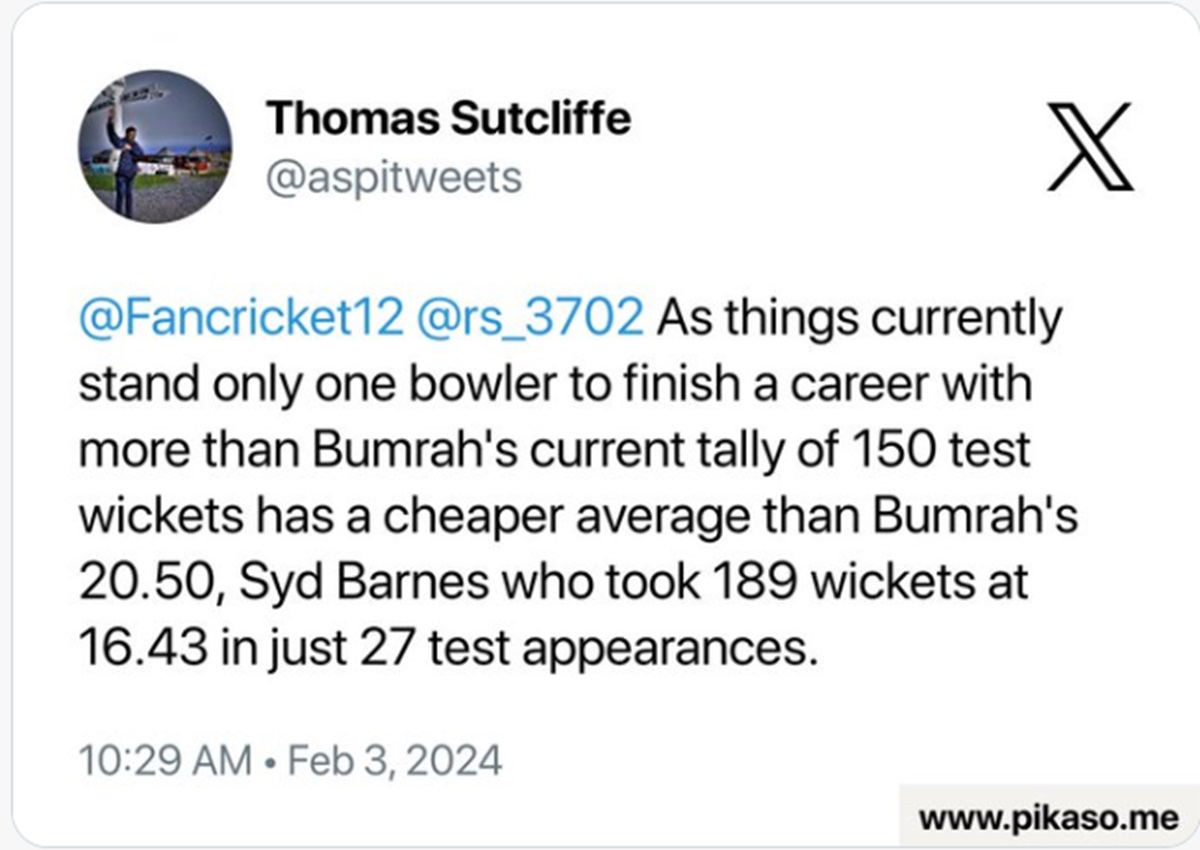
England began brightly, with Zak Crawley playing well. Mukesh Kumar did not at any stage resemble a genuine test match new ball bowler. Axar Patel, R Ashwin and left arm wrist spinner Kuldeep Yadav all took turns at the bowling crease. At high water mark England were 114-1, but then Crawley fell to catch by Iyer of Axar Patel. Bumrah was then called back into the attack to deal with Joe Root. Nine runs later Bumrah found the edge of Root’s bat, Gill took the catch and it was 123-3. Then Pope, who was just beginning to look settled after a typically nervous start had two of his stumps uprooted by an absolutely unplayable ball from Bumrah to make it 136-4. Bairstow and Stokes resisted for a time, but the unstoppable Bumrah found one to take the edge of Bairstow’s bat for another catch to Gill to make it 159-5. Kuldeep Yadav got Foakes with a good ball and Ahmed courtesy of a loose stroke which gave Gill his third catch of the innings and England were 182-7. Tom Hartley now joined Ben Stokes, and Stokes threatened to wrest the initiative back for England. However, with Stokes on the verge of a half century a superb delivery from Bumrah rattled his stumps to make it 229-8. That was Bumrah’s 150th test wicket, at an average of 20.50 a piece, a fact the significance of which I noted in the tweet reproduced in screenshot form below (follow the link highlighted in blue to note the exact time at which I posted it):

The day got better yet for Bumrah, as he induced Hartley to give Gill a fourth catch of the innings, which brought the debutant Shoaib Bashir in to join Anderson, given a one place promotion from his usual slot presumably on grounds of experience for the last wicket stand. Bumrah finished the innings by pinning Anderson LBW. England had just crept past 250, but a final score of 253 all out gave India a first innings advantage of 143. Bumrah had taken 6-45 from 15.5 overs on a pitch not offering much assistance, a truly great display of test match fast bowling, from one of the great masters of that art. This gives him an overall tally of 152 test wickets at 20.29 each, with Barnes ahead of him on 189 wickets at 16.43, and Alan Davidson the great Australian left armer having taken 186 at 20.53, with West Indians Ambrose, Garner and Marshall all also having finished with over 150 wickets at less than 21 a piece. Barnes and Bumrah were both in my all time Bs XI. I make one change to that XI in retrospect, Benaud being moved from being in the XI to fronting the TV commentary and Bishan Bedi taking his place giving an XI off: C Bannerman, SG Barnes, *DG Bradman, KF Barrington, AR Border, IT Botham, +Wasim Bari, W Bates, SF Barnes, BS Bedi, JJ Bumrah. I first noticed Bumrah when not long discharged from Addenbrooke’s after emergency cancer treatment, when he destroyed Australia in Australia (see here).

There was time for five overs of the Indian second innings, in the course of which they scored 28-0, meaning that they start day three with a lead of 171 and all their second innings wickets intact. Cricket is a game which regularly makes fools of those who make over-dogmatic statements about match situations, and this is never truer than when Stokes’ England are involved in the action, but it is at any rate not contentious to state that India are in a very strong position, especially given the tendency of Vizag pitches to break up as the match progresses (average innings scores there show a very straightforward pattern of declining from first to fourth innings of the match).

My usual sign off…

All Time XIs – Golden Oldies

In view of today’s happenings in Vizag I offer an XI of players whose skills and appetite for the game remained undimmed into their 40s. I also have my usual photo gallery for you.

The second test match of the five match series between India and England began at 4:00 this morning UK time. The pitch at Vizag is a batters paradise, which is why I reckon it is honours even at the end of day one. India are 336-6, with Yashavsi Jaiswal having batted all through the day for 179*. England actually bowled three overs more than the statutory minimum of 90, which is almost as rare as seeing a woodpecker in the environs of King’s Lynn, which also happened today:

Close up of a Green Woodpecker seen while walking along the Gaywood River path this morning.

England’s two young spinners, Rehan Ahmed and debutant Shoaib Bashir (born in Nottinghamshire and Surrey respectively for those who care about such things) each picked up two wickets, and each took a catch of the other’s bowling. Bashir became the 713th player capped by England Men, and one of his team mates in this match is the 613th player capped by England Men, one James Michael Anderson, who is the inspiration for today’s XI, comprising players who had great test match moments when past 40 years of age. Anderson had a fine day on a pitch offering him precious little, being parsimony personified, with 1-30 from 17 overs, meaning that he has now taken at least one test wicket in each of 22 successive calendar years.

  1. Jack Hobbs (England, right handed opening batter). Almost half of his test runs were scored after he had turned 40, and at Melbourne in 1929, at the age of 46, he became test cricket’s oldest ever centurion with an innings of 142.
  2. Warren Bardsley (Australia, left handed opening batter). At Lord’s in 1926, almost 17 years after he had become the first to score twin centuries in a test match, Bardsley, then 43 years old, carried his bat through Australia’s first innings, scoring 193 not out.
  3. Patsy Hendren (England, right handed batter). Like Hobbs a tall scoring batter to the very end of his long career – over 1,000 of his test runs came after turning 40.
  4. Tom Graveney (England, right handed batter). Another in the select ‘1,000 test runs after the age of 40’ club.
  5. *Misbah-ul-Haq (Pakistan, right handed batter, captain). Someone whose prime test years were after he had turned 40.
  6. Basil D’Oliveira (England, right handed batter, right arm medium pacer). Based on his test record a batter who bowled rather than a genuine all rounder, though that might very well have been different had he been able to play for his native land starting in his mid 20s rather than for another country starting officially in his mid 30s.
  7. +Bob Taylor (England, wicket keeper, right handed batter). The only candidate for this slot.
  8. Clarrie Grimmett (Australia, leg spinner, right handed batter). His career did not begin in earnest until his mid 30s, and his test career only ended when at 46 years of age he was left out of the squad for the 1938 Ashes in England. By then he had taken 216 wickets in 37 tests.
  9. Sydney Barnes (England, right arm fast medium bowler, right handed batter). His last series, played at the age of 41, saw him claim 49 wickets in four matches before an argument of terms and conditions saw him miss the fifth and final match of the series. Those 49 wickets were just over a quarter of his career tally of 189, taken in just 27 matches.
  10. James Anderson (England, right arm fast medium bowler, left handed batter). Incredible longevity at the top for a 21st century cricketer, and his performance today suggests that the skills are very much still there. He has been known to bowl left arm spinners in the nets, though as far as I am aware has not yet deployed this method in a match. The oldest ever test cricketer, Wilfred Rhodes, who played his last match at the age of 52 years 165 days bowled left arm spin.
  11. Bert Ironmonger (Australia, left arm orthodox spinner, left handed batter). He made his debut at the age of 46, played 14 tests over the course of five years, and took 74 wickets at 17.97 in those matches. Thus in spite of being the ultimate in one-dimensional players – a clumsy fielder, and possessor of a test batting average of 2.62, he was nailed on for selection in this XI.

This side features a strong top six, a keeper whose batting was better than it is often given credit for being, and four great bowlers. Going by D’Oliveira’s actual record rather than dealing in ‘what might have been’ it is very much six batters, a keeper and four bowlers, rather than five batters, an all rounder, a keeper and four bowlers. However, the two most dominant men’s test cricket forces of my life time, the West Indies under Lloyd and Richards, and their successors at the top of the test tree, the Australians under Mark Taylor and Steve Waugh, both relied on six batters, a keeper and four bowlers, so it clearly can work provided that the personnel involved are good enough at their jobs, and I believe that this team ticks that box.

Among the batters to merit serious consideration were Bobby Simpson of Australia, Eric Rowan of South Africa and Herby Taylor of South Africa. The only other keeper to do well at the very highest level when past 4o was Bert Strudwick of England, and he was a genuine tailender with the bat, which would have made things very dicey indeed batting wise. Freddie Brown, who captained England in Australia at the age of 40 and had a respectable series would have had the number six slot had I been desperate to tick the all rounder box, but I felt in view the people at 8-11 that D’Oliveira, the batter who bowled, was a better fit for the XI.. Few genuine quicks have kept their pace into their 40s, and although his presence at number eight would have strengthened the batting I did not feel that Gubby Allen (England), one of that select company, was good enough to dislodge any of my chosen bowlers.

My usual sign off…

An Aspiblog All Time XI

A bit of fun on the all time XI theme, a look back at a James and Sons auction, and a photo gallery.

The first test match of a five match series between India and England is two days old as I type this post, but I am holding fire on that for the moment. This all time XI is picked with a view to being an entertaining watch. I have restricted it to players who played before I started following cricket, and save for allowing myself one overseas player I have concentrated on English cricketers. After I have paraded the XI there will be a section about some of the players who missed out, though I will limit myself, otherwise that section could be very long indeed.

  1. Frank Woolley (left handed batter, left arm orthodox spinner). An attacking batter, an excellent spinner and the only non-wicket keeper ever to take 1,000 first class catches.
  2. *WG Grace (right handed batter, right arm bowler of various types through his career, captain). Cricket’s first superstar.
  3. Wally Hammond (right handed batter, right arm medium fast bowler). Over 50,000 first class runs, including 167 centuries, in spite of missing eight complete seasons in the course of his career – one to bureaucratic malice on the part of Lord Harris, one to illness and six to WWII. Considered by Bradman to possess the best of all cover drives.
  4. Denis Compton (right handed batter, occasional left arm wrist spin bowler). A great cricketer and an even greater entertainer.
  5. Garry Sobers (left handed batter, left arm bowler of every type known to cricket). No cricketer before or since has mastered so great a range of skills as my chosen overseas player.
  6. +Les Ames (wicket keeper, right handed batter). Twice winner of the Lawrence trophy for the fastest first class hundred of the season, scorer of over 100 FC hundreds, maker of a record 418 first class stumpings in his career. The “wicket keeper’s double” of 1,000 runs and 100 dismissals in first class matches in an English season was only achieved four times before the reduction of first class fixtures in 1969 made it impossible, and three of those were by Ames (John Murray of Middlesex was the other to do it).
  7. Percy Fender (right handed batter, leg spinner, vice-captain). I have remarked before on his suitability for batting at seven in a strong line up and his tactical acumen.
  8. Jim Laker (off spinner, right handed batter). In 1956 he absolutely destroyed the visiting Australians, and it wasn’t all about the pitches helping him – when Australia played Surrey before the test series had started they batted first, and Laker, on a good pitch and having not slept the previous night due to his children being sick had figures of 46-18-88-10 in the first innings.
  9. George Simpson-Hayward (under-arm off spinner, right handed batter). The last specialist under arm bowler to play at the highest level, and his five test matches yielded him 23 wickets. Someone prepared to buck the trends as spectacularly as he did must have been worth watching,
  10. Syd Barnes (right arm fast medium bowler, right handed batter). My pick for the greatest bowler of them all – 189 wickets in just 27 test matches, at 16.43 a piece.
  11. Tom Richardson (right arm fast bowler, right handed batter). Only 14 test matches, which yielded him 88 wickets. His first class record was outstanding – he took his 1,000th first class wicket in his 134th first class match, and his 2,000th in his 327th match, both these figures being records.

This side has a powerful batting line up, and a spectacular bowling line up, with massive variety on show – Barnes, Richardson, Sobers in his quicker guises and Hammond to bowl pace/ seam, and Laker, Simpson-Hayward, Fender, Woolley, Sobers in his slower guises, and Compton to bowl spin plus of course the wild card of WG Grace.

The number seven slot was a two-way choice, and I opted for Fender who bowled spin over Jessop who bowled pace. I considered the presence of Woolley and Sobers to obviate the need for a specialist left arm spinner. There would have been a number of possibilities, Rhodes, Blythe, Verity and Wardle being just four of those I might have chosen. Digby Jephson who bowled fast underarm just a few years before Simpson-Hayward’s prime and was enough of a bat to be considered an all rounder was a possibility there, but Simpson-Hayward got the nod for two reasons: he played test cricket and Jephson did not, and also in view of the current state of England’s spin bowling, and some of the comments flying around that imply that England have never had great spinners I wanted to place extra emphasis on spin. I regretted not being able to accommodate either Harold Larwood or Frank Tyson, but I had only 11 spaces to fill. I also didn’t include a specialist left arm quick bowler, relying on Sobers for that. Had I done so William Mycroft would have got the nod.

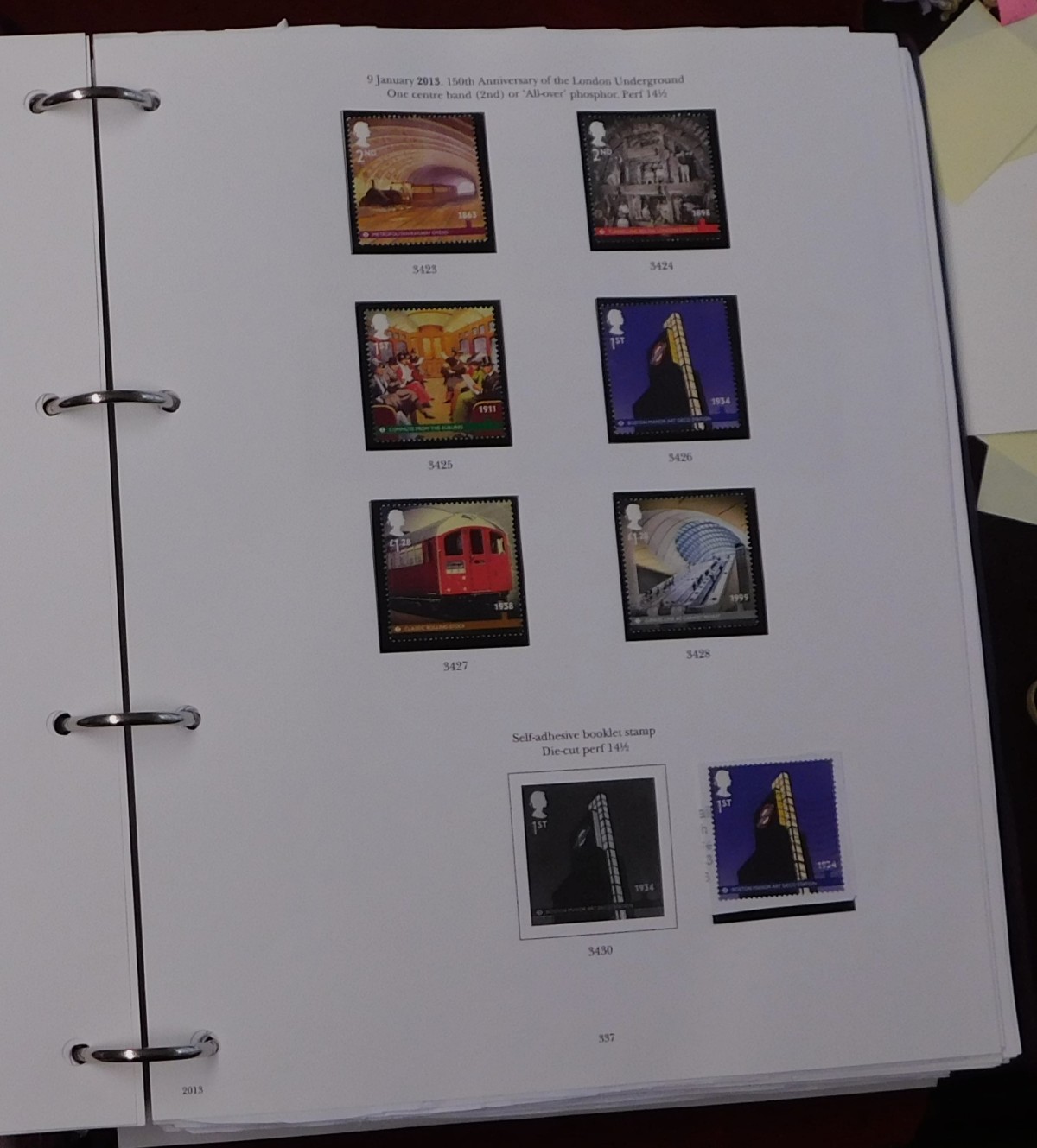
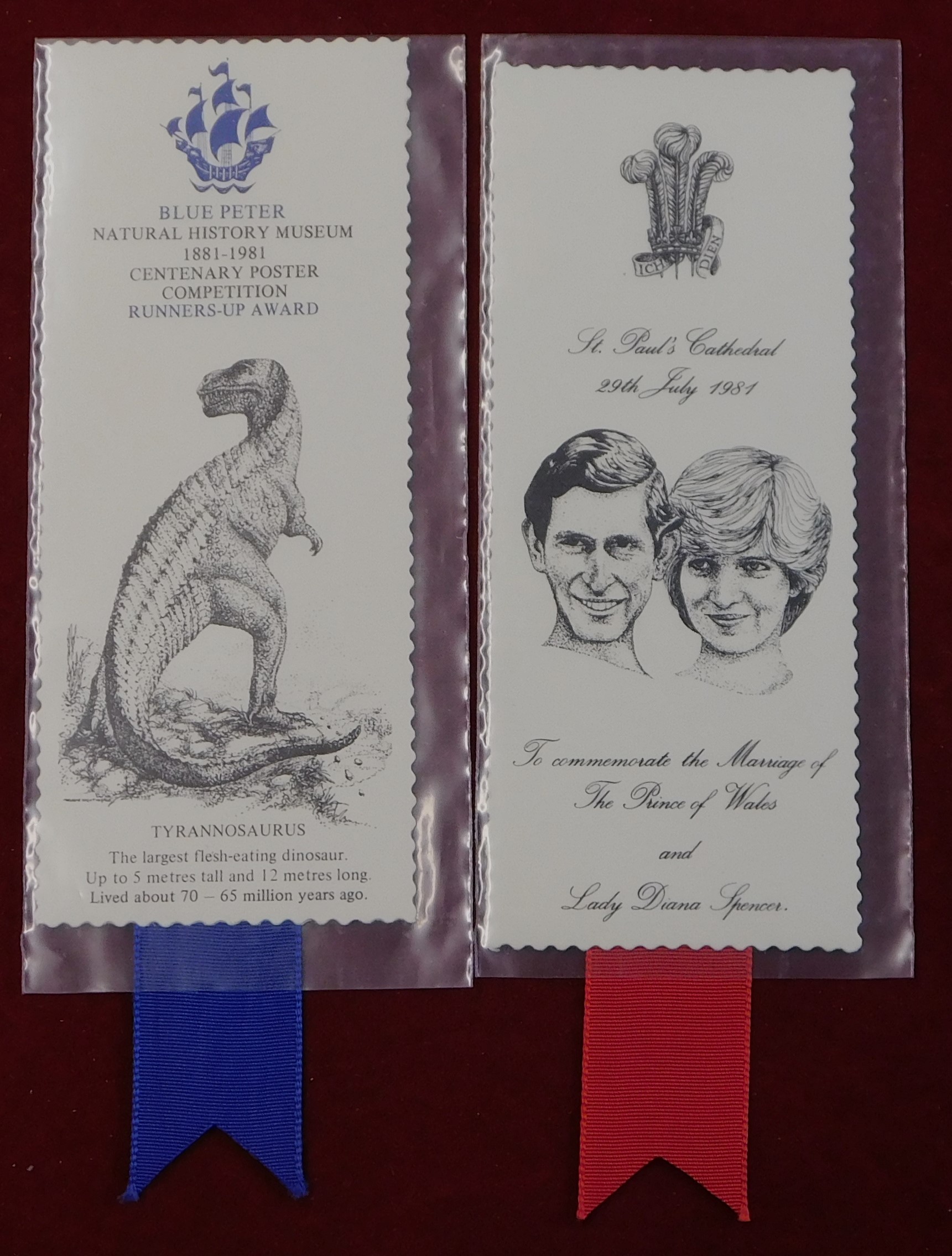
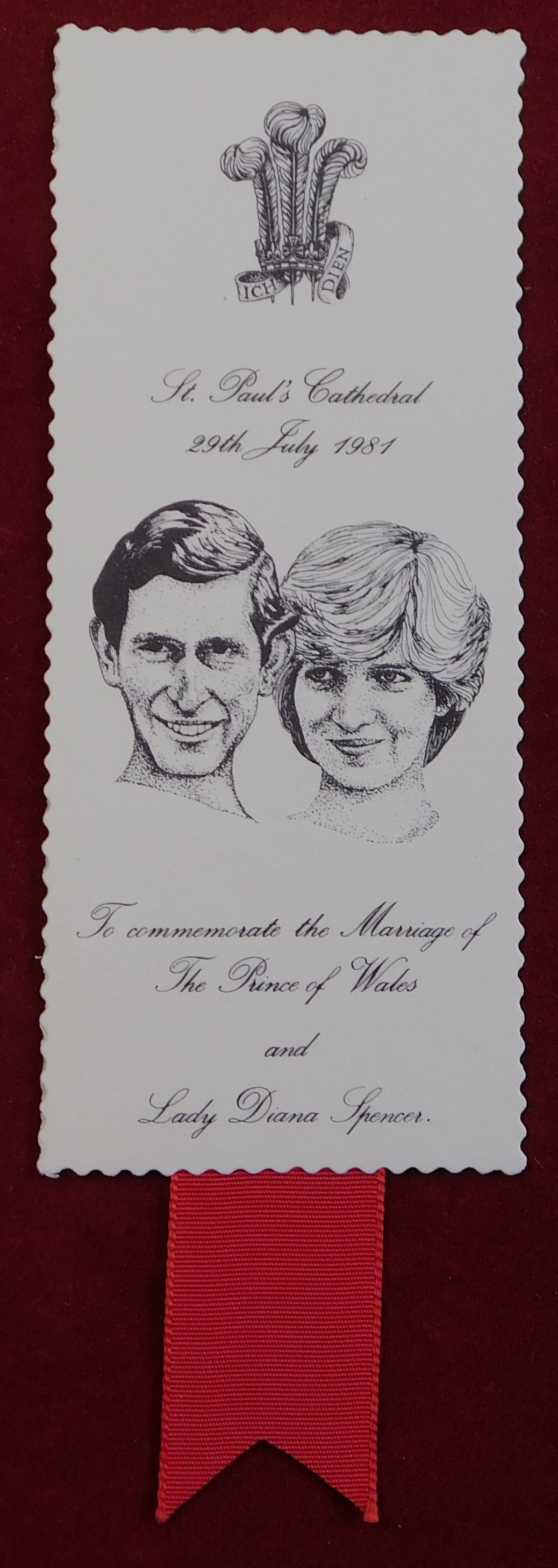
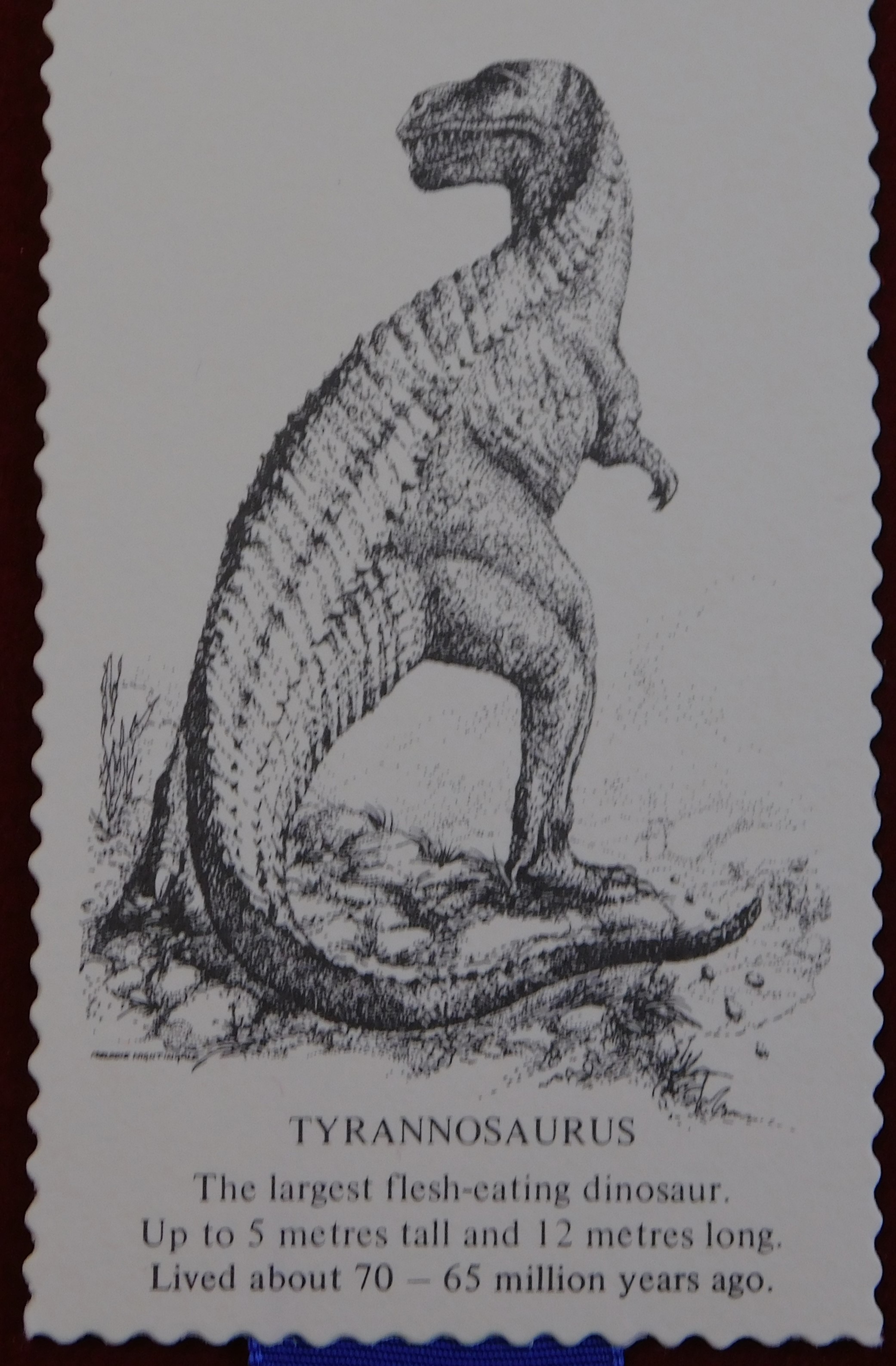
James and Sons had an auction earlier this week, which did reasonably well, especially given that it was basically an appetizer for next week’s auction of sporting memorabilia. There were a few items of interest to me. Lot 68 was a pair of bookmarks, which went my way cheaply.

No prizes for guessing which bookmark I actually wanted!

Lots 141 and 142 would have been of interest to me but were beyond my purchasing power.

I did get lot 269.

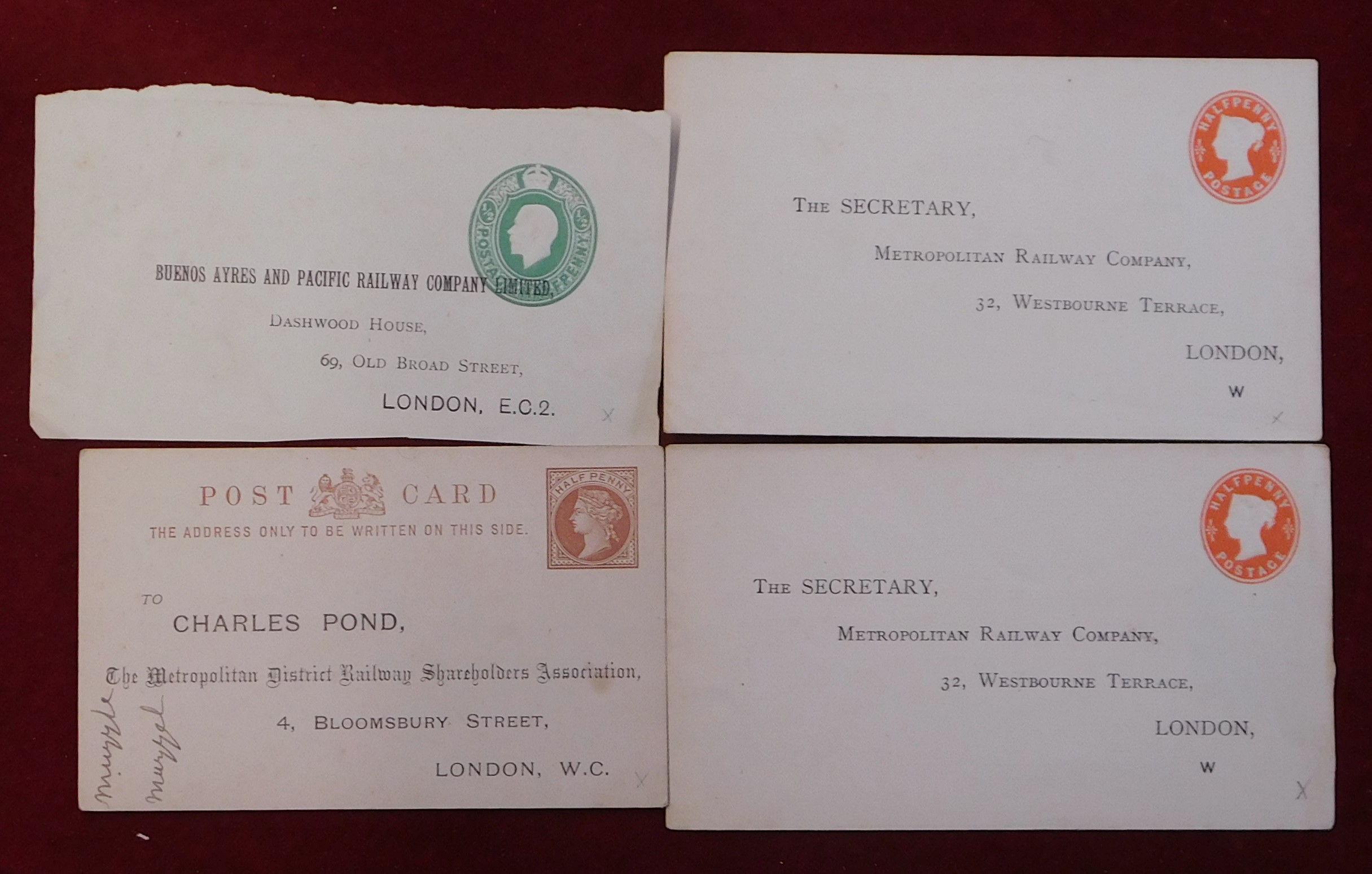
Lot 329 also went to me…

I ignored lot 399…

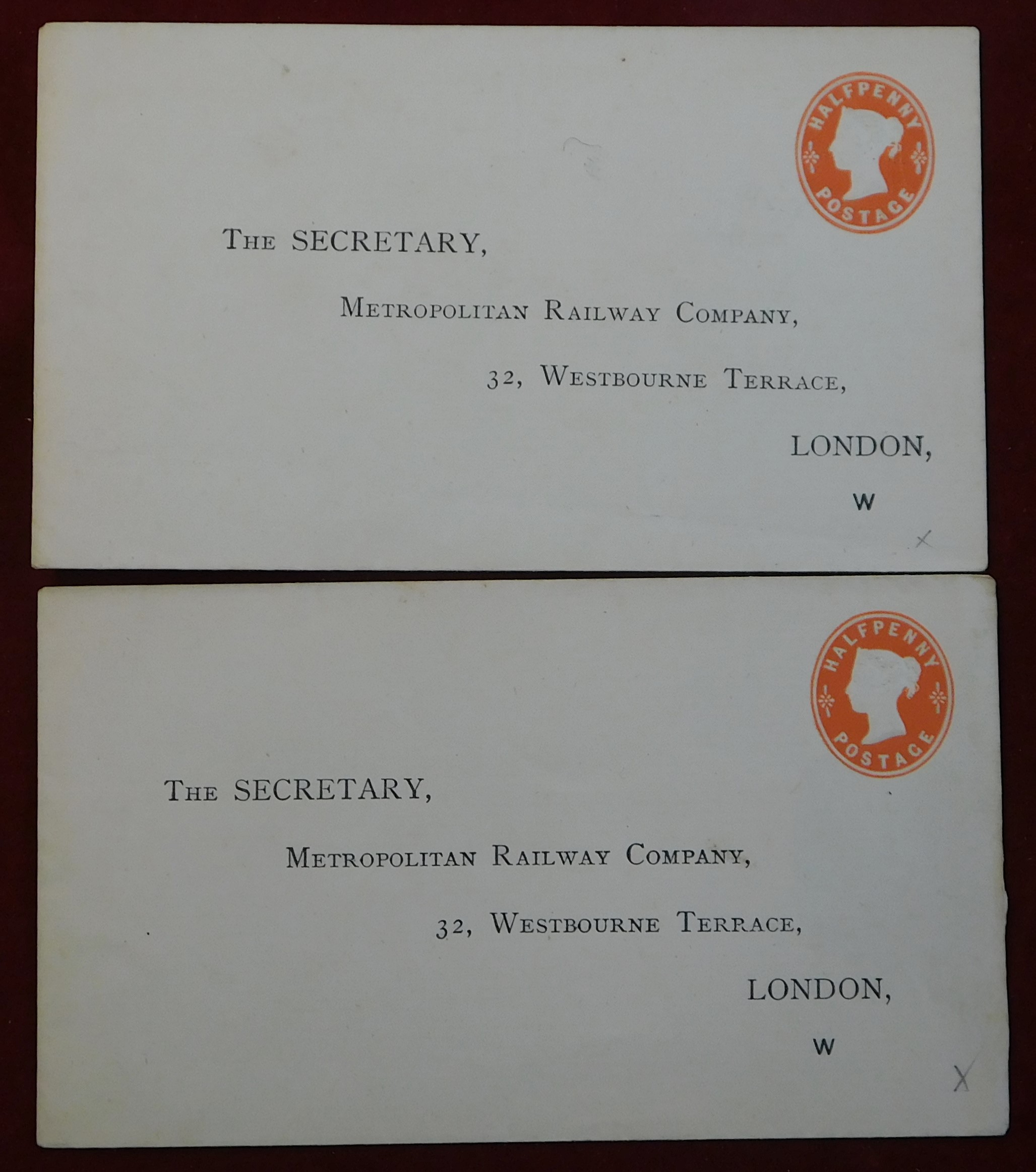
I had produced a very extensive image gallery for lot 400, made more so by fielding a query on that lot. However, in the end my opportunistic bid was the only one on the lot.

Lots 402 was also railway related but discipline had to prevail.

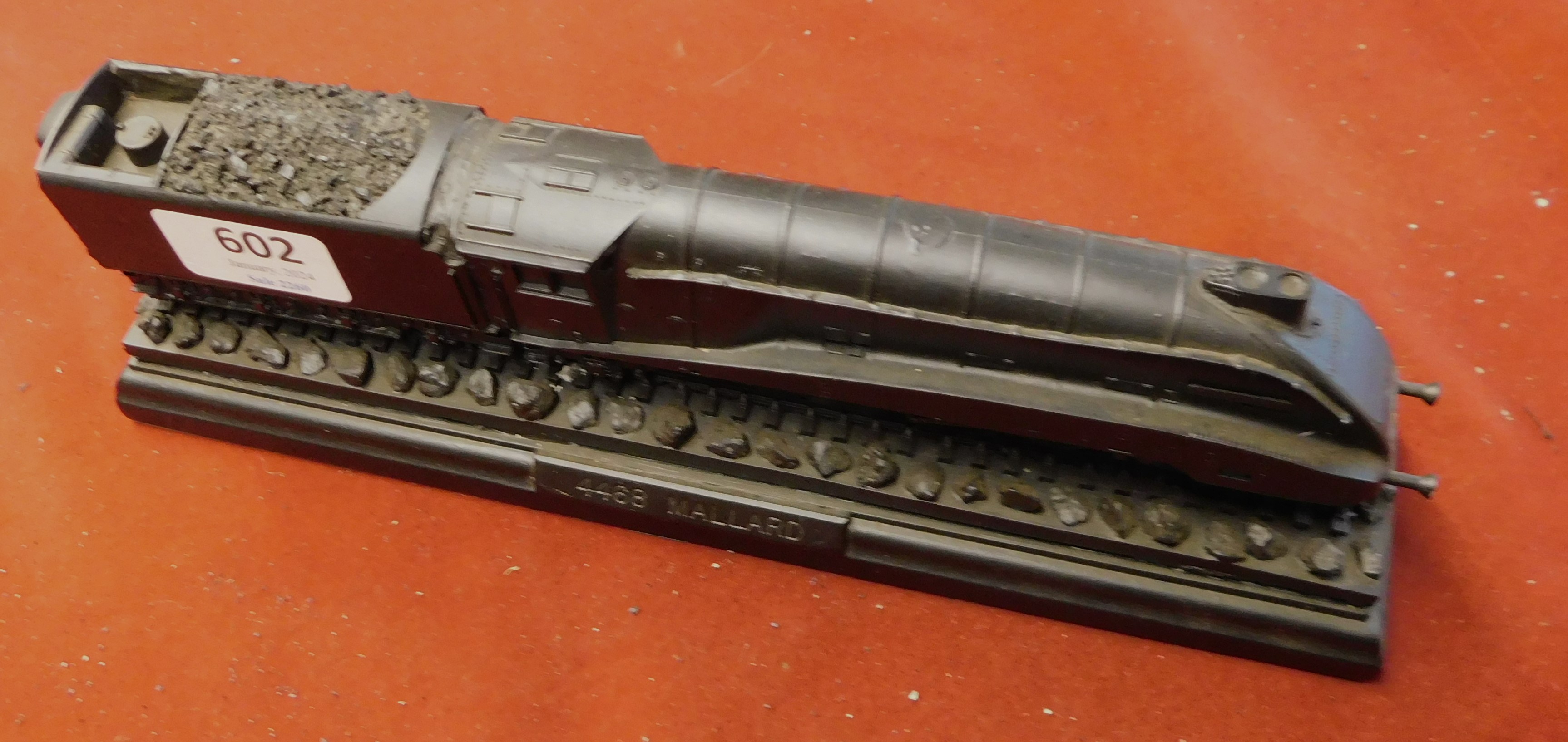
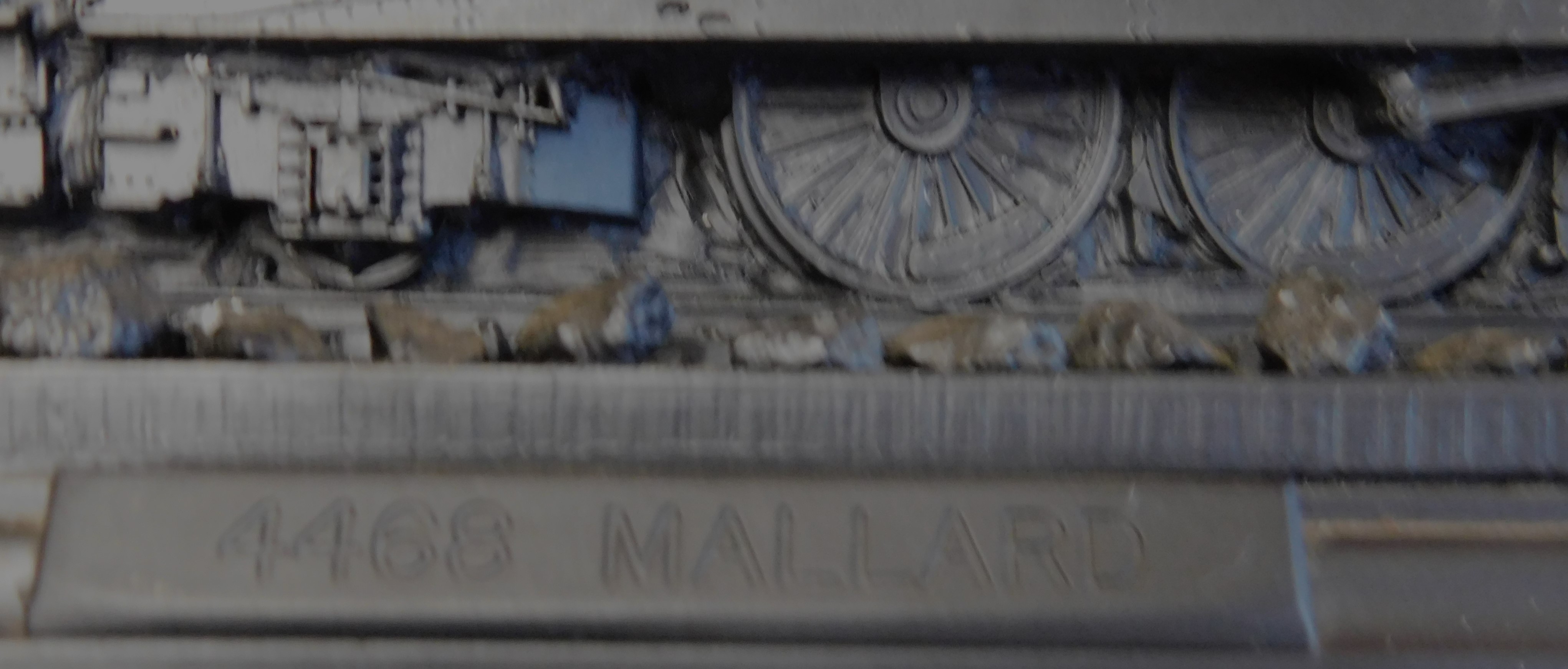
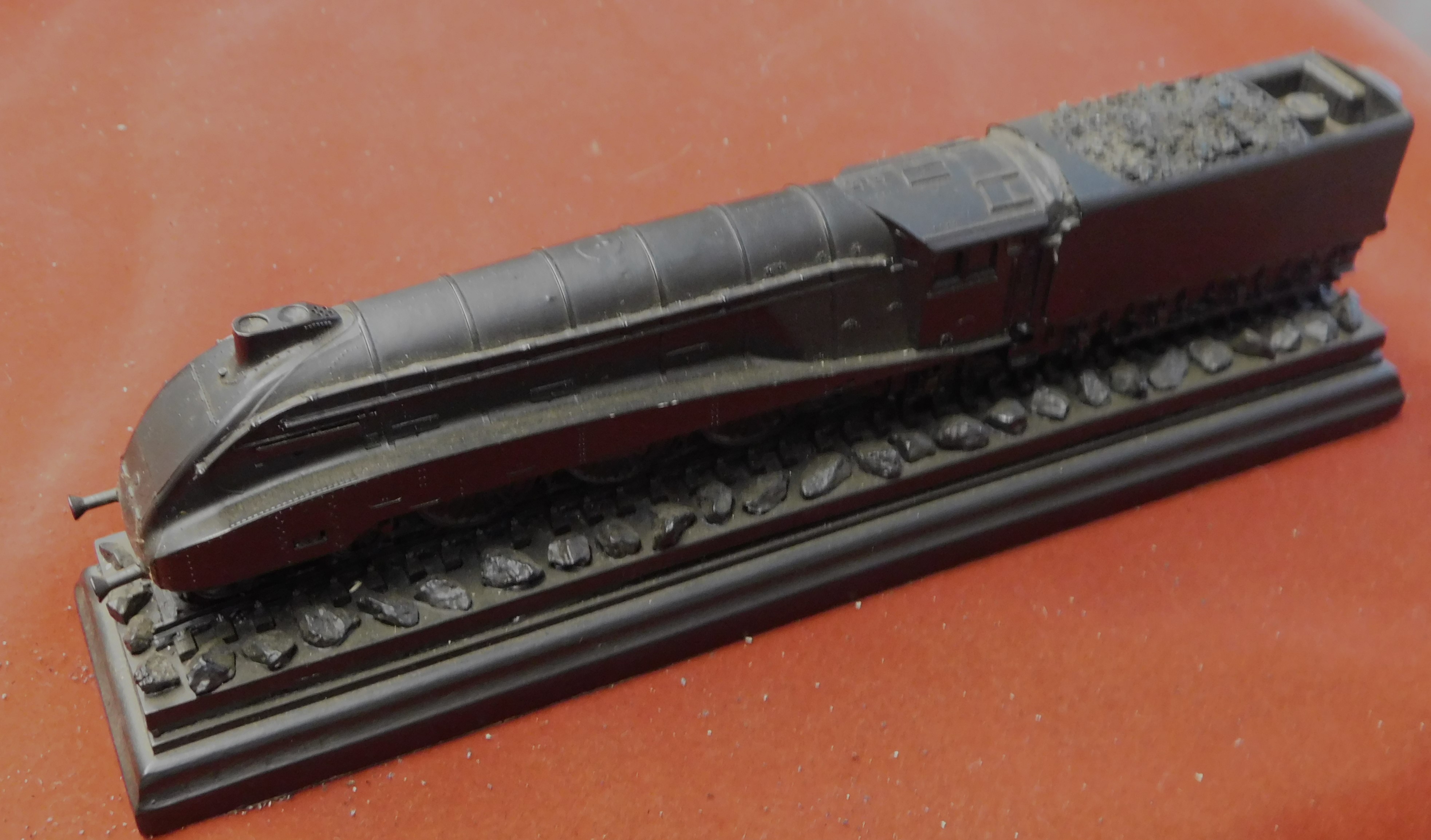
Lot 602, a model of a locomotive sculpted from coal proved, as I expected to be the case, to be beyond my price range.

I end this section with a lot that attracted a fierce bidding war (in which I had no part, other than creating the images that generated it), and ended up fetching £150, having been expected to do no more than 20-30, number 197.

My usual sign off…

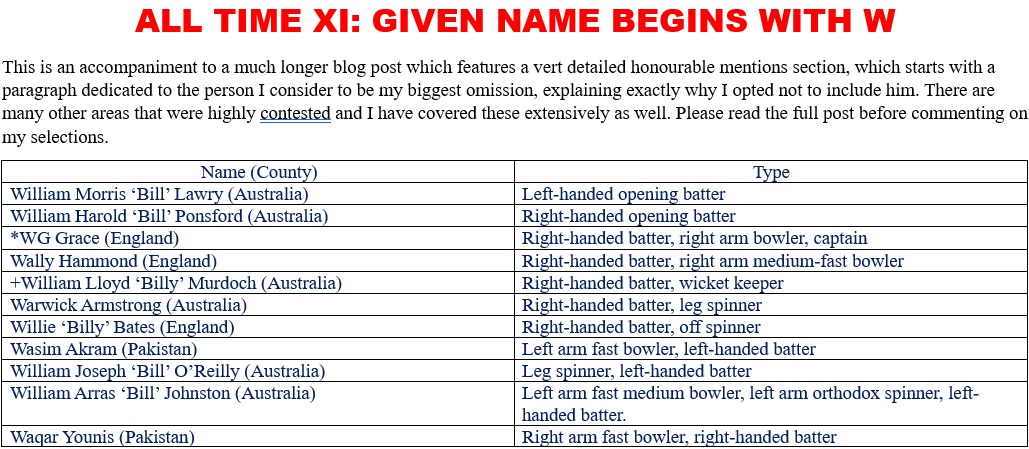
W is for Winners

An all time XI of players whose given names begin with W, a very detailed honourable mentions section and a photo gallery.

Today I present an all time XI of players whose given names begin with W and a detailed honourable mentions section, as well as my usual photo gallery.

  1. William Morris ‘Bill’ Lawry (Australia, left handed opening batter). He averaged 47 with the bat in test cricket.
  2. William Harold ‘Bill’ Ponsford (Australia, right handed opening batter). Until Brian Lara came along only one player had achieved two first class scores in excess of 400, Ponsford, with 429 against Tasmania in 1922 and 437 against Queensland in 1927. In December of 1927 he became the only player ever to score 1,000 first class runs in a calendar month outside of England, with a sequence of 1,146 runs in five innings. His test record was not quite so outstanding, but even at that level he averaged 48, which included centuries in each of his first two test matches and centuries in each of his last two.
  3. *WG Grace (England, right handed batter, right arm bowler of various styles, captain). Cricket’s first superstar, and in his best decade, the 1870s, he averaged 49 with the bat at a time when the best of the rest were just about managing 25. Only one other person in cricket history ever sustained being twice as prolific as the best of the rest over a long period – Bradman.
  4. Wally Hammond (England, right handed batter, right arm medium-fast bowler). He scored 7,249 runs at 58.45, including 905 at 113.125 in the 1928-9 Ashes.
  5. +William Lloyd ‘Billy’ Murdoch (Australia, right handed batter, wicket keeper). Australia’s best batter in the earliest years of test cricket, and a fine enough keeper that FR Spofforth missed the first ever test match because he initially didn’t believe that any keeper other than Murdoch could handle his bowling.
  6. Warwick Armstrong (Australia, right handed batter, leg spinner). A fine all round cricketer whose feats included scoring over 2,000 runs and taking over 100 wickets in first class matches on the 1905 tour of England. 16 years later he almost captained an undefeated side, the only loss they sustained on the tour coming at the hands of ‘an England XI’ assembled by AC MacLaren.
  7. Willie ‘Billy’ Bates (England, right handed batter, off spinner). The first England bowler ever to take a test hat trick, part of a match performance in which he scored a 50 and took seven wickets in each Australian innings.
  8. Wasim Akram (Pakistan, left arm fast bowler, left handed batter). One of the greatest ever.
  9. William Joseph ‘Bill’ O’Reilly (Australia, leg spinner, left handed batter). Only one batter among those he came up against in the course of his career could truly claim to have his measure: Don Bradman.
  10. William Arras ‘Bill’ Johnston (Australia, left arm fast medium bowler, left arm orthodox spinner, left handed batter). The third essential member of Australia’s immediate post WWII bowling attack after Lindwall and Miller, as well as being two types of bowler in one he was possessed of great stamina – it was not unknown for him to go straight from spinning the old ball to swinging the new one. Three times he was Australia’s leading wicket taker in Ashes series. In England in 1953, with the active connivance of some his team mates, who got themselves out in some of the later matches to help engineer the outcome, he became only the second player to average 100+ for an English first class season (17 innings, 16 not outs, 102 runs, average 102.00) after Bradman in 1938 (the Don achieved his average of 115.66 for that season without any such shenanigans going on).
  11. Waqar Younis (Pakistan, right arm fast bowler, right handed batter). A superb practitioner, and one who regularly shared the new ball with Wasim Akram.

This side has a powerful batting line up, and a wealth of bowling options. The only regular type of bowling that is not featured is left arm wrist spin. The front five of Younis, Akram, Johnston, O’Reilly and Bates are formidable in their own right, and in the unlikely event that they prove insufficient there are Armstrong, Grace and Hammond as back up options.

I start this section with a paragraph devoted to my most notable omission…

One of the most extraordinary performers in the history of cricket, with a remarkable five-phase playing career – specialist left arm spinner, all rounder, specialist batter, all rounder, specialist left arm spinner. The trouble is that brilliant as he was as an all rounder at county level his England career was almost exclusively spent either as specialist bowler (early and late periods) or as a specialist batter (in the run up to WWI). His batting would not warrant selection as a specialist and if I pick him as a specialist bowler I would have to leave out Johnston, who offers me two bowling options in one and had an outstanding test record.

The opening slots were rich in potential candidates. Lawry’s only rival for the left handed openers slot was Warren Bardsley, the first batter ever to score twin centuries in a test match and possessor of a fine overall test record, as well as being Australia’s leading scorer of first class centuries until Bradman came along, more than half of those tons having come in England.

Ponsford was rivalled for the right handers opening slot by two other Williams who were generally known as Bill, WA Brown and WM Woodfull. Woodfull in particular is unlucky to miss out, while Brown also had a fine record.

I regard WG Grace as an essential pick and my reckoning is that he could handle first drop, though he did prefer to open. Two regular number threes who thus miss out are William Gunn, the Gunn of Gunn & Moore, whose test record did not live up to his superb first class record and William Scotton, also of Nottinghamshire, whose ability to bat for long periods of time came at the expense of run scoring. William John ‘Bill’ Edrich was another who might have had this slot, averaging 40 in test cricket in spite of losing six prime years to WWII. WG ‘Billy’ Quaife had a splendid record for Warwickshire but his seven tests were disappointing. Wajahatullah Wasti of Pakistan once scored twin tons in a test match but did little else at that level. William Yardley has a place in the record books – in 1870 he became the first player ever to score a century in the Varsity Match.

Among the all rounders I could not accommodate were Wasim Raja, WE ‘Bill’ Alley, Wanindu Hasaranga de Silva, Wilf Flowers and William ‘Billy’ Barnes.

My decision to entrust the gloves to Murdoch meant that three very accomplished keepers, Wriddhiman Saha of India, Wasim Bari of Pakistan, and Arthur Theodore Wallace ‘Wally’ Grout of Australia missed out.

WH ‘Bill’ Lockwood was a fine bowling all rounder, and possibly the pioneer of the slower ball, but not a serious rival to Akram for the number eight slot. A number of Williams, all known as Bill, were fine quick bowlers: Whitty, Voce, Bowes, Copson, Andrews and Bestwick among them. Two Williams known by their full first names, Lillywhite and Mycroft, were both great bowlers kept out by the immense strength in depth available for this squad. Wes Hall and Wayne Daniel were two of the many superb quicks to come from the coral island of Barbados, and both can be considered unlucky to miss out. Walter Mead, a bowler of mixed spin for Essex who claimed a 17 wicket match haul against the 1893 Australians and had a magnificent first class record was the biggest miss in the spin bowling department.

In a few years time there may be a second WG in the line up – WG Jacks of England, an attacking batter and a capable off spinner who is in the process of establishing himself in international cricket.

My usual sign off…

V for Victory

An all time XIU of players whose given names begin with V, some honourable mentions and a photo gallery.

Today I present an all time XI of players whose given names begin with V, plus some honourable mentions, including two players given whole paragraphs to themselves. I also have a photo gallery which includes pictures taken while travelling to and from Cambridge today. I am not going to publish an XI of players whose given names begin with U because such an XI owes more to cricinfo than it does to me, and is also far from great.

  1. Victor Trumper (Australia, right handed opening batter, occasional medium pacer). A great player and according to all available reports a great human being as well. His finest hours came on the 1902 tour of England, in an exceptionally wet season on uncovered pitches. In first class matches on that tour he scored 2,570 runs including 11 centuries. The highlight of this procession round England came in the fourth test match of the series at Old Trafford, when with England on a mission to ‘keep Victor quiet before lunch’ he proceeded to become the first player ever to reach a test ton on the first morning of the match.
  2. Vijay Merchant (India, right handed opening batter). Only ten test matches, spread over 18 years for him, in which he recorded a career batting average of 47. In all first class cricket he averaged 71.22, a figure which places him second only to Bradman among those who played enough matches to qualify (another Australian, Norman Calloway, played a solitary a first class match, scoring 207 in his only innings at that level, before going off to fight in WWI, where he was killed in action).
  3. Viv Richards (West Indies, right handed batter, occasional off spinner). One of the greatest of all time.
  4. Virat Kohli (India, right handed batter). Across formats the best batter of the current era.
  5. Vijay Hazare (India, right handed batter, right arm medium pacer). At a time when few Indians had great test records he averaged 47 with the bat at that level. In first class cricket he once scored 309 in a total of 387 all out, the lowest FC innings total to include a triple century.
  6. Vyell Walker (England, right handed batter, right arm slow bowler). One of only two players to have scored a century and taken all ten wickets an in innings of the same first class match, WG Grace being the other.
  7. Vallance Jupp (England, right handed batter, off spinner). Achieved the double of 1,000 runs and 100 wickets in first class matches in each of eight successive English seasons in the 1920s. In all he scored 23,296 first class runs at 29.41 and took 1,658 first class wickets at 23.01.
  8. +Victoria Lind (New Zealand, wicket keeper, right handed batter). Finding a wicket keeper for this XI was difficult, and I have selected someone who did not actually have the gloves when I saw her in action (she was playing as a specialist batter, with Katey Martin keeping wicket), but who was a recognized keeper.
  9. Vanburn Holder (West Indies, right arm fast medium bowler, right handed batter). Was part of the first WI pace quartet in 1976.
  10. Vernon Philander (South Africa, right arm fast medium bowler, right handed batter). In test cricket he claimed 224 wickets at 22.32 a piece, enough to underwrite his claim for a place in this XI.
  11. Vince van der Bijl (South Africa, right arm fast medium bowler, right handed batter). His entire career happened while South Africa were banned from the international arena, but 767 FC wickets at 16.54, taken at a rate of fractionally below five per match and the universally high opinion of all who encountered him are good enough for me.

This side has a powerful top five, two genuine all rounders of different style, a keeper who could bat and three excellent specialist bowlers. The bowling attack should be able to capture 20 opposition wickets in most conditions.

First of all…

Vangipurappu Venkata Sai Laxman, universally known by his initials VVS, had a test average of only just over a run per innings less than that of Hazare, and maintained over larger number of matches. That fine career record included a thunderous 281, at the time the individual record score for an Indian in test cricket, against the mighty Aussies in 2001. However my feeling was that Hazare offered a back up bowling option as well as his batting, and was part of a less strong batting order than Laxman had the luxury of belonging to. Had Laxman been a left hander, of whom there are none in this order, he would have had the nod, but I felt Hazare had the edge and selected accordingly.

Virender Sehwag was the first Indian ever to score a test triple century, and achieved that feat twice, but he did not do much outside Asia, and especially he did not do much against the swinging or seaming ball, whereas the attacking opener I did select, Trumper, was at his very finest on an overseas tour in conditions that would have been massively alien to a Sydneysider – one of the wettest English summers ever.

Vernon Ransford was the best left handed batting option available for this squad. Vic Wilson, the only other left hander worth mentioning was even further adrift, though he could be named as designated fielding substitute. With Richards and Kohli absolutely certain selections he could only have been accommodated at the expense of Hazare, and my feeling is that getting a left hander in isn’t worth sacrificing an average of ten runs per innings for. Vic Richardson, a legendary all round sportsperson and grandfather of two Aussie skippers, did not have a good enough record at test level to merit inclusion. Vikram Solanki was a good county batter, but such international success as came his way did so in limited overs cricket. Vic Jackson, an Aussie who bowled both medium pace and off spin, and played for Leicestershire as well as his native NSW was in the mix for an all rounders slot. Varun Aaron was a quicker bowler than any of three specialists I selected, but he was also much more erratic, and 18 test wickets at 52.61 hardly constitutes a strong basis for a challenge. Vinod Kambli was hugely talented, and was probably cast aside too soon by the Indian selectors, but unfortunately when up against Richards, Kohli and Hazare, with Laxman also deserving a mention a player who only gained 17 test caps, even one who averaged 54 with the bat at that level cannot be included.

My usual sign off…

Testing Times

An all time XI of players whose given names begin with T, including an honourable mentions section which pays particular attention to four specific areas, and a photo gallery.

Today I look at great players with given names beginning with the letter T. This was a particularly tough XI to select, and I will be starting the honourable mentions section with four disputed areas in this team. Incidentally I offer wholehearted congratulations to India Women on their all time record test victory over England Women. Their star was Deepti Sharma, who scored runs in both innings and was the chief destroyer with the ball as well, claiming 5-7 in the first England innings and 4-32 second time round.

  1. Tom Hayward (England, right handed opening batter, right arm medium pacer). In 1900 he passed his 1,000 FC runs for the season before the end of May, only the second ever to do so after WG Grace, all though the good Doctor scored all his runs actually in May, whereas Hayward’s tally included runs in April. 14 years later Hayward brought up the career landmark of 100 first class hundreds, again second ever to do so after WG. In 1906 he scored 3,518 first class runs in the season, a tally that stood as a record for 41 years, before Denis Compton and Bill Edrich both beat it in the same season. He also ushered on to the scene a fellow native of Cambridge named John Berry Hobbs.
  2. Tamim Iqbal (Bangladesh, left handed opening batter). An attack minded left hander to go with the more conservatively minded right hander Hayward, and one with a test average of close to 40.
  3. *Tom Abell (England, right handed batter, right arm medium pacer, captain). I needed a captain for this side, and this was my solution.
  4. Tom Graveney (England, right handed batter, occasional leg spinner). A stylish batter, with a test record of very considerable substance as well.
  5. Travis Head (Australia, left handed batter, occasional off spinner). It has taken a while for him to really establish himself at the very highest level but he is now one of the best batters in the world.
  6. Trevor Goddard (South Africa, left handed batter, left arm medium pacer). A genuine, but massively under-appreciated all rounder, I go into more detail about this slot in the next section of the post. For the moment, suffice it to note that he averaged 34 with the bat and 26 with the ball at test level.
  7. +Tom Blundell (New Zealand, wicket keeper, right handed batter). An accomplished keeper/ batter for New Zealand, his record demands that he be included.
  8. Tom Emmett (England, left arm fast bowler, left handed batter). By the time test cricket was a thing he was past his absolute prime, but his FC averages were the right way around, 14.84 with the bat and 13.55 with the ball, which convert using my usual metric to 22.26 with the bat and 20.23 with the ball in the modern era.
  9. Tom Richardson (England, right arm fast bowler, right handed batter). His 14 test appearances yielded 88 wickets. His achievements for Surrey were staggering as well. Between 1894 and 1897 inclusive (four English seasons and one tour of Australia), Richardson claimed 1,005 first class wickets.
  10. Tom Goddard (England, off spinner, right handed batter). He started as a fast bowler, but following advice from Gloucestershire team mate Charlie Parker, who had noted the size of Goddard’s hands and the strength of his fingers he went away and remodelled himself as a spinner, and in that capacity he was one of the greats, ending a very long career (forced because of an attack of pleurisy) as the fifth leading first class wicket taker of all time, with 2,979 scalps at 19.84 each.
  11. Taijul Islam (Bangladesh, left arm orthodox spinner, left handed batter). 44 test appearances have yielded him 192 wickets, sufficient to earn him his place in this XI.

This side is strong in batting, even with the 9, 10, 11 being old style tail enders, and has lots of bowling, with Emmett, Richardson, Tom Goddard, Islam and Trevor Goddard as the main attack and Hayward, Abell and Head all capable of providing support if needed.

I will start with four particularly contentious areas, in batting order:

First, the number three slot. Technically I should have given this to Tom Latham of New Zealand, but I decided it was worth possibly sacrificing a few runs per innings to have Abell’s captaincy available.

Second, the all rounder position. Many would have opted for Trevor Bailey, but Goddard actually had better records in both departments than the other Trevor. Bailey averaged 29.74 with the bat and 29.21 with the ball at test level, Trevor Goddard 34.46 with the bat and 26.22 with the ball. Goddard also had a better wicket taking rate than Bailey, claiming an average of exactly three per test whereas Bailey averaged just 2.16 per test. Thomas Odoyo of Kenya would be a contender for a limited overs side.

Third, the wicket keeper’s slot. Taslim Arif had an amazing record with the bat for Pakistan in the few tests he got selected for, but he was never first choice keeper. Tim Ambrose of England was a quality keeper and a useful batter, but not quite good enough to displace Blundell. Tom Box, an legendary keeper of the mid 19th century also merits a mention.

Fourth, the new ball pairing. I opted for a pair of outstanding practitioners he never overlapped, rather than a pair with respectable records who bowled in tandem a considerable number of times at the highest level, Trent Boult (LFM) and Tim Southee (RFM), both of New Zealand. My feeling is that Emmett and Richardson were so great as individuals that I am prepared not to pick the established pairing, but I acknowledge that there is a good case for picking the Kiwis.

Thilan Samaraweera of Sri Lanka was a fine batter on flat subcontinental pitches, but did little outside of Asia.

Two quality English seamers who missed out were Tom Cartwright and Tim Bresnan. Tom Wass of Nottinghamshire, a bowler of both fast medium and leg spin who took 1,666 first class wickets at 20 without ever getting an England call up was a challenger for the place I gave to Taijul Islam. Tymal Mills would be in the mix for a T20 side, but concerns over his back have led him to restrict himself to cricket in which he never has to bowl more than four overs at a stretch.

Tim May of Australia was a fine off spinner, but not fine enough to dislodge the fifth leading wicket taker in FC history. Tommy Mitchell of Derbyshire was a good leg spinner, who claimed three wickets at 20 each in his sole test appearance, which came during the 1932-3 Ashes in the one match for which England deemed two specialist spinners necessary.

Tom Walker of Hambledon does not have a complete enough career record to be selected, but needs mention for historic reasons – he was the first to attempt round arm bowling, and also pioneered lob bowling. Thomas Lord, a native of Thirsk, was a negligible cricketer, but the third of the three grounds he arranged for the Marylebone Cricket Club, which opened for business in 1814 is one of the most famous cricketing venues in the world.

Finally, while picking a fictional character is too much even for me to consider, Tom Spedegue of “Spedegue’s Dropper” would certainly have given the bowling extra variety.

My usual sign off…

Steel, Swashbuckling, Stumpings, Speed, Swing, Spin

An all time XI of players whose given names begin with the letter S, including a detailed honourable mentions section which features some serious players. Also a photo gallery.

Today I run the rule over players whose given names begin with the letter S. My chosen XI contains players who match all the words in my title and more besides. Also, while the embarrassment of riches is not on the same scale as two days ago when I looked at given names beginning with R, there are some indubitable greats who have received no more than an honourable mention.

  1. Sunil Gavaskar (India, right handed opening batter, occasional medium pacer). He was the first to reach the career milestone of 10,000 test runs. At the time of his retirement his career tally of 34 test centuries was also an all comers record.
  2. Saeed Anwar (Pakistan, left handed opening batter). With a defensively minded right hander locking down one of the opening berths the ideal would be to fill the remaining place with an attack minded left handed, and fortunately I have available someone who was just that and was also good enough to have a test average of 45.
  3. Shivnarine Chanderpaul (West Indies, left handed batter, occasional leg spinner). He first came to general attention when he scored a double century for West Indies U19s against England U19s, and was promptly fast tracked into the test side (unlike England’s own double centurion in that U19s series, whose achievement was ignored by England management). He went on to establish a magnificent test record in a side that was went into freefall around him.
  4. Steve Smith (Australia, right handed batter, occasional leg spinner). Probably the second best batter ever to come out of Australia behind the mighty Don Bradman.
  5. Sachin Tendulkar (India, right handed batter, occasional off/ leg spinner). Most test runs, most test hundreds, most test appearances, only player to have scored 100 or more centuries across international formats. Probably the biggest compliment ever paid him was by Don Bradman, who was watching television coverage of one of his innings when he thought he spotted something familiar about Tendulkar and called his wife to check, and she confirmed that there were indeed similarities in batting style between the two of them.+
  6. Shakib Al Hasan (Bangladesh, left handed batter, left arm orthodox spinner, vice-captain). A genuine all rounder. Sometimes controversial, many were critical of his role when Angelo Mathews made history as the first person ever to be given Timed Out in an international match, though in truth the Bangladeshi was in the right, and Mathews’ reaction to falling victim to such an unusual dismissal was what really deserved censure.
  7. +Sarah Taylor (England, wicket keeper, right handed batter). A superb keeper and a fine batter as well.
  8. *Sammy Woods (Australia, England, right arm fast bowler, right handed batter, captain). Born in Sydney, but spent most of his career playing for and captaining Somerset. Somerset rarely if ever had the luxury of a settled side in his day, but his achievements as a captain were still impressive, including leading his county to victories over Yorkshire in three successive seasons when the northern county were generally ruling the roost.
  9. Shane Warne (Australia, leg spinner, right handed batter). One of the all time greats of the game, his case for inclusion needs no further amplification.
  10. Syd Barnes (England, right arm fast medium bowler, right handed batter). That official ‘right arm fast medium’ tells a tiny fraction of the story of Barnes’ methods. His signature weapon was a leg break delivered at fast medium pace, and 189 wickets at 16.43 each in just 27 tests (yes, an average of seven wickets per match at test level) is testament to just how good he was.
  11. Shaheen Shah Afridi (Pakistan, left arm fast bowler, left handed batter). He is still in the fairly early stages of his career, but 105 wickets at 25.58 in 27 test matches is a very fine start at the highest level.

This side has an excellent and contrasting opening pair, a mighty engine room of Chanderpaul, S Smith and Tendulkar, a genuine all rounder, a great keeper/ batter, a bowling all rounder and three superb specialist bowlers. The bowling, with Afridi, Barnes and Woods to attend to the pace and Warne and Al Hasan to bowl spin is also superb, and it is hard to see any conditions in which this attack would struggle.

The opening pair both had ironclad cases for inclusion. If I were picking for limited overs then I would settle for two left handed openers, with Sanath Jayasuriya replacing Gavaskar whose record in limited overs was not great, but in long form there is no contest. The trouble comes in the number four and five slots, where in addition to the two I opted for, there were two other outstanding candidates, who are very unlucky that their given names begin with this letter, which keeps them out: Steve Waugh and Stan McCabe both of Australia. Also, Saud Shakeel has had an amazing start to his test career, and may yet force his way in, but with the top five I have plus the two reserves I have already mentioned selecting someone on the basis of seven test matches, however outstandingly he has done in them would be unwarrantable. Finally for this area of the order, Stephen Fleming had a respectable rather than truly outstanding record for New Zealand, and could only have commanded a place had I been dire need of a captain, which I was not.

Shakib Al Hasan had no challengers at six, not least because with Warne inked into the side Shahid Afridi’s leg spin was unlikely to add much to the bowling attack. In a limited overs side, Sikandar Raza of Zimbabwe, an off spinning all rounder, would come into the mix – with Jayasuriya opening he increases the bowling variation available. However, his long form record is not special.

There were at a push four serious challengers to my actual choice for the wicket keeping role: Steve Marsh, who was fine keeper/ batter for Kent without ever getting the England job, Steve Rhodes who did do the England job, but was not IMO in Taylor’s bracket in either department, Sadanand Viswanath, a talented Indian keeper who didn’t fully deliver on his talents and Steve Rixon, understudy to Rod Marsh on at least one Ashes tour for Australia.

In the fast bowling department two England bowlers missed out for differing reasons: Steve Harmison was devastating when it was his day, but it was rather too frequently not his day for him to be classed as a genuine great. Had Simon Jones been able to keep himself in one piece he would have been a shoo-in, but injuries ruined his career. Schofield Haigh had a magnificent record for Yorkshire for many years, but never accomplished much for England. Sarfraz Nawaz, right arm fast medium for Pakistan, merits a mention, but no way could he dislodge either Barnes or his countryman Afridi. There is an extra reason for backing Shaheen Afridi in this area, which is that Barnes’ finest Ashes series, in 1911-2, came when he shared the new ball with a left arm pacer, Frank Foster.

Three off spinners have to be mentioned, though I had no way of accommodation them in the XI: Simon Harmer, unlucky to have played as little international cricket as he has, Saqlain Mushtaq, a genuine great, but not good enough to displace Warne, and Srinivas Venkataraghavan, one of the Indian spin quartet of the 1970s. The truth is that the other three spinners in question, Bedi, Chandrasekhar and Prasanna were all a distinct cut above Venkataraghavan, who sometimes got the nod because he offered extra batting compared to the other three. The quartet only once played in the same XI, on which occasion Prasanna, the other off spinner, was the most successful of the four. However, Venkataraghavan definitely qualifies for an umpiring gig, and his on-field colleague can be Sadanand Viswanath.

I start this section with a single picture and a reminder that you can view those in the gallery the follows at a larger size by clicking on any picture that attracts your attention.

Now for the rest of the gallery…