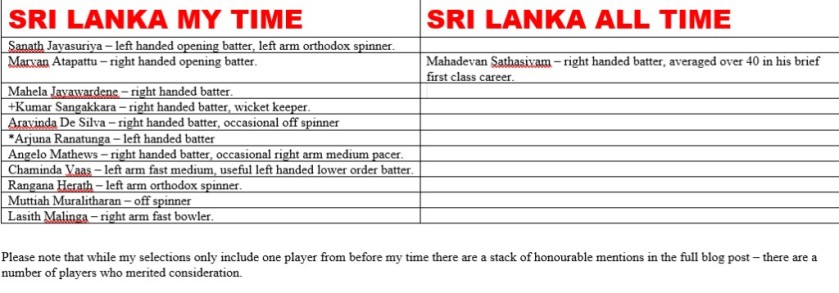
All Time XIs – Playing Cards vs Alliterative

Today’s ‘all time XI’ cricket themed piece of whimsy pits an XI with connections to playing cards against an XI with alliterative names.

INTRODUCTION

Today’s ‘all time XI‘ cricket themed exercise sees an eleven whose names have an association with playing cards take on an eleven whose first names and surnames begin with the same letter. There are a few extra sections in which I explain various selection difficulties as well.

THE PLAYING CARD XI

Playing cards is a well known way of passing time in the pavilion when not directly involved in the action. Apart from his distaste for ‘taking candy off babies’ one of the explanations offered for Keith Miller’s first baller at Southend in 1948 (the 721 in a day match) is that he was enjoying a winning streak at the card table, which further increased his disinclination to involve himself with the slaughter of the Essex bowling. Mike Brearley once had some stern words to say about card playing in the Middlesex dressing room, creating a brief silence which was punctuated when someone finally piped up “whose deal is it then?”. Finally, at Melbourne in 1982 Australia resumed on the final day needing 37 to win with one wicket left, and Rod Marsh insisted that those in the pavilion should resume what they had been doing in the final session of the previous day, which in the case of Marsh and a handful of others meant playing cards and drinking beer. Marsh’s ‘superstitionship’ as Stephen Potter would have called it proved unavailing, as England did eventually get that last wicket and won by three runs.

  1. Jack Hobbs – right handed opening batter. The jack is the lowest ranking picture card in the deck, sometimes referred to as the knave.
  2. Jack Robertson – right handed opening batter. A worthy opening partner for ‘the master’.
  3. Collis King – right handed batter. His most famous innings was played in the final of the 1979 World Cup, when he and Viv Richards took England’s bowlers to the cleaners.
  4. Ryan ten Doeschate – right handed batter, right arm medium pacer. The Dutchman had a first class batting average of 46, and in ODIs for the Netherlands he averaged 67. He is the only one who gets in by association with a spot card – courtesy of having ten in his name.
  5. *Jack Mason – right handed batter, right arm fast medium bowler, excellent captain. He played regularly between 1893 and 1906, after which his work as a solicitor restricted his appearances. He averaged 33 with the bat in first class cricket and took his wickets at 22 runs each. As well as his considerable skill as a player he was a highly rated captain. Frank Woolley, not generally noted for hyperbole, rated him the best captain he ever saw.
  6. Jack Gregory – left handed batter, right arm fast bowler, ace slip fielder.
  7. John King – left handed batter, left arm medium pacer. He had a fine record for Leicestershire over the years.
  8. +Jack Board – wicket keeper, right handed batter. Good enough to amass nine first class hundreds over the years, with a best of 214, but not a consistently big scorer – he averaged 19.37 in first class cricket, which I believe is the lowest for someone who scored a double century, with Jason Gillespie averaging 19.59 and having a best of 201 not out. However, 851 catches and 355 stumpings are the real reasons for his inclusion.
  9. Bart King – right arm fast bowler, useful lower order batter. 415 first class wickets at 15.66.
  10. Jack Walsh – left arm wrist spinner.
  11. Jack Saunders – left arm medium pace bowler, left arm orthodox spinner. His 14 test matches left him with a batting average of 2.29, but also 79 wickets at 22.73, including an Ashes retaining moment, when he cleaned up Fred Tate at Old Trafford in 1902 to give Australia victory by three runs and put them 2-1 up with one to play, meaning that as Ashes holders they kept possession of the urn.

This team has a solid batting line up, with everyone down to Bart King at no 9 capable of significant contributions. The bowling, with Bart King and Jack Gregory taking the new ball, pace back up available from Mason, John King, Saunders in his quicker style and at a pinch ten Doeschate, and Walsh and Saunders offering different styles of left arm spin also looks impressive.

NEAR MISSES AND EXCLUSIONS

Jack Brown of Yorkshire was an excellent opening batter, and I was close to including him. Two players known as ‘Jack’ who I had to disqualify on grounds that it should be considered a nickname and not genuinely connected to their first names were Clifton James Richards of Surrey and Robert Charles Russell of Gloucestershire. Another great wicket keeper who missed out was Jack Blackham Australia’s first test wicket keeper. Surrey’s 21 year old batter who bowls a bit Will Jacks does not yet have a record of sufficient substance to merit inclusion, but there is certainly talent there, and his time may well come. Doubtless readers will have examples of their own.

THE ALLITERATIVE XI

Now it is time to defy that famously contradictory ‘commandment’: Always assiduously avoid all alliteration…

  1. Graham Gooch – right handed opening batter, occasional right arm medium pacer. 8,900 test runs at 42.38
  2. Gordon Greenidge – right handed opening batter. 7,558 test runs at 44.72. These two could have become a regular opening pair, because the Barbados born Greenidge was educated in Reading, and might have chosen to throw his lot in with England rather than the West Indies.
  3. Richie Richardson – right handed batter. 5,949 test runs at 44.39. At the height of his career he was ranked no 1 batter in the world.
  4. Steve Smith – right handed batter, occasional leg spinner. 7,227 test runs at 62.84 to date, an average that if he maintains it will see him second to Bradman among those who have played 20 or more tests.
  5. Colin Cowdrey – right handed batter. 7,624 test runs at 44.06. He played 114 test matches in all, and was the first to play a three figure number of such games.
  6. Mushtaq Mohammad – right handed batter, leg spinner. 3,643 test runs at 39.17, 79 wickets at 29.22.
  7. Sydney Smith – left arm orthodox spinner, left handed batter. Born in the West Indies, he played most of his career for Northamptonshire. He averaged 31 with the bat and 18 with the ball in first class cricket, missing out the career double of 10,000 runs and 1,000 wickets by 45 wickets.
  8. *Frank Foster – left arm fast medium bowler, right handed batter. He averaged 26.61 with the bat and 20.75 with the ball in first class cricket, and he took an average of 4.5 wickets per match.
  9. +Robert Charles ‘Jack’ Russell – wicket keeper, left handed batter. A very handy person to be coming at no 9, but it is his 1,192 first class catches and 128 stumpings that get him the nod.
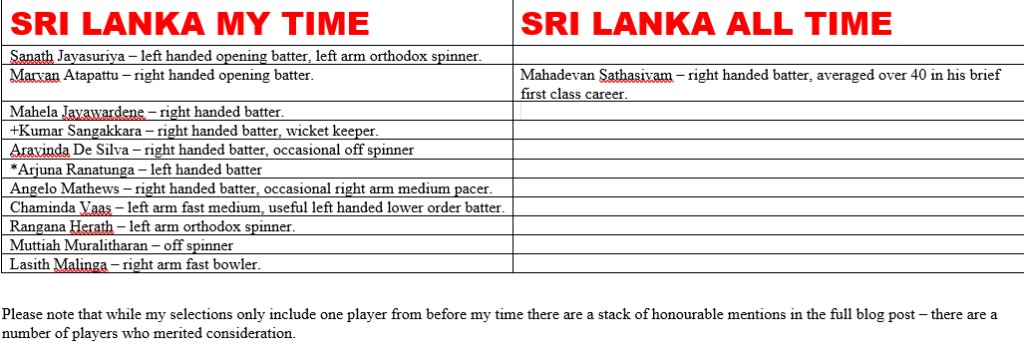
  10. Muttiah Muralitharan – off spinner. 800 test wickets in his 133 appearances at that level – an average of six wickets per game.
  11. Colin Croft – right arm fast bowler. With Garner, Holding, Roberts and the young Malcolm Marshall as colleagues he was part of the meanest fast bowling machine ever assembled by any side in the history of cricket.

This team has an excellent top five, three genuine all rounders, a keeper who is by no means a ‘bunny’ with the bat and two master bowlers at 10 and 11. The bowling, with Croft and Frank Foster sharing the new ball, and Murali, Sydney Smith and Mushtaq Mohammad to bowl varieties of spin looks strong and well balanced. An extra quick would be nice, but accommodating them would be tricky.

SPECIAL MENTION: PETER POLLOCK

The best alliteratively named fast bowler after Croft is Peter Pollock of South Africa. Croft played 27 test matches and took 125 wickets at 23.30 at that level. Pollock played 28 test matches and took 116 wickets at 24.18. The only two players I could drop to accommodate Pollock would be Richie Richardson or Colin Cowdrey.

AWESOMELY ALLITERATIVE ASSOCIATES

Cecil Charles Coles Case, known as ‘Box’, obviously wins the alliterativeness stakes hands down, but he was a specialist batter who averaged only 22, so I could not include him. Robert Richard Relf, a Sussex bowler of fast medium pace and good enough batter that his career averages were the right way round (28.41 with the bat, 27.49 with the ball) was very close to inclusion, but Foster’s clear superiority as a bowler and the fact the he bowled left arm got him the nod.

HONOURABLE MENTIONS

There were huge numbers of possibilities. William Maldon Woodfull was a fine opening batter for Australia, but was generally called Bill. Conversely Billy Bates, the England off spinning all rounder was actually Willie in full, and hence he appears in records as W Bates. John Jameson had a fine record for Warwickshire but was a distinct cut below the very highest class. Paul Parker was a magnificent fielder but did not quite have the batting record to justify a place. Two Aussie keepers, Ben Barnett and Richie Robinson might have had Russell’s place, as might Ben Brown of Sussex or the Indians Parthiv Patel and Deep Dasgupta, but I felt it would be harsh to rule him out of two XIs on the same day. A hard hitting middle order batter and sometimes effective purveyor of medium pace who might have his advocates is the Aussie Mitchell Marsh. George Geary’s CV includes two Ashes winning moments, as he took the last wicket to fall at The Oval in 1926, and belted the four through mid on that won the match at Melbourne in 1928-9 to put England 3-0 up with only two matches to play. Chris Cairns the Kiwi all rounder would have his advocates as well. Two fine fast bowlers of the 19th century, John ‘Foghorn’ Jackson and Martin McIntyre, both with Nottingham connections, were also among the possibles. Finally, 23 year old George Garton has shown some promise as a left arm fast bowler, but his record needs considerable improvement before he can be considered. Two players named Willie Watson, the Yorkshire and England left handed batter and the Kiwi right arm medium pacer might have their advocates, while another Yorkie, Tom Taylor enjoyed some success in the late 1890s and early 1900s. Mulvantrai Himmatlal ‘Vinoo’ Mankad was a possibility for the place I gave to Sydney Smith, and Bishan Bedi was a great left arm orthodox spinner. Pakistani batter Wajahatullah Wasti one scored twin tons in a test match, but his overall record did not quite merit inclusion.

THE CONTEST

The only thing I can say for sure about this contest, which in honour of a great writer about the game I shall describe as being for the ‘Raymond Robertson-Glasgow Trophy’ is that it would be an absolute humdinger.

PHOTOGRAPHS

Time now for my usual sign off…

IMG_0431 (2)IMG_0432 (2)IMG_0433 (2)IMG_0437 (2)IMG_0438 (2)IMG_0439 (2)IMG_0440 (2)IMG_0441 (2)IMG_0442 (2)IMG_0443 (2)IMG_0444 (2)IMG_0445 (2)IMG_0445 (3)IMG_0446 (2)IMG_0447 (2)IMG_0448 (2)IMG_0449 (2)IMG_0450 (2)IMG_0451 (2)IMG_0453 (2)IMG_0454 (2)IMG_0455 (2)IMG_0457 (2)IMG_0458 (2)IMG_0459 (2)IMG_0460 (2)IMG_0461 (2)IMG_0463 (2)IMG_0464 (2)IMG_0465 (2)IMG_0466 (2)IMG_0467 (2)IMG_0468 (2)IMG_0469 (2)IMG_0470 (2)IMG_0472 (2)IMG_0473 (2)IMG_0474 (2)IMG_0476 (2)

PC v A
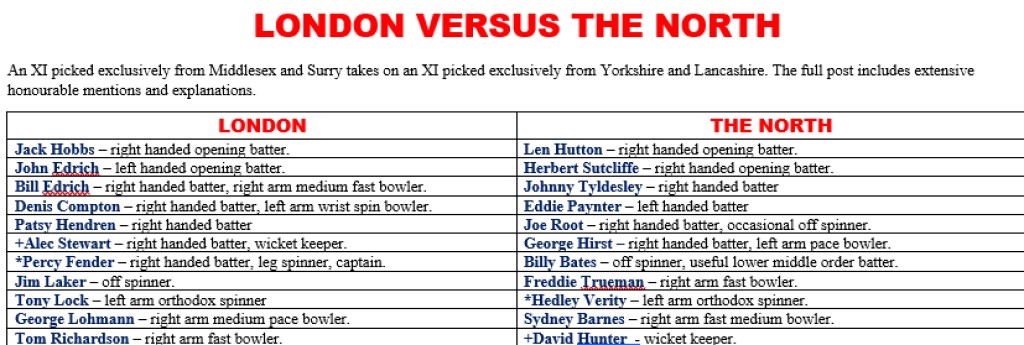
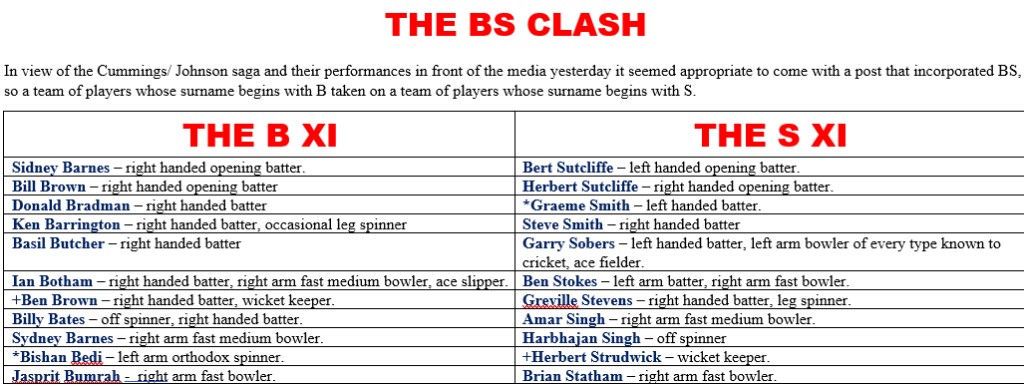
The teams in tabulated form.


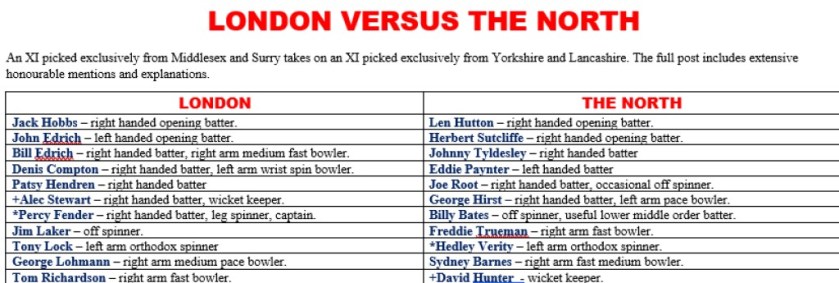
All Time XIs – London vs The North

Today in ‘all time XI’ land we have a contest between London and the North.

INTRODUCTION

Welcome to today’s variation on an ‘all time XI‘ theme. Today features a battle between London and The North. I grew up in London, but have some northern ancestry and lived for a period in Barnsley, while I now live in Norfolk, so I consider myself decently equipped to handle this one.

THE BRIEF IN MORE DETAIL

For the purposes of of this post London means players from either Middlesex or Surrey. I am well aware that among the first class counties Kent and Essex also overlap with London. The Northern XI is drawn exclusively from Yorkshire and Lancashire, although there is an honourable mention for a Durham player. I have not included overseas players at all. Do check out my county XIs here.

LONDON ALL TIME XI

  1. Jack Hobbs – right handed opening batter. The man with more first class runs and more first class hundreds than anyone else who ever played the game (I go with the traditional figures of 61,237 runs and 197 hundreds). This is all the more remarkable, because having been born in Cambridge he had to serve out a two year qualification period before making his Surrey debut, and he also lost four years to Wiorld War 1. He ultimately became Sir Jack Hobbs, the first professional games player of any description to be knighted.
  2. John Edrich– left handed opening batter. Another scorer of over 100 first class hundreds.
  3. Bill Edrich – right handed batter, right arm medium fast bowler. A cousin of John. His test career got off to a slow start, but when he did manage a big score at that level it was seriously big – 219 versus South Africa at Durban, when England were baulked of victory by the weather and the necessity to return to Cape Town to get their boat home – they were 654-5 chasing 696 when time in what was supposed by a ‘timeless’ test match ran out.
  4. Denis Compton – right handed batter, left arm wrist spinner. Only Don Bradman reached the career landmark of 100 first class hundreds in fewer innings than Compton’s 552.
  5. Patsy Hendren – right handed batter, brilliant fielder. The second largest tally of first class hundreds, 170, and the third largest ever tally of first class tuns, 57,611, and he did all that while never forgetting that cricket was a game to be enjoyed. He took full advantage of playing for Middlesex – a record 75 of his first class hundreds were scored at ‘the home of cricket’.
  6. +Alec Stewart – right handed batter, wicket keeper. The man who scored more test runs than anyone else in the 1990s.
  7. *Percy Fender – right handed batter, leg spinner, captain. Exactly the right kind of player to be coming in at no7 in a very strong side, and an excellent captain.
  8. Jim Laker – off spinner. He was apparently capable of putting so many revs on the ball that it would hum in the air on its way to the batter.
  9. Tony Lock – left arm orthodox spinner.
  10. George Lohmann – right arm medium pace bowler. His test wickets came at 10.75 each, and a rate of one per 34 balls. He was joint quickest to 100 test wickets (17 matches, a record he shares with ‘Terror’ Turner).
  11. Tom Richardson – right arm fast bowler. The man who would walk from his home in Mitcham to The Oval carrying his cricket bag, bowl plenty of overs in the day and then walk back similarly encumbered. He nearly did a ‘Bob Willis’ at Old Trafford in 1896, when ‘Ranji’ had scored 154 to set the old enemy a victory target of 125 after England had been made to follow on. Richardson took 6-76 bowling unchanged, and Australia were relieved in the end to get home by three wickets.

This team has a super strong top five, a batter keeper at six, an all rounder who was also a very shrewd captain at seven and four well varied bowlers. Bill Edrich as third seamer can hardly be described as a weakness, given that he did on occasion take the new ball for his country, while Laker, Lock and Fender represent a fine spin trio.

THE NORTH

  1. Len Hutton – right handed opening batter, occasional leg spinner. His record looks even more extraordinary when you consider that he lost six years to World War Two, and a training accident during that conflict left him with one arm shorter than the other.
  2. Herbert Sutcliffe – right handed opening batter. He averaged 52.02 in first class cricket, 60.73 in test cricket and 66.85 in Ashes cricket, bearing out his famous comment “Ah Mr Warner, I love a dogfight.” His career was affected at both ends by war – World War 1 delayed his entry into first class cricket until he was 24 years old, while World War II finished his career – and in that last season of 1939 he had become the oldest player ever to carry his bat through a first class innings, so without the interruption he may well have carried on at first class level.
  3. Johnny Tyldesley – right handed batter. In the first decade of the 20th century only two professionals were selected for England purely on the strength of their batting, David Denton and Johnny Tyldesley. Tyldesley’s record was outstanding for a player of his era, and he was noted for his skill on bad wickets. He was also notably nimble footed, it being not unknown for him to deploy his favourite cut shot against balls pitched in line with middle stump.
  4. Eddie Paynter – left handed batter. He was baulked by the strength of Lancashire’s batting in his early years, but when he did reach the top he made it count, averaging 59.23 in test cricket, which included double centuries against Australia and South Africa.
  5. Joe Root – right handed batter, occasional off spinner. Note that I have not named him as captain because of his batting record while in that role, which is noticeably less good than his record before he became captain. It is his batting that I want, the same batting that saw him reach 3,000 test runs quicker than any other England batter.
  6. George Hirst – right handed batter, left arm pace bowler. This one caused me considerable thought, but his record was so good that, notwithstanding the roars of rage this decision will generate from folk based west of the Pennines I decided it had to be him. His 1906 feat of scoring 2,385 runs and taking 208 wickets in first class matches, echoed in miniature by his performance in the game against Somerset at Bath when he scored 111 and 117 not out and took six first innings wickets and five more in the second was a truly outstanding demonstration of skill and stamina – an equivalent in today’s much shorter first class season would be someone scoring 1,000 runs and taking 100 wickets in first class games, not an impossibility but certainly a feat that would be estraordinary, although anyone good enough to pull it off would very likely either be involved with England or spend some part of the season playing franchise T20 cricket somewhere else in the world.
  7. Billy Bates – off spinner, right handed lower middle order batter. He had a magnificent record until an eye injury brought a premature end to his career.
  8. Freddie Trueman – right arm fast bowler. No further comment needed.
  9. *Hedley Verity – left arm orthodox spinner. I have named him as captain, a role he never filled on the cricket field due to the prejudices of the era in which he lived, but which I believe he would have done splendidly. He did ultimately become a captain in a very different field – it was as Captain Verity of the Green Howards that he was fatally wounded in World War II. In less than a full decade of first class cricket prior to that he had captured 1,956 wickets at 14.90 each.
  10. Sydney Francis Barnes – right arm fast medium bowler. The man who took 189 wickets in 27 test matches at 16.43 each just has to feature.
  11. +David Hunter – wicket keeper. He was the keeper in the first truly great Yorkshire side, the one that dominated the early years of the 20th century, being champions five times in its first decade, including going unbeaten twice in 1900 and 1908.

This team has a formidable top five, one of the greatest of all allrounders, four excellent bowlers and a star keeper. There is a lack of leg spin, but otherwise all departments are well covered.

HONOURABLE MENTIONS

I am going to cover these in order by playing role:

  • Opening batters – South: At least three other Surrey openers, Hayward, Sandham and Abel had outstanding records, while Andrew Strauss and Jack Robertson of Middlesex might also have their advocates.
  • Opening batters – North: Percy Holmes of Yorkshire might be considered to recreate the great pairing of him and Herbert Sutcliffe, while Louis Hall and Jack Brown had fine records in an earlier era. Among Lancastrians, Cyril Washbrook and Mike Atherton were the two nost obvious candidates.
  • Nos 3-5 – South: strong cases could be made for Ken Barrington and Peter May here, although bringing either in for Bill Edrich would change the balance of the side, and it is hard to envisage dropping Compton or Hendren. If told that I must accommodate Barrington on account of his test average of  58.67 I would do so by dropping John Edrich, and moving Bill up to open, a job he sometimes did in tests, slotting Barrington in at no3. Mike Gatting and Mark Ramprakash both had fine county records, but neither did enough at test level – Gatting averaged 35.55, and Ramprakash less than 30. ‘Young Jack’ Hearne might have got in on all-round talent. If Ollie Pope continues his career the way he has started it he will in due time command a place.
  • Nos 3-5 North: Ernest Tyldesley of Lancashire scored over 100 hundreds, David Denton of Yorkshire warranted consideration, while more recently the Lancastrians Neil Fairbrother and John Craw;ey would have their advocates. Jonny Bairstow would have his advocates as well,and I might have created an extra slot by selecting him as keeper if I had full confidence in his glove work. Brian Close would also have his advocates.
  • The all-rounder South: I have already mentioned ‘young Jack’, and Bernard Bosanquet was another candidate, as was Greville Stevens.
  • The all-rounder North: Andrew Flintoff was an obvious candidate, and I did consider shelving the issue of transpennine rivalry by giving Ben Stokes of Durham the nod – he may yet make an already strong case irrefutable.
  • Spinners – South: No other Surrey spinners rank wiht the two I chose, although Pat Pocock was a fine cricketer. Fred Titmus, Philippe Edmonds, John Emburey and Phil Tufnell would all have their advocates on the Middlesex side.
  • Spinners – North: Ted Peate, Bobby Peel, Wilfred Rhodes and Johnny Wardle of Yorkshire were all possibles for the left arm spinner role, as was Johnny Briggs of Lancashire. For off spinners, Ted Wainwright, Bob Appleyard, Ray Illingworth and Roy Tattersall had fine records, although Wainwright had a disastrous tour of Australia in 1897-8.
  • Pace bowlers South: Alec Bedser is the most obvious miss, but Gubby Allen also had a fine record, and Maurice Allom took a hat trick on test debut, although his overall record was not that great. Martin Bicknell had a superb county record and was unlucky not to get more chances for England. Bill Lockwood, who was also a useful batter, appears to have been the first to develop a slower ball as a variation, and by all accounts it was devilishly difficult to spot. Neville Knox’s pace was legendary but he only had two really good seasons, in 1906 and 1907.
  • Pace bowlers North: Jimmy Anderson is the most obvious miss, but his huge tally of test wickets is down to longevity and the frequency with which test matches now take place more than to any special brilliance that he possesses. Brian Statham was a great bowler, but with Trueman and Barnes making irrefutable cases for selection there was no way to get him in without changing the balance of the side. Such luminaries as Schofield Haigh, George Macaulay and Bill Bowes, all magnificent bowlers, have to make do with honourable mentions, as to the two greatest Yorkshire quicks of the 19th century, Tom Emmett and George Freeman (209 wickets at 9.94 in first class matches). George ‘Happy Jack’ Ulyett was another early great, who could also have been considered as an all rounder.
  • The Keepers – South: Had I been going to select a specialist keeper for the South rather than rely on Stewart there were two obvious choices, John Murray and Herbert Strudwick, with some 3,000 dismissals in first class cricket between them.
  • The Keepers – North: apart from Jonny Bairstow, already mentioned for his batting, George Pinder, Joe Hunter (brother of David), Arthur Dolphin, Arthur Wood, Jimmy Binks and David Bairstow all had fine records for Yorkshire, while George Duckworth and Warren Hegg of Lancashire were both fine keepers.

There will doubtless be many more names that occur to readers, and do feel free to weigh in with comments.

THE CONTEST

The contest for what I shall jokingly call the ‘Watford Gap Trophy’ would be an absolute classic. I rate the London XI as stronger in batting, though not by much, but reckon that the Northern XI is somewhat better equipped in the bowling department. I cannot pick a winner here.

PHOTOGRAPHS

Having set up a fruity London vs The North contest, introduced the players and provided a detailed honourable mentions section it is time for my usual sign off…

IMG_0391 (2)IMG_0392 (2)IMG_0393 (2)IMG_0394 (2)IMG_0395 (2)IMG_0396 (2)IMG_0397 (2)IMG_0398 (2)IMG_0399 (2)IMG_0400 (2)IMG_0402 (2)IMG_0403 (2)IMG_0404 (2)IMG_0405 (2)IMG_0406 (2)IMG_0407 (2)IMG_0408 (2)IMG_0409 (2)IMG_0410 (2)IMG_0411 (2)IMG_0412 (2)IMG_0413 (2)IMG_0415 (2)IMG_0416 (2)IMG_0417 (2)IMG_0418 (2)IMG_0419 (2)IMG_0420 (2)IMG_0421 (2)IMG_0422 (2)IMG_0423 (2)IMG_0425 (2)IMG_0426 (2)IMG_0427 (2)IMG_0428 (2)IMG_0429 (2)IMG_0430 (2)

London vs North
The teams in tabulated form.

All Time XIs – England Women

Today we look at the England Women for our ‘all time XI’ cricket themed post.

INTRODUCTION

Welcome to the latest installment in my ‘all time XI‘ cricket series. Today is Monday,, which means that it is tipme to look at an international set up, and today’s subject is the England Women’s set up.

ENGLAND WOMEN IN MY LIFETIME

  1. Charlotte Edwards – right handed opening batter. She was an England regular for two decades, and her departure from the international scene caused some controversy when it final;y happened. However, it was undoubtedly the right decision, and within a short time the England Women had reaped rich rewards for making it. I first saw her in action as a teenager, when her more experienced team mates were by and large unable to offer any kind of resistance to Australia, and she chiselled out 74.
  2. Tammy Beaumont – right handed opening batter. She was moved up to the top of the order after Edwards’ departure and almost immediately began making big scores there. Regular readers of this blog will know that back in 2018, with Cook obviously due to retire soon and Jennings due for the chop (having replaced the proven international failure Mark Stoneman) I advocated that she be given an opportunity to play alongside the men. As it happened Rory Burns who had made an unanswerable case for selection came in, Jennings stayed on for the winter, and Joe Denly got given his test chance. After a disastrous experiment with Jason Roy as red ball opener and a summer of top order strife England subsequently turned to Dominic Sibley who had made a clear case for inclusion and also elevated Zak Crawley on rather less firm ground. I expect that when test cricket resumes post covid-19 the England men’s top three will read Sibley, Burns, Crawley, as it should, and that top three would be the most solid looking England have boasted since Strauss, Cook and Trott were in their prime.
  3. Claire Taylor – right handed batter. She averaged over 40 in both test cricket and ODIs, and no 3 was her regular position.
  4. *Heather Knight – right handed batter, occasional off spinner, captain. She has proven an outstanding captain since being given the job in succession to Edwards, and he record with the bat is excellent as well, while she has taken important wickets with her off spin.
  5. Natalie Sciver – right handed batter, right arm medium pacer. The Tokyo born all rounder has been one of the first names on the team sheet ever since first being picked for the side.
  6. +Sarah Taylor – right handed batter, wicket keeper. One of the two finest keepers I have ever personally seen in action (the other being Ben Foakes) and a magnificent batter as well. Her presence, plus the batting abilities of the next two in the order enables to the selection of five top line bowlers.
  7. Katherine Brunt – right arm medium fast bowler, useful lower middle order batter. She was a pure bowler when she came into the side, but has developed her batting, not quite in the manner of Ellyse Perry and Kiwi Sophie Devine to the point where it is arguably more important to the side than her bowling, but certainly to a sufficient extent to justify selection at no7.
  8. Laura Marsh – off spinner, right arm fast medium bowler, useful lower order batter. A multi-purpose bowler, and perfectly capable of batting for long periods in support of a more established batter, as she demonstrated famously in partnership with Heather Knight.
  9. Anya Shrubsole – right arm medium fast bowler. Brunt’s regular new ball partner. She was the hero of the 2017 Women’s World Cup final, taking six wickets to enable England to defend a fairly modest total against India, an achievement that saw her become the first female to appear on the front cover of Wisden.
  10. Sophie Ecclestone – left arm orthodox spinner. The best of the collection of young spinners currently doing well for England Women, which also features the likes of Kirstie Gordon, Linsey Smith, Sarah Glenn and Sophia Dunkley, with others such as Helen Fenby on the fringes.
  11. Isa Guha – right arm medium pacer. She made her international debut at the age of 17, bagging three cheap wickets to begin a journey that would see her at one time rated the best female bowler on the planet. She is probably better known today as an entertaining commentator who is a regular and welcome part of TMS. She did most of her international bowling into the wind, with Brunt often bowling with the wind at the other end.

This team has a formidable top six, including an incredible wicket keeper, and a collection of five bowlers who between them tick every box save leg spin.

ADDITIONS TO THE ALL TIME XI

  • Janette Brittin – right handed opening batter. Her record demands inclusion, although Beaumont still has time in which to change that.
  • *Rachael Heyhoe-Flint – right handed batter. Amagnificent captain, and a batter who averaged 45.54 in test cricket and just over 58 in ODIs.
  • Carole Hodges – right handed batter, off spinner. A magnificent all-rounder, whose feats included an ODI performance in which she scored 96 with the bat and her bowling figures included a hat trick.
  • Enid Bakewell – left handed batter, left arm orthodox spinner. An extraordinary all round record, averaging almost 60 with the bat and under 17 with the ball, including being the firsst player of either sex to score a century and claim a 10-wicket haul in the same test match.

Rejigging the team to include these legends gives us a batting line of Edwards, Brittin, C Taylor, *Heyhoe-Flint, Hodges, Bakewell, +S Taylor, Brunt, Shrubsole, Ecclestone, Guha. This makes the batting formidably strong, and gives us three front line seamers in Brunt, Shrubsole and Guha backed by three topline spinners, Ecclestone, Bakewell and Hodges. The similarity in bowling style between Bakewell and Ecclestone can be coped with.

HONOURABLE MENTIONS

I have already mentioned the phalanx of young spinners currently available to England Women, and I add to that list Alex Hartley, who was part of the 2017 World Cup winning squad, and up-and-coming off spinner Mady Villiers. Isabelle Wong, still in her teens, is quicker by some way (and actually styles herself as a fast bowler, as does her Aussie contemporary Tayla Vlaemink) than any of the seamers I have picked, and I fully expect her to force her way into consideration sooner rather than later. There has been one previous player of Chinese ancetsry to play international cricket, Ellis Achong after whome the ‘chinaman’ was named, and there was also a Sheffield Shield player many years ago by the name of Hunter Poon, while in my brief umpiring career I saw a boy who I believe to have been of Korean descent, named Kim (but no relation AFAIK to the ruling family of North Korea!) take 6-6 in a spell. Three fine all rounders who I could not find space for were Jo Chamberlain, player of the match in a world cup final back in the day,  Melissa Reynard, an unglamorous but mighty effective middle order accumlator and bowler of medium pace, and Jenny Gunn, possessor of the slowest ‘slower ball’ yet seen in international cricket. Danielle Wyatt would be a shoe-in for a T20 side, but her record in other formats is not good enough for her be given serious consideration in this exercise.

WOMEN PLAYING ALONGSIDE THE MEN

I reckon that a female playing alongside the men at the highest level is something that will be seen before too many more years has elapsed. Arran Brindle nee Thompson scored a century in men’s league fixture a few years ago. While it is unlikely that a female could ever bowl as fast the quickest men, batting does not depend solely or even principally on power – timing and placement are key, and there is also no reason why a female spinner should not prove deadly, and I have named a female wicket keeper as one of the best I have ever seen in that department. Of course women who can hold their own alongside the top men,if we do see such, will always be rarities, but I refuse to accept that the possibility should be ruled out entirely.

AN INVITATION

One of my twitter followers, Iain Davidson McKane, suggested that I might offer to produce these to fill third party requests. So, keeping things sensible (perhaps study previous posts in this series to see what I have already done), I now ask readers who have an ‘all time XI’ idea for me to suggest it in the comments. If you have a blog of your own and mention that as well then if your idea works and I can produce a post about it I will link to your blog.

PHOTOGRAPHS

And it is time for my usual sign off…

IMG_0339 (2)IMG_0341 (2)IMG_0342 (2)IMG_0345 (2)IMG_0347 (2)IMG_0350 (2)IMG_0352 (2)IMG_0353 (2)IMG_0355 (2)IMG_0356 (2)IMG_0358 (2)IMG_0359 (2)IMG_0360 (2)IMG_0362 (2)IMG_0364 (2)IMG_0365 (2)IMG_0366 (2)IMG_0367 (2)IMG_0368 (2)IMG_0370 (2)IMG_0371 (2)IMG_0372 (2)

IMG_0373 (2)
For the first time in over two months I have been somewhere other than my bungalow and its bit of garden – not very far afield (I don’t trust this government an iota, and although I am prepared to go out walking now I remain exceedingly cautious).

IMG_0374 (2)IMG_0375 (2)IMG_0376 (2)IMG_0378 (2)IMG_0379 (2)IMG_0380 (2)IMG_0381 (2)IMG_0383 (2)IMG_0386 (2)IMG_0387 (2)IMG_0388 (2)IMG_0389 (2)IMG_0390 (2)

EW
The teams in tabulated form.


All Time XIs – The Birthday Bash

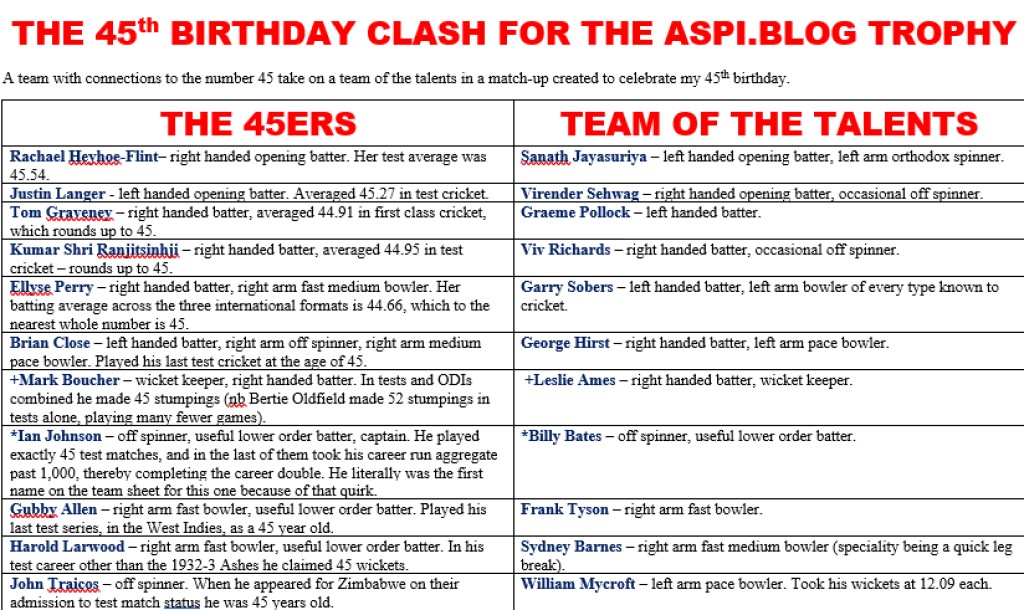
A special ‘all time XI’ cricket themed post to mark my 45th birthday – the 45ERs, who all have a connection to that number, take on an Entertainers XI.

INTRODUCTION

Welcome to the 45th birthday special edition of my ‘all time XI‘ series. I have selected one team with a specific eye to the landmark itself, and the second with an eye to entertainment value.

THE BRIEF IN DETAIL

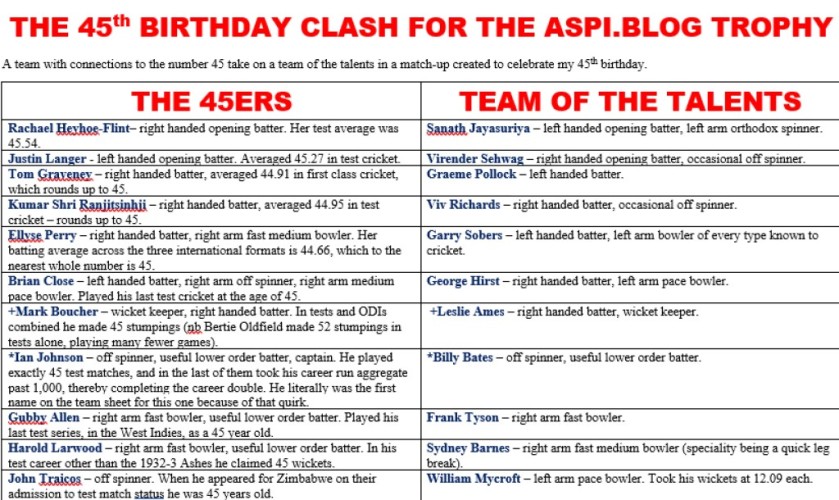
The teams who will do battle for the aspi.blog trophy consist of an XI all of whom have associations with the number 45. In each case I explain the connection with varying degrees detail. The other side is a side picked for entertainment value, although of course class is not overlooked. The Gentlemen v Players match at Lord’s in 1898 was scheduled so that the third day thereof was WG Grace’s 50th birthday (see David Kynaston’s book “WG’s Birthday Party”), while eight years later WG again marked his birthday by batting against the Players at Lord’s, and played a crucial innings of 74.

THE 45ERS

  1. Rachael Heyhoe-Flint – right handed batter. Her test average was 45.54, which tecnically rounds to 46, but I allowed myself this tiny degree of latitude. Her best test score was 179 against Australia. It is appropriate that as I listen to ‘retrolive’ commentary on the 2019 World Cup final there is a someone who won a world cup for England in action (she captained England to success in the 1973 Women’s World Cup, the first such tournament ever played).
  2. Justin Langer – left handed opening batter. He had a test average of 45.27. His test best was 250 against England.
  3. Tom Graveney – right handed batter. He averaged 44.91 in first class cricket, which to the nearest whole number is 45. His test average was a little less, a mere 44.38. His highest test score was 258 against the West Indies. He holds two niche first class records – he scored 200 in the lowest ever team score to feature such an innings, and he is also alone in scoring over half of his team’s score in each innings of a first class match.
  4. Kumar Shri Ranjitsinhji – right handed batter. He averaged 44.95 in test cricket, which to the nearest whole number is 45. His two test centuries were both 150+ scores – 154 at Old Trafford on debut and 175 at Sydney in the opening match in the 1897-8 series.
  5. Ellyse Perry – right handed batter, right arm fast medium bowler. Her combined average across the three international formats is 44.66 (4,864 runs in total for 109 times out), which to the nearest whole number is 45. You may consider that using an all-format average is a slightly sneaky way of including someone, but I consider this to be entirely justified, especially given who it enables me to pick.
  6. Brian Close – left handed batter, right arm off spinner, right arm medium pace bowler. He gets in because he played his last test series (against the West Indies in 1976) at the age of 45, a mere 27 years after making his debut at the highest level.
  7. +Mark Boucher – wicket keeper, right handed batter. In total across tests and ODIs he made 45 stumpings, which qualifies him for this team (Bert Oldfield in many fewer matches, tests alone, made 52, while Eng;and’s Sarah Taylor made over 50 in each of ODIs and T20Is. Boucher did almost all of his keeping at the highest level to quick bowlers which is why his stumping tally is low for so accomplished and enduring a practitioner.
  8. *Ian Johnson – off spinner, useful lower order batter. He was literally the first name on tbis team sheet because he played precisely 45 test matches. In the 45th and last he took his tally of test runs to precisely 1,000, thereby completing the career double. He was captain of Australia in between Lindsay Hassett, who succeeded Bradman, and Richie Benaud, another spinner who could handle a bat as well.
  9. Gubby Allen – right arm fast bowler, useful lower order batter. His last international appearances came when at the age of 45 he captained a tour party to the West Indies. He once scored a test century from no9 – 122 against New Zealand as he and Les Ames (137) put on 246 for the eight wicket, England rebounding from 190-7 to tally 454.
  10. Harold Larwood – right arm fast bowler, useful lower order batter. Setting aside his 33 wickets in the 1932-3 Ashes series, in the rest of his test career he managed 45 scalps.
  11. John Traicos – off spinner. The ultimate multinational cricketer, born in Egypt to parents of Greek descent, he turned out for South Africa as a youngster. Then, when Zimbabwe were promoted to test status he played for them at that level as well, and  by the time the great moment arrived, 22 years after his last appearance for South Africa, he was 45 years old.

This team has a good top six, of whom two, Perry and Close, could also weigh in with the ball, a top of the range keeper, and four fine bowlers, of whom three are capable of contributing with the bat. The balance is not ideal, with both spinners being off spinners, but it is still a side that should give a good account of itself, and given the constraints around selection I am pleased with it. On the name 45ERS, USian readers will recognize ’49ers’ as the name of a famous sporting franchise, which reflects the 1849 California gold rush (they are, or at least were, based in San Francisco), and I adapted that name to suit my purposes.

THE ENTERTAINERS XI

  1. Sanath Jayasuriya – left handed opening batter, left arm orthodox spinner. The star of the 1996 World Cup, his finest test batting display was probably the 213 he made at The Oval in 1998, which gave Muralitharan the opportunity to spin England to defeat, duly accepted.
  2. Virender Sehwag – right handed opening batter, occasional off spinner. The only batter ever to score a 100+ runs in each session of a test day. He made a century on test debut, and he is definitely among his country’s all time top five openers (Agarwal and Sharma, the current incumbents would be there in most reckonings, Gavaskar’s record speaks for itself and Vijay Merchant, at a time when India by and large struggled had a test average of 47.
  3. Graeme Pollock – a magnificent and all-attacking batter, with an average of 60.97 in test cricket.
  4. Viv Richards – right handed batter, occasional off spinner. The man who gave cricket ‘intimidatory batting’.
  5. Garry Sobers – left handed batter, left arm bowler of every type known to cricket. The most complete all rounder the game of cricket has ever known. In 1971-2 he scored  254 for The Rest of The World versus Australia, an innings that Don Bradman described as the greatest he evr saw played in Australia.
  6. George Hirst – right handed batter, left arm pace bowler. One of the two subjects of the famous question and answer: “Who is the world’s best all rounder?” “He comes from Kirkheaton, bats right handed and bowls left, and that is all that can be saud for sure.” Hirst was more aggressive in approach than Rhodes, and was also noted as one of the most brilliant fielders of the day.
  7. Leslie Ames – right handed batter, wicket keeper. The man who won the Walter Lawrence trophy for the fastest first class hundred of the season twice in its first three seasons. Over 400 of his 1,100+ first class dismissals were stumpings, a tribute both to his skill standing up and to the spinners who played for Kent at that time.
  8. *Billy Bates – off spinner, useful lower order batter. Opposite number to Ian Johnson. He averaged 27 with the bat and 16 with the ball in his 15 match test career, which was terminated by an eye injury.
  9. Frank Tyson – right arm fast bowler. My pick to ‘keep Larwood honest’ – how’s that for a tasty clash.
  10. Sydney Barnes – right arm fast medium. His speciality was a leg break delivered at fast medium pace, and 189 wickets in 27 tests at16.43 each, 77 of them in 13 matches down under, is testament to his effectiveness.
  11. William Mycroft – left arm fast bowler. He was the first ever to take 17 wickets in a county match (17-103 for Derbyshire v Hampshire in 1876 – Hampshire sneaked home by one wicket in spite of his efforts). He took his first class wickets at 12.09 each, but was in his prime just too early to play test cricket.

This team has a powerhouse top six, all attacking players by instinct, two fo them genuine all rounders, an aggressive keeper batter and wonderful depth and variety in the bowling department – right arm pace from Tyson, left arm pace from Mycroft, Hirst and Sobers, off spin from Bates, with Sehwag and Richards as back up, Barnes’ craft and guile which serves as a leg spin equivalent, and left arm spin from Sobers or Jayasuriya.

THE FIGHT FOR THE ASPI.BLOG TROPHY

Unsurprisingly given the selection constraints on the 45ERS, the Entertainers would start as strong favourites, but I would expect it to be a fine contest, well worth watching. I would hope for the curator to produce a pitch with pace and bounce that also offers turn for the spinners.

A QUIRK ABOUT THE NUMBER 45

45 X 45 = 2,025 and 20+25 = 45
45 x 45 x 45 = 91,125 and 9+11+25 = 45
45 x 45 x 45 x 45 = 4,100,625 and 4+10+06+25 = 45

The sequence ends at this point – there is a way of making the digits of 45 x 45 x 45 x 45 x 45 add up to 45 but involved a lot more in the way of ‘cooking’ than merely using a leading zero which would not normally be present. However, no other number has arrangemnets of this nature for its second, third and fourth powers.

PHOTOGRAPHS

My 45th birthday special post is at an end, so all that remains is to apply my usual sign off…

IMG_0310 (2)IMG_0311 (2)IMG_0313 (2)IMG_0314 (2)IMG_0315 (2)IMG_0316 (2)IMG_0317 (2)IMG_0319 (2)IMG_0321 (2)IMG_0323 (2)IMG_0323 (3)IMG_0324 (2)IMG_0325 (2)IMG_0326 (2)IMG_0327 (2)IMG_0328 (2)IMG_0329 (2)IMG_0330 (2)IMG_0331 (2)IMG_0333 (2)IMG_0334 (2)IMG_0335 (2)

45
The teams in tabulated form.


All Time XIs – The Foreign Born Ashes

With an Anglo-Australian contest as today’s ‘retrolive’ commentary I have made today’s All Time XI cricket post Anglo-Australian.

INTRODUCTION

Welcome to today’s ‘all time XI‘ cricket themed post. With a ‘retrolive’ commentary on a game between England and Australia in the background it seemed appropriate to focus on cricket’s most enduring international rivalry.

THE BRIEF

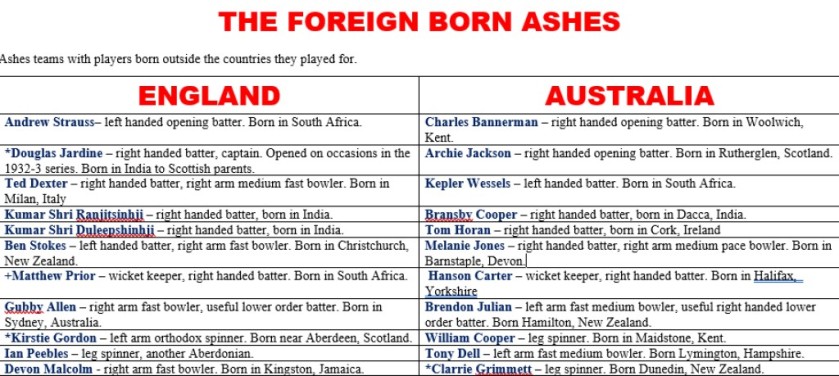
Foreign born for the purposes of this exercise means born outside the country that you represented. The governing body under whose aegis the England team plays is called tne England and Wales Cricket Board, so Welsh born players are not eligible for England in this context. As always, class is not entirely overlooked – some of these players would be considered even without the extra restriction on selection.

FOREIGN BORN ENGLAND XI

  1. Andrew Strauss – left handed opening batter. Few have come across as more quintessentially English than the Middlesex and England opener, but he was born in South Africa.
  2. *Douglas Jardine – right handed batter, captain. He was born in India to Scottish parents. Although he only scored one test century, 127 vs the West Indies at Old Trafford in 1933, he averaged 48 at that level, and as captain has one the four best results ever achieved for England in Australia – Johnny Douglas was in charge for 4-1 win in 1911-12, Percy Chapman for another 4-1 in 1928-9 and Mike Brearley for the 5-1 win in the six match series of 1978-9. None of the others qualify by birth for this team, and only Douglas could be seriously considered as worth his place as a player. In that 1932-3 series he opened the batting on more than one occasion.
  3. Ted Dexter – right handed batter, right arm medium fast bowler. He was born in Milan, Italy. In the 1962-3 Ashes, when he was captain he contributed 481 runs at 48.10 to a drawn series which saw the Ashes stay in Aussie hands. His unwillingness to risk outright defeat in the series saw him delay his second innings declaration until lunch on the final day of the final match at Sydney, leaving Australia 241 to get in two sessions, a target that they made no serious attempt to chase since the draw was enough for them to keep the Ashes.
  4. Kumar Shri Ranjitsinhji – right handed batter. The first of three Indian princes to turn out for England before their country gained test status, and like the other two he made a century of debut. He also scored a century at the first time of asking down under, on the 1897-8 tour. He averaged 44.95 in his brief test career, a truly remarkable figure for his era (the legendary Victor Trumper, a slightly later contemporary, averaged 39 in his test career).
  5. Kumar Shri Duleepsinhji – right handed batter. Nephew of Ranji, and the second Indian prince to play for England. South African attitudes in 1929 disgracefully caused his test debut to be held back by a year, but he started with 173 on debut at Lord’s in 1930. He had health issues which shortened his career, and prevented him from going on the 1932-3 Ashes tour. His 995 test runs came at an average of 58.53.
  6. Ben Stokes – left handed batter, right arm fast bowler. Born in Christchurch, New Zealand. Hero of the 2019 World Cup, and later that year the ‘Headingley Heist‘, when he and Jack Leach (a courageous and defiant 1 not out) put on 76 for the final wicket to pinch a game that Australia had under lock and key. He subsequently had a fine series in South Africa.
  7. +Matthew Prior – wicket keeper, right handed batter. Born in South Africa. Better with both bat and gloves than Geraint Jones who has a more exotic birthplace. As with many of his era his finest international moments came on the Ashes tour of 2010-11, when outperformed his opposite number Brad Haddin with the gloves and his regular rapid scores also contributed significantly to England’s triumph.
  8. Gubby Allen – right arm fast bowler, useful lower order batter. He was born in Sydney, Australia. He toured Australia in 1932-3, skippered the 1936-7 side there which went 2-0 up but then lost the last three matches of the series, and his last international venture was to captain the 1947-8 tour to the West Indies, when he was 45 years old, and unsurprisingly failed to recapture past glories, and he may also have played a role in messing up Maurice Tremlett, selected for that tour after one first class season, and persuaded by his captain to seek extra pace, which cost him both his ability to swing the ball and his bowling rhythm.
  9. Ian Peebles – leg spinner. The first of two successive spinners to hail from the Aberdeen area. He suffered from the traditional English distrust of leg spinners, but in the 1930 Ashes he produced a googly that gave him the wicket of Don Bradman.
  10. Kirstie Gordon – left arm orthodox spinner. Born in Huntly, Aberdeenshire. Yes, having sneaked in yesterday by virtue of her surname, the Aberdonian youngster gets in today as Peebles’ envisaged spin twin.
  11. Devon Malcolm – right arm fast bowler, Born Kingston, Jamaica. His highlight was the 9-57 he took against South Africa in 1994. He was among the casualties of the disastrous period in which Ray Illingworth, firmly resident in the past and seemingly positively proud to be out of touch, was supremo of English cricket. Malcilm was chief victim of a disgusting article by Robert Henderson which targetted various non-English born England cricketers, though notably not Allan Lamb or Robin Smith. I have said elsewhere, and now repeat that if someone is good enough they could hail originally from a lunar colony for all that I would care.

This side has a strong top five, an x-factor all rounder at six, an excellent keeper batter and four well varied bowlers. Malcolm and Allen, with Stokes as third seamer and Dexter if needed in that department backed by the contrasting Aberdonian spin pair of Peebles (right arm wrist spin) and Gordon (left arm finger spin) looks a fornidable unit.

AUSTRALIA FOREIGN BORN XI

  1. Charles Bannerman – right handed opening batter. Born in Woolwich, Kent. In the first test match of all he became the very first cricketer to score a century against the land of his birth – 165 in an all out total of 245. He suffered a hand injury in the process, but even without him for the remaining three innings of the match the Aussies won by 45 runs.
  2. Archie Jackson – right handed opening batter. Born in Rutherglen, Scotland. He made his debut at the age of 19, in the second match of the 1928-9 Ashes, and scored 164 first up. Sadly tuberculosis hit, and four years later at the age of 23 he died.
  3. Kepler Wessels – left handed batter. Born in South Africa. The only person to have scored 1,000 or more test runs for each of two countries, after playing for Australia he returned to his native South Africa and played for them after their readmission to the test arena.
  4. Bransby Cooper – right handed batter. He was born in what was then Dacca, India and is now Dhaka, Bangladesh. He subsequently spent time in England, sharing an opening stand of 283 with WG Grace along the way, before heading for Australia for whom he played in the inaugural test match.
  5. Tom Horan – right handed batter. Born in Cork, Ireland – which means that as a participant in the first test of all back in 1877 he was the first Irish born test cricketer. He subsequently became a highly respected writer about the game, using the pen name Felix (he may not have been familiar with Nicholas Wanostrocht, who had earlier used the name Felix – the world was in many ways a much bigger place then than it is now).
  6. Melanie Jones – right handed batter, right arm medium pacer. Born in Barnstaple, Devon. I have selected her in preference to the Gloucestershir born Billy Midwinter, as I felt that the first test match of all was already over represented.
  7. +Hanson Carter – wicket keeper, right handed batter. Born in Haliffax, Yorkshire – yes, had he been prepared to abandon his test career, as the rules of the time dictated he would have been eligible by birth to play for Yorkshire, thereby beating the likes of Bevan and Lehamnn by some eighty years. He succeeded the long serving Jim Kelly as Australia’s keeper, and barring missing the 1912 tour due to a dispute with the board he kept the gloves until the emergence of Bertie Oldfield in the 1920s.
  8. Brendon Julian – left arm fast medium bowler, useful right handed lower order bat. Born in Hamilton, New Zealand.
  9. William Cooper – leg spinner. Born at Maidstone, Kent. He played two test matches in the early 1880s, and di not fare badly. The reason his career was so short was that he had an encounter with WG Grace that virtually finished him as a bowler.
  10. Tony Dell – left arm fast medium bowler. Born at Lymington, Hampshire. He appeared in one test in the 1970-1 Ashes, the last English born male to don the baggy green (he did so before Melanie Jones was even born). He did not fare especially well, and one suspects that his involvement in home Ashes loss counted against him when it came to subsequent selection meetings.
  11. Clarrie Grimmett – leg spinner. Born in Dunedin, New Zealand. He crossed the Tasman to better his cricketing fortunes, and then crossed two state boundaries in his new country before establishing himself as a first class cricketer with South Australia. He was the first bowler to reach 200 test wickets, capturing 216 in 37 appearances at that level.

This team features a respectable top six, an excellent keeper in Carter, and four bowlers one of whom is a bona fide great. Two left arm pacers and two leg spinners is not great in terms of balance, but they should be able to take the wickets.

HONOURABLE MENTIONS

I regretted not being able to find a place for the Tokyo born Natalie Sciver, but while I am not shy of arguing the vase for females not even I would attempt to make the case that she could seriously be considered for selection in place of Ben Stokes. South African born Robin Smith and Kevin Pietersen had strong cases for inclusion, but I could not put them ahead of the two Indian princes, and Dexter’s bowling gave him an edge. Irish born skipper of the 1907-8 Ashes party Freddie Fane did not have the record to merit inclusion, nor did the only clan chieftain ever to play test cricket, Francis Alexander MacKinnon, the MacKinnon of MacKinnon, 35th Chief of Clan MacKinnon. Paul Terry, born in Germany, had a rfespectable record for Hampshire but his only test experience was not a happy one. Some would have advocated a wicket keeping slot for Kiwi born Luke Ronchi, but he never played test cricket for Australia, and I reckon Carter was definitely his superior with the gloves. The first player of West Indian descent to play test cricket did so for Australia in the 1880s, but hsi record was very modest. Finally, although they had exotic (in cricketing terms) ancestry all of Albert Hartkopf, Hans Ebeling and Shelley Nitschke were born in Australia.

THE CONTEST

The contest for what I shall call the ‘Midwinter Trophy’, honouring the only person to play on both sides in Anglo-Australian tests would be worth watching, as any Ashes contest would, but I think this is one variant where the Poms definitely start as firm favourites!

PHOTOGRAPHS

The scene has been set and the teams introduced to do battle for the ‘Midwinter Trophy. It is now time for my usual sign off…

P1330285 (2)
The first four pictures were taken with what is now my reserve camera.

P1330286 (2)P1330287 (2)P1330289 (2)

IMG_0290 (2)
From here on the pics were taken with my new camera.
IMG_0291 (2)
Some of these shots appear twice, once cropped, and then cropped and edited.

IMG_0291 (3)IMG_0293 (2)IMG_0294 (2)IMG_0294 (3)IMG_0295 (2)IMG_0295 (3)IMG_0296 (2)IMG_0296 (3)IMG_0297 (2)IMG_0298 (2)IMG_0298 (3)IMG_0299 (2)IMG_0299 (3)IMG_0300 (2)IMG_0300 (3)IMG_0301 (2)IMG_0301 (3)IMG_0302 (2)IMG_0302 (3)IMG_0303 (2)IMG_0303 (3)IMG_0304 (2)IMG_0305 (2)IMG_0305 (3)

IMG_0306 (2)
This is the first of five pics from the same original..
IMG_0306 (3)
…an edit of the foregoing
IMG_0306 (4)
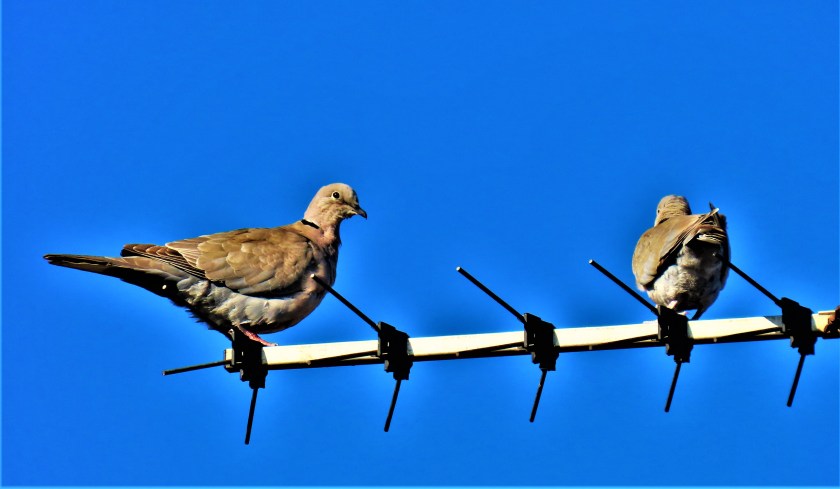
One of the birds
IMG_0306 (5)
The other bird…
IMG_0306 (6)
The head of the third bird in the original (all of it that was visible – this one was perhaps an overambitious piece of editing.

IMG_0307 (2)

IMG_0308 (2)
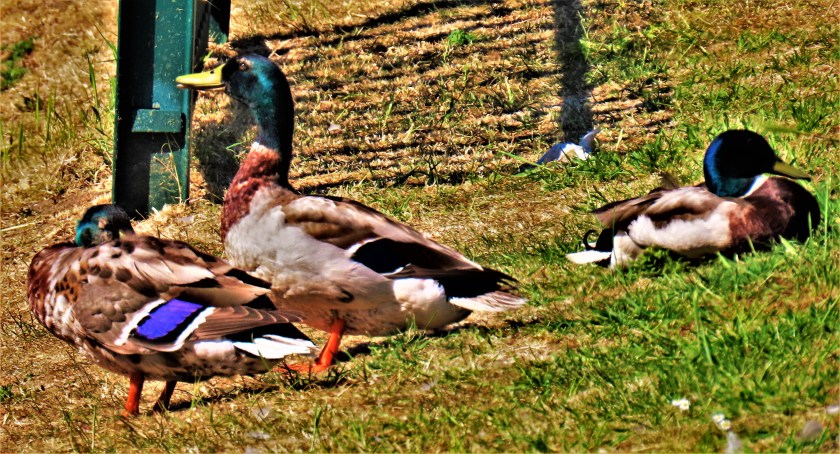
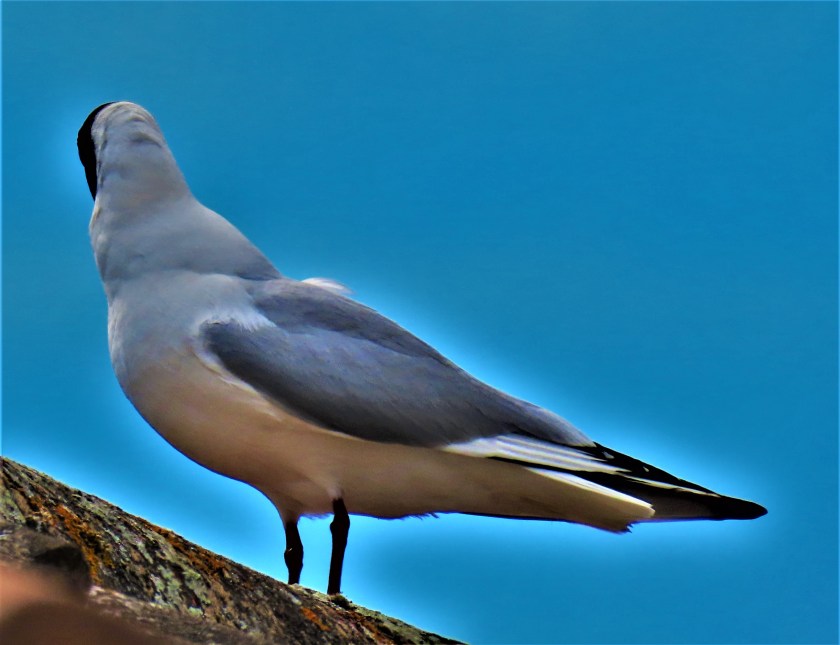
Two flying gulls…
IMG_0308 (3)
…and the edited version.
Foreign born Ashes
The teams in  tabulated form.

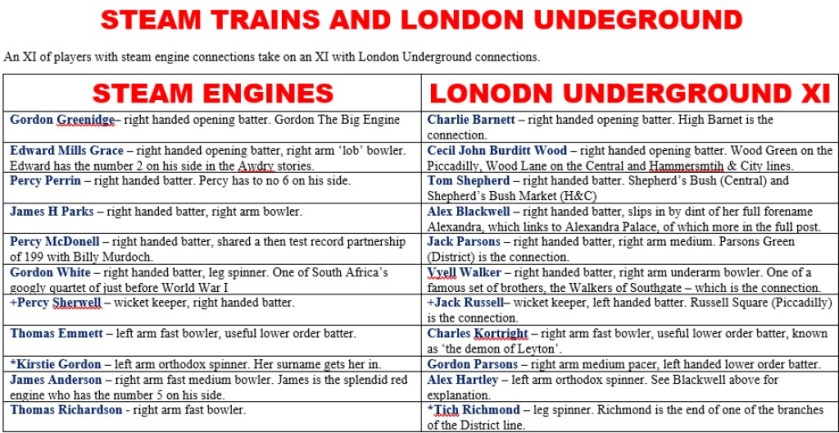
All Time XIs – Steam Trains and London Underground

Today’s ‘all time XI’ cricket themed post meshes two special interests – cricket and trains.

INTRODUCTION

Welcome to another variation on the ‘all time XI’ cricket theme. Today we look at two forms of rail based transport. One team consists of players who share a name with one of the locomotives in the stories by the Reverend W Awdry, while against them is a team of players who can be linked to London Underground. Hwoever, before getting to the main body of the bost I have one other piece of business to attend to.

AN ACKNOWLEDGEMENT

Within a few moments of yesterday’s post going live up popped a twitter correspondent with the name of Johnny Wardle. Wardle should certainly have had a mention and a strong case could be made for his selection in place of Jack Walsh, though the case my correspondent made was less strong as he suggested Emburey the off spinner to be the one who dropped out. My name not being Dominic I tend not to edit blog posts I have already published, and I am not prepared to actually change my selection, but I freely acknowledge that Wardle coming in for Walsh specifically would be a valid decision.

THE STEAM LOCOMOTIVES XI

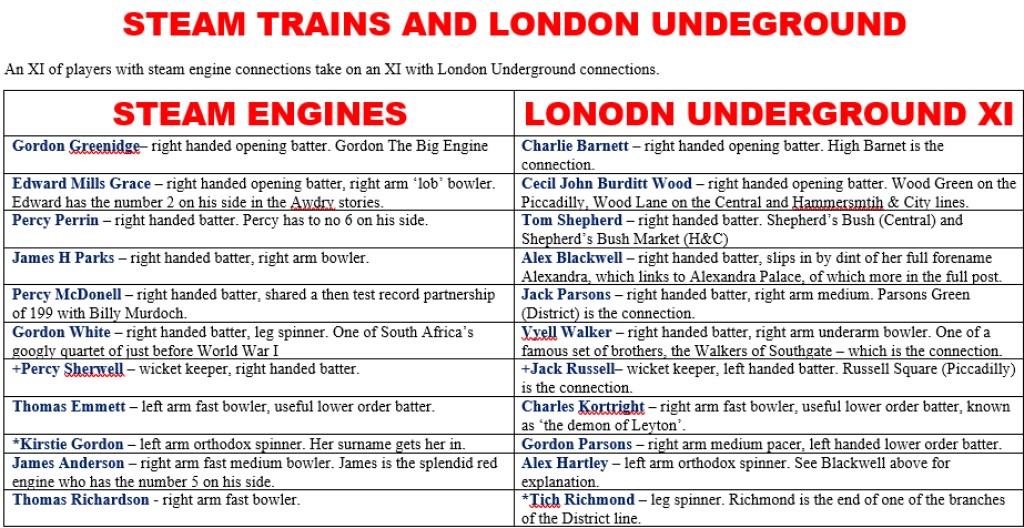
  1. Gordon Greenidge – right handed opening batter. His ‘Awdry Alter Ego’ is of course Gordon the big engine. His 90 first class hundreds, amassed for Barbados, Hampshire and The West Indies  provide solid back up for his inclusion.
  2. Edward Mills Grace – right handed opener, close fielder, ‘lob’ bowler. I have given him his full name, rather than the EM Grace that appears on scoresheets from the time, because the engine who has the number 2 in the Awdry stories is Edward. He was a phenomenon when he first appeared, an d he tends to miss out on his due recognition because he had a brother who was even better.
  3. Percy Perrin – right handed batter. Almost 30,000 first class runs including 66 centuries. Percy is the number six locomotive in the Awdry stories.
  4. James Horace Parks – right handed batter, right arm bowler. The only cricketer ever to score 3,000 first class runs and take 100 first class wickets in the same season. James is the splendid red engine with the number 5 in the Awdry stories.
  5. Percy McDonnell – right handed batter. He played for Australia in the 1880s, and his highlight came when he shared a partnership of 199 with Billy Murdoch, then an all time record test partnership for any wicket.
  6. Gordon White – right handed batter, leg spinner. One of the South African googly quartet of the period immediately before World War 1 (the other members of the quartet being Vogler, Schwarz and Faulkner).
  7. +Percy Sherwell – wicket keeper, right handed batter. He made one of the fastest rises up the batting order of anyone, starting his test career at no11, and three years later making a century as an opening batter.
  8. Thomas Emmett – left arm fast bowler, useful lower order batter. He was almost always known by the diminutive Tom, but his full first name is of course that of the most famous of all the Awdry locomotives, Thomas The Tank Engine, no1. He was one of the more quotable of all cricketers. On one occasiona when Yorkshire’s fielders were having a particularly unimpressive time he remarked after one drop “there’s an epidemic round here but it’s not catching.”
  9. Kirstie Gordon – left arm orthodox spinner. The only member of this XI to have been selected on the basis of her surname. The Aberdonian is at the start of would should be a long and distinguished career, but has already done some impressive things.
  10. James Anderson – right arm fast medium bowler. England’s all time leading test wicket taker, and currently the leading test wicket taker among pace bowlers.
  11. Thomas Richardson – right arm fast bowler. The man who took over 1,000 wickets in the space of four seasons (1894-7). Another known by the diminutive Tom.

This team has a good top five, a genuine all rounder, a keeper who can bat and four varied bowlers. The bowling attack, with Emmett, Richardson and Anderson to bowl pace and White and Gordon to bowl spinners also looks good.

THE LONDON UNDERGROUND XI

Just before I introduce my players I am going to give a bit more detail about the selection process for this XI. In most cases it is the name that provodes the London Underground connection, and with two thoroughly explained exceptions I have not used birthplace or geographical location in my selections. Also, I did not allow myself to select former Leicestershire wicket keeper Tom Sidwell who has the distinction of the only person ever given out in first class cricket for reasons to do with London Underground. He was not out overnight at The Oval, and on the following morning got lost on London Underground, arriving late and being given out by the umpires for not being ready to resume his innings. As you will see when we get to him I had a decent keeper available anyway.

  1. Charlie Barnett – right handed opening batter. He came closer than any other England batter to reaching a hundred before lunch on the opening day of a test match, being on 98 when that interval arrived at Trent Bridge in 1938. I got him in because if you take the final t off his surname you get Barnet, and the northern terminus of one of the two outer branches of the Northern line is High Barnet.
  2. Cecil John Burditt Wood – right handed opening batter. Carried his bat through 17 first class innings, including twice in the match v Yorkshire. Wood Green is a station near the northern end of the Piccadilly line, while Wood Lane is nowadays an interchange between the Central line and the Hammersmith & City line.
  3. Tom Shepherd – right handed batter for Surrey in the early part of the 20th century. He averaged 39.81 in first class cricket, very respectable for his era. In a crucial match versus Middlesex which helped settle that year’s County Championship he was outsmarted by Middlesex skipper Pelham Warner. Warner had declared setting Surrey 244 to win three hours, and Warner spotted his opposite number Percy Fender signal the ‘general chase’ to the batters Shepherd and Sandham. Warner dropped Patsy Hendren back from short leg to long on, and a few minutes later Shepherd holed out to Hendren. He qualifies by way of Shepherd’s Bush, a Central line station and Shepherd’s Bush Market, a Hammersmtih and City line station.
  4. Alex Blackwell – right handed batter. The Aussie qualifies by way of her full first name, Alexandra. Although the current Alexandra Palace is a railway station with no official underground interchange (although Wood Green is walkable from there) there was at one stage a plan to incorporate various suburban lines in north London into London Underground, and one of the stations that would have been on a branch of the Northern line had that come to fruition would have been another station called Alexandra Palace which was the terminus of one the branch lines that featured in the plan. Also, as the District line approaches Wimbledon it runs parallel for the last stage of the journey with Alexandra Road.
  5. Jack Parsons – right handed batter, right arm medium pace bowler. It is his skill with the bat that gets him in, but he did also take his wickets at under 30 each, did once take seven in a first class innings. Parsons Green is a station on the Wimbledon branch of the District line. At one time there was a plan to create a new line running SW – NE which would have taken over the southern end of this branch, with District line trains terminating at Parsons Green, and then after cutting through London slightly to the east of the Victoria line would have taken over the southern portion of the Hainault loop.
  6. Vyell Walker – right handed batter, right arm underarm bowler. Vyell Walker is one of only two cricketers ever to score a century and take all ten wickets in an innings of the same first class match, the other being WG Grace. He is also one of a famous set of cricketing brothers who were referred to as ‘The Walkers of Southgate’, and Southgate is the third to last stop at the northern end of the Piccadilly line (followed by Oakwood and Cockfosters). Southgate station is in a hill, which gives it a unique feature of having platforms that are in a tube tunnel but from which daylight can clearly be seen – both ways no less. The Walker Ground at Southgate is sometimes used by Middlesex, when their landlords at St John’s Wood cannot spare Lord’s.
  7. +Jack Russell – wicket keeper, left handed batter. Russell Square is a station on the Piccadilly line, in between Holborn and King’s Cross St Pancras. The platforms are accessible either by lift or by stairs (175 in total, and these days of you use them you trigger a recorded messgae that tells you that this is equivalent to a 13 storey building). Among other places it serves the British Museum, Great Ormond Street Hospital and Coram’s Fields, a park which because of its purpose only allows adults in if they are accompanying children.
  8. Charles Kortright – right arm fast bowler, useful lower order batter. One of the fastest and nastiest of all fast bowlers. He was known as ‘The Demon of Leyton’, and Leyton is a station that nowadays is near the eastern end of the Central line (it started life as part of what was then the Eastern Counties Railway). On one occasion he took exception to a youngster cocking his toe in his stance, and when warnings that WG Grace was the only person he allowed to do that fell on deaf ears the offending toe was smashed by a yorker.
  9. Gordon Parsons – right arm medium pacer. The Leicestershire bowler paid just over 30 each for his first class wickets.
  10. Alex Hartley – left arm orthodox spinner. She gets in on the same grounds as Blackwell at no 4. Although she has been overtaken in the England pecking order by the likes of Sophie Ecclestone and Kirstie Gordon she has a fine record at the ighest level, and at 26 years old it is not impossible that she will add to it.
  11. *Tich Richmond – leg spinner. He paid just 21 each for some 900 first class wickets, one of the better records for someone consistently ignored by the England selectors of his day (he got in one test appearance, at Trent Bridge, his home ground,  in 1921). Richmond is the terminus of one of the branches of the District line, and between Kew Gardens and Richmond the railway crosses the Thames on a bridge, one of only two occasions on which a London Underground line crosses the Thames above ground level (the other being the Wimbledon branch of the same line). Between 1877 and 1910 there was a branch of what is now the Hammersmith and City line which connected to the Richmond branch by means of a station at Hammersmith Grove Road and a descent the remains of which can still be seen at the approach to Ravenscourt Park, while a London Overground line joins the branch at Gunnersbury (the other terminus these days is Stratford – it used by North Woolwich, but that latter section became part of a Docklands Light Railway branch which terminates at Woolwich Arsenal.

This team has a fine top five, a genuine all rounder, a keeper who can bat and four varied bowlers. Kortright and Gordon Parsons, backed if necessary by the other Parsons, should combine well with the new ball, while Richmond, Hartley and Walker command a fine range of trickery between them.

THE CONTEST

This one should be a fine contest. I think the ‘Steam Locomotives’ team has the edge on account of their bowling resources. However, I would fully expect this contest to go the distance.

PHOTOGRAPHS

Having set the scene, made a necessary acknowledgement and introduced the teams it remains only to provide my usual sign off…

P1330259 (2)P1330260 (2)P1330263 (2)P1330264 (2)P1330265 (2)P1330266 (2)P1330268 (2)P1330269 (2)P1330270 (2)P1330271 (2)P1330272 (2)P1330273 (2)P1330274 (2)P1330275 (2)

P1330279 (2)
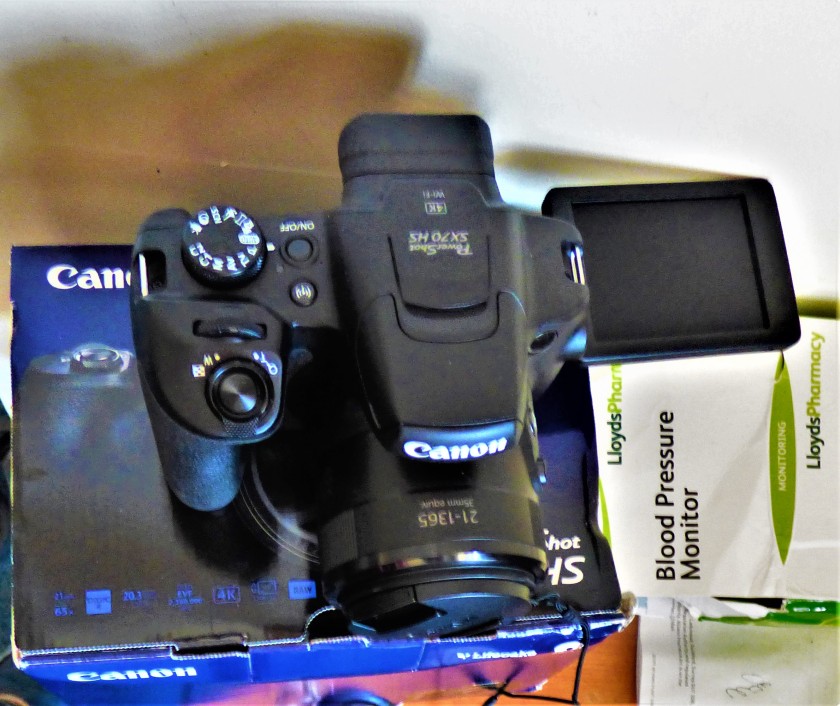
Two days before the actual day my 45h birthday present from my parents (thank you) arrived – note the swivel screen for ease of seeing what one is photographing. The battery is charging at the moment, but I should be able to start using it properly by tomorrow morning…
IMG_0001 (2)
…after which this, which has served me well for several years, will become my back up camera.
Steam v Underground
The teams in tabulated form.

All Time XIs – Graeme v John

Today’s voyage through ‘all time XI’ cricket territory features a team of players with forename Graham or Graeme take on a feature of players with forename John for the ‘Bretton Trophy’.

INTRODUCTION

Today’s exploration of ‘all time XI‘ cricket territory focusses on forenames. An XI all of whom have the forename Graeme or Graham take on an XI who all have the forename John.

THE GRAEME/GRAHAM XI

  1. Graeme Fowler – left handed opening batter, occasional medium pace bowler, occasional wicket keeper. His highest first class score came in a test match, 201 vs India in India. His most remarkable first class batting performance came against Lancashire at Southport in1982. He made 128 in the first innings and 126 not out in the second, as Lancashire, after seeing their opponents make 523-4 declared on the first day won by ten wickets. Fowler was injured early in his first innings, and batted for the rest of that innings with David Lloyd as his runner. In the second innings Ian Folley took over as runner, while Lloyd reverted to his main role as opening partner to Fowler. At the end of this match Fowler had eight first class hundreds to his credit and four of them had come at the expense of Warwickshire. He was dropped by England at the start of the 1985 season to make way for Gooch, returning from his three year international ban for going on the first rebel tour of apartheid South Africa. Then, with England winning the Ashes in 1985 the incumbents Gooch and Tim Robinson who had made a remarkable start to his test career were selected for the trip to the West Indies, with Wilf Slack of Middlesex chosen as reserve opener and Fowler ignored. Robinson failed badly on that tour, but there was to be no international return for Fowler.
  2. Graham Gooch – right handed opening batter, occasional medium pacer. He was a little fortunate to be brought straight back into the team after his ban for going to South Africa, and he then missed the 1986-7 Ashes, when Chris Broad and Bill Athey opened for England. He had a good series against the West Indies in 1988, but then some crass comments of his played their own role in the cancellation of the planned 1988-9 tour to India, and in 1989 against Australia he fared poorly, at one point in the series actually asking to be dropped. The 1989-90 tour of the Caribbean saw England fare respectably, winning one test and being denied victory in another only by scandalous time wasting tactics. However, it was the 1990 home season against New Zealand and India that saw Gooch, then 37 years of age, really come to the fore as an international batter. At Headingley in 1991 he played one of the finest of all test innings, and as late as 1994 at the age of 41 he hit a double century against New Zealand, but the Ashes tour of that winter was as he would subsequently admit a tour too far, and his test career ended with 8.900 runs at 42.38.
  3. Graeme Smith – left handed batter. An unattractive player to watch but his record speaks for itself.
  4. Graeme Pollock – left handed batter. He averaged 60.97 in test cricket before his country’s isolation for political reasons ended his career. He was due to play in Kerry Packer’s World Series Cricket, but fears of that being used as a stalking horse for the readmission of apartheid South Africa led to a ruling that only South Africans who played county cricket could participate. Besides Pollock a leg spinner named Denys Hobson missed out because he too was not a county cricketer.
  5. Graham Thorpe – left handed batter, occasional medium pace bowler. He made his debut in the Trent Brisge test of 1993, scoring 114 in the second innings, but not getting to savour a victory first time out as skipper Gooch delayed the declaration too long and Australia had no great difficulty securing a draw. His England career ended in 2005, when the selectors decided to go with Pietersen and Ian Bell for that year’s Ashes (for my money they made two mistakes in the early part of that season – Pietersen should have played in the tests against Bangladesh at the start of it, and Bell should have been left out – he fared well against Bangladesh but was unconvincing against Australia.
  6. Graham Dowling – right handed batter. He averaged 31 in test cricket for New Zealand, similar to the average recorded by Graeme Hick for England. The highlight of his test career was an innings of 239.
  7. +Graham Kersey – wicket keeper, right handed batter. His death following a  car accident at the age of 25 ended a career that had shown huge promise – in 59 matches at first class level he made 193 dismissals (181 catches and 12 stumpings) and had produced a few significant batting performances as well.
  8. *Graeme Swann – off spinner, useful lower order bat. England’s best off spinner of my life time.
  9. Graham McKenzie – right arm fast medium bowler. At the end of his career he had the most wickets ever by an Australian pace bowler (246), though he was overhauled by Dennis Lillee not many years later. On an Old Trafford pitch in 1964 which yielded 1,271 runs for 18 wickets over five days he had bowling figures of 7-153 in England’s 611.
  10. Graham Dilley – right arm fast medium bowler. His career was ravaged by injuries, and he also suffered from the sometimes bizarre approach of England selectors in those days. His test career ended when he signed up for what turned out to be the last of the rebel tours of apartheid South Africa in 1989, and he took his wickets at the highest level at only just under 30, while at first class level he paid 26 a time. It was him joining Botham, with the score reading 135-7 in the England second innings and 92 still needed to avoid the innings defeat that started the incredible turnaround at Headingley in 1981 – he contributed 56 to a stand of 117 in 80 minutes, which inspired Old to contribute a further 29 to a stand of 67, and finally Willis resisted gamely will Botham continued to lash out. In the final innings Dilley showed a cool head and excellent judgement to remain within the fine leg boundary while catching Rod Marsh’s skied hook, a moment that left Australia 74-7. Had Dilley misjudged and slipped over the rope it would have been 80-6 instead.
  11. Graham Onions – he was first noted because of his combination with his county wicket keeper, Phil Mustard, which led to a significant number of C Mustard B Onions entries on scoresheetts. While never a star at the very highest level he did not ever let England down either. He himself would not quarrel with his position at no11, but would justly point out that he did help to save two successive test matches withe bat.

This team is strong in batting, has an excellent wicket keeper, but the bowling attack is neither absolutely top line nor fully balanced. Still they would not be pushovers for anyone.

THE JOHN/JACK XI

  1. Jack Hobbs – right handed opening batter. ‘The Master’ is a fine start to any batting order.
  2. Jack Robertson – right handed opening batter. His 11 test appearances between 1946 and 1951 saw him average 46 at that level. Bizarrely he was not chosen for either the 1946-7 or the 1950-1 Ashes tours, even though one of England’s chief weaknesses on both tours concerned the top of the order.
  3. Johnny Tyldesley – right handed batter. His test highlight was 138 at Edgbaston in 1902. He was a regular part of the Lancashire line up from 1895 until the outbreak of World War I and made further sporadic appearances over the course of four years after that war ended. He was once involved in a famous exchange with Lancashire opener and captain Archie MacLaren. The pair of them were batting against Frank Laver who discovered a way to bowl a really vicious late swinger, and they initially played him with great caution. After a few overs MacLaren summoned Tyldesley for a mdiwicket conference. MacLaren said “Johnny, I’m going to drive this chap Laver” to which Tyldesley responded “You’ll of course do as you think best, Mr MacLaren, but I am going to cut him.”
  4. John Small – Right handed batter. He was one of the greats of Hambledon. He once batted through an innings lasting three whole days of play. He was also indirectly responsible for a major change to the game – on one occasion Edward ‘Lumpy’ Stevcns, rated no2 to David Harris among bowlers of that era beat him three times in an innings with balls the passed between the wicket, which at that time comprised two stumps and a single crosspiece linking them. Stevens’ misfortune was noted, and the arrangement of three stumps set sufficiently close together that a ball could not pass through with two bails on top was introduced. Since then top level matches have not seen any repeats of Stevens’ misfortune, but one HS Dawe of Thistleton took all of his opponents wickets but had his analysis slightly spoiled by two deliveries passing between the stumps. What happened? The umpires had used an old (and as it transpired) swollen ball to measure the distance between the stumps!
  5. John Richard Reid – right handed batter, right arm fast medium bowler. One of New Zealand’s greatest ever.
  6. *Johnny Douglas – right handed batter, right arm medium fast bowler. His initials, JWHT (for John William Henry Tyler), and his approach to batting saw Aussie spectators dub him “Johnny Won’t Hit Today”, with a few even suggesting that “Johnny Won’t Even Hit Tomorrow”. He was an effective user of the new ball, although giving it to himself in preference to SF Barnes in the first test of the 1911-2 Ashes was misconceived – a fact which Douglas eventually acknowledged, and he restored the new ball to Barnes for the rest of the series, which England won 4-1. He was sometimes temperamental in the field. On one occasion the Essex slips were being more than usually generous towards opposition batters, and eventually second slip muffed one sitter too many, and turning to chase the ball he found himself being overtaken by his skipper, who was shouting “don’t worry, I’ll fetch the bl***y thing myself.”
  7. +John Murray – wicket keeper, right handed batter. Eratosthenes, Librarian of Akexandria at a time when that was THE plum academic posting was once dubbed ‘Beta’ by a rival, after the second letter of the Greek alphabet on the grounds the he was “second best in the world at everything.” In a sense, Murray was the ‘Beta’ of wicket keepers  – second to Bob Taylor in career dismissals, and the second of only two (the other being Les Ames who achieved the feat three times) to manage the wicket keeper’s season double of 1,000 runs and 100 dismissals.
  8. John Emburey – off spinner, useful unorthodox lower order batter.  He was in his prime in an era that was not friendly to any kind of spin bowling, and was often required by his captains to bowl in a purely defensive capacity, keeping things tight while the quicker bowlers got thier breath back. This means that his record looks very ordinary by comparison with many of his forebears among conventional off spinners, but until the 1992-3 tour of India when he encountered batters who regularly dealt with quality spinners even in club cricket and was simply not allowed to bowl in his preferred style he was rarely collared. He visited Australia twice, in 1978-9 and 1986-7, and England won both series quite comfortably (the 1986-7 scoreline looks close, but England;s loss was in the final match of the series, when they took on a run chase that they would have eschewed had the series been live.
  9. Jack Walsh – left arm wrist spinner. An excellent counter part to the very orthodox off spin fo Emburey, the Leicestershire based Aussie was a huge spinner of the ball, regular taking huge bags of wickets in the county championship.
  10. John Wisden – right arm fast bowler. I opted for him in preference to that other Sussex speedster John Snow. His most famous bowling performance was all ten wickets in an innings, all clean bowled. On a tour of North America he once took six wickets with successive balls in a two day match.
  11. Jack Ferris – left arm medium fast bowler. One of the finest of Australia’s early bowlers.

This team has a fine top four, two genuine all rounders, a splendid keeper and four excellent and varied bowlers, three of whom could make useful contributions with the bat.

THE CONTEST

The contest for what I shall dub the ‘Bretton Trophy’ (from Charlotte Bronte’sVillette“, honouring the character John Graham Bretton, who we meet first as ‘Graham’ and then as ‘Dr John’) should be a good one. The Graene/Graham team are stronger in batting, but as against that the John/Jack (and all my chosen Jacks were actually registered as John at birth, but later referred to as Jack) team have greater strength, depth and variety in bowling, and therefore I would expect them to emerge victorious in the end.

A CRICKET VIDEO

My thanks to the pinch hitter for putting me on to video footage of Murali’s destruction of England at The Oval in 1998:

POLITICAL UPDATE

The Cummings/ Johnson scandal continues to rumble on, with the number of Tory MPs now being openly critical of Cummings into the 60s. Durham Police have confirmed what most of us already knew, namely that Cummings’ activities did constitute a breach of lockdown. My second message to my own MP, former Johnson advisor James Wild, remains, as does the first, unresponded to. If this is still the case come tomorrow morning then a third message from me will be hitting his inbox. This has gone beyond the political scandal it has been since Cummings’ activities were revealed and is now a public health scandal, as in spite of such being necessary to anyone with eyes to see, no government with Cummings still involved can claim the moral authority to enforce a lockdown. I recognize that I am fortunate in two regards, in that my home small as it is is all mine – it is not shared with anyone, and it does have a small garden, which means that although it is still two weeks before my shielding period expires I am at least able to get out in the open air, but it is still thoroughly annoying to see senior Tories effectively declaring that normal rules do not apply to them and their mates, while I have not been further afield than my little bit of garden since mid March.

SOLUTION TO YESTERDAY’S TEASER

Yesterday’s post included the following from brilliant.org:

The blue area is three quarters of a square, which thus has area (48 x 4)/3 = 64. The orange area has area 64 less the overlapping portion of the green square. The green square has dimensions precisely half that of the blue and orange squares, i.e 4X4, making its area 16, and the overlap is one quarter of that = 4, so the orange region has a total area of 64 -4 = 60.

PHOTOGRAPHS

Having introduced today’s teams and explained the contest, produced a quick update on the political situation and solved yesterday’s teaser it is time for my usual sign off:

P1330216 (2)P1330217 (2)P1330218 (2)P1330219 (2)P1330220 (2)P1330221 (2)P1330222 (2)P1330224 (2)P1330227 (2)P1330228 (2)P1330229 (2)P1330231 (2)P1330232 (2)P1330236 (2)P1330239 (2)P1330241 (2)P1330242 (2)P1330243 (2)P1330244 (2)P1330245 (2)P1330247 (2)P1330250 (2)P1330252 (2)P1330254 (2)P1330255 (2)P1330256 (2)P1330257 (2)P1330258 (2)

Graeme v John
The teams in tabulated form.

All Time XIs – Good vs Bad

Today we have a topical battle between good and bad as the Ardern XI, containing some of the more prominent good folk of cricket, takes on the Cummings XI featuring 11 from the dark side of cricket.

INTRODUCTION

Today’s variation on the all-time XI maintains the link with the scandal convulsing British politics at the moment, as a team of cricket’s more prominent good people, named in honour of New Zealand Prime Minister Jacinda Ardern takes on a team drawn from the dark side of cricket, which as punishment for their collective misdeeds bears the name of the 21st century Rasputin.

THE CUMMINGS XI

  1. David Warner – left handed opening batter. One of the two members of the sandpaper trio to be included in this team (the third of this particular unholy trinity, Cameron Bancroft, is not a good enough player to merit selection, so must make do with this dishonourable mention). He was prepared to appeal against his punishment, so lacking in genuine repentance was he, but when both of his two partners in crime held their hands up even he recognized the hopelessness of his position.
  2. Salman Butt – right handed opening batter. Captain of Pakistan at the time of the 2010 spot fixing scandal, and one of those in the pay of illegal bookmakers (during the previous Australian season, when I was in that country, he was involved in some odd happenings that in view of his later fall from grace look highly suspicious, such). His two partners in crime, the bowlers Mohammad Asif and Mohammad Amir miss out on places, as he serves for all three (Amir at least pleaded guilty at the first opportunity and accepted his punishment, and is now back playing, whereas the other two both failed to show repentance).
  3. Mohammad Yousuf – right handed batter. He was captain of Pakistan when they took Australia on at Sydney in 2010. Australia sank for 124 in the first innings, Pakistan led by 200 on first dig, and Australia at the end of the third day were 274-8 in their second innings, Huseey an unconvincing 79 not out and Siddle new to the crease. The following morning Yousuf failed to attack either Hussey or Siddle, and they batted through to lunch without either of their wickets being threatened. As a result of this, instead of having under 100 to chase, Pakistan ended up needing 176, and with Yousuf compounding his felonies by getting out to a dreadful shot to make the score 57-4 they ended up losing. The subsequent abrupt end to Yousuf’s international career suggests that his failings that allowed Australia back into that match had more about them than met the eye.
  4. *Hansie Cronje – right handed batter, occasional medium pace bowler, captain, criminal and hypocrite. Not only did this man not merely accept but solicit money from illegal bookies, he drew at least two of his most vulnerable team mates (Herschelle Gibbs and Henry Williams) into his web of corruption. When there was no longer any way of denying his guilt he finally confessed, and was banned from cricket for life. Subsequently he died in a flying accident, and some of his compatriots have made attempts to rehabilitate his reputation, but no one outside South Africa is buying it.
  5. *Steve Smith – right handed batter, occasional leg spinner, captain. The captain of the sandpaper trio, and very lucky indeed as such not to have been banned for life.
  6. Shahid Afridi – right handed batter, leg spinner. HIs various misdeeds include an incident in which he was caught on camera biting the ball.
  7. +Kamran Akmal – right handed batter, wicket keeper. He was regarded as a fine batter, but an unreliable wicket keeper, until it emerged that not all of his droped catches had been accidental, and his international career came to a very sudden end.
  8. Roy Gilchrist – right arm fast bowler. His indelible entry in the hall of shame came in a Central Lancashire League game between Crompton and Radcliffe. Marsh of Radclifffe had been involved as fielder in an incident that aroused Gilchrist’s ire, and when Marsh walked out to open the Radcliffe batting, Gilchrist opening the bowling began with a bouncer, followed by a beamer, and then completed his little performance by charging through the bowling crease and hurling the thing at Marsh from about 16 yards. At that point Marsh and his partner took matters into their own hands and walked off. Both Crompton and Gilchrist copped severe punishments.
  9. Sylvester Clarke – right arm fast bowler. There were no major incidents like the Gilchrist one above, just a pattern of vicious aggression as a bowler that saw him established as comfortably the most disliked county pace bowler of the 1980s.
  10. Leslie Hylton – right arm fast bowler. The only test cricket ever to be hanged for murder (just for the record I am deeply opposed to the death penalty). His victim was his wife Lurlene who had been having an affair with a notorious lothario and wanted to leave him. There were those who reckoned that Hylton killed the lothario he would probably have been acquitted, suchwas the man’s reputation. As it was he shot his wife, and came with a defence that has hints of ‘Classic Dom’ about it – he claimed he had been trying to shoot himself rather than her. Among the holes in this were problems with just how anyone could be that inaccurate, and the fact that some point in proceedings he had reloaded the gun. The jury took 40 minutes to arrive at their guilty verdict.
  11. Jack Crossland – right arm fast. The Lancashire quick was such a chucker that England always refused to select him for that very reason. He was eventually no-balled out of the game.

This team lacks a bit of balance with four fast bowlers and only Afridi as genuine spin option, but otherwise it is perfectly functional.

THE ARDERN XI

  1. Jack Hobbs – right handed opening batter, occasional right arm medium. A great cricketer and by all reports a fine human being as well.
  2. Victor Trumper – right handed opening batter. There are countless stories of his goodness. Once on a tour of England Trumper spotted an urchin selling sheet music on the street on a cold wet evening, bought his entire stock, and soon as he was out of sight, binned it. On another occasion a wannabe batmaker asked Trumper to use his product, a misshapen club at least a pound heavier than Trumper’s preferred bats. Trumper used it, scored 80-odd, and returned signed and with a hearty endorsement to the young hopeful.
  3. *Frank Worrell – right handed batter, left arm medium fast bowler, occasional left arm spinner, captain. In the words of CLR James “He was a happy man, a good man and a great man.”
  4. Sachin Tendulkar – right handed batter. In the 1996 World Cup, when he could have secured sponsorships from absolutely everybody he made a point of refusing to accept money from purveyors of booze or cigarettes. Subsequently he has used the great wealth he acquired from cricket to assist the less well off in his native Mumbai.
  5. Ellyse Perry – right handed batter, right arm fast medium bowler. She is regarded pretty much as highly for how she conducts her life as for how she plays the game.
  6. Learie Constantine – right handed batter, right arm fast bowler. CLR James again “He revolted against the revolting contrast between his first class status as a cricketer and his third class status as a human being”. His civil and human rights work after his cricket days were done earned him a knighthood and ultimately the title of Baron Constantine of Maraval and Nelson.
  7. +Sarah Taylor – right handed batter, wicket keeper. Her bravery in speaking out about her own mental health issues and encouraging others to do likewise gets her in here.
  8. Tom Cartwright – right arm medium fast bowler, useful lower order batter. He actually began his career as a batter, before concentrating his attention on bowling. His withdrawal from the 1968-9 tour party to South Africa virtually obliged the MCC to name Basil D’Oliveira as his replacement, which forced Balthazar Johannes Vorster, the racist thug who ran South Africa at the time, to tip his hand. Vorster stated publicly what he had already privately told certain English high-ups, that D’Oliveira would not be accepted, and that was the end of the tour,  and the beginning of the process that led to South Africa’s sporting isolation, and contributed to the downfall of Apartheid. Various people tried various underhanded methods to get apartheid South Africa back into the international fold, but it took the release of Nelson Mandela and subsequent dismantling of apartheid to end their isolation.
  9. Hedley Verity – left arm orthodox spinner. Captain Verity of the Green Howards was leading his men towards a strategically important farmhouse on the island of Sicily in 1943 when he was hit by a shell. His last words were “Keep going, keep going”.
  10. Radha Yadav – left arm orthodox spinner. 49 international wickets, all in T20s, at 16 each, and she has only just turned 20, and is clearly still improving. When she got her central contract to play for the Indian Women the first thing she did with the money that came with it was buy a proper shop for her father, who had earned a small living as a street vendor.
  11. Glenn McGrath – right arm fast medium bowler. A good few English batters of the 1990s and early 2000s will wonder how he can qualify for this team, but his work with the Jane McGrath foundation, which he established in honour of his first wife who died of breast cancer at the age of just 42 gets him in.

This team has a good batting line up, and a well varied bowling line up. Although Verity and Radha Yadav both bowl left arm spin Verity was quicker than most bowlers of that type, and except on rain affected pitches not a huge turner – variations of flight and pace were his main weapons.

HONOURABLE AND
DISHONOURABLE MENTIONS

Everyone will have their own ideas about inclusions and exclusions from these squads. Conrad Hunte might had an opening berth in the Ardern XI but for me he cannot quite dislodge Hobbs or Trumper. Mohammad Azharruddin and Saleem Malik were probably the most prominent batters to escape the Cummings XI, while Charlie Griffith and Colin Croft might have had places as fast bowlers. Obviously there have been spinners with dodgy bowling actions, but the worst offender, Tony Lock, was genuinely horrified when he saw video footage of his own bowling on the 1958-9 tour and promptly remodelled his action, going on to bowl with distinction for Leicestershire and Western Australia. Most of the stories that exist of spinners misdemeanours do not suggest true villainy. Also just for clarification I do not regard ‘Mankadding’ as in any way an offence – if you seek to gain advantage by leaving your ground at the non-strikers end early and the bowler runs you out, well don to them, so I never even considered Vinoo Mankad. Finally, there have been plenty of wicket keepers whose over-enthusiasm for appealing has led to dodgy incidents, but I am disinclined to be over harsh on that sort of thing.

THE CONTEST

I think that the Ardern XI would see justice done by winning this one – especially if the groundstaff were discreetly advised to prepare turners for Hedley Verity and Radha Yadav to exploit. Given some of the players in the Cummings XI, I suggest Dickie Bird and Frank Chester as on field umpires, Aleem Dar as TV Replay umpire, Clive Lloyd as match referee.

ON THE SCANDAL

At the most recent count that I have seen, which dates from last night, has almost certainly increased since then the number of Tory MPs to have publicly stated that Cummings needs to go has gone into the forties:

MPs turning on Cummings

Shrewd observers will note that the name of Northwest Norfolk MP James Wild is not on that list. I have as yet have no response to my email to my him on Monday (automated ones do not count), and this morning I got on to him again:

Thomas Sutcliffe
21 Columbia Way
King’s Lynn
Norfolk
PE30 2LA

Email: thomasavsutcliffe@gmail.com

Wednesday 27 May 2020

Dear James Wild,

I wrote you on Monday morning about the Dominic Cummings scandal. So far other than the automated acknowledgement one always gets for such things I have yet to receive a response from you. Meanwhile the scandal has deepened and extended to become the Cummings/ Johnson scandal. Cummings’ public appearance in the rose garden at Downing Street exacerbated an already bad situation as he failed to show any remorse for his conduct or any understanding of why people were angry, and the story he hold in a pathetic attempt to justify his conduct had more holes in it than my colander. Then came Johnson’s follow up in which he refused to answer questions about Cummings. Then yesterday there was ‘Hancock’s Half Hour’ which was again marked by the arrogance and lack of understanding that has been the feature of all official Tory responses to the situation.

Cummings’ position is completely untenable, and by supporting him so unequivocally Johnson has put his own position in great jeopardy. Over 40 of your Conservative colleagues have publicly stated that Cummings must go, and one minister at least has resigned in protest at the government’s handling of this situation. It is way past time for you, who used to be one of Johnson’s advisors, to stand up and be counted, and make it clear to Johnson that continuing to ignore the public is entirely unacceptable and that at barest minimum Cummings must be fired (at this stage allowing him to resign would no longer be acceptable).

Many people in tougher situations than that experienced by Cummings managed to adhere to the lockdown in full and without caveats.

While ever Cummings remains in post the government has no moral authority to impose lockdown measures, though I believe that such are still necessary.

Yours sincerely,

Thomas Sutcliffe

A MEASURE OF MATHEMATICS

I have a solution and another problem for you. In yesterday’s piece I included the following:

There are only to ways to split eight tiles such that each of three people have different numbers of tiles and all eight are used: 4,3,1 and 5,2,1. 11 cannot be reached with one tile, so Kaitlin has at least two tiles, but she has also said that she does not have the greatest number, so she has no more than three. Kaitlin’s tiles have sum 11 and a product divisible by three, which means that they must include either the six or the three. A little bit of experimenting leads to the conclusion that the only way to meet all the criteria is if Kaitlin had 6,4 and 1, Kevin just has the 8 and Conor the remaining four tiles, 2,3,5 and 7. We are looking for the sum of Conor’s tiles and that comes to 17.

Today’s problem is this:

Orange

Solution as usual in a later blog post.

PHOTOGRAPHS

My usual sign off…

P1330199 (2)P1330200 (2)P1330202 (2)P1330202 (3)P1330203 (2)

P1330206 (2)
A bug put in appearance while I was reading this yesterday afternoon (John Gribbin’s “The Reason Why”).

P1330208 (2)P1330209 (2)P1330209 (3)P1330210 (2)P1330211 (2)P1330212 (2)P1330213 (2)P1330214 (2)P1330215 (2)

Good v Evil
The teams in tabulated form.

All Time XIs – The BS Clash

Today in ‘all time XI’ territory cricket and politics overlap as a team of players whose surnames begin with B take on a team of players whose surnames begin with S for the Johnson-Cummings trophy. Also a few extras.

INTRODUCTION

Welcome the latest in my series of variations on an ‘all-time XI‘ cricket theme. Today’s takes its inspiration from recent developments in British politics.

THE BRIEF

The Johnson-Cummings scandal now has more legs than a millipede, as both leading figures in it provided media appearances which managed to conflict with both the truth and each other. One government minister has already resigned in protest, and others may well follow. Today’s variation on an all-time XI theme therefore sees a team og players whose surnames begin with B pitted against a team of players whose surnames begin with S, combining to form BS, competing for the Johnson-Cummings Trophy.

THE B XI

  1. Sidney Barnes – right handed opening batter. A combination of World War II and conflicts with various authority figures limited his test career, but the few matches he did get to play yielded an average of 63.05 at that level. His most famous match was at Sydney in the second match of the 1946-7 Ashes when he and Don Bradman each scored 234, sharing a 5th wicket stand of 405.
  2. Bill Brown – right handed opening batter. Had a fine record at the highest level, with a test best of 206. He was briefly before his death the oldest living test cricketer.
  3. *Don Bradman – right handed batter, captain. The greatest batter the game ever saw.
  4. Ken Barrington – right handed batter, occasional leg spinner. Averaged 58.67 in test cricket. His first nine test centuries were all scored away from home, his first three figure test innings in England being the 256 he made at Old Trafford in 1964 to save that match for England after Bob Simpson, given a plumb pitch on which to take on the task of ensuring at least a draw to guarantee his side retention of the Ashes managed to do so quite literally off his own bat, making 311 in just over two full days at the crease.
  5. Basil Butcher – right handed batter. He averaged 43 in test cricket with a highest score at that level of 209. However, his greatest and most important test knock came at Lords in 1963, when his 133 with the West Indies otherwise doing very little with the bat in their second innings helped save the match for the visitors. A great spell of fast bowling by Wes Hall almost won it for the West Indies, but Colin Cowdrey came out to bat one handed when the ninth England wicket fell, and David Allen survived the last two balls with England needing six for victory.
  6. Ian Botham – right handed batter, right arm fast medium bowler, ace slipper. The designated all rounder in this side, although in truth the 6.7 and 8 slots could be moved around without difficulty.
  7. +Ben Brown – wicket keeper, right handed batter. The Sussex stumper has a first class batting average of 40 (he has never had the opportunity to play at the top level, and by now is too old for such to be a realistic prospect) and is a highly regarded keeper.
  8. Billy Bates – off spinner, right handed batter. He played 15 tests in the 1880s, averaging 27 with the bat and 16 with the ball. His greatest highlight came at Melbourne in 1882-3 (as part of Ivo Bligh’s mission to regain ‘The Ashes of English Cricket’, following the defeat at The Oval in 1882 and Regunald Shirley Brooks’ mock obituary in The Sporting Times) when he took 7-28 including the firt hat trick by an English bowler at test level, scored 55 and then took 7-74 to give England an innings win.
  9. Sydney Barnes – right arm fast medium bowler. The greatest there has ever been in this department, 189 wickets in just 27 test matches at 16.43 each.
  10. Bishan Bedi – left arm orthodox spinner. The former Indian skipper had a splendid test record and also did well for Northamptonshire as an overseas player.
  11. Jasprit Bumrah – right arm fast bowler. The best genuine quick bowler his country has ever produced (they have not been overstocked in that department down the years), a rare visiting fast bowler who managed to rattle the Aussies in their own backyard.

This team features a very strong top five, two bowling and one wicket keeping all rounder and three of the finest specialist bowlers you could wish to meet. With Bumrah and Barnes to share the new ball, Bedi and Bates to bowl spin and the ‘golden arm’ of Botham as fifth bowling option a good number of bowling bases are covered. It is true that with Barrington the best available the leg spin department is under stocked, but this side should be able to cope with that.

THE S XI

  1. Bert Sutcliffe – left handed opening batter. One of the greatest batting talents ever produced by New Zealand.
  2. Herbert Sutcliffe – right handed opening batter. Statistically England’s greatest ever opener, averaging 60.73 in test cricket, including 2,741 Ashes runs at 66.8S. The two great Sutcliffes complement each other nicely, Bert the New Zealander being left handed and attack minded, Herbert the Englishmen being more inclined to dig in for the long haul (although never neglectful of scoring opportunities).
  3. *Graeme Smith – left handed batter, captain. A third recognized opener just to make sure that the middle order are not exposed too early. He was a fine captain of his country, and his many batting feats included scores of 259 and 277 in successive matches against England.
  4. Steve Smith – right handed batter, occasional leg spinner. His current test batting average places him second to Bradman among those who have played at least 20 games on the all-time list.
  5. Garry Sobers – left handed batter, left arm bowler of every type known to cricket, ace fielder. The most complete cricketer there has ever been.
  6. Ben Stokes – left handed batter, right arm fast bowler. A clash of the all round titans as he goes head to head with Botham. In this team it is his batting that will count for more, his bowling being used in short sharp bursts.
  7. Greville Stevens – right handed batter, leg spinner. Averaged 29.56 with the bat and 26.84 with the ball in first class cricket.
  8. Amar Singh – right arm fast medium bowler. One of the greatest pace bowlers his country ever produced, capturing his wickets at 18.56 each in first class cricket, at a time when Indian cricket was chiefly known for tall scoring. He is at no 8 here because his batting record included first class centuries.
  9. Harbhajan Singh – Off spinner, occasionally useful lower order batter. His performance against the 2001 Australians when he took 32 wickets in a three match series was the highlight of his career.
  10. +Herbert Strudwick – wicket keeper. Born in Mitcham in 1880 (even today, though to a large extent swallowed by the sprawl of London, Mitcham is classed as Surrey – I grew up a few miles away from there in Tooting, which is very definitely southwest London), he made his Surrey debut in 1902, beginning an association with the county that would last in various guises for over six decades. His first class career, which lasted until 1927 (and he was keeper in the 1926 Ashes) saw him take 1,237 catches and execute 258 stumpings. His 28 test matches yielded 61 catches and 12 stumpings. The batting available to this team, and Strudwick’s brilliance as a keeper between them are enough to pick a specialist with the gloves in this XI.
  11. Brian Statham – right arm fast bowler. 252 test wickets at 24, his overall first class bowling average was a mere 18. He has an end named in his honour at the Old Trafford ground that he graced for so many seasons.

This team has a strong if not entirely aesthetically pleasing top four (remember, there are no style marks in cricket), the most complete player there has ever been at no 5, an x-factor all rounder at six, another genuine all rounder at seven, three bowlers and one of the greatest keepers ever to play the game. The bowling has all bases covered – there is outright pace from Statham and Stokes, fast-medium from Amar Singh, anything left handed that conditions call for courtesy of Sobers, Harbhajan Singh’s off spin and Stevens’ leg spin.

HONOURABLE MENTIONS

For the B XI Alec Bedser missed out as IMO SF Barnes would do the same job better, I considered Palwankar Baloo for the role I gave to Bishan Bedi, and Bernard Bosanquet would have dealt with the leg spin shortage. For the S XI the biggest miss is John Snow, but I rated Statham higher. If I wished to include an extra pace option and sacrifice the leg spinner then Franklyn Stephenson could come in for Greville Stevens. Finally, there would be some who would have given a batting slot to Guyanese stayer Ramnaresh Sarwan.

THE CONTEST FOR THE
JOHNSON-CUMMINGS TROPHY

Even though the ‘B’ XI has both Bradman and SF Barnes in its ranks, and they are well backed by quite a few other greats, I do not consider this to be a one-sided contest – the S XI have a quite awesome top five, a keeper in Strudwick who will miss nothing and some awesome bowling options. I cannot predict a winner.

A COUPLE MORE CUMMINGS STORIES

Having introduced the two teams who fill the BS brief and will compete for the ‘Cummings-Johnson Trophy’. I have a couple more bits for you. Fintan O’Toole has a piece in The Guardian comparing the arrogance of Cummings and Johnson with that of the Catholic Church in O’Toole’s native land and notes that the behaviour of the church cost it most of its influence in that country. The Tory Fibs twitter account has brought my attention the letter signed by leaders of six opposition parties (Labour being cunningly, forensically absent from the list). The letter is below:

Image

A MATHEMATICAL TEASER

Can you solve this little tester from brilliant.org:

Brilliant

Solution will appear in a later blog post.

LINKS AND PHOTOGRAPHS

Just before we come to the pictures I have a few more links to share:

Now it is time for my usual sign off:

P1330166 (2)P1330169 (2)P1330171 (2)P1330173 (2)P1330174 (2)P1330175 (2)P1330176 (2)P1330178 (2)P1330181 (2)P1330182 (2)P1330183 (2)P1330184 (2)P1330185 (2)P1330186 (2)P1330187 (2)P1330188 (2)P1330189 (2)P1330190 (2)P1330191 (2)P1330192 (2)P1330193 (2)P1330194 (2)P1330195 (2)

P1330197 (2)
This goldfinch shot was blurry (due to the nature of the light I could not really see what I was doing – but was not remotely tempted to head off for a jaunt to a castle).
P1330198 (2)
This was a better shot, and I was able to extract from it…
P1330198 (3)
…this magnificent close up.
BS Clash
The teams in tabulated form.

All Time XIs – Sri Lanka

Our ‘all time XI’ exploration takes in Sri Lanka, and more on the Cummings/ Johnson scandal that broke over the weekend and has been getting worse.

INTRODUCTION

Today being a Monday it is time for our ‘all time XI’ cricket themed series to look at an international set up. Today it is Sri Lanka in the spotlight.

SRI LANKA IN MY TIME

  1. Sanath Jayasuriya – left handed opening batter, left arm orthodox spin bowler. At his best he was absolutely magnificent – in a recent post I covered his 213 at The Oval in 1998, and he was the player of the 1996 World Cup.
  2. Marvan Atapattu – right handed opening batter. A test average of under 40 raises an instant question, but the explanation is that his test career consisted of three installments. After the first two of those he had played 14 innings at the highest level and amassed 108 runs at 7.71. The third and main installment of his test career yielded 5394 runs at 42.47, including five double centuries.
  3. Mahela Jayawardene – right handed batter. He holds the record test score for a Sri Lanakn, and the record test score for any right handed batter – 374 versus South Africa. He has numerous other huge scores to his credit.
  4. Kumar Sangakkara – right handed batter, wicket keeper. One of the greatest ever in his role, and he and Jayawardene shared a number of fine partnerships, including 624 against South Africa, a first class record for any wicket.
  5. Aravinda De Silva – right handed batter, occasional off spinner. His highest test score was 267. He demonstrated his flair for the big occasion in the 1996 World Cup when he scored an amazing 66 to rescue Sri Lanka in the semi-final, and then in the final he made undefeated century as Sri Lanka comfortably beat Australia in spite of losing both openers cheaply.
  6. *Arjuna Ranatunga – left handed batter, captain. There are quite a few whose batting records appear to give them a superior claim to this place but I rate his captaincy so high that I am prepared to lose a few runs an innings an exchange for it.
  7. Angelo Matthews – right handed batter, occasional right arm medium pacer. His bowling record does not really qualify him as an all rounder, but his batting record is good enough tat I am prepared to compromise.
  8. Chaminda Vaas – left arm fast medium bowler, useful left handed lower order batter. The list of Sri Lankan pace bowlers with really good records is a short one, and this man is the best such they have ever had.
  9. Rangana Herath – left arm orthodox spinner. His country’s all time second leading test wicket taker.
  10. Muttiah Muralitharan – off spinner. The only bowler to have taken 800 test wickets, claimed at an average rate of six wickets per game. First name on the team sheet.
  11. Lasith Malinga – right arm fast bowler. ‘Malinga the slinger’, possessor of the lowest bowling arm in 21st century cricket. He is the fastest his country has ever produced, and is especially well suited to being Vaas’ new ball partner (sorry, Chaminda, you’re going into the wind).

This team has a splendid top seven, including one of the greatest of all keeper batters and a master of the art of captaincy, and four superbly varied bowlers.

COMPLETING THE ALL TIME XI

There are plenty of honourable mentions to come, but the only player from before my time as a cricket fan to get in is Mahadevan Sathasivam, a man whose brief first class career saw him average 41, and who is regarded as one of the finest batters his country ever produced. He displaces Marvan Atapattu, giving a Sri Lanka all-time order of Jayasuriya, Sathasivam, Jayawardene, +Sangakkara, De Silva, *Ranatunga, Mathews, Vaas, Herath, Muralitharan, Malinga.

HONOURABLE MENTIONS

I shall work through these in sequence, starting with:

  • Opening batters – Chamari Atapattu played the finest innings I have personally ever witnessed from a Sri Lankan, her 178 not out vs Australia being a Bannermanesque proportion of her team’s score. Sadly however it has to be considered a flash in the pan – her overall record is only moderate. Among other opening batters Tillakaratne Dilshan came close while Michael Vandort, Upul Tharanga, Roshan Mahanama, Brendan Kuruppu and Sidath Wettimuny all had moments in the sun without establishing really good records.
  • Middle order batters – historically a strong area for Sri Lanka, with Hashan Tillakaratne, Russel Arnold and Thilan Samaraweera all had records that put them on the cusp of inclusion. Duleep Mendis, the first Sri Lankan to hit twin tons in a test match, was a rival to Ranatunga for the captain’s berth. Roy Dias, scorer of the first two ODI hundreds by a Sri Lankan, did not quite have the overall record to be a genuine challenger. Also acknowledgements are due to two guys who had decent records in the County Championship long before their country was considered for top table international status – Clive Inman and Laddie Outschoorn.
  • Spin bowling options: There were not many to merit consideration, but I regretted the absence of a leg spinner. However, the only such to come close to meriting inclusion was Upul Chandana whose record definitely falls short. Don Anurasiri bowled a hugely long spell at Lord’s in 1991, but the wickets column told its own sad story about that effort.
  • Pace bowling options – Sri Lanka have never been spoilt for choice in this department, and other than my chosen duo Nuwan Zoysa and Dilhara Fernando were the only two to merit serious consideration. Rumesh Ratnayake had talent but hus overall record ended up being pretty modest, and Ravi Ratnayeke also fell short. Graeme Labrooy showed promise at one time but again his record does not stack up.
  • Wicket keepers – the presence of Sangakkara overshadowed all other potential claimants to the gauntlets.

AFTERWORD

Our cricketing tour of the island that under one of its previous names, Serendib or Serendip (from the Voyages of Sindbad The Sailor in “The Thousand and One Nights”), gave us the word serendipity is at an end. There was an embarrassment of batting riches, but not a lot of competition for bowling slots. Nevertheless I think our team would give a good account of itself.

CUMMINGS, JOHNSON
AND PHOTOGRAPHS

Since I wrote a bit about the Cummings scandal yesterday things have moved on. The number of Tory MPs to have publicly spoken out against Cummings now numbers at least twenty, and is still increasing as the people concerned check their inboxes and realize just how badly Johnson and Cummings misjudged the public mood. Johnson appeared for a press briefing yesterday and was arrogant, out of touch, off hand and lazy in his conduct of it – his ‘effort’ was the equivalent of showing up for a fire fighting assignment with several barrels of petrol and flinging the contents onto the flames. Apparently Cummings will be putting in a public appearance today, but he can say nothing to save himself – his least bad option would be a brief statement confirming that his political career is over and finally, belatedly admitting his guilt. I also believe that yesterday’s performance rendered Johnson’s position untenable – it is very hard to see how he could possibly have believed that it would be considered acceptable. Not only is Mr Johnson unfit for the office he holds, as far as I am concerned he has brought that office into gross disrepute and he too should publicly abandon his political career, standing down not just as PM but as MP, and publicly confirming that he will not take a seat in the House of Lords. I used Write to Them to contact my own MP, former Johnson advisor James Wild, and my letter can be seen below, as the start of my usual sign off…

JW

Just one of many such letters that MPs will have been receiving today.

P1330153 (2)

CS
This tweet was deleted 20 minutes after being posted, but screenshots ensure that it will be seen by more than had no attempt been made at track covering.

P1330154 (2)P1330155 (2)P1330156 (2)P1330157 (2)P1330158 (2)P1330159 (2)P1330161 (2)P1330162 (2)P1330164 (2)P1330165 (2)P1330165 (3)

Sri Lanka
With ten of the team from my life time in the all time team it did not seem worth copying their details across.