All Time XIs – Staffordshire Born (Plus Bonus Feature)

Another variation on the ‘All Time XI’ theme, featuring an XI of Staffordshire born players from which I lead into some suggestions for reforming the County Championship.

INTRODUCTION

Pandemic continues to stop play, and in an attempt to help fill the gap I continue to come up with variations on my ‘All Time XIs‘ theme. Today we have a two part post. The first part of the post presents an XI made up entirely of players born in Staffordshire (who have never enjoyed first class status). The second part of the post makes some suggestions for reform of the County Championship which will doubtless engender reactions ranging all the way from endorsement to people reaching for pins and waxen images.

BORN IN STAFFORDSHIRE XI

  1. John Steele – we met this right handed opener and occasional purveyor of left arm spin when I did my post about Leicestershire.
  2. *Danielle Wyatt – current star of the England Women’s team, an attack minded opener who also bowls off spin. She has centuries in both T20Is and ODIs to her credit,though she has yet to be given her chance in a test match (the women play far too few of these contests). I have taken a punt by naming her as captain of this XI, but it is my belief that she would do the job well – and I would bet money that a game with her as captain would be worth watching.
  3. David Steele – brother of John, and like him and adhesive right handed batter and an occasional bowler of left arm spin. We met him in my Northamptonshire post, and also in my ‘Underappreciated Ashes‘ post.
  4. Kim Barnett – attack minded batter and occasional leg spinner, who enjoyed a distinguished career with Derbyshire before moving to Gloucestershire. I would hope that some flexibility would be shown of the batting positions of him and David Steele – in general of Wyatt was out first I would want him in next, while if John Steele fell first I would send brother David in to replace him at the crease, the plan being where circumstances permit to avoid having both blockers or both hitters together.
  5. Frank Sugg – a right handed bat who played first for Derbyshire, and then having discovered that he had been born in Smethwick (Cricinfo lists him as born in Ilkeston and lists him as having also played for Lancashire, but the Derbyshire chapter in the book “County Champions” says otherwise, and I go with them).
  6. Brian Crump – an all rounder who played for Northants, batting right handed and bowling right arm medium pace and off spin.His 221 first class matches yielded 8,789 runs and 914 wickets.
  7. +Bob Taylor – a wicket keeper and right handed bat, with more first class dismissals to his credit than any other.
  8. Dominic Cork – a right arm medium fast bowler and aggressive lowe order bat. He took 7-43 in the second innings of his England debut at Lord’s in 1995, and the highlights of his somewhat chequered international career also include a hat trick. He also suffered from the desperation of people involved with English cricket at the time to find all rounders – his undoubted skill with the ball and his moments as a lower order batter were blown out of all proportion (the then 20 year old me was guilty of allowing the wish to be the father of the thought in this case – mea culpa). He played for Derbyshire, Lancashire and Hampshire in county cricket.
  9. Sydney Barnes – yes , the one and only SF Barnes (see my Lancashire post, and the ‘Underappreciate Ashes’), probably the greatest bowler the game ever saw. He played a few games for Warwickshire in 1894-5 and a couple of full seasons at Lancashire in the early 1900s, but mainly plied his trade in the northern Leagues and for his native Staffordshire. Incidentally, while he did not a lot when he turned our for Warwickshire, they also did have a problem in the 1890s with recognizing talent when they saw it – the Warwickshire yearbook of 1897 contains the memorable phrase “it was not possible to offer a contract to W Rhodes of Huddersfield” – and yes it was the one and only Wilfred they were referring to – a genuine rival to Essex’s failure to respond to Jack Hobbs’ letter to them requesting a trial! Incidentally the then NSW selectors nearly perpetrated a miss to rival even these because some of them were in doubt as to whether it was worth forking out for a return rail fare for the lad so that they could have a closer look at a certain DG Bradman!
  10. Jason Brown – off spinner who took part in an England tour to Sri Lanka in 2001. He did not break into the team on that tour, and subsequently a combination of injuries and the rise of Monty Panesar blocked further chances for international recognition.
  11. Eric Hollies – leg spinner, and the most genuine of genuine number 11s.

This team features a solid front five, an all rounder, a record breaking keeper who tended to score his runs when they were most needed and four varied bowlers, two of whom, Cork and Barnes had the capacity to weigh in with useful runs. It is certainly an impressive collection of talent for what has never been a first class county.

POSSIBLE REFORMS TO THE COUNTY CHAMPIONSHIP

I am going to start this section by presenting some suggestions which I will expand on:
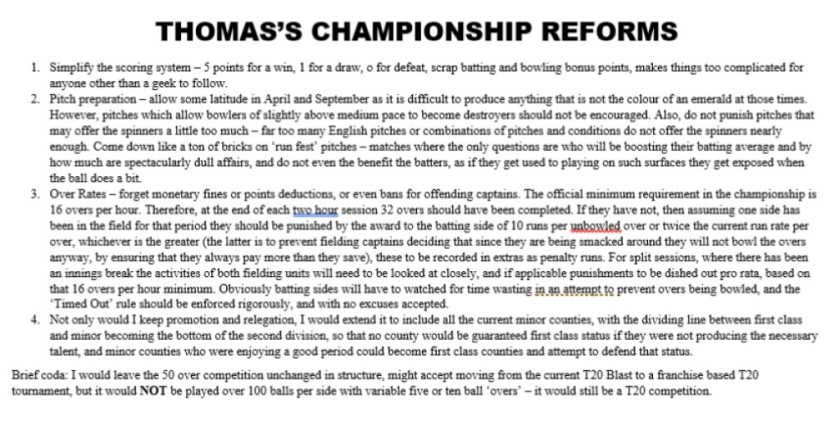
County Reforms

To expand on the above points:

1) The bonus point system as it currently stands offers up to five batting points and three bowling points to each team, awarded only during the first 110 overs of each team’s first innings. The batting bonus points are awarded when the score reaches 200, 250, 300, 350, and if it happens inside 110 overs 400, while the bowling points are awarded for taking 3, 6 and 9 wickets, so long as those milestones are reached within the 110 overs. This comes on top of 16 points for a win and 5 points for a draw. The 110 over limit is designed to encourage teams to try to score reasonably quick in their first dig and to bowl for wickets, but the truth is that few teams manage to claim a full haul of batting points, and occasions on which full bowling points are not garnered are fairly rare. It can lead to situations where teams do things that they would not normally even be thinking about (a prime example being the farce involving a prearranged declaration that Middlesex and Yorkshire perpetrated when they knew that an outright win for either of them would give that side the championship at the expense of Somerset, who were top having completed their programme). Yorkshire deliberately bowled badly on that occasion to allow Middlesex to get far enough ahead for the intended declaration. I have no objection (not in the slightest) to genuine declarations, and to batting sides trying to put themselves in position to do so by attacking bowling that it is intended to make life difficult for them, but I despise the notion of deliberately giving the opposition runs to keep a game alive – why were neither of the contending sides prepared to go the aggressive route without relying on co-operation from the other? My 5-1 ratio of points for a win and a draw may be an insufficient margin, but a draw should have some reward attached to it – to anyone telling me that there is no such thing as a good draw, I would a) tell them not to talk nonsense (publishable version) and b) mention a few of the classics such as Old Trafford 2005 and Brisbane 2010.

2) On pitch preparation: whatever the official guidelines say, pitches that offer turn early in the game get viewed more harshly than pitches which assist seamers, which in turn are generally viewed more harshly than shirtfronts. This is in my opinion is wrongheaded – the game is more fun when spinners are involved, so pitches that allow that should be encouraged, while given that conditions in April and September mean that a preponderance of green pitches is always likely at those times, and that there is good chance of seamers getting overcast skies to help them further. Shirtfronts produce games that are utterly uninteresting, boosting the averages of various batters, but not really helping even them – batters who fare well on flat tracks are frequently exposed when the pitch does a bit, because they get away with things on flat tracks which would see them dismissed on livelier surfaces. So, I would almost never punish a team for having a pitch the offered spinners overmuch, would not be harsh on greentops in April and September, but would punish anyone who produced one in mid season, as then it would clearly be deliberate, and I would be down like a ton of bricks on anyone producing a shirtfront.

3)Over rates – this one is a problem that blights test cricket more than county cricket, but I have known some late finishes when listening to commentaries of county games, and I believe that my scheme should be rolled out at that level before then being extended to test level. There might be a few early matches in which extras, swelled by penalty runs, threatened to score at a Bradmanesque rate, but I am pretty sure that it would not take long for the message to sink in.

4)The first part of this post demonstrated just one minor county that has produced serious talent, and they are not alone – Norfolk have provided the Edriches (all six of the English Edriches are members of the same family) and a few others over the years, Berkshire boasts among its products the Bedsers (EA and AV), Peter May, Ken Barrington, Tom Dollery and in the women’s game Claire Taylor the batter (as opposed to Clare Taylor, the Yorkshire medium pacer) and other minor counties have similar stories, and it is my belief that there should be more movement between minor and first class county status – first class counties should have to prove that they merit that status and failure to do so should mean being temporarily supplanted by a minor county. The introduction of promotion and relegation into the county championship was just one of a raft of changes made at that time which had a telling effect on England’s fortunes (remember folks, England were bottom of the test rankings in 1999, and while there have been a few dips in the 21 years since then they have never seriously threatened to occupy that place again). Jack Hobbs who I mentioned earlier, and Tom Hayward, his great Surrey predecessor, and the man who persuaded Surrey to give him a chance (and there were those at the time who did not approve) were both natives of Cambridgeshire.

I would like to see more County Championship action at the height of the season and less at the extreme ends thereof as well.

PHOTOGRAPHS

Well that is today’s exhibit from the Museum of All Time XIs revealed, and it now remains only for me to provide my usual sign off…

P1310851 (2)P1310852 (2)P1310853 (2)P1310854 (2)P1310855 (2)P1310856 (2)P1310857 (2)P1310858 (2)P1310859 (2)P1310860 (2)

P1310861 (2)
Three shots from the garden.
P1310862 (2)
This aeroplane stood out against the otherwise pristine blue sky.

P1310863 (2)P1310864 (2)

P1310865 (2)
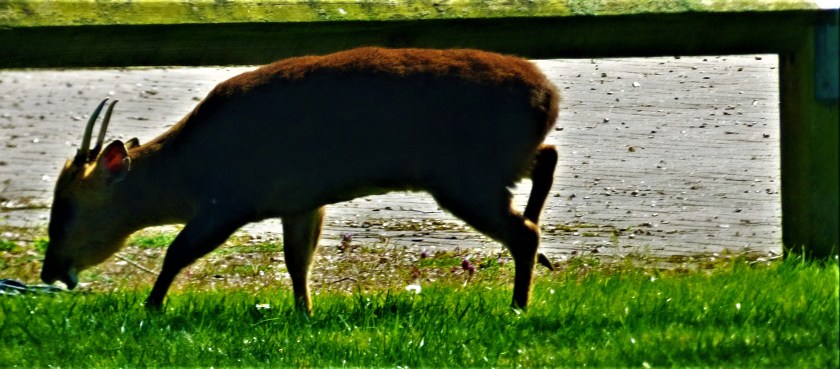
The muntjac again, this time enjoying the afternoon sun.

P1310866 (2)

P1310867 (2)
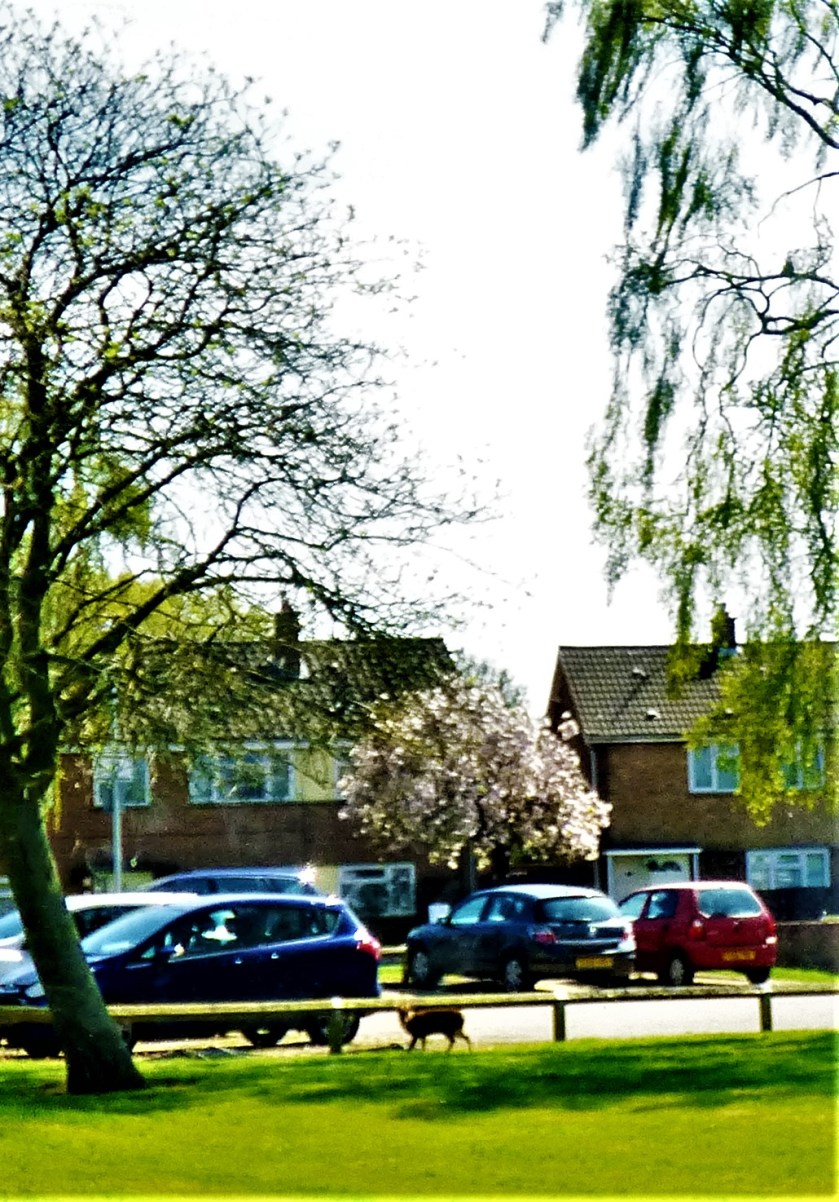
A shot emphasising how small the muntjac is.

P1310868 (2)

Staffordshire Born
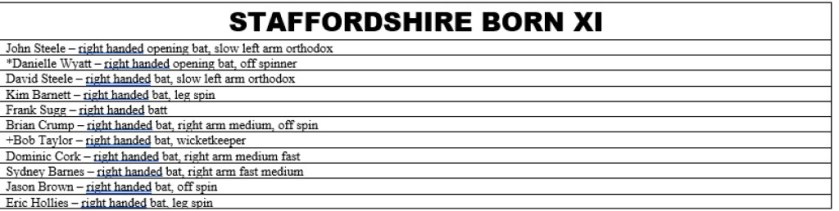
The XI in batting order.


All Time XIs – Northamptonshire

Continuing my ‘all time XIs’ series with a look at Northamptonshire.

INTRODUCTION

Welcome to the latest post in my series of All Time XIs. Today we look at Northamptonshire. This post features two more players who will be in the ‘what might have been?’ XI  (see my Somerset post for more) when I create it, and two more who had I not decided that what they actually did was sufficient to get them into this XI might have been eligible.

NORTHAMPTONSHIRE ALL TIME XI

  1. Fred Bakewell – his career was ended early by a car crash, but he had still done enough to prove his greatness. The eight test matches he managed to play before his career ending crash yielded him a batting average of 45, including a ton against Australia.
  2. Colin Milburn – an attacking opener, who like Bakewell suffered a career ending car crash (in his case he lost an eye). Also like Bakewell he had already achieved enough to prove his greatness. His county captain Keith Andrew, worried about his alcohol consumption, once suggested that he drink halves instead of pints. Not long after this they were in the bar and Andrew asked Milburn what he wanted, and the opener unerringly responded “two halves please skipper”.
  3. David Steele – brother of John, who features in my Leicestershire post, an adhesive right handed batter and sometimes useful as a slow left arm bowler. Tony Greig as England captain wanted someone difficult to dislodge to be brought into the team which had just lost the opening test match of the 1975 series by an innings and 85 runs, costing Mike Denness the captaincy, and Steele’s was the name that kept recurring when he asked about this. Greig, thus fortified insisted on Steele being selected and the then 33 year old and already white haired batter responded with 365 runs in six innings – 50 and 45 on debut at Lord’s, 73 and 92 at Headingley and 39 and 66 at The Oval, and England had the better of draws in the first two of those matches and saved the third as well. His performances so captured the public imagination that he was named as 1975 BBC Sports Personality of the Year, only the second time that honour had gone the way of a cricketer, after Jim Laker (see my Surrey post) in 1956. Since Steele’s year three further cricketers have received the honour – Ian Botham (Somerset, 1981), Andrew Flintoff (Lancashire, 2005) and Ben Stokes in 2019. In the 1976 series against the West Indies he scored his one and only test century, but was dropped for the tour of India because people did not believe he would be able to handle their spinners. By the start of the 1977 season Greig’ s name was mud because of his association with Kerry Packer and Steele was never recalled, but his eight test matches yielded him an average of 42.06 without any not outs to boost the figure.
  4. Raman Subba Row – moving north from Surrey he flourished at Northants, becoming the first batter ever to score 300 in an innings for the county, and representing England with distinction before retiring at the age of only 29.
  5. Dennis Brookes – he came south from Yorkshire as a 17 year old and did not take long to convince the county of his merits. As so often with people who play for unfashionable counties he was badly treated by the England selectors, being a one cap wonder at that level.
  6. *Sydney Smith – a West Indian all-rounder who batted in the middle order and bowled left arm spin. He qualified for the county in 1909, only four years after they had gained first class status, and fell just 45 wickets short of the career double of 10,000 runs and 1,000 wickets. He averaged 31 with the bat and 18 with the ball. I have also chosen to award him the captaincy.
  7. Vallance Jupp – moving north from Sussex, once he had served out his residential qualifying period he achieved a period of sustained all round success matched in the game’s history only by George Hirst of Yorkshire, doing the season’s double of 1,000 runs and 100 wickets eight times in a row (Hirst’s great run extended to 10 seasons in a row, while the other ‘Kirkheaton twin’, Rhodes, twice achieved the feat seven successive times at different stages of his extraordinary career). He gained just eight test caps, and his averages at that level were the wrong way round, 17 with the bat and 22 with the ball, but in first class cricket he averaged 29 with the bat and 23 with the ball.
  8. George Thompson – one of two all rounders (Bill East being the other) who was largely responsible for Northamptonshire gaining first class status in 1905. However, while East was never more than a solid county pro (a status which in itself put him streets ahead of most of his team mates), Thompson, who bowled right arm fast medium, became his county’s first ever England player. On the 1909-10 tour of South Africa when only Hobbs (series average 67) really mastered the combination of matting pitches and googly bowlers, Thompson was third in the batting averages with 33 per time, a fraction of a run an innings below Rhodes. In his six test matches he averaged 30 with the bat and 27 with the ball, while his first class figures were 22.10 with the bat and 18.89 with the ball.
  9. +Keith Andrew – the presence of the three all-rounders above (and yes, all three merit that term, even for one who in general uses it as sparingly as I do) enables me to have no qualms about selecting the best wicket keeper, and Andrew, who at one time combined the captaincy with his keeping duties was that. Due to the fact that his career overlapped with the likes of Godfrey Evans (Kent), John Murray (Middlesex) and Sussex’s Jim Parks whose batting put him into the frame he was only twice selected for his country, but his 388 domestic appearances yielded 722 catches and 181 stumpings.
  10. Frank Tyson – a right arm fast bowler, who,  like Larwood (Nottinghamshire) he managed to blitz the Aussies in their own backyard. He moved south from his native Lancashire, was picked by Hutton for the 1954-5 Ashes more or less as a bolt from the blue – at a press conference before the series commenced Hutton said “no we haven’t got mooch boolin’ – there’s a chap called Tyson but you won’t ‘ave heard of him because he’s ‘ardly played”. Tyson played huge roles in the winning of the second, third and fourth tests of that series. How quick was he? Well, Geoffrey Boycott once asked Richie Benaud what Tyson did with the ball, and Benaud said “didn’t need to do anything, Geoffrey”, Boycott double took with “That quick?” and Richie confirmed “That quick.”. Trevor Bailey (Essex) who played in that series as an all-rounder reckoned that the step up in pace from his fast medium to Statham (genuinely fast), was the same as the step up from Statham to Tyson. Finally, John Woodcock who covered cricket for The Times when it was a real newspaper as opposed to the Murdoch rag it has become, saw Tyson at his fastest in 1954-5 and Patrick Patterson’s famously fast spell at Sabina Park in 1986. Woodcock reckoned that the two spells he saw 31 years apart were equally quick with the difference that Tyson pitched it up as regularly as Patterson banged it in short.
  11. Nobby Clark – left arm fast bowler. In the 1930s he was probably the next quickest thing to Larwood. He only got to play eight test matches and his bowling average at that level was 28 per wicket, but his 1,208 first class wickets at 21.49 each tell a different tale from his sporadic England appearances.

This team has an excellent top five, three genuine all rounders, a superb keeper and two of the fastest bowlers you could wish to see. The bowling attack, with Clark and Tyson a ferocious new ball proposition, Thompson a high class fast medium, front line spinners (of different types) Smith and Jupp and Steele as a back up option looks both strong and well varied (there is no leg spinner, but that is the only major bowling type not represented). A regular theme of these exercises has been giving my putative captains the opportunity not just to change the bowler, but to change the bowling. Being English and starting to follow cricket when I did has meant that I have witnessed far too many bowling ‘attacks’ that consist either mainly or worse still wholly of right arm fast medium practitioners for my liking, and this is reflected in my own selection policy.

TWO BIG FAIRLY RECENT OMISSIONS

Much as I respect Monty Panesar, Sydney Smith’s irrefutable case for inclusion as all-rounder meant that there could not be room for someone who could offer nothing other than left arm spin. Allan Lamb, an attacking middle order bat whose test career began superbly before falling away, was another who I enjoyed watching but could not fit in.

FOR THE ‘WHAT MIGHT HAVE BEEN XI’

I was listening to a test match (not a great one, this moment is all I remember from it!) when I heard the tones of Christopher Martin-Jenkins announcing a potentially important moment in the history of English cricket. A 17 year old had just scored 210 on debut for Northamptonshire. His name was David Sales, and it seemed certain that this performance would get him fast tracked into the England set up. Unfortunately, I failed to allow for the conservatism of those in high places in English cricket. David Sales not only did not get fast tracked, he was destined never to play for his country, and although he enjoyed some good moments at county level, including scoring a triple century and a 276 not out he has to settle for a place in the ‘what might have been XI’. The highest score made by a first class debutant is 240 by Eric Marx, whose career never really developed. Sam Loxton, scorer of 232 in his debut innings, did go on to represent Australia with some distinction. Saddest of all the tall scoring debut stories is that of Norman Callaway, who played one Sheffield Shield match in the 1914-15 season, scored 207 in his only innings and then went off to fight in World War One where he was among the many killed in action. In one of those parallel universes that physicists talk about will be a David Sales who got fast tracked into the England set up and became a stalwart of his country’s middle order.

My other ‘what might have beener’ with a Northants connection is Jason Brown, an off spinner who was named in the 2001 touring party to Sri Lanka, got picked for only one warm up game on that trip and then returned to county cricket never to be heard from again.

HONOURABLE MENTIONS

Among the top order batters who I could not find places for were Wayne Larkins, Geoff Cook and Alan Fordham who all had fine records. Charles Pool, Russell Warren and Riki Wessels (now on his third county, Worcestershire, after a spell at Nottinghamshire) were all good middle order players, and the last two named might have attracted the attention of someone who wanted a batter/keeper rather than a top class gloveman. David Ripley was a fine keeper and useful lower middle order bat who was unlucky never to gain England recognition. The Willeys, Peter and David missed out for different reasons, Peter because his batting record is not quite weighty enough to warrant selection on his own, and his off spin was not a front line option, and David because his red ball record, always my chief concern, is not good enough. Freddie Brown, an attacking middle order bat and leg spin bowler, did not have the weight of achievement to merit inclusion, his captaincy of the 1950-1 Ashes party coming only after two others had declined and because the obsession with amateur skippers had not yet died, though it was on life support by then (he will feature in the ‘exotic birthplaces’ XI, since Lima, Peru is pretty hard to top in that regard). Harry Kelleher, a fast bowler of the 1950s, did not have the kind of consistent success to merit serious consideration, although he once rattled the Aussies in a tour match by firing out three of their top four with the new ball. Paul Taylor bowled his variety of left arm pace well enough to play for England briefly, but at that level he never looked remotely good enough.

Finally we come to the overseas players. My usual preference for the nominee being a bowler ruled out two quality Aussies, ‘Buck‘ Rogers and ‘Mr Cricket’ himself, aka Mike Hussey. Bishan Singh Bedi was a classical slow left arm bowler but did not also offer runs as Smith did. Anil Kumble would have given me a leg spin option, but would also have lengthened the tail, since to fit him in I would have had to pick Panesar instead of Smith. George Tribe, an Aussie who specialized in left arm wrist spin was also a possible, but offered less batting wise than Smith. Finally, Curtly Ambrose was a magnificent cricketer, but again there was no way to accommodate him without altering the balance of the side. I could have argued that as someone whose native land did not yet play test cricket Smith does not really count as an overseas player and allowed myself one of the above as well, but decided that one overseas player means one overseas player.

As with Leicestershire who I covered yesterday Northamptonshire is also associated with a top quality commentator, in this case Alison Mitchell.

Northamptonshire only became a first class county in 1905, have never been County Champions, though they were second in 1912 and have spent far more of their history near the wrong end of things than near the top. In 1907 they were bowled out for 12 by Gloucestershire (Dennett 8-9, Jessop 2-3) and reduced to 40-7 in their second innings (Dennett 7-12) before rain intervened to save them. In 1908 against Yorkshire they were put out for 27 and 15, to lose by an innings and 326 runs (although on that occasion George Thompson was injured and unable to bat, whereas when Border were dismissed for 16 and 18 by Natal they had a full complement of 11 batting for them). They were winless in all of 1935, 1936, 1937 and 1938 and won only once in 1939. However, if you believe I have missed someone do feel free to comment.

PHOTOGRAPHS

It is now time for my usual sign off…

P1310590 (2)
Seven shots of the moon in a late evening sky edited in various ways….

P1310591 (2)P1310592 (2)P1310593 (2)P1310595 (2)P1310596 (2)P1310597 (2)P1310600 (2)P1310601 (2)P1310602 (2)

P1310603 (2)
The fuchsia in my gardne…
P1310604 (2)
…with thus far one bud.