Picking an all time Asian Test XI

Constructing an all time Asian XI, also sharing a petition and as usual including a photo gallery.

This post is my extended response to a tweet from Tanmay:

What would be your All Time Asian Test XI?

🇮🇳 • 🇵🇰 • 🇱🇰 • 🇧🇩

— TANMAY 🤡 (@spear_93) April 13, 2023

https://platform.twitter.com/widgets.js

I gave a brief twitter friendly answer yesterday, and I am now using this post to expand my thoughts and look at the architecture of an all time XI.

THE BRIEF

I have taken Tanmay’s question as referring specifically to players who played for Asian nations as opposed to players of Asian heritage who played for other nations. I also decided that for the purposes of this post only players with genuinely weighty test records should be considered – there have been players who have been brilliant at lower levels and struggled at the summit, and there have been players who have made incredible starts at test level and then fizzled out (look up Narendra Hirwani in the context of this specific post). I also require that any XI I name be well balanced and obviously capable of functioning as a unit, so I try to select varied players.

BUILDING OUR XI

We start with the openers. Here there is one candidate who overshadows all others, Sunil Gavaskar with over 10,000 test runs at an average above 50. Gavaskar’s partner should ideally pose a contrast, so I want a more attacking player, and preferably a left handed one. For me the person who fits the bill best in terms of Asian test players is Saeed Anwar of Pakistan.

The number three slot is non-negotiable in my opinion – Rahul Sharad Dravid with 13,288 test runs at an average of 53 is a lock for this slot

There would be more candidates for the number four slot but for the presence of Sachin Ramesh Tendulkar who preferred this slot in test matches.

At number five I want a left hander given that numbers three and four are right handers, and again there is one commanding candidate: Kumar Sangakkara, the second most prolific of all test match left handers behind Alastair Cook, and with a better batting average than the former England opener.

At number six I want an all rounder, and there is once again a clear cut candidate, who also happens to have been an outstanding captain, Imran Khan.

A wicket keeper who can make major contributions with the bat is a major asset to any side, and Mushfiqur Rahim, a fine keeper and one of the most consistent test batters Bangladesh has yet produced fits the bill nicely.

A number eight should be primarily a bowler, but ideally you want them to be reasonably capable with the bat as well, and Wasim Akram, one of the greatest of all left arm fast bowlers and possessor of a test match double century to boot would seem the ideal candidate.

Numbers 9, 10 and 11 are bowling slots, and we want at least one more fast bowler and at least one spinner. Waqar Younis of Pakistan and Muthiah Muralidaran of Sri Lanka answer these descriptions – the former a genuinely great right arm fast bowler and regular bowling partner of Wasim Akram as well and the latter an off spinner and holder of the record for career test scalps – 800 in 133 matches. For the number nine slot my preference is for a second spinner and one who does something different to Murali, and I opt for leg spinner Anil Kumble, fourth in the list of all time test wicket takers and a big contrast to Murali.

Thus we have constructed our XI and in batting order it reads:

Sunil Gavaskar
Saeed Anwar
Rahul Dravid
Sachin Tendulkar
Kumar Sangakkara
*Imran Khan
+Mushfiqur Rahim
Wasim Akram
Anil Kumble
Waqar Younis
Muthiah Muralidaran

This gives us a very powerful top five, one of the greatest of all all rounders, a quality keeper who is also a very good bat and four top line bowlers of great quality and variety. The bowling with three fast bowlers, one of whom bowls left arm for extra variation and two of the greatest spinners ever to play has both depth and variety as well. I hesitate to say that this side could beat an ROW all time XI because the latter, something like: JB Hobbs, H Sutcliffe (the best ever test match opening pair), *DG Bradman, SPD Smith, G St A Sobers, AW Greig, +AC Gilchrist, AK Davidson, MD Marshall, SK Warne, GD McGrath has arguably even stronger batting and definitely greater depth and variety in the bowling – between Sobers and Davidson any type of delivery that a left arm bowler can produce is covered, while Marshall, McGrath, Warne and Greig do likewise for right arm bowlers, but this Asian XI would be able to give even such formidable opposition as this a genuine contest.

THE MISSING

In an exercise of this nature many legendary cricketers are bound to miss out and probably no two people would pick the same XI. I would not argue against the likes of Virat Kohli, Javed Miandad or any of a fistful of left arm spinners: three all rounders, ‘Vinoo’ Mankad, Ravindra Jadeja and Shakib al Hasan and at least two specialists in the craft, Bishan Singh Bedi and Rangana Herath would all have their advocates, merely in favour of my own choices. Two contemporary greats who I decided did not yet have the weight of achievement at test level to merit selection but who I may well include should I revisit this in a few years were Rishabh Pant (who may very well displace Mushfiqur Rahim) and Rashid Khan (who faces an even more formidable obstacle in the form of Kumble).

PHOTOGRAPHS

Just before my usual sign off I have a petition to share: The Academy in Brixton is in danger and there is a petition on change.org to save it. I grew up in southwest London, close enough to Brixton that when I temped there for a period in 1997 I walked to and from work. Finally we come to the photographs…


An All Time XI All From Different Countries

A variation on the all-time XI, this time requiring every player to come from a different country. Also some photographs.

I have one other thing to mention besides my main topic, which is a revisit to the All Time XI theme which I have explored here many times, especially during the period immediately after Covid-19 was officially declared a pandemic.

THE BRIEF

This is to be an All Time XI with every selected player coming from different countries. It is to be a team that will pose a formidable threat in any and all conditions, so variety is essential. There are some players (Bradman and Sobers e.g) whose preeminence is such that they have to be their country’s representative, and in the case of some of the minor nations who are represented they had only one player wh0 could even be considered. This in turn limited who could be picked from other countries where the field was theoretically wider.

THE TEAM INCLUDING 12TH

  1. Jack Hobbs (England, right handed opening batter and occasional medium pacer). “The Master”, scorer of 61,237 FC runs including 197 centuries, scorer of 12 Ashes centuries. The oldest ever test centurion, the last of his centuries at that level coming at Melbourne in 1929 by when he was 46 years old. My English representative is highly likely to be one half of a pair that gets the innings off to a strong start.
  2. Sunil Gavaskar (India, right handed opening batter, occasional medium pacer). He was the first to reach the milestone of 10,000 test runs. He had an excellent technique and seemingly limitless patience. One would absolutely ideally prefer one of the openers to be left handed but I can’t see many new ball bowlers queuing up for a crack at this opening pair!
  3. Don Bradman (Australia, right handed batter, occasional leg spinner). The greatest batter ever to have played the game (his test average of 99.94 puts him almost 40 runs an innings ahead of the next best, his FC average of 95.14 puts him 24 an innings ahead of the next best at that level). He is also vice captain of the team.
  4. Graeme Pollock (South Africa, left handed batter, occasional leg spinner). The best test average of any left hander to have played 20 or more test matches, 60.97 per innings.
  5. Garry Sobers (West Indies, left handed batter, left arm bowler of every type known to cricket). Quite simply the most complete player the game has yet seen and one whose absence from this XI I could never countenance.
  6. +Mushfiqur Rahim (Bangladesh, right handed batter, wicket keeper). One of the great stalwarts of Bangladesh cricket, an excellent keeper and a gritty middle order batter whose test record would almost certainly be even more impressive than it actually is had he been part of a stronger side.
  7. *Imran Khan (Pakistan, right handed batter, right arm fast bowler). Has a strong case to be regarded as the greatest genuine all rounder in test history (batting average 37, bowling average 22), and a great captain as well (he is designated skipper of this side, and one of very few who could possibly see Bradman named vice captain rather than captain).
  8. Rashid Khan (Afghanistan, leg spinner and useful right handed lower order batter). This one was fairly inevitable – I need a wide range of top class bowling options, and a leg spinner of undisputed world class who hails from a minor nation is pretty much indispensable in that regard.
  9. ‘Bart’ King (USA, right arm fast bowler, useful right handed lower order batter). The original ‘King of Swing’, taker of over 400 FC wickets at 15 a piece, and good enough with the bat to average 20.
  10. Richard Hadlee (New Zealand, right arm fast bowler, useful left handed lower order batter). With genuine respect to today’s Kiwi side, comfortably the strongest they have ever been able to field, he remains his country’s greatest ever cricketer.
  11. Muttiah Muralitharan (Sri Lanka, off spinner, right handed tail end batter). 800 test wickets, taken at a rate of six per game. At The Oval in 1998, on a pitch that was quite hard and quite dry but basically blameless he claimed 16 English wickets in the match (7-155 in the first innings, and then after SL had taken a lead of 150, spearheaded by Jayasuriya scoring a double hundred, 9-65 in the second English innings).
  12. Andy Flower (Zimbabwe, left handed batter, wicket keeper, occasional off spinner). This man covers as many bases as possible as 12th – while I would not relish him coming in for any of the front line bowlers given that he is very much a part timer, and Sobers and Bradman can both be considered impossible to cover for anyway he won’t massively weaken the side even in a worst-case scenario.

RESULTS AND PROSPECTS

I start this little section by looking at the bowling, as it is that department that separates winners and also-rans. A pace bowling unit of Richard Hadlee, ‘Bart’ King and Imran Khan is awesome by any reckoning, and if there is definitely nothing for spinners, there is Sobers in his faster incarnations as fourth seamer. If spinners are called for, Rashid Khan and Muttiah Muralitharan are two of the all time greats, and offer a contrast, being leg spinner and off spinner respectively, and Sobers can bowl left arm orthodox and left arm wrist spin support. Thus there are bowling options available to meet every eventuality, and this side can be very confidently expected to take 20 wickets in any conditions.

The batting features a pair of openers who are highly likely to give the innings a strong start, a trio of fast and heavy scoring batters at 3, 4 and 5, a keeper who scores lots of runs at six, a genuine all rounder at seven, and three bowlers who can genuinely bat as well. Murali is the only bunny in a very deep batting order.

A number of the players in this XI, most notably Hobbs, Bradman and Sobers are rated among the the finest fielders ever to have played the game, and there are no carthorses anywhere, so they will give a good account of themselves in this department as well.

Finally, with Imran Khan as captain and Don Bradman as vice captain and Hobbs also there to be consulted this team has tactical acumen to burn and is highly unlikely to be outmatched in that area.

Thus this team seems to tick every box, and I would confidently expect it to dispose of any opposition put in front of it.

THE STEAM HOUSE CAFE

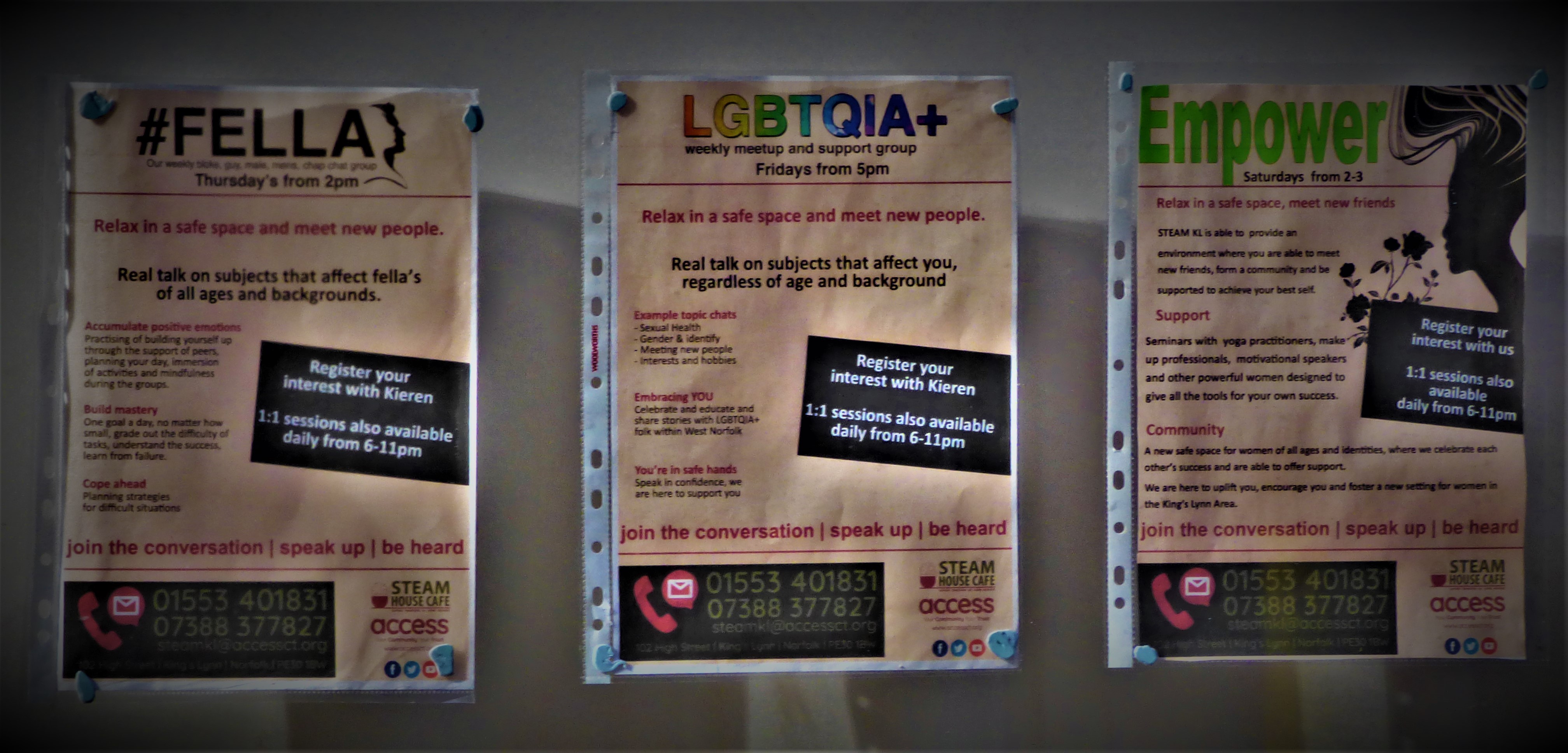
The STEAM House Cafe on King’s Lynn High Street is a cafe-style safe space for people with mental health issues, and I was there yesterday as part of a group from NAS West Norfolk. We and they are hoping to be able to organize something there specifically for autistic people.

PHOTOGRAPHS

Time for my usual sign off…

A brief summary of the XI.

All Time XIs – Davids v Goliaths

My latest variation on the ‘all time XI’ theme pits Davids against Goliaths. I also present the answer to yesterday’s teaser, an important post about disease prevention and of course some photographs.

INTRODUCTION

It is time for another variation on the ‘All Time XI‘ theme, this time pitting a team made of players of small stature against a team of some of the tallest of all cricketers. I will also answer yesterday’s mathematical teaser.

THE GOLIATHS XI

  1. Chris Gayle – left handed opening batter, occasional off spinner. He stands 6’5″ tall. His career highlights include two test triple centuries. However, he would be banned from using the DRS because of his record in that department.
  2. Will Jefferson – right handed opening batter, occasional right arm fast medium. At 6’11” the Essex and later Leicestershire opener is one of the tallest of all professional cricketers. He never quite managed to attract the attention of the England selectors, but achieved a very respectable output in first class cricket.
  3. Kevin Pietersen – right handed batter, occasional off spinner. At 6’4″ one of the shorter members of this team. He averaged almost 50 in test cricket, with his highest score 227 at Adelaide. Late in his career he came within two of the highest score ever made for Surrey, with 355. He was not always popular with team mates – his departures from his first two counties, Nottinghamshire and Hampshire were both decidedly acrimonious, but his record speaks for itself.
  4. Tom Moody – right handed batter, occasional medium pacer. The 6’7″ Aussie scored stacks of runs for Warwickshire and Worcestershire over the years and was also a fine fielder. One of the few to have admitted to being embarrassed by making a century due to the circumstances of its making. The innings in question, which saw the normally prized landmark arrive in just 26 minutes, was played against bowlers who were deliberately giving away runs to expedite a declaration was at the time greeted as a new first class record, but wiser counsels have since prevailed and it is now entirely correctly relegated to a footnote. Moody made ample numbers of runs that he had to earn, and his genuine embarrassment at effectively being handed a century speaks volumes for him.
  5. *Clive Lloyd – left handed batter, cover specialist fielder, captain. The 6’5″ bespectacled Guyanese ace featured in my piece about the West Indies. Against Glamorgan he once reached 200 in precisely two hours against genuine bowling. In the inaugural men’s world cup in 1975 (the women played one two years earlier, won by Rachael Heyhoe-Flint’s England) he scored a ton in the final to put West Indies in charge of the contest, a position they never relinquished.
  6. +Clyde Walcott – right handed batter, wicket keeper. Wicket keepers are rarely particularly tall, and Walcott was over six feet tall. I wrote about him in the West Indies piece.
  7. George Bonnor – right handed batter, medium pacer, excellent catcher. Bonnor was one of the first renowned big hitters, with his best test innings being a score of 128 that included sending the ball clean out of the ground four times. He was inclined to attempt to ‘bat properly’, a policy that did not work for him – his best moments came when he realized that he was a big hitter and did not try to play a real innings.
  8. Sulieman Benn – left arm orthodox spinner. At 6’7″ the West Indian is probably the tallest specialist spinner there has ever been, and he did have his moments. When I watched the West Indies play Australia at Adelaide in 2009 he was one of only two of their bowlers, greased lightening quickie Kemar Roach being the other, to cause the Aussie batters genuine apprehension. That match should have been an all-time classic, the West Indies being all out early on the final morning to leave Australia needing 330 off 81 overs on a pitch that was still pretty good for batting. Unfortunately, influenced by being already one up in a three match series, the Aussie skipper ‘Punter’ Ponting declined to live up to his nickname and Australia made no serious attempt to mount a chase that they should have had a fair chance of pulling off.
  9. Mohammad Irfan – left arm fast bowler. The Pakistani paceman at 7’1″ is officially the tallest international cricketer there has ever been.
  10. Joel Garner – right arm fast bowler, excellent boundary fielder. The 6’8″ Barbadian who has one end of his home ground, the Kensington Oval in Bridgetown, named in his honour was a very difficult bowler to score off, and took ana average of just over four wickets per test match. His ODI economy rate of 3.09 is unapproached in that format. He was my chosen overseas player for Somerset.
  11. Bruce Reid – left arm fast bowler. The 6’8″ Aussie had a fine test record for those matches when he was able to play, though he spent a lot of time on treatment tables (his only rival that I can think of in that regard was another Aussie, Damien Fleming).

This team has a good top six, including a serviceable wicket keeper, a big hitter at no 7 and four fine bowlers. It is weak in the spin bowling department, with only the part time tweakers of Gayle and Pietersen to supplement Benn’s left arm spin. That is the suitably Brobdingnagian “Goliaths XI”, and now, slings at the ready, here are their opponents:

THE DAVIDS XI

  1. Bobby Abel – right handed opening bat. The diminutive Surrey opener (officially 5’4″ but perhaps less) was the first to carry his bat through an England innings, finishing on that occasion with 132 not out. He also holds the record for carrying his bat through the highest first class team total to feature such an innings, and in that same innings the highest score ever made for Surrey. In 1899 at Taunton, Surrey scored 811 all out, with Abel batting through for an undefeated 357. Abel and Tom Hayward shared the Surrey record partnership for any wicket, 448 for the 4th. Playing for the Players against the Gentlemen at The Oval Abel scored 247, a score only beaten in that series by his fellow Surreyite Jack Hobbs (266). Abel also formed a contrasting friendship with WG Grace, and was among the pallbearers at the latter’s funeral. There is a biography of him by David Kynaston that I recommend.
  2. Tammy Beaumont – right handed opening bat. She has established a magnificent record at the top of the order in recent years (visit my post of two days ago to see a clip of highlights from one of her innings), and while the women play scandalously little test cricket, her record in ODIs is significantly better than her record in T20s, leading me to take the view that if she got a proper chance in long form cricket she would be highly successful.
  3. *Don Bradman – right handed batter, brilliant outfielder, captain. He was just a little over 5’6″ in height, the second tallest of my chosen XI. A test average of 99.94 renders further comment superfluous. This is his third appearance in this series of posts, after Australia and the Scribes.
  4. Sachin Tendulkar – right handed batter. The Indian maestro, scorer of 100 international hundreds is an automatic selection at four as Bradman was at three.
  5. Gus Logie – right handed batter. The West Indian, one of the smallest players of his era, was not anything like as heavy a scorer as his immediate predecessors in this order, but he tended to score his runs when his side really needed them.
  6. +Mushfiqur Rahim – right handed batter, wicket keeper. The Bangladeshi, one of the smallest players ever seen in the test arena, has two test double centuries to his credit, and averages 36.77 overall with the bat, and he has not all that often had the luxury of being able to build on a strong start by his team. He has also taken 104 catches and executed 15 stumpings in test cricket. Bangladesh has probably during his career only had five players who can genuinely be regarded as top class, opener Tamim Iqbal, all-rounder Shakib Al Hasan (currently suspended), off spinner Mehedi Hasan, fast bowler Mashrafe Bin Mortaza (now a member of the Bangladeshi parliament, and a spent force as a player) and Mushfiqur Rahim himself. In this team he is part of a strong unit, which would be a new experience for him.
  7. Gilbert Jessop – right handed bat, right arm fast bowler, brilliant fielder. At 5’7″ the tallest member of my chosen XI, he is the x-factor all rounder in the side. He featured in yesterday’s post.
  8. Katherine Brunt – right arm fast medium bowler, right handed bat. The Barnsley born Brunt is approximately 5’5″ tall – among her regular England team mates only Beaumont and Danielle Wyatt are noticeably shorter. It is her skiddy bowling that has earned her a place in this XI, but she has also developed her batting to a very considerable degree, and shares with Logie the knack of producing the goods when they are most required – her career best 72 not out got England to a total in excess of 200 when at one stage a prediction of 150 would have been viewed as seriously optimistic.
  9. John Wisden – right arm fast, useful lower order batter. The Sussex pacer, also founder of the United All England XI, a touring XI which played matches against local teams who had a numerical advantage – 18 and 22 were the two most frequent sizes of team for such matches, and sometimes secured the services of professionals, described as ‘given men’, once took all ten in a first class innings, all clean bowled. He stood only 5’4″, probably the shortest specialist fast bowler there has ever been.
  10. Tich Freeman – leg spinner. The 5’2″ Freeman (his actual given names were Alfred Percy) was the second most prolific wicket taker in first class cricket history, with 3,776 (and he played only about half the number of matches that Yorkshire’s Wilfred Rhodes, the no1 in this category, did). He holds all manner of records for large wicket hauls. Even more remarkable by today’s standards is the age at which he achieved these feats – a combination of his being a late developer and World War 1 meant that by the age of 30 the Kent leggie had precisely 29 first class wickets to his credit.
  11. Poonam Yadav – leg spinner. The tiny Indian leg spinner was one the stars of the recent Women’s World T20, again and again confounding opponents with her flight and spin. She is also one of the slowest bowlers of any description to have been seen in top level cricket.

This team has an opening pair who should combine well, a powerhouse combination at three and four, a battler at no six, a wicket keeper batter at six, the most explosive batter the game has ever seen at seven, and four varied bowlers to round out the XI. I regret that both spinners are leg spinners, but I think there is enough difference in their methods that this is not a very serious weakness.

THE CONTEST

This contest for the ‘Sling Trophy’ as I shall call it should be a fine one. However, especially if Wisden, Brunt and Jessop, the pace bowlers for the Davids, concentrate on yorkers, which the Goliaths would find it difficult to get down to, I would still expect this to go the same way as the original David vs Goliath – in favour of the Davids.

SOLUTION TO YESTERDAY’S TEASER

Yesterday I offered up this, from brilliant.org

Measurement

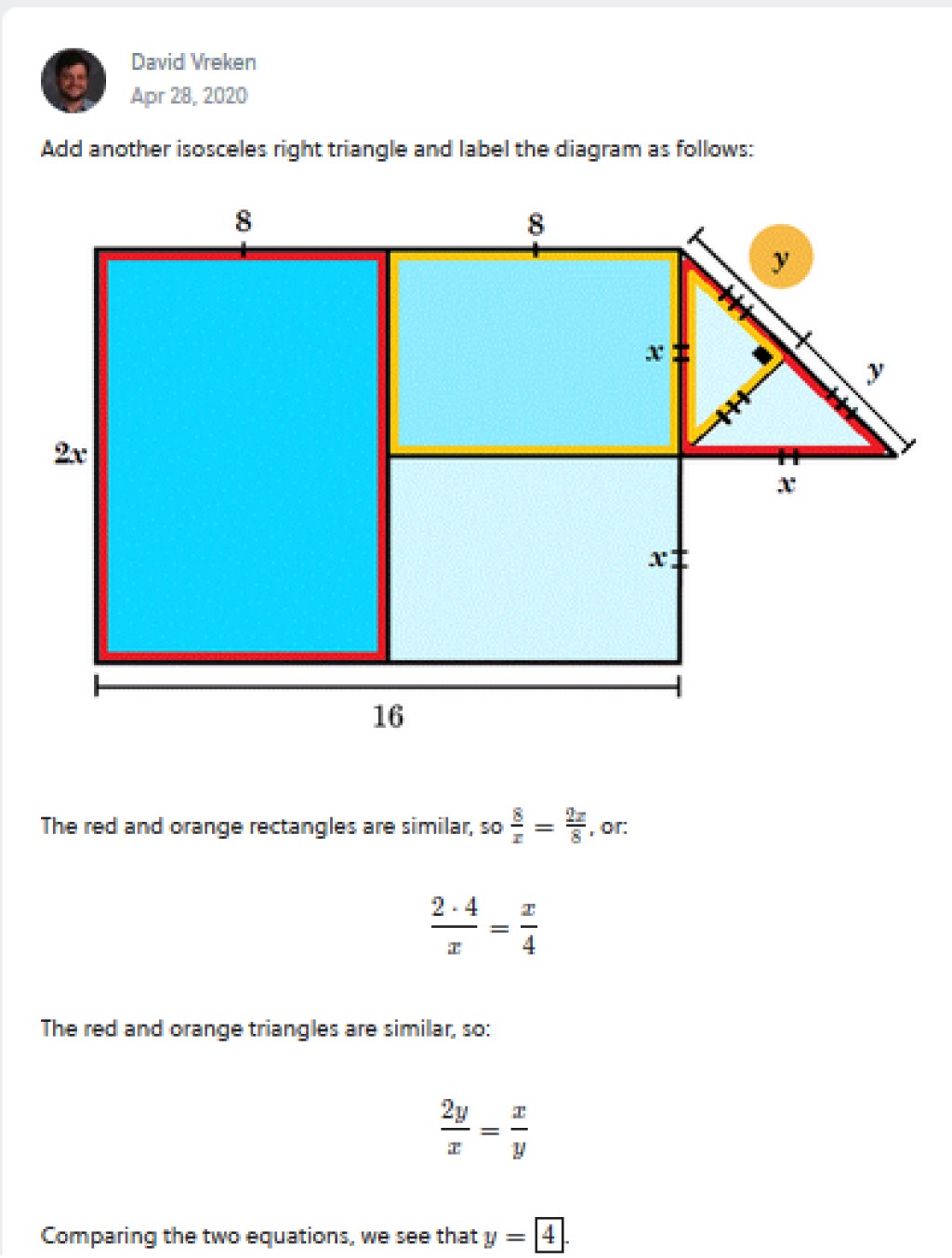
The key lies in that word ‘similar’. All the four rectangles (the big overarching rectangle, with long side 16, the intermediate rectangle that is half the area of that one and the two smaller rectangles all have the same proportions. This means that the key shape, the triangle is an isosceles right angled triangle and its longest side can be calculated from the similarity of the rectangles to equal to 4 x the square root of 2. This squares up to 32, and Pythagoras tells us that the sum of the squares of the other two sides is equal to the square of the longest side (aka hypoteneuse). Since the triangle is isosceles as well as right angled, the square of each remaining side is half of 32, i.e. 16. 16 has two square roots, 4 and -4, and the length of the side of a triangle is a positive number, so the answer is four.

Here is David Vreken’s elegant published solution:

VrekenSol

Just to complete this mini-section, it took me much less long to actually solve this than to type my explanation, and I am a fairly rapid typist.

A FINAL LINK AND PHOTOGRAPHS

The Davids and Goliaths of cricket have been paraded in all their glory, and I have a single link left to share before finishing with my usual sign off. Phoebe MD has hosted a post by Barbara Leonhard titled “Avoiding the Tragedy: A Look into Disease Preventionwhich I consider to be a must-read. My thanks to both Phoebe and Barbara for that piece.

Finally, my usual sign off…

P1320309 (2)P1320310 (2)P1320311 (2)P1320312 (2)P1320313 (2)P1320314 (2)P1320315 (2)P1320316 (2)P1320317 (2)P1320318 (2)P1320319 (2)P1320320 (2)P1320321 (2)P1320323 (2)P1320324 (2)P1320328 (2)P1320329 (2)P1320330 (2)P1320331 (2)

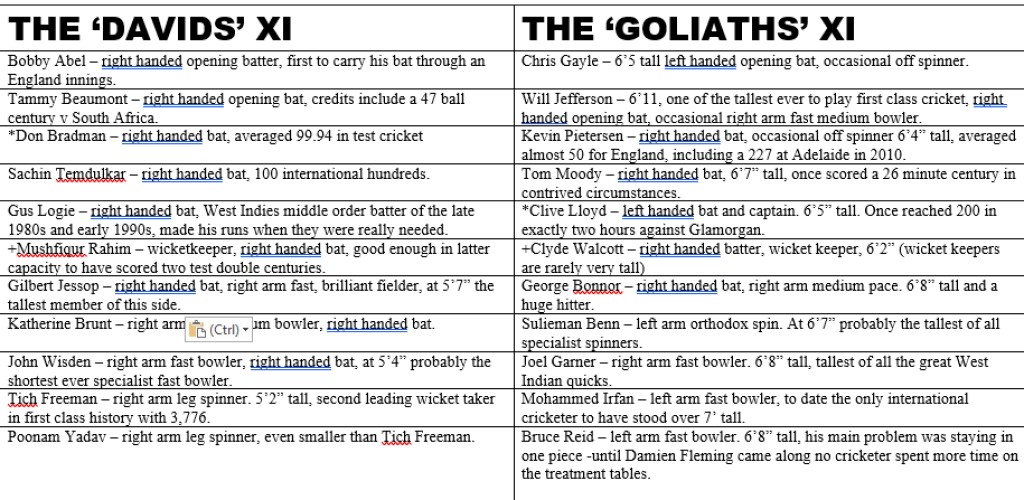
David v Goliath
The teams in tabulated form with abbreviated comments.