All Time XIs – Australia

Continuing the all-time XIs theme with a look at Australia, I use this post to make more explicit some of my thinking about team balance.

INTRODUCTION

After completing my look at the English first class counties yesterday (click here to visit a page from which you can access all 18 of those posts) I am now moving on to the next stage of this series. In this post I am going to attempt to explain more of my thinking about selection. I will begin by presenting an Australian XI of players from my time following cricket, which I am taking as starting from the 1989 Ashes (I saw odd bits from the 1985 series and heard about the 1986-7 series but 1989 was the first I can claim really direct memories of. Before moving on to the team that many of my fellow Poms would be watching from behind the sofa there is one other thing to do…

THE RECEPTION OF MY FIRST 18 POSTS (WITH A NOD TO THE PINCHHITTER)

Yesterday I shared my All Time XIs for the counties on twitter. The feedback was very interesting, and mainly tendered in the right spirit. The PinchHitter, who sends out a daily email to those who sign up for it was today kind enough to include a reference to this endeavour in today’s email, which you can view here. Everyone’s opinions differ, and so long as suggestions are made with constructive intent I will not complain, though I would ask that you suggest who should be left out to accommodate your favoured choices. I am bound in an endeavour of this nature to fail to flag up people who merit attention – tthere are vast numbers of players to be considered when doing something like this.

AUSTRALIA IN MY CRICKET LIFE XI

  1. Matthew Hayden – an attack minded left handed opener who was very successful over a number of years. He had a horrible time in the first four matches of the 2005 Ashes, but bounced back with 138 in the fifth match at The Oval. In Brisbane in 2002 he cashed in on Nasser Hussain’s decision to field first by scoring 197, and then adding another ton in the second innings.
  2. Justin Langer – a different style of left handed opener to Hayden, his most regular partner, Langer was no less effective at the top of the order. His greatest performance was a score of 250 at the MCG. He played in the county championship for Middlesex and Somerset.
  3. Ricky Ponting – a right hander whose natural inclination was to attack but who could also produce a defensive knock at need. Although he had one very poor Ashes series, in 2010-11 his overall record demanded inclusion.
  4. Steve Smith – a right hander, with an even better average (to date), than Ponting. He was tarnished by his involvement in sandpapergate, but his comeback in the 2019 Ashes showed that while he cannot be trusted with a leadership position his skill with the bat remains undminished.
  5. *Allan Border – a left handed middle order bat who was the first to 11,000 test runs, also an occasional left arm spinner who did once win his country a match with his bowling (match figures of 11-96 against the West Indies in 1988). For the first 10 years of his long career he was a mediocre side’s only serious bulwark against defeat, but in the last years of his career he was part of the first of a succession of great Australian teams. The role he played as captain in Australia’s transformation from moderate to world beaters was an essential part of the story of the ‘Green and Golden Age’ and I recognize it as such by naming him captain of this side.
  6. +Adam Gilchrist – attacking left handed middle order bat (opener in limited overs cricket) and high quality wicket keeper. One of the reasons that England won the 2005 Ashes was that they were able to keep him quiet (highest score of the series 49 not out), the only time in his career any side managed that. At Perth in the 2006-7 series, immediately following a victory at Adelaide after England had made 550 in the first innings and then did a collective impression of rabbits in headlights against Warne in the second, he smashed a century off 57 balls, then the second fastest ever test century in terms of balls faced.
  7. Mitchell Johnson – left arm fast bowler and attacking left handed lower middle order bat, also the ‘Jekyll and Hyde’ of 21st century test cricket. In the 2010-11 Ashes the ‘Hyde” version predominated, save for one great match at Perth, struggling to such an extent in his other games in that series that he probably scared his own fielders more than the England batters! The ‘Jekyll’ version was on display in the 2013-14 Ashes, when he bowled as quick as anyone in my cricket following lifetime, was also accurate, and scared the daylights out of the England batters, taking 37 wickets in the series and being the single most important reason for the 5-0 scoreline that eventuated.
  8. Shane Warne – leg spinner and attacking right handed lower order bat – one of the two greatest spinners I have seen in action (Muttiah Muralitharan being the other). From the moment that his first ball floated in the air to a position outside leg stump and then spun back to brush Mike Gatting’s off stump at Old Trafford in 1993 he had a hex on England, becoming the first bowler ever to take 100 test wickets in a country other than his own. In the 2005 Ashes, when England regained the urn after 16 years, he took 40 wickets and scored 250 runs in the series. His only blot in the series came at The Oval when he dropped an easy chance offered by Kevin Pietersen, which allowed that worthy to play his greatest ever innings and secure the series. He took over 700 test wickets (the exact figure is open to argument, since some of his credited wickets were taken in an Australia v Rest of The World game, and earlier ROW games organized when South Africa were banished from the test scene are not counted in the records). He also scored more test runs than anyone else who never managed a century, 3,154 of them.
  9. Pat Cummins – right arm fast bowler, right handed lower order bat. Injuries hampered his progress (he first appeared on the scene as a 17 year old, but he has still done enough to warrant his inclusion. At the MCG in 2018, when Jasprit Bumrah rendered the Aussies feather-legged with a great display of fast bowling, Cummins took six cheap wickets of his own in India’s second innings, not enough to save his side, who lost both match and series, but enough to demonstrate just how good he was, a fact that he underlined in the 2019 Ashes.
  10. Nathan Lyon – off spinner and right handed tail end bat. One of only three spinners of proven international class that Australia have produced in my time following cricket (Stuart MacGill, a leg spinner, is the third). In the first match of the 2019 Ashes he cashed on Steve Smith’s twin tons by taking 6-49 in the final innings of the game.
  11. Glenn McGrath – right arm fast medium bowler and right handed tail end bat. Australia lost only one Ashes series with McGrath in the ranks, and he was crocked for both of the matches they ,lost in that series. I tend to be a bit wary of right arm fast mediums having seen far too many ineffective members of the species toiling for England over the years but this man’s record demands inclusion. In that 2005 Ashes series he was the player of the match that his side did win – his five cheap wickets after Australia had been dismissed for 190 in the first innings wrenched the initiative back for the Aussies and they never relinquished it. He is at no11 on merit, but even in that department he is a record breaker – more test career runs from no 11 than anyone else.

This combination comprises a stellar top five, a wicket keeper capable of delivering a match winning innings and a strong and varied bowling attack – left arm pace (Johnson), right arm pace (Cummins), right arm fast medium (McGrath), leg spin (Warne) and off spin (Lyon) with Border’s left arm spin a sixth option if needed. It also has a tough and resourceful skipper in Border.

BUILDING THIS COMBINATION

Australia in the period concerned have not had a world class all rounder – the nearest approach, Shane Watson, was ravaged by injuries and although he delivered respectable results with the bat his bowling was not good enough to warrant him being classed as an all rounder. I could deal with this problem by selecting Gilchrist as a wicket keeper and assigning him the traditional all rounders slot (one above his preferred place admittedly), which is what got him the nod over Ian Healy, undoubtedly the best pure wicket keeper Australia have had in my time following the game. A more controversial option would have been to borrow Ellyse Perry from the Australian Women’s team and put her at no six. Having opted for Gilchrist the question was then whether I wanted extra batting strength or extra bowling strength, and in view of the batters I could pick from and the need to take 20 wickets to win the match I opted for an extra bowling option – those who have studied my county “All Time XIs” will have noted that I always made sure they had plenty of depth and variety in the bowling department – I want my captains to be able to change the bowling, not just the bowlers. Warne and Lyon picked themselves for the spinners berths, with the coda that if the match was taking place in India Warne would have to be dropped and someone else found as he was expensive in that country (43 per wicket). Australia in this period has had two left arm quick bowlers who merited consideration, Johnson and Mitchell Starc. I opted for Johnson, as Johnson at his best, as seen in the 2013-14 Ashes was simply devastating. McGrath picked himself. For the final bowling slot I had an embarrassment of riches to choose from. I narrowed the field by deciding that I was going to pick a bowler of out and out pace. Brett Lee’s wickets came too expensively, Shaun Tait does not have the weight of achievement. I regard Cummins at his best as a finer bowler than either Josh Hazlewood or James Pattinson, so opted for him.

Turning attention to the batting, Langer and Hayden were a regular opening pair, and I did not consider either Mark Taylor or David Warner who both have great records to have done enough to warrant breaking an established pairing. Border got the no 5 slot and the captaincy because of his great record as both batter and captain and the fact that Ponting and Smith whose claims were irrefutable are both right handers. If I revisit this post in a few years I fully expect Marnus Labuschagne to be in the mix – he has made an incredible start to his test career. Adam Voges averaged 61.87 in his 20 test matches, but his career only spanned a year and a half, and a lot of the opposition he faced was weak – and in the heat of Ashes battle he failed to deliver, scoring only two fifties and no century in the series, which is in itself sufficient reason not to deem him worthy of a place. He never played in an Ashes match, the ultimate cauldron for English and Australian test cricketers, and so that average not withstanding cannot truly be considered a great of the game. The Waugh twins both had amazing test records, especially Steve, but such has been Australia’s strength in the period concerned that they cannot be accommodated.

TURNING THIS INTO AN ALL TIME XI

For me Smith and Border of the front five hold their places. Ponting would be a shoo-in for the no3 slot in almost any other team one could imagine, but for true if cruel reason that he is only the second best Australia have had in that position he loses out, with Donald Bradman (6,996 test runs at 99.94) getting the no 3 slot. At no six we now have a genuine all rounder, Keith Miller (George Giffen, once dubbed “the WG Grace of Australia”, Monty Noble and Warwick Armstrong also had superb records), with Gilchrist retaining the gloves and now dropping to no 7. There is a colossal range of bowling options, out of which I go for Alan Davidson (186 test wickets at 20.53 and a handy man to have coming in at no 8), Hugh Trumble, an off spinner whose tally of 141 Ashes wickets was a record over 70 years, and who twice performed the hat trick in test matches at the MCG, in “Jessop’s Match” at The Oval in 1902 he scored 71 runs without being dismissed and bowled unchanged through both England innings, collecting 12 wickets, comes in at no 9, Clarrie Grimmett the New Zealand born leg spinner who captured 216 wickets in just 37 test matches gets the no 10 slot and Glenn McGrath retains his no 11 slot. This team has a stellar top five, an all-rounder at six, a fine wicket keeper and explosive batter at no 7 and a very varied and potent line up of bowlers. Why Grimmett ahead of Warne? Grimmett in both test and first class cricket (he took more wickets in the latter form than anyone else who never played county championship cricket) averaged a wicket per match more than Warne.

At the top of the batting order I have replaced Hayden and Langer with Arthur Morris, a left handed opener who Bradman rated the best such that he ever saw and Victor Trumper, right handed batting hero of the early 20th century. In 1902 at Old Trafford, when England needed to keep things tight on the first morning until the run ups dried sufficiently for Bill Lockwood to be able to bowl Trumper reached his century before lunch, and since Australia won that game by just three runs this was a clearly defined match winner.

Australia has had a string of top class glove men down the years – Blackham who played in each of the first 17 test matches, Bert Oldfield, Don Tallon, Wally Grout, Rodney Marsh and Ian Healy are some of the best who appeared at test level, but none of them offer as much as Gilchrist does with the bat.

There are an absolute stack of legendary bowlers who have missed out, likewise batters – I will not attempt a listing these, but everyone who wants to is welcome to mention their own favourites.

FINAL THOUGHTS

This has been a very challenging exercise, but also a very enjoyable one. As for my All Time Aussie XI, not only would I not expect anyone else to agree with all my picks, I might well pick different players next time – there are a stack of players one could pick and be sure of. The one from my cricket following life (remember that start point of the 1989 Ashes) has fewer options, but again, it is probable that with the options available even in that period, no one else would pick the same XI that I have. If you plan to suggest changes please indicate who your choices should replace, and please consider the balance of the side when making your choices.

PHOTOGRAPHS

Our little look at the oldest enemy is over, and it remains only for my usual sign off…

Aussies
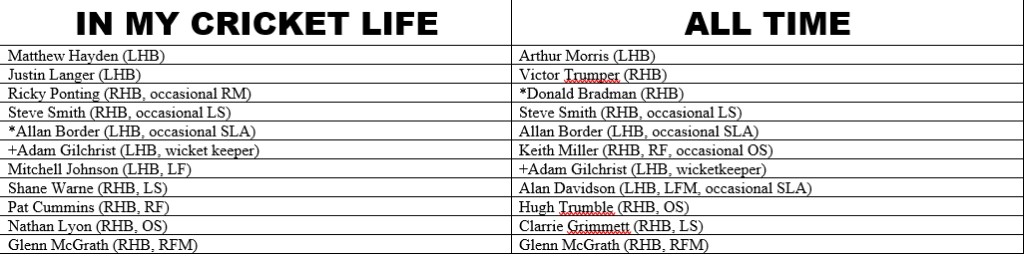
My two teams tabulated for ease of consumption.

P1310686 (2)P1310687 (2)P1310688 (2)P1310690 (2)P1310691 (2)P1310692 (2)P1310693 (2)P1310695 (2)P1310702 (2)P1310703 (2)P1310704 (2)P1310704 (3)P1310705 (2)P1310706 (2)P1310707 (2)P1310710 (2)P1310711 (2)P1310712 (2)P1310713 (2)P1310714 (2)P1310716 (2)P1310717 (2)P1310718 (2)P1310719 (2)P1310720 (2)P1310722 (2)

All Time XIs – Durham

Reaching the end of the beginning of my “All Time XIs” series with a whistle stop tour of Durham to complete the 18 first class counties.

INTRODUCTION

Welcome to the latest post in my “All Time XIs” series. This post marks the end of the beginning of the series, as it completes the set of 18 first class counties. Durham has posed difficulties caused by no other county for reasons I shall go into after introducing my XI. Tomorrow’s post, the first in the next stage of this series, will be very different indeed.

DURHAM ALL TIME XI

  1. Mark Stoneman – a reliable county pro who was exposed as being out of his depth at the highest level. He left Durham for Surrey, where he still plays.
  2. Keaton Jennings – unlike Stoneman he did manage to reach three figures at test level, but this achievement should not conceal the fact that he also was not good enough at the highest level. He, like Stoneman, headed for pastures new, in his case Lancashire.
  3. Michael Di Venuto – a rare example of me making a batter my overseas pick. He had an excellent domestic record without ever attracting the attention of the Australian selectors. As well as Durham he played for Derbyshire.
  4. Paul Collingwood – a man who made the absolute most of his talents, which as well as his gritty middle order batting included being a world class fielder and an occasionally useful medium paced bowler. He amassed 10 test centuries, with a highest of 206 at Adelaide in 2006 – a match the England ended up losing, in part because in his second innings Collingwood adopted too purely defensive an approach, meaning that Australia’s eventual chase contained no element of time pressure. Similarly his fighting innings at Cardiff in 2009 nearly led to disaster for the same reason – his passivity at the crease meant that England were still in arrears when he was ninth out leaving Anderson and Panesar to battle hard to secure the draw. Nevertheless, his record makes its own case on his behalf.
  5. +Phil Mustard – a good middle order batter and a fine wicket keeper.
  6. Ben Stokes attacking left handed bat and right arm fast bowler (like Stan Nichols, Essex), a genuine 22 carat gold all rounder. His highest score was 258 against South Africa, but his two most iconic innings were both played in 2019. In the World Cup final at Lord’s his 84 hauled England out of what had looked like an impossible situation to tie the match and take it to a super over in which he then batted along with Jos Buttler (Somerset and Lancashire). The super over was tied, leaving England ahead on boundary count and lifting the World Cup. Then, in the test match at Headingley later that year (I am currently listening to a replay of the commentary on that match as I type this) after England had been bowled out for 67 in the first innings and were set 359 in the second innings he delivered an extraordinary performance. England lost their ninth wicket at 283, bringing Jack Leach (Somerset) in to join Stokes with 76 needed, and it was then that Stokes turned a good innings into the stuff of legends. By the time the winning run was scored Leach was on 1 not out, Stokes 135 not out having scored all bar one of that last wicket partnership. A third extraordinary display from Stokes in the calendar year came in South Africa when Dominic Sibley (Warwickshire) was heading towards a maiden test century, and England needed to increase the tempo for a declaration. Leaving Sibley to go steadily on Stokes blasted 72 off 47 balls to attend to the matter of upping the run rate. South Africa staged a typically defiant rearguard action in the final innings of the game but not quite hold out and England won a well merited victory.
  7. Liam Trevaskis – one of two highly controversial picks which I shall explain in more detail in the next section of the post. His career has only just begun, but both his batting and his left arm spin hold out considerable promise for the future.
  8. Mark Wood – attacking lower order bat and right arm fast bowler. Wood, a slightly built chap of no more than average height, is quite capable of producing 150 kilometre per hour thunderbolts. He hails from the town of Ashington, and has emulated that town’s most famous former residents, Bobby and Jackie Charlton, by helping to win a world cup in his chosen sport. England always look more potent when he is part of the bowling attack, and although he and Jofra Archer (Sussex) have not yet both been fit and firing simultaneously I look forward to seeing and hearing it happen.
  9. *Danielle Hazell – off spinner and useful lower order bat. She, like Wood, has been part of a world cup winning combination. She is also as far as I am aware the only genuinely top class spinner her county has thus far produced, which is why I have selected her in this combination, the only female cricketer I have actually named in one of these XIs – though I have mentioned a couple of others (see Somerset and Nottinghamshire). After her playing days ended recently she has gone into coaching and is bidding fair to be a great success in that role as well (if Covid-19 does not number that tournament among its casualties she will be involved with the highly controversial Hundred – and while I make no secret of my, to put it politely, scepticism as to the virtues of this new creation I recognize that having a coaching role in it is a considerable feather in her cap). For more on possible roles for women playing alongside the men see this post from my ‘100 cricketers‘ series.
  10. Graham Onions – right arm fast medium, and at need an adhesive lower order batter. His accuracy will be an invaluable foil to the more spectacular bowlers who constitute the rest of the attack. Like Jennings he is now to be found in the Lancashire ranks, but it was as a Durham cricketer that he gained England recognition, and achieved most of his best bowling feats.
  11. Stephen Harmison – right arm fast bowler and attacking lower order bat. At his best (e.g when he took 7-12 against the West Indies in early 2004) he was as difficult a proposition as anyone. He was part of the 2005 Ashes winning attack – Justin Langer and Ricky Ponting had literal as well as metaphorical scars to show for their early encounters with him.

This team has a respectable top five one of whom is a good wicket keeper, a genuine X factor all rounder at six, two genuine speedsters and a high quality fast medium to back them up. It is unquestionably deficient in the spin department, with only Hazell’s off spin and the promise offered by Trevaskis’ left arm spin available.

DURHAM’S HISTORY

Durham was promoted to first class status only in 1992, and many did not think it a good move. In the early stages of their first class history Durham had a lot of veterans from other counties come in in an effort to stiffen them up. They opened a new ground at Chester-Le-Street with the stated ambition of staging test matches, something that they achieved for the first time in 2005. They did win two county championships, but their ambition proved larger than their wherewithal, and a few years ago they had to go to the England and Wales Cricket Board (ECB) for a bail out. The bail out came on harsh (possibly overly so) terms, with automatic relegation and a massive points deduction to start the following season. They are still trying to recover from this set back. Many fine cricketers hailed from this part of the world including Cecil Parkin (Lancashire), Tom Graveney (Gloucs and Worcestershire), Peter Willey (Leics and Northants) and Colin Milburn (Northants) among the cream of the crop, but save for pace bowlers and Paul Collingwood (with due respect to Messrs Stoneman, Jennings and Mustard) they have not as a first class county produced a great amount of talent. Even coming from someone as unconventional as me, the selection of Danielle Hazell is revealing as to how little they have produced in the way of spin bowling talent, as a in a different way is that of the youngster, Trevaskis.

OMISSIONS

Had Simon Brown, the first Durham player to be selected by England, been a yard or two quicker than he actually was then as a left arm pace bowler he would have been a shoo-in, but although I did consider selecting him in place of Onions his single experience of test cricket exposed both him, and the selectors who had picked him to play at that level – he managed one wicket in each innings, rarely looked remotely threatening and is a rare example of a ‘one cap wonder’ for whom I feel no sympathy. Melvyn Betts, who has a first class nine-for on his CV was a fine county bowler (he played for Warwickshire after starting with Durham) who gained no international recognition. Brydon Carse of the current team is on the fringes of the England set up, and James Weighell is building up an impressive record, though both his batting (average 24) and bowling (average 28) need some improvement before he can be rated really highly, and may yet get to play at a higher level. Had I been prepared to select a specialist fielder Gary Pratt, of whom Ricky Ponting will have fond memories, would have had a place. Also, I had to ignore the claims of a record breaker: wicket keeper Chris Scott perpetrated the drop that cost more runs than any other in first class history – he dropped Brian Lara (Warwickshire) when that worthy was on 18 and thereafter was a spectator while the Trinidadian went on to the world record 501 not out.

PHOTOGRAPHS

We have reached the end of our whistle stop tour (the world’s first passenger carrying railway line was the Stockton & Darlington, and one of the most famous of the early steam locos was Puffing Billy, which operated at Wylam Colliery, also in the North East) of Durham cricket, and so it remains only to provide my usual sign off…

P1310664 (2)P1310665 (2)P1310666 (2)P1310668 (2)P1310669 (2)P1310670 (2)P1310671 (2)P1310672 (2)P1310673 (2)P1310676 (2)P1310677 (2)P1310678 (2)P1310679 (2)P1310681 (2)P1310682 (2)P1310683 (2)P1310684 (2)

All Time XIs – Derbyshire

Continuing my series of “All Time XIs” with Derbyshire. We are approaching not the end, but the end of the beginning of this series, as I have just one more first class county to do.

INTRODUCTION

Welcome the latest installment in my “All Time XIs” series. Today the focus is on Derbyshire, alphabetically the first of the 18 first class counties. Those who have been following this series in detail will realize that this is the 17th county to be looked at so far. Tomorrow’s post about Durham will not be the end of the series, merely the end of the beginning, an occasion I shall mark by creating a page with links to all 18 county posts (I already have several more posts mentally mapped out. Before getting to the main meat of this post I wish to start with…

BIG UP TO THE FULLTOSS BLOG

The Fulltoss blog, which I follow avidly and recommend you to do likewise, have been given an honourable mention in Wisden Cricketers Almanack (see yesterday’s Sussex post for more about the both the name Wisden and the origin of the publication), for which they deserve the heartiest of congratulations. Check out this recent fulltoss post inviting readers to nominate the greatest innings they have ever seen.

DERBYSHIRE ALL TIME XI

  1. Stan Worthington – an opening batter of the 1920s and 1930s, who appeared briefly for England. He managed a test hundred, which in Derbyshire terms places him in elite company.
  2. Kim Barnett – a Derbyshire stalwart for many years who gained a few England caps and did not do altogether badly at that level. He was also known to bowl serviceable leg spin. At the end of his long career he fell out with Derbyshire and decamped to Gloucestershire.
  3. Charles Ollivierre – one of the first Caribbean born cricketers (preceded in that regard by Lord Harris of Kent and a contemporary of Pelham Warner of Middlesex, both of whom were born in that part of the world and captained England) to appear in county cricket. He hailed from the island of St Vincent, and first came to England with a touring West Indian team in 1900 (WI gained test status only in 1928) and then settled in Derbyshire, who found him a clerical job while he was qualifying by residence. In the 1904 match against Essex at Chesterfield in which Percy Perrin made 343 not out in ultimately losing cause Ollivierre scored 229 and 92 not out for Derbyshire. Technically he does not count as an overseas player, but since I have not selected an official overseas player you can regard him as such if you insist.
  4. Albert Alderman – a consistent and reliable batter at a time when Derbyshire were especially weak in this department.
  5. George Davidson – for a long time he held the record individual score for the county with 274, which innings was moreover his maiden first class hundred. Also a useful bowler of medium pace but unlikely to be needed in that regard by this team.
  6. *Arthur Morton – a tough, determined batter who bowled both medium pace and off spin, the latter of which would be more required in this side. He often made his runs when they at a premium. At Chesterfield in 1914 against Yorkshire he and his team were caught on a rain affected pitch, and of the 68 that they managed to scrape up precisely 50 came from the bat of Morton. The last eight Derbyshire wickets crashed for just four runs, and the last six without addition in the space of just eight balls (Alonzo Drake finished one over by taking four wickets in four balls, and then another rather better known left arm spinner, Rhodes, took the remaining two in the next four balls). I have named his as captain of this side.
  7. +Bob Taylor – more first class dismissals (1,473 catches and 176 stumpings) than any other wicket keeper in the game’s history. His batting is often denigrated, but a six hour 97 at Adelaide on the 1978-9 tour that put England in control of both match and Ashes series indicates that not only could he do it, he could do it when the team really needed it. In 1986 when England’s chosen wicketkeeper, Bruce French of Nottinghamshire, suffered a freak injury, Taylor, then 45 and retired for two years, left a glad-handing role in a hospitality tent to don the gloves as substitute until a proper replacement (Bobby Parks of Hampshire being the choice) could get to the ground.
  8. Billy Bestwick – right arm fast bowler and lower order batter. He was in his mid forties when he took all ten Glamorgan wickets in an innings. He was the father of the father-and-son pair of Bestwicks who opened the bowling against the Warwickshire pair of Willie and Bernard Quaife, also father and son. In the 1904 Chesterfield match mentioned in connection with Ollivierre it was he with assistance from Arnold Warren who destroyed the Essex second innings. He had some turbulent times (including a brush with a manslaughter conviction after a pub brawl) but his skill and stamina were both undoubted.
  9. Les Jackson – right arm fast bowler, with an amazing first class record (1,733 wickets at 17 a piece between 1947 and 1963) whose test appearances were limited to two, largely one suspects because the establishment deemed him insufficiently willing to tug his forelock at appropriate moments (in those beggarly two games he collected 7 wickets at 22).
  10. William Mycroft – left arm fast bowler of immense stamina, who had a magnificent record in the 1870s. I shall have more to say about him in the next section of this post. There is also a theory that Conan Doyle, a huge cricket fan, and indeed a fine player, who once dismissed WG Grace (albeit that worthy already had a ton to his name) named Mycroft Holmes in honour of William and his brother Thomas, a wicket keeper, while the other brother Sherlock was a fusion of the Notts pair Sherwin and Shacklock, likewise a fast bowler and keeper.
  11. Tommy Mitchell – leg spinner, he was a bit part player in Jardine’s 1932-3 Ashes winning tour party, but his county record was excellent, and the guy he could not displace as England’s number one spinner was Hedley Verity, a man whose test wickets cost 24 in spite of the inflationary effects on the bowling average of being opposed to Bradman, while his first class wickets cost 14.9 a piece.

This team has a solid top six, with a genuine all rounder in Morton and three others (Barnett, Worthington and Davidson) who could bowl usefully, the most prolific wicket keeper of all time and four specialist bowlers who are well varied and of high quality. The spin bowling is a little thin, with only Mitchell and Morton genuinely recognized in that department, while the question with the pacers was always who would be unlucky, this has historically been Derbyshire’s only really strong department.

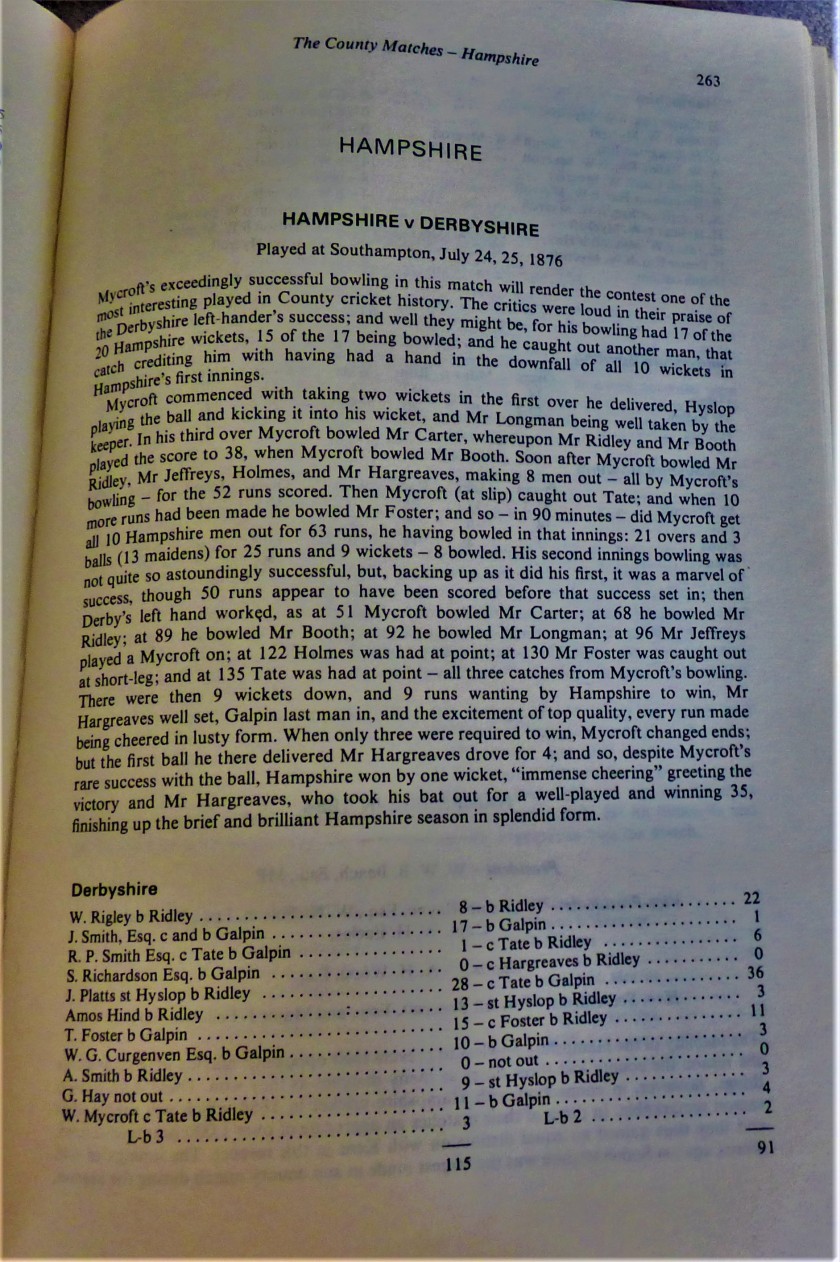
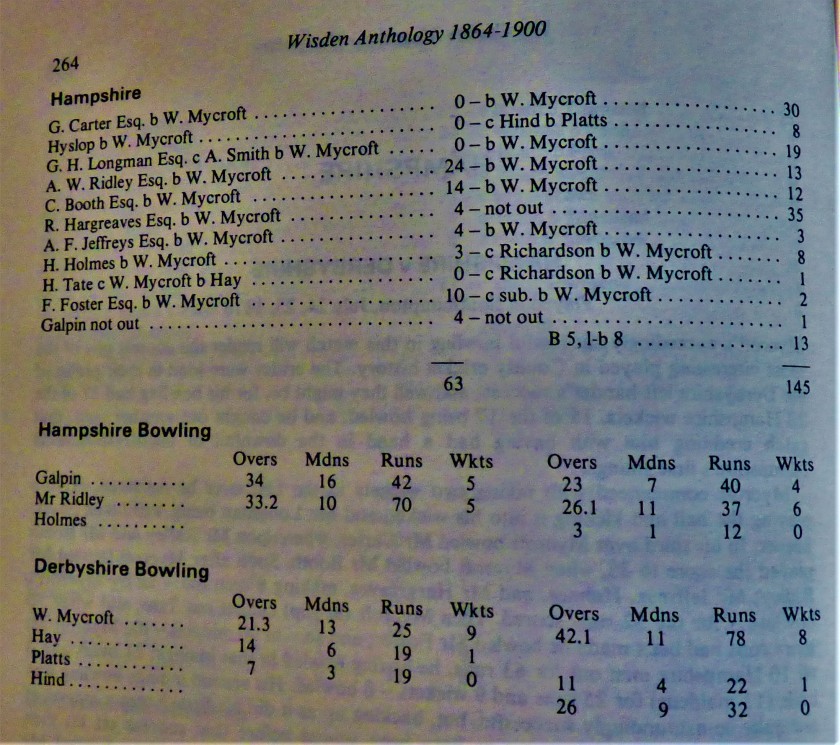
HAMPSHIRE V DERBYSHIRE 1876 – EVERYTHING BUT A MATCHWINNER

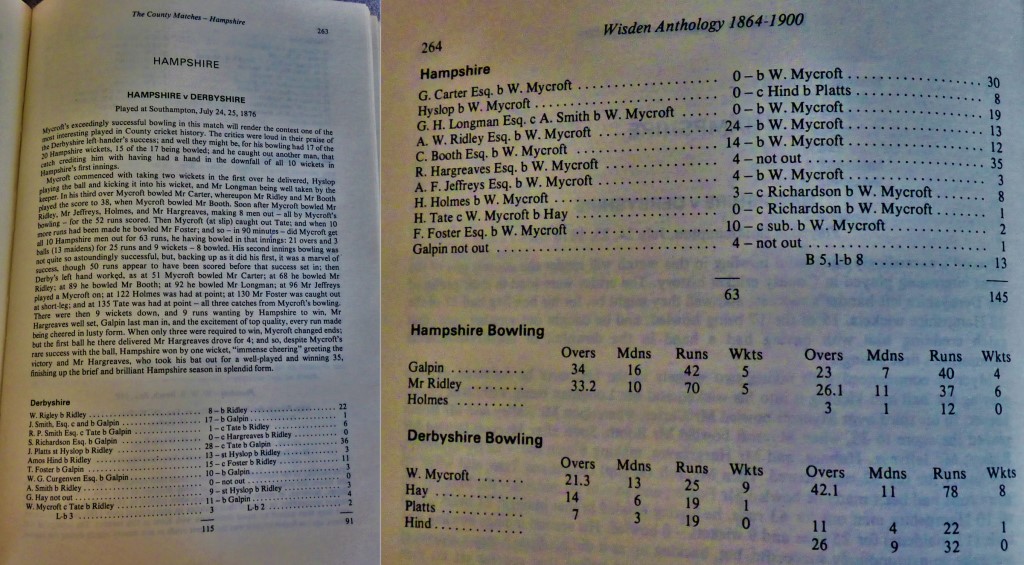
This match, chapter two in Patrick Murphy’s “Fifty Incredible Cricket Matches”, my copy of which has not survived the ravages of time, but of which I have reasonably clear memories stands out as one the game’s great hard luck stories. William Mycroft captured 17 wickets with his own bowling, held a catch and took part in the biggest stand of the Derbyshire first innings. Yet at the end, Hampshire, courtesy of one Reginald Hargreaves (35 not out at the death) sneaked home by one wicket. Few can have so dominated a match that their team ended up losing. In those days there was a mechanism referred to as ‘switching ends’, by which a bowler was allowed by two consecutive overs on occasion (but never three), which explains why Mycroft bowled so many overs, as shown in the report and scorecard from the relevant pages of my “Wisden Cricket Anthology: 1864-1900”) appended in photographic form.

1876 (1)1876 (2)

A brief footnote: Hargreaves, the batting hero (or villain), also has a curious literary connection – he married Alice Pleasance Liddell, otherwise known as the Alice of “Alice in Wonderland” and “Alice Through The Looking Glass”.

OMISSIONS

Starting with those of fairly recent times, fast bowler Devon Malcolm (who later appeared for Leicestershire and Northamptonshire) was unlucky to miss out, given that he has a test match nine for to his credit. Fast medium bowler and useful lower order batter Dominic Cork might be considered unlucky, but Morton was a more complete player. Off spinning “all rounder” Geoff Miller, a contemporary of Bob Taylor’s, was actually not good enough in either department to merit a place (although he later did a good job as national selector). Mike Hendrick, a high class operator on the quick side of medium was overly worried about being hit and therefore tended no to pitch the ball up enough to get the wickets he should have done – he never managed a test five-for, which his best known England captain, Brearley, attributed to this failing (in “The Art of Captaincy” and his various Ashes accounts). There was an absolute stack of pace bowlers who had good records – Arnold Warren, George Pope, Bill Copson and Cliff Gladwin being the four most obvious. Danish express Ole Mortensen might also be thought unlucky in certain circles. Leg spinner Garnet Lee came close, but Mitchell was definitely superior. As far as I am aware, although I am open to correction, Derbyshire have never had a high class left arm spinner. Billy and Harry Storer both had solid records for the county, and but for Taylor’s achievements in that department Billy could have been nominated for the keeping role. Peter Bowler was a useful but dull batter (he later played for Somerset), and a candidate along with Kent specialist fast bowler Arthur Fielder for the “Oxymoron XI” if I can find nine others who did not do what their name suggests, however the fact that he topped 150 three times in a single season is not quite enough to warrant inclusion.

In view of the selection of Ollivierre I opted to eschew an official overseas player. Had I named one the honour would have gone to Michael Holding, aka “Whispering Death”, who would have replaced Les Jackson, and batted at no 8 above Billy Bestwick. Eddie Barlow was a tough all-rounder who many would have considered for the overseas player role, and the captaincy.

Performing this exercise with Derbyshire as the subject has been tough for the reverse of the usual reasons. The general problem one encounters when doing this is just where the truest gold is located in amongst a positive embarrassment of riches, but with the signal exception of pace bowling options the problem here is the reverse one of actually finding anyone good enough.

PHOTOGRAPHS

Our look at Derbyshire is complete, and all that is left is my usual sign off…

P1310616 (2)P1310617 (2)P1310618 (2)P1310619 (2)P1310620 (2)P1310621 (2)P1310622 (2)P1310623 (2)P1310624 (2)P1310625 (2)P1310626 (2)

P1310628 (2)
Full moon pics from last night
P1310629 (2)
Edited…
P1310629 (3)
..and then edited again.

P1310631 (2)

P1310632 (2)
I spotted this jay just too late.

P1310634 (2)P1310636 (2)P1310637 (2)P1310638 (2)P1310639 (2)P1310641 (2)P1310641 (3)P1310642 (2)P1310646 (2)P1310647 (2)

P1310650 (2)
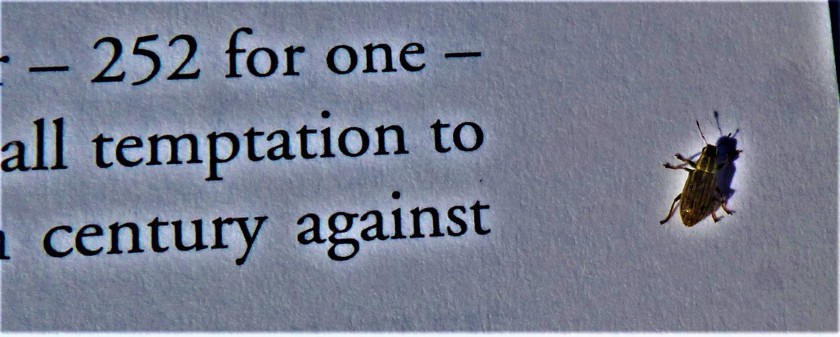
A bug crawling on my right hand (very close zoom)
P1310651 (2)
The text here is footnote sized (In Jardine’s account of the 1932-3 “In Quest of the Ashes”.

P1310652 (2)P1310653 (2)P1310654 (2)P1310655 (2)P1310656 (2)P1310657 (2)

P1310658 (2)
The bug is on the left of this shot, with the bottom part of an old fashioned pub beer mug on the right (it contained water, ftr).

P1310660 (2)

P1310661 (2)
still only one bud on the fuchsia.

All Time XIs – Sussex

The latest in my series of All Time XIs, this time featuring Sussex. Also includes a couple of bonus links.

INTRODUCTION

Welcome to the latest post in my “All Time XIs” series. This post has been more fraught with difficulties than most in this series because Sussex, today’s subject, have a very long but not particularly glorious cricketing history.

SUSSEX ALL TIME XI

  1. Charles Burgess Fry – an extraordinary character, in many ways the UK’s nearest equivalent to Leonardo Da Vinci. In public examinations he outdid two of the leading scholars of his day, F E Smith (later Lord Birkenhead) and John Simon who later got to put a Sir in front of his name. He represented his University (Oxford) in Athletics, Football and Rugby as well as cricket (and for 18 months, a period that has been massively exaggerated in some accounts, he was joint holder of the world long jump record). He played football as well as cricket at full international level, and had he learned in time that the 1896 Olympic was happening would probably have been a medallist there, while only an injury prevented him from making history by becoming a triple international (rugby, as well as football and cricket). He ran a training ship (The Mercury) at Hamble. He stood for election three times but was unsuccessful at that. He was even considered as a potential candidate for the throne of Albania! In amongst these and other varied activities he played enough first class cricket (including a stint at Hampshire) to amass over 30,000 runs at an average of 50, including 94 centuries. In 1912, when both South Africa and Australia visited for the Triangular Tournament (a rain ruined disaster) he captained England and emerged from his six game tenure with four wins and two draws. He once scored six successive first class centuries, a performance equalled by Bradman but unsurpassed. Iain Wilton is the author of a definitive biography of him, simply titled “C B Fry”, which I recommend.
  2. John Langridge – over 30,000 first class runs including 76 centuries and precisely zero international recognition. He shared an opening partnership with Ted Bowley worth 490 against Middlesex, Sussex’s record stand for any wicket and one beaten in English cricket only by two Yorkshire pairs, Brown and Tunnicliffe who put on 554 against Derbyshire in 1898, and Sutcliffe and Holmes who beat that stand by one run in 1932 against Essex.
  3. Ted Dexter – an attacking right handed batter, a fine fielder and a useful bowler of above medium pace. In 1962-3 he captained England in Australia and in the five test matches scored 481 runs at 48.10. Dexter, like Freddie Brown who I mentioned in passing yesterday, has a place in the ‘Exotic Birthplaces XI’ although Milan, Italy does not quite match Lima, Peru.
  4. Kumar Shri Ranjitsinhji – a right handed batter who pioneered the leg glance, averaged 56 in his long and distinguished first class career and had a fine if brief test career. His two centuries at that level, 154 not out on his debut at Old Trafford (a match I wrote about in my Warwickshire piece in connection with Dick Lilley) and 175 in the first match of the 1897-8 Ashes show that he could make big hundreds. During his Cambridge days he achieved at Parker’s Piece, the green space that used to be considered the demarcation between ‘town’ and ‘gown’, the rare feat of three individual centuries on the same day, in three different matches that were taking place there.
  5. Kumar Shri Duleepsinhji – nephew of ‘Ranji’, and possibly an even better batter. His career was cut short by health problems, but he scored 989 test runs at an average of 58, including 173 on debut against Australia at Lord’s (a match Australia won by seven wickets in spite of England tallying 800 in their two innings). For Sussex he once scored 333 in less than a full day’s play, which stood as a county record until Murray Goodwin who subsequently alo played for Glamorgan surpassed it in 2003.
  6. +Matthew Prior – a fast scoring middle order batter and a fine wicket keeper. In 2010-11 his keeping and ability to score middle order runs when needed played a major role in England’s first Ashes triumph down under since the 1986-7 series.
  7. *Tony Greig – a genuine all rounder, an attacking middle order batter, two kinds of bowler (medium-fast or off spin according to conditions – he once took 13 wickets in a test match in Trinidad using the latter method) and a great fielder. Controversial because of his tendency to make ill-advised comments (e.g. “I intend to make them grovel” in the run up to the visit of the 1976 West Indies, who were provoked by the fury they felt at this to new heights of brutal destructiveness) and his activities as a recruting agent for Packer while still official England captain, but his record speaks for himself, and as Greig the commentator might have said of Greig the player “he could certainly come to the party”.
  8. James Langridge – brother of John, a slow-left arm bowler good enough to take seven wickets in an innings on test debut (which came late due to him being overshadowed by Hedley Verity) and a useful middle order batter, who often had to play the sheet anchor role in the weak Sussex sides of his time.
  9. Maurice Tate – More first class wickets than any other Sussex bowler – 2,784 of them, and a useful middle order batter as well. His official bowling designation of ‘right arm fast medium’ tells only part of the story – on all surfaces and in all types of conditions he could get significant lateral movement (both Woolley in “King of Games”, see my Kent piece, and Monty Noble in “Gilligan’s Men”, his account of the 1924-5 Ashes tour state that Tate never spun the ball at all, so trusting the judgement of these two writers who had both been top class all rounders before taking up the pen I will assume that he achieved his movement either by means of swing or cut), including 38 wickets in the 1924-5 Ashes.
  10. John Wisden – right arm fast bowler, also good enough with the bat to make two centuries in major matches during his career. He is the eponym and original creator of the Wisden Cricketeter’s Almanack, also known as “The Cricket Bible”. His greatest bowling achievement was to take all 10 wickets in an innings, all clean bowled.
  11. John Snow – right arm fast bowler. Between the retirement of Trueman and the emergence of the 2005 Ashes winning attack probably only Bob Willis and Devon Malcolm on his good days among English bowlers bowled as quick as Snow. In the 1970-1 Ashes, when England reclaimed the little urn after 12 years, Snow joined Larwood (Nottinghamshire) and Tyson (Northamptonshire) as an England quick who could claim to have blitzed the Aussies in their own backyard. I am relying with this selection on skipper Greig to be able to administer a metaphorical kick to the Snow backside when needed, as Snow was a somewhat temperamental character. Snow could be a bit of a practical joker: once at Leicester he bowled a bouncer with a soap cricket ball purchased at the local Woolworths, the batter, Peter Marner, hooked fiercely and the ball shattered into fragments. The scorer put an asterisk next to the dot and at the bottom of the page recorded, dead pan, “ball exploded”. On another occasion, Snow, desirous of spinning things out a bit and knowing the character of the bowler’s end umpire, deposited a pocketful of cake crumbs at the end of his run up, whereupon “birds swooped, Bird (the umpire) panicked, Snow smiled.”

This team comprises a high calibre top five, a good no six who was also a fine wicket keeper, two genuine all-rounders at seven and eight  and three guys picked predominantly as bowlers. The bowling, with two purveyors of outright pace, Tate’s swing and cut, two genuine spin options in James Langridge and Greig and two medium-fast options in Greig in his other style and Dexter also looks strong and varied, missing only a leg spin option for completeness.

HISTORICAL FOOTNOTE ON THE FIRST GREAT BOWLING PARTNERSHIP

In the 1820s and 30s Sussex had the first documented example of a genuine bowling partnership, William Lillywhite and James Broadbridge, whose exploits made Sussex a force capable of taking on and beating the rest of England, a position they have never since occupied (nb if you think this is taking things a long way back, Philippe-Henri Edmonds begins his “100 Greatest Bowlers” with David Harris, star of Hambledon in the 1770s and 1780s, while the first known match to have taken place between teams using county names was between Kent and Surrey in 1708, there are verifiable references to cricket from the late 16th century, and some claim references from even earlier than that). I gave serious consideration to including this pairing in my all-time Sussex XI, but decided that the documented test match successes of Snow and the historical significance of Wisden just had the edge, with the latter being a nod to the old guard as well). The fact that one of this duo was a Lillywhite leads on to…

CRICKETING FAMILIES

You will have noted that my XI included an uncle and nephew pairing and a pair of brothers. Sussex has a more extensive history of family involvement in cricket than anywhere else I can think of. The first of Sussex’s cricketing families were the Lillywhites, who as well as William produced among others John, and James who led the 1876-77 tour party to Australia that inaugurated test cricket. The ruling family of Nawanagar have already been covered by the inclusion of two of them in the XI, as have the Langridges. Maurice Tate was the son of Fred Tate, a Sussex stalwart in his day and a one cap wonder for his country. Tate Sr’s sole test experience, at Old Trafford in 1902 was eminently forgettable – he got to play because of a spat between chairman of selectors Lord Hawke (Yorkshire) and skipper MacLaren (Lancashire), and was involved in two very unfortunate incidents in that match. First, in the second Aussie innings, Fred Tate, who normally fielded close to the bat, found himself at deep square leg because MacLaren would not countenance making the gentleman amateur Lionel Palairet (Somerset) move all the way from deep square leg to the right hander to deep square leg for the left hander. The left hander Joe Darling sent a skier in that direction which had it been held would have made Australia 16-4, but it went to ground, and Darling went on to 37, and Australia, who would not even have topped 50 without the reprieve, scraped up 86 setting England 124 to win. Then, England suffered a major attack of nerves in the chase, and Fred Tate found himself walking in to bat at 116-9, eight still needed to win. He snicked a four to halve the requirement, but then Jack Saunders produced his quicker ball (there were suspicions about his action when he bowled that one – such are nothing new under the sun), which also kept fiendishly low, and all poor Fred Tate ever knew of it was the death rattle as it clattered into the timber behind him to give Australia victory by three runs. Afterwards someone tried to console him and he said “I’ve got a little lad at home who’ll make the Aussies pay for this”. The boy was of course Maurice Tate, and 24 years later he was a key part of England’s first post World War 1 Ashes winning combination.

Among other Sussex family combinations were Albert and Bob Relf, brothers who were both considered all rounders of differing types. Albert had a curious tour of South Africa in which he scored 404 runs at 25.25 and took 16 wickets at 25.25 – he conceded precisely as many runs as he scored and took the same number of wickets as he suffered dismissals. Bob Relf was once sent in as nightwatchman with no prior notice by his captain CB Fry and is alleged to have said to Joe Vine who he joined at the wicket “right, let’s keep the old B__ waiting all today tomorrow as well”. The two of them stayed together until after 5PM the following day, before Vine was out, with Relf on about 130. Fry finally got his innings and found himself in the shadow of Relf who was by now thoroughly enjoying himself, and ultimately finished the innings on 210 not out. George Cox Sr and George Cox Jr between them spanned 66 years (Sr made his debut in 1895, Jr played his last first class game in 1961), the latter once scoring 234 v India in a tour match. In more recent times there have been the Wellses, of whom Colin, Alan and Luke have all played first class cricket, with Alan experiencing test cricket, although not much of it – his test batting career lasted one ball. Finally, there is the commentator-player link of Christopher and Robin Martin-Jenkins (whose middle order batting and right arm medium-fast were not sufficiently potent to merit serious consideration), father and son.

OMISSIONS

Other than Bowley and Vine who have already been mentioned in passing Roger Prideaux and David Smith (who attended Battersea Grammar, one of the forerunners of my own secondary school, Graveney) also had respectable records. Bill Athey, who made Sussex his third home after spells at Yorkshire and Gloucestershire was good without ever approaching greatness. Chris Adams, Paul Parker, Neil Lenham and Martin Speight all had decent records in the middle order without seriously challenging my chosen nos 3,4 and 5. Billy Griffith, Tim Ambrose and Michael Burgess all had or have good records as wicket keepers, with the first two having received England recognition, and the third possibly in the frame (although the England selectors have still not got the message, clear to everyone else, that Jos Buttler is not, repeat not, a test cricketer or even a particularly good wicket keeper, and Ben Foakes, Ben Cox of Worcestershire and Oliver Graham Robinson of Kent would all probably be ahead of Burgess in the queue). Among the home grown bowlers not making the cut were Jason Lewry, a left arm paceman who had been a yard or two quicker than he actually was would have given me pause at the very least, Ed Giddins and James Kirtley who both did gain England recognition, Ian Thomson, who once took a first class all-ten but was basically a workaday medium pacer, and also Ian Salisbury, a leg spinner who could bowl good ‘uns, but also bowled far too many bad ‘uns to warrant serious consideration. Also of course there is the old (in two ways) record breaker James Southerton who used to regularly turn out for both Surrey and Sussex before qualification rules were tightened and who was one of the combatants in the inaugural test match, becoming at 49 the oldest ever test debutant, which record he is likely to hold for ever more.

Of the overseas players I might have considered, Murray Goodwin was ruled out on my usual ‘go for a bowler’ grounds, while neither Imran Khan nor Garth Le Roux had sufficiently imposing records to warrant excluding any of my chosen XI, though at a pinch Imran might have got in in place of John Snow. The foreign omission I felt most keenly was Mushtaq Ahmed, the leg spinner who played such a key role in Sussex’s first ever County Championship win.

If you are going to suggest changes, which you are very welcome to do, please consider the balance of the side, and who you would displace for your chosen ones.

LINKS AND PHOTOGRAPHS

Yes, our excursion along the highways and byways of Sussex cricket has reached its end, but before my usual sign off I have a couple of things to share. Firstly, a piece by Richard Murphy of Tax Research UK titled “The FT says its time for the Bank of England to start direct funding of the government: modern monetary theory has won the day.

Second, Ritu Bhathal who has an author website and also blogs at But I Smile Anyway has a novel titled “Marriage Unarranged” out, and she has recently done a very entertaining interview with Rebecca at The Book Babe – please do take a look.

Finally, it is time for my usual sign off…
P1310605 (2)
This cat was in a very typical feline pose on the patch of grass outside my bungalow yesterday, but any hope it might have had of finding prey was thwarted – the only other creatures outside with it were a couple of mallard drakes – somewhat too substantial for a cat of this size to have a go at!

P1310606 (2)

P1310607 (2)
A full moon last night, and the sky was clear enough to see it. Trying to do the sight justice is a challenge, but I hope that some these pictures come close.

P1310608 (2)P1310608 (3)P1310609 (2)P1310610 (2)P1310611 (2)P1310611 (3)P1310611 (4)

P1310612 (2)
An unobtrusive little bird that I spotted early this morning.

P1310614 (2)


All Time XIs – Northamptonshire

Continuing my ‘all time XIs’ series with a look at Northamptonshire.

INTRODUCTION

Welcome to the latest post in my series of All Time XIs. Today we look at Northamptonshire. This post features two more players who will be in the ‘what might have been?’ XI  (see my Somerset post for more) when I create it, and two more who had I not decided that what they actually did was sufficient to get them into this XI might have been eligible.

NORTHAMPTONSHIRE ALL TIME XI

  1. Fred Bakewell – his career was ended early by a car crash, but he had still done enough to prove his greatness. The eight test matches he managed to play before his career ending crash yielded him a batting average of 45, including a ton against Australia.
  2. Colin Milburn – an attacking opener, who like Bakewell suffered a career ending car crash (in his case he lost an eye). Also like Bakewell he had already achieved enough to prove his greatness. His county captain Keith Andrew, worried about his alcohol consumption, once suggested that he drink halves instead of pints. Not long after this they were in the bar and Andrew asked Milburn what he wanted, and the opener unerringly responded “two halves please skipper”.
  3. David Steele – brother of John, who features in my Leicestershire post, an adhesive right handed batter and sometimes useful as a slow left arm bowler. Tony Greig as England captain wanted someone difficult to dislodge to be brought into the team which had just lost the opening test match of the 1975 series by an innings and 85 runs, costing Mike Denness the captaincy, and Steele’s was the name that kept recurring when he asked about this. Greig, thus fortified insisted on Steele being selected and the then 33 year old and already white haired batter responded with 365 runs in six innings – 50 and 45 on debut at Lord’s, 73 and 92 at Headingley and 39 and 66 at The Oval, and England had the better of draws in the first two of those matches and saved the third as well. His performances so captured the public imagination that he was named as 1975 BBC Sports Personality of the Year, only the second time that honour had gone the way of a cricketer, after Jim Laker (see my Surrey post) in 1956. Since Steele’s year three further cricketers have received the honour – Ian Botham (Somerset, 1981), Andrew Flintoff (Lancashire, 2005) and Ben Stokes in 2019. In the 1976 series against the West Indies he scored his one and only test century, but was dropped for the tour of India because people did not believe he would be able to handle their spinners. By the start of the 1977 season Greig’ s name was mud because of his association with Kerry Packer and Steele was never recalled, but his eight test matches yielded him an average of 42.06 without any not outs to boost the figure.
  4. Raman Subba Row – moving north from Surrey he flourished at Northants, becoming the first batter ever to score 300 in an innings for the county, and representing England with distinction before retiring at the age of only 29.
  5. Dennis Brookes – he came south from Yorkshire as a 17 year old and did not take long to convince the county of his merits. As so often with people who play for unfashionable counties he was badly treated by the England selectors, being a one cap wonder at that level.
  6. *Sydney Smith – a West Indian all-rounder who batted in the middle order and bowled left arm spin. He qualified for the county in 1909, only four years after they had gained first class status, and fell just 45 wickets short of the career double of 10,000 runs and 1,000 wickets. He averaged 31 with the bat and 18 with the ball. I have also chosen to award him the captaincy.
  7. Vallance Jupp – moving north from Sussex, once he had served out his residential qualifying period he achieved a period of sustained all round success matched in the game’s history only by George Hirst of Yorkshire, doing the season’s double of 1,000 runs and 100 wickets eight times in a row (Hirst’s great run extended to 10 seasons in a row, while the other ‘Kirkheaton twin’, Rhodes, twice achieved the feat seven successive times at different stages of his extraordinary career). He gained just eight test caps, and his averages at that level were the wrong way round, 17 with the bat and 22 with the ball, but in first class cricket he averaged 29 with the bat and 23 with the ball.
  8. George Thompson – one of two all rounders (Bill East being the other) who was largely responsible for Northamptonshire gaining first class status in 1905. However, while East was never more than a solid county pro (a status which in itself put him streets ahead of most of his team mates), Thompson, who bowled right arm fast medium, became his county’s first ever England player. On the 1909-10 tour of South Africa when only Hobbs (series average 67) really mastered the combination of matting pitches and googly bowlers, Thompson was third in the batting averages with 33 per time, a fraction of a run an innings below Rhodes. In his six test matches he averaged 30 with the bat and 27 with the ball, while his first class figures were 22.10 with the bat and 18.89 with the ball.
  9. +Keith Andrew – the presence of the three all-rounders above (and yes, all three merit that term, even for one who in general uses it as sparingly as I do) enables me to have no qualms about selecting the best wicket keeper, and Andrew, who at one time combined the captaincy with his keeping duties was that. Due to the fact that his career overlapped with the likes of Godfrey Evans (Kent), John Murray (Middlesex) and Sussex’s Jim Parks whose batting put him into the frame he was only twice selected for his country, but his 388 domestic appearances yielded 722 catches and 181 stumpings.
  10. Frank Tyson – a right arm fast bowler, who,  like Larwood (Nottinghamshire) he managed to blitz the Aussies in their own backyard. He moved south from his native Lancashire, was picked by Hutton for the 1954-5 Ashes more or less as a bolt from the blue – at a press conference before the series commenced Hutton said “no we haven’t got mooch boolin’ – there’s a chap called Tyson but you won’t ‘ave heard of him because he’s ‘ardly played”. Tyson played huge roles in the winning of the second, third and fourth tests of that series. How quick was he? Well, Geoffrey Boycott once asked Richie Benaud what Tyson did with the ball, and Benaud said “didn’t need to do anything, Geoffrey”, Boycott double took with “That quick?” and Richie confirmed “That quick.”. Trevor Bailey (Essex) who played in that series as an all-rounder reckoned that the step up in pace from his fast medium to Statham (genuinely fast), was the same as the step up from Statham to Tyson. Finally, John Woodcock who covered cricket for The Times when it was a real newspaper as opposed to the Murdoch rag it has become, saw Tyson at his fastest in 1954-5 and Patrick Patterson’s famously fast spell at Sabina Park in 1986. Woodcock reckoned that the two spells he saw 31 years apart were equally quick with the difference that Tyson pitched it up as regularly as Patterson banged it in short.
  11. Nobby Clark – left arm fast bowler. In the 1930s he was probably the next quickest thing to Larwood. He only got to play eight test matches and his bowling average at that level was 28 per wicket, but his 1,208 first class wickets at 21.49 each tell a different tale from his sporadic England appearances.

This team has an excellent top five, three genuine all rounders, a superb keeper and two of the fastest bowlers you could wish to see. The bowling attack, with Clark and Tyson a ferocious new ball proposition, Thompson a high class fast medium, front line spinners (of different types) Smith and Jupp and Steele as a back up option looks both strong and well varied (there is no leg spinner, but that is the only major bowling type not represented). A regular theme of these exercises has been giving my putative captains the opportunity not just to change the bowler, but to change the bowling. Being English and starting to follow cricket when I did has meant that I have witnessed far too many bowling ‘attacks’ that consist either mainly or worse still wholly of right arm fast medium practitioners for my liking, and this is reflected in my own selection policy.

TWO BIG FAIRLY RECENT OMISSIONS

Much as I respect Monty Panesar, Sydney Smith’s irrefutable case for inclusion as all-rounder meant that there could not be room for someone who could offer nothing other than left arm spin. Allan Lamb, an attacking middle order bat whose test career began superbly before falling away, was another who I enjoyed watching but could not fit in.

FOR THE ‘WHAT MIGHT HAVE BEEN XI’

I was listening to a test match (not a great one, this moment is all I remember from it!) when I heard the tones of Christopher Martin-Jenkins announcing a potentially important moment in the history of English cricket. A 17 year old had just scored 210 on debut for Northamptonshire. His name was David Sales, and it seemed certain that this performance would get him fast tracked into the England set up. Unfortunately, I failed to allow for the conservatism of those in high places in English cricket. David Sales not only did not get fast tracked, he was destined never to play for his country, and although he enjoyed some good moments at county level, including scoring a triple century and a 276 not out he has to settle for a place in the ‘what might have been XI’. The highest score made by a first class debutant is 240 by Eric Marx, whose career never really developed. Sam Loxton, scorer of 232 in his debut innings, did go on to represent Australia with some distinction. Saddest of all the tall scoring debut stories is that of Norman Callaway, who played one Sheffield Shield match in the 1914-15 season, scored 207 in his only innings and then went off to fight in World War One where he was among the many killed in action. In one of those parallel universes that physicists talk about will be a David Sales who got fast tracked into the England set up and became a stalwart of his country’s middle order.

My other ‘what might have beener’ with a Northants connection is Jason Brown, an off spinner who was named in the 2001 touring party to Sri Lanka, got picked for only one warm up game on that trip and then returned to county cricket never to be heard from again.

HONOURABLE MENTIONS

Among the top order batters who I could not find places for were Wayne Larkins, Geoff Cook and Alan Fordham who all had fine records. Charles Pool, Russell Warren and Riki Wessels (now on his third county, Worcestershire, after a spell at Nottinghamshire) were all good middle order players, and the last two named might have attracted the attention of someone who wanted a batter/keeper rather than a top class gloveman. David Ripley was a fine keeper and useful lower middle order bat who was unlucky never to gain England recognition. The Willeys, Peter and David missed out for different reasons, Peter because his batting record is not quite weighty enough to warrant selection on his own, and his off spin was not a front line option, and David because his red ball record, always my chief concern, is not good enough. Freddie Brown, an attacking middle order bat and leg spin bowler, did not have the weight of achievement to merit inclusion, his captaincy of the 1950-1 Ashes party coming only after two others had declined and because the obsession with amateur skippers had not yet died, though it was on life support by then (he will feature in the ‘exotic birthplaces’ XI, since Lima, Peru is pretty hard to top in that regard). Harry Kelleher, a fast bowler of the 1950s, did not have the kind of consistent success to merit serious consideration, although he once rattled the Aussies in a tour match by firing out three of their top four with the new ball. Paul Taylor bowled his variety of left arm pace well enough to play for England briefly, but at that level he never looked remotely good enough.

Finally we come to the overseas players. My usual preference for the nominee being a bowler ruled out two quality Aussies, ‘Buck‘ Rogers and ‘Mr Cricket’ himself, aka Mike Hussey. Bishan Singh Bedi was a classical slow left arm bowler but did not also offer runs as Smith did. Anil Kumble would have given me a leg spin option, but would also have lengthened the tail, since to fit him in I would have had to pick Panesar instead of Smith. George Tribe, an Aussie who specialized in left arm wrist spin was also a possible, but offered less batting wise than Smith. Finally, Curtly Ambrose was a magnificent cricketer, but again there was no way to accommodate him without altering the balance of the side. I could have argued that as someone whose native land did not yet play test cricket Smith does not really count as an overseas player and allowed myself one of the above as well, but decided that one overseas player means one overseas player.

As with Leicestershire who I covered yesterday Northamptonshire is also associated with a top quality commentator, in this case Alison Mitchell.

Northamptonshire only became a first class county in 1905, have never been County Champions, though they were second in 1912 and have spent far more of their history near the wrong end of things than near the top. In 1907 they were bowled out for 12 by Gloucestershire (Dennett 8-9, Jessop 2-3) and reduced to 40-7 in their second innings (Dennett 7-12) before rain intervened to save them. In 1908 against Yorkshire they were put out for 27 and 15, to lose by an innings and 326 runs (although on that occasion George Thompson was injured and unable to bat, whereas when Border were dismissed for 16 and 18 by Natal they had a full complement of 11 batting for them). They were winless in all of 1935, 1936, 1937 and 1938 and won only once in 1939. However, if you believe I have missed someone do feel free to comment.

PHOTOGRAPHS

It is now time for my usual sign off…

P1310590 (2)
Seven shots of the moon in a late evening sky edited in various ways….

P1310591 (2)P1310592 (2)P1310593 (2)P1310595 (2)P1310596 (2)P1310597 (2)P1310600 (2)P1310601 (2)P1310602 (2)

P1310603 (2)
The fuchsia in my gardne…
P1310604 (2)
…with thus far one bud.

All Time XIs – Leicestershire

Continuing my ‘all-time XIs’ series with Leicestershire, including a little challenge – can you find a more economical player to player linked chain that spans the whole of test cricket’s 143 year history than the one I have included while covering George Geary?

INTRODUCTION

Welcome to the latest installment in my series of “All Time XIs”. Today we will look at Leicestershire. However, before getting into the main body of today’s post I have a small additional thing to do…

INTRODUCING MY MOTHER’S BLOG

Yes, my mother has started blogging. Her first post, about the camellias that grow near her home in Cornwall can be viewed here – and I urge to you do so, and to offer her comments and support.

LEICESTERSHIRE ALL TIME XI

  1. Cecil John Burditt Wood – an opener who had limited support from the rest of his batting order. He holds two batting records to this day: most times anyone has carried their bat through a completed first class innings (17 – two ahead of joint second place WG Grace of Gloucestershire and Dick Barlow of Lancashire), and the unique double feat of carrying his bat for centuries in both innings of a match, which he did against Yorkshire – 117 not out in the first dig and 107 not out in the second, and his team still lost by nine wickets. At the end of that match George Hirst paid him a Yorkshire tribute – “next time master Wood, we’ll get a gun and shoot you out”.
  2. Les Berry – another opener who could never count on much support from lower down the order (Leicestershire have not historically been a strong county, and they are not currently bucking that trend).
  3. John Steele – a solid right handed batter and capable purveyor of left arm spin.
  4. David Gower – a left handed batter of the type for whom words such as elegant and graceful were invented. Unlike those above him in this order he did get the chance to prove himself at the very highest level, and 8,231 test runs at 44.25 is an eminently respectable record. His greatest series was the 1985 Ashes when he scored 732 runs, including scores of 166 at Trent Bridge, 215 at Edgbaston and 157 at The Oval. Five years after that he scored another 157 at The Oval to save a match against India. Another notable effort was his 154 not out in eight hours to save the 1981 test match at Sabina Park, Jamaica (England would lose their next ten test matches against the West Indies). A combination of narrow-mindedness, inflexibility and possibly (on the part of then captain Graham Gooch – see my Essex piece) envy from the England setup brought his international career to a premature close, which led to his retirement from the first class game. Immediately after his final departure England had an unqualified disastrous tour of the subcontinent. Gower, who had scored 200 not out against India at Edgbaston in 1979, could scarcely have fared worse than most of the England batters who were selected. In addition to his batting Gower was, until a shoulder condition affected him, a superb fielder.
  5. James Whitaker – a heavy scoring batter in his day (he was a county team mate of Gower for some years) who only got one England cap – England selection practices in the 1980s and 1990s were inconsistent at best and downright scandalous at worst, and the teams that emerged as a result of such practices tended to have very ordinary records as one might expect. Whitaker eventually became part of the 21st century England management structure and did well as a national selector. Although not completely eradicated, England selections in the 21st century have featured many fewer “WTF? moments” than used to be the case in the 1980s and 1990s, when they were almost the rule rather than the exception.
  6. *Ewart Astill – an offspinning all-rounder who did the season double of 1,000 runs and 100 wickets eight times in the course of the 1920s. Although he never got to perform the role due to the class based obsession with amateur skippers that prevailed in his day I have named in captain as I believe that he would have been good at the job.
  7. +Paul Nixon – an excellent wicket keeper over many years, and a useful batter as well.
  8. George Geary – a right arm medium-fast bowler who could bowl a good leg cutter, possessed immense reserves of stamina (in one test innings at Melbourne on the 1928-9 Ashes tour he had figures of 5-105 from 81 overs – yes you read that right, 81 overs in a single innings) and was also a useful lower order batter and a capable fielder. His CV includes two Ashes winning moments – at the Oval in 1926 he clean bowled Arthur Mailey to win the match and the Ashes, and at Melbourne in 1929 he smote a four through mid on the get England to their victory target of 332, which won them that match and out them invincibly 3-0 up in the series. Also, he features in what I believe (though feel free to comment if you reckon you can outdo me on this one) to be the most economical player to player chain spanning the whole of test cricket’s 143 year history. My rules are these: everyone in the chain must have played test cricket, and there must be a verifiable link between any two successive members of the chain. My chain runs as follows: Billy Midwinter who played for Australia in the inaugural test match in 1877 was also a county team mate of WG Grace who played for England in the first test match on English soil in 1880, WG in his last test match was a team mate of Wilfred Rhodes, who in 1926 was a team mate of George Geary, who in retirement coached at Charterhouse where one of his charges was Peter May (Surrey), who after his own distinguished career was done became a selector and was chair of the panel that picked Chris Broad (Nottinghamshire), whose son Stuart is now an England regular, making Stuart Broad, the current player, the seventh link in the chain. There are several other ways to link Grace to people who played in the inaugural test match, but no way to link Rhodes directly to any of them. Geary has the second cheapest ever first class ‘all ten’ to his name – 10-18 against Glamorgan, bettered only by Hedley Verity’s 10-10 for Yorkshire vs Nottinghamshire.
  9. David Millns – the last person to have worked at a coalface before becoming a professional cricketer, a right arm fast bowler, he was also a useful lower order bat (left handed). Injury problems meant that he never got to represent England. After his retirement he became an umpire and has done well at that job too. People who have been following this series will have already noted that I am sparing in my use of the term ‘all rounder’. This is because getting into following cricket when I did meant that with Ian Botham (Somerset) going into decline I witnessed a time when England were absolutely desperate for all rounders, and many people who were not good enough to warrant the label (in many cases inadequate in both departments) were touted as all rounders in an effort to fill the Beefy shaped hole in England’s ranks. In reaction against this I will only describe someone as an all-rounder if I genuinely believe that they would have warranted selection based on either part of their skill set. In this side in addition to Astill who was a genuine all rounder there are three players who have useful secondary skills that are not enough for them to be described as all rounders, at least in my book: John Steele, George Geary and Millns.
  10. Jack Walsh – an Australian left arm wrist spinner, and my overseas pick. He holds a several Leicestershire bowling records, and gives this side a bit of variety.
  11. Haydon Smith – a right arm fast bowler, who had some great moments in partnership with Geary, including a spell of consistent success in which they bowled together unchanged through four straight opposing innings none of which totalled as much as 80. On one occasion he let Harold Larwood have a bouncer, and when it was his turn to bat he had to face Larwood. Smith edged one of Larwood’s expresses into the slips where it was scooped up on the half volley. Smith instantly turned for the pavilion, and when the fielder tried to say that he had not caught it (a fine piece of honesty), Smith, who had a stutter, said “Yes you f-f-f-f-ucking well did” and continued his walk back to the pavilion – lesson learned about dishing out bouncers when you are genuine no 11 yourself methinks.

This team comprises a top three who are definitely capable of giving the innings a solid foundation, two high quality middle order batters, one left handed and one right handed, a genuine all rounder, a wicketkeeper who can bat, a medium-fast bowler who can bow a dangerous leg cutter, a left arm wrist spinner and two purveyors of out and out pace in Millns and Smith. With Geary and Millns both capable of providing useful batting support the order looks quite solid (which would be a bit of a novelty for Leicestershire!).

OMISSIONS

Maurice Hallam and Barry Dudleston were both fine opening batters, and when Darren Maddy’s career started I thought he was going to become an England regular, but he did not kick on. Willie Watson, Chris Balderstone, Sam Coe, Ben Smith, Clive Inman and Peter Marner all did good things for Leicestershire, although Inman and Marner were both told to go elsewhere by Ray Illingworth because he felt that with them around the team could not function as such. Illingworth himself could have had the role that I gave to Astill, but he was noted for under bowling himself as captain (Brearley mentions this in “The Art of Captaincy”) and does not strike me as having been quite so complete a player as Astill. The wicket keeping position was not contested in my book – although Roger Tolchard was named as reserve keeper in a few England tour parties that was largely a way a smuggling in an extra batter rather than a tribute to his keeping. Dick Pougher (pronounced ‘puffer’) was an early Leicestershire fast bowler who was part of the MCC bowling attack that routed an Australian XI for 18, the lowest score ever recorded by a team with that designation, while Jonathan Agnew, Les Taylor and Alan Mullally all got picked for England, but none were convincing at the highest level (although the first named of course has first dibs on a commentary gig, while the last named would have given extra variety as a left arm bowler). Harry Gurney, a left arm fast bowler who started with Leicestershire before decamping to Nottinghamshire, would have increased the variety of bowling available to this side, but though an England career seemed likely at one stage he is actually not quite in the front rank even of current performers. I have been restricting myself to one overseas player, and felt it important not to play fast and loose when dealing with a county in whose dressing room Afrikaans was once the first language. That meant that having chosen Walsh for the variety he provides I had to overlook one great and one high quality fast bowler, Andy Roberts and Winston Benjamin, and also one of the most talented batters ever to emerge from The Land of the Long White Cloud, Stewie Dempster (he did actually play briefly for his native land, so I felt that I could not regard him as a forerunner to Ben Stokes).

PHOTOGRAPHS

Yes, we have finished our look at Leicestershire, and it remains only for me to provide my usual sign off…

Test cricket chain
A jpg showing my player to player linked chain that covers the whole span of test history. Can you do better?

P1310562 (2)P1310564 (2)P1310567 (2)P1310569 (2)P1310570 (2)P1310571 (2)P1310573 (2)P1310575 (2)P1310576 (2)P1310577 (2)P1310578 (2)

P1310579 (2)
Today has been a warm and sunny day, and I took the opportunity of spending an hour or so in my garden (though I am tightly restricted at present due to my medical history I am one of the fortunate ones whose home, small though it is, comes with a private garden, which means that I can get outside when the weather allows).

P1310580 (2)P1310581 (2)P1310582 (2)P1310583 (2)P1310584 (2)P1310585 (2)P1310586 (2)P1310587 (2)P1310588 (2)P1310589 (2)

All Time XIs – Somerset

Continuing my all-time XIs series with a look at Somerset.

INTRODUCTION

Welcome to the latest installment in my “All Time XIs” series. Today we are looking at Somerset. In the course of our journey we will meet heroes of the past, stars of the present, a couple of hopes for the future and the man who when I get round to creating it will be captain of the “What Might Have Been XI”.

SOMERSET ALL TIME XI

  1. Marcus Trescothick – left handed opener who scored stacks of runs in his long and distinguished career. He was selected for England against the West Indies in 2000, showed masses of character in surviving an early onslaught from the veteran pacers Ambrose and Walsh, going on to score 66 on debut. That same winter facing the very different challenges posed by a dry pitch and some crafty spinners in Sri Lanka he made his maiden test hundred. Runs continued to flow against all opponents for some years. At Edgbaston in 2005 after England had been badly beaten in the opening match of that year’s Ashes series at Lord’s a display of controlled aggression brought him 90 on the opening day, after Ponting in spite of losing McGrath, the bowler most likely to cause such a decision to succeed, to injury on the morning of the game put England in. His England career was ended my mental health issues at the back end of 2006, but he returned to Somerset and went on scoring runs for them right up until the end of the 2019 season. He was also a fine slip fielder and bowled respectable medium pace.
  2. Harold Gimblett – the man who still holds the record for most career first class runs for Somerset, and the highest first class score by a Somerset native (310). On his debut against Essex, after being called up at the last moment, he scored 123 in 79 minutes, winning that season’s Lawrence Trophy for the fastest first class hundred of the season in the process. As with many others who plied their trade for a county who were generally on the fringes of things he received less international recognition than he deserved.
  3. Lionel Palairet – a stroke making batter of the late Victorian and Edwardian period. In the 1901 season he scored 100 runs in a morning session on five separate occasions. One of those was in a game against Yorkshire that tests credulity: On the first morning Somerset were rolled for 87, to which Yorkshire replied with 325, only for Somerset to score 630 in their second innings, nos 1,2 and 3 all scoring hundreds. Facing a victory target of 393 Yorkshire crumbled to 113 all out, and defeat by 279 runs, their only defeat of the season. He was picked twice for England, Old Trafford and The Oval in 1902, a pulsating three run defeat that settled the destination of that year’s Ashes and “Jessop’s Match” – see my Gloucestershire piece, an extraordinary one wicket victory.
  4. James Hildreth – a free and heavy scoring middle order batter who somehow completely escaped the notice of the England selectors during a distinguished career. He was used a fielding substitute during the 2005 Ashes, but never got closer than that to the test arena.
  5. Leonard Braund – at a time when Somerset had few reliable batters, and were not unknown to struggle to get 11 players together for their matches he was a very consistent run scorer, rated as one of the finest of all slip fielders and was a high quality leg spinner. Braund was one of the three centurions in the Somerset come-back mentioned in connection with Palairet (Frank Phillips was the third), and, mirabile dictu, the following season Yorkshire were again champions, again lost only one game and again it was Somerset who were their undoing. This triumph was very much down to Braund – he made the highest individual score of the game and captured 15 wickets in the two Yorkshire innings. In 1907 he found himself in a “good player were at t’other end” scenario, when Albert Trott comprehensively ruined his own benefit match by taking four wickets in four balls and then shortly afterwards ending such resistance as Somerset had offered by doing the hat trick – and poor Braund observed this carnage from 22 yards away, emerging with 28 not out.
  6. *Sammy Woods – born in Sydney but Somerset through and through. Captain through some very difficult times, and my choice for that role in this side. An attacking right handed bat and a right arm fast bowler.
  7. Ian Botham – all rounder, a third acknowledged expert in the art of slip fielding alongside Trescothick and Braund in this side. I have him in the position in the batting order from which he scored his two most iconic centuries – 149 not out at Headingley in 1981 to breathe life back into that year’s Ashes when it seemed that Australia were in charge (Bob Willis then took 8-43 to complete the turnaround – see my Warwickshire piece) and then a few weeks later, after he psyched out the Aussie lower order at Edgbaston (a spell of 5-1 in 28 balls, and the only wicket to go a really difficult ball was Ray Bright), with England looking to push home a first innings advantage at Old Trafford he settled the destination of the Ashes and the series by reaching his century off 86 balls, eventually finishing with 118 off 102. After 53 balls of that Old Trafford innings he was on 28 not out, meaning that his last 90 came off 48 balls.
  8. Dominic Bess – an offspinner and handy lower order bat, who I would hope still has a lot of his career to run. I have selected him in this team because I have been hugely impressed by what he has done in his career thus far, and because I felt obliged for reasons I will explain later to overlook another current England spinner. I first wrote about him in this post, on July 19, 2017, and he has done plenty right since then.
  9. Joel Garner – my chosen overseas player. A right arm fast bowler of extreme accuracy who was especially awkward on account of his great height (6’8″, which coupled with a leap in his delivery stride and a high arm action meant that the ball was coming down from a height of somewhere in the region of 10 feet above ground level).
  10. Farmer White – a slow left arm bowler of extreme stamina and accuracy. In the course of the 1928-9 Ashes series in which all matches were played to a finish (and England won 4-1) he ploughed through 542 overs in the five test matches. In the Adelaide match (and beautiful place though it is I would doubt that Adelaide is on many bowlers’ lists of preferred destinations!) in great heat he bowled 124 overs over the course of the two Australian innings, collecting match figures of 13-256.
  11. +Wally Luckes – a wicket keeper who rendered 25 years service to his county. He batted low in the order on the instructions of his doctor (on one occasion against Kent he was sent in at no 5 and scored 121 not out, so he could make runs). His neat and unobtrusive style of wicket keeping was massively appreciated by the bowlers, but was so very unobtrusive as to absolutely fail to attract the attention of the England selectors. As already mentioned he was largely restricted on health grounds to batting late in the order, and he made a name for himself in tight finishes. Against Gloucestershire in 1938 he hit the third and fourth balls of the last possible over of the game for fours to give Somerset a one wicket win (Ben Stokes, if you are reading this, you and only you are permitted to say “what, he didn’t wait until the fifth and sixth balls to complete the job?”). In 365 first class appearances he took 587 catches and executed 240 stumpings.

My chosen XI consists of four specialist batters, three genuine all-rounders of differing types, three specialist bowlers of differing types and an excellent wicketkeeper. I have two out and out pacemen of contrasting approach in Garner and Woods, a right arm swing bowler in Botham, and all types of spin other than left arm wrist spin (White, Bess and Braund). The only type of bowling not available to this side is left arm pace. Other than that, unlike far too many real Somerset sides it looks both balanced and formidably strong.

SOMERSET PRESENT AND FUTURE

Somerset have never won the County Championship, and deep into the 1980s had never finished higher than third. They have been runner-up a number of times in recent years, including in 2019, and in 2016 when they topped the table going into the final day of the season but lost out when Middlesex and Yorkshire connived to create a result out of what looked a certain draw (Middlesex being the beneficiaries in the end). Firmly established in front rank of current players are Jack Leach, who I considered for the left arm spinners slot given to White, Lewis Gregory, a right arm fast medium bowler who is also a useful lower middle order bat and the Overton twins, Craig and Jamie, robust lower order hitters who both bowl right arm at above medium pace (Jamie on top form can be genuinely quick). Also rapidly establishing himself is Tom Abell, a right handed batter who seems to positively relish playing long innings against the red ball (a rarity in this day and age), and who has shown himself to be a shrewd captain. Finally, three youngsters who are at various stages of emerging talent, all of whom I expect to be seriously big names before too many years have passed are Tom Banton, an attacking top order batter and sometimes wicket keeper, George Bartlett, another top order batter who also bowls off spin, and Lewis Goldsworthy, slow left arm bowler and middle order bat (and the only player so far mentioned anywhere in this series whose birth year begins with a 2) who had some memorable moments in the under-19 world cup. That elusive County Championship should not remain elusive for many more years with this kind of talent on tap.

MAURICE TREMLETT – A TALENT DENIED

When Somerset went to Lord’s in 1947 to take on Middlesex who were on their way to that year’s County Championship they took with them a young fast medium bowler named Maurice Tremlett. He took 3-47 in the first Middlesex innings, and then in the second innings 5-39, all of those wickets coming in a spell of five overs during which he conceded only eight runs. Then, batting at no 11 he joined Horace Hazell, a slow left armer who already had a reputation in tight finishes (he was Luckes’ last wicket partner in that 1938 game against Gloucestershire) and won the game for his side with a little gem of an innings which included a straight six off spinner Jack Young. This sort of debut should have set the stage for an illustrious career (and maybe if physicists are right about there being parallel universes that is what happened in one of those). Sadly England’s desperate need for pace bowling options at that time and maybe Tremlett’s own nature intervened. Various coaches, and at least one international captain, Gubby Allen, in the West Indies that winter, tried to mould him into the genuine fast bowling article. Changes to the length of his run up (four strides added in an effort to generate more pace), the position of his hips, thighs and feet, and so on led to a loss of his greatest natural asset, the outswinger, control and confidence. Within a few years he had packed in bowling save for occasional attempts to break a partnership and was making his way as a specialist batter, in which capacity he did fairly well but was never of international standard. He was also for a period a highly regarded county captain, which is why when I have created it he will be captain of the “What Might Have Been XI”. In a counterfactual novel dealing with the cricket of this period (or that parallel universe!) Tremlett, not messed about with, would have developed into an attacking no 8 bat and new ball bowler with a hugely successful test record. In the real world it would be two generations before a Tremlett, grandson Chris, would enjoy serious test match success as a bowler, playing a vital role in 2010-11 Ashes triumph.

OMISSIONS

In addition to Leach and White the left arm spinner’s berth could have gone to Edwin Tyler, Beaumont Cranfield or Horace Hazell. Roy Virgin, Brian Rose and Mark Lathwell were three fine opening batters (and there are those who would say that had be been properly handled Lathwell could have been a great batter). In the middle of the order three names who might have had a place were Jack MacBryan (who would have expected to be unlucky – this is the guy who played test cricket but never batted, bowled or fielded, since the match he was selected for was ruined by rain, and there was evidently something wrong with the way he hung around in the pavilion), Brian Close, who taught Somerset how to win in the 1970s, and Peter Randall Johnson. The last named played in an era when residential/ birth qualifications were taken very seriously by the powers that be, but less so by Somerset, who found ingenious ways round these rules. In Mr Johnson’s case Somerset went for the absolutely brazen approach of airily telling the powers that be “oh yes, he was born in Wellington”, which was the truth but not the whole truth – they failed to mention which Wellington he was born in, and yes, it was the one in New Zealand! Bill Alley, an Australian born batter and medium pace bowler merited consideration. Arthur Wellard, a fast medium bowler and big hitting batter (25% of his 12,000 first class runs came in the form of maximums) was also a candidate, but with Woods and Botham nailed-on selections his presence would have unbalanced the side. ‘Crusoe’ Robertson-Glasgow, a Scottish born pace bowler and no 11 batter did not make the cut as a player but has the consolation of being my first choice to write about this team’s performances. Finally, only one Somerset born bowler has ever lifted a senior world cup: Anya Shrubsole – and I did think about it. Somerset has had some splendid official overseas players down the years, with Viv Richards, Sunil Gavaskar, Justin Langer, Greg Chappell and Martin Crowe all authentic greats, but as usual when it came to the overseas player I went for a bowler, in this case Garner. The off spinner’s position could have gone to Brian Langford, who had a long and distinguished Somerset career, while Vic Marks also played for England as an off spinning all rounder. Ian Blackwell, a big hitting middle order bat and left arm spinner simply could not be accommodated. Among the wicket keepers the wonderfully named Archdale Palmer Wickham (nicknamed ‘snickham’ such was his incompetence with the bat) was clearly s splendid practitioner. More recently Piran Holloway, Craig Kieswetter, Jos Buttler and Steven Davies would all have their advocates.

Readers may have other players that I have not mentioned in mind, and suggestions are welcome, but remember to consider the effect that your suggestions will have on the balance of the side.

PHOTOGRAPHS

Yes, our rollercoaster ride through Somerset cricket is at an end, and all that remains is my usual sign off…

P1310548 (2)P1310550 (2)P1310551 (2)P1310552 (2)P1310553 (2)P1310555 (2)P1310556 (2)

P1310557 (2)
To give you an indication of how small this bottle green beetle is, the text you can see in shot is nornal sized print from the blurb of a book (I sat out in my garden earlier today, for a brief period).

P1310560 (2)P1310561 (2)P1310561

P1310554 (2)
A highly entertaining history of Somerset cricket.
Somerset All Time
The team in batting order.
P1310558 (2)
Pictures from the David Foot book (two shots)

P1310559 (2)


All Time XIs – Nottinghamshire

INTRODUCTION

Welcome to the next post in my “All Time XIs” series. Today we look at Nottinghamshire. There is at least one omission that will seem huge to some eyes, but as I explain in the section immediately after I have presented my chosen XI it is actually not.

NOTTINGHAMSHIRE ALL TIME XI

  1. Arthur Shrewsbury – when WG Grace (see my Gloucestershire team) became the first batter to record 100 first class hundreds he was second on the list of century makers with 41 to his credit. WG at a time when his primacy was unchallenged was asked who he rated next best among batters and responded “Give me Arthur”. In 1886 at Lord’s he took 164 off the Aussies to set England up for an innings victory, and at the time his score was the highest for England in a test match (WG Grace reclaimed the record that this took from him two matches later at The Oval with 170). Shrewsbury’s Nottinghamshire team mate Alfred Shaw, probably the most miserly bowler of all time, asked that he be buried 22 yards from Shrewsbury so that he could send him a few balls – and their graves are actually 27 yards apart, allowing space for Shaw’s standard five yard run up. For much of Shrewsbury’s playing career there was no such thing as a tea break, and it is said that if he was not out at lunchtime he would instruct the dressing room attendant to bring a cup of tea out to the middle at 4PM, such was his confidence that he would still be batting by then.
  2. George Gunn – a man who positively relished taking on the quicks. In 1907-8 when he was in Australia not as part of the official tour party but initially for the good of his health he was drafted into the test side in desperation and proceeded to score 119 and 74. He was also on the 1911-12 tour as part of the chosen party. In 1929-30 when England contested a test series in the West Indies for the first time Gunn at the age of 50 formed one half of test cricket’s oldest ever opening partnership along with the comparative pup 39 year old Andy Sandham (an honourable mention in my Surrey piece). In the 1929 English season he had celebrated turning 50 by being one half of a unique occurrence – he scored 183 for Nottinghamshire and his son George Vernon Gunn made precisely 100 in the same innings. A local amateur of no huge skill once determined to take Gunn on in a single wicket match, suggesting a £100 stake. Gunn was reluctant at first, but eventually succumbed to repeated importunings, although insisting that the stake be reduced to £5. They played during successive evenings – Gunn batted first and by the end of the first evening was 300 not out. At the end of the second evening Gunn had reached 620 not out and the amateur suggested that a declaration might be in order. Gunn refused but as a concession allowed the amateur to bowl at the heavy roller, six feet wide, instead of a regulation set of stumps. Half way through the third evening Gunn had reached 777 and the amateur finally decided that he had had enough and left Gunn to his triumph.
  3. William Gunn – elder brother of George (there was a third brother, John, who also played for Notts and indeed England as well, plus George’s son GV, but as far as I can establish, although she was born in Nottingham, contemporary England Women’s star Jenny Gunn is not related to this Gunn family), regularly no 3 for Notts and England. He scored 225 for The Players against the visiting Australians on one occasion, and in a Non-smokers v Smokers match he and Shrewsbury shared a stand of over 300 as the non-smokers made 803 (qualifications for these matches were not that rigorously checked – on another occasion Bonnor, the big hitting Aussie, made a century for the non-smokers – and was subsequently seen strolling round the boundary puffing on a cigar). William Gunn in addition to his playing career was the original Gunn of “Gunn and Moore” the bat makers, and at a time when many professionals died in poverty, sometimes destitution, he left an estate worth over £100,000. There is a book about the Gunns, “The Bridge Battery”, by Basil Haynes and John Lucas.
  4. Richard Daft – in the 1870s he was considered the next best batter in the country to WG Grace.
  5. Joe Hardstaff Jr – played for Nottinghamshire and England in the 1930s and 1940s. He contributed an undefeated 169 to England’s 903-7 declared at The Oval in 1938, while in 1946 he scored a double century against India.
  6. Garry Sobers – aggressive left handed batter, with a test average of 57.78, left arm bowler of absolutely everything (he began his career as slow left arm orthodox bowler, adding first wrist spin and then also adding pace and swing. He was at one time as incisive as anyone with the new ball. He was also excellent in the field.
  7. Wilfred Flowers – an off spinning all rounder from the late 19th century whose record demands inclusion.In first class cricket he averaged 20 with the bat and 15 with the ball.
  8. +Chris Read – a wonderful wicket keeper and a useful attacking middle order batter, he was badly treated by the England selectors and should have played more test cricket than he actually did. He made 1,109 dismissals in his first class career.
  9. Harold Larwood – the list of English fast bowlers who have blitzed the Aussies in their own back yard is a short one (Frank Tyson in 1954-5 and John Snow in 1970-1 are the only post Larwood examples I can think of, and while Tom Richardson (see my Surrey piece) was clearly magnificent in the 1894-5 series his gargantuan efforts hardly constitute a blitzing of his opponents), and he is on it. His treatment after that 1932-3 series, when he should have been seen as the conquering hero, was utterly shameful as the English powers that be caved to Aussie whinging, and he never again played test cricket after the end of that series, though he continued for Nottinghamshire until 1938. As late as 1936 he produced a spell in which took six wickets for one run.
  10. Tom Wass – a bowler of right arm fast medium and leg spin. On one occasion an over zealous gate keeper did not want to let his wife into the ground and Wass dealt with him by saying “if that beggar don’t get in then this beggar don’t play”. 1,666 first class wickets at 20.46, 159 five wicket hauls and 45 10 wicket matches are testimony to his effectiveness.
  11. Fred Morley – left arm fast bowler who was in his pomp in the 1870s. He paid a mere 13 a piece for his wickets. He died at the tragically young age of 33, or he would probably have had many more wickets even than he did. He was the most genuine of genuine number 11s. In his day the roller at his home ground, Trent Bridge, was horse drawn, and it is said that the horse learned to recognize Morley and when it saw him walking out to bat it would place itself between the shafts of the roller ready for the work it knew would not be long delayed (Bert Ironmonger, the Aussie slow left-armer who was the second oldest of all test cricketers, playing his last game at the age 51, is the subject of another classic ‘incompetent no 11’ story – a phone call came through to the ground he was playing at, and it was Mrs Ironmonger wanting to speak to her husband, “sorry, he has just gone into bat” came the response, to which Mrs Ironmonger said “I’ll hang on then”!).

This team contains a solid top five, the greatest of all all rounders at no 6, a second fine all rounder at 7, a top of the range wicket keeper and three specialist bowlers of widely varying types.

NOTTINGHAMSHIRE PRESENT & FUTURE

Stuart Broad did not qualify for two reasons. Firstly, his wickets cost 27 a piece, which is respectable but not by any means bargain basement. Secondly, as a right arm fast medium (kindly do not attempt to persuade me that he counts as fast, he does not) his effectiveness is heavily dependent on conditions and therefore very variable.Graeme  Swann was a very fine spinner of the recent past, but the inescapable fact is that his first class wickets cost 32 a piece, twice as much as those of Wilf Flowers, and while I would accept that Flowers would pay more today and Swann would have paid less in Flowers’ day I do not accept that the difference would be enough to close the gap that yawns between them. Joe Clarke is a highly talented young batter who may yet go on to become great, but he is very much not the finished article yet. Billy Root has shown some signs of skill but has a way to go to get close to big brother Joe (see my Yorkshire piece). Liam Patterson-White is a left arm spinner who if handled properly should have a huge future ahead of him, and if I revisit this series in a decade or so it is quite possible that he like Zak Crawley and Oliver Graham Robinson who I mentioned in yesterday’s piece about Kent will demand consideration by then.

OTHER OMISSIONS

First of all, I deal with…

OVERSEAS PLAYERS

There were four of these other than Sobers who obviously demanded attention. Bruce Dooland immediately before Sobers was an Australian all-rounder (right hand bat, leg spin) who performed wonders for Nottinghamshire, but he is hardly in the same bracket as Sobers. Clive Rice was more a batter who bowled than a genuine all rounder but he could bowl decidedly quick when in the mood. He was not as good a wielder of the willow as Sobers and his bowling did not have the same range. Closest to displacing Sobers as overseas pick was Sir Richard Hadlee, a right arm fast bowler and attacking left hand bat in the lower middle order. Had he not been a Kiwi he would have been an absolute shoo-in, but I am restricting myself to one overseas player per team, and with the presence of Larwood and Morley I felt that Sobers brought more that I did not already have available to the table. Franklyn Stephenson had one sensational season in 1990, when he did the double of 1,000 runs and 100 wickets, the only player other than Hadlee to do so since 1969 (for those who consider that the limitation of English first class seasons to 14 games now makes this impossible, WG Grace achieved this double in the space of the last 11 games of his 1874 season – and people who are over-inclined to use the word “impossible” in the context of cricket often end up with egg on their faces), and he finished that season with a match in which he scored twin centuries and took four first innings wickets and seven second innings wickets, the most dominant four-innings match display since George Hirst’s twin centuries and twin five wicket hauls for Yorkshire against Somerset in 1906), but overall he did not do enough to warrant consideration.

OPENING BATTERS

William Scotton was too much the out and out stonewaller for my liking. He was part of a rare happening at The Oval in 1886, when such was the difference in approach between him and WG Grace that the scoreboard at one stage showed No 1 134 and No 2 34. Walter Keeton, Freddie Stocks, Reg Simpson and Brian Bolus all had their moments at the top of the order, without the enduring success of Shrewsbury and the Gunns. In the 1980s Chris Broad and Tim Robinson were both chosen to open for England, and each had one magnificent Ashes series, Robinson at home in 1985, Broad in 1986-7, but neither did enough overall as far as I am concerned, and Robinson was certainly found out in no uncertain terms by the West Indies.

THE MIDDLE ORDER

I regretted not being able to find a place for Derek Randall, but I had reasons for all of my inclusions. Wilf Payton, Joe Hardstaff Sr and John Gunn (who also bowled medium pace), would all have their advocates as well.

WICKET KEEPERS

Nottinghamshire does not quite offer the embarrassment of riches in this department that some other counties do, but other than my choice of Read there are four who would definitely have their advocates: Fred Wyld, Mordecai Sherwin, Ben Lilley (who did the job when Larwood and Voce were in their pomp) and Bruce French who was an England pick at times in the 1980s.

BOWLERS

Sam Redgate was the first Nottinghamshire bowler to make a real impression, and he was followed by John Jackson. Alfred Shaw, over 2,000 wickets at 12 a piece was unlucky to miss out, while his name sake Jemmy Shaw, a left arm medium pacer of similar vintage also had a fine record. It was Jemmy Shaw who summed up what many at that time probably felt in similar circumstances when tossed the ball to have a go against a well set WG Grace: “there’s no point bowling good ‘uns now, it’s just a case of I puts where I pleases and he puts it where he pleases”. William Barnes was an England all-rounder for a time, and once arrived for a match late and rather obviously the worse for wear and still had a hundred on the board by lunchtime. Rebuked over his tardiness by the committee he responded by asking them “how many of you ever scored a hundred, drunk or sober?”. Finally, there was Larwood’s partner in crime Bill Voce. Voce was less quick than Larwood, and probably less quick than Morley who I selected as my left arm pace option, and while not by any means an expensive wicket taker, he did pay 23 a time for his scalps, which puts him in the respectable rather than truly outstanding class. Once many years after their careers were done Voce visited Larwood in Australia where the latter had settled, and while they were drinking together a breeze blew through a window behind Larwood, prompting Voce to say “Harold, after all these years you’ve still got the wind at your back”, a comment that Gus Fraser (an honourable mention in my Middlesex piece) would probably have appreciated.

AFTERWORD

Although the County Championship was not put on an official footing until 1890, various cricketing publications named what they called “champion counties” before then, and in the last 25 years before that watershed in 1890 Nottinghamshire were so named on ten occasions. This is why there are so many 19th century names in my selections for this county – Nottinghamshire were strong then, and barring odd intervals have not been particularly so. The current Nottinghamshire would but for Covid-19 be preparing for a season in the second division of the championship after a quite ghastly season in 2019. Doubtless some readers will have their own ideas about players who I could have included, and I welcome such comments with the proviso that they show due consideration for the balance of the side and that there is some indication of who your suggestions would replace.

LINKS AND PHOTOGRAPHS

Our little journey through Nottinghamshire cricket is at an end, but just before my usual sign off I have a couple of important links to share, to posts by Richard Murphy of Tax Research UK:

  1. Answering the Question: ‘How are you going to pay for it’? – a very clear and straightforward answer to this question, and one that everybody should read.
  2. Writing off NHS debt of 134 billion is a charade. What is required instead is the renationalisation of the NHS: nothing less will doanother hugely important piece, and one that again I urge you to read.

We end as usual with some pictures…

Test of Time
The John Lazenby book that I mentioned in my Kent and Lancashire pieces.

Test of Time back cover

Tour map
The map showing the route of the 1897-8 Ashes tour.

P1310537 (2)P1310538 (2)P1310540 (2)P1310541 (2)P1310542 (2)P1310543 (2)P1310544 (2)P1310545 (2)P1310546 (2)

P1310547 (2)
Virtual interaction with NAS West Norfolk for Autism Awareness Month – this shows me donating £1 as I prepare to eat my lunch (just for the record the wine went back in the fridge with a plate covering the glass, and I will drink it with supper this evening). On the top page the spiral bound notebook are four of my all-time XIs – Warwickshire, Lancashire, Kent and Nottinghamshire.


All Time XIs – Kent

My ‘All Time XIs’ series continues with a look at Kent.

INTRODUCTION

Welcome to the next installment in my “All Time XIs” series. Today we look at Kent, and although there will no controversies to match one of my omissions from yesterday’s Lancashire side, this one has also had its challenges.

KENT ALL TIME XI

  1. Bill Ashdown – an attack minded opening bat. He holds the record for the highest individual Kent score, 332, made in just over a day against Essex at Brentwood. Kent were 623-2 at the close of the first day, Ashdown 300 not out, and declared at 803-4 and then bowled Essex out twice to win by an innings and 192 runs. His medium pace bowling was also sometimes of use to the team. He and Sussex pro Bert Wensley once teamed up to defeat a village XI in a reprise of an event that happened a century previously. The original match came about because the landlord of the village pub grew so incensed with the boasting of its team the he told them he would find two players who could beat them without team mates. He came back with two of the best players of the day, and they duly beat the village team. A century later the event was recreated with Ashdown and Wensley taking on the villagers, and the result was the same, a victory for the pros. In the field Ashdown and Wensley alternated between bowling and keeping wicket, meaning that there were just two gaps in the field – the off side and the on side! Andrew Ward’s “Cricket’s Strangest Matches” features this game.
  2. Arthur Fagg – in 1938 at Colchester he scored 244 and 202 not out in the same match, the only time in first class history that anyone has hit two double centuries in a game. Once his playing days were done he became an umpire.
  3. *Frank Woolley – left handed batter who scored 58,969 first class runs including 145 centuries, 2,066 wickets with his left arm spin at less than 20 a piece and 1,018 catches, the most in first class history by anyone who did not keep wicket. He was an integral part of Kent’s first four county championships. He was picked in every England team for a 19 year period (1909-28) – a run which today would give anyone achieving it about 250 test appearances as opposed to his final total of 64. In 1921 at Lord’s when everyone else was being blown away by Gregory and McDonald he scored 95 and 93. In the 1924-5 Ashes he and his county colleague Freeman shared a ninth wicket stand of 128 in ultimately losing cause. His greatest test with the ball was at The Oval in 1912 in the match that settled the Triangular Tournament (an experiment which was ruined by the weather, the weakness of the third team, South Africa, and the fact the the Aussies were hit by a serious dispute) in England’s favour. In that match Woolley had combined figures of 10-49. His volume of cricket related memoir “King of Games” is an excellent read, and I would also recommend Ian Peebles‘ “Woolley: The Pride of Kent”. It is partly on ground of the tactical thoughts expounded in “King of Games” that I have awarded Woolley the captaincy, a post that due to the class-based obsession with amateur captains that prevailed in his day he never actually held.
  4. Colin Cowdrey – a right handed batter who made a record six tours of Australia, the last of them at the age of 42 when he answered an SOS call and replaced his intended festive season with a trip out to attempt to counter Dennis Lillee and Jeff Thomson. At the time his career ended his 114 test match appearances were an all comers record and his tally of 7,624 runs at that level was an England record, while his 22 centuries were a joint record with Wally Hammond. He was part of a family that currently stands alone in having produced four successive generations of first class cricketers (his father Ernest played a handful of games, two of his sons Graham and Chris were stalwarts of Kent in the 1980s and 1990s and his grandson Fabian played for Kent and now commentates on Kent games for local radio. The Tremletts with Maurice, Tim and Chris and the Headleys with George, Ron and Dean have each had three successive generations of first class cricketers and may yet get a fourth.
  5. Fuller Pilch – rated as the best batter of his era. He also featured in a dismissal that suggests a somewhat overly lively pitch – in the Gentlemen vs Players match of 1837 his dismissal reads ‘hat knocked on wicket’. He is one of two players from this era in my Kent team. He was noted for using a bat with a long blade and a short handle.
  6. +Leslie Ames – the only recognized wicketkeeper ever to score a hundred first class hundreds. The ‘wicket keeper’s double’ of 1,000 runs and 100 dismissals in the same season was achieved three times in history, and two of those were by Ames. In 1929 he pouched 78 catches and executed 49 stumpings, for a total of 127 dismissals. He won the Walter Lawrence trophy for the fastest first class hundred of the season twice in the first three years of its existence, and his career high score of 295 took a mere three and a half hours. His test best of 149 came against the West Indies at Sabina Park in 1929-30, when Andrew Sandham scored 325, skipper Calthorpe was overly doctrinaire about not enforcing the follow on in a timeless match (England led by 563 on first innings!) and two days of rain and the necessity of England catching their boat home caused this timeless match to be drawn, with the West Indies 408-5 needing a further 428 to win (yes – they were set 836).
  7. Alfred Mynn – a fast bowling all rounder from the same era as Pilch. He was known as ‘The Lion of Kent’, and would appear in both his physical build and his approach to the game to have been the Freddie Flintoff of the 1830s and 40s.
  8. Arthur Fielder – right arm fast bowler, and useful lower order batter. He once scored 112 not out from no 11, as he and Frank Woolley added 235 for the last wicket.
  9. Tich Freeman – a diminutive (5’2″) leg spinner who made use of his extreme lack of height by releasing the ball upwards so that it spent most of its journey towards the batter above their eyeline. He stands second in the all time list of first class wicket takers with 3,776. In the 1928 season he collected 304 wickets, and he also holds second and third place if the list of season wicket hauls with 298 and 295. He stands alone in having taken all 10 wickets in a first class innings on three separate occasions. He took 386 five wicket innings hauls in his astonishing career and bagged 10 in a match 140 times.
  10. Colin Blythe – a left arm spinner who was killed during World War One, but not before he had taken a lot of wickets very cheaply. Against Northamptonshire in 1907 he took 17-48 in the match, and according to Woolley, writing in “The King of Games” he came within touching distance of getting all twenty in that match. As Woolley describes it, Blythe took all 10 in the first innings, and had the first seven in the second innings, before Vials, the last remaining Northants batter of any substance offered a return catch, which would have left Blythe a couple of absolute rabbits to polish off to claim an ‘all twenty’. Blythe dropped the catch and was apparently so discomposed by doing so that he was unable to refocus on his bowling, and the Kent captain had reluctantly to put another bowler on to finish it. He took 2,503 first class wickets at 16, and his 100 test wickets came in 19 games at that level.
  11. Fred Martin – a left arm fast bowler who took over 900 wickets for Kent at 19 a piece. He was selected for England at The Oval in 1890, and recorded 6-50 in the first innings and 6-52 in the second, still a match record for an England debutant.

These choices give me a team with a strong top five, a wicketkeeper who made big runs at a rapid pace at no 6, a fast bowling all-rounder at 7 and four bowlers of widely varying type. The bowling resources this side has include a left arm fast bowler, two right arm fast bowlers, a leg spinner and two slow left armers, plus Ashdown’s occasional medium pace if needed.  The next section will look to the present and future, and then I will look at some of the other players I have missed out.

KENT PRESENT AND FUTURE

This section deals with three current Kent players who part of the England setup and a fourth who may well become so. Joe Denly, a stop gap selection at no 3 in the test team, has produced a string of consistent performances since taking on the role. I suspect that when play resumes again post Covid-19 he will be displaced as England will go with Sibley, Burns, Crawley as their top three. Zak Crawley was elevated to international level without having what most would consider any considerable weight of achievement ad domestic level in the bank but has unquestionably thrived at the top level, and I suspect that if I revisit this series in ten years or so he will be challenging Ashdown or Fagg for one of those openers slots. Sam Billings is part of the England limited overs setup, but unlikely to feature in test selections. His wicket keeping will not be factor, given Kent’s illustrious history in that department, but were I selecting with white ball cricket in mind he would definitely be a candidate. Finally, Oliver Graham Robinson (as opposed to Sussex medium pacer and useful lower order batter Oliver Edward Robinson – please guys could you allow yourselves to be referred to by your middle names?) is a 21 year old wicket keeper who would appear to have a colossal future ahead of him (here’s hoping that the selectors treat him better than they have Ben Foakes), and even allowing for Kent’s historic riches in this department he may force his way into consideration in time.

OTHER CANDIDATES

Had I not been determined to include the “Lion of Kent” the number seven slot, and the captaincy that I actually awarded to Frank Woolley would have gone to Jack Mason, the subject of John Lazenby’s “Test of Time”, and also mentioned in many other cricket books, including Woolley’s “King of Games”.

There were a number of candidates for the opener’s slots: Wally Hardinge, Mark Benson (a one cap wonder for England in 1986 – 21 and 30 in a drawn game against India), David Fulton (ignored by the England selectors, even in the season in which he notched his 1,000 runs by mid June) and Robert Key being just four who merited consideration. In the middle of the order Kenneth Hutchings, Percy Chapman and Geoffrey Legge would all have their adherents. Among the bowlers to miss out were Doug Wright, who took more first class hat tricks, seven in total, than anyone else in cricket history, Derek Underwood whose left arm slow medium could not quite displace Blythe in my thinking and Bill Bradley, a right arm fast bowler who could have had the slot I gave to Fielder. I genuinely could not think of a Kent offspinner who I could even consider (yes folks, I am well aware that James Tredwell was an England pick at one time, but he was no one’s idea of a great bowler!).

The wicket keeping issue was a knotty (or should that be Knotty?) one, as Kent have had a stack of great practitioners down the years – Fred Huish, John Hubble, Godfrey Evans and Alan Knott most notably, but also in more recent times Geraint Jones has done the job for England and I have already mentioned the emerging talent of Oliver Graham Robinson. However, to select any of these legendary practitioners and play Ames as a specialist batter would have been to deprive myself of a desperately needed slot in the team, hence giving the gloves to Ames.

PHOTOGRAPHS

Yes, a journey that has taken us through nearly 200 years of cricket in the hop county (during any period of which you could if so inclined have partaken of Shepherd Neame’s finest!) is now at an end it is time for my usual sign off…
P1310516 (2)P1310517 (2)P1310518 (2)P1310519 (2)P1310520 (2)P1310522 (2)P1310523 (2)P1310524 (2)P1310525 (2)P1310526 (2)P1310527 (2)P1310528 (2)P1310529 (2)P1310531 (2)P1310532 (2)P1310533 (2)

All Time XIs – Lancashire

Continuing my ‘All Time XIs’ series with a look at Lancashire. There is one very controversial omission from the XI, but I hope that I have adequately explained my reasoning.

INTRODUCTION

Welcome to the next post in my series of ‘All Time XIs‘. This one deals with Lancashire, and features one selection decision that is by any reckoning colossally controversial and another that will be seen as such in certain quarters. Before we move into the main body of the post however, today is the first day of ‘Autism Awareness Month’, and I therefore start with a small item that reflects that…

A GREAT TWITTER THREAD ON AUTISM BY AN AUTISTIC PERSON

This thread, from Pete Wharmby, aka @commaficionado deserves to widely read and shared. Please click on the screenshot of the start of it to view it in its entirety.

Thread

Now it is time for the main business of the day…

LANCASHIRE ALL TIME XI

  1. *Archie MacLaren – an attack minded opening bat who scored the first ever first class quadruple century – 424 against Somerset at Taunton in 1895, amassed in eight hours. Also, have a gander at his stats for the 1897-8 Ashes tour, which you can read about in John Lazenby’s “Test of Time”, which reconstructs the tour through the eyes of his ancestor Jack Mason, one time captain of Kent. I have also named him as my captain – he guided Lancashire to a county championship in which they went through the season unbeaten in 1904. In 1921 he put together a team to take on Warwick Armstrongs all-powerful Aussies, and after being all out for 43 in the first and losing MacLaren early in the second they emerged victorious by 28 runs. In 1922, eight year before the Kiwis took their official test bow he scored 200 not out in a representative game in Wellington, that at the age of 51.
  2. Cyril Washbrook – he and Len Hutton hold the record opening stand for England, 359 against South Africa at Ellis Park, Johannesburg.
  3. Johnny Tyldesley – no 3 for Lancashire and England in his day. At Edgbaston in 1902 he scored 138 in the first innings against Australia. His highest first class score was 295 against Kent, an innings that Frank Woolley, who played for Kent in that match, writes about in some detail in “King of Games”.
  4. Eddie Paynter – a left hander whose test opportunities were limited by the extreme strength of batting available to England at that time, but who still managed to average 59.23 at that level, including double centuries against both Australia and South Africa. His most famous innings came during the 1932-3 Ashes (aka Bodyline), when he rose from his sick bed to score 83 in four hours at Brisbane, and innings that put England in control of the match and with it the series (the Brisbane game was the fourth of that series, not the opener as it would be today and England had won an acrimonious match in Adelaide to go 2-1 up).
  5. Ernest Tyldesley – much younger brother of Johnny, and the only Lancastrian ever to score 100 first class hundreds, reaching the landmark at the age of 45, the second oldest after W G Grace.
  6. Andrew Flintoff – big htting middle order bat and right arm fast bowler. His finest hours came in the 2005 Ashes, though it was also his spell of bowling that settled the destiny of the Lord’s match in 2009, and in his final test appearance at The Oval in 2009 he produced a direct hit throw to run out Ricky Ponting. He is this team’s X Factor player, a luxury that the strength of the top five permits.
  7. Cecil Parkin – his stock delivery was the off break, but he also bowled just about every other kind of delivery known (and probably more besides!) to right armers, and he had his moments with the bat as well, hence his position in this order.
  8. Johnny Briggs – a slow left arm bowler, a brilliant fielder and a useful lower order bat. He was one of two such bowlers who caught the Aussies on a ‘sticky’ in Sydney in 1894 (Bobby Peel of Yorkshire was the other) to achieve the first test victory by a side following on (Aus 586, Eng 325 and 437, Aus 166, Eng won by 10 runs). England also won the second match of that series, before Australia took games three and four and then England won the decider.
  9. +George Duckworth – Wicket keeper in Lancashire’s greatest period, the latter half of the 1920s.
  10. Syd Barnes – rated by most of those who saw him as the greatest of all bowlers. He worked out a way of bowling a leg break at fast medium pace, which was his deadliest delivery. In 27 test matches he took 189 wickets at 16.43, a haul that included 77 at 21 a piece down under. He also destroyed South Africa in their own backyard, in a series in which he took 49 wickets at 10.93 in four matches before refusing to play the fifth following an argument over terms. As late as 1930 there were those who thought that Barnes, then approaching 60 years of age, was the best hope of subduing Bradman. Bradman was sufficiently impressed by what he read and heard about Barnes to include him in his all-time England XI (see “Bradman’s Best Ashes Teams by Roland Perry). Barnes remained a league pro until the outbreak of World War Two, meaning that for 44 years of his adult life there was someone willing to pay him to play cricket.
  11. Brian Statham – right arm fast bowler. He combined with Frank ‘Typhoon’ Tyson to bowl England to the 1954-5 Ashes, and later formed a hugely successful England new ball pairing with Freddie Trueman. For England his 252 wickets cost 24 a piece, for Lancashire where he had first choice of ends as undisputed lead bowler he took his wickets at a mere 16 a piece.

This team has a hugely powerful top five, an attacking all rounder at six, four widely varied bowlers and a top of the range wicket keeper to ensure that no chances go begging.

CONTROVERSIES AND OMISSIONS

I start this section by dealing with my most obviously controversial admission…

JIMMY ANDERSON

England’s all time leading test wicket taker, which is a tribute to his longevity. However his test bowling average is only just the right side of 30, and to include him would mean either sacrificing variety by dropping one of Parkin or Briggs, or dropping Statham. If I have Anderson, Statham and Barnes in the team that means Statham not getting the new ball, since Barnes would have to have it and Anderson would lose a huge amount of his value if not given the new ball.

OTHER OMISSIONS

There were a number of openers who could have been considered, starting with “My Hornby and my Barlow, long ago”, continuing with the transplanted Yorkie Albert Ward whose career highlight was his 75 and 117 in the Sydney test that England won after following on, R H Spooner whose omission probably has Neville Cardus turning in his grave, left hander Charles Hallows, one of only three players to achieve the strict feat of scoring 1,000 first class runs actually in the month of May (as opposed to in the English season before the start of June), ‘Shake’ Makepeace, Geoff Pullar, Barry Wood, David Lloyd, Graeme Fowler and Mike Atherton. Hornby was an amateur stylist, as was Spooner, and MacLaren was also an amateur with a rather weightier record. Barlow, though his left arm medium pace could also have been a useful addition, was an absolute stonewaller (twice spending two and a half hours over scores of 5, and on another occasion taking 80 minutes over a blob). All of the others would have their advocates, and only Atherton has a big black mark against him – his negative attitude to county cricket as conveyed in his writings since his retirement (hence why, unlike in the case of Anderson, I do not personally see his omission as in any way controversial).

Among the middle order batters Neil Fairbrother is the most obvious non-overseas omission, along with John Crawley. However, neither of those two really delivered at the highest level, and although Fairbrother holds the record for the highest score in a first class match in London (366 at The Oval in 1990), that innings was played on a pitch of mind-numbing flatness. Ian Greig of Surrey, no ones idea of a great player, scored 291 on that same pitch. Clive Lloyd could easily have had the nod as an overseas player, although I am normally disinclined to choose batters for that as will now be obvious to anyone who has followed this series. 

I could find no way of fitting in Wasim Akram (left arm quick, attacking left handed bat) unless I had gambled on him batting as high as six and had dropped Flintoff for the sake of greater variety in the bowling department. I felt that having bitten one king sized bullet by leaving out Anderson dropping Freddie was going too far.

There were three spinners who entered my thoughts but who I could not accommodate, leg spinner Richard Tyldesley (unrelated to the two Tyldesleys already in the side), off spinner Roy Tattersall who had the misfortune of overlapping with Jim Laker (see my Surrey team) and Malcolm Hilton, who has a niche in the history books, because playing for Lancashire v Australia in 1948 he accounted for Bradman in both innings, but he does not quite have the overall weight of achievement to displace Briggs.

That brings to an end this section of the post. Feel free to comment, but remember to consider how your chosen selections might fit into an XI and which of mine you would displace.

PHOTOGRAPHS

My usual sign off…
P1310496 (2)P1310497 (2)P1310499 (2)P1310500 (2)P1310501 (2)P1310502 (2)P1310503 (2)P1310504 (2)P1310505 (2)P1310506 (2)P1310507 (2)P1310508 (2)P1310510 (2)P1310511 (2)P1310512 (2)P1310514 (2)P1310515 (2)