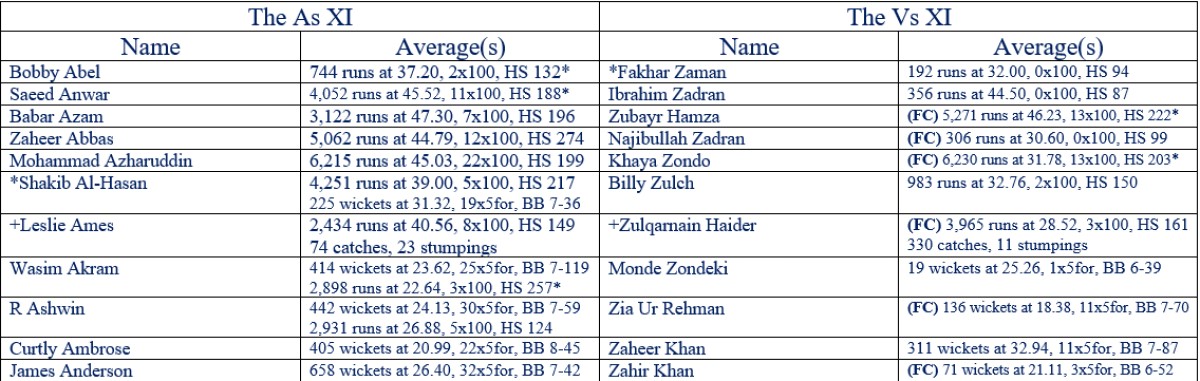
Continuing my extended analysis of how the all time XIs I picked for each letter of the alphabet fare against one another.
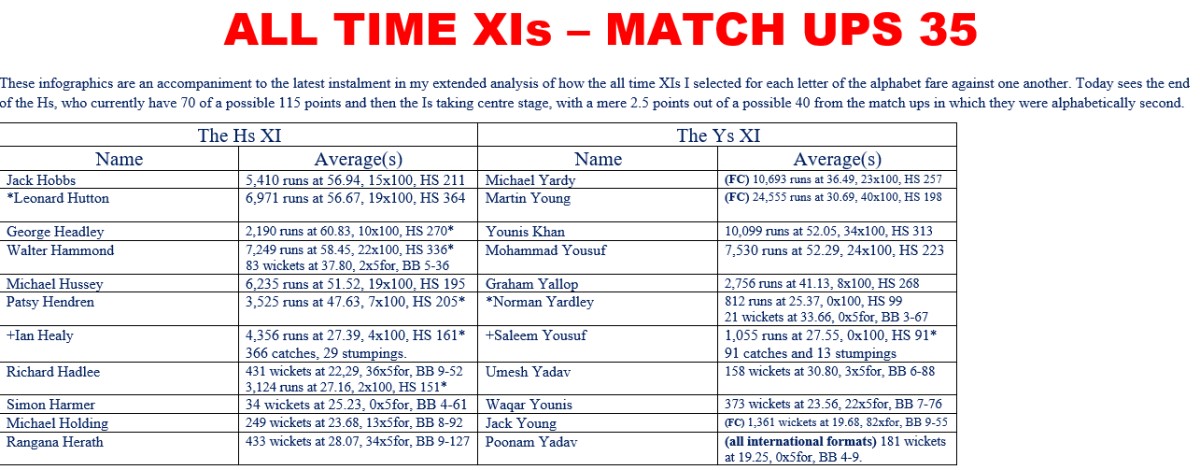
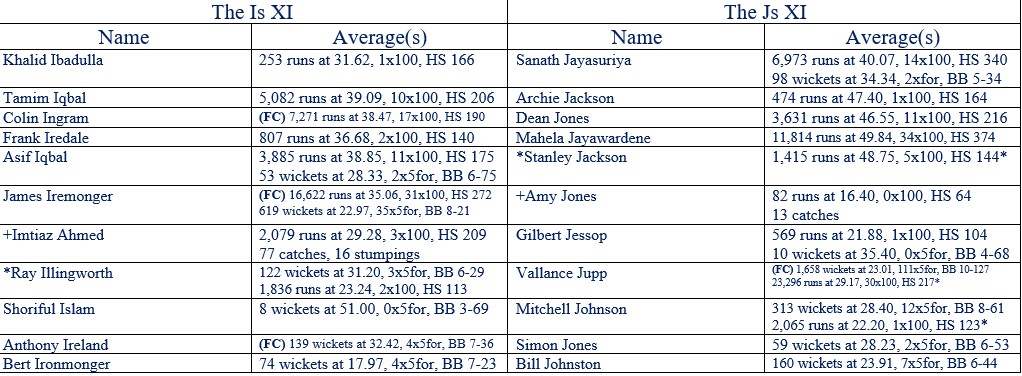
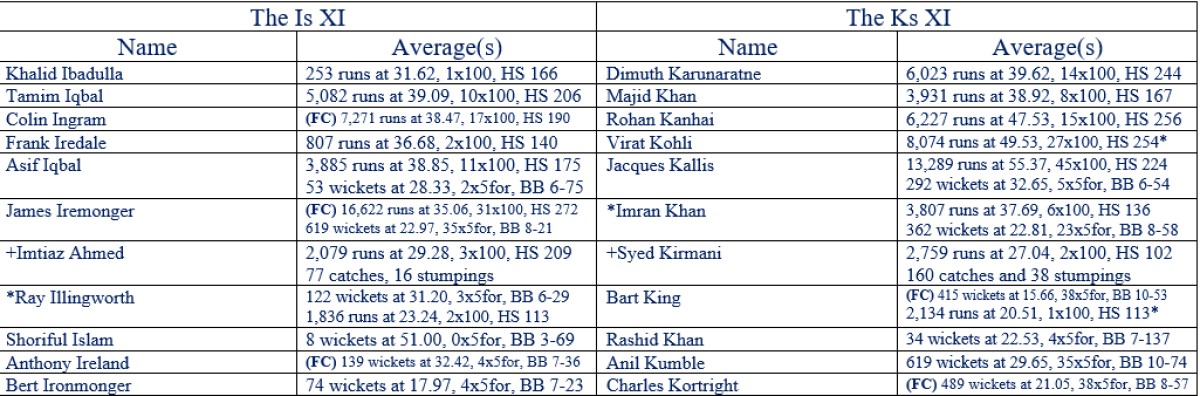
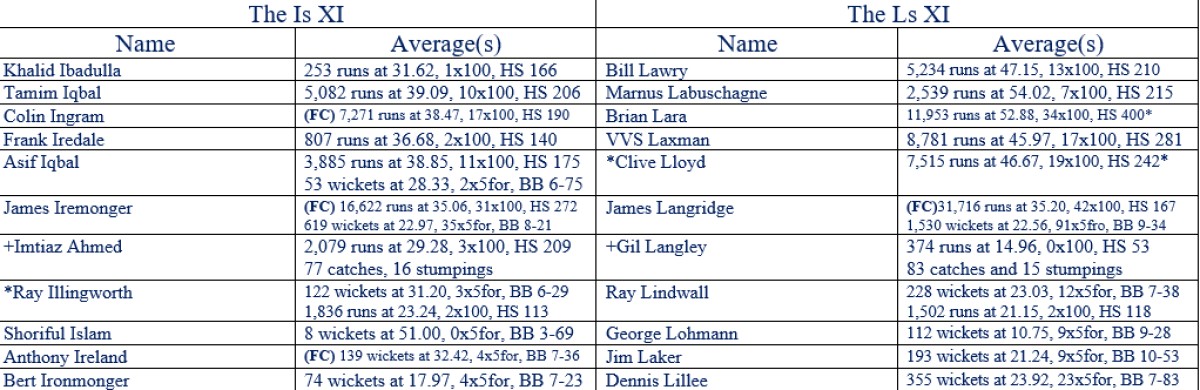
Welcome to the latest instalment in my extended analysis of how the all time XIs I selected for each letter of the alphabet fare against one another. Today sees the last two match ups involving the Hs, who come into today with 70 of a possible 115 points, and also the first three match ups of the Is period in the spotlight, which they come into with 2.5 of a possible 40 points banked.
THE Hs V THE Ys
The Hs dominate the batting, have the better new ball pairing, the better keeper and the better spin combination. Norman Yardley perhaps rates as a somewhat better third seamer than Hammond but even that is debatable. The Ys have no chance here: Hs 5 Ys 0.
THE Hs V THE Zs
The Hs have the Zs beaten in all departments. Hs 5, Zs 0.
THE Hs FINAL SCORE
The Hs finish with 80 of a possible 125 points, a score of 64%.
THE Is V THE Js
The Js have a strong superiority in batting, an overwhelming advantage in pace bowling, and they lose only tiny amount of ground in spin bowling, and also have the better keeper. The Is are miles adrift and I score this Is 0, Js 5.
THE Is V THE Ks
This is even more conclusive in the Ks favour. My scoring system limits margins of victory to 5-0, so I score this Is 0, Ks 5 and note that the Is are lucky to get 0.
THE Is V THE Ls
The Ls have an overwhelming advantage in both batting and pace/ seam bowling, the better keeper, the better captain, and while James Langridge rates below Ironmonger as a left arm spinner, Jim Laker comfortably outranks Illingworth as an off spinner. Only one scoreline is possible: Is 0, Ls 5.
THE Is PROGRESS REPORT
The Is have not added a single point to their tally and are now on 2.5 points out of a possible 55, 4.55%.
Continuing my extended analysis of how the all time XIs I selected for each letter of the alphabet fare against one another. Also a photo gallery.
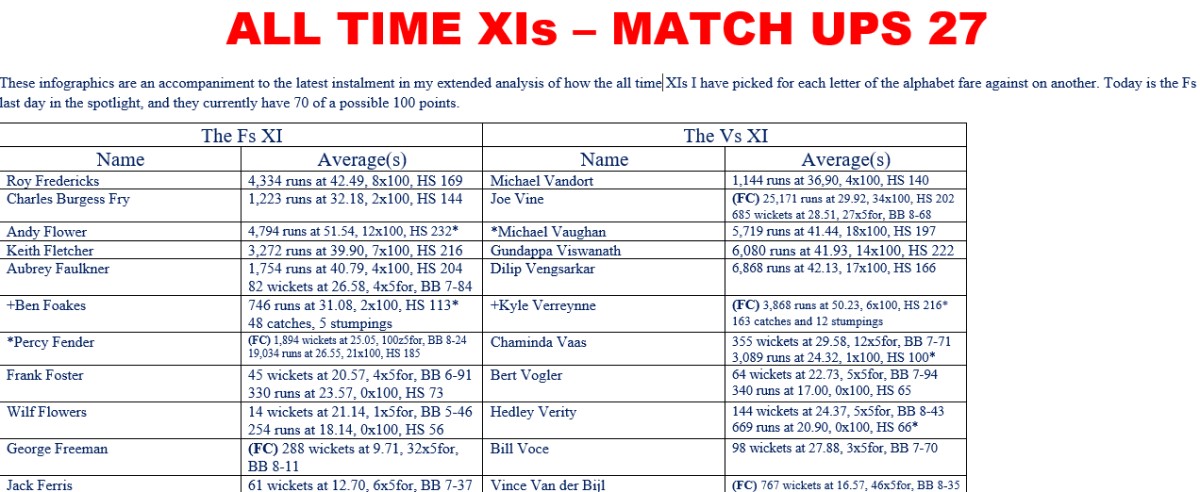
Welcome to the latest instalment in my extended analysis of how the all time XIs I selected for each letter of the alphabet fare against one another. Today is the Fs last day in the spotlight.
THE Fs V THE Vs
The Fs win the first three batting match ups, the Vs win the no 4 and 5 slots, but Faulkner’s bowling mitigates his narrow loss to Vengsarkar on the batting front. Verreynne is significantly ahead of Foakes on FC batting average, although Foakes out batted him in the only test series in which both have featured, and Foakes is also the better keeper. Fender, whose captaincy I rate ahead of Vaughan’s, outbats Vogler, though the Saffa was much the better bowler. Foster and Vaas is a good battle – Foster was the classier bat, Vaas probably the better bowler, especially given that in this XI he would be third seamer in a strong attack rather than opening bowler in a moderate one. Verity is far ahead of Flowers as a bowler, though the Notts man was a better batter. I would rate Freeman and Ferris a better new ball pairing than Voce and Van der Bijl. Ferris can definitely be ranked ahead of Voce as a left arm seamer, though like Voce he was metaphorically overshadowed by a team mate who was an even more fearsome bowler than himself. Freeman and Van der Bijl both missed out on test cricket, Freeman because he retired just before test cricket started, Van der Bijl because SA were personae non grata during his playing days. On my usual method of allowing for bowlers being more expensive now than they were in the 19th century Freeman’s bowling average of 9.71 becomes 14.56, while Van der Bijl had an FC bowling average of 16.54, two runs a wicket more expensive than Freeman’s adjusted figure. The Fs have better batting, a better captain, a better keeper and better pace bowlers while the Vs have better spinners. I will allow the Vs spinners their day and score this one Fs 4, Vs 1.
THE Fs V THE Ws
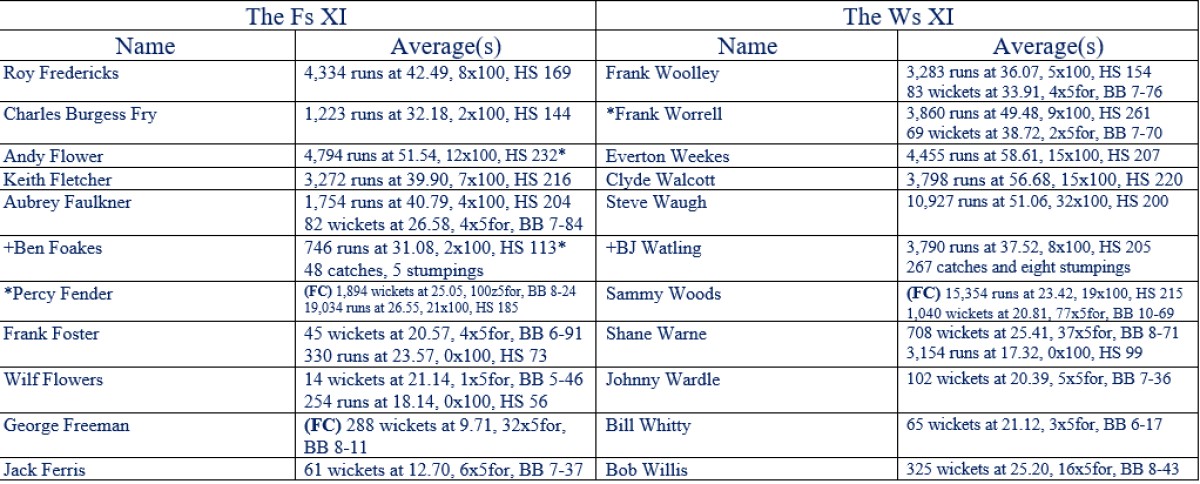
The Fs have the better left handed opener, while the Ws have the better right handed opener, and both Ws openers offer bowling options. The Ws boss the 3-5 slots batting wise, although Faulkner outranks Worrell and possibly Woolley as a bowler. Watling outranks Foakes as a batter, but Foakes is clear as a keeper. Woods and Foster are about equal as pace bowling all rounders, Warne is way ahead of Fender with the ball, but Fender was the finer batter. Wardle was a much better bowler than Flowers. Ferris outranks Whitty as a left arm pacer, while I would rate Freeman ahead of Willis. Worrell was at least the equal of Fender as a captain. I think the Ws are far enough ahead in batting and spin bowling to make up for their deficit in pace bowling and award them a narrow win – Fs 2, Ws 3.
THE Fs V THE Xs
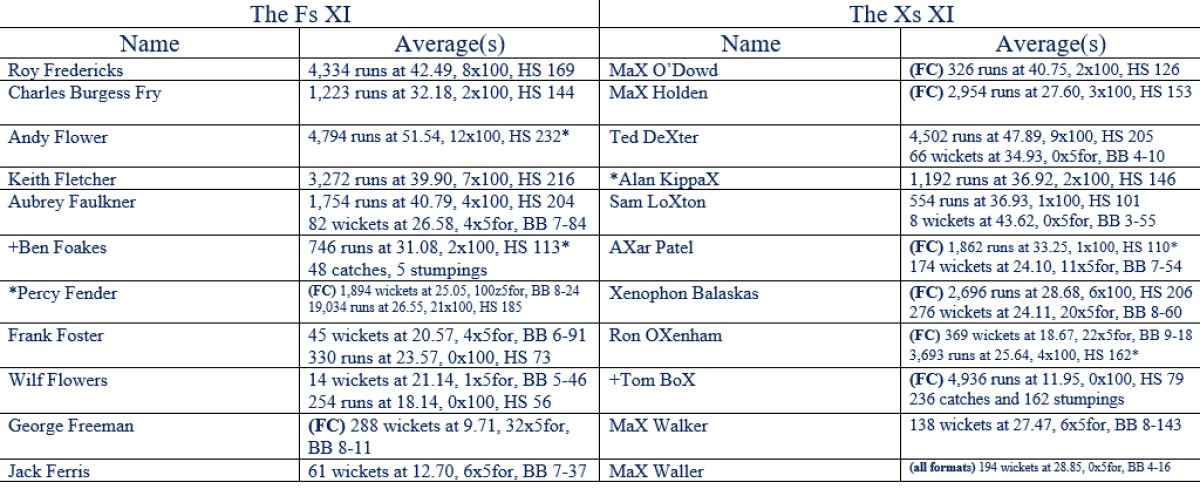
The Fs win the batting and pace bowling hands down, but the Xs are closer in spin bowling, and Box may even have been a better keeper than Foakes. Fender was definitely the finer skipper. I cannot see the Xs causing the Fs any problems and can only score this as Fs 5, Xs 0.
THE Fs V THE Ys
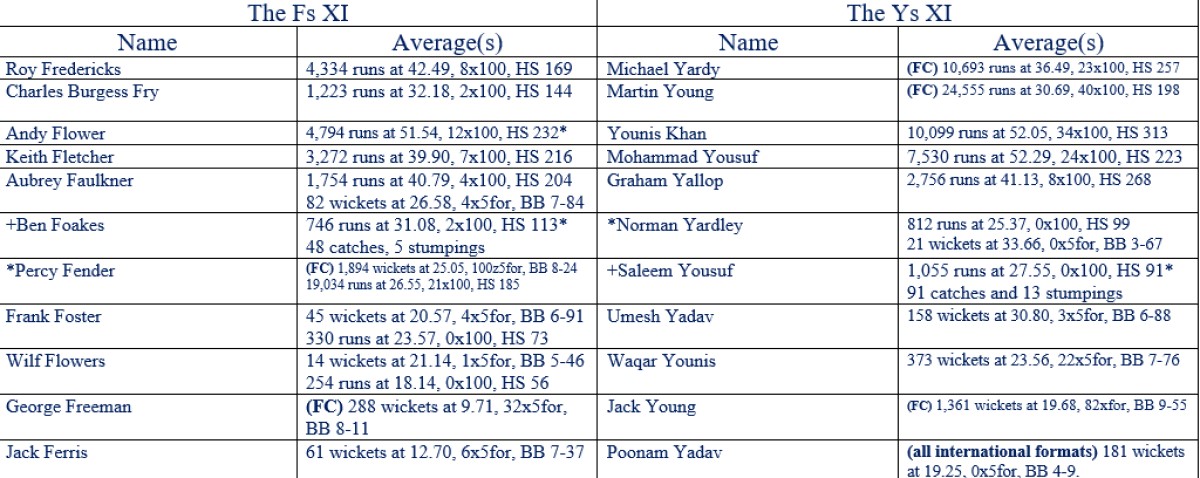
Younis Khan and Mohammad Yousuf win their batting match ups for the Ys, and Yallop narrowly wins the batting element of his match up with Faulkner, although the latter offers a bowling option. Foakes is comfortably ahead of Saleem Yousuf in both departments, Yardley is massively outpointed by Frank Foster, and similarly the Fs have the better new ball pairing. Poonam Yadav rates highest of the three leg spinners involved in this match, and Jack Young was a finer bowler than Wilf Flowers, so the Ys must be conceded an advantage in spin bowling. I score this one Fs 4, Ys 1.
THE Xs V THE Zs
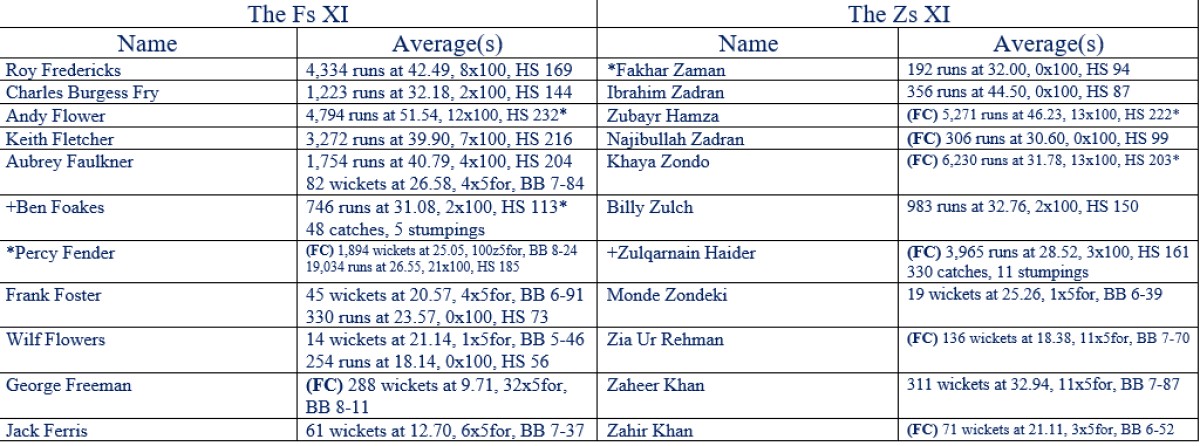
The Fs win the first five batting slots, and have a genuine bowling option in there in the form of Faulkner. Foakes outranks Zulqarnain Haider in both departments, Zulch was a better batter than Fender but the latter offers a bowling option and also outranks Zaman as a captain. Zondeki and Zaheer Khan are massively outpointed as a new ball combo by Freeman and Ferris, while the Fs have a third seamer of high class in Frank Foster whereas the Zs have no back up seam options. The Zs two spinners are unproven, whereas the Faulkner/ Fender/ Flowers trio were all quality practitioners. Fs 5, Zs 0.
THE Fs FINAL RESULT
The Fs scored 20 of a possible 25 points today, giving them a final score of 90 out of 125, 72% and currently top of the rankings among those teams who have been fully analysed.
Continuing my analysis of how my all time XIs for each letter of the alphabet match up against one another.
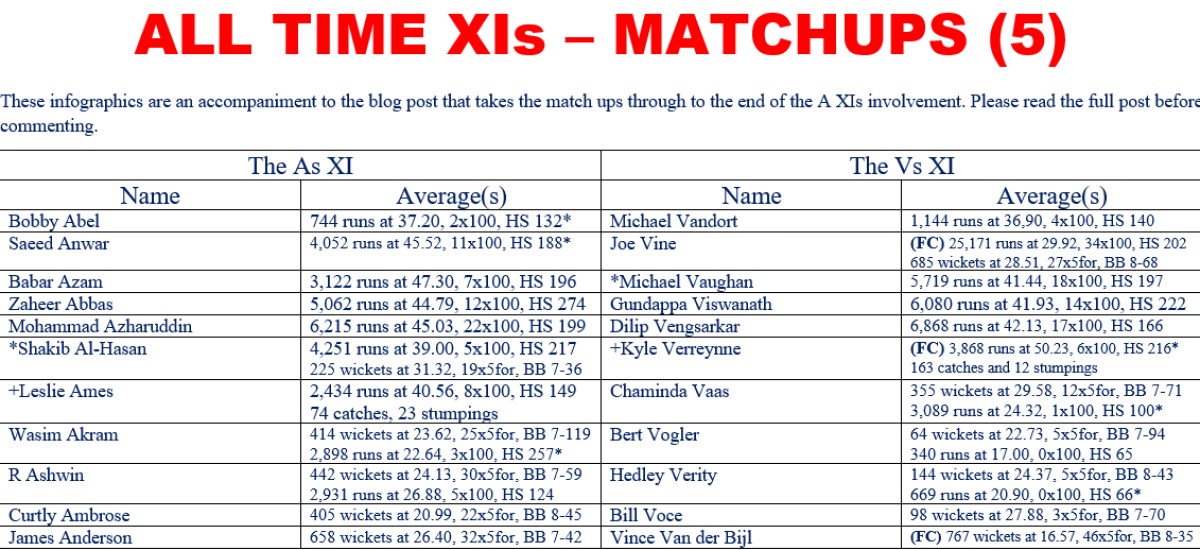
This is the fifth post in my series analysing how the XIs I picked for each letter of the alphabet fare against each other. This will conclude the As involvement. At the start of this post the As have 51 out of a possible 100 points.
THE As V THE Vs
The As are stronger in batting and in seam bowling, though less though than the averages make the latter look – Vaas would fare better as third seamer in a strong attack than he did as opening bowler in a moderate one. The Vs are comfortably ahead in spin bowling. The As are definitely getting the better of this, but not by a huge margin. I score this one as As 3, Vs 2.
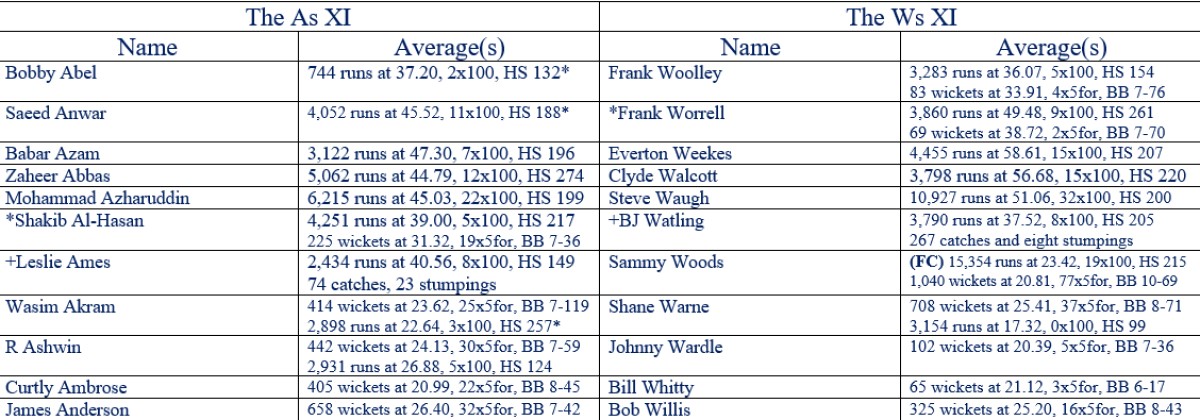
THE As V THE Ws
The Ws are comfortably ahead in batting, behind but not massively so in seam bowling and ahead in the spin bowling department. The extra bowling options provided by Woolley and Worrell count in their favour, and Worrell is clearly the better of the two skippers. I award the Ws a clear advantage here and score this one: As 1 Ws 4.
THE As V THE Xs
The As have a massive advantage in this one. For me this one is As 5 Xs 0.
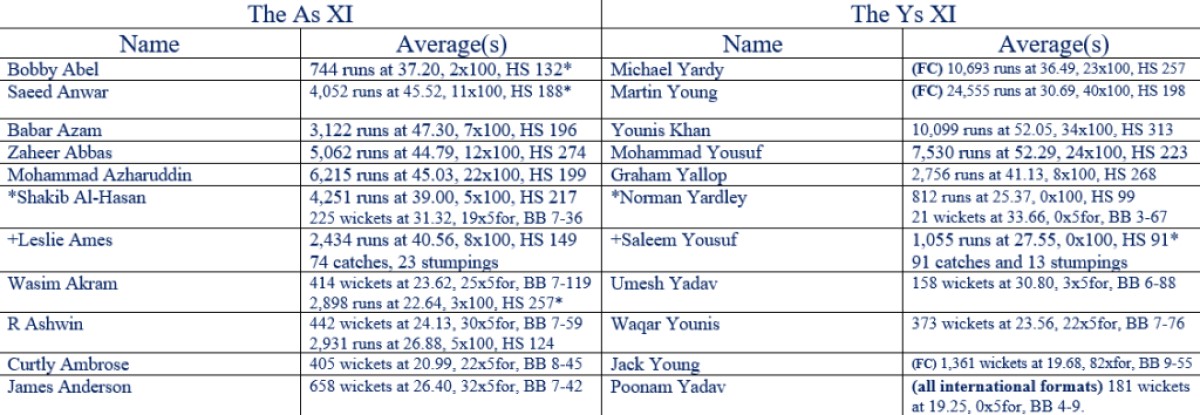
THE As V THE Ys
Even allowing for the presence of Younis Khan and Mohammad Yousuf the As have an advantage in batting. They also boss the seam bowling department. The Ys have the advantage in spin bowling, but not enough to compensate. As 4, Ys 1.
THE As V THE Zs
The As boss the batting and have a massive advantage in seam bowling. Spin bowling may be in favour of the Zs, but even if it is it cannot alter the outcome: As 5 Zs 0.
THE AS OVERALL
A strong final section for the As, seeing them take 18 of a possible 25 points to finish on 69 out of 125 points, 55.2%. The As fare respectably in the comparison and will be a lot closer to the top than the bottom.
Continuing my exploration of the all time XIs theme with a look at the letter Y.
I continue my exploration of the all time XIs theme with a look at players whose surnames begin with the letter Y (the kind of chicanery required for the letter X is not needed for this letter. A quick reference back to the Xs – Ted DeXter was an honourable mention for the Ds, so I felt able to include him in the Xs, and edited yesterday’s post to reflect this – please read the edited version. VVS Laxman was in the Ls XI, and I am not allowing myself to include someone in two different XIs in this trip through the alphabet.
THE XI IN BATTING ORDER
Michael Yardy (Sussex, England). A left handed opening batter who scored over 10,000 FC runs at 36, and also an occasional bowler of left arm orthodox spin, though his chief value in that department was in limited overs cricket.
Martin Young (Gloucestershire). A right handed opener who was a consistent score for his county for a number of years without ever attracting the attention of the England selectors.
Younis Khan (Pakistan). Over 10,000 test runs at 52, and number three is this right hander’s natural position in the order.
Mohammad Yousuf (Pakistan). He also averaged 52 in test cricket, though he did not score quite as many runs as Younis Khan. He holds the record for most test runs in a calendar year with 1,788.
Graham Yallop (Australia). A left handed batter with a fine test record in that department.
*Norman Yardley (Yorkshire, England). A right handed middle order batter, and a right arm medium pacer who revealed an aptitude for breaking partnerships on the 1946-7 tour of Australia. He was also a fine captain, a role I have given him in this side.
+Saleem Yousuf (Pakistan). A fine wicket keeper and useful right handed batter.
Umesh Yadav (India). A right arm fast bowler, his presence at no eight indicates this team’s biggest issue – lack of runs from the lower order.
Waqar Younis (Surrey, Glamorgan, Pakistan). One of the fastest bowlers in the world in his pomp, and one of the finest pacers his country ever produced.
Jack Young (Middlesex, England). A left arm orthodox spinner who took his FC wickets at less than 20 a piece, but got few opportunities at test level.
Poonam Yadav (India). The most controversial of all my selections, the diminutive leg spinner has a fine record in all formats, including 3-68 in her only test appearance to date. I have mentioned various skilled female cricketers in a lot of these posts, and a look at the E XI will confirm that I have named at least one female in a previous XI.
This XI has a solid opening pair who should be able to set a platform for the engine room of Younis Khan, Mohammad Yousuf and Graham Yallop. Yardley would captain the side well, which should make up for any shortfall in his own performance. Saleem Yousuf is a fine keeper, and there are four excellent bowlers. The pace department is a trifle thin, with Yardley officially third seamer, but Jack Young and Poonam Yadav look a fine spin combo. Overall I would expect this XI to give a decent account of itself.
HONOURABLE MENTIONS
Other than those I named there were three obvious candidates for opening batting slots: Bryan Young and Will Young, both of New Zealand have done the job at test level, but in both cases their record is no more than respectable. Rob Yates has had his moments for Warwickshire, but is too inconsistent to merit selection. Among middle order batters Suryakumar Yadav and Yashpal Sharma are unlucky that this team has such a strong middle order.
The only wicket keeping alternative to Saleem Yousuf was Hugo Yarnold of Worcestershire, but he was far inferior to Yousuf as a batter, and given the length of the tail as things were I felt the slot had to go to the Pakistani.
Three off spinners, Bruce Yardley, Shivlal Yadav and Jayant Yadav, were available, and any of them would have strengthened the batting, but all have moderate bowling records, and I am not prepared to boost the batting at the cost of reducing the team’s chances of taking 20 wickets. A left arm wrist spinner, Kuldeep Yadav, was available, and was the logical alternative to Poonam Yadav for the role of the second spinner. Radha Yadav, a left arm orthodox spinner, has had some successes for the Indian women’s team, but does not as yet compare to Jack Young, and like him is not to be relied on with the bat.
The only quick bowler other than two I selected that I could think off was Kuldip Yadav, a left arm fast medium bowler, but he has one first class scalp to his name, which makes picking him an unwarrantable gamble for me.
I end with one for the future: Yash Dhull, an off spinning all rounder, has had some captaincy experience with India Under 19s, and I will be surprised if in ten years time he does not dislodge Norman Yardley from the number six slot in this team. He has made a sensational start to his FC batting career, although he has yet to do much with the ball at that level. I would also sound a mild cautionary note: Tom Lammonby scored three centuries in his first six FC matches, but fell away badly in his first full length season to the extent that he was actually dropped five matches into it.
PHOTOGRAPHS
Our cricketing journey through the letter Y is at an end, and all that is left is my usual sign off…
An addition to my ‘All Time XIs’ series, this time taking double letters as its theme.
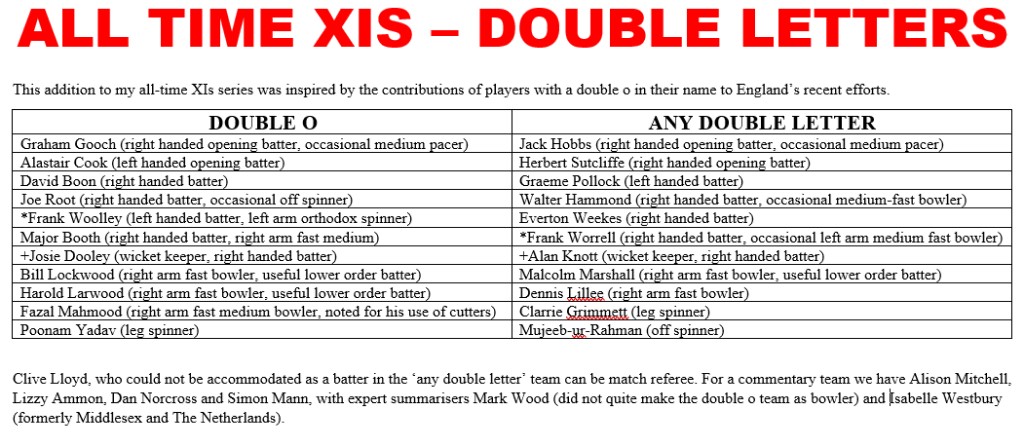
The role of players with a double o in their names for England in recent times got me thinking about a team of players who all featured that combo, and I then started thinking about other names with double letters in, resulting in a new post for my All Time XIs series.
THE DOUBLE O XI
Graham Gooch – right handed opening batter, occasional medium pacer. Scorer of 8,900 test runs, and player of the best test innings I have ever personally witnessed – 154 not out in an innings tally of 252 vs West Indies at Headingley in 1991, with Ambrose running riot on a pig of a pitch.
Alastair Cook – left handed opening batter, scorer of more test runs than any other left hander – 12,475 of them in all.
David Boon – right handed batter, started as an opener, but moved down to no3 to enable the formation of the right-left Marsh-Taylor combination and enjoyed tremendous success in that latter position.
Joe Root – right handed batter, occasional off spinner. Arguably England’s finest batter of the 21st century, Cook’s achievements notwithstanding.
*Frank Woolley – left handed batter, left arm orthodox spinner. The only player to have the treble of 10,000 first class runs, 1,000 first class wickets and 1,000 first class catches, and indeed the only person to have taken 1,000 catches as other than a wicket keeper. In first class cricket he averaged 40 with the bat and 19 with the ball, and his bowling won at least one test match for England. I am sufficiently impressed by his tactical thoughts, as expressed in “King of Games” to name him as captain even though as a professional of that era he never had the job.
Major Booth – right handed batter, right arm fast medium bowler. Major was his given name (he was named in honour of a respected Salvation Army figure), not a rank. He would certainly have played many times for England but for the first World War (he lost his life during the battle of the Somme). In the late stages of the 1914 season he and Alonzo Drake, another cut off in his prime by the outbreak of war, bowled unchanged together through four successive first class innings.
+Josephine Dooley – wicket keeper, right handed batter. One of the successes of the most recent edition of the Women’s Big Bash League.
Bill Lockwood – right arm fast bowler, useful lower order batter. He was one of the first fast bowlers to develop a really effective slower ball.
Harold Larwood – right arm fast bowler, useful lower order batter. The list of visiting fast bowlers to have blitzed the Aussies in their own backyard is a short one, and the Notts express features prominently on it.
Fazal Mahmood – right arm fast medium bowler. Pakistan’s first authentically great bowler, he took 12 wickets in their first ever test victory at The Oval in 1954. He was known as a master of bowling cutters, often wreaking havoc on the matting pitches which were standard in his homeland at the time.
Poonam Yadav – leg spinner. The tiny Indian causes huge problems with her craftily flighted slow leg breaks. The greatest demonstration of her ability to change the course of a match came in the most recent World T20 when Australia seemed to be coasting as she began her spell and were obviously beaten by the time she had finished.
This team contains a strong top five, an all rounder at six in Booth, a keeper who can bat at seven and four great bowlers with plenty of variation. Woolley is an excellent second spin option with his left armers, and Gooch and Root might also contribute with the ball.
THE ANY DOUBLE LETTER XI
Jack Hobbs – Right handed opening batter, occasional medium pacer. The Master, scorer of 197 first class centuries in total, 12 of them in Ashes tests. He achieved all that in spite of losing four years of his cricketing prime to World War 1.
Herbert Sutcliffe – right handed opening batter. First class average 52.02, test average 60.73, Ashes average 66.85. When the going got tough, he got going. He formed the most successful opening pairing in test history with Hobbs, their average opening stand being 87.81.
Graeme Pollock – left handed batter. The South African averaged 60.97 before his country’s international isolation ended his test career. I opted for his left handed stroke play in preference to having a third right handed opener in Hutton occupy this slot.
Walter Hammond – right handed batter, occasional medium-fast bowler. 7,249 runs in 85 test matches at 58.45, and that average only ended up below 60 because he returned to test action after World War Two, when into his forties.
Everton Weekes – right handed batter. He had a similar average to Hammond in test cricket.
*Frank Worrell – right handed batter, occasional left arm medium-fast bowler, captain. He averaged 49.48 in test cricket, and was one the most successful captains ever, taking the West Indies from also rans which they had been for their entire history to that point to being champions by the time he finished.
+Alan Knott – wicket keeper, right handed batter. One of the game of cricket’s most noted eccentrics, and also one of the greatest keepers ever to don the gauntlets. He also averaged 32.75 with the bat, and tended to score big runs when the team most needed them.
Malcolm Marshall – right arm fast bowler, useful lower order batter. Arguably the greatest fast bowler of the golden age of West Indies fast bowling.
Dennis Lillee – right arm fast bowler. The Aussie was for some years test cricket’s all time leading wicket taker, and his 164 Ashes wickets is a tally surpassed in the history of those contests only by Shane Warne who finished just short of 200.
Clarrie Grimmett – leg spinner. The New Zealand born Aussie who having moved country to better his cricketing prospects had to then cross two state boundaries before establishing himself in first class cricket at the third time, and did not make his test debut until the age of 33 still became the first bowler ever to take 200 test wickets, capturing 216 from 37 test appearances – nearly six per game at the highest level. His Aussie team mate Bill O’Reilly, who was second choice for this spot, was adamant that Grimmett, then 46, should have been selected for the 1938 tour of England.
Mujeeb-ur-Rahman – off spinner. A bit of a gamble on this one – left armer George Dennett with 2,151 first class wickets at less than 20 a piece could easily have been named for this spot, but the young Afghan off spinner has impressed most times he has had the ball in his hand of late.
This team features a very strong top six, one of the all time great keepers, and four great bowlers. I consider that Hammond and Worrell between them make up for the lack of a genuine all rounder. There are too many honourable mentions to name, but before moving on to the next section I would just like to say that if you have someone who you think I have missed please indicate which of my selections should be dropped to make way for them.
OFF THE FIELD
Clive Lloyd, a near miss for a batting place in the ‘any double letter’ team can be match referee, a role he also filled with distinction. In the commentary box we can have Alison Mitchell, Lizzy Ammon, Dan Norcross and Simon Mann, with expert summarisers Mark Wood (not too far off a bowling spot in the double o XI) and Isabelle Westbury (Middlesex and Holland).
Continuing the all time XI #cricket series with a tenth ‘through the alphabet’ post. Also includes some photographs.
INTRODUCTION
Welcome to today’s all time XIs cricket post, the tenth in our alphabetic progression mini series. Unlike yesterday I also have some photos to share. Today we start with a Q…
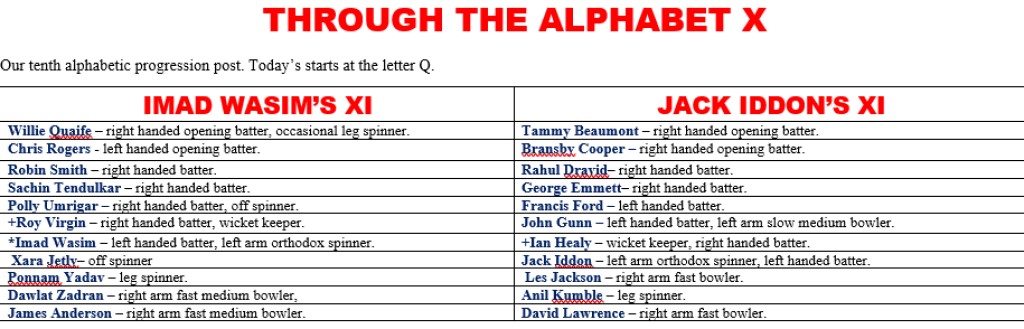
IMAD WASIM’S XI
Willie Quaife – right handed opening batter, occasional leg spinner. When it comes to opening batters whose surnames begin with Q there is really only one contender, the man who played for Warwickshire for almost 35 years, signing off with a century at the age of 56 years and four months. In the later years of his career he did on occasion open the batting with his son Bernard, but the latter only ever got picked because of whose son he was – he was not close to being top player (my source for this is long serving Warwickshire keeper EJ “Tiger” Smith by way of the ‘autobiography’ he gave to Pat Murphy by means of a series of recorded interviews).
Chris Rogers– left handed opening batter. His test record for Australia was not stellar, partly because he was long past his prime before becoming a regular member of the side, but he was a seriously big scorer for Northamptonshire, Derbyshire and Middlesex in the county championship.
Robin Smith – right handed batter. One of those rare batters who positively relished doing battle with the opposition fast bowlers (George Gunn, the Nottinghamshire legend was another, as was an earlier Hampshire man, George Brown) and even rarer in being an England player who actually enhanced his reputation during the 1989 Ashes series (keeper Jack Russell was the only other of whom that could be said). Another rare club to which Smith belongs is the ‘winners of a sledging contest with Merv Hughes’ club, again from that 1989 Ashes series. After a Smith play and miss Hughes, the bowler, said to him “you can’t ****ing bat”, Smith smacked the next ball for four and said “we make a fine pair: I can’t ****ing bat and you can’t ****ing bowl”.
Sachin Tendulkar – right handed batter. Don Bradman, then a very old man, was watching a match an the TV at home and thought he had spotted something about the young man who was batting. He called his wife through to verify his observation, and Lady Jessie Bradman confirmed that yes, there was more than a passing resemblance between the methods of the batter in that match and Don’s own. The batter was, of course, Sachin Ramesh Tendulkar, who would go on to become the first and to date only batter to score 100 hundreds in international matches.
Polly Umrigar – right handed batter, off spinner. He was at one time India’s leading test run scorer. There was a question mark about him against genuine pace, which he never got to face in Indian domestic cricket. Fred Trueman once claimed that on one occasion when he was bowling at Umrigar the square leg umpire was nearer the wicket than Umrigar. At No5, behind this side’s top four he is unlikely to be facing fast bowlers who have not already done a fair amount of bowling.
+Roy Virgin – right handed batter, wicket keeper. He was only an occasional wicket keeper, but V is a difficult letter to fill. He was once named in the 12 for England but left out on the morning of the match, and that was as close to international cricket as he came.
*Imad Wasim – left handed batter, left arm orthodox spinner, captain. He has played ODIs and T20Is with some success, but not yet test cricket. His first class record is 3,702 runs at 40.68 and 141 wickets at 31.14. I have named him as captain based on my thinking about slow bowling all rounders in this role. A cynic might say that since he is a Pakistani who is already an established part of their international set up I have a better than average chance of finding out how he handles the captaincy, given the way they go through captains.
Xara Jetly – off spinner. This side has a longish looking tail, with the young kiwi off spinner at no8. X is a difficult letter to fill, and there is enough in her recent performances to at least suggest promise, and at the age of 18 she is certainly young enough to improve.
Poonam Yadav – leg spinner. One of the attributes that is said to have made the Kent leg spinner Tich Freeman so difficult for opposition batters was his lack of height, which enabled him to release the ball upwards, making it difficult for the batters to follow its flight. Poonam Yadav is even shorter than Freeman’s 5’2″ and takes a similar approach to her own leg spin, releasing the ball upwards, and in her case, at as slow a pace as can ever have been seen in top level cricket.
Dawlat Zadran – right arm fast medium bowler. The best pace bowler to have come from Afghanistan thus far, and he has an experienced new ball partner here in the form of…
James Anderson – right arm fast medium bowler. 584 test wickets, and officially still counting. When the ‘bio-secure’ series starts next week we will see if he is in the England team. For me the choice is between him and Broad, with Curran (left arm, and a useful lower order batter), Wood (searing pace) and Bess the others chosen primarily for bowling and Stokes the all rounder providing a fourth pace option, with Parkinson possibly replacing Curran if a second specialist spinner is warranted (unlikely on a 21st century English pitch). However, whether or not he is selected for that match, his record speaks for itself, and in this team his experience will be invaluable.
This side has a fine top six, an admitted gamble with Roy Virgin, an occasional in the role in his playing days, trusted with the keeping gloves, an effective all rounder, two quality specialist spinners and an excellent new ball pairing.
Bransby Beauchamp Cooper – right handed opening batter. He once shared an opening stand of 283 with WG Grace, and as a participant in the inaugural test match at Melbourne in 1877 has the distinction of being the first test cricketer to have been born in what is now Bangladesh (he was born in what was then Dacca, India and is now Dhaka, Bangladesh).
Rahul Dravid – right handed batter. For many years the sheet anchor of the Indian test team. Probably his greatest innings was at Kolkata in 2001, when he played the support role to VVS Laxman’s pyrotechnics, as India came back from being made to follow on to win by 171 runs, scoring 657-7 declared in that second innings.
George Emmett – right handed batter. A Gloucestershire stalwart of the immediate post world war two era who played a few matches for England.
Francis Ford– left handed batter. He was in his prime in the last decade of the 19th century, when he acquired a reputation for ‘gentle violence’ at the crease. He played a part in the first test victory by a side made to follow on, at Sydney in 1894. He contributed an aggressive 48 to England’s second innings revival, which saw them reach 437, setting Australia 177 to win. Australia were then spun to defeat when overnight rain gave Peel and Briggs a vicious sticky to exploit.
John Gunn – left handed batter, left arm slow medium bowler. The youngest of three brothers who all played for Nottinghamshire. At one time he held the county record individual score with 294, and he took over 1,000 first class wickets at 25 each.
+IanHealy– wicket keeper, right handed batter. After Rod Marsh’s retirement in 1984 Australia struggled to find a keeper, as they did in other respects in that period. Then in 1989 along came Ian Healy, a champion keeper, a useful batter who reserved his best performances for the test arena (usually against England) and even in that Aussie unit a stand out sledger.
Jack Iddon – left handed batter, left arm orthodox spinner. Slightly out of position, as he was in reality more of a batter than a bowler, but his bowling record was very respectable, and given England’s fairly recent usage of Moeen Ali in the test team I am not going to be overly apologetic about this one.
Les Jackson– right arm fast bowler. A phenomenal bowler for Derbyshire, but picked only twice for England.
Anil Kumble – leg spinner. The third leading wicket taker in test history, and one of only two to have taken all ten wickets in a test innings.
David Lawrence – right arm fast bowler. A combination of the unwillingness of the then England selectors to pick him and Devon Malcolm in the same team and a horrific knee injury curtailed his test chances, but he was consistently successful for Gloucestershire.
This team has a solid top five, a couple of all rounders, a keeper who can bat and three excellent bowlers. Jackson, Lawrence, Kumble, Gunn and Iddon should be able to take 20 wickets between them on any surface.
THE CONTEST
This should be close. Jack Iddon’s XI are stronger in batting, but Imad Wasim’s XI have a somewhat better bowling attack. I cannot call this one.
PHOTOGRAPHS
My usual sign off…
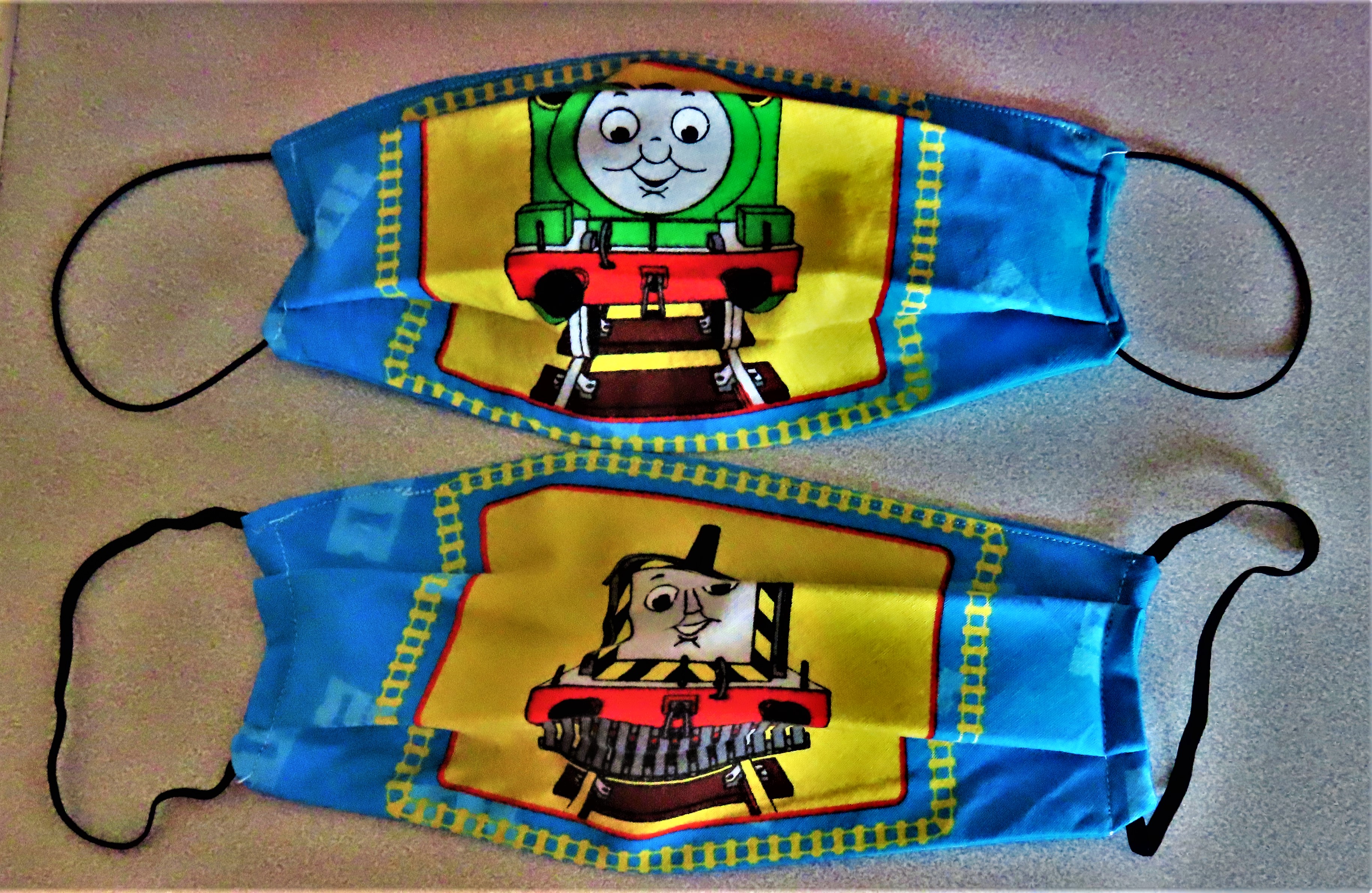
Masks, handmade for the use of members of NAS West Norfolk.
My latest variation on the ‘all time XI’ theme pits Davids against Goliaths. I also present the answer to yesterday’s teaser, an important post about disease prevention and of course some photographs.
INTRODUCTION
It is time for another variation on the ‘All Time XI‘ theme, this time pitting a team made of players of small stature against a team of some of the tallest of all cricketers. I will also answer yesterday’s mathematical teaser.
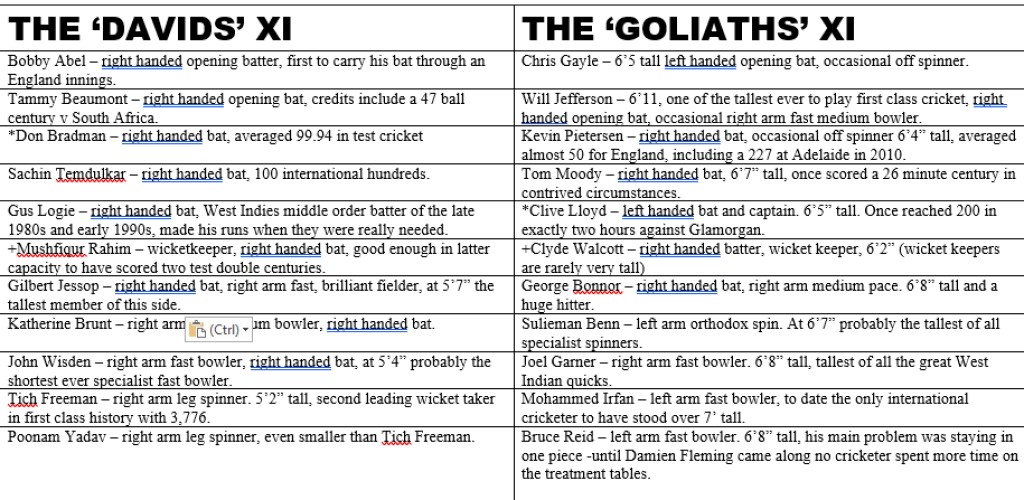
THE GOLIATHS XI
Chris Gayle – left handed opening batter, occasional off spinner. He stands 6’5″ tall. His career highlights include two test triple centuries. However, he would be banned from using the DRS because of his record in that department.
Will Jefferson – right handed opening batter, occasional right arm fast medium. At 6’11” the Essex and later Leicestershireopener is one of the tallest of all professional cricketers. He never quite managed to attract the attention of the England selectors, but achieved a very respectable output in first class cricket.
Kevin Pietersen – right handed batter, occasional off spinner. At 6’4″ one of the shorter members of this team. He averaged almost 50 in test cricket, with his highest score 227 at Adelaide. Late in his career he came within two of the highest score ever made forSurrey, with 355. He was not always popular with team mates – his departures from his first two counties, Nottinghamshire and Hampshire were both decidedly acrimonious, but his record speaks for itself.
Tom Moody – right handed batter, occasional medium pacer. The 6’7″ Aussie scored stacks of runs for Warwickshire and Worcestershire over the years and was also a fine fielder. One of the few to have admitted to being embarrassed by making a century due to the circumstances of its making. The innings in question, which saw the normally prized landmark arrive in just 26 minutes, was played against bowlers who were deliberately giving away runs to expedite a declaration was at the time greeted as a new first class record, but wiser counsels have since prevailed and it is now entirely correctly relegated to a footnote. Moody made ample numbers of runs that he had to earn, and his genuine embarrassment at effectively being handed a century speaks volumes for him.
*Clive Lloyd – left handed batter, cover specialist fielder, captain. The 6’5″ bespectacled Guyanese ace featured in my piece about the West Indies. Against Glamorgan he once reached 200 in precisely two hours against genuine bowling. In the inaugural men’s world cup in 1975 (the women played one two years earlier, won by Rachael Heyhoe-Flint’s England) he scored a ton in the final to put West Indies in charge of the contest, a position they never relinquished.
+Clyde Walcott – right handed batter, wicket keeper. Wicket keepers are rarely particularly tall, and Walcott was over six feet tall. I wrote about him in the West Indies piece.
George Bonnor – right handed batter, medium pacer, excellent catcher. Bonnor was one of the first renowned big hitters, with his best test innings being a score of 128 that included sending the ball clean out of the ground four times. He was inclined to attempt to ‘bat properly’, a policy that did not work for him – his best moments came when he realized that he was a big hitter and did not try to play a real innings.
Sulieman Benn – left arm orthodox spinner. At 6’7″ the West Indian is probably the tallest specialist spinner there has ever been, and he did have his moments. When I watched the West Indies play Australia at Adelaide in 2009 he was one of only two of their bowlers, greased lightening quickie Kemar Roach being the other, to cause the Aussie batters genuine apprehension. That match should have been an all-time classic, the West Indies being all out early on the final morning to leave Australia needing 330 off 81 overs on a pitch that was still pretty good for batting. Unfortunately, influenced by being already one up in a three match series, the Aussie skipper ‘Punter’ Ponting declined to live up to his nickname and Australia made no serious attempt to mount a chase that they should have had a fair chance of pulling off.
Mohammad Irfan – left arm fast bowler. The Pakistani paceman at 7’1″ is officially the tallest international cricketer there has ever been.
Joel Garner – right arm fast bowler, excellent boundary fielder. The 6’8″ Barbadian who has one end of his home ground, the Kensington Oval in Bridgetown, named in his honour was a very difficult bowler to score off, and took ana average of just over four wickets per test match. His ODI economy rate of 3.09 is unapproached in that format. He was my chosen overseas player for Somerset.
Bruce Reid – left arm fast bowler. The 6’8″ Aussie had a fine test record for those matches when he was able to play, though he spent a lot of time on treatment tables (his only rival that I can think of in that regard was another Aussie, Damien Fleming).
This team has a good top six, including a serviceable wicket keeper, a big hitter at no 7 and four fine bowlers. It is weak in the spin bowling department, with only the part time tweakers of Gayle and Pietersen to supplement Benn’s left arm spin. That is the suitably Brobdingnagian “Goliaths XI”, and now, slings at the ready, here are their opponents:
THE DAVIDS XI
Bobby Abel – right handed opening bat. The diminutive Surrey opener (officially 5’4″ but perhaps less) was the first to carry his bat through an England innings, finishing on that occasion with 132 not out. He also holds the record for carrying his bat through the highest first class team total to feature such an innings, and in that same innings the highest score ever made for Surrey. In 1899 at Taunton, Surrey scored 811 all out, with Abel batting through for an undefeated 357. Abel and Tom Hayward shared the Surrey record partnership for any wicket, 448 for the 4th. Playing for the Players against the Gentlemen at The Oval Abel scored 247, a score only beaten in that series by his fellow Surreyite Jack Hobbs (266). Abel also formed a contrasting friendship withWG Grace, and was among the pallbearers at the latter’s funeral. There is a biography of him by David Kynaston that I recommend.
Tammy Beaumont – right handed opening bat. She has established a magnificent record at the top of the order in recent years (visit my postof two days ago to see a clip of highlights from one of her innings), and while the women play scandalously little test cricket, her record in ODIs is significantly better than her record in T20s, leading me to take the view that if she got a proper chance in long form cricket she would be highly successful.
*Don Bradman – right handed batter, brilliant outfielder, captain. He was just a little over 5’6″ in height, the second tallest of my chosen XI. A test average of 99.94 renders further comment superfluous. This is his third appearance in this series of posts, after Australia and the Scribes.
Sachin Tendulkar – right handed batter. The Indian maestro, scorer of 100 international hundreds is an automatic selection at four as Bradman was at three.
Gus Logie – right handed batter. The West Indian, one of the smallest players of his era, was not anything like as heavy a scorer as his immediate predecessors in this order, but he tended to score his runs when his side really needed them.
+Mushfiqur Rahim – right handed batter, wicket keeper. The Bangladeshi, one of the smallest players ever seen in the test arena, has two test double centuries to his credit, and averages 36.77 overall with the bat, and he has not all that often had the luxury of being able to build on a strong start by his team. He has also taken 104 catches and executed 15 stumpings in test cricket. Bangladesh has probably during his career only had five players who can genuinely be regarded as top class, opener Tamim Iqbal, all-rounder Shakib Al Hasan (currently suspended), off spinner Mehedi Hasan, fast bowler Mashrafe Bin Mortaza (now a member of the Bangladeshi parliament, and a spent force as a player) and Mushfiqur Rahim himself. In this team he is part of a strong unit, which would be a new experience for him.
Gilbert Jessop – right handed bat, right arm fast bowler, brilliant fielder. At 5’7″ the tallest member of my chosen XI, he is the x-factor all rounder in the side. He featured in yesterday’s post.
Katherine Brunt – right arm fast medium bowler, right handed bat. The Barnsley born Brunt is approximately 5’5″ tall – among her regular England team mates only Beaumont and Danielle Wyatt are noticeably shorter. It is her skiddy bowling that has earned her a place in this XI, but she has also developed her batting to a very considerable degree, and shares with Logie the knack of producing the goods when they are most required – her career best 72 not out got England to a total in excess of 200 when at one stage a prediction of 150 would have been viewed as seriously optimistic.
John Wisden– right arm fast, useful lower order batter. The Sussex pacer, also founder of the United All England XI, a touring XI which played matches against local teams who had a numerical advantage – 18 and 22 were the two most frequent sizes of team for such matches, and sometimes secured the services of professionals, described as ‘given men’, once took all ten in a first class innings, all clean bowled. He stood only 5’4″, probably the shortest specialist fast bowler there has ever been.
Tich Freeman – leg spinner. The 5’2″ Freeman (his actual given names were Alfred Percy) was the second most prolific wicket taker in first class cricket history, with 3,776 (and he played only about half the number of matches that Yorkshire’sWilfred Rhodes, the no1 in this category, did). He holds all manner of records for large wicket hauls. Even more remarkable by today’s standards is the age at which he achieved these feats – a combination of his being a late developer and World War 1 meant that by the age of 30 the Kent leggie had precisely 29 first class wickets to his credit.
Poonam Yadav – leg spinner. The tiny Indian leg spinner was one the stars of the recent Women’s World T20, again and again confounding opponents with her flight and spin. She is also one of the slowest bowlers of any description to have been seen in top level cricket.
This team has an opening pair who should combine well, a powerhouse combination at three and four, a battler at no six, a wicket keeper batter at six, the most explosive batter the game has ever seen at seven, and four varied bowlers to round out the XI. I regret that both spinners are leg spinners, but I think there is enough difference in their methods that this is not a very serious weakness.
THE CONTEST
This contest for the ‘Sling Trophy’ as I shall call it should be a fine one. However, especially if Wisden, Brunt and Jessop, the pace bowlers for the Davids, concentrate on yorkers, which the Goliaths would find it difficult to get down to, I would still expect this to go the same way as the original David vs Goliath – in favour of the Davids.
SOLUTION TO YESTERDAY’S TEASER
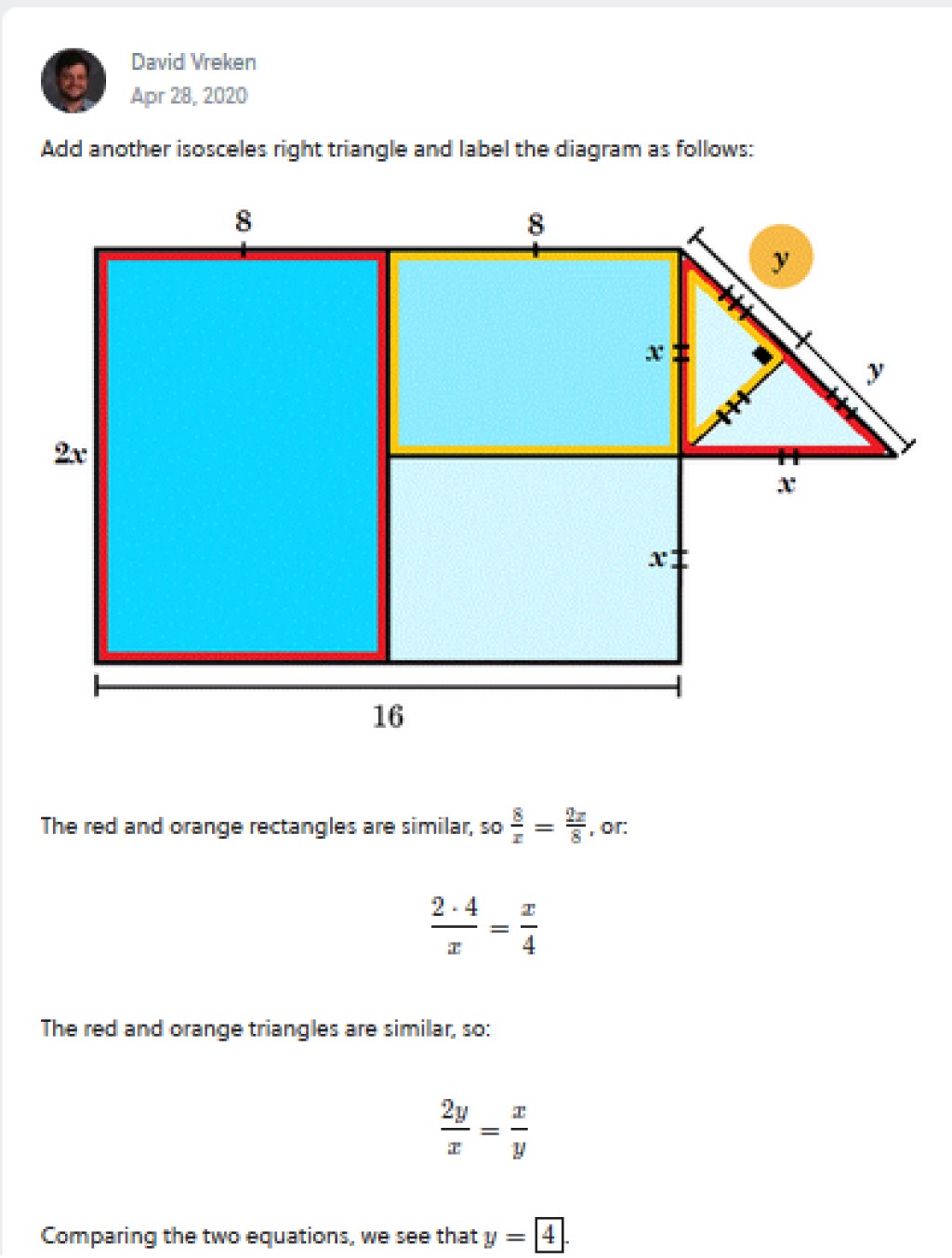
Yesterday I offered up this, from brilliant.org
The key lies in that word ‘similar’. All the four rectangles (the big overarching rectangle, with long side 16, the intermediate rectangle that is half the area of that one and the two smaller rectangles all have the same proportions. This means that the key shape, the triangle is an isosceles right angled triangle and its longest side can be calculated from the similarity of the rectangles to equal to 4 x the square root of 2. This squares up to 32, and Pythagoras tells us that the sum of the squares of the other two sides is equal to the square of the longest side (aka hypoteneuse). Since the triangle is isosceles as well as right angled, the square of each remaining side is half of 32, i.e. 16. 16 has two square roots, 4 and -4, and the length of the side of a triangle is a positive number, so the answer is four.
Here is David Vreken’s elegant published solution:
Just to complete this mini-section, it took me much less long to actually solve this than to type my explanation, and I am a fairly rapid typist.
A FINAL LINK AND PHOTOGRAPHS
The Davids and Goliaths of cricket have been paraded in all their glory, and I have a single link left to share before finishing with my usual sign off. Phoebe MD has hosted a post by Barbara Leonhard titled “Avoiding the Tragedy: A Look into Disease Prevention” which I consider to be a must-read. My thanks to both Phoebe and Barbara for that piece.
Finally, my usual sign off…
The teams in tabulated form with abbreviated comments.
The latest in my “100 cricketers” series, with updates from the County Championship, some twitter finds and some of my photographs.
INTRODUCTION
Welcome to the latest in my “100 cricketers series“, finshing the ninth XI by looking at three woman cricketers who feature in it. The introductory post to the series can be found here, the post in which I introduce the ninth XI is here and the most recent post in the series is here. Now before we get into the main meat of the post it is time for a…
COUNTY CHAMPIONSHIP UPDATE
We are into day 2 of the second round of county championship matches, and the current situations are as follows:
Yorkshire v Hampshire – Yorkshire 446-6 Yorkshire are piling on the runs in this one. The big innings came from Gary Ballance (148), and there have been solid contributions all the way down the order. Fidel Edwards, Gareth Bergand bits and pieces player Liam Dawson each have two wickets.
Nottinghamshire v Somerset – Nottinghamshire 263, Somerset 221-3 Following Lewis Gregory’s six wickets yesterday (he is one of my Five to Follow) the Somerset innings began with a sense of deja vu as the top three in their order were despatched for 10 runs reach, but George Bartlett(another of my Five to Follow, 91 not out) and Tom Abell (82 not out) have put together a fine partnership which has their team well on top. Still, Somerset will need runs from their top order somewhere along the line.
Surrey v Essex – Surrey 395, Essex 65-2 A patient effort from Ryan Patel (100 not out while the score rose from 75-1 to the eventual 395 all out was the sheet anchor of the Surrey effort. Ben Foakes (69) and Will Jacks(88) made significant contributions in more aggressive fashion. Both Essex openers are back in the hutch already, with the wickets going to Morne Morkel and Tom Curran.
Warwickshire v Kent – Kent 504-9declared, Kent 1-0 Kent are clearly having the better of the battle of the newly promoted sides, with Zak Crawleymaking a ton yesterday, and wicketkeeper Ollie Robinsongoing on to 143 today. We wait to see how the Kent bowlers fare.
Durham v Sussex – Durham 224, Sussex 84-7 Durham owed much to the shot in the dark among my Five to Follow, Liam Trevaskis, who battled his way to 54 for their modest looking total. Chris Rushworth and potential England man James Weighell (48 first class wickets prior to this magtch at 28 a piece) each have three wickets to their credit in the Sussex innings, as they are collapsing in a heap, sadly including a cheap dismissal for Philip Salt, another of my Five to Follow. Of course the trouble with Sussex faring so poorly with the bat is that Trevaskis has not yet been givena chance to deploy his left-arm spin.
Gloucestershire v Derbyshire – Derbyshire 291, Gloucestershire 81-1 Intriguingly poised. The Derbyshire wickets were shared around, and nobody made a huge score for them. Braceyat no 3 for Gloucestershire is 41 not out, and Dent has 25 not out. Sadly for those with a sense of history Miles Hammondat the top of the Gloucestershire order does not appear to be living up to his great namesake and fellow Gloucestershire batter of yesteryear, Wally – he was out cheaply.
Glamorgan v Northamptonshire – Glamorgan 570-8 declared, Northamptonshire 50-0 This one looks like being capsized by an overload of runs. Labuschagne, Will Root and 2o year-old Kiran Carlson all made centuries for Glamorgan, Carlson’s 111 coming off 126 balls. The Northamptonshire reply has been untroubled thus far, and some of the scoring thus far suggests that the playing condition allowing the visiting side to avoid the toss if they want to bowl first is flawed – it is leading to counties producing ultra-flat pitches so that visitors cannot gain an advantage from bowling first.
Worcestershire v Leicestershire – Worcestershire 553-6 declared, Leicestershire 16-0 Another one where the bowlers have been reduced to mere serfs, existing merely for the batters convenience. Daryl Mitchell and Hamish Rutherford had centuries yesterday, and wicketkeeper Ben Coxcompleted the third ton of the Worcestershire innings today. In the circumstances, although he like all the others took some tap, Ben Mike’s 2-119 from 23.5 overs was a creditable effort.
Middlesex v Lancashire – Middlesex 265, Lancashire 126-1 Two men at opposite ends of the experience spectrum, Tom Bailey (youngster, 5-67- is it possible that over 50 years on from the retirement of the original there will again be a fast-medium bowler called T E Bailey playing for England?) and Jimmy Anderson(3-41, veteran) took most of the Middlesex wickets. Eskinazi (75) and Gubbins (55) made the only significant batting contributions for Middlesex. Jennings made 52 for Lancashire (shoiuld not be sufficient to keep his England place) while Haseeb Hameed has followed his double hundred against a load of students last week by getting to 70 not out far in this match. James Harris has the one wicket to fall.
Further update from the Nottinghamshire v Somerset game – Abell and Bartlett both completed centuries, Abell has fallen for 101, but Bartlett (one of my Five to Follow, remember) is still there on 117 not out, and Somerset with six first innings wickets standing are already 16 in credit at 279-4. Now it is time for the main business of the post, starting with…
From news of one batter who bowls offspin on the side to another, 27 year-old Stoke on Trent native Danielle Wyatt. Her princiapl successes have come in T20Is, in which format she has twic reached three figures, with a best of 124, but of late she has begun translating that form to ODIs to as well, with a few useful efforts in India and Sri Lanka. Her 46 wickets at 15.34 in T20Is, with a best of 4-11 show that her offspin is not entirely to be disregarded (she would be sixth bowler in this XI). I expect to see more big performances from her in the next year or so.
The 21 year-old off-spinning all-rounder has recently been batting up the order for the Sydney Sixers in the Women’s Big Bash League, while her bowling has been consistently effective. Being so young she is still definitely improving, and it is on future promise that she has really been selected in this XI.
The 27 year-old leggie is the smallest player in my 100, and makes use of her lack of inches to release the ball upwards, sending it in an arc that takes it out of the batter;s eyeline for much of its flight. She also bowls with extreme lack of pace (only about 60kph – 37mph) meaning that batters have to supply all the impetus themselves. As so often with the women she has not had sufficient opportunity to show her skill in test cricket, but she has 63 ODI wickets at 21.09 and 74 T20I wickets at 14.77, which are testament to the effectiveness of her methods. She has yet to achieve a five-for but has a best of 4-13 and a T20I best of 4-9. For a historic comparison involving dimunitive leggies I give you Alfred Percy “Tich” Freeman, the 5’2″ Catford born leggie, whose 592 first class appearances brought him 3,776 wickets at 18.42 (second to Wilfred Rhodes in the all-time list, and the Yorkshireman played over 1,000 first class games), including all ten in an innings three times (a record), and in 1928 a barely believeable 304 wickets in the season (again an all time record).
THE FUTURE AND A GUESSING GAME
I have one more post to do to complete this series, and will then create a page from which all posts in the series can be accessed. That post will feature the 100th cricketer in my list, and with the clue that it is somebody who was no stranger to completing hundreds I invite readers to attempt to guess who it is.
LINKS AND PICTURES
Before my usual sign-off I have some links to share…
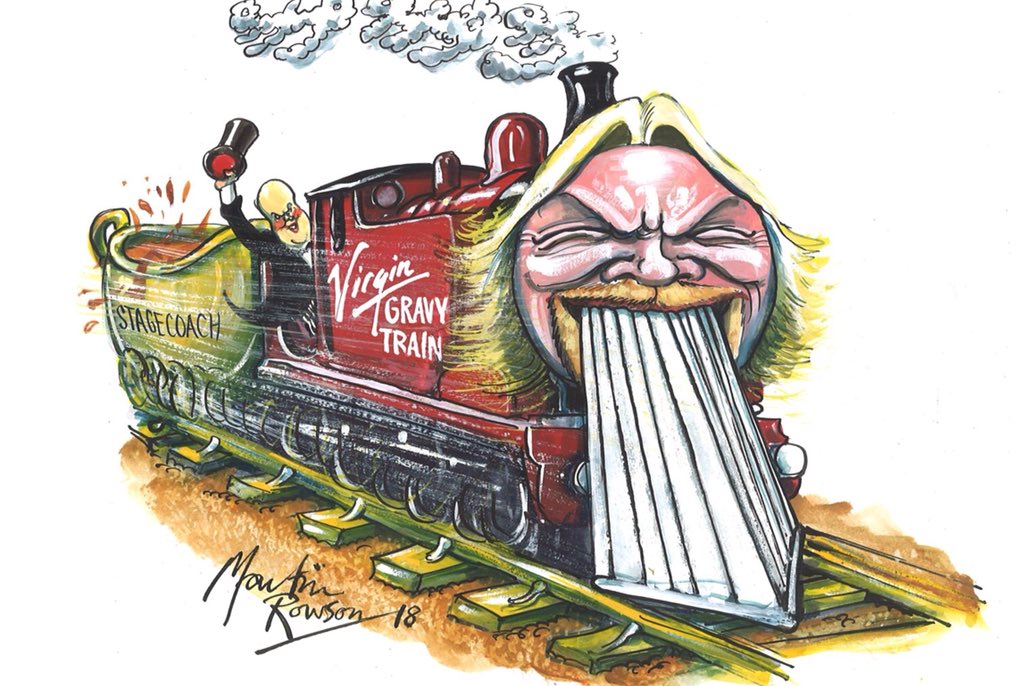
A great twitter picture based on Branson daring to complain about the fact that Virgin/Stagecoach have been barred from bidding for rail franchises, courtesy of Michael (@PrinceJasper):






































































































































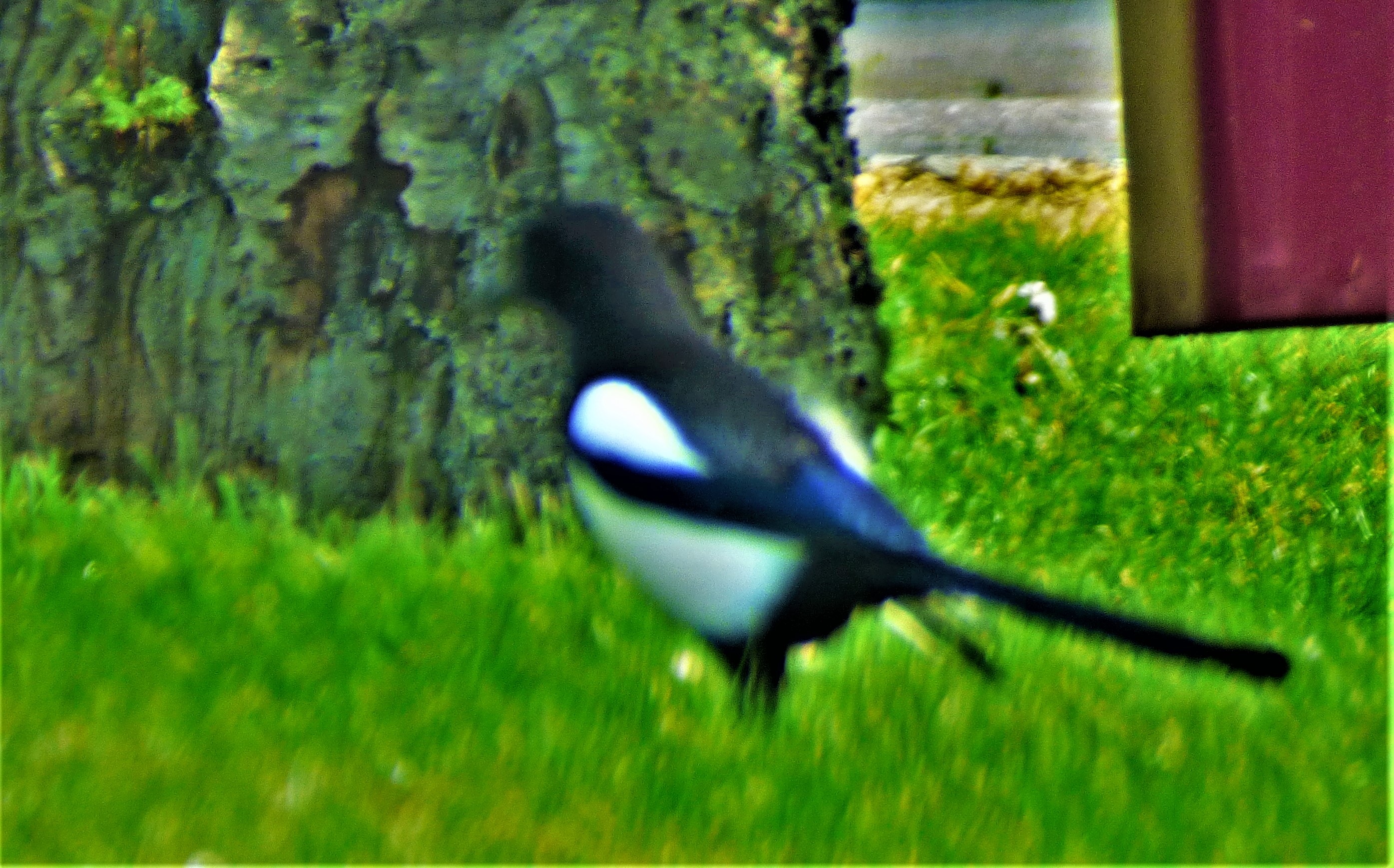

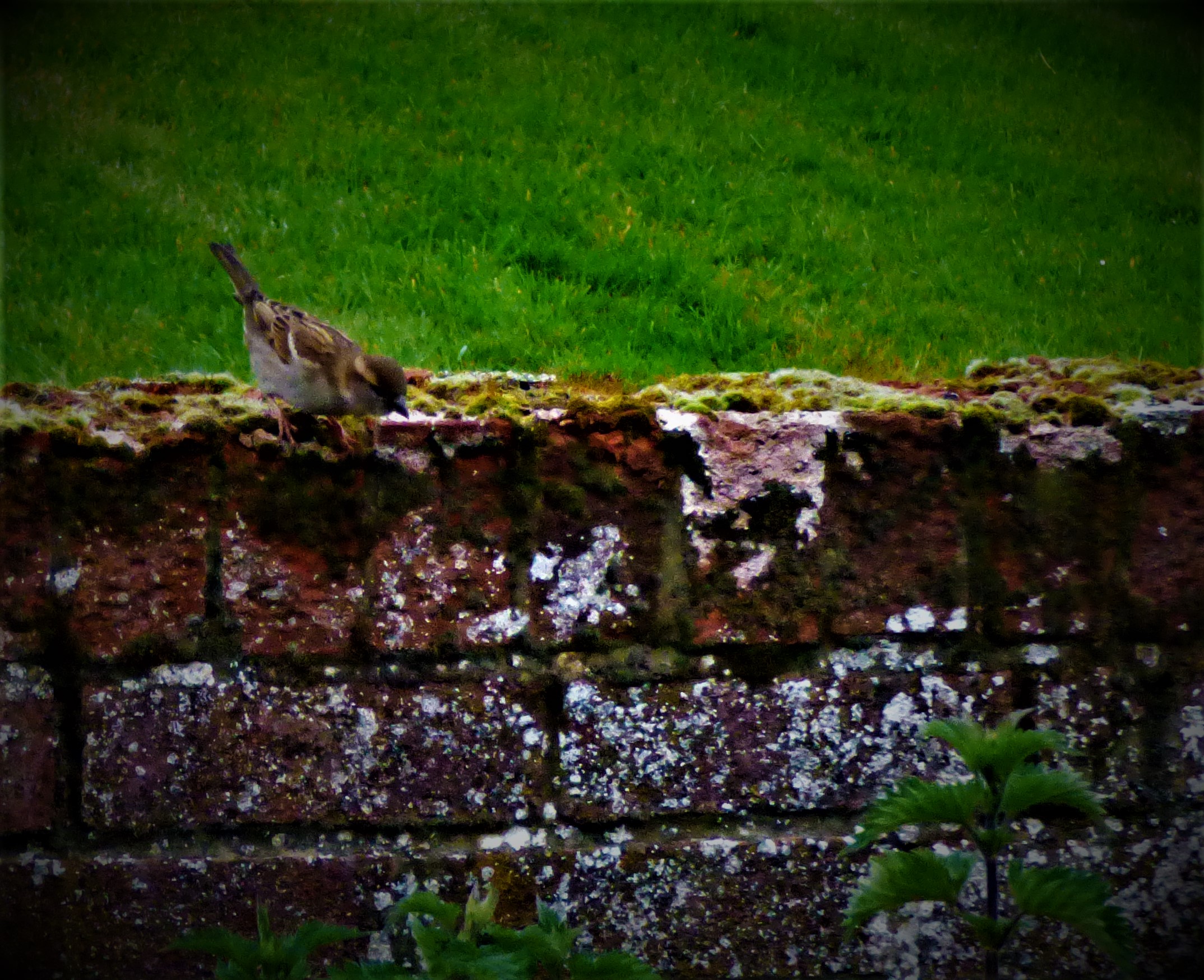

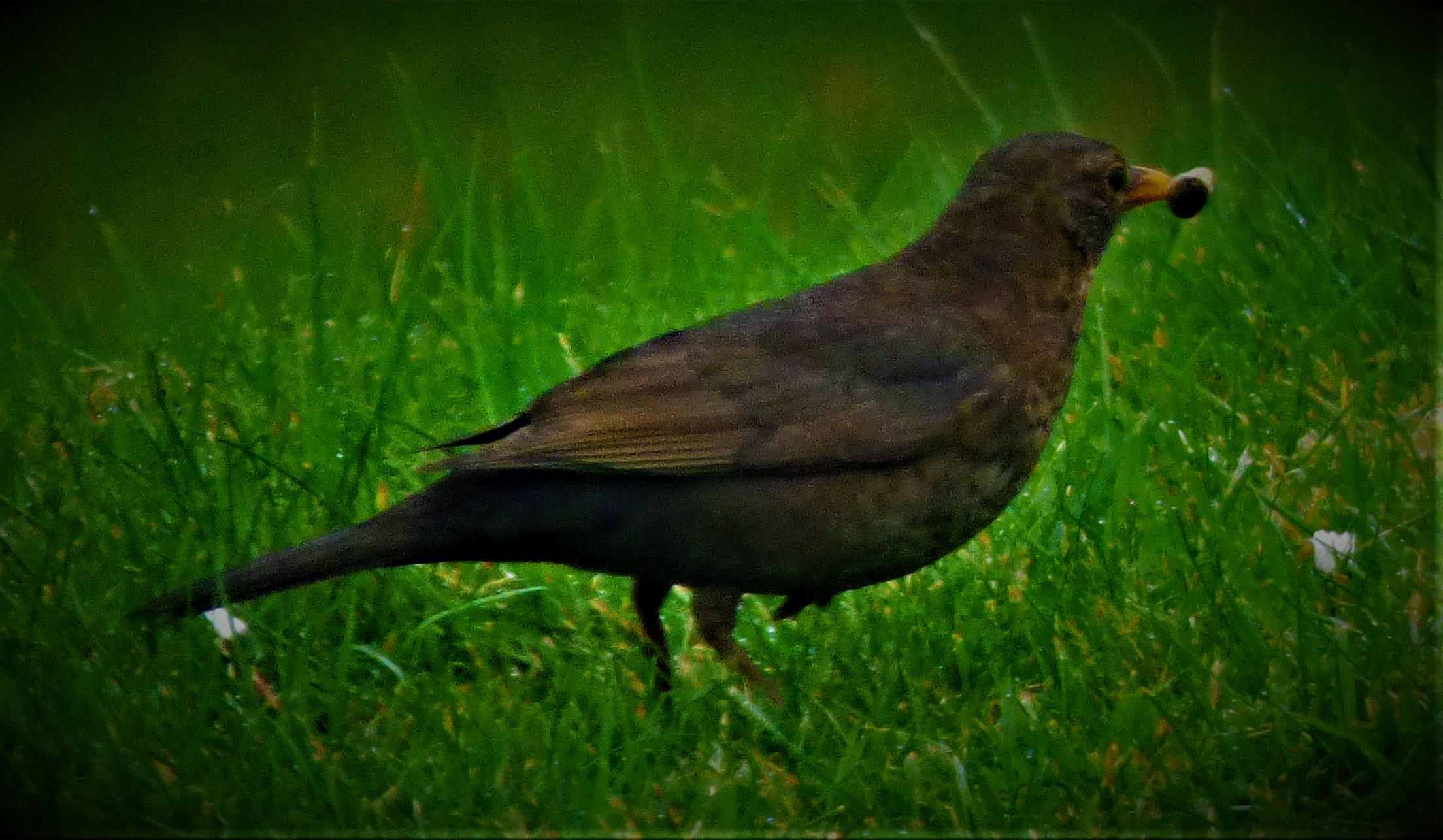







 aspiblog