All Time XIs – The CLR James Trophy

A variation on the ‘all time XI’ cricket theme inspired by CLR James’ great question “What do they know of cricket who only cricket know?” – contrives to touch on a huge variety of topics.

INTRODUCTION

Welcome to another variation on the all-time XI theme. This one requires a little preliminary explanation to set the scene, but first before getting into the main body of the post it is time for a…

CORRECTION AND APOLOGY

Some observant readers will have observed, as did one James Carroll on twitter that in yesterday’s post about New Zealand I somehow contrived to leave out Kane Williamson. So, following my usual ‘reverse tabloid’ policy in such matters I take this opportunity to redress the wrong: Williamson replaces Rutherford in the NZ My Time team and if absolutely mandated to do so I could accommodate him in the NZ All Time by dropping Martin Crowe. My thanks to Mr Carroll for being civil about making the correction and my apology to Mr Williamson for an inexcusable oversight.

EXPLAINING THE CLR JAMES TROPHY

The CLR James Trophy gets its name from the question at the heart of that classic cricket book “Beyond a Boundary”, “what do they know of cricket who only cricket know?” I pit two teams against each other of top level cricketers whose names give me non-cricketing links, with brief explanations of those links. I did consider honouring a former cricketer with a famously broad range of interests, Ed Smith and a polymath in Peter Medawar, but decided to stick with the CLR option. It is time to meet the first of our two XIs…

WG GRACE’S XI

  1. *William Gilbert Grace – right handed opening batter, right arm bowler of various types. The scorer of 54,896 first class runs and taker of 2,876 first class wickets, his parents’ eighth child and fourth son was named in honour of William Gilbert, Royal Physician to Queen Elizabeth I. He was among other things a pioneer in the field of magnetism, author of “De Magnete”, and subject of “Latitude” by Stephen Pumfrey. Another Gloucestershire physician, Dr Jessop, named his 11th child Gilbert, because it was WG’s middle name, while ‘The Champion’ had several cricketing cousins surnamed Gilbert as well.
  2. Alec Stewart – right handed opening batter. His average when picked for England in this specific role was 45 per innings. Here he gets in in order to publicize Professor Ian Stewart, author of a stack of books about mathematics, including a series of books of curios “Professor Stewart’s Cabinet of Mathematical Curiosities”, “Professor Stewart’s Hoard of Mathematical Treasurers” and “Professor Stewart’s Casebook of Mathematical Mysteries”, and many others such as “Does God Play Dice?”, “Nature’s Numbers” and “Taming the Infinite”.
  3. Kepler Wessels – left handed batter. The only man to score over 1,000 test runs for each of two different countries. In his case the connection is by way of his given name, to ground breaking astronomer Johannes Kepler.
  4. Bill Bruce – right handed batter. A successful Aussie of the 1890s. His analogue is Colin Bruce, author of “The Strange Case of Mrs Hudson’s Cat” and “Conned Again Watson”. These two books use stories featuring Baker Street’s most famous duo to explore mysteries of science, mathematics and logic.
  5. Merv Wallace – right handed batter. The Kiwi averaged 44 in first class cricket, but his few appearances at test level were not so successful. The non-cricketing link is Alfred Russel Wallace, co-discoverer of the theory of evolution by natural selection. The Wallace line, which runs (among other places) between Lombok and Bali marks the geological and zoological divide between Asia and Australia.
  6. David Hookes – right handed batter. The scorer of the fastest first class hundred by any Australian batter, in just 43 minutes. He is the only one whose name needs altering to create the non-cricketing links – deleting the final s gives Hooke, as in Robert Hooke, the great 17th century scientist, author of Micrographia, and well covered in John Gribbin’s “Science: A History 1543-2001”, while deleting the e from that surname provides a connection to philosopher Bell Hooks, who I learned a little bit about while studying philosophy as one of the modules of my degree.
  7. Franklyn Stephenson – right handed batter, right arm fast medium bowler. Our all rounder, one of only two since the reduction of first class fixtures in 1969 to have done the double of 1,000 runs and 100 wickets in an English season, and appropriately he is doing double duty. George and Robert Stephenson were both eminent engineers, among the pioneers of railway development. The most famous Stephenson design with a railway connection was of course ‘The Rocket’. Robert Louis Stephenson, a relative of the engineers, is famous as a novelist. I have read most of his books, the first one I read being “Kidnapped”, while I studied “Dr Jekyll and Mr Hyde” at degree level.
  8. +Jack Russell – wicket keeper, left handed lower middle order batter. His ‘alter ego’ is philosopher Bertrand Russell, author of many books, and one of the writers featured in “Portable Atheist”, edited by Christopher Hitchens.
  9. Xenophon Balaskas – leg spinner, capable right handed batter. His brief test match career does not look that impressive, but in 75 first class matches he scored 2,696 runs at 28.68 with a best of 206 and took 276 wickets at 24.11 with a best of 8-60. The original Xenophon was an Athenian who went to Sparta when his situation in his home city became untenable, signed up as a mercenary solider there and travelled to Persia as part of an army attempting to overthrow King Artaxerxes and place his brother Cyrus on the throne. After a battle in which Cyrus was killed, Xenophon and his men found themselves in deepest Persia under sentence of death, but managed to escape, and Xenophon eventually returned to Greece, writing up his adventures in a book he called Anabasis. This has been novelized by Conn Iggulden as “Falcon of Sparta”. Much later one Xenophon of Cos served as physician to the Roman Emperor Claudius, being mentioned in Suetonius’ “The Twelve Caesars” and also in the fictional setting of Robert Graves’ “I Claudius” and “Claudius The God”. Finally, to complete Balaskas’ ancient historical links his middle name was Constantine, linking him the first christian Roman Emperor.
  10. George Dennett – left arm orthodox spinner. Over 2,100 first class wickets and no England cap. He claims his place as second spinner by virtue of his surname, shared by philosopher Daniel C Dennett, among whose books are numbered “Darwin’s Dangerous Idea” and “Breaking The Spell”, both of which adorn my shelves.
  11. Danny Morrison – right arm fast medium bowler. He was one of the Kiwis best bowlers of the 1990s and his presence creates two splendid links. Toni Morrison won the Nobel prize for Literature for “Beloved”, and is also the author of a number of other hard hitting books – anything with her name on the cover will be worth reading. Boyd Morrison writes novels that combine action, adventure and elements of science and history – I have a copy of “The Noah’s Ark Quest” and can also recommend “The Tsunami Countdown”.

This team features a good top six, a genuine all rounder in Stephenson, a keeper who can bat, and three varied specialist bowlers. With Grace also worth his place as a bowler the bowling has depth and variety, with Stephenson and Morrison to take the new ball and Dennett, Balaskas and Grace to provide alternatives.

GREVILLE STEVENS XI

  1. Harold Dennis ‘Dickie’ Bird – right handed opening batter. Best known as an umpire, but he was a successful opening bat for Barnsley, and ultimately amassed two first class hundreds, with a best of 181 not out. David Bird is a prolific writer of books about Contract Bridge. He is particularly noted for his humorous stories featuring the monks of St Titus, the nuns of St Hilda’s and latterly staff and pupils alike at Cholmeley and Channing schools, located at opposite ends of the same village.
  2. Alan Melville – right handed opening batter. The South African had a splendid test record, including four successive centuries straddling World War II. His ‘alter ego’ is Herman Melville, author of “Moby Dick”.
  3. Hugh Massie – right handed attacking top order batter. He scored 55 in the original ‘Ashes’ test at The Oval in 1882, made out of 66 in under an hour – and had kicked off that tour with an innings of 206, a record first innings in England for an Aussie until 1930 when Bradman opened his English account with a score of 236. His non-cricketing counterpart is historical novelist Allan Massie, author of a series of Roman history themed books including “Augustus”, “Tiberius”, “Caesar” and “Nero’s Heirs”. “Augustus” features a wonderful spoof foreword taking on the persona of master of Michaelhouse College, Cambridge, one Aeneas Fraser-Graham, and declaring that ‘even a glimpse of a photostat is sufficient to assure one of the authenticity of these memoirs’.
  4. HJH ‘Tup’ Scott – right handed bat. Scott was one of three Aussie centurions at The Oval in 1884. He is not in fact here as an analogue for Captain Scott, although I commend to your attention the books about the ‘Captain Scott Invitational XI’ by Marcus Berkmann (“Rain Men” and tangentially “Zimmer Men”) and Harry Thompson (“Penguins Stopped Play”). No he has two ‘alter egos’ for my purposes, Walter Scott, prolific 19th century novelist and someone from whom Emily Bronte of “Wuthering Heights” fame drew inspiration, and Eugenie Scott of the Freedom From Religion Foundation, who was one of the contributors to “Scientists Confront Creationism”, edited by Andrew Petto and Laurie Godfrey and highly recommended by me.
  5. Colin Munro – left handed big hitting batter. The Kiwi averages over 50 in first class cricket, though he has only played a couple of tests and those unsuccessfully. He owes his place in this XI to Hector Munro, aka ‘Saki’, a master writer of short stories.
  6. *Greville Stevens – right handed batter, leg spinner. 10,376 first class runs at 29.56, 684 wickets at 26.84. At the close of the 1920 season it was he who ensured that the curtain would descend on Plum Warner’s career with an appropriately grand finish, by clean bowling Herbert Strudwick to settle the destiny of that year’s County Championship. He is here as a tribute the detective work of Daisy Wells and Hazel Wong, and the writing of their amanuensis Robin Stevens, who has created the ‘Murder Most Unladylike’ series to chronicle their exploits.
  7. Alonzo Drake – middle order batter, left arm orthodox spinner. The first Yorkshire bowler ever to take all ten wickets in an innings – 10-35 v Somerset in 1914, the outbreak of World War 1 finished his career. Although he is a namesake of Sir Francis Drake who famously played bowls on Plymouth Hoe it is actually another Drake, Frank Drake of SETI fame who gets him into this team. Frank Drake co-authored with Dava Sobel a book titled “Is Anyone Out There?” about the search for extra-terrestrial life. Sobel has a stack of other credits, including “Longitude”, “A More Perfect Heaven”, “The Planets” and “Galileo’s Daughter” all of which I recommend.
  8. +Ian Gould – wicket keeper and right handed lower order batter, later a successful umpire. ‘Gunner’ Gould just about merits his place as a keeper/batter, which makes it possible for me to bring in Stephen Jay Gould, USian scientist, science writer and master essayist. I own a number of his books, including “Questioning The Millennium”, “The Richness of Life”, “Life’s Grandeur”, “Bully for Brontosaurus”, “Ever Since Darwin”, “Dinosaur in a Haystack” and “Urchin in a Storm”. Given the amount of baseball that features in Gould’s oeuvre it seems quite appropriate to find a way a slipping him into a cricket themed post.
  9. Mitchell Johnson – left arm fast bowler, left handed attacking lower order bat. The Aussie’s claims for a place need no further elaboration, and he allows me two connections. Samuel Johnson, author of the first recognized dictionary is one. There was a road not massively far from where I lived as a child in south west London called Dr Johnson Avenue, and it had that name because he used to cycle that way when going to visit his friend Mrs Thrale, who also has a road named in her honour that is even closer to my old family home. I used to walk along Thrale Road very frequently because if one was using either Streatham or Streatham Common stations it was the natural way to go. The second connection is Charles Johnson, an African American writer whose books include “Oxherding Tale” and “Dreamer”, the latter based on the life of Martin Luther King.
  10. Max ‘Tangles’ Walker – right arm fast medium. He was a magnificent third string to Lillee and Thomson in the mid 1970s, gaining big movement in the air and off the pitch on occasions. At Edgbaston in 1975 when Mike Denness put Australia in and they scored 359 Walker matched Lillee’s five wickets in the first England innings with five of his own, before ‘Thommo’ turned chief executioner in the second dig. His ‘alter ego’ for my purposes is Alice Walker, well known as author of “The Color Purple”, and also the author of a collection of what she calls “Womanist Prose”, both of which come highly recommended. She became radicalized by her experiences as a student at Spelman College (although she left that institution and moved north the New York where she studied at Sarah Lawrence College), where she met the historian Howard Zinn, someone any of whose books will be worth reading. There is a quote from her which appears on the back cover of “The Zinn Reader”: “What can I say that will in any way convey the love, respect and admiration that I feel for this unassuming hero who was my teacher and mentor, this radical historian and people-loving ‘troublemaker’, this man who stood with us and suffered with us? Howard Zinn was the best teacher I ever had and the funniest.”
  11. Harry Boyle – right arm medium pacer. FR Spofforth’s regular bowling partner. He earns his place as one half of the first great Australian bowling duo. His ‘alter ego’ is Robert Boyle whose contribution to science is covered on pages 126-42 of John Gribbin’s “Science: A History 1543-2001”.

This team has a decent top five, a couple of genuine all rounders, a keeper who can bat, and three fine and varied bowlers. Johnson, Walker, Boyle, Drake and Stevens is a bowling attack that should not struggle overmuch to take 20 wickets.

THE CONTEST

WG Grace’s XI are the stronger in batting of the two, although no side who can send Johnson in at no9 can be considered deficient in that department. But I suspect that the bowling resources of Greville Stevens’ XI are stronger overall. However countering that is the undeniable fact that WG Grace’s XI have the better keeper. I believe this would be a very close and highly compelling contest, and I cannot pick a winner. Note that the presence of Mr Bird notwithstanding I have not selected players solely on the basis of their names – it is always what they offer as cricketers that comes first.

PHOTOGRAPHS

The correction has been made and due apologies issued, the CLR James Trophy has been introduced and the contending XIs have been put through their paces, so all that now remains is my usual sign off:

P1320469P1320456 (2)P1320457 (2)P1320458 (2)P1320460 (2)P1320461 (2)P1320466 (2)P1320467 (2)P1320468 (2)P1320470 (2)P1320471 (2)P1320473 (2)P1320474 (2)

P1320475 (2)
The best picture I have seen of ‘The Champion’ – this is the first page of the section on Batting in the Badminton Book of Cricket.

P1320476 (2)P1320478 (2)P1320479 (2)P1320479 (3)P1320480 (2)P1320481 (2)P1320482 (2)

P1320483 (2)
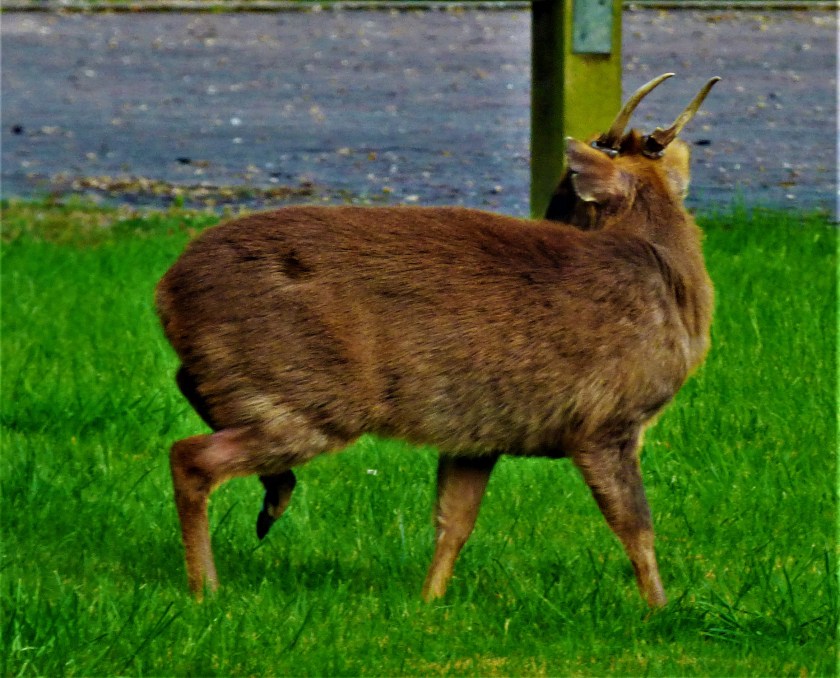
At about 11:30AM this muntjac put in a fleeting appearance.

P1320484 (2)P1320485 (2)P1320486 (2)P1320487 (2)P1320488 (2)P1320489 (2)

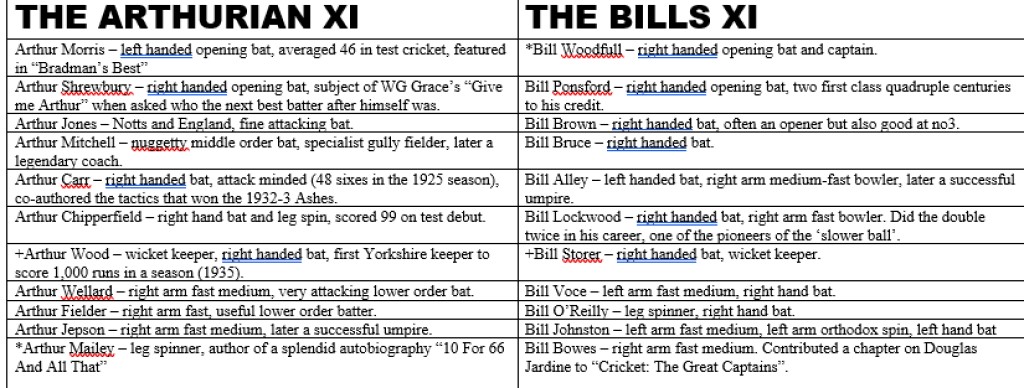
CLRJT1
Part 1 of publicity sheet
CLRJT2
Part 2
CLRJT
And the whole bolted together ready for public consumption.

All Time XIs – New Zealand

It being Monday, today’s exploration on the ‘all time’ cricket XI theme looks at an international unit, in this case New Zealand.

INTRODUCTION

Welcome to the latest in my series of ‘all time XI’ themed posts. Today being a Monday we are looking at an international outfit, and under the spotlight today is the land of the long white cloud (actually more often the land of the the thick black cloud) New Zealand.

NEW ZEALAND IN MY LIFETIME

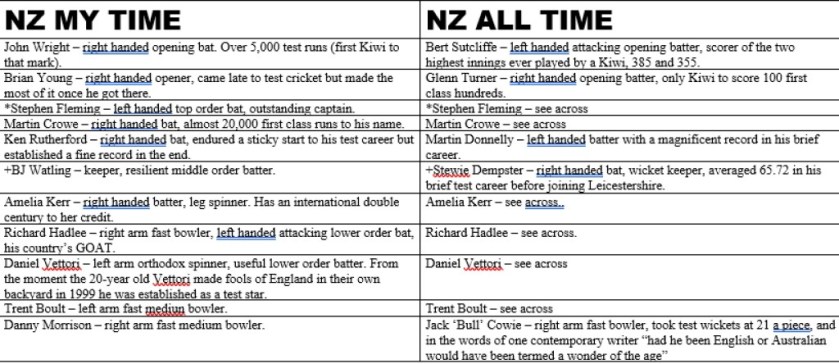
  1. John Wright – right handed opening batter. He was the first Kiwi to reach the landmark of 5,000 test runs. He was at one time successful for Derbyshire as well.
  2. Bryan  Young – right handed opening batter. He came late to this role but performed it conscientiously and successfully when the time came.
  3. *Stephen Fleming – left handed top order batter, excellent captain. A successful captain and a big run scorer, though a stickler would point the relative dearth of centuries in his record.
  4. Martin Crowe – right handed middle order batter. He scored almost 20,000 first class runs. His elder brother Jeff also played for NZ, though not so successfully. The other family link is that world famous actor Russell Crowe is a cousin. Martin Crowe’s maiden test century, against England in the 1983-4 series was the key innings that inspired his team to save a game that England has been bossing – Coney then made 174 not out and Lance Cairns played a useful supporting knock at the end. Against Sri Lanka, facing a huge first innings deficit he shared a New Zealand record partnership for any wicket with Andrew Jones, making 299 himself as the Kiwis reached safety on 671-4. He was unfortunate to find himself in the midst of a vicious controversy when Somerset named as overseas player in preference to either of the two West Indians Viv Richards and Joel Garner, which prompted the acrimonious departure from the club of Ian Botham.
  5. Ken Rutherford – right handed batter – his test batting career got off to a start that might have made a tail ender blush, but he ended up with a fine record, and was also a good captain for a period.
  6. +BJ Watling – wicket keeper and gritty middle order batter. He is the pivot of this side, and I have good cause to know just how dangerous he is – it was a long innings by him that out New Zealand in control of England’s last series there, a position they never relinquished.
  7. Amelia Kerr – leg spinner and right handed middle order bat. My pick is the genuine all rounder. As is all too common with the best female players she has not had the opportunity to show what she can do in long form cricket, but a 232 not out in a 50 overs a side international match plus her leg spin bowling is recommendation enough for me.
  8. Richard Hadlee – right arm fast bowler, left handed attacking lower middle order bat. Quite simply his country’s GOAT (Greatest Of All Time). What makes his performances at the highest level all the more impressive is that his support cast was generally speaking pretty ordinary. Graham Gooch, scorer of 183 not out against the 1986 Kiwis, the first to win a test series in England, described facing New Zealand as being like “facing a world XI at one end and Ilford 2nds at the other.” He became the first person knighted specifically in connection with cricket to play a test after acquiring the ‘Sir’ in front of his name (Bradman played his final first class match as Sir DG Bradman, while the Hon Sir FS Jackson was not knighted for reasons to do with cricket).
  9. Daniel Vettori – left arm orthodox spinner, useful lower middle order batter. At the age of 20 he helped consign England to the bottom of the world test rankings not long after they had been shown the door of the World Cup they were hosting, and from then until his retirement he was an essential part of New Zealand’s plans. In later years the captaincy and the fact that he also had to do a lot of batting somewhat reduced his effectiveness as a bowler, but the 1999 version bowled left arm orthodox spin as well as I have seen it bowled.
  10. Trent Boult – left arm fast medium bowler. The ‘conductor’ has been an effective leader of New Zealand’s pace attack for some years now, and just a few months ago he caused England considerable problems. He also gives my chosen pace attack an extra element of variety, bowling with his left hand.
  11. Danny Morrison – right arm fast medium. Danny ‘the duck’ (hence his position at no11) was New Zealand’s outstanding pace bowler of the 1990s, and could be relied on to provide excellent back up in that department for Messrs. Hadlee and Boult.

This team has a solid opening pair, an excellent no 3,4 and 5, a fine keeper at six, Amelia Kerr the x-factor all rounder at seven and a fine bowling line up. The bowling attack, with a varied pace trio of Hadlee, Boult and Morrison backed by the contrasting spin styles of Vettori and Kerr also looks pretty impressive.

HONOURABLE MENTIONS

Had it not been for Stephen Fleming’s claims, and my desire that he should be captain, Andrew Jones would have been a strong contender for the no3 slot, and some would say that I should have picked him as an opener anyway. Nathan Astle, an explosive batter and sometimes useful purveyor of slow-medium would definitely have his advocates, as would big hitting all rounder Chris Cairns. ‘Two Metre Peter’ Fulton would have his advocates for an opening slot. Among the seam/swing/pace options I have overlooked were Shane Bond, the quickest his country has ever produced but sadly blighted by injuries, Tim Southee the ever reliable and Neil ‘the composer’ Wagner whose bouncers sometimes confound opposition batters. Colin De Grandhomme, a magnificent limited overs player, might have had the number seven slot I gave to Kerr, but his bowling offers less. I also considered another big hitting female all-rounder, Sophie Devine, but decided I wanted the extra spin option offered by Kerr. Brendon McCullum would have his advocates for the wicket keeping slot, as would Adam Parore, while I also thought about Ian Smith, but he will have to make do with being part of the commentary team, for which role he is a ‘shoo-in’. Finally, combative off spinner John Bracewell would have been the obvious choice had I wanted a third spin option.

THE NEW NAMES IN THE ALL TIME XI

  • Bert Sutcliffe, a left handed attack minded opener, who averaged just over 40 in a test career that began at Christchurch in 1947 and ended at Edgbaston in 1965 comes in at the top of the order. For Otago against Canterbury he once scored 385. Otago’s all out tally in that innings was precisely 500, and in their two efforts Canterbury scored 382 runs off the bat – three fewer than Sutcliffe managed on his own! One over, bowled a chap named Poore, had Sutcliffe in two minds in the way bowlers don’t want – he hit three deliveries for four and three for six.
  • Glenn Turner, a right handed opening batter, the only Kiwi to score a hundred first class hundreds. During the Kiwis 1973 tour of England he reached his thousand first class runs before the end of May, one of only two to do that in an English season since World War II, the other being Graeme Hick in 1988.
  • Martin Donnelly, left handed middle order bat, scorer of Lord’s centuries in The Varsity Match, for The Gentlemen against The Players and in a test match for New Zealand. Also, in a 1945 match for The Dominions against England he made a century, considered by observers the outstanding innings in a game that also featured a ton by Keith Miller and one in each innings by Wally Hammond.
  •  +Stewie Demspter – right handed batter, wicket keeper. Charles Stewart Dempster played a mere 10 test matches for New Zealand, before devoting himself to county cricket with Leicestershire. In this 10 test matches he scored 723 runs at 65.72, assisted it is true by four not outs, but even not taking the not outs into account that average would still be 48.20. Selecting him as keeper, a role he did on occasion perform, was the only way I could fit him in.
  • Jack ‘Bull’ Cowie – right arm fast bowler. He took his test wickets at 21 each, and one contemporary writer was moved to comment “had he been English or Australian he would no doubt have been termed a wonder of the age.” His last test series was in 1949 at the age of 37, and even then on flat pitches (all four test matches were drawn) he caused plenty of problems.

With these players coming in our All Time New Zealand XI reads: B Sutcliffe, GM Turner, *S Fleming, MD Crowe, MP Donnelly, +CS Dempster, AC Kerr, RJ Hadlee, DL Vettori, T Boult, J Cowie. This combo, with a great opening pair, Dempster in for Watling and Cowie looking a distinct cut above Morrison looks like a superb unit.

HONOURABLE MENTIONS

Merv Wallace, who came close to 1,000 first class runs before the end of May on that 1949 tour was considered for a batting place. John Richard Reid, a man whose range of cricketing skills was huge, was also a big miss. Middle order batters Geoff Howarth and Bevan Congdon both had good records at a time when New Zealand collectively had little to shout about. Two keepers, Eric Petrie and Ken Wadsworth, were both outstanding practitioners, but neither could offer much with bat, Petrie in particular being a genuine ‘bunny’ in that regard. Brian Taylor, who scored a century and bagged a five wicket haul on his test debut earned consideration as an all rounder, but there is no shortage of pace options. Of the cricketing Hadlees, other than Richard the only one who many would seriously consider was Dayle, a fast bowler who at one time was rated higher than his brother, but ended up many leagues behind. New Zealand have had few class spinners play for them, which leads neatly on to…

THE ONES WHO GOT AWAY

One name dominates this category, that of leg spinner Clarrie Grimmett, who crossed the Tasman to better himself. He failed to claim a place in either the NSW or Victorian state sides, but eventually managed to establish himself for South Australia, and at 33 made his test debut for his adopted country, bagging 11 England wickets for 82 runs. In 37 test matches he took 216 wickets, a wickets to matches ratio outstanding for anyone not named Sydney Barnes. He was dropped for the 1938 Ashes tour, a decision that Bill O’Reilly for one considered to be crazy – Frank Ward who travelled in his place did little, while Chuck Fleetwood-Smith had his moments but was as erratic, unpredictable and expensive as anyone familiar with his approach would have expected.

Two others who would have merited consideration had they not abandoned the possibility of playing for their country were leg spinner Bill Merritt whose first class victims (mainly for Northamptonshire) cost 24 each and fast bowler Tom Pritchard who had an impressive record for Warwickshire (818 wickets at 23.30 in all first class cricket, and he lived – just – long enough to celebrate the most impressive of all centuries, dying 165 days after reaching that landmark birthday).

PHOTOGRAPHS

We have concluded our virtual tour of the home of The Lord of The Rings and The Hobbit movie series, and it remains only to apply my usual sign off…

P1320425 (2)P1320427 (2)P1320428 (2)P1320429 (2)P1320430 (2)P1320431 (2)P1320432 (2)P1320433 (2)P1320434 (2)P1320435 (2)P1320437 (2)P1320438 (2)P1320440 (2)P1320441 (2)P1320442 (2)P1320444 (2)P1320445 (2)P1320446 (2)P1320447 (2)P1320448 (2)P1320449 (2)P1320450 (2)P1320451 (2)P1320452 (2)P1320459 (2)P1320462 (2)P1320464 (2)P1320465 (2)P1320469

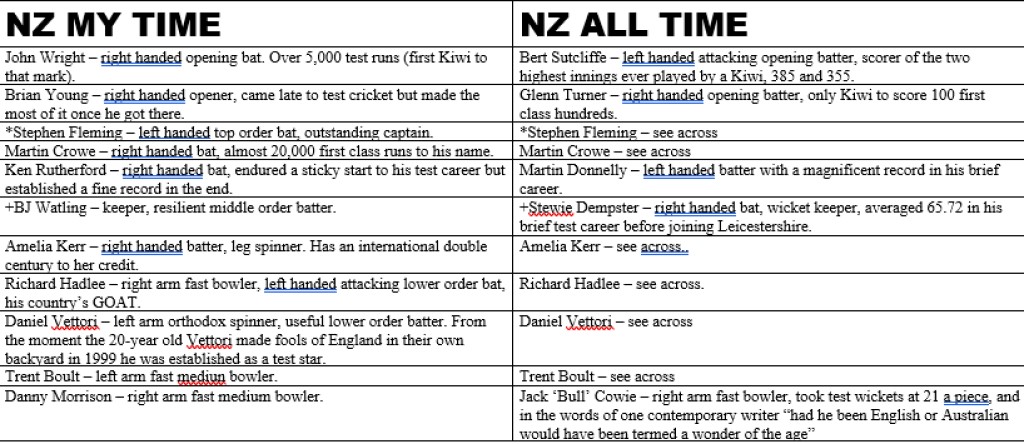
NZ
The teams in tabulated form, with abbreviated comments.


All Time XIs: No Surname v All Surname

My latest variation on an ‘all time XI’ cricket theme. Also features photographs. Read and enjoy!

INTRODUCTION

Welcome to today;s variation on the ‘All Time XI‘ theme. In this post a team who appear deficient in the surname department pit their wits against a team who seem to be all surname.

THE NO SURNAME XI

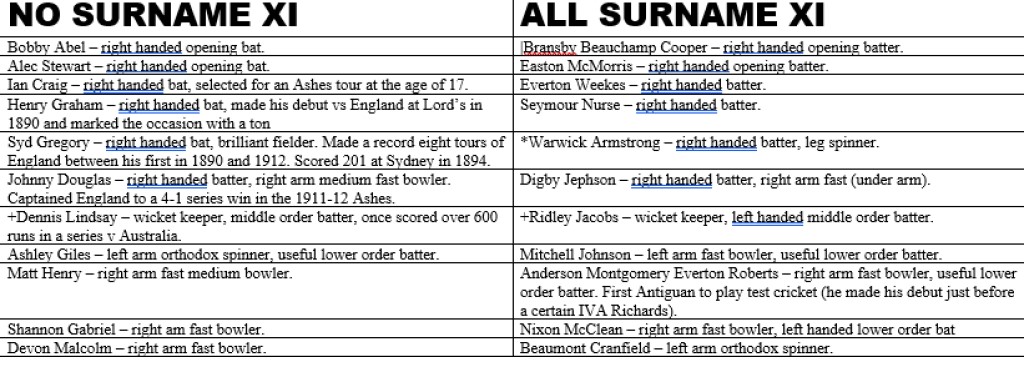
  1. Bobby Abel – right handed opening bat. We have met the Surrey man before in this series, playing for Davids v Goliaths among others. Abel as a given name of course goes all the way back to the beginning of the Bible. In my more recent times two fictional Abels are Abel Whittle who has a bit part in Thomas Hardy’s “The Mayor of Casterbridge” and Abel Fearon, villain in “Steps To The Gallows”, the second book in a series by Edward Marston that currently runs to four books.
  2. Alec Stewart – right handed opening batter. We met him in the very first post in this series, dedicated to Surrey. Stewart spelt that way does sometimes feature as a given name, even of Stuart is the more common version. A cricketing Stewart is the illustrious Stewart ‘Stewie’ Dempster, who we will be making the acquaintance of in tomorrow’s post.
  3. Ian Craig – right handed batter. The Aussie was a mere 17 years of age when selected for the 1953 Ashes tour. He never quite delivered at the very highest level, though at Old Trafford in 1956 he battled over four hours for 38 in the second Aussie innings.
  4. Harry Graham – right handed batter. He made his test debut at Lord’s in 1890 and marked the occasion with a ton. The next person to make their debut at Lords with a ton was John Hampshire v West Indies in 1969.
  5. Syd Gregory – right handed batter, excellent fielder. Between his debut in 1890 and has retirement in 1912 Gregory made a record eight tours of England. His finest batting hour came at Sydney in 1894 when he scored 201, helping Australia to a score of 586. Australia ended up losing that one by 10 runs however. In the 1902 match at Old Trafford, which his side won by three runs he took a crucial catch in the England second innings to account for Stanley Jackson.
  6. *Johnny Douglas – right handed batter, right arm medium fast. Douglas took over from Pelham Warner, rendered hors de combat by illness as captain of the 1911-2 Ashes side and guided them, with some important assistance from the sick Warner, to a 4-1 series triumph. 21 years later under the captaincy of a man with the given name Douglas, Mr Jardine, England would duplicate that 4-1 winning margin in Australia.
  7. +Dennis Lindsay – wicket keeper, middle order batter. The stumper once scored over 600 runs in a series versus Australia, in which he also effected over 20 dismissals.
  8. Ashley Giles – left arm orthodox spinner, useful right handed lower order batter. Before the 2005 Ashes series began Terry Alderman stated that “if any Aussie batter gets out to Giles they should go hang themselves.” By the end of that series Giles had accounted for each of the top eight in the Aussie order at least once and intervened twice crucially with the bat. At Trent Bridge he kept his nerve in a very tense finish to put England one up with one to play, and then at The Oval he played a crucial support role while Pietersen was destroying the Aussie bowlers, holding up his end for over two hours and amassing 59 runs of his own. This meant the Australia needed 342 from 18 overs when the England innings ended, an impossible chase even had the weather not intervened one last time (of course given the difference between losing and drawing the series Australia would but for the weather have been obliged to throw everything at attempting this crazy run chase, the draw being valueless to them, and 1-3 very little worse than 1-2).
  9. Shannon Gabriel – right arm fast bowler. The West Indian, part of a cricketing revival in that part of the world after a dreadful period in the early 2000s, is the heir to a great fast bowling tradition. For those who feel that he properly belongs in the other XI, most of the names that come up when I search cricinfo using the name Shannon are of players with forename Shannon, and I also give you current US politician Shannon Bearman. Gabriel is well documented as a given name, going back to the archangel, but I offer you as further examples composer Gabriel Faure and one of the principal characters in Thomas Hardy’s “Far From The Madding Crowd”, Gabriel Oak.
  10. Matt Henry – right arm fast medium bowler. The Kiwis have produced a lot of purveyors of pace/ seam and/or swing over the years (contrary to what some may think, New Zealand is actually an even cloudier country than England, so there is even more natural encouragement for that kind of bowling), and Henry is part of the current crop along with such luminaries as Lockie Ferguson, Trent ‘the conductor’ Boult and Tim Southee (Neil ‘the composer’ Wagner does not wholly count, since although a Kiwi he is actually a product of South Africa).
  11. Devon Malcolm – right arm fast, genuine no11. In the immortal words of then England chairman of selectors Ted Dexter “Who could forget Malcolm Devon?”.

This then is the ‘no surnames’ XI, with a solid top five, an all rounder, a keeper who can certainly bat, and four specialist bowlers. It is short in the spin department, with only Giles as a front line option there, but it still looks a decent side, especially given the actual selection criteria!

THE ALL SURNAME XI

  1. Bransby Beauchamp Cooper – right handed opening bat, born in what is now Bangladesh but was then part of India, raised in England and played his two test matches, the first two ever contested, for Australia. He and WG Grace playing for the Gentlemen against the Players shared a then first class record opening stand of 283, Cooper 101, Grace 180.
  2. Easton McMorris – right handed opening bat. He churned out runs in domestic cricket in the Caribbean, but his test returns were disappointing.
  3. Everton Weekes – right handed batter, lends some much needed class to this side. Everton is not a hugely common surname, but some of my readers may remember snooker commentator Clive Everton, and additionally Weekes’ middle name of De Courcy is the surname of a former Australian batter James De Courcy, who toured England in the 1950s.
  4. Seymour Nurse – right handed batter with a fine record.
  5. *Warwick Armstrong – right handed batter, leg spinner. Although George Giffen, whose playing days overlapped with those of the Gloucestershire legend, was dubbed ‘The WG Grace of Australia’, this man was in many ways a better fit for that moniker. He once tallied 2,000 first class runs and took 100 first class wickets on a tour of England. He captained Australia to a 5-0 triumph in the 1920-1 Ashes, a scoreline not duplicated in Ashes series until 86 years later, when Ponting and company exacted a devastating revenge on England for 2005, and secured retention of the urn by guiding his team the victories in the first three matches of the 1921 series, before the final two games were both drawn. His eventful life can be read about in full in Gideon Haigh’s “The Big Ship”, a title derived from one of Armstrong’s nicknames. At the end of his career he weighed in at 22 stone. I am aware that Warwick is a recognized forename, but I also give you singer Dionne Warwick as an example of it as a surname.
  6. Digby Jephson – right handed bat, right arm fast (under arm). Digby Loder Armroid Jephson to give him his extraordinary full name started the brief revival of under arm bowling in first class cricket that was taken into the test arena by George Simpson-Hayward. Again, Digby is not entirely unknown as a given name, but I can also point to Fraser Digby, former goalkeeper for Swindon Town FC and Andrew Wingfield-Digby, former captain of Dorset in mim. nor counties cricket and briefly chaplain to the England cricket team. Also of course there was the 17th century courtier Kenelm Digby who had a later cricketing namesake who played eight first class matches between 1855 and 1859.
  7. +Ridley Jacobs – wicket keeper, left handed middle order batter. Many years ago there was a government minister named Nicholas Ridley, while in a cricket context Arthur Ridley played in the 1870 Varsity Match (‘Cobden’s Match’) and also played for the MCC in the 1878 match against the Australians that was done and dusted in a day.
  8. Mitchell Johnson – left arm fast bowler, left handed lower order bat. We met him when I turned the spotlight on Australia. This is a player who can form an intermediary in cricket linkages – Yorkshire player and later coach Arthur Mitchell, or commentator Alison Mitchell being obvious starts and West Indian opening batter Johnson Charles being the next link.
  9. Anderson Montgomery Everton Roberts – right arm fast bowler, right handed lower order batter. The first Antiguan to play test cricket, being selected just before Viv Richards gained the honour, and the original leader of the four pronged pace assault that propelled the West Indies to the top of the cricket world.
  10. Nixon MccLeanright arm fast bowler, left handed lower order batter.
  11. Beaumont Cranfield – left arm orthodox spinner for Somerset. 137 matches yielded him 621 wickets at 23.98. Of course Beaumont is very well documented surname, the most obvious cricketing example belonging at the other end of the batting order – Tammy of that ilk.

The all surname team has a solid top six, two of whom are genuine all rounders, a keepr who can bat and four bowlers. Johnson, Roberts, MacLean, Cranfield, Armstrong and Jephson is an attack should not struggle to take 20 wickets.

THE CONTEST

Notwithstanding the question marks over both openers for the ‘All Surname’ XI I still reckon they have a clear edge – their bowling attack looks much the stronger and has greater variety. On a turning pitch Giles on his own would not be a match for Cranfield and Armstrong, while if the pitch offers pace bowlers assistance Johnson, Roberts, MacLean and Jephson clearly offer more than Malcolm, Gabriel, Henry and Douglas. I am not going to take my prediction from the ‘Pidge’ McGrath handbook, but I would confidently predict that the ‘All Surname XI’ would win a five match series 4-1.

A BRIEF NOTE ABOUT THE
COMPOSITION OF THESE ELEVENS

I compose these XIs mentally, jotting them down in a notebook preparatory to then creating the tables with abbreviated comments that I use to advertise the contents of the teams and ultimately typing up the blog posts. I use cricinfo to find out details about players, but not in general as a selection tool – sometimes if I am a player or maximum two players short of a full XI I will do a bit of hunting, but most of the players I select are players I have across in my thirty-odd years of being a cricket fan and reading about the game – no game has a greater wealth of literature than cricket. I am already prepped in terms of selections for further posts up to and including Wednesday, plus a post which for reasons I will reveal on that day has to appear a week today.

THE FINISHING LINE

The pinchhitter has reached 300 not out – yes, today’s offering in which I get yet another mention, is the 300th post that blog has produced. A little etymological note: the term pinch hitter originated in baseball, where it referred to sending in a batter who adept at getting on base in preference to a regular batter who may be less reliable, it was pressed into cricket service in the 1990s to refer to batters who did not regularly open in long form cricket but were asked to do so in one day cricket in an effort to get their teams off to a fast start. The first successes with this method were Ian Botham and Mark Greatbatch, deployed in this manner by their countries in the 1992 World Cup, but it was four years later, when Kaluwitherana of Sri Lanka, Mark Waugh of Australia, Sachin Tendulkar of India and various others were used in the same fashion that the term became popular. Certain teams overdid it by using lower order batters rather than actual recognized batters (Zimbabwe tried it with Paul Strang, England with Neil Smith as opposed to Robin ‘Judge’ Smith who they should have used and there were probably others. And now it is time for my usual sign off…

P1320388 (2)P1320391 (2)P1320393 (2)P1320394 (2)P1320396 (2)P1320397 (2)P1320398 (2)P1320399 (2)P1320400 (2)P1320401 (2)P1320402 (2)P1320405 (2)P1320406 (2)P1320407 (2)P1320408 (2)P1320409 (2)P1320410 (2)P1320411 (2)P1320412 (2)P1320413 (2)P1320415 (2)P1320416 (2)P1320417 (2)

P1320418 (2)
This muntjace put in an appearance last night – more pics in tomorrows post, as I had a surplus.

P1320419 (2)P1320420 (2)P1320421 (2)P1320422 (2)P1320423 (2)P1320424 (2)P1320426 (2)P1320448 (2)No Surname v All Surname

All Time XIs – Day In The Sun vs Supporting Cast

My latest variation on the all-time XI theme in which a team of players who had a day in the sun take on a team of supporting acts.

INTRODUCTION

Welcome to the latest in my series of ‘All Time XI’ posts. This one pits a team of players who produced one glorious performance that set them apart from the common run of cricketers but never succeeded in duplicating it against a team representing the best of cricket’s supporting cast (yes cricket needs its supporting cast too, and the folk I have picked were superb examples).

THE ‘DAY IN THE SUN’ XI

  1. Charles Bannerman – right handed opening bat. He completely dominated the first test ever played in March 1877, scoring 165 out of Australia’s first innings 245, in a match in which only one other person, England’s Harry Jupp topped fifty in a single innings. This not only accounted for three quarters of his entire test run tally, it was his only first class hundred. Minus this astonishing performance the Woolwich born Aussie amassed 1522 runs in first class cricket for 78 times out, giving an average of 19.64 (with his one big innings included that average was 21.62).
  2. David Lloyd – left handed opening bat, occasional left arm orthodox spinner. He played nine test matches for England and 14 of his 15 innings at that level brought him 338 runs at an average of 26.00, a very modest looking record. The one innings I have excised from that reckoning was sole 50 plus score at that level, a mere bagatelle of 214 not out that earned him his place in this XI and means that his actual test average was 42.46. For his native Lancashire Lloyd played a curious role in one of most extraordinary first class games ever. On day 1 Warwickshire declared at 523-4 in their first innings, Humpage 254, Kallicharran 230 not out, and has captured Lloyd’s wicket by the close of play. On the journey home that evening Lloyd told his passenger Graeme ‘Foxy’ Fowler “I reckon we’ll win this one”. The following day Fowler injured himself and Lloyd was sent in to act as his runner. Fowler scored 128, Lancashire declared at 414-6 just in case something curious was going to happen. On the third morning a sea fret (the match was being played at Southport) covered the ground and West Indian swing bowler Les MacFarlane found it to his liking, recording a career best 6-59 as Warwickshire slumped to 111 all out in their second dig. Lloyd decided he wanted a few runs of his own second time round rather than settle for running Fowler’s, so Ian Folley, a left arm spinner and tailend batter was deputed to act as runner for Fowler. Fowler was 126 not out, and Lloyd 88 not out when Lancashire completed an astonishing victory by ten wickets, the winning hit being a six off Asif Din, and Lloyd’s throwaway line on the journey home on day 1 was vindicated in some style. Lloyd went on after his playing days were done to become a fine commentator and a decent coach. After a draw, which Zimbabwe had secured with the assistance of some fairly blatant time wasting and some deliberately wide bowling, the then England coach Lloyd had a public meltdown declaring “We flippin’ murdered ’em”.
  3. *Heather Knight – right handed bat, occasional off spinner, fine captain. Heather Knight spared England’s blushes in one test match with a magnificent 157. Other than that marvellous knock her test record reads 229 runs at 20.82, and she has only two other fifties to her name at that level. The women do not get to play nearly enough test cricket, and having just turned 29 Knight is still young enough to render herself ineligible for this team, especially if the amount women’s test cricket increases. Her record in ODIs is impressive for a non-opener, with an average of 37.83. She is a shoo-in for the captaincy of this side, and if and when she plays the test innings that renders her ineligible for it no one will be more delighted than me.
  4. Tip Fosterright handed batter, 287 in his first innings as a test batter, at Sydney in 1903, increasing the record individual score at that level by 76. The Worcestershire ace, the only player to captain England men’s sides at both cricket and football, scored only 315 further test runs 13 more innings at that level, with one solitary fifty, a very fortuitous 51 against South Africa. His average with his virtuoso effort removed is therefore a very mortal looking 24.23 – as opposed to 46.30 with it included.
  5. Faoud Bacchus – right handed batter. Sheik Faoud Ahamul Fasiel Bacchus to give him his astonishing full name played 19 tests for the West Indies, making 30 visits to the crease. 29 of those of 30 knocks brought him 532 runs at 19.34, while the innings missing from that reckoning, his lone foray into three figures at the highest level, was worth a cool 250, increasing his average to 26.06.
  6. +Taslim Arif – right handed bat, wicket keeper. Picked for Pakistan in six test matches, in which he took six catches and executed three stumpings, the wicket keeper played 10 innings. In nine of them his tally was 291 runs with a single red inker to boost the average to a respectable 36.375, including two half centuries. The missing innings was a gargantuan 210 not out, giving him a full test record of 501 runs 62.625. In his case, given his perfectly respectable record outwith the double hundred that gets him into this team, the question seems to be why was an apparently competent keeper who could definitely bat only picked six times for his country?
  7. Ted Alletson – right handed batter, right arm medium pace bowler. When the players broke for lunch on day three of the Sussex v Nottinghamshire match at Hove in 1911 Sussex would have been anticipating a comfortable victory – Notts at 260-9 were less than 90 to the good, and although Alletson, 47 not out in his fifty minutes at the crease to date, had struck some meaty blows the end of the Notts resistance could not be long delayed. It was delayed for 40 minutes of that post lunch session, which was enough for Alletson to write himself into the record books. By the time he finally holed out off the bowling of George Cox, those 40 crazy minutes had seen Alletson increase his score by 142 to 189, with Bill Riley the no 11 batting sensibly for 10 not out. Tim Killick had been smashed for 34 in one over, having hindered himself by sending down two no balls, and had gone for 22 in another. There was a skating rink across the road from the Hove ground in those days and by the time Alletson had finished five cricket balls were on the roof of that building. Having been anticipating a comfortable victory a shell shocked Sussex lost some early wickets and ended up being grateful to escape with a draw. That 189 in 90 minutes remained Alletson’s only three figure score in first class cricket, and he finished with a first class average of 18.59, while his medium pacers netted him a mere 33 wickets in his 119 matches. Alletson benefitted from his innings to the tune of £100, then a significant amount of money, from his father’s employer and his mentor the Duke of Portland (Portland is on the southwestern tip of Dorset, but the main Portland estate is (or was) in Nottinghamshire). His Grace was not the only one to have expected big things from Alletson – Gilbert Jessop who knew a thing or two about big hitting batting had also reckoned that there were likely to be big scores as well as big hits from Alletson’s bat.
  8. Denis Atkinson – right handed bat, off spinner. A respectable but far from outstanding cricketer who contributed with both bat and ball but did not set the world alight save once. The West Indies were six wickets down against Australia when Clairmonte Depeiaza joined Atkinson, and the Aussies were probably already thinking about batting, but they were in for a rude shock. By the time the seventh wicket fell the West Indies score had advanced by 347 runs. Atkinson scored 219, Depeiaza 122, and neither of them had previously made a test ton. nor ever would again. Setting that 219 to one side Atkinson’s record in test cricket reads 703 runs at 25.11 and 47 wickets at 35.04. The 219 raises that batting average to 31.
  9. Bob Massie – right arm fast medium bowler. England had won the first match of the 1972 Ashes series, and Massie came into the Australian side for his debut at Lord’s. The ball swung crazily in that match, and the chief beneficiary was Massie who finished his debut with 16-137. Massie made five further test appearances, and they brought him a combined 15-510, 34.00 per wicket, meaning that he finished with 31 test wickets at 20.87. Immediately after the 1972 Ashes the Aussies headed for the West Indies, and with the ball not moving under Caribbean sunshine Massie attempted to alter his action so as to increase his pace and ended up losing his ability to swing the ball.
  10. Devon Malcolm – right arm fast bowler. The Derbyshire, Northamptonshire and Leicestershire speedster and genuine out and out tail ender played 40 test matches for England between 1989 and 1997, being like many of his contemporaries in and out of the side frequently. Against South Africa at The Oval in 1994 he was hit on the helmet by a bouncer from Fanie De Villiers, and when South Africa batted again he produced a quite awesome response of his own with the ball – he took 9-57, the best figures ever by an England fast bowler in a test match, and just five runs worse than the all-time fast bowler’s test record analysis, Richard Hadlee’s 9-52 v Australia. 18 months after this ultimate day in the sun Malcolm and then England supremo Ray Illingworth had a decisive falling out during a tour of South Africa, although Malcolm did come back into the England team briefly after Illingworth had departed the scene. Malcolm took 128 wickets in test matches at 37.09, but he was handled poorly at England level, and was never given a second genuine out and out speedster to support him.
  11. Narendra Hirwani – leg spinner. Against the West Indies at Chennai in 1988 he burst onto the test scene by destroying them in both innings to record match figures of 16-136. 16 further test matches brought him precisely 50 more wickets for 1851 runs, 37.02 per wicket.

This team has a strong top five, a keeper-batter at six, a big hitting no seven, an off-spinning all rounder at eight and three specialist bowlers. There is a good range of bowling options, and all 11 could produce the match winning performance if it is their day.

THE SOLID SUPPORTERS XI

  1. Percy Holmes – right handed opening batter. No 2 to Herbert Sutcliffe at Yorkshire, and denied England opportunities by the presence of Jack Hobbs. He averaged over 40 at a time when few managed that, and at the time of his retirement had five of the ten highest individual scores ever made for Yorkshire under his belt. In a curious coincidence he and Sutcliffe were eight years apart in age to the day.
  2. Andrew Sandham – right handed opening batter. The southern equivalent of Holmes, opening the Surrey batting alongside Hobbs, and like Holmes not getting many opportunities at England level.
  3. Larry Gomes – left handed batter. The West Indies in the 1980s were noted for fast bowlers and stroke making batters. However, one key piece of the jigsaw at that time was a solid, dependable number three who without tearing up record books was frequently at the heart of a big West Indies score. Hilary Angelo Gomes made two centuries during the 1984 ‘blackwash’ series and was at the other end on 92 not out playing the quiet support role when Gordon Greenidge’s pyrotechnics won the Lord’s match after West Indies had been set 344 in less than a full day. There is a post about him here, which I urge you to read. If cricket had ever had an equivalent to the Oscar for ‘best supporting actor’ Gomes would have had a shelf full of them. 60 test matches brought him 3,171 test runs at 39.63 with nine centuries and a best of 143 – just compare with ‘Dependable Denly’ and his average of 30.00 in a similar role.
  4. *Herby Collins – right hand bat, occasional left arm orthodox spin. Australian captain after Warwick Armstrong, 19 test appearances brought him 1,352 runs at 45.06.
  5. Wilf Barber – right handed bat. An unobtrusive but vital cog in the Yorkshire machine that dominated the 1930s. He was picked twice for England, but it his first class record of 16,402 runs at 34.38 with 29 centuries that gets him in here.
  6. Bertie Buse – right handed bat, right arm medium fast. 10,623 first class runs, including seven centuries, 657 first class wickets including 20 five fors. For many years Somerset would never dream of taking the field without him.
  7. Ernie Robson – right arm medium fast, right handed bat. 1,147 wickets with his bowling (his out swinger was still an effective weapon after he had turned 50 – are you reading this Jimmy?) and 12,620 runs with his batting in  a career that ebgan in 1895 and ended in 1923.
  8. +Colin Metson – wicket keeper, right handed bat. Over the years England selectors have seemed to be afflicted by a curious visual handicap that restricts how far west they are capable of seeing, and one victim of this was the stalwart Glamorgan wicket keeper who took 561 catches and executed 51 stumpings in the course of 232 first class appearances. Yes, he was a limited batter, but he did tend to score his runs when they were most needed, and may well, as Ian Healy did for Australia, have proved better at international level than he was at first class level. For me, especially given some of the performers who did don the gloves for England in that period, it stands as a travesty that we never saw him do the job at that level.
  9. Ellis Robinson – off spinner. He played 301 first class matches, first for Yorkshire, then for Somerset, collecting 1,009 wickets at 22.58 with his off breaks. He never got the chance for his country.
  10. Horace Hazell – left arm orthodox spinner, one of the first names on the Somerset team sheet throughout his career. He frequently did useful work supporting senior partners as a lower order batter. Like Robinson he could never attract the attention of the England selectors, but 957 wickets at 23.97 is a more than respectable first class record.
  11. Tony Nicholson – right arm medium fast bowler. Nicholson was the best of the various individuals who opened the bowling with Fred Trueman for Yorkshire (although Melville Ryan also had a decent record doing that job), collecting 879 wickets in 283 first class appearances at 19.76 each, a record that is particularly impressive given that he always got the end Fred did not want to bowl from. However, it was not quite sufficient to gain him an England place, so he had to settle for being the best supporting act in county cricket.

This team has a solid top five, two unobtrusive but effective all rounders, a superb keeper, two high quality spinners and a splendid specialist new ball bowler in Nicholson. The bowling has three fine seam/swing bowlers and two quality spinners.

THE CONTEST

Obviously in any game any one of the ‘Day in the Sun’ XI could produce the match winning performance, but in the long haul I would expect the Solid Supporters XI to produce on a consistent basis, and would reckon that in a five match series the latter would definitely start favourites.

A SOLUTION

Yesterday I set you this teaser from brilliant.org:

Perimeter

This is a test of visualisation. The dotted square surrounding the shaded shape has side length 5m. If you look closely you will see that the sides of the dotted square can be ‘pushed and pulled’, or deformed, into shape to make the shaded figure which therefore has the same perimeter as the dotted square. Thus the answer is the the shaded shape has a perimeter of 4 x 5 = 20m.

LINK AND PHOTOGRAPHS

Our two contending teams have appeared on the pavilion balcony, we have seen the answer to the mathematical teaser set yesterday, which leaves but one more thing to do before applying the photographic flourish: Phoebe has invited people to share their blogs, and I recommend that you head over there and join me in doing so. Now for my usual sign off…

P1320370 (2)P1320371 (2)P1320373 (2)P1320374 (2)P1320375 (2)P1320377 (2)P1320377 (3)P1320377 (4)P1320378 (2)P1320381 (2)P1320382 (2)P1320384 (2)

Day In Sun v Supporting Cast
The teams in tabulated form with abridged comments.

All Time XIs – Pioneers v Developers

Some cricket history in today’s twist on the ‘All Time XI’ theme as ‘The Pioneers’ take on the ‘The Developers’, a couple of bonus cricket links, a measure of mathematics, some important stuff about the NHS and of course photographs.

INTRODUCTION

A new month starts today, and in keeping with the theme of beginnings my latest ‘All Time XI’ variation features various milestones from the beginning of cricket’s history. For those of a geological turn of mind it can be thought of spanning the cricketing equivalent of Cambrian to Cretaceous. The scene thus set, we can introduce the teams, beginning with…

THE PIONEERS XI

  1. Jack Brown – right handed opening batter. Brown scored two triple centuries for his native Yorkshire in the course of his career, but his greatest innings came for England. The 1894-5 Ashes saw England leap out of the blocks by winning a thriller in Sydney and then more comfortably in Melbourne (this was the first ever five match Ashes series, and Sydney and Melbourne each got two games, with the middle match being played at Adelaide) before Australia hit back by winning in Adelaide and in the second Melbourne game. In the final match of the series (all tests in Australia at the time were played out until a definite result was gained, so a draw was not a possibility, and in any case England needed to win the series to recapture the Ashes, held by Australia) England were set 297 to win, lost two very early wickets, which brought Brown and Albert Ward together. Brown responded to crisis by reaching 50 in 28 minutes (still the fastest in time times by an Englishman in test cricket), and though he could not main this hectic pace he reached his hundred in a then test record 95 minutes, and his stand with Ward (93) was worth 210. Brown ultimately scored 140 in that innings, falling as victory beckoned, but the Australian resistance had been well and truly broken, and England won by six wickets to win the series and the Ashes. In travelling to Australia without the urn and returning with it England’s captain for that series, Andrew Stoddart, had achieved a feat since duplicated among England captains only by Warner (1903-4), Douglas (1911-2, with a sick Warner masterminding from his sickbed), Jardine (1932-3) and Illingworth (1970-1). In addition to his own role as a stalwart opener, Brown was one half of the game’s first recognized great opening pairs along with…
  2. John Tunnicliffe – right handed opening bat, brilliant slip fielder (667 catches in 408 first class games). Tunnicliffe was the first Pudsey product to open the innings for Yorkshire, and as such a forebear to more illustrious Herbert Sutcliffe and Len Hutton. In 1898, against Derbyshire, he and Brown shared an opening stand of 554, accumulated very rapidly. This was the record first class stand for any wicket until Herbert Sutcliffe and Percy Holmes opened up with a stand of 555 against Essex in 1932. After he had retired from playing Tunnicliffe became a coach, working at among others, Cirencester Grammar School where his charges included a certain Walter Reginald Hammond. Unusually for a long serving Yorkshire opener he never got to play for England.
  3. James Aylward – left handed bat. In 1777, a mere eight years after John Minshull scored the first century recorded at any level of cricket, in a local derby match between Wrotham and Sevenoaks, Aylward playing against an England side racked up 167 in an innings which saw him occupy the crease for two whole days. This score stood as the first class record for 43 years, and the fixture in which William Ward who beat it scored his 278 would not today be regarded as first class.
  4. William ‘Silver Billy’ Beldham – right handed batter. I covered him in detail in my ‘one cap wonders v nontest stars‘ piece earlier in this series. He was the first to be anything approaching a consistently big scorer.
  5. William Lambert – right handed batter, brilliant close fielder and sometimes wicket keeper. In 1817 William Lambert, playing for Sussex, became the first ever to score twin centuries in a match, a feat next achieved by WG Grace over half a century later. His fielding skills are attested to by his partner in more than one double wicket game…
  6. George Osbaldeston – right handed batter, right arm fast bowler (underarm). The first acknowledged great all rounder. In his autobiography, which did not see the light of day until 1926, Osbaldeston describes a couple of matches in which he teamed up with Lambert, and mentions that the latter took catches and executed stumpings off his bowling, the fastest around at the time. In one of these encounters Osbaldeston and Lambert got the better of the decidedly ignoble Lord Frederick Beauclerk, one of the most unsavoury characters from that period of cricket’s history.
  7. +Jack Blackham – wicket keeper, right handed bat.  The Aussie stumper who appeared in the first 17 test matches ever played, before missing a game due to a dispute and then returning to the side for another 10 years, was the first to habitually do without a ‘long stop’ fielder behind him – and he pulled of stumpings of the bowling of Fred ‘The Demon’ Spofforth on occasion. Blackham was also the first keeper to score fifties in both innings of a test, a record that remained solely his for half a century before Dilawar Hussain equalled it.
  8. *William Clarke – right handed (under arm) bowler, captain. Clarke established Trent Bridge (he was landlord of the Trent Bridge inn as well as a cricketer), and also founded the first of the great itinerant XIs who flourished until the mid 1870s. The MCC were sufficiently worried by the travelling elevens that WG Grace was proposed for membership of that club at the age of 21 (by the treasurer, with the secretary seconding) in an effort to secure the game’s biggest drawcard. Grace duly joined the MCC, but also until 1879 captained the United South of England XI, and earned good amounts of money from doing so. Clarke played high level cricket until his mid-fifties, continuing to bag hatfuls of wickets right up to the very end.
  9. William Lillywhite – right arm fast bowler (round arm). ‘The Nonpareil’ featured in my post about nicknames, and is here is the fast half of the first recognized great bowling partnership, along with…
  10. James Broadbridge – right arm fast bowler (round arm). His partnership with Lillywhite as pioneers of the then new craft of round arm bowling enabled Sussex to take on and beat The Rest of England.
  11. David Harris – right arm fast bowler (under arm). The first universally acknowledged master bowler, I included him in my T20 Clash post.

This team features a solid opening pair, a magnificent looking three, four and five, a genuine all rounder, a keeper who can bat and four varied bowlers. Clarke can provide the craft to go with the pace of the others, and the differing angles of attack offered by these bowlers will also pose a problem. Osbaldeston, as the all rounder and a very quick bowler will be used in short bursts as a shock weapon, while the front four will bowl more overs.

THE DEVELOPERS XI

  1. *WG Grace – right handed opening bat, right arm bowler of multiple types, captain. I covered him in my Gloucestershire post.
  2. Victor Trumper – right handed opening bat, fine fielder. The first to score a hundred before lunch on day 1 of a test match, the Aussie opener revolutionized batting in his own country.
  3. Frank Woolley – left handed batter, left arm orthodox spinner. He defined the image of Kent cricket, based on attacking batting and slow bowling, throughout his long career.
  4. Charles Macartney – right handed batter, left arm orthodox spinner. The second batter ever to score a hundred on the first morning of a test match, what made Macartney’s performance even more extraordinary is that he was a blocker in his early years, before becoming more expansive and aggressive in approach as he grew older.
  5. Kumar Shri Ramjitsinhji – right handed batter, occasional right arm slow bowler, slip fielder. I covered him in my Sussex post, and he is in this squad as the pioneer of the leg glance.
  6. Bernard Bosanquet – right handed batter, right arm leg spinner. I covered the inventor of the googly in my Middlesex post.
  7. Gilbert Jessop – right handed batter, right arm fast bowler, brilliant fielder. This man has been in a number of my previous XIs, and he is here for his unique approach to batting, based on “doing everything we are taught not to – with consummate success”.
  8. +Ted Pooley – wicket keeper, right handed bat. Pooley (Surrey) should have been England’s keeper in the first ever test match, except that he was cooling his heels in a Kiwi prison at the time. He had got into a fracas with one Ralph Donkin over a bet. Pooley had bet Donkin at a shilling to a penny that he could nominate the scores for match England were playing in. Donkin took the bet, and Pooley simply wrote a duck against each batters name, which even in a first class match would have seen him a comfortable winner, while in a game against odds, which this one was it was even more of a certainty. Donkin refused to pay, and heated words and ultimately blows were exchanged. There was some sympathy for Pooley on the grounds that “a bet is a bet” and also because Donkin was notorious for being a trouble maker. Pooley set a first class match record while keeping for Surrey that stood unchallenged for over a century when he caught nine and stumped three of the opposition in a single game.
  9. Sydney Barnes – right arm fast medium, right handed bat. Never has a piece of cricket terminology been more unfit for purpose than that standard descriptor of Barnes’ bowling method. The truth is he bowled every type of delivery then known save the googly, and that his special weapon, of his own creation, was a fast-medium leg break. Ian Peebles, in a chapter called ‘Barnes the Pioneer’ which appeared originally in “Talking of Cricket” and reappears in “The Faber Book of Cricket”, where it starts on page 12 and ends on page 15 explains Barnes’ methods in some detail. I have previously covered Barnes in the Lancashire and ‘Staffordshire Born‘ posts in this series.
  10. George Simpson-Hayward – right arm off spin (under arm). I mentioned him, and the possibility of reviving under arm, both slow in his manner and fast in the manner of the likes of Harris and Osbaldeston in my ‘Eccentrics‘ piece. The brief revival of under arm that he was the star of was initiated by Digby Jephson of Surrey who bowled fast under-arm, and must have come close to being picked for England. However, the crafty Simpson-Hayward (Worcestershire) not only did get to play test cricket, he was one of the stars of a series in South Africa (1909-10), when he took 23 wickets at 18 in the five matches, so it is he who I honour with a place in this XI. No one took up the cudgels on behalf of under arm after him.
  11. William Mycroft – left arm fast bowler. The first bowler ever to take 17 wickets in a county game, for Derbyshire v Hampshire in 1876, a game that I featured in my Derbyshire post, he rounds out this XI.

This XI features a power packed and all attacking top five, a fine and innovative all rounder at six, the inimitable Jessop at seven, a class keeper who was no mug with a bat in Pooley and a splendidly varied trio of specialist bowlers in Barnes, Simpson-Hayward and Mycroft. The bowling is equally varied, with left arm speed, the all-purpose maestro Barnes, right arm speed for Jessop, leg spin from Bosanquet, under arm off spin from Simpson-Hayward, two purveyors of left arm orthodox spin in Woolley and Macartney (each had a ten wicket haul in a test match in their day) and the types of bowling pursued by Grace in his day, which included fastish round arm at the start of his career.

THE CONTEST

This contest would be a splendid affair, red blooded in the extreme (Grace and Osbaldeston on opposing sides would guarantee that even of the other 20 players were all anodyne, which they are most certainly not) and featuring a vast range of skills. I cannot even attempt to pick a winner.

A COUPLE OF BONUS CRICKET LINKS

The pinchhitter blog has honoured me not just with a mention, but with the official title of their post this morning – check out their offering here.

The above blog introduced me to cricblog who have a post up analysing the England men’s ODI revival post 2015. I recommend you have a read.

ANOTHER TEASER

I give you another problem from brilliant.org, one which I solved very easily this morning:

Perimeter

In it’s original setting this was a multiple choice question, but I reckon that makes it far too easy.

TWO FINAL LINKS AND PHOTOGRAPHS

Our two teams, dubbed ‘pioneers’ and ‘developers’ have made their appearances, there have been a couple of bonus cricket links, and a mathematical teaser. Before proceding my usual sign off I have a couple of related links to share:

And now, here is my closing flourish:

P1320332 (2)P1320333 (2)P1320335 (2)P1320337 (2)P1320338 (2)P1320339 (2)P1320340 (2)P1320341 (2)P1320342 (2)P1320343 (2)P1320344 (2)P1320345 (2)P1320346 (2)P1320348 (2)P1320350 (2)P1320351 (2)P1320352 (2)P1320353 (2)P1320354 (2)P1320355 (2)P1320356 (2)P1320357 (2)P1320359 (2)P1320360 (2)P1320361 (2)P1320362 (2)P1320363 (2)P1320364 (2)P1320365 (2)P1320366 (2)P1320367 (2)P1320368 (2)

Pioneers v Developers
The two teams, in tabulated form with abridged comments.


All Time XIs – Davids v Goliaths

My latest variation on the ‘all time XI’ theme pits Davids against Goliaths. I also present the answer to yesterday’s teaser, an important post about disease prevention and of course some photographs.

INTRODUCTION

It is time for another variation on the ‘All Time XI‘ theme, this time pitting a team made of players of small stature against a team of some of the tallest of all cricketers. I will also answer yesterday’s mathematical teaser.

THE GOLIATHS XI

  1. Chris Gayle – left handed opening batter, occasional off spinner. He stands 6’5″ tall. His career highlights include two test triple centuries. However, he would be banned from using the DRS because of his record in that department.
  2. Will Jefferson – right handed opening batter, occasional right arm fast medium. At 6’11” the Essex and later Leicestershire opener is one of the tallest of all professional cricketers. He never quite managed to attract the attention of the England selectors, but achieved a very respectable output in first class cricket.
  3. Kevin Pietersen – right handed batter, occasional off spinner. At 6’4″ one of the shorter members of this team. He averaged almost 50 in test cricket, with his highest score 227 at Adelaide. Late in his career he came within two of the highest score ever made for Surrey, with 355. He was not always popular with team mates – his departures from his first two counties, Nottinghamshire and Hampshire were both decidedly acrimonious, but his record speaks for itself.
  4. Tom Moody – right handed batter, occasional medium pacer. The 6’7″ Aussie scored stacks of runs for Warwickshire and Worcestershire over the years and was also a fine fielder. One of the few to have admitted to being embarrassed by making a century due to the circumstances of its making. The innings in question, which saw the normally prized landmark arrive in just 26 minutes, was played against bowlers who were deliberately giving away runs to expedite a declaration was at the time greeted as a new first class record, but wiser counsels have since prevailed and it is now entirely correctly relegated to a footnote. Moody made ample numbers of runs that he had to earn, and his genuine embarrassment at effectively being handed a century speaks volumes for him.
  5. *Clive Lloyd – left handed batter, cover specialist fielder, captain. The 6’5″ bespectacled Guyanese ace featured in my piece about the West Indies. Against Glamorgan he once reached 200 in precisely two hours against genuine bowling. In the inaugural men’s world cup in 1975 (the women played one two years earlier, won by Rachael Heyhoe-Flint’s England) he scored a ton in the final to put West Indies in charge of the contest, a position they never relinquished.
  6. +Clyde Walcott – right handed batter, wicket keeper. Wicket keepers are rarely particularly tall, and Walcott was over six feet tall. I wrote about him in the West Indies piece.
  7. George Bonnor – right handed batter, medium pacer, excellent catcher. Bonnor was one of the first renowned big hitters, with his best test innings being a score of 128 that included sending the ball clean out of the ground four times. He was inclined to attempt to ‘bat properly’, a policy that did not work for him – his best moments came when he realized that he was a big hitter and did not try to play a real innings.
  8. Sulieman Benn – left arm orthodox spinner. At 6’7″ the West Indian is probably the tallest specialist spinner there has ever been, and he did have his moments. When I watched the West Indies play Australia at Adelaide in 2009 he was one of only two of their bowlers, greased lightening quickie Kemar Roach being the other, to cause the Aussie batters genuine apprehension. That match should have been an all-time classic, the West Indies being all out early on the final morning to leave Australia needing 330 off 81 overs on a pitch that was still pretty good for batting. Unfortunately, influenced by being already one up in a three match series, the Aussie skipper ‘Punter’ Ponting declined to live up to his nickname and Australia made no serious attempt to mount a chase that they should have had a fair chance of pulling off.
  9. Mohammad Irfan – left arm fast bowler. The Pakistani paceman at 7’1″ is officially the tallest international cricketer there has ever been.
  10. Joel Garner – right arm fast bowler, excellent boundary fielder. The 6’8″ Barbadian who has one end of his home ground, the Kensington Oval in Bridgetown, named in his honour was a very difficult bowler to score off, and took ana average of just over four wickets per test match. His ODI economy rate of 3.09 is unapproached in that format. He was my chosen overseas player for Somerset.
  11. Bruce Reid – left arm fast bowler. The 6’8″ Aussie had a fine test record for those matches when he was able to play, though he spent a lot of time on treatment tables (his only rival that I can think of in that regard was another Aussie, Damien Fleming).

This team has a good top six, including a serviceable wicket keeper, a big hitter at no 7 and four fine bowlers. It is weak in the spin bowling department, with only the part time tweakers of Gayle and Pietersen to supplement Benn’s left arm spin. That is the suitably Brobdingnagian “Goliaths XI”, and now, slings at the ready, here are their opponents:

THE DAVIDS XI

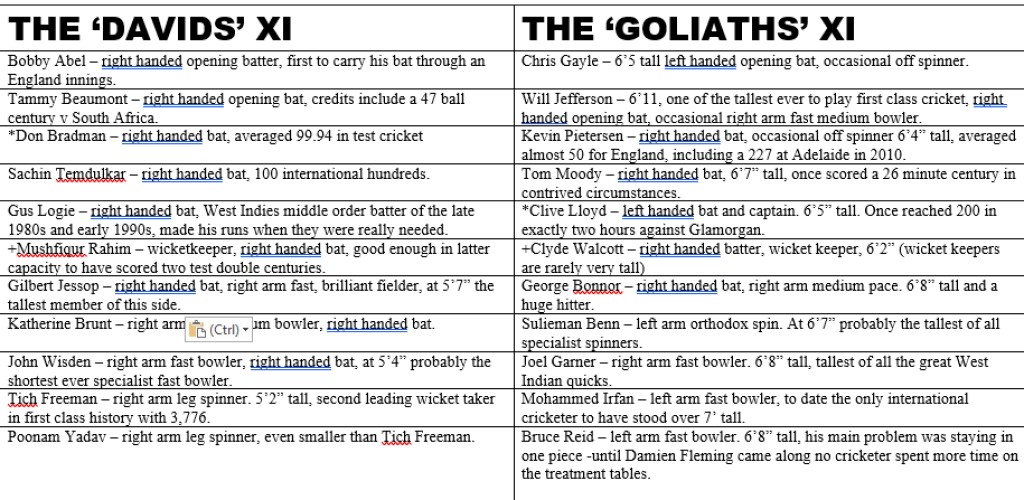
  1. Bobby Abel – right handed opening bat. The diminutive Surrey opener (officially 5’4″ but perhaps less) was the first to carry his bat through an England innings, finishing on that occasion with 132 not out. He also holds the record for carrying his bat through the highest first class team total to feature such an innings, and in that same innings the highest score ever made for Surrey. In 1899 at Taunton, Surrey scored 811 all out, with Abel batting through for an undefeated 357. Abel and Tom Hayward shared the Surrey record partnership for any wicket, 448 for the 4th. Playing for the Players against the Gentlemen at The Oval Abel scored 247, a score only beaten in that series by his fellow Surreyite Jack Hobbs (266). Abel also formed a contrasting friendship with WG Grace, and was among the pallbearers at the latter’s funeral. There is a biography of him by David Kynaston that I recommend.
  2. Tammy Beaumont – right handed opening bat. She has established a magnificent record at the top of the order in recent years (visit my post of two days ago to see a clip of highlights from one of her innings), and while the women play scandalously little test cricket, her record in ODIs is significantly better than her record in T20s, leading me to take the view that if she got a proper chance in long form cricket she would be highly successful.
  3. *Don Bradman – right handed batter, brilliant outfielder, captain. He was just a little over 5’6″ in height, the second tallest of my chosen XI. A test average of 99.94 renders further comment superfluous. This is his third appearance in this series of posts, after Australia and the Scribes.
  4. Sachin Tendulkar – right handed batter. The Indian maestro, scorer of 100 international hundreds is an automatic selection at four as Bradman was at three.
  5. Gus Logie – right handed batter. The West Indian, one of the smallest players of his era, was not anything like as heavy a scorer as his immediate predecessors in this order, but he tended to score his runs when his side really needed them.
  6. +Mushfiqur Rahim – right handed batter, wicket keeper. The Bangladeshi, one of the smallest players ever seen in the test arena, has two test double centuries to his credit, and averages 36.77 overall with the bat, and he has not all that often had the luxury of being able to build on a strong start by his team. He has also taken 104 catches and executed 15 stumpings in test cricket. Bangladesh has probably during his career only had five players who can genuinely be regarded as top class, opener Tamim Iqbal, all-rounder Shakib Al Hasan (currently suspended), off spinner Mehedi Hasan, fast bowler Mashrafe Bin Mortaza (now a member of the Bangladeshi parliament, and a spent force as a player) and Mushfiqur Rahim himself. In this team he is part of a strong unit, which would be a new experience for him.
  7. Gilbert Jessop – right handed bat, right arm fast bowler, brilliant fielder. At 5’7″ the tallest member of my chosen XI, he is the x-factor all rounder in the side. He featured in yesterday’s post.
  8. Katherine Brunt – right arm fast medium bowler, right handed bat. The Barnsley born Brunt is approximately 5’5″ tall – among her regular England team mates only Beaumont and Danielle Wyatt are noticeably shorter. It is her skiddy bowling that has earned her a place in this XI, but she has also developed her batting to a very considerable degree, and shares with Logie the knack of producing the goods when they are most required – her career best 72 not out got England to a total in excess of 200 when at one stage a prediction of 150 would have been viewed as seriously optimistic.
  9. John Wisden – right arm fast, useful lower order batter. The Sussex pacer, also founder of the United All England XI, a touring XI which played matches against local teams who had a numerical advantage – 18 and 22 were the two most frequent sizes of team for such matches, and sometimes secured the services of professionals, described as ‘given men’, once took all ten in a first class innings, all clean bowled. He stood only 5’4″, probably the shortest specialist fast bowler there has ever been.
  10. Tich Freeman – leg spinner. The 5’2″ Freeman (his actual given names were Alfred Percy) was the second most prolific wicket taker in first class cricket history, with 3,776 (and he played only about half the number of matches that Yorkshire’s Wilfred Rhodes, the no1 in this category, did). He holds all manner of records for large wicket hauls. Even more remarkable by today’s standards is the age at which he achieved these feats – a combination of his being a late developer and World War 1 meant that by the age of 30 the Kent leggie had precisely 29 first class wickets to his credit.
  11. Poonam Yadav – leg spinner. The tiny Indian leg spinner was one the stars of the recent Women’s World T20, again and again confounding opponents with her flight and spin. She is also one of the slowest bowlers of any description to have been seen in top level cricket.

This team has an opening pair who should combine well, a powerhouse combination at three and four, a battler at no six, a wicket keeper batter at six, the most explosive batter the game has ever seen at seven, and four varied bowlers to round out the XI. I regret that both spinners are leg spinners, but I think there is enough difference in their methods that this is not a very serious weakness.

THE CONTEST

This contest for the ‘Sling Trophy’ as I shall call it should be a fine one. However, especially if Wisden, Brunt and Jessop, the pace bowlers for the Davids, concentrate on yorkers, which the Goliaths would find it difficult to get down to, I would still expect this to go the same way as the original David vs Goliath – in favour of the Davids.

SOLUTION TO YESTERDAY’S TEASER

Yesterday I offered up this, from brilliant.org

Measurement

The key lies in that word ‘similar’. All the four rectangles (the big overarching rectangle, with long side 16, the intermediate rectangle that is half the area of that one and the two smaller rectangles all have the same proportions. This means that the key shape, the triangle is an isosceles right angled triangle and its longest side can be calculated from the similarity of the rectangles to equal to 4 x the square root of 2. This squares up to 32, and Pythagoras tells us that the sum of the squares of the other two sides is equal to the square of the longest side (aka hypoteneuse). Since the triangle is isosceles as well as right angled, the square of each remaining side is half of 32, i.e. 16. 16 has two square roots, 4 and -4, and the length of the side of a triangle is a positive number, so the answer is four.

Here is David Vreken’s elegant published solution:

VrekenSol

Just to complete this mini-section, it took me much less long to actually solve this than to type my explanation, and I am a fairly rapid typist.

A FINAL LINK AND PHOTOGRAPHS

The Davids and Goliaths of cricket have been paraded in all their glory, and I have a single link left to share before finishing with my usual sign off. Phoebe MD has hosted a post by Barbara Leonhard titled “Avoiding the Tragedy: A Look into Disease Preventionwhich I consider to be a must-read. My thanks to both Phoebe and Barbara for that piece.

Finally, my usual sign off…

P1320309 (2)P1320310 (2)P1320311 (2)P1320312 (2)P1320313 (2)P1320314 (2)P1320315 (2)P1320316 (2)P1320317 (2)P1320318 (2)P1320319 (2)P1320320 (2)P1320321 (2)P1320323 (2)P1320324 (2)P1320328 (2)P1320329 (2)P1320330 (2)P1320331 (2)

David v Goliath
The teams in tabulated form with abbreviated comments.

All Time XIs – T20 Clash

In today’s variation on the all-time XI theme we look at T20 cricket, with a team of former greats all of whom would have been well suited to that format pitted against a team of the best actual T20 players.

INTRODUCTION

Today’s variation on the ‘all time XI‘ theme looks at the game’s shortest regular format, T20 (one innings each of 20 overs per side), and I pit a team who were in their prime before top level limited overs cricket was played against a team of T20 experts.

T20 PLAYING CONDITIONS

At least five bowlers must be used, and no bowler may bowl more than four overs in a T20 innings. For the first six overs no more than two fielders may be stationed more than 30 metres from the bat, and thereafter no more than five. This format has been very successful since its top level introduction in 2003, with T20 tournaments flourishing all round the world. Having briefly set the scene it is time to meet our teams starting with…

THE PRET20 FRANCHISE XI

  1. Garry Sobers – left handed bat, every kind of left arm bowling known to cricket, brilliant fielder. The most complete cricketer ever to play the game, he was an absolute must for this side.
  2. Gilbert Jessop – right handed bat, right arm fast bowler and brilliant fielder. Even if his batting was his only recommendation the most consistently fast scorer the game has ever known would have been a ‘shoo-in’. Add his intelligent bowling and fielding that was estimated as being worth 30 an innings to his team and, from a century before the format was used at top level you have the blueprint for the perfect T20 exponent.
  3. *WG Grace – right handed batter, right arm bowler of various styles, fine close catcher. My chosen captain.
  4. Frank Woolley – left handed bat, left arm orthodox spin bowler, brilliant close catcher.
  5. Denis Compton – right handed bat, left arm wrist spinner, fine fielder.
  6. +Leslie Ames – right handed bat, wicket keeper. He won the Lawrence trophy for the fastest hundred of the season twice in the first three years of its existence. He was one of the Kent batters who combined to chase down 219 in two hours, with no fielding restrictions in place.
  7. Bill Lockwood – right handed bat, right arm fast bowler. He was one of the pioneers of the ‘slower ball’, a type of delivery that is especially useful in T20, and it is for that reason that I have included him here.
  8. Jim Laker – off spinner and right handed lower order bat.
  9. Alfred Shaw – right arm medium/ slow bowler, lower order bat. The Nottinghamshire man bowled more overs in first class cricket than he conceded runs. He paid just 12 a piece for his first class wickets. He once said that “length and variation of pace are the secrets of successful bowling”, and though he would probably get hit occasionally I think his method would work beautifully in T20.
  10. Hedley Verity – left arm orthodox spinner, useful lower order batter. His match against Nottinghamshire in 1932 provides a vignette of his bowling skills – in the first Notts innings on a pitch not assisting him he operated as a stock bowler taking 2-64 in 41 overs. In their second innings, after an overnight thunderstorm had gingered up the pitch he took 10-10 in 19.4 overs, with 16 maidens, still the cheapest ‘all ten’ in first class history. He was noted for being especially skilled at varying his pace to suit the conditions, and even in T20 it is hard to imagine anyone ‘collaring’ him.
  11. David Harris – right arm fast bowler. Hambledon’s finest, who once sent a spell of 170 deliveries from which one solitary single was garnered by the opposition. I have argued elsewhere (see the Eccentrics post in this series) that proper styles of underarm bowling such as his, and the lobs of Simpson-Hayward mentioned in that post, as opposed to Trevor Chappell style grubbers should be legal. The grubber can be covered under today’s legislation with the single addition that a ball rolled along the deck is considered to have bounced an infinite number of times and will therefore be called no-ball.

This XI is strong in batting, everyone other than Ames would be capable of contributing with the ball, and the bowling is staggeringly rich in variety as well. Their designated fielding substitute can be Sydney Copley, who while on the Notts groundstaff took an astonishing catch as sub in the 1930 test match there to dismiss Stan McCabe (who unlike another Aussie top order batter dismissed by a sub in more recent times did not give vent to a string of obscenities on his way back to the pavilion), breaking a threatening partnership. Now we we turn to…

T20 ERA FRANCHISE XI

  1. Chris Gayle – left handed opening bat, occasional off spinner. The ‘Universe Boss’ has to open the innings for this team, his record in this format being simply astonishing. As a very tall left handed bat he forms a perfect contrast to the person I have chosen to open with him…
  2. Tammy Beaumont – right handed opening bat of diminutive stature but possessed of a full range of strokes, good footwork and incredible timing. Her many highlights include a 47 ball hundred against South Africa. Additionally, I consider that the completeness of the contrast between her and Gayle would pose a huge challenge to opposition bowlers. Yesterday’s post featured a video clip showing her in action – please go back and watch it.
  3. *Virat Kohli – right handed batter. The best all format batter currently in world cricket – Steve Smith is better at test cricket, and Chris Gayle is better at T20.
  4. Glenn Maxwell – right handed batter, off spinner. A man with an incredible record in limited overs cricket, and had I failed to select him I probably wouldn’t have needed radio equipment to hear the howls of protest from Australia.
  5. Ben Stokes – left handed batter, right arm fast bowler. The x-factor all rounder.
  6. +Adam Gilchrist – left handed batter, wicket keeper. His career started before the establishment of top level T20, but he did play the format before he finished.
  7. Rashid Khan – right arm leg spinner, lower order batter. The Afghan has a phenomenal record in limited overs cricket, and has had some successes in his few forays into long form cricket as well. Save for being brutalized by Eoin Morgan in the 2019 world cup he has had few bad days.
  8. R Ashwin – off spinner, lower order bat. An excellent limited overs record. Also, the possibility for what would be the cricket incident to end all cricket incidents were he to (as he has done to others) ‘Mankad’ WG Grace!
  9. Jofra Archer – right arm fast bowler, right handed lower order batter. He went in a few months from people questioning whether England should pick him to being an essential part of a world cup winning outfit.
  10. Chris Jordan – right arm fast medium bowler, right handed lower order bat, brilliant fielder. One of the most effective bowlers at mixing the pace up and sowing confusion that way, his fielding is so good as to practically be worth picking him even if you don’t plan to use his bowling.
  11. Lasith Malinga – right arm fast bowler. The Sri Lankan slinger would be especially dangerous in the ‘death overs’.

This team has depth in batting, with only Malinga absolutely ruled out of making a significant contribution in that department, and a splendid range of bowling options to choose from. As a designated fielding sub I give them (who else?) the one and only Gary Pratt. I apologize for the player names not being formatted as links to their cricinfo profiles – that site is currently malfunctioning – hope normal service will soon be resumed.

THE CONTEST AND AN EXPLANATION

This would be a heck of a contest, with I think the PreT20 team just about favourites, but any of these 22 players could be the match winner.

Until this post my all-time XIs have all been picked with long form cricket in mind. The reason I changed that today was because of the following tweet from the folks at cricinfo:

They were asking specifically about T20 and their options were Gayle or Kohli, and I voted for Gayle, but as I explained, it is actually a very poor comparison, since Gayle’s bowling gives him a second string that wins it for him at T20 (and at that format, and only that format, he is of more value even purely as a batter than Kohli). I decided to use this blog post to address their question at greater length than can be managed in a tweet, meaning that post I was mentally planning for today will feature tomorrow instead (yes, when sufficiently provoked even an autistic person can make rapid changes to their plans). Note that while I have named Gayle as one half of the ultimate example of a contrasting opening pair I have also named Kohli as no 3 and skipper.

LINKS AND PHOTOGRAPHS

Just a few of links before signing off. First, the pinchhitter has again mentioned me in today’s offering, which I urge you to read. Second, to bring to the cricket part of this post to a close, a quiz in The Guardian.

Finally, a mathematical teaser adapted from a problem I solved on brilliant.org this morning (I considered their version waaay too easy, since they had made it multiple choice):

Measurement


Finally, after a good sized chunk of cricket and a measure of mathematics it is time for my regular sign off:

P1320271 (2)P1320272 (2)P1320273 (2)P1320274 (2)P1320275 (2)P1320279 (2)P1320283 (2)P1320284 (2)

P1320288 (2)
The first squirrel I have seen recently.

P1320289 (2)P1320290 (2)P1320290 (3)P1320292 (2)P1320293 (2)P1320293 (3)P1320294 (2)P1320295 (2)P1320296 (2)P1320297 (2)P1320298 (2)P1320299 (2)P1320300 (2)P1320301 (2)P1320302 (2)P1320304 (2)P1320305 (2)P1320306 (2)P1320307 (2)P1320308 (2)T20 Clash


All Time XIs -The Cognominal Clash

For my latest variation on the ‘All time XI’ cricket theme I offer you the Cognominal Contest for the ‘Nugget-Davo’ Trophy! Also features a video clip of the little gem that is Tammy Beaumont, an important autism related link and a few photos.

INTRODUCTION

Welcome to my latest variation upon an ‘all time XI‘ theme. This one requires a little bit of preliminary explanation, so without further ado…

THE COGNOMINAL BRIEF

I have devised the word cognominal myself from the Latin cognomen, meaning nickname. Some Roman cognomina were merely functional: Scaevola indicated that the cognominee or an ancestor (cognomina were often inherited) was left handed, Magnus or Maximus indicated achievement, arrogance or some combination of the foregoing, since the meant great and greatest respectively, and there were many other such. Others pointed up features, so that if an ancestor had a wart on their nose one might inherit the cognomen Cicero, meaning chickpea because that was what the wart looked like. Others were ironic – the first Claudius to be cognominated Pulcher meaning beautiful was so dubbed because he had a decidedly unbeautiful character, and some could be cruel – the already multiply cognominated Gaius Julius Caesar Strabo Vopiscus (Caesar implying possession of a luxuriant head of hair, Strabo meaning ‘cross-eyed’ and Vopiscus meaning that he was the survivor of what had been a pair of twins) subsequently acquired Sesquiculus, not just an arsehole but an arsehole and a half! Cricketer nicknames can be excellent or they can show an utter lack of imagination. The Cognominal Clash features an XI who had impressive nicknames and an XI whose nicknames were all in the ‘must do better’ category. Some of the players I have placed in the latter XI also had less unimpressive nicknames, but I have played fair in terms of creating a contest by picking two decent looking teams. It is now time to meet the teams starting with the…

LAME NICKNAMES XI

  1. Graham Gooch – Goochie – right handed batter, right arm bowler of a pace that was described at various stages of his career as anything from fast medium to slow medium, scorer of 8,900 test runs, one of the openers for my all-time Essex XI. As well as his ‘must do better’ nickname his moustache caused him to be dubbed ‘Zap’ in honour of the Mexican revolutionary Zapata. I personally rate the 154 not out in a team total of 252 all out on a pig of a pitch and in the face Ambrose at his most host hostile at Headingley in 1991 to have been the finest innings he ever played, although he scored more on quite a few occasions.
  2. Matthew Hayden – Haydos – left handed batter, very occasional medium pacer. He was also referred to as Hulk on account of his size and his approach to batting. He was the first to cash in on the brain fade that led Nasser Hussain to put Australia in at the Gabba in 2002, walloping 197 in the first innings and then belting another ton in the second innings. He finished with a test average of over 50, in spite of a dreadful run spanning the first four matches of the 2005 Ashes.
  3. *Michael Vaughan – Vaughany – right handed batter, occasional off spinner, uncertain catcher. The elegant right hander, who also had the nickname Virgil, crunched three centuries in ultimately losing cause in the 2002-3 Ashes series (not a record, Herbert Sutcliffe hit four centuries for England in the 1924-5 Ashes which Australia won 4-1) but got his revenge when he captained England to victory in the 2005 series. In the home summer of 2002 the Indians found weaknesses, but not generally until a double century (approached closely on two occasions but never actually reached) was on the horizon!
  4. Neil Harvey – Harv – left handed batter. At the age 19 Neil Harvey ran up a ton in his first Ashes innings, at Headingley in 1948, and by the time he called it a day he had amassed over 6,000 test runs at an average of 48.41.
  5. Mike Gatting – Gatt – right handed batter, occasional right arm medium pacer. He benefitted from being far more chances to establish himself in test cricket than most, and after taking over 50 innings to notch his first three figure score at that level he ended up producing sufficiently much more to finish with an average of 35.
  6. Ian Botham – Both – right handed bat, right arm fast medium bowler. The all rounder, who also had some more colourful monikers such as Beefy (for his build), Guy and Gorilla, both in honour of a popular resident of London Zoo, took just 21 matches to complete the test double of 1,000 runs and 100 wickets.
  7. +Ian Healy – Heals – wicket keeper, right handed lower middle order bat. The most accomplished male Australian wicket keeper I have actually seen in action, and without doubt, even in a team captained Steve Waugh, the undisputed world sledging champion for pretty much his entire career. Adam ‘Church’ Gilchrist was of course a far better wielder of the willow, though Healy could be a major irritant in that department as well. Why did I specify male Australian wicket keeper? Well, Alyssa Healy, Ian’s niece, is a very fine practitioner with the gloves as well and undoubtedly a finer striker of the ball than her uncle was.
  8. Shane Warne – Warney – leg spinner, attacking lower order bat. He took over 700 wickets in test cricket, and was only once in 14 years on the losing end of an Ashes series, in 2005. He was also a shrewd tactician, and although I have honoured Vaughan with the captaincy, I name him as vice-captain, and was severely tempted to name him as captain.
  9. John Emburey – Embers – off spinner and unorthodox right handed lower order bat. He also had the marginally less unimaginative moniker Ernie, derived from his middle name of Ernest. He was four times an Ashes winner, at home in 1981 and 1985 and away in 1978-9 and 1986-7.
  10. Jeff Thomson – Thommo – right arm fast bowler and occasionally useful right arm lower order batter. One of those mentioned when discussion arises about who was the fastest bowler ever. He was at his best in the second half of the 1970s, and although he toured England in 1985 he was by then approaching 35, and unlike Lillee, his most famous bowling partner, he did not have the technical virtuosity to turn himself into a quality operator once the pace had gone, which meant he posed little threat by then.
  11. Matthew Hoggard – Hoggy or The Hogster – right arm fast medium, sometimes adhesive as a lower order batter. He took over 300 test wickets, and unlike many who make their names gaining movement on green pitches and under grey English skies he did not lose much of his effectiveness abroad. His career batting highlight was undoubtedly at Trent Bridge in 2005 when his cool head pulled England through what had every appearance of a crisis – chasing 129 to win and go one up with one to play England were 116-7 with only Harmison and a crocked Simon Jones to follow when Hoggard walked into bat. Hoggard and Giles scored those 13 runs, with Hoggard latching on to a full toss from Brett Lee for a crucial boundary to ease the tension. The full value of that little innings was illustrated a couple of weeks later, when a combination of the weather, some odd Australian decision making (accepting an offer of the light when they were pummelling England’s bowlers, and they needed there to be as much play as possible, since only a win could do them any good) and an extraordinary knock by Kevin Pietersen, well supported by that man Giles, saw England draw the match and claim the Ashes which had been in Australian hands since 1989.

The ‘Lame Nicknames’ have a solid opening pair, a contrasting 3,4 and 5, an x-factor all rounder, a keeper who can bat, two spinners who would complement each other nicely and Thommo to take the new ball with the wind behind him, while Hoggy gets his regular job of opening into the wind. Now it is time to meet…

THE COOL NICKNAMES XI

  1. Jack Hobbs – The Master – right handed opening batter, occasional medium pacer. The scorer of 61,237 first class runs, including a 197 centuries at that level, both all-time records. His tallies of 3,636 runs and 12 centuries are England Ashes records, beaten only by Bradman (5,028 runs and 19 centuries). You may have seen other figures given for his first class records, but Hobbs himself vehemently opposed any changes to traditionally accepted figures. I am 100% certain that Hobbs would not have retired had he believed himself to be only one short of 200 centuries rather than three. He opens for my Surrey All Time XI.
  2. *WG Grace – The Champion – right handed opening bat, right arm bowler of various types, close fielder. He had a wide variety of other nicknames over the course of his long, illustrious and richly storied career. He tallied 54,896 first class runs, including 126 centuries and took 2,876 first class wickets, both records at the time of his retirement, and both still in the top half dozen all-time figures. The revisionists who increase Hobbs’ tallies decrease Grace’s, reducing his century county by two, an action which retrospectively nullifies the scenes at Taunton in 1925 when Hobbs scored his 126th and 127th first class centuries there to equal and then break the Grace record. Of course it is unthinkable for anyone else to captain this side, just as he captains my all time Gloucestershire XI.
  3. George Headley – Atlas – right handed batter, nicknamed after the titan of Greek mythology who carried the world on his shoulders, because he carried the West Indies on his shoulders. Twice he scored twin tons in test matches.
  4. Mike Hussey – Mr Cricket – left handed batter. He averaged over 50 in test cricket, and in the 2010-11 Ashes series down under it was only when England got him cheaply at Melbourne and Sydney that Australia’s resistance definitively crumbled.
  5. Clem Hill – Kruger – left handed batter, brilliant fielder. Hill amassed eight test centuries, which was a record until Hobbs overhauled it. At Old Trafford in 1902, when Australia secured the Ashes with a victory by three runs he had a ‘champagne moment’, when he sprinted thirty yards and then dived to take a catch that accounted for Dick Lilley – and it is claimed that his momentum carried him on a further twenty yards beyond where he actually held the catch! This catch made the difference between England needing eight with one wicket left and needing four with two wickets left, so it can genuinely be claimed as a catch that won a match. He was one of the ‘big six’ who refused to travel to England in 1912 because of a quarrel with the then newly established Australian Board of Control for International Cricket, later the Australian Cricket Board and now Cricket Australia. During the 1911-2 Ashes, won 4-1 by England, Hill was involved in a selectorial row that turned physical – he and Peter McAlister who were at loggerheads regarding the board anyway disputed over the right make up of the team, insults were exchanged, and an outraged Hill snapped and slapped McAlister’s face, which was the start of a brawl between the two that allegedly lasted twenty minutes. The ‘Kruger’ nickname arose because of a supposed physical similarity between him and the great South African leader.
  6. Alfred Mynn – The Lion of Kent – right handed batter, right arm fast bowler. The best all rounder of the 1830s and 40s.
  7. Gilbert Jessop – The Croucher – right handed batter, right arm fast bowler, brilliant fielder. His nickname was derived from his batting stance, and is perhaps not all that cool, but I was prepared to compromise to set up a contest in which Jessop and Botham were on opposite teams.
  8. FR Spofforth – The Demon – right arm fast bowler (added many variations later in his career), right handed bat. Frederick Robert Spofforth announced himself to English audiences at Lord’s in 1878, when he was brought on to replace Frank Allan (dubbed ‘bowler of the century’ in the pretour publicity – Aussie mind games are nothing new) with the MCC score reading 27-2. MCC were all out for 33, Spofforth 6-4 in 23 deliveries! The Australians fared little better, inching their way to a very slow 41, after which the Australian captain did not call on Allan but went straight to Spofforth and Harry Boyle. This time MCC were all out for 19, with Boyle the chief destroyer capturing 6-3, while Spofforth had 4-16. Needing 12 to win, Australia lost one wicket getting them, the game ended on the same day it had started, and that aggregate of 105 runs for 31 wickets remains the lowest ever for a completed first class match. Spofforth was injured for the inaugural test on English soil in 1880, which the hosts won, but in 1882 he produced the bowling performance that created The Ashes, 14-90 in the match, seven of them in the second England innings, when needing only 85 to win the hosts crashed for 77 and were beaten by seven runs. England reached 50 with only two batters, Hornby and Barlow, gone, but then Ulyett was out 51 and crucially, Grace at 53, for only the second 30 plus score of the match, 32. Lyttelton and Lucas froze like rabbits in headlights, and Hornby, a poor choice as skipper, started tinkering with the batting order, and that was where the match was lost. Spofforth ultimately settled in England, marrying a woman from Derbyshire, and turning out a few times for that county.
  9. Charles Turner – The Terror -right arm medium-fast. Just as England were thinking that the terrors of Spofforth and Boyle were safely behind them, another amazing Aussie bowling pair arrived on the scene, Turner and the left armer Jack Ferris. Medium-fast described Turner’s pace, but leaves his method entirely out of account. He had formidably strong fingers (he could crush an orange to pulp between his thumb and forefinger), and gave the ball a ferocious rip, generating vicious .movement in any and all conditions. Only one bowler has ever taken 100 first class wickets in an Australian season – Turner in 1887-8.
  10. William Lillywhite – The Nonpareil – right arm fast, right handed lower order bat. He was one of the pioneers of ’round arm’ bowling, the form that came between under arm and over arm, and with his regular partner James Broadbridge he turned Sussex into a force that could take on the Rest of England, a situation that has never been the case since then and had not previously been the case. Some bowlers today still bowl with their arms at similar height to the position used by Lillywhite – I refer you to Lasith Malinga, the Sri Lankan slinger. In any case, I suspect Lillywhite would have been delighted to be allowed to bowl proper over arm and would have done so magnificiently – a champion in one era would be a champion in any era. About that nickname, courtesy of merriam-webster.com:
    Nonpareil MW

    Note the first entry under the ‘noun’ section.
  11. +EJ Smith – Tiger – wicketkeeper, was wont to say that he was willing to bat at no 1 or no 11 but nowhere in between, so I have given him his second choice, no 1 having a prior claimant! The nickname owed to his ferocious disposition. He kept at a time when wicket keepers habitually stood up no matter who was bowling, and I would guarantee that ‘St Smith B Spofforth’ would appear at least once, and probably more in scorecards featuring these teams.

This team has a top of the range opening pair, a wonderful array at nos 3-5, two ferocious all rounders at six and seven, a fine and varied trio of bowlers who would live up to their fearsome cognomina and a brilliant keeper who would let nothing through.

THE CONTEST

The battle for what I shall call the “Nugget – Davo” Trophy, honouring Keith Miller and Alan Davidson, who I could not find a place for in the two teams would be intense and hard fought, but I think the ‘Cool Nicknames’ would have the edge on as well as off the field and I would expect them to emerge victorious.

LINKS AND PHOTOGRAPHS

The scene has been set for the Cognominal Clash for the ‘Nugget-Davo’ Trophy, but I have a few links to share before applying my usual sign off.

One final cricket related link – as drawn to my attention by the pinchhitter blog, England cricket are honouring their female batting stars this week. Our ‘cool nicknames’ XI features a fast scorer of diminutive stature, 5’7″ Gilbert Jessop, and this video courtesy of England cricket shows and even smaller player, Tammy Beaumont climbing into South Africa to the tune of a 47-ball hundred (and it’s not slogging – these are high class cricket shots struck with perfect timing):

Charlie Hancock, an autistic writer who I follow on twitter has contributed two magnificent pieces to spyglass magazine this month, which between them make a superb ten points:

Please read both, and on that note, due to the weather being uncooperative I there is less to my standard sign off than usual…

P1320262 (2)P1320263 (2)P1320264 (2)P1320265 (2)P1320266 (2)P1320267 (2)P1320267 (3)P1320268 (2)P1320269 (2)P1320270 (2)

Nicknames battle
The teams in tabulated form with abbreviated comments.

All Time XIs – The West Indies

Today in a break from some of my more esoteric ‘all time’ XIs we take a look at the West Indies. Also features, politics, nature and a couple of family blogs, plus a mention for the fulltossblog.

INTRODUCTION

Welcome to the latest installment in my series of ‘All Time XI‘ themed posts. It being a Monday (yes, even in the somewhat strange circumstances in which I am currently living I am managing to keep track of what day of the week it is!) I am looking at an international outfit, in this case the West Indies, before reverting to more esoteric matters for the rest of the week. As usual with an international set up I will start with a team from my cricket lifetime and move on from that to an all-time version.

THE WEST INDIES WITHIN MY LIFE TIME

For this purpose I am considering only players I actually witnessed.

  1. Gordon Greenidge – right handed opening batter, for Hampshire as well as his home island of Barbados and the West Indies. He scored two contrasting double centuries in the 1984 series, 223 not out in ten hours at Old Trafford, and 214 not out in about half of that time to win the Lord’s test for his side. I saw him score a ton in the MCC Bicentennial match, when he hit one square cut with such ferocity that the ball actually went through an advertising board. He was one half of a legendary opening partnership with…
  2. Desmond Haynes – right handed opening batter, also Barbadian, and played county cricket for Middlesex for many years as well as international cricket for the West Indies. Where Greenidge was an attacker by instinct but capable at need of defending for long periods, Haynes was by inclination an anchor man, who could when circumstances demanded it absolutely annihilate bowling attacks, as shown by his magnificent ODI record.
  3. Brian Lara – left handed batter. The Trinidadian holds the record test and first class scores, one of only two ever to have the double distinction (Bradman did so for a couple of years, between Headingley in 1930 where he made 334 to go with his 452 not out for NSW v Queensland and Christchurch 1933 where Hammond scored 336 not out) – 501 not out for Warwickshire against Durham in 1994 and 400 not out v England at Antigua in 2004. Ten years earlier he had hit 375 v England on the same ground, the only player to hold the world test record twice (Hayden intervening with 380 v Zimbabwe at Perth). A small caveat over these feats of tall scoring by Lara is that none came in winning cause – all three matches were drawn. Just for the record, the full progression of test record high scores is: Bannerman 165 in the first test innings of all in 1877, Murdoch 211 at The Oval in 1884, Foster 287 at Sydney in 1903, Sandham 325 at Kingston in 1930, Bradman 334 at Headingley in 1930, Hammond 336 not out at Christchurch in 1933, Hutton 364 at The Oval in 1938, Sobers 365 not out at Kingston in 1957, Lara 375 at Antigua in 1994, Hayden 380 at Perth, Lara 400 not out at Antigua in 2004.
  4. Viv Richards – right handed bat, occasional off spinner. The ‘Master Blaster’. Among his many credits are a 56 ball hundred v England at Antigua in 1986, and an innings in 1990 against the same opposition when he twice mishit Devon Malcolm for sixes. He came into bat in a manner equivalent to a prima donna taking centre stage in an opera – all eyes immediately focussed on him, while everyone else, especially opposition bowlers, seemed simply to have the task of feeding him lines.
  5. Shivnarine Chanderpaul – left handed bat, occasional leg spinner. He announced himself by scoring a double century in an under-19 match, and unlike his English equivalent who went straight back to his county second XI after doing so, he was fast tracked in the West Indies full team, and immediately began scoring runs (he would tally over 12,000 in test cricket).
  6. Carl Hooper – right hand bat, semi-regular off spinner. This man simply exuded elegance and class – the main criticism that he attracted being that he did not often enough go on for the really big score.
  7. +Jeff Dujon – Wicket keeper, right handed middle order bat – quite simply the best keeper the West Indies have had in my lifetime, and an average of over 30, including four test tons. He tended to get his runs when the team really needed them, not by thrashing already demoralized bowlers.
  8. Malcolm Marshall – right arm fast bowler, useful lower right handed lower order bat. By my reckoning the greatest fast bowler of the West Indies’ golden age of fast bowling – and 376 test wickets at 20.94 is substantial backing for that claim. He was pretty much the ultimate pro, as he demonstrated during his years as Hampshire’s overseas star, and developed bucketloads of  craft and guile to go with the pace he always possessed.
  9. Michael Holding – right arm fast bowler, aggressive right handed lower order bat. ‘Whispering Death’ as he was known because of his silent run up was another magnificent fast bowler, one of the stars of the attack during both the ‘blackwashes’ the West Indies inflicted on England in the 1980s.
  10. Curtly Ambrose – right arm fast bowler (later in his career slowed to fast medium, if not medium fast). Twice he won test matches by destroying the England batting, once with 8-45 in an innings at Bridgetown, and he was only prevented from the being the match winner at Headingley in 1991 by the batting of Graham Gooch (154 not out in a total of 252 all out on a pig of a pitch, second highest score 27 jointly by Ramprakash and Pringle) and a display of ineptitude by his own colleagues in the face of England’s much less threatening bowling ‘attack’. Against the Aussies in Perth he once produced a spell of 7-1 which unsurprisingly settled the outcome of that match. I saw him in action last year for Lashings World XI, when he bowled two overs off a reduced run up, and the opposition simply could not lay a bat on him.
  11. *Courtney Walsh – right arm fast bowler (slowed late in his very long career to fast medium if not medium fast). The first bowler of any description to capture 500 test wickets. Although I do not usually think that fast bowlers make the best captains, he did the job well, suffering mainly from the fact that a once great side was becoming ordinary around him. His last bow, in England in the year 2000, showed up the problems in sharp relief (under the captaincy of Jimmy Adams), with the batting folding on a regular basis, and the bowling other than that of the then 38 year old Walsh being little to write home about – Trescothick made his test debut in that series, showed great character to survive the new ball but was still on 0 not out when Walsh was relieved, and got off the mark from the first ball bowled by Walsh’s replacement, going on to a fine 66.

This team has six quality batters, five of them definitely meriting the label ‘great’, a top drawer glove man who knew how to bat and four of the finest fast bowlers you would ever meet. There is little in way of spin for reasons I will go into in the next section of this post, with Hooper’s off breaks the nearest thing to a front line spin option.

EXPLANATIONS, HONOURABLE MENTIONS AND A SPECIAL FEATURE

I will start with a few honourable mentions: Chris Gayle, ‘Universe Boss’, scored two test triple centuries, and I saw him make a classic 167 not out at Adelaide in 2009, but I felt that the value of the Greenidge/Haynes combo was too great to include him. Richie Richardson was a fine batter, at one time rated no1 test batter in the world, but I could only have got him in by sacrificing Hooper at no 6. Clive Lloyd was a fine batter and captain, but I never actually witnessed him in action, so could not select him. Ramnaresh Sarwan was also a fine batter who I regretted not being able to fit in. Denesh Ramdin probably believes he was a candidate for the keeper’s slot, but in truth, a double ton against England on a feather bed of a pitch in Barbados notwithstanding, he was not in Dujon’s class in either department.

SPECIAL FEATURE: BALANCE, ALL ROUNDERS, BOWLERS AND THE WEST INDIES GOLDEN AGE

As mentioned in my overview of it the team lack either an all-rounder or a genuine spinner. The reason for this is that in my lifetime the West Indies men have only produced four cricketers who could be dubbed all rounders, Eldine Baptiste, Hamesh Anthony, Franklyn Stephenson and Ottis Gibson, and none were really good enough with the bat to drop a front liner for, nor with so many genuine fast bowlers to pick from could they force their way in that category. If I am mandated to select an all rounder then Stephenson comes in for Hooper, but under protest. Roger Harper, a middle order batter who bowled off spin and was a great fielder, was not quite good enough in either department to be considered. I only gave serious consideration to two specialist spinners, Suleiman Benn and Sunil Narine, but although Narine especially would have his advocates, neither have a test record that really commands respect, though Narine is an outstanding limited overs bowler.

Even had there been a spinner in the period concerned with a really fine test record, I had a particular reason for picking four specialist pace bowlers (albeit Marshall and Holding were both capable of scoring useful runs) – the four pronged pace battery propelled the West Indies to the top of the cricket world under Clive Lloyd and kept them there under Viv Richards. At Trinidad in the 1975-6 series against India Clive Lloyd, in anticipation of a turner was given a team containing three front line spinners, Inshan Ali, Albert Padmore and Raphick Jumadeen, to match the three India would play, Bedi, Chandrasekhar and Venkataraghavan. For three of the four innings, things went to plan, and India were set 406 to win. India knocked those runs off, a test record at the time, for the loss of just four wickets, the three West Indies spinners leaking 220 of the runs. Lloyd decided there and then that he wanted his best available bowling attack irrespective of conditions, and secured an all pace quartet (initially Andy Roberts, Wayne Daniel, Bernard Julien and Vanburn Holder) for the future. The West Indies did not look back from that point. One series was lost to New Zealand in 1980, but otherwise the West Indies ruled supreme until the rise of the Aussies in the 1990s. Other pace stars who featured for greater or lesser periods in this period were Colin Croft, Joel Garner, Sylvester Clarke, Milton Small and Tony Gray. Later, even after their domination had faded the West Indies produced a few other notably quick bowlers – Ian Bishop who was blighted by injuries, Kemar Roach (who I saw bowling at over 150kph at Adelaide, not a ground beloved of many bowlers) and most recently Shannon Gabriel. It is now time to move on to…

WEST INDIES ALL TIME

Of the players I named in the XI from my life, Lara, Richards, Marshall, Holding and Ambrose make the all-time XI. They are joined by the following:

  • George Headley – right handed bat, nicknamed ‘Atlas’ because he carried the team on his shoulders, like the titan of Greek mythology carried The Earth on his shoulders. He averaged 60.83 in test cricket, converting 10 of his 15 fifty plus scores into centuries. He usually batted three, but the West Indies in his day so often lost an early wicket that he was effectively opening anyhow, which is how I use him in this team.
  • *Frank Worrell – right handed bat, left arm fast medium and occasional left arm spin. He sometimes opened, which is the task I have given him in this team, and CLR James’ ghost would haunt me for eternity if I dared named anyone else as captain of an all-time West Indies XI. He was the first black player to be West Indies captain, breaking a particularly vile shibboleth that black fellows needed to be led by someone with white skin, and he led the West Indies to the top of the cricket world, becoming the first to succeed in banishing inter-island rivalries from the dressing room.
  • Everton Weekes – right handed bat, averaged 58 in test cricket, including a run of five successive centuries (ended by a run out 90). He also represented his home island of Barbados at Contract Bridge, a game that I enjoy playing.
  • Garry Sobers – left handed bat, left arm fast, left arm swing or seam and left arm finger and wrist spinner, brilliant fielder. Quite simply the most complete cricketer the world has ever seen, averaging 57.78 with the bat and taking 235 test wickets. If Ellyse Perry (still only 29 years old, though she has been around a long time) takes up spin bowling to add to her other cricketing accomplishments she may match him in that regard. Sobers was actually first selected as a left arm spinner, developed his batting after that, and then as a Lancashire League pro developed the ability to deploy pace, seam and swing because pros there are expected to be able to contribute heavily with both bat and ball no matter what, and the heavy skies and green surfaces that are both such regular features of north western England tend to lend themselves more to pace, swing and seam than to spin.
  • +Clyde Walcott – right hand bat, wicket keeper. He was a recognized wicket keeper, as well averaging 56 in test cricket, and the only way I could have got him in as other than a keeper would have been by dropping King Viv.
  • Lance Gibbs – off spinner, taker of 309 test wickets (world record at the time). While there was a reason why the West Indies team from my lifetime should feature an all-pace battery, for this combo I revert to a more balanced attack.

Thus my all-time XI in batting order reads: Headley, *Worrell, Lara, Weekes, Richards, Sobers, +Walcott, Marshall, Holding, Ambrose, Gibbs. This combination has a splendid looking opening pair, a stellar 3,4 and 5 with Lara a left hander for extra balance, the most complete cricketer of all time at six, a batter/keeper at 7, three fast bowlers and an off spinner. The bowling, with the three specialist quick bowlers backed up by Gibbs’ off spin, Sobers’ variety of left arm options, Worrell and possibly Richards as seventh bowler, looks awesome (the only base not covered is right arm leg spin).

HONOURABLE MENTIONS

George Challenor and Percy Tarilton, the pioneers of ‘Caribbean style batting’ never got to show what they could do at test level. Allan Rae and Jeff Stollmeyer were a highly successful opening combo, but had I opted to pick an opening partnership Greenidge and Haynes would have got the nod. Conrad Hunte was a great opener who never benefitted from having a truly established partner. I have the word of CLR James that Rohan Kanhai was an absolute genius with a bat in his hands, but just who could I drop to make way for him?

Among the great fast bowlers not getting the nod were: George John who flourished before his country played test cricket, Herman Griffith (also a tough captain – he was once captaining a youngster of whom big predictions were being made and when it came to time for the youngster to bowl he requested a suggestion of field placements beginning with the word ‘deep’, and when he prefaced his fourth successive position with that word Griffith snapped, and called up another bowler, saying “No, you obviously intend to bowl foolishness” – a refusal to accept low standards of which I wholeheartedly approve), Learie Constantine, Manny Martindale, Roy Gilchrist, Wes Hall and Charlie Griffith. Spinners to miss out included Ellis Achong (from whom the term ‘chinaman’ for the left arm wrist spinner’s equivalent of a googly derives – his parents came to Trinidad as indentured labourers, and were indeed Chinese, and the story is that when Walter Robins fell LBW to him, misreading the spin, he said en route back to the pavilion “fancy being done by a chinaman” and so the term was born), and my little pals Ram and Val (Sonny Ramadhin and Alf Valentine, who took the first eight wickets to fall in the first test innings in which he bowled). Had I been able to accommodate a specialist wicket keeper Deryck Murray would have got the nod, but with only 11 spaces to fill there was just no way to do so.

I am well aware that at least one of the regular readers of this series of posts knows a very great deal about West Indian cricket, and I hope that ‘africanherbsman’ as he identifies himself feels that I have done something approaching justice to the cricketers of his islands, for whose achievements I have great admiration.

LINKS AND PHOTOGRAPHS

Well, our virtual Caribbean cruise is at an end, but I have a few links to share before applying my usual sign off…

Finally, it is time for my usual sign off…

P1320194 (2)P1320195 (2)P1320198 (2)P1320199 (2)P1320200 (2)P1320201 (2)P1320202 (2)P1320203 (2)P1320204 (2)P1320206 (2)P1320207 (2)P1320208 (2)P1320209 (2)P1320212 (2)P1320213 (2)P1320216 (2)P1320217 (2)P1320238 (2)P1320239 (2)P1320241 (2)P1320242 (2)P1320245 (2)P1320248 (2)P1320248 (3)P1320250 (2)P1320251 (2)P1320252 (2)P1320252 (3)P1320253 (2)P1320254 (2)P1320255 (2)P1320256 (2)P1320257 (2)P1320258 (2)P1320260 (2)P1320261 (2)

West Indies
The teams in tabulated form with abridged comments.

All Time XIs – Arthurians vs Bills

Another twist on the ‘all time XI’ theme as the Arthurians (11 players with given name Arthur) take on the Bills (11 players with given name Bill) for a trophy I have playfully dubbed “The Grail Trophy”.

INTRODUCTION

Welcome to my latest take on the ‘All Time XI‘ theme that I am exploring while ‘Pandemic Stops Play’ remains the case. Today we look at two teams of players whose common factor is their given name.

THE BRIEF

The Arthurians, a team moniker plucked from the realms of mythology (knights of the round table etc), all have the given name Arthur. The Bills, a team moniker borrowed from an outfit based in Buffalo, NY each have the given name Bill. I stuck resolutely to the given name theme, ignoring players surnamed Arthur and Australian batter Wendell Bill. I also ignored nicknames, so no ‘Bill Fender’ or (Graeme Swann has the “credit” for this one) Tammy ‘BIll’ Beaumont. Also I stuck rigidly to Bills, no mere Billies allowed, sadly for  Barnes and Gunn of Nottinghamshire, Bates of Yorkshire, Murdoch of Australia and Sussex or Messrs. Godleman (Middlesex, Derbyshire) and Taylor (Hampshire) of more recent vintage. Similarly, for readers of my most recent post, ‘Silver Billy’ Beldham had to be disqualified. I also stuck resolutely to the ‘team’ principle – no crowbarring players in out of position here. Ground rules laid out it is time to meet the teams, starting with…

THE ARTHURIANS

  1. Arthur Morris – left handed opening bat, flourished immediately post World War II. He is one of relatively few players to have had a seriously big score overshadowed by someone else scoring a blob in the same innings. It occurred at The Oval in 1948, when Don Bradman was bowled second ball by Eric Hollies ot be left with a test average of 99.94. Morris batted through the Aussie innings on that occasion, leading to the following oft repeated snatch of conversation:
    questioner: did you see Bradman’s last test innings? Morris: “Yes, I was batting at the other end” questioner: “how many did you get” Morris, deadpan: “196”
  2. Arthur Shrewsbury – right handed opening bat, famously rated by WG Grace as second only tp himself.
  3. Arthur Jones – regular number three for Notts and England in his day. He lalso bowled leg spin.
  4. Arthur Mitchell – vital part of Yorkshire’s top or middle order in the 1930s, specialist gully fielder who turned himself into one of the best around in that position. When his playing days were done he became a hugely successful coach. Harold ‘Dickie’ Bird and Michael Parkinson (later famous as writer and broadcaster), then  opening partners for Barnsley in league cricket were summoned to the Yorkshire nets when he was coach, Parkinson got Maurice Leyland’s net, enjoyed himself but did not get invited back, while Bird got Mitchell’s net, was reduced by the stern “Ticker” to a quivering wreck, but did enough right to be asked back (the story appears in “Parkinson on Cricket”, by the aforementioned Michael Parkinson).
  5. Arthur Carr – Nottinghamshire middle order bat, inclined to attack (he hit 48 sixes in the 1925 season) and a shrewd tactician. He helped Jardine with his tactics for the 1932-3 Ashes Tour (he was county captain to two of the key bowlers). It was also Carr who confirmed to Jardine that Larwood and Voce were accurate enough to bowl to a 7-2 field. Incidentally, the two injuries sustained by Aussie batters in taht series both happened while Larwood was bowling to an offside field, and one of them, Oldfield’s, was admitted by the victim to be his own fault – he took on the hook shot and edged the ball into his own head.
  6. Arthur Chipperfield – right hand bat and leg spinner. He still has a place in the record books as the only amle to score 99 on test debut (it was a lunch interval that did for him – he was out second ball on the resumption, while Jess Jonassen an Aussie of more recent vintage hit 99 in her first test innings). Chipperfield did eventually manage a test century, a feat that Ms Jonassen has yet to accomplish, though she has time to do so.
  7. +Arthur Wood – wicket keeper and right handed lower middle order bat. In 1935 he became the first Yorkshire keeper to score over 1,000 runs in a season. In 1938 he made his test debut at the Oval, and walked out following Hutton’s dismissal for 364, with the score reading 770-6 and is alleged to have announced his presence in the middle by saying “Always wor a good man for a crisis, me”. No Aussie responses to this have been recorded. He rattled up 53 in that debut innings, being out with the score on 879. Another Yorkshireman, Verity, followed him to the crease and was with Joe Hardstaff, when the 900 came up, and Hammond having had confirmation that Bradman would not be batting finally declared, to the relief of all save Oval groundsman ‘Bosser’ Martin who had wanted to see a score of 1,000 achieved on his pitch.
  8. Arthur Wellard – right arm fast medium bowler, very attacking right handed lower order batter. In all he smote 500 first class sixes, 66 of them in 1935 alone, which stood as a season’s record for 50 years, before Ian Botham wellied 80 maximums in just 27 innings. Like Botham, Wellard played for Somerset, and he appears to have been every bit as inclined to deposit balls in the river Tone. In a match against Nottinhamshire he featured in a ‘gotcha’ sequence – when Notts batted a certain H Larwood was out B Wellard 0, while the corresponding line in the Somerset scoresheet read AW Wellard B Larwood 0.
  9. Arthur Fielder – right arm fast bowler, right handed lower order bat.
  10. Arthur Jepson – right arm fast medium, right handed lower order bat.After his playing days were done he became an umpire, and in that capacity was responsible for one of the great refusals of an appeal against the light. It was a limited overs match, and the time was closer to 9PM than 8, and when the issue of light was raised Jepson pointed to the sky and said “You can see the moon, how far do you need to be able to see?”
  11. *Arthur Mailey – leg spinner, no 11 batter. Until Rodney Hogg surpassed it in 1978-9 he held the record for wickets by an Aussie in an Ashes series, with 36 of them in 1920-1. In a tour match against Gloucestershire he dismissed the county by himself, recording innings figures of 10-66, which gave him the title for his autobiography “10 For 66 And All That” – and it is a splendid read. When Victoria put up their all time record first class team total of 1,107 (Ponsford 352, Ryder 295, Woodfull 133, Hendry 100, FL Morton run out for 0  amidst the carnage) Mailey took 4-362, still the most runs conceded by a bowler in a first class innings, although for me the 1-298 recorded by ‘Chuck’ Fleetwood-Smith in the Oval test match of 1938 is a worse shocker, because at least Mailey was getting wickets. Mailey himself claimed to have regretted that Jack Ellis, the last Victorian dismissed, had run himself out “just as I was striking a length” and also pointed out that “a chap in the shilling stand dropped an easy chance from Jack Ryder early in his innings”. In 1930 the manager of the Australian tour party upbraided him for passing on bowling tips to Scottish born leg spinner Ian Peebles and Mailey produced the classic response: “Spin bowling is an art and art is international.” Well spoken, Mr Mailey.

That is the Arthurian cast in all its glory, so now it is time to meet…

THE BILLS

  1. *Bill Woodfull – prolific opener for Victoria and Australia, twice regained the Ashes as Captain on his birthday (1930 and 1934). He was known in his day as ‘the unbowlable’, and did once go two entire seasons without being dismissed by that method.
  2. Bill Ponsford – regular opening partner of Woodfull for Victoria and Australia, scorer of two first class quadruple centuries.
  3. Bill Brown – right handed top order batter, usually an opener but could also go in at three, where I have put him in this team.
  4. Bill Bruce – attacking top order bat for Australia in the 1890s.
  5. Bill Alley – left handed bat, right arm medium fast. Became an umpire once his playing days were down.
  6. Bill Lockwood – right arm fast, right handed bat. Played for Nottinghamshire, Surrey and England. He was among the first fast bowlers to become noted for bowling a ‘slower ball’, and it would seem that not until Franklyn Stephenson, approximately 90 years later did anyone else wreak quite such havoc with that type of delivery. He achieved the double of 1,000 runs and 100 wickets in a seaosn twice
  7. +Bill Storer – wicketkeeper and combative right handed bat. The Derbyshire man toured Australia in 1897-8. In 1904 it was he who partnered Charles Ollivierre in the match winning second wicket stand at Chesterfield, when Derbyshire set 149 in 125 minutes knocked them off easily. Ollivierre and Storer were each also eyeing up personal landmarks – Ollivierre a century to go with his double in the first innings and Storer a fifty, and neither got there – Ollivierre 92 not out, Storer 48 not out. Storer was one of the players involved in the ‘netting boundary’ scheme trialled briefly in the late 1890s: netting 2-3 feet high was erected around the boundary, and batters got three for shots clearing the netting and two plus any they had managed to run if the ball rolled into the netting. This scheme, intended to discourage slogging and encourage gentle ground strokes made snicks through the slips very remunerative indeed. Storer did produce a score of 175 under this scheme, while in that same innings Wood was credited with 10 off a delivery from Cuthbert Burnup. The scheme was abandoned pretty swiftly however. Andrew Ward covers it in “Cricket’s Strangest Matches”.
  8. Bill Voce – left arm fast medium bowler, right handed batter. Toured Australia three times, successfully in 1932-3, as part of a narrowly beaten side in 1936-7 and in the ‘goodwill tour’ of 1946-7 where Bradman did not get the memo and an ill-equipped England were utterly routed. Cliff Cary, an Australian who commentated during that series, also wrote a book length account of it, “Cricket Controversy”.
  9. Bill O’Reilly – leg spinner, greatest bowler of the inter-war years and excellent writer (e.g “Cricket Taskforce”, his book about the 1950-1 Ashes).
  10. Bill Johnston – left arm fast medium, left arm orthodox spin, tail end batter. He was Australia’s leading wicket taker in the 1946-7, 1948 and 1950-1 Ashes series, and although hampered by an injury on the 1953 tour he became only the second after Bradman to average 100 for an English season (102 runs at 102.00, courtesy of 16 red inkers in 17 innings, some of them gained with the active connivance of team mates who saw the amusement value in him claiming a batting record). In the 1954-5 series, his last outing, he helped Neil Harvey to add 39 for the last wicket on the second test match, but too much damage had already been done, and England eventually got that last wicket to level the series at 1-1 (Harvey 92 not out), a position from which Hutton’s team never looked back.
  11. Bill Bowes – right arm fast medium, genuine no11 batter. His county, Yorkshire, were champions seven times in the 1930s, and in that decade he was only once outside the top 10 of the national bowling averages. His test opportunities were limited, but 68 wickets at 22 from 15 appearances does not exactly betoken failure at that level. In retirement he became an entertaining writer – he contributed the chapter on Jardine to “Cricket: The Great Captains”.

That is the Bills introduced, and we move on to:

AN EVALUATION

The Arthurians have a nicely contrasted opening pair, a useful look 3-5, an all rounder, a wicket keeper who can bat, three pace bowlers of varying types and a quality leg spinner. They are short in the finger spin department, but apart from that the look a pretty good unit.

The Bills have a solid opening partnership, nos 3,4 and 5 look pretty useful, they have a genuine all rounder at six, a good wicket keeper and combative bat at seven, and four widely varied bowlers to round out the XI. They are also a little short finger spin wise, but Johnston could bowl that, and Voce occasionally deployed it to.

I would expect a close and entertaining contest for the trophy (provisional name, given the presence of the Arthurians, The Grail!). One final section:

HONOURABLE MENTIONS

Arthur Morton of Derbyshire only just missed out for the Arthurians, while there were also two other possible wicket keepers for them, another Yorkshireman, Arthur Dolphin and Gloucestershire keeper and WG Grace’s best man, Arthur Bush. The Bills, even with my tight restrictions had a surplus of top order riches – Bill Lawry missed out on an opening slot, while Bill Hitch was unlucky among the bowlers, and Bill Edrich would also have his advocates. Bill Andrews of Somerset was another who merited consideration for his bowling. Bill Athey could not be accommodated in a side that had two renowned stickers opening the batting.

PHOTOGRAPHS

My chosen combatants for the ‘Grail Trophy’ have been introduced, along with a few potential replacements, and all that now remains to apply my usual sign off…

P1320169 (2)P1320172 (2)P1320173 (2)P1320174 (2)P1320175 (2)P1320177 (2)P1320178 (2)P1320179 (2)P1320182 (2)P1320186 (2)P1320187 (2)P1320188 (2)P1320189 (2)P1320192P1320219 (2)P1320220 (2)P1320221 (2)P1320223 (2)P1320224 (2)P1320227 (2)

P1320230 (2)
A small beetle making use of one og my clothes pegs, which is holding a t-shirt on the line (three pics).

P1320231 (2)P1320233 (2)

P1320234 (2)
A bug scuttling across the page of “Summer of Success”, the book about Essex’s first County Championship triumph in 1979, that I was reading.

P1320236 (2)

Arthurians v Bills
The teams in tabulated form, with abridged comments.