All Time XIs – One Cap Wonders v Nontest

Another variation on the ‘all time XI’ theme, this time ‘one cap wonders’ against ‘nontest stars’, with a bonus feature on women’s cricket and some photographs.

INTRODUCTION

It is time for another variation on the “All Time XI” theme. This one features an XI made up of one-cap wonders and and XI designated Nontest.

THE BRIEF

The ‘one cap wonders’ XI is fairly self explanatory – these people made precisely one appearance at the highest level for various reasons. The Nontest XI comprises players who either flourished before their country gained test status or belong to a country that has never enjoyed test status. Many of these players are making their debuts in this series of posts, but in some cases they have featured elsewhere. First be introduced, in most cases representing decisions that appear to make as much sense as cluttering up an already overloaded cricket calendar with a new competition featuring innings of 100 balls per team and a raft of rule changes are…

THE ONE CAP WONDERS XI

  1. Ken Eastwood – brought in for the final test of the 1970-1 Ashes series when the Australian selectors decided to replace Bill Lawry as skipper and without consulting their new skipper to be Ian Chappell decided that the old skipper could not play under the new. Eastwood, already 35 years of age, was like Bill Lawry a blocker by instinct, but he was nowhere near as good a batter, hence why he had not previously caught the selectors eyes. He is an example of what I consider the worst kind of ‘one cap wonder’ story – someone brought in at the end of a series who unless they do something very special is practically guaranteed never to get picked again. England in the 1980s and 1990s were continuously guilty of doing this, indeed Mike Brearley was only confirmed as skipper for the sixth test of the 1981 Ashes on the understanding that he would accept an ‘experimental selection’ for that game, with the series already decided, and I personally think that Mr Brearley should have said “If you are going to be experimental bring in your envisaged new skipper as well.”
  2. EM Grace – played in the first test on English soil in 1880, by when he was 40 years of age. He contributed 39 to opening stand of 91 with his brother WG in the first innings. He had toured Australia with an amateur party in 1863-4. He should have played in the 1882 test that inaugurated The Ashes, rather than AN ‘Monkey’ Hornby (the Hornby of “my Hornby and my Barlow, long ago”), who was as much Spofforth’s bunny as another Lancashire opener, Atherton, would be McGrath’s bunny in the later 1990s. Hornby’s bizarre tampering with the England batting order in the final innings contributed to the defeat – CT Studd, with two centuries against the Aussies to his name already that season was held back, getting progressively more nervous, until no10, and ended up 0 not out having not faced a ball! In addition to his aggressive top order batting EM Grace was a fearless close fielder (he once caught AE Stoddart, a renowned hitter, while standing so close in at point that he was able to pass the ball to the wicket keeper without moving his feet) and had moments with his bowling, which included lobs (he once dislodged renowned stonewaller Harry Jupp by landing a steepler directly onto that worthy’s bails).
  3. Jack MacBryan – the only capped test cricketer who never batted, bowled or fielded at that level – the match was ruined by rain, he was waiting for a bat when the weather made its final intervention and he was never called up again.
  4. Andy Ganteaume – the West Indian right handed batter suffered from a doctrinaire interpretation of the situation – he was selected in place of an injured player, scored 112 in his only innings, and then the injured player returned. Ganteaume thus had a test average of 112.
  5. Rodney Redmond – the Kiwi left hander is his country’s equivalent of Ganteaume – one test match in which he made 107 and 56, a record match aggregate for a one cap wonder.
  6. GF Grace – in his case the selectors cannot be blamed, since by the time of England’s next game after his solitary cap he was in his grave. However, he rated second only to his brother WG as an attacking batter at the time, had his moments with the ball and was a brilliant fielder.
  7. Arnold Warren – the Derbyshire fast bowler who was also a good enough bat to have a first class hundred was called up for one match in the 1909 Ashes, collecting 6-113 overall, including 5-57 in one innings.
  8. +Leslie Gay – when he was called up to keep wicket for England at the SCG in 1894 Gay completed a curious double – he had also kept goal for England at football. His performance with the wicket keeper’s gloves was not a distinguished one, and in England’s second innings 437 he was the only person not to reach double figures (bowled off his pads by a full toss with his score on 4). Nonetheless, England won the game (it was the ‘follow on’ match at the start of that series).
  9. Jack Durston – the giant Middlesex fast bowler was among the many called up by England during the 1921 Ashes (30 players appeared in home colours that series), and match figures of 5-136 suggest he was unlucky to be dropped, even if you do not subscribe to my opinion that ‘one cap wonders’ in general; say more about the inadequacies of the selectors than they do about the players.
  10. Charlie Parker – the Gloucestershire left arm spinner took more first class wickets than anyone else bar Rhodes (Yorkhsire, SLA) and Freeman (Kent, LS) and yet had to make do with one test cap. He was named in the XII for Leeds in 1926 but was the player left out, and skipper Carr then put Australia in, saw Bardsley out to the first ball of the game and then dropped a sitter from Macartney in the same over, and watched Macartney reach 100 by lunch time and ultimately 151 at a run a minute.
  11. Charles ‘Father’ Marriott – the Lancashire and Kent leg spinner and genuine no11 was called up against the West Indies in 1933, took 11-96 in the match and was never picked again.

Our assemblage of ‘one cap wonders’ has a strong looking top five, an all rounder at six, some good bowlers and a wicket keeper. It is now time to meet the opposition…

NONTEST STARS XI

  1. Percy Tarilton – one of the pair considered by many, including CLR James, to be the forefathers of West Indian batting (the other, George Challenor, did get to play test cricket, but only when well past his best).
  2. Mahadevan Sathasivam – reckoned the first great batter to be produced by the island then known as Ceylon, now Sri Lanka. He only played 11 first class matches, recording an average of 41 in those games with a best score of 215. Mike Marqusee in “War Minus The Shooting”, his account of the 1996 World Cup, tells some good stories about ‘Satha’ as he was known.
  3. William ‘Silver Billy’ Beldham – two centuries before Graham Thorpe this Farnham native was rated the best batter around. At a time when centuries at any level were rare (the first ever documented individual century was scored by John Minshull in 1769) Beldham amassed no fewer than three in matches considered to have been first class. He lived, as befits a character from the game;s old testament, to a great age, 96 to be precise, and in equally classic old testament fashion became the father of sons and daughters (no fewer than 39 of them, 11 with his first wife and 28 with his second!) According to one witness, James Pycroft, his speciality shot was the cut, which if Pycroft is even close to accurate must have rivalled the Robin Smith version for ferocity.
  4. Charles Ollivierre – the right handed batter came to England with the 1900 West Indians and stayed to play for Derbyshire.
  5. Clive Inman – among the first Ceylonese to be a regular in the County Championship, for Leicestershire and Derbyshire  (Laddie Outschoorn of Worcestershire, a near contemporary, was also from that island).
  6. Duncan Fletcher – A fine all rounder for Zimbabwe, batting left handed and bowling right arm fast medium. He was just too old to get to play test cricket, his playing highlight being 69 and 4-42 v Australia at the 1983 World Cup. After his playing days he coached, first at Glamorgan and then with England. He was in charge for the 2005 Ashes triumph, and although he overused the provisions of central contracts, effectively using them as a blanket ban on their holders playing county cricket overall he did a splendid job for England, the first of two Zimbabweans who did not say much to do so, the other being Andrew Flower who guided England to the top of the test match rankings, a mere 12 years after they had been bottom thereof. The story of England’s renaissance in the early 2000s spearheaded as it was by these two Zimbabweans is well told in Steve James’ (who experience Fletcher the coach in his Glamorgan playing days) “The Plan”.
  7. +Lebrun Constantine – West Indian middle order batter and wicket keeper. He made the 1906 tour party to England only after fans raised a subscription to pay for his passage. His son Learie did get to play test cricket as a brilliant and dashing all rounder and went on to achieve considerable success in the field of human rights, ultimately becoming Baron Constantine of Nelson and Maraval (Nelson was the Lnacashire town for whom he played league cricket, and where he settled, Maraval the place in Trinidad from which he hailed).
  8. Bart King – the USian (acknowledgement to Kiwi blogger Heather Hastie for this handy term) fast bowler was the original ‘King of Swing’ as I mentioned in my ‘non-cricketing birthplaces XI’, and took his wickets at a mere 15 a piece. He made four tours of England with The Philadelphians, on the last of which he took 87 wickets in 10 first class appearances.
  9. *Palwankar Baloo – those who saw my India post will already know that I was impressed enough by this mans achievements in the matches he did get to play to name him in my all-time India XI. It will come as no surprise that I chosen to name a spin bowler (left arm orthodox in this case) as captain, a distinction he was denied in life due to caste prejudice.
  10. George John – CLR James for one insisted that this man was one of the all time great fast bowlers. The West Indies gained test status too late for him to benefit (although his slightly younger regular bowling partner George Francis did play test cricket near the end of his career).
  11. Sandeep Lamichhane – the Nepalese leg spinner (see my ‘100 cricketers series‘, especially this post) has a magnificent record in limited overs cricket. Any county signing him as an overseas player would get a round of applause from me (he is still not yet 20), although I would not recommend an effort to fast track his country to the top table – Bangladesh were promoted at the wrong time and have suffered in consequence, Ireland’s promotion came just as a gifted generation were fading from the scene and has not worked out that well for them, though Afghanistan have benefitted from their promotion. Lamichhane the county overseas star could be one of the great stories of post Covid-19 cricket – I truly believe that if a county could secure his services it would be a case of ‘who dares wins’.

This team has a fine looking top five, an all rounder at six, a keeper who can bat and spectacular quartet of bowlers.

THE CONTEST

While according full respect to the ‘one cap wonders’ I would confidently expect the ‘Nontest Stars’ to dominate proceedings – the lower half of the ‘one cap wonders’ order is unlikely to score many runs, and King and John would seem to have the edge on Warren and Durston as new ball bowlers, while I would also expect Lamichhane and Baloo to compare decently with Marriott and Parker. Allowing for the uncertainties of cricket I will settle for predicting a series score of 4-1 to the Nontest Stars (no McGrath style 5-0 predictions for me!). The acknowledgement of the Nontest Stars in this post sets up a nice bonus feature.

FOR MORE WOMEN’S TEST MATCHES

It is time to attend to half of the potential pool of cricketers (see this post for nore on my opinions on women playing alongside the men), the women. At the moment, the women’s game is thriving, but save for one match every two years between the two oldest foes it is exclusively played over limited overs. I would like to see much more women’s test cricket played, involving many more countries. Here are just a few who will almost certainly miss out on what cna confidently predicted to be successful test careers:

  • Smriti Mandhana – the attack minded Indian opener fares better in ODIs than in T20s and it is my reckoning that she would be better still in tests.
  • Laura Wolvaardt – the 20 year old South African is a superb technician with the bat, fares considerably better in ODIs than T20s, and given the chance to open in test matches (her natural position in any batting order) she could well establish an Agarwal-like record.
  • Deepti Sharma – the Indian off spinning all rounder is another whose ODI record far outweighs her T20 record, and whose fundamentally correct batting approach seems to have all the right ingredients for long form cricket, while spinners usually benefit from being able to bowl more overs.
  • Shabnim Ismail – the South African quick bowler is impressive in limited overs cricket, and given the opportunity in test cricket she could be devastating.
  • Poonam Yadav – the diminutive Indian leg spinner is fabulous in limited overs cricket, and is a huge wicket taker, which latter suggests that she would make excellent use of the opportunity to bowl for long spells.

Also of course, if long form cricket were a regular feature of the women’s game there would be more who would be well suited to it.

PHOTOGRAPHS

Our two teams for today’s contest have strutted their stuff, and it remains only for me to apply my usual sign off…

P1320137 (2)P1320138 (2)P1320139 (2)P1320144 (2)

P1320146 (2)
A fly resting on top of my back gate.

P1320149 (2)P1320150 (2)P1320152 (2)P1320153 (2)P1320154 (2)P1320155 (2)P1320156 (2)P1320157 (2)P1320158 (2)P1320160 (2)P1320161 (2)

P1320166 (2)
My back gate has also been alimed as a hime by one of our eight legged friends (two pics).

P1320167 (2)P1320168 (2)

OC v NTS
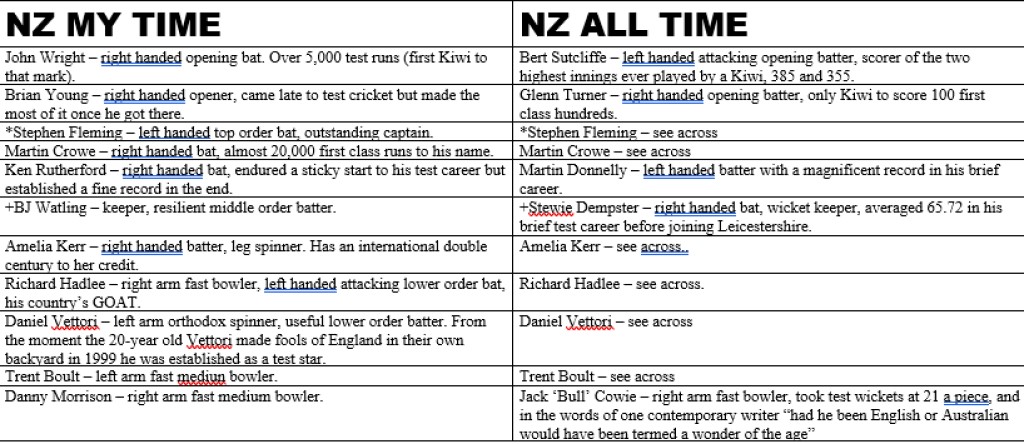
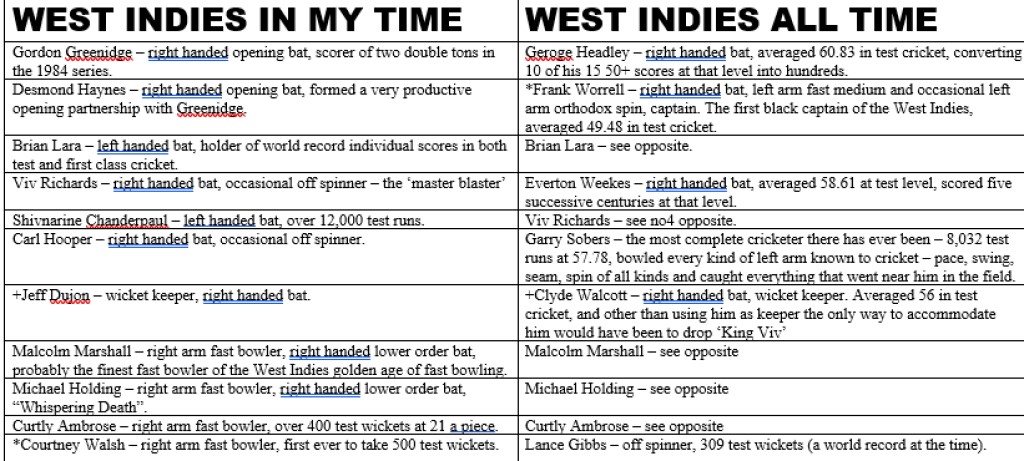
The two teams in tabulated form with abbreviated comments.

All Time XIs: Functional Left Handers v Elegant Right Handers

My latest variation on the ‘All Time XI’ theme, the answer to yesterday’s maths teaser, an important petition, a soupcon of science and nature and some photographs – enjoy!

INTRODUCTION

Another day brings another variation on the ‘All Time XIs‘ theme. Today’s is based on a well known piece of cricket folklore – the belief that left handers are naturally more elegant than their right handed colleagues. Like all good folklore it has a basis in fact, but it is definitely an overstatement of the case. Thus today I challenge it by providing an XI of strictly functional left handers and to oppose it an XI of notably elegant right handers. Note that some the bowlers in the left handers XI  batted with their right hands – it is their bowling for which they are picked, and mutatis mutandis for the right handed batter who bowled with his left. First to parade their skills are…

THE FUNCTIONAL LEFT HANDERS XI

  1. Gary Kirsten – the South African, half brother of Derbyshire’s Peter Kirsten, had seemingly limitless patience and concentration but a decidedly limited range of strokes.
  2. Sir Alastair Cook – the Essex and England man, his country’s all time leading scorer of test runs, was another who cultivated a limited range of strokes but used those he did possess to great effect.
  3. Graeme Smith – the former South African was mighty effective, but an aesthetic disaster (among top order batters named Smith it is an interesting question as to whether he or current Aussie right hander Steve represents the greatest aesthetic outrage).
  4. Shivnarine Chanderpaul – the Guyanese stayer had the oddes batting stance I have ever seen, so open that he was almost at 45 degrees to the bowler as opposed to the recommended side-on position (Austin Matthews who played for Glamorgan many decades ago as a bowler of medium pace and lower middle order batter wrote a coaching manual after his retirement in which he stated “cricket is a sideways game”), and while the method worked for him it was very much ‘one not to watch’.
  5. *Allan Borderthe nuggety NSW, Queensland and Australia middle order man had in the words of Frances Edmonds “not so much a style as a modus operandi”. This quote appears in “Cricket XXXX cricket” her humorous book about the 1986-7 Ashes (she also wrote “Another Bloody Tour”, which somehow managed to be amusing about England’s unqualified disastrous Caribbean excursion of 1985-6. For about the first decade of his long career he pretty much was, in batting terms, Australia’s resistance.
  6. Jimmy Adams – his obdurate approach saw him dubbed ‘Jimmy Padams’.
  7. +Jack Russell – wicket keeper and as a batter just about the ultimate in lower middle order irritants, sometimes very usefully for his country.
  8. Richard IllingworthWorcestershire and England slow left armer (emphatically NOT a spinner – if he ever turned one I never saw it). His economical, reliable but unthreatening methods were often preferred by England selectors of the time to the higher risk Phil Tufnell.
  9. Ryan Sidebottom – the Yorkshire, Nottinghamshire and England fast medium bowler had long run up which his pace never quite seemed to justify.
  10. Doug Bollinger – the NSW and Australia fast medium bowler was another whose run up appeared to promise more pace than he actually proved capable of delivering. I saw him bowl live at Adelaide v the West Indies in 2009, and, the first innings scalp of Gayle not withstanding he looked unimpressive, while his ‘efforts’ at the same ground in the 2010 Ashes match there were of a very low order.
  11. Paul Adams – the left arm wrist spinner’s action was once memorably likened to a frog in a blender. South Africa have not in recent times been overly understanding or supportive of spinners, and Adams probably should have played more test cricket than he actually did.

This line up has a solid top six, though no genuine all rounder, a splendid keeper who could do useful work with the bat and four bowlers of differing left handed types. They would take some digging out and might put up some decent totals because of that, but they would struggle to capture 20 wickets unless Paul Adams found some assistance in the surface. Now we meet their opponents…

THE ELEGANT RIGHT HANDERS

  1. Jack Robertson – the Middlesex man was a highly regarded stylist, and although he only got picked for 11 test matches an average of 46 at that level suggests that he had steel to go with that style.
  2. Reggie Spooner – opener for Lancashire and occasionally England. Noted for grace and poise at the crease. Neville Cardus used to watch Lancashire whenever he could in his schooldays, and later, established through his decades of work for the Manchester Guardian as one of cricket’s finest writers he waxed lyrical about Spooner and his part of what Cardus claimed as a uniquely distinctive top three – MacLaren, Spooner, JT Tyldesley. (the latter an ancestor of Michael Vaughan – can elegant batting be inherited?!). Spooner was the first ever to score 200 in a ‘Roses’ match, and did so in under four hours at the crease – they were not always dour affairs.
  3. *Sir Frank Worrell – the first black captain of the West Indies (yes, as with England and so-called ‘amateur’ skippers the Windies had their own captaincy fetish, in their case a belief that blacks had to be led by someone white skinned), and generally reckoned the most stylish of the ‘Three W’s” who dominated Caribbean batting in the 1950s and early 1960s.
  4. Tom Graveney – another whose grace and elegance at the crease had folk waxing lyrical – and he backed it up with over 47,000 first class runs.
  5. Kenneth Lotherington Hutchings – noted as one of the most attractive batters in a very successful Kent unit (four championships in seven years) that was also noted for playing particularly dazzling cricket. Such was the nature of his driving that for him and him alone George Hirst would retreat a few yards from his usual mid off position.
  6. Keith Miller – whether batting, bowling fast (or his occasional off spin with which he once took a test match seven-for on a rain affected Gabba pitch) or fielding he never failed to cut a dash. Once when playing in a ‘picnic match’ at East Molesey (the opposite bank of the Thames to Hampton Court Palace) he took on a challenge to land a ball on Tagg’s Island, a carry of 140 yards (just over 125 metres), and was only just short of making it.
  7. +Jeff Dujon – wicket keeper who kept with panther like grace to the quick bowlers (given the nature of Caribbean bowling units is his day it is impossible to comment on his keeping to class spinners) and batted attractively in the middle order, scoring four test centuries and averaging 30 at that level.
  8. Ray Lindwall – fast bowler, attacking lower order bat. His run up and bowling action are routinely described as being ‘poetry in motion’, and in addition to the pace he possessed he could swing the ball both ways seemingly at will.
  9. Michael Holding – fast bowler, referred to as ‘Whispering Death’ on account of the silence of his approach to the bowling crease. His opening over to Boycott at Bridgetown in 1981 has become a classic cricketing scare story – the Yorkshireman was beaten by four of the six deliveries, got bat on one and was comprehensively bowled by the sixth. Five years earlier, on a pitch at The Oval from which no one else could even raise a squeak he had recorded match figures of 14-149, the best ever test match figures by a West Indian.
  10. Sydney Barnes – the greatest bowler of them all. Even at Warwickshire in 1894 where he achieved little his bowling action was noted for its beauty, and CLR James, watching a 59 year old Barnes in action in the Lancashire League, noted that his arm remained classically high and straight. Mr James, by the way is the author of that sine qua non of cricket books “Beyond a Boundary’, which takes as its theme the question “what do they know of cricket who only cricket know?”, and my collection also features a book of his writings titled “Cricket”, and he contributed a chapter about Worrell to “Cricket: The Great Captains”, as well as being the author of “Black Jacobins”, a history of the Toussaint l’Ouverture rebellion in what is now Haiti.
  11. David Harris – cricket’s first great bowler (see Phil Edmonds “100 Greatest Bowlers” and John Nyren’s “Cricketers of My Time”) and even if you refuse to permit under arm (he played in the late 18th century when all bowling was under arm) I counter by saying that I reckon he could have mastered over arm had it been legal in his day. See also my Eccentric XI post for my opinion on real under arm, as opposed to Trevor Chappell style grubbers (although Harris was in part responsible for a change in cricket’s approach from relying on balls either rolling or at least shooting through to looking to cause problems by generating extra bounce, which he was an expert at – the very early bats looked more like hockey sticks than today’s cricket bats precisely because they were intended to counter balls at ground level, and it was Harris who was more responsible than any other for the shape of bats changing towards what we now recognize). Late in his career Harris suffered dreadfully from gout, but such was the value of his bowling that his team would bring an armchair on to the field, and when not actually engaged in bowling he would have a sit down. The Hambledon ace, who I felt I could not mention in connection with Hampshire, for all that he lived there, gets his moment in the sun this time round.

This team as a high quality to five, a great all rounder at six, an excellent wicket keeper at seven and four varied bowlers (Barnes, for all his official fast medium designation, can be classed as a spinner, while Harris if his actual bowling style is permitted offers a variation of a different sort, Miller as mentioned had off spin as a variation, and Worrell was a recognized bowler of left arm fast medium who also occasionally turned his hand to left arm spin.

THE CONTEST

I suspect that what I shall provisionally call the Strauss/ Trumper trophy, honouring a functional left hander and a stylish right hander, would go to the Elegant Right Handers, because while the functional left handers would take a lot of dislodging I have no doubts that the right handers could take 20 wickets, whereas the left handers are lacking in that department. The big question for Worrell as captain of the right handers, given that Barnes would not tolerate not being given the new ball is which of Holding or Lindwall does not get it – my reckoning is probably that Lindwall shares the new ball with Barnes and Holding comes on first change when Lindwall needs a rest.

A QUESTION ANSWERED

Yesterday I included a teaser from brilliant.org:

Brilliant Challenge

The four possible answers were 94, 96, 98 or 100.

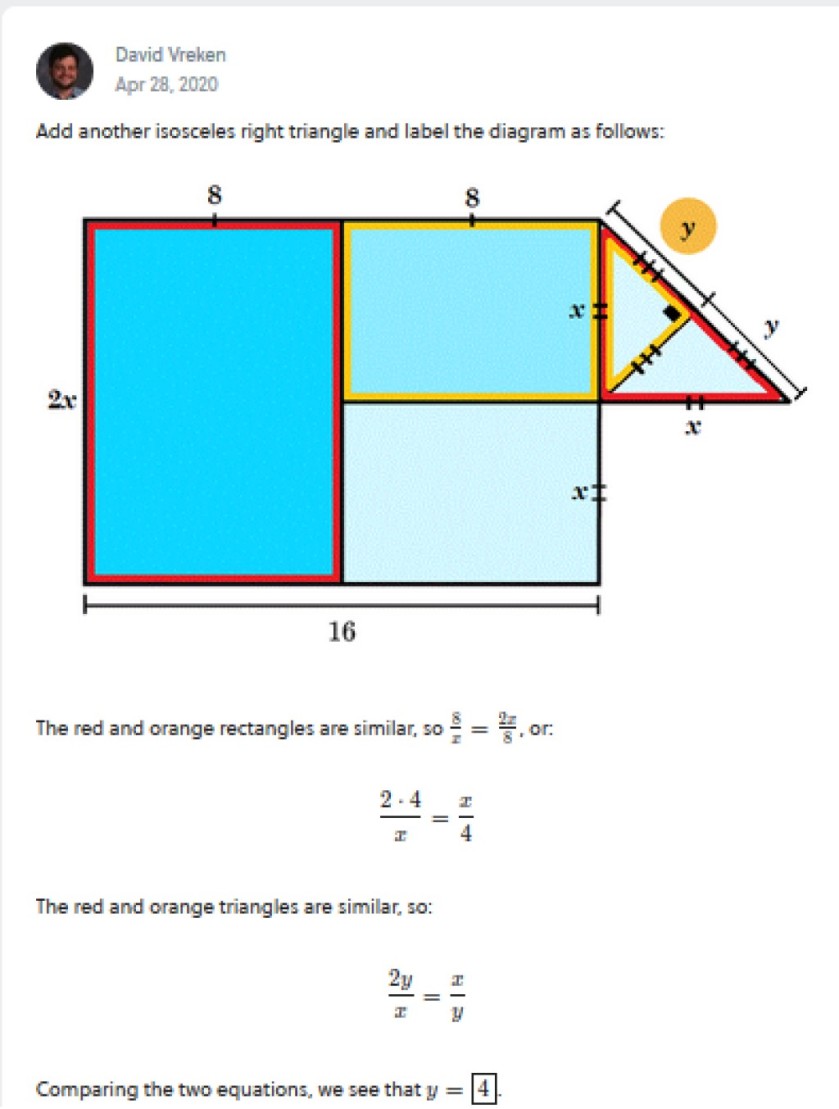
My own method of solving this, a mixture of cheat and punt, was to start by ruling out 100, as that is a square number, and it would therefore be out of keeping with brilliant for it to be the right answer. I then looked at the the areas given and noted that they added up to 56 – could I see a connection between 56 and one of the other answers? Yes, a very appealing one came instantly to mind – both have seven as a factor. A quick mental calculation confirmed that the ratio of 98 to 56 was 1.75, and that was enough for me to take a punt (I had already ensured that my problem solving streak had gone into another day – and it is now equal in days to Bobby Abel’s indvidual Surrey record innings in runs), and I was right.

Here is a more authentic solution courtesy of David Vreken:

DV Sol

LINKS AND PHOTOGRAPHS

As we move towards the conclusion of today’s post I have a few links to share.

  • The pinchhitter have given me an extended mention in today’s offering, and apparently a copy of one of the ‘Chapelli’ books I mentioned in yesterday’s post is en route to pinchhitter HQ. If you have found this blog by way of pinchhitter please comment, and likewise, if anyone has found pinchhittter by way of me why not let them know.
  • A very important petition on change.org, calling for the surcharge that penalises NHS and Care workers from abroad to be scrapped – as someone who owes a huge debt of gratitude to workers in both categories I urge you to sign and share.
  • A science piece from Culture’s Ways about Sagittarius A*, believed to be the location of a supermassive black hole – the picture below is formatted as a link:
    Sagittarius A*, thought to be the location of a supermassive black hole Culture's Ways

And now it is time to sign off with my usual photographic flourish…

P1320093 (2)P1320093 (3)P1320099 (2)

P1320100 (2)
This butterfly, which strayed into my bungalow yesterday, set me a poser – it was not in a my Butterfly book. My sister responded to my twitter inquiry with a reference to butterflyconservation.org and a suggestion of either Brimstone or Clouded Yellow. My own feeling having visited the site and looked at their pictures is that is a Brimstone.

P1320101 (2)P1320102 (2)P1320103 (2)P1320105 (2)P1320107 (2)P1320109 (2)

P1320110 (2)
The combination of the colour and the delicate veining in the wings lends them the appearance of small green leaves – a fine example of mimicry in the natural world.

P1320112 (2)P1320115 (2)P1320116 (2)P1320118 (2)P1320119 (2)P1320120 (2)P1320123 (2)P1320129 (2)P1320131 (2)P1320132 (2)P1320133 (2)P1320134 (2)P1320136 (2)P1320136

The teams
The teams in tabulated form with abridged comments.


All Time XIs – The Scribes Battle

Another variation on the ‘All Time XIs’ theme, this time featuring top cricketers who were or became top cricket writers. Where would your money be on the outcome of the battle for the ‘Cardus-Haigh’ Trophy?

INTRODUCTION

My latest variation on the ‘All Time XIs‘ theme looks at players who turned writer. Before introducing my chosen players I will explain my envisaged scenario to set the scene.

THE SCRIBES BATTLE – THE CONTEST FOR THE CARDUS – HAIGH TROPHY

My teams comprise people who made their names as high level players and who also wrote about the game. In each case I my cricket library contains at least one full book authored or co-authored by the chosen player. The Cardus – Haigh Trophy name honours two of my favourite cricket writers who did not play at a high level – Neville Cardus, a useful off spinner in club cricket, but never a first class cricketer, and Gideon Haigh, a rather less useful club off spinner. Thus, I have two teams to introduce, and I think I can guarantee that this would be a contest not to miss…

THE SCRIBES TEAMS

First up in our contest for the Cardus-Haigh Trophy I give you…

DOUGLAS JARDINE’S XI

  1. Jack Fingleton – opening batter and excellent writer. His author credits include “Brightly Fades The Don”, “Brown and Company” and “Four Chukkas to Australia” among others. His cricketing achievements included four successive test centuries.
  2. *Douglas Jardine – captain, and although not a regular opening bat, he did do the job at test level on occasions. His writing credit is for “In Quest Of The Ashes”, his own account of the 1932-3 tour of Australia when he was England captain. He was always adamantly of the opinion that runs could be scored against the method he devised, and when in 1933 the West Indies, via Manny Martindale and Learie Constantine, turned his own tactics on him he gave a convincing defence of his own case by scoring his one and only test century (127).
  3. Frank Woolley – left handed bat, left arm orthodox spinner, author of “King of Games”. He has already featured in my Kent all time XI and in my Record Setters XI.
  4. Walter Hammond – right handed bat, slip ace, occasional right arm fast medium and author of two highly entertaining books, “Cricket: My Destiny and “Cricket: My World”. Had he not made an ill-advised test comeback after World War II he would have finished with 6,883 test runs at 61.75, and had the highest average of any England batter to play 20 or more test matches. As it was he became the first to reach the landmark of 7,000 test runs and finished with 7,249 at 58.45.
  5. Denis Compton – right handed bat, left arm wrist spinner, author of “Playing for England” and “Compton on Cricketers”, co-author with Bill Edrich of “Cricket and All That”. He features in my Middlesex and Record Setters XIs.
  6. Ben Stokes – left handed bat, right arm fast bowler, author of “On Fire”. The X-factor all rounder features in my Durham All Time XI. There is no bespectacled left arm spinner for him to bat with in the closing stages this time.
  7. +Rodney Marsh – wicket keeper, left handed bat, author “The Inside Edge”.
  8. Alec Bedser – right arm fast medium, right handed bat, author of “Cricket Choice” and “Twin Ambitions”. He also features in my Surrey All Time XI.
  9. Bill O’Reilly – leg spinner, right handed bat, author of “Cricket Task Force” and “The Bradman Era”. 
  10. Brian Statham – right arm fast bowler, right handed bat, author of “Spell At The Top”. He features in my Lancashire All Time XI, and should be an excellent foil to…
  11. Bob Willis – right arm fast bowler, right handed bat, author “Captai n’s Diary: Australia 1982-3”, “Captain’s Diary: New Zealand 1983-4” and “Six Of The Best”. He features in my All Time Warwickshire XI.

This side has a solid looking opening pair, an excellent trio at 3,4 and 5, all of whom can also contribute with the ball, an x-factor all rounder at six, a brilliant keeper  and four splendid bowlers. It lacks an off spinner, but has every other base covered, and of course has a ruthless skipper at the helm. It is now time to meet their opponents…

IAN CHAPPELL’S XI

  1. Len Hutton – right handed opening bat, author of “Fifty Years In Cricket”. One hald of the opening pair in my Yorkshire All Time XI (with my namesake, Herbert Sutcliffe), and scorer of 6.971 test runs at 56.67.
  2. *Ian Chappell – right handed bat, captain, author of “Chapelli Laughs Again” and “Chapelli Has The Last Laugh”. He usually batted three rather than opening, but I have moved him up one, because as you will see I have a rather stronger claimant to the no3 slot in this XI.
  3. Don Bradman – right handed bat, author of among others “Farewell to Cricket”. Quite simply the greatest batter of all time, and here given an opportunity to match wits once more with the only opposition captain who could claim with any justification to have got the better of him.
  4. Tom Graveney – right handed bat, author of “The Ten Greatest Test Teams”. He features in my Gloucestershire All Time XI, and had I not named there I would have done so for Worcestershire, the other county he played for. The first half of a supremely elegant middle order duo, with…
  5. David Gower – left handed bat, author of “Anyone for Cricket” (jointly with Bob Taylor), “On The Rack”, and an autobiography. 8,231 runs in test cricket at 44.25, he would need to me on his mettle in this contest as Jardine would without doubt keep two gullies in place for him owing to his tendency to fish at balls outside off stump. However I reckon that he would relish the contest. He features in my Leicestershire All Time XI and later played for Hampshire.
  6. Monty Noble – right hand bat, right arm medium and/or off spin, author of “Gilligan’s Men”, an account of the 1924-5 Ashes tour.
  7. +Bob Taylor – wicket keeper, right handed bat and co-author with Gower of “Anyone For Cricket?”. He has previously featured in my Derbyshire All Time XI and in the Staffordshire Born piece.
  8. Richard Hadlee – right arm fast bowler, left handed bat, author of “Rhythm and Swing”. He featured in my Record Setters XI and got an honourable mention in the Nottinghamshire piece.
  9. Ashley Mallett – right arm off spinner, right handed bat, gully specialist fielder, author of “Victor Trumper: The Illustrated Biography”.
  10. John Snow – right arm fast bowler, right handed bat, author of “Cricket Rebel”. He features in my Sussex All Time XI. In 1970-1 he blitzed the Aussies who had Ian Chappell in their ranks (captain for the final match after the deposition of Bill Lawry) in their own backyard. This time ‘Chapelli’ would be captaining Snow.
  11. Ian Peebles – leg spinner, right handed bat, author of “Batters Castle”, “Spinners Yarn”, “Woolley: Pride of Kent” and “The Fight For The Ashes 1958-9”. He featured in my Non-Cricketing Birthplaces XI.

This team has an opening pair who should combine well, the greatest batter of them all at no3, a supremely elegant combo at 4 and 5, a tough all rounder at six, a superb wicket keeper and four excellent bowling options. The presence of Hadlee and Snow gives them means to counter a barrage should Willis, Statham and Stokes provide one, something that the 1932-3 Aussies deprived themselves of (had Fingleton, Chapelli’s grandfather Vic Richardson, or Bill O’Reilly been given HOa say I suspect that at least two out of Laurie Nash, Jack Scott, Eddie Gilbert and ‘Bull’ Alexander would have been picked as part of the Aussie attack, and Jardine would not have had such on overwhelming advantage in fast bowling firepower).

HOW THE CONTEST WOULD WORK AND MY PREDICTION FOR THE OUTCOME

I envisage 10 5-day matches, five in England at Edgbaston, Lord’s, Headingley, Trent Bridge and The Oval, and five in Australia at Brisbane, Adelaide, Perth, Melbourne and Sydney. If after 10 matches the score is level, I would have the teams reconvene for a timeless match to settle the issue, to played at a neutral venue (Cape Town, Kolkata or Bridgetown would all be possibilities). Should that match be tied, then tie splitting option one would be for the trophy to go the team that took most wickets over the 11 matches played, and if that does not split them, then, and only then, would we resort to ‘super overs’ to find a winner (hope you’re still fit by then Mr Stokes!). In addition the main trophy, there would of course be player of the match and player of the series awards, and a special “Grace-Murdoch” medal (named after two of the early Ashes ‘heroes’) along similar lines to the “Compton-Miller” medal.

The umpires would need to be chosen carefully, and the only match referee who would even have a chance of handling this would be Clive Lloyd.

Notwithstanding the presence of Bradman in Ian Chappell’s XI I make Douglas Jardine’s XI slight favourites – and more than slight favourites if it gets so close that all the tie-splitting procedures are needed – assuming Stokes is still fit only one of these sides could win a ‘super over’ contest!

LINKS AND PHOTOGRAPHS

The ‘Cardus-Haigh’ Trophy for the battle of the cricket scribes and the two XIs to compete for it have taken their bows, but before I apply my usual sign off I have a couple of links to share (the honourable mentions are just too numerous to even attempt):

  • The pinchhitter has again honoured me with a mention in today’s offering, which I highly recommend.
  • Van Badham has a piece in The Guardian (Cardus wrote for it in it’s great days as The Manchester Guardian, under the control of legendary owner-editor CP Scott) giving awards to all the worst responders to coronavirus (small but unsurprising spoiler, the overall grand champion currently resides at 1600 Pennsylvania Avenue).
  • Finally, courtesy of brilliant.org, a little mathematical teaser (my current, personal record, problem solving streak there now runs to one day more than Dennis Lillee’s career tally of test wickets) – see screenshot and four available answers below. In my next post I will provide both my own (mathematical equivalent to Grace’s run out of Sammy Jones, as I freely admit) and a more authentic solution in my next post.
    Brilliant Challenge
    The four answers offered by the setter are 94, 96, 98 and 100. Over to you.

Now it is time for my usual sign off:

P1320074 (2)P1320075 (2)P1320076 (2)P1320077 (2)

P1320079 (2)
A couple of illustrations photographed from Hammond’s “Cricket: My World”

P1320080 (2)P1320082 (2)P1320083 (2)P1320086 (2)P1320087 (2)P1320088 (2)P1320089 (2)P1320090 (2)P1320092 (2)

Scribes XIs
The XIs in tabulated form with abridged comments.

All Time XIs – Bizarre Dismissals

My latest variation on the ‘all time XI’ theme looks at bizarre dismissals. There is also a correction in my usual ‘reverse tabloid’ fashion and some thoughts about laws of the game that are connected to my theme.

INTRODUCTION

It is time for another variation on the ‘All Time XI‘ theme. Today we have an XI who have all suffered bizarre dismissals. I will follow this up with a look at some of the more unusual ways of getting out and at a few other aspects of the laws. However, before I get into the body of the post I have one other duty to perform…

A CORRECTION

In my previous post when I introduced the ‘Signed Off In Style XI‘ I made an error with significant consequences. Alec Stewart did not score a century in his final test match – the innings I was thinking had been played earlier. He did finish in front of his own home crowd, and with a tally of runs to match the digital form of his birth date, but his score in that final innings was a mere 38. This being the case, especially bearing in mind the shortage of left handed batters in the XI, his slot should have gone to Alastair Cook, rather than the Essex man having to make do with a special honourable mention. My apologies to Sir Alastair as the one who suffered from a rare lapse of memory on my part. Note that I have followed my usual ‘reverse tabloid’ policy when it comes to making a correction!

THE ‘BIZARRE DISMISSALS’ XI

  1. Sir Leonard Hutton – the Yorkshire opener, the first professional ever to captain his country in a home test, was also the first to be given out ‘obstructing the field’ in a test match. It happened against South Africa, and we shall be meeting the obstructed fielder a little later on.
  2. Gilbert Parkhouse – the Welshman was playing for England in New Zealand when he suffered the rare fate of being out twice to the same ball. The deliver, from a left arm spinner named Burtt hit his pad, and the umpire raised his finger instantly to give him out. However, the ball had been trickling backwards from the pad, and ultimately rolled into the stumps and dislodged a bail. The laws of cricket have this sort of thing covered, with an order of precedence for modes of dismissal, and Parkhouse was officially recorded as B Burtt, bowled outranking LBW in the pecking order. In the modern era this could actually have been made even worse, because the batter might have signalled for a review while that ball was trickling backwards! My own inclination in such a situation, for all that the review request would technically be null and void due to the subsequent dismissal would be to count it as a review burned off – no one who is that comprehensively out has any business reviewing, do they Mr Watson?
  3. Andrew Ducat – the Surrey stalwart, who was also an international footballer, was playing for England in the 1921 Ashes when a ball from Ted McDonald broke his bat, sending a splinter therefrom cannoning into his stumps, while at the same moment Jack Gregory at slip pouched the catch. In this case, ‘caught’ outranks ‘hit wicket’, so the entry on the scorecard was C Gregory B McDonald.
  4. Martin Donnelly – the elegant Kiwi left hander, who created a unique treble by scoring centuries at Lord’s in the Varsity Match, for the Gentlemen against the Players and in a test match, was once bowled by a delivery that broke his wicket from behind. The ball, from Jack Young, hit his boot, looped over the stumps and then spun back to hit them from behind!
  5. Henry Charlwood – running misjudgements don’t get much more horrendous than this one. He came back for a sharp second, and was comfortably run out – and what makes this a true classic, at the same time the bowler’s end umpire was signalling ‘one short’! Sometimes, especially if they were partnering Geoffrey Boycott and it was his call, run out victims deserve sympathy, but when you have failed to make your ground at either end of the pitch I feel that you can have little cause for complaint.
  6. *Steve Waugh – the tough Aussie who regarded allowing himself to be dismissed in any way as an offence nevertheless joined the select ranks of those to have been given out ‘handled ball’ in a test match.
  7. +Russell Endean – a few years after being the fielder obstructed by Hutton the South African entered the record books as the first person in test match history to be out ‘handled ball’. Endean also holds a rather more impressive record – most runs ever scored by one batter in a pre-lunch session of a first class match – 197, albeit in an extended session. His best test innings was 162 against Australia.
  8. James Southerton – the Surrey and Sussex slow bowler who was test cricket’s oldest ever debutant ended in an innings in a very curious way. He offered up a very straightforward catch, and headed for the pavilion without even waiting to see it taken. It was actually dropped, but the message did not reach Southerton, and he left the ground, to be recorded in the scorebook as ‘retired thinking he was caught’!
  9. James Grundy – best known as a right arm fast bowler, he only occasionally had his moments with the bat, but he featured in two of the ‘unusual dismissals’ list in the copy of the Wisden Book of Cricket Records that I used to own – from memory ‘handled ball’ and ‘hit ball twice’. As far I as am aware, his surname not withstanding, this particular Grundy did not have a side line producing home brewed cider!
  10. Haydon Smith – the Leicestershire right arm fast bowler and no11 batter’s unusual ‘dismissal’ was mentioned in my post about that county – he became one of a fairly select group of batters to have declined to accept a fielder’s word that they had NOT taken a catch!
  11. Harold Heygate – the 35 year old had not been planning to bat in Sussex’s second innings v Somerset due to back trouble, but when the ninth Sussex wicket fell with the scores dead level he rose from his sickbed and hobbled out in his everyday clothes. Unfortunately for him he took far too long to get to the middle, and a Somerset appeal for ‘Timed Out’ was duly upheld, ending the match in a tie, and no small quantity of confusion. This was Heygate’s sixth appearance for Sussex, and unsurprisingly his last.

The presence of Heygate at no11, mandatory given the nature of the XI, means that the side is light on bowling options, but I am hoping that Grundy, Smith and Southerton with a little help from skipper Waugh can carry the workload. The batting is definitely strong (when fully fit it was his batting that got Heygate selected).

THE REALLY UNUSUAL
MODES OF DISMISSAL

I believe that under the latest revisions of the laws of cricket ‘handled ball’, ‘hit ball twice’ and ‘obstructing the field’ now all come under the same heading of ‘obstructing the field’, while ‘timed out’ remains. However, I am go to look briefly at all of them individually:

HANDLED BALL

Batters are forbidden from handling the ball unless specifically and explicitly invited to do so by members of the fielding side. In addition to Waugh and Endean, Graham Gooch is another frontline batter to fall foul of this in a test match. The caveat over being invited to handle by the fielding side covers the situation where a fielder entices the batter to pick it up and then appeals (there is a Grace family story regarding the dismissal of Nottinghamshire’s Charles Wright which was apparently achieved in precisely such a manner). However, I think that in the last test match of the South Africa series (simultaneously only a few months and an epoch ago) England erred when Francois ‘Faf’ Du Plessis repeatedly and obviously deliberately handled the thing with sweaty batting gloves – rather than bother with official complaints about his conduct they should have simply appealed and sent him on his way – and ticked off anyone who dared to complain on South Africa’s behalf for being mischief makers. As it happened Du Plessis’ cheating (yes, that is what it was and I will not apologize for saying so) did not prevent his side from going down to a heavy defeat and the series going to England.

HIT BALL TWICE

This one specifically allows for a double hit if it is inadvertent or if it is purely to protect one’s wicket. What is being guarded against is the unscrupulous batter who uses one hit to ‘control’ or ‘tee the ball up’ and then smacks it out of the park with a second hit. Although I do not know of any stories of this happening I presume that it has done, since legislation, especially in the context of cricket, is rarely based on hypothetical happenings.

OBSTRUCTING THE FIELD

This is quite simple – if the batter deliberately prevents a wicket from being taken by getting in the fielder’s way it is out. Most often it is used in relation to catches, where fielder’s can easily be baulked by unscrupulous batters, but it could also apply to run outs if the batter had obviously altered their course to prevent a throw-in from running them out. There is no recourse if the batter is fairly diving for their ground with no obstructive intent and the ball hits them or their bat and races away to the boundary, although it would be considered out of order for the batter to attempt extra runs if the ball did not reach the boundary.

TIMED OUT

A simple, and to my mind, underused one. The batter is allowed a maximum amount of time (used to be two minutes, is now three) from the fall of a wicket to be at their place in the middle. I would say that the incoming batter should pass the outgoing batter on the field of play. Maybe in extreme circumstances, such as if the bowler has just taken four wickets with successive balls and that has caused the new batter to be caught unprepared, leeway should be given, but in general I would be harsh on this one, recommending fielding sides to appeal as soon as that three minutes is up.

HOW LEGISLATION DEVELOPS

Basically what happens with cricket laws is that something happens that makes people sit up, and legislation is passed to counteract it. Sometimes it is sensible, and sometimes very much not. I am now going to look at one specific topic:

DECLARATIONS

Originally no declarations were permitted – the batting side had to go on till they were all out. Then Surrey and Nottinghamshire, the two best county sides of the day, were playing a match the Surrey were ahead in, but unlikely to be able to bring to a conclusion. At this point John Shuter, the Surrey captain (yes, a Shuter on one side and a Gunn on the other!) had his ‘Baldrick’ moment, and instructed his team to get themselves out, so that they had time to dismiss the opposition and win the match. Surrey won that match, and the concept of the declaration was introduced. Subsequently there have been various scandals involving contrived declarations, at least one ‘bookmaker induced’ declaration and the declaration that led to the banning of declarations in limited overs matches. Declarations can be splendid when properly used, but also can be a huge blot on the game. Especially annoying is the giving away of runs to get your opponents to declare – no, back yourself and your team to win properly. I have mentioned (here) my distaste for the County Championship’s bonus point system. Justin Langer once declared an innings on 50-8 so that his opponents did not get full bowling points, which is obviously not to be approved of. The lawmakers have now said that declarations must be made with the intent to move the game forward, a woolly piece of phrasing practically designed to generate arguments. I have a hypothetical case: the batting side have scored rapidly, but have just had a mini clatter of wickets, and with an hour of day 1 remaining they are 375-8, with no 9 the not out batter and no 10 due to come in – now to me the declaration sticks out like a sore thumb, since 50 minutes bowling at a team who have spent most of the day chasing leather may well net two or three wickets, while it is unlikely the such extra runs as the tail produce will make a great difference. However, because of the bonus point system I would be prepared to bet money that in the event of such a declaration the opposition skipper would complain, although the batting side have given up a bonus point by declaring, they have also prevented the fielding side from getting full bowling points. Would the powers the be in such a circumstance have the guts to tell the complaining skipper that he needs to grow up or words to that effect? I now move to a really controversial subtopic:

DECLARATIONS IN LIMITED OVERS CRICKET

These have been outlawed since Brian Rose as captain of Somerset used a declaration to deliberately throw a game, because under the rules governing that competition doing so guaranteed that Somerset would progress. Rose declared at Worcester after one over, with the score 1-0, and Worcestershire of course won by ten wickets in a ‘match’ that contained ten minutes of actual playing time. While Rose’s declaration deserved the condemnation it got, and measures would be needed in some situations such as: last round of group fixtures, side A have already qualified, and side B who A are playing need a win to be sure of qualifying. Side C, who side A fear more are the other potential qualifiers, so side A use a declaration to give side B the game and eliminate side C. However, especially in this country, there should be some scope for declarations: Side A are 300-2 after 40 of their allocated 50 overs, and they know that the weather is likely to intervene, and to constitute a match each side must have faced at least 20 overs. If Side A are prepared to back their bowlers to defend 300 in the full 50 overs should it come to that then they should be allowed to declare their innings closed in the attempt to ensure that in the event of the predicted bad weather coming a match can be got in. Such a declaration should actually be considered praiseworthy in the circumstances, since Side A could probably be fairly confident of reaching 400 if they batted for the remaining 10 overs of their innings.

A LINK AND SOME PHOTOGRAPHS

The Fulltoss blog have a new post up speculating about the 2021-2 Ashes tour, and I heartily recommend it. Now, another XI has been put through its paces, I have raised some related issues, and it remains only to apply my usual sign off (nb for those who are squeamish about such things there is a picture featuring one of our eight legged friends)…

P1320040 (2)P1320041 (2)P1320043 (2)P1320044 (2)P1320046 (2)P1320048 (2)P1320049 (2)P1320053 (2)

P1320056 (2)
A bug carwling across my book (Hammond’s “Cricket: My World”)

P1320058 (2)

P1320062 (2)
A hovering insect, quite easy to see but very diifcult to capture – I hope the two shots I have managed to get of it are good.

P1320064 (2)P1320065 (2)P1320070 (2)

P1320071 (2)
An eight legged little friend crawling over the back of my hand.

Bizarre Dismissals

All Time XIs -The ‘Signed Off In Style’ XI

My latest variation on the ‘all time XI’ theme, with a couple of special honourable mentions and a bonus feature on enforcing the follow on.

INTRODUCTION

Yes folks, it is time for another variation on the ‘All Time XI‘ theme. Today the focus is on people who produced particularly special final curtain calls. This is an all Test Match XI, and I follow it with a couple of honourable mentions, and then a piece that touches on a topic that a couple of my XI had more than a little to do with – The Follow On. Scene setting complete it is time to introduce the…

‘SIGNED OFF IN STYLE’ XI

  1. Andrew Sandham – his last test match took place in Kingston, Jamaica in1930. He scored 325 of England’s first innings 849 (both of them records at the time, his innings being the first test score of over 300, relieving Tip Foster with his debut 287 of the record), and then when skipper Calthorpe decided that as it was a ‘timeless’ match he would not enforce the follow on, in spite of having an advantage of 563 on first innings, Sandham scored a further 50 as England scored 272-9 declared. His aggregate of 375 was a record for a test match until Greg Chappell tallied a total of 380 for Australia v New Zealand about half a century later. Sandham (Surrey) was the in many ways the southern equivalent of Percy Holmes – one half of a tremendously successful county opening pair who did not get the opportunities at test level – their county opening partners Herbert Sutcliffe and Jack Hobbs, test cricket’s greatest ever opening pair, getting the nod most of the time, and quite rightly. Nevertheless, Hobbs and Sandham gave their county a century start 66 times in all (as opposed to the 69 by Sutcliffe and Holmes for Yorkshire). Sandham was involved with Surrey in various capacities for over six decades. It was typical in a way of his unobtrusiveness that his hundredth first class hundred came not at one of cricket’s big showpiece venues but at humble Basingstoke. Sandham was 39 at the time of his last test bow, a mere pup compared to his opening partner in that game, 50 year old George Gunn.
  2. Bill Ponsford – the stocky Victorian scored 181 at Leeds in the 4th test of the 1934 Ashes, a game which was drawn due to the weather. With the series tied, the final game at The Oval was decreed to be timeless, and when Australia won the toss and batted they needed to get some serious runs on the board. Helped by Bradman (244) in a second wicket stand of 451, Ponsford produced an innings of 266, the Aussie score when he was finally dislodged reading 574-4. Australia went on to 701, and after declining to enforce a follow on, won the match by 562 runs, as skipper Woodfull regained the urn on his birthday, for the second time in four years. That was Ponsford’s swansong, and he had announced his arrival at the top level eight years and a bit previously with tons in each of his first two test matches, the only person to have both started and finished his career in such fashion. It says something about the nature of Aussie pitches of the period and timeless matches, then in vogue in Australia, that Ponsford averaged 84 in the Sheffield Shield but only 48 in test cricket.
  3. Alec Stewart – as a Surrey native, Stewart had an easy way to take his final test match curtain call in front of a home crowd – retire at the end of a test summer, which is what he did. He treated his home crowd to wonderful farewell century, finishing with a tally of test runs, 8.463, that had an interesting symmetry with the digital representation of his 8th April, 1963 birthdate – 8.4.63! Although I named as wicket keeper in order to fit him into my Surrey all time XI, the truth is that Stewart the specialist batter was about 15 runs an innings better than Stewart the keeper, and as an excellent player of quick bowling who was an uncertain starter against spin, a top order slot makes sense for him.
  4. Greg Chappell – the 6’4″ South Australian (one of a number of distinguished cricketing products of Prince Alfred College, Adelaide dating back to Joe Darling and Clem Hill in the late 19th century) produced a score of 182 in his final test innings against Pakistan in 1984. 14 years earlier, at the WACA, he had scored 108 in his first test match innings, and barring the quibble-cook exception of Andy Ganteaume whose first and last test innings were one and the same, no one else has centuries in their first and last test innings.
  5. *Steve Waugh – being a native of NSW, Steve Waugh was in a position to script the fairy tale ending to his illustrious career – has final test match was the last match of a triumphant Ashes series and took place on his own home ground, the SCG. He supplied the last ingredient needed to complete the recipe – a bravura century brought up off the final ball of a day’s play. The tension in the closing overs of that day, as Waugh got tantalisingly closer and closer to the landmark was really something.
  6. Stanley Jackson – the Yorkshireman was 35 years old (the same age to the day as his opposite number Joe Darling) when he captained England in the 1905 Ashes series. He won all five tosses in that series, England won both the matches that had definite results, and Jackson topped both the batting and bowling averages for the series (70 and 15 respectively). In the final match he contributed 76 with the bat. It would be 76 years before an England all rounder next dominated an Ashes series in such a way – and his golden period came only after he had resigned the captaincy just before he got pushed.
  7. +Alan Knott – the keeper who had declared himself unavailable for tours was brought back at Old Trafford in 1981, and contributed 59 to an England win. Then at The Oval, with England in serious danger of defeat he signed off with a match saving 70, well backed by his skipper Brearley who also scored a fifty. At the time of his retirement he had made more dismissals – 269 (250 catches and 19 stumpings) than any other England wicket keeper. He had also averaged 32.75 with the bat for his country. He subsequently (in my opinion at least) blotted his copybook by going on the first ‘rebel tour’ of apartheid South Africa, but his test farewell was splendid.
  8. Harold Larwood – the bowling star of the 1932-3 Ashes, which also turned out to be his last test series. In the final game he scored 98, before injuring himself while bowling. Skipper Jardine made him complete the over, and then kept him out on the field while Bradman was still batting. When Bradman was out, Larwood was finally allowed to leave the field, so the two greatest antagonists of the series departed the arena at the same moment. I have mentioned his subsequent shameful treatment by the powers that be in other posts.
  9. Jason Gillespie – sent as nightwatchman he scored 201 not out in what turned out to be his last test innings. This ended his career on much higher note than had looked likely when in the 2005 Ashes he bowled largely unthreatening medium pace, paying out over 100 runs per wicket and looking every inch a spent force.
  10. Sydney Barnes – The England ace took seven wickets in each innings of the fourth match of the 1913-4 series in South Africa. That brought his tally for the series to 49, and his overall test tally to 189. He then quarrelled with management over money and refused to play the final game, otherwise, such was his hold over the South Africans that it is likely he would have had 60+ wickets for the series and been the first to reach the landmark of 200 career test wickets (in what would have been only 28 games). Still, one match earlier than ought to have been the case, Barnes had produced an appropriate swansong performance to confirm his status as the greatest bowler the game had ever seen.
  11. Hugh Trumble – in the final innings of his final test match he bowled his team to victory by bagging 7-28, bringing his tally of Ashes scalps to 141, which remained a record for over 77 years until Dennis Lillee overhauled it at Headingley in 1981.

This XI has a splendid top five, including a tough and resourceful skipper, an all-rounder at six, a splendid keeper/batter at seven and four front line bowlers of varying types.

HONOURABLE MENTIONS

I am limiting these to two, who I think demand explanation, although one was a first class rather than a test farewell. I start with…

SIR ALASTAIR’S SWANSONG

In 2006 Alastair Nicholas Cook announced himself at test level by scoring a fifty and a century versus India. 12 years and 12,500 test runs later the Essex left hander signed off by scoring a fifty in the first innings and a century in the second at The Oval – against India, for a neat dual symmetry. So why have I not included him? Well, my XI includes a top three who were all regular openers, the performances of Sandham and Ponsford in their sign off matches (remember the name of the XI) commanded inclusion, and in spite of the fact that a left handed batter would have been useful I could not place Cook’s sign off effort above Stewart’s home ground century. Also I could not miss the opportunity to include Stewart in his optimal role as a specialist batter. Finally, I wanted a stroke maker to follow my opening pair. Additionally I was slightly disappointed by the timing of Cook’s announcement of his plan to retire. England were struggling to find folk to open in test matches as the summer of 2018 drew its close, with Stoneman already having been found wanting and Jennings blatantly obviously being in the process of being found wanting. I envisaged, as I wrote in a post at that time, Cook staying on for one last tilt at the oldest enemy in 2019, and helping to usher through two new openers, Burns (who had made an irrefutable case for selection by then) and another (my suggestion, to alleviate concern over having two openers with no international experience, was that England should indulge in a spot of lateral thinking and invite Tammy Beaumont to take her place alongside the men). Thus, while I concede that there is a strong case for Cook having a top three place in this XI, I conclude (a bit like the umpire in a festival match who responded to an appeal against WG Grace by saying “close, but not close enough for a festival match”) that it is not quite strong enough, especially with the most likely drop being Stewart.

HEDLEY VERITY’S LAST BURST

In August 1939, as the warmongers mobilized, Hedley Verity played in Yorkshire’s last championship fixture of the year at Hove. In one final spell of left arm spin wizardry he captured seven Sussex wickets at a personal cost of nine runs. Four years later Captain Verity of the Green Howards was hit by sniper fire as he led his men towards a strategically important farmhouse on Sicily. He was moved to a military hospital at Caserta but died of his wounds at the age of 38. Although his story is a poignant one, and an extra spinning option would have appealed to me, I decided that it would be out of keeping to an include him in an XI picked for their test match sign offs. It is more than likely that had he survived the war Verity would have carried on playing, and I suspect that had been in the test side at Headingley in 1948 Australia would not have been able to chase down 404 on a wicket that was taking spin. It is even possible, without allowing him to break his great forebear Wilfred Rhodes’ record for being the oldest to play test cricket to imagine a 51 year old Verity being Laker’s spin twin in the 1956 Ashes rather than Tony Lock. His 1,956 wickets at 14.90 in less than a full decade of first class cricket show him to have been a very great bowler indeed, which is backed up by Bradman’s acknowledgement of precisely one bowler he faced as an equal: Hedley Verity.

TO ENFORCE OR NOT TO ENFORCE,
THAT IS THE QUESTION

This is a thorny question, and I tackle it here because of the presence in my XI of Sandham, who played in a match that was drawn after a refusal to enforce, Ponsford who played in several matches where the follow on was not enforced with varying degrees of success and Jackson who played a role in the enforcement of the follow on becoming voluntary.

A POTTED HISTORY OF FOLLOW ON REGULATIONS

While the margin required to enforce the follow on changed over the years, being as low as 80 at one point and climbing by stages to 150, until the 1890s it was compulsory to enforce it. Then there was a Varsity match in which Stanley Jackson (son of Lord Allerton, and never anyone’s idea of a rebel) deliberately orchestrated the giving away of eight runs so that his opponents would not follow on. It backfired – set 330 in the final innings the dark blues chased them down, but the lawmakers got the message after years of tampering with required margins that what people wanted was the right to choose.

FOLLOW ON HAPPENINGS

Three test matches have been won by a side following on – Sydney 1894, when enforcing was compulsory, Headingley 1981 and Kolkata 2001. The Sydney match, in which no decision over whether to enforce could have been made anyway, was largely lost on the fifth evening, when Giffen decided to block until the close, keeping wickets in hand for the morrow. Australia ended that day 113-2, needing just 64 for more to win. It rained overnight, though Bobby Peel, who seems to have had a Flintoffesque capacity for unwinding at the end of a day’s play apparently did not hear it. The combination of overnight rain (remember, uncovered pitches in those days) and a hot Sydney sun turned the pitch seriously nasty, and Australia fell to the wiles of Peel and Briggs, losing eight wickets for 36 runs (Darling, the other not out overnight batter, began with some big hitting, but was caught in the deep with the score at 130, and thereafter it was a complete procession). Additionally, during the England second innings the Aussies lost a bit of discipline in the field – both Francis Ford (48) and Johnny Briggs (42) offered easy chances that went begging. At Headingley in 1981 Ian Botham and Graham Dilley did not initially believe they could make a contest of it, and England’s great revival began as a slogfest. Australia had some undistinguished moments in the field, but the crucial period of play happened just before lunch on the final day. Australia were 56-1 with the interval not long away, when Willis was given a go from the Kirkstall Lane end to save his career. In the last stages of the morning play Trevor Chappell could not get out of the way of a bouncer and gave an easy catch, Kim Hughes and Graham Yallop fell to fine catches by Botham and Gatting respectively, and at lunch Australia were 58-4, and suddenly thinking about defeat as a real possibility. Even if Australia had scored no runs at all in that last period before lunch it is hard to imagine that a lunch score of 56-1 could have given them collywobbles to quite the same extent. The third match, which I mentioned in yesterday’s post, was turned on its head by an amazing partnership between Dravid and Laxman, and is the only one of the three where you can seriously argue that the decision to enforce the follow-on contributed to the defeat. At the end of the first day at Headingley, when Australia were 203-3, Brearley opined that a side could be bowled out for 90 on that surface, and it may well have been the case had Australia gone in again that something along those lines happened – third innings collapses are not unknown by any means (Australia once lost a test match after not enforcing when they were rolled for 99 in the third innings and South Africa successfully chased over 300, and Essex in 1904 and Warwickshire in 1982 to name but two can tell their own tales of horrendous third innings folds), and with a draw out of the question England may well have chased a target of just over 300. In the ‘timeless match’ that marked the end of Sandham’s test career England skipper Calthorpe declined to enforce the follow on, and the West Indies were 408-5 (Headley 223) chasing 836 when rain and England’s departure plans scuppered the match. Six years earlier Calthorpe had been involved in a credulity straining comeback, when Hampshire collapsed for 15 in their first innings, Calthorpe enforced the follow on and Hampshire made 521 second time round and emerged victorious by 155 runs. However, we have the word of Warwickshire keeper Tiger Smith that autocratic secretary RV Ryder had sent Calthorpe a message saying that the committee were meeting the following day and would like to see some cricket, and Calthorpe obediently put on some part time bowlers to ensure that there was not an early finish. In other words, this was another match in which the decision to enforce was not itself key to the outcome. Finally, we come to the last ever timeless test, at Durban in early 1939. South Africa batted first, made 530, England were out for 316, South Africa, scorning to enforce the follow on, scored a further 481, leaving England 696 to get. England, helped by a long defensive innings from Paul Gibb (140 in nine hours) and a double century from Bill Edrich (who had never previously scored a test 50) had reached 654-5, a mere 42 short of their goal, when rain and England’s departure plans intervened, and 11 days after its commencement the match was officially confirmed as a draw. Had the match, as originally intended, been played to its conclusion, there seems little doubt that England would have scored those last 42 runs, and claimed the victory. One man who was utterly convinced that South Africa’s failure to enforce the follow on was a blunder was England skipper Hammond, who was no fan of timeless matches (and for the record, neither am I). Hammond felt that after that 316 all out in their first innings England were demoralized, and that a follow on would have seen South Africa comfortably home.

My opinion on enforcing the follow on is that there are a few circumstances in which I might countenance not enforcing it, to whit:

  • It is the last (five day) test of a series, and your side is a match to the good. While I would consider it stolid, if not downright negative, I would understand the reasoning behind declining to enforce and aiming instead to pile up a colossal lead.
  • It is the final round of the County Championship, and your team, at the top of the table, are playing the team in second place, and a draw will see you champions, while a defeat would see the opposition take the title. Again, while I would not go so far as to support a decision to to enforce, I would understand the reasoning behind it.
  • Notwithstanding a couple of counter examples already mentioned, in a timeless match I could understand why it might seem imperative to rest your bowlers by going in again.

However, even making due allowance for these specific situations, my firm opinion remains: if you have the opportunity to go for the quick kill by enforcing the follow on you should be very strongly inclined to take it.

PHOTOGRAPHS

Another ‘All Time XI’ has paraded its skills on this blog, a couple of magnificent cricketers have been given well merited honourable mentions and an answer has been offered to the question of whether or not to enforce the follow, and all that remains is my usual sign off…

TNOs
This comes from the twitter account of Olivier Hernandez.

P1320009 (2)P1320010 (2)P1320012 (2)P1320015 (2)P1320016 (2)P1320017 (2)P1320018 (2)P1320019 (2)P1320020 (2)P1320021 (2)P1320022 (2)P1320023 (2)P1320027 (2)P1320028 (2)P1320029 (2)P1320030 (2)P1320031 (2)P1320032 (2)P1320033 (2)P1320034 (2)P1320035 (2)P1320036 (2)P1320037 (2)P1320038 (2)P1320039 (2)

Signed Off In Style
The XI in tabulated form with abbreviated comments.

All Time XIs – India

Today in my all-time XIs series I look at a test playing line up and put myself in the firing line for 1.3 billion of the game’s most avid fans – yes it’s India in the spotlight.

INTRODUCTION

Welcome to the latest of my variations on an ‘All Time XIs‘ theme. Today for only the second time since starting this series I am doing a test XI, and I my choice puts me in the firing line of 1.3 billion avid cricket fans – yes it is India in the spotlight today. I am going to begin from players whp featured in the time that I have been following the game, and will then move to on the all-time element of the selection.

INDIA FROM MY CRICKET LIFETIME

For this element of the post I have set my cut off point at that 1990 series in England – I caught snatches of the 1986 series, but the 1990 one is the earliest involving India of which I can claim genuine recollection (England should have visited India in 1988-9 but that tour was cancelled for political reasons). 

  1. Mayank Agarwal – 11 test matches, 17 innings, 974 runs at 57.29, no not outs to boost the average. He has made a sensational start at the highest level, and is also part of a tremendously successful opening partnership with…
  2. Rohit Sharma – 2,164 runs at 46.54 in test cricket sounds good but a little short of true greatness. However, Sharma was initially played at test level as a middle order batter, and his results since being promoted to the top of the order have been utterly outstanding.
  3. Rahul Dravid – 13,288 test runs at 52.31 for ‘the wall’. In the 2002 series, he and Michael Vaughan of England took it in turns to produce huge scores. Dravid assisted in one of test cricket’s greatest turnarounds in 2001, when India were made to follow on and emerged victorious by 171 runs, and I shall have more to say about this match in due time.
  4. Sachin Tendulkar – more runs and more hundreds (precisely 100 of them) in international cricket than anyone else in the game’s history. He was one of the few batters of his era who could genuinely claim to have had the whip hand on Shane Warne. I first saw him in that 1990 series when he was 17 years of age, and his personal highlights included a maiden test century and an astonishing running catch (he covered at least 30 metres to get to the ball).
  5. *Virat Kohli – one of the top few batters in the world today (the Aussies Smith and Labuschagne both have higher test averages, and Kiwi skipper Kane Williamson bears comparison, and heterodox as I am about such matters I would also when it comes to long form batting throw Ellyse Perry into the mix), and has certainly already achieved enough to be counted among the greats.
  6. +Mahendra Singh Dhoni – wicket keeper and dashing middle order batter. Of the contenders for the gloves he alone has a batting record the enables me to select five front line bowlers.
  7. Ravindra Jadeja – left arm orthodox spinner, lower middle order batter and superb fielder. His averages are the correct way round (35 with the bat and 24 with the ball).
  8. Kapil Dev – right arm medium fast, attacking lower middle order batter. He spent much of his career with no pace support whatsoever, having to attempt to be the spearhead of an attack that was often moderate. At Lord’s in that 1990 series he played an innings that should have saved his side from defeat, though it did not. Facing 653-4 declared (Gooch 333) India were 430-9, with Narendra Hirwani, a fine leg spinner who had captured 16 West Indian wickets on test debut but a genuine no11 bat at the other end, when Kapil faced off spinner Eddie Hemmings. There were four balls left in the over, and Kapil’s task was to score 24 to avert the follow-on. He proceeded to hit each of those last four balls for six to accomplish the task. Hirwani, as predicted, did not last long, and England had a lead of 199. Gooch crashed a rapid 123 in that second England innings (a record 456 runs in a test match, the triple century/ century double was subsequently emulated by Sri Lanka’s Kumar Sangakkara), and India collapsed in the fourth innings of the match, giving England what turned out to be the only victory of the series.
  9. Anil Kumble – leg spinner, lower order batter. One of only two bowlers, the other being Jim Laker, to have taken all 10 wickets in a test innings, and the third leading test wicket taker of all time.
  10. Mohammed Shami – right arm fast bowler. India has not generally been known for producing out and out quick bowlers, but Shami’s 180 wickets at 27.49 are a testament to his effectiveness.
  11. Jasprit Bumrah – right arm fast bowler, 14 test matches, 68 wickets at 20.33. Save for when the West Indies were in their pomp visiting fast bowlers have rarely been able to claim to have blitzed the Aussies in their own backyard. Bumrah, who virtually settled the destiny of the Melbourne test of 2018, and with it the Border-Gavaskar trophy, with a devastating spell in the Australian first innings is one of the exceptions.

This combination boasts a stellar top five, a wicket keeping all rounder at six, and five varied and talented bowlers, the first three of whom can all contribute with the bat as well. I believe that Kapil Dev as third seamer in a top quality attack rather than spearhead in a moderate one, which was too often the role he had to play, would be even finer than he was in real life. Now we look at the…

HONOURABLE MENTIONS

This section begins with an explanation (nb not an excuse, there being in my opinion nothing to excuse) of one of my choices:

JADEJA V ASHWIN

The choice for the second spinner role was really between these two, and there will be many wondering at the absence of Mr Ashwin. Here then is the explanation:

Jadeja – 1,869 test runs at 35.24, 213 test wickets at 24.62.
Ashwin – 2,389 test runs at 28.10, 365 wickets at 25.43

Jadeja outdoes Ashwin both with bat and ball, which is why he gets the nod from me.

Now we on to the other honourable mention to get his own subsection…

THE VERY VERY SPECIAL INNINGS

Against the mighty Aussies in 2001 Vangipurappu Venkata Sai Laxman came in in the second innings with India having followed on and already four down and still some way behind. He proceeded to score 281, at the time the highest individual test score ever made by an Indian, India reached 657-7 declared (Dravid 180 as well), and with 383 to defend rolled Australia for 212 to win by 171 runs. India took the next match and with it the series as well – Laxman in one brilliant, brutal innings had upended the entire series. Laxman finished his career with 8,781 test runs at 45.24, a very respectable record, but not quite on a par with the middle order batters I actually selected – India has always been hugely strong in this department.

OTHER HONOURABLE MENTIONS

Two other opening batters besides my chosen pair featured in my thoughts – Virender Sehwag, scorer of two test triple hundreds, and a shoo-in for Agarwal’s partner had I decided not go with the known effective partnership, and Navjot Singh Sidhu, an attack minded opener in the 1990s, who had a fine test record, but not quite fine enough to make the cut. For much of my time as a cricket follower India have struggled to find openers, often selecting makeweights to see of the new ball before the folks in the middle order take control (Deep Dasgupta, Shiv Sunder Das, Manoj Prabhakar and Sanjay Bangar, the last two of whom also served as opening bowlers are four examples that I can remember). In the middle of the order Mohammed Azharruddin, Sourav Ganguly and Vinod Kambli were three of the highest quality performers to have missed out, although the first named is of course tainted by his association with match fixing. Cheteshwar Pujara was a candidate for the no 3 slot I awarded to Dravid, but for me ‘the wall’ just shades it. Kiran More, Nayan Mongia, Rishabh Pant and current incumbent Wriddhiman Saha are a fine foursome of glove men all of whom would have their advocates. Among the spinners I passed over were Chauhan and Raju in the 1990s, Harbhajan Singh in the early 2000s and Narendra Hirwani the leg spinner who took 16 on debut but did little else in his career. Also, while mentioning Indian spinners who I have been privileged to have witnessed in action I cannot fail to mention Poonam Yadav, who nearly bowled her country to this years T20 world cup. The seam bowling department offered fewer alternatives, but Javagal Srinath, the first Indian bowler of genuine pace who I ever saw, left arm fast medium Zaheer Khan and dependable fast medium Bhuvneshwar Kumar would all have their advocates, but I had already inked Kapil in the for role of third seamer and wanted the two out and out quick bowlers of the current era as my shock bowlers.

INDIA ALL TIME

I will only mention the players I have not already covered, before listing the batting order in full and moving on to the honourable mentions.

  • Sunil Gavaskar has a test record that absolutely demands inclusion – he was the first to 10,000 test runs and made a good portion of those runs against the West Indies when they were stacked with fast bowlers. I could not include him in the team from my time as a cricket follower, because he was finishing his great career just as my interest in cricket began to develop. I saw one reminder of his past glories, when he batted for The Rest of The World v the MCC in the MCC Bicentenary match and made a chanceless century, never giving the bowlers a sniff.
  • Cottari K Nayudu was an off spinning all rounder and India’s first ever test captain. His seven test matches left him with a modest looking record at that level, but his first class record, built up over a span of 46 years looks very impressive indeed.
  • Syed Kirmani is generally considered to be have been India’s greatest wicket keeper.
  • Amar Singh was a shooting star across the cricketing sky, India’s first great fast bowler, and for many years the only one of international repute that his country produced. His seven test appearances produced 28 wickets at 30.69, but it is record in 92 first class appearances, 506 wickets at 18.35 that gets him the nod from me, especially given what cricket in India was like in that period.
  • Palwankar Baloo was a left arm spinner who played his cricket before India was a test playing nation, and had to contend with huge prejudice as a member of a low caste. Unlike the various Jam Sahebs, Maharajas and Nawabs who were able to strut their stuff in English county cricket he had to settle for those games people would pick him for in India. The 33 games he played at first class level yielded him 179 wickets at 15.31 each. Although I am open to correction on this I believe he is also the only first class cricketer to share a name with a character from the Jungle Book (Baloo is the big brown bear who teaches Mowgli the law of the jungle in Rudyard Kipling’s magnum opus).

Thus my all-time Indian team in batting order is: 1)Sunil Gavaskar 2)Mayant Agarwal who in spite of his short career to date holds his position 3)Rahul Dravid 4)Sachin Tendulkar 5)*Virat Kohli 6)Cottari K Nayudu 7)Kapil Dev 8)+Syed Kirmani 9)Amar Singh 10)Palwankar Baloo 11)Jasprit Bumrah

This combination features a stellar top five, 6,7 and 8 all capable of useful runs, and three superb specialist bowlers. The wicket keeper is top drawer. The bowling attack features two genuinely fast bowlers, Kapil Dev as third seamer  and two contrasting spinners in Baloo (left arm orthodox) and Nayudu (off spin).

HONOURABLE MENTIONS

Other than those mentioned earlier the only other opener I considered was Vijay Merchant, who had the second highest first class average of anyone at 71.22. His test average was a mere 47 however, a massive decline on his first class output for reasons I shall go into later, and for this reason I reluctantly ruled him out. In the middle order Vijay Hazare, Pahlan Umrigar and Gundappa Viswanath would all have their advocates, will I also had to ignore the possessor of the 4th highest first class score in history, Bhausaheb Nimbalkar. Among all rounders the biggest miss was Mulvantrai Himmatlal ‘Vinoo’ Mankad, who completed the double of 1,000 runs and 100 wickets in test cricket in his 23rd match (only Botham has required fewer), but I was determined to select Baloo, which meant that there would be less scope for Mankad’s left arm spin, so in the interests of balance I left him out. My view on the mode of dismissal named after him is that it is the batter who is trying to gain an unfair advantage by leaving the ground earlier, and if the bowler spots and runs them out well done to them, although delaying before going into delivery stride in the hope of catching a batter napping is taking things a little too far. Dattu Phadkar, a middle order batter who was often used as an opening bowler was another who could have been considered. With all due respect to Messrs Bedi, Prasanna and Venkataraghavan who each had more than respectable records the only one of the great 1970s spinners I really regretted not being able to find a place for was Bhagwath Chandrasekhar the leg spinner who was a genuine original. His right arm was withered by polio, and that was the arm he bowled with. Among specialist pace bowlers there are, as I have previously indicated, few contenders, but Chetan Sharma had has moments in the 1980s. It is now time for…

A CODA ON THE DOMINANCE OF THE BAT IN INDIAN CRICKET

For a long time first class matches in India were timeless, which is to say they were played out until a definite result was reached. Some of the scores were astronomical, with the only two first class matches to have had aggregates of over 2,000 runs both played in India. I will use one match as a case study:

BOMBAY V MAHARASHTRA 1948

This match featured in Patrick Murphy’s “Fifty Incredible Cricket Matches”, and he used a phrase about matches such as this one that I just love “a meaningless fiesta for Frindalls” (William Howard Frindall, aka ‘Bearders’, was the second chronologically of two legendary statisticians to have initials WHF, the other being William Henry Ferguson). Bombay scored 651-9 declared in their first innings, Maharashtra made 407 in response, and Bombay declined to enforce the follow-on, racking up 714-8 declared at the second time of asking to set Maharashtra 959 to win. Maharashtra managed 604 of these, losing by 354 runs in a match that saw 2,376 runs and 37 wickets, the highest aggregate for any first class match ever. Three batters notched up twin centuries, Uday Merchant (nb Uday, not the famous Vijay) and Dattu Phadkar for Bombay, and Madhusudan Rege for Maharashtra. Phadkar was a test regular, Rege played one test match in which he aggregated 15, and even in first class cricket averaged only 37 in all, while Merchant had a first class average of 55.78 but was never picked for a test match, and there were three other individual centuries. What this kind of thing meant was that Indian bowlers tended to operate under a collective inferiority complex, while the batters would flounder any time they faced other than a shirt front. Fred Trueman, who bowled against Pahlan Umrigar in the 1952 test series (at his retirement Umrigar held a fistful of Indian test records), and claimed that there were times when he was bowling and the square leg umpire was nearer the stumps than Umrigar, the batter, and while this story may have grown in the telling, it would have been an exaggeration rather than a complete invention. This is why I would need a lot of convincing of the actual merits of some of those who had fine looking batting records in those years, while any bowler with a good looking record is likely to get huge credit, and it is one reason why I make no apology for my choices of Amar Singh and Palwankar Baloo in my All Time Indian XI.

LINKS AND PHOTOGRAPHS

We have reached the end of our journey through Indian cricket, and it only remains to put in a couple of links before applying my usual sign off. First, finishing with the cricket I draw your attention to the pinchhitter’s latest offering, which will certainly repay a read. Finally, a splendid piece on whyevolutionistrue in defence of governor Andrew Cuomo who has been pilloried by religious zealots for daring to not give god full credit for such success as has been had in the fight against Covid-19. And now, in my own distinctive way it is time to call ‘Time’:

P1310978 (2)P1310979 (2)P1310980 (2)P1310981 (2)P1310982 (2)P1310983 (2)P1310984 (2)P1310985 (2)P1310986 (2)P1310987 (2)P1310987 (3)P1310987 (4)P1310988 (2)P1310989 (2)P1310991 (2)P1310992 (2)P1310993 (2)P1310995 (2)P1310996 (2)P1310997 (2)P1310998 (2)

P1320001 (2)
A splendid orb web brought to my attention by the angle of the sun in my garden this morning (five pictures)

P1320002 (2)P1320002 (3)P1320003 (2)P1320003 (3)P1320004 (2)P1320005 (2)P1320006 (2)P1320007 (2)

India
The two XIs in tabulated form with greatly abridged comments.


All Time XIs – Record Setters XI

My latest variation on the all-time XI theme, a USian thread about protecting one’s family, introducing my father’s blog and the inevitable photographs.

INTRODUCTION

It is time for another variation on the ‘All Time XI‘ theme. Today I introduce you to a squad of record setters. While most of them had extraordinary careers, the records I have chosen to highlight were usually established over a few matches or a season, with one and a bit exceptions. As usual with one of my XIs I have been selecting it as a team as well as a collection of individuals, so it encapsulates a broad range of talents.

THE RECORD SETTERS XI

  1. *WG Grace – I have selected him for two extraordinary purple patches, not his overall career record, although that too is extraordinary. In his last 11 matches of the 1874 season, at the start of which no one had ever achieved the season double of 1,000 runs and 100 wickets in first class matches, he achieved that double. These 11 matches, capping an already fine season, included a spectacular burst of six games in which he scored a century and took 10 or more wickets five times, managing a 10 wicket haul in the other game but only one run. Before this the dual feat had been accomplished only seven times, four of them by WG himself. In August 1876 he scored 839 runs in three successive first class knocks – 344 for MCC v Kent, 177 for Gloucestershire v Nottinghamshire and 318 not out for Gloucestershire v Yorkshire.
  2. Tom Hayward – the Cambridgeshire born Surrey opener achieved a feat the to this day remains his alone – he scored twin centuries in each of two successive first class games, all four centuries being scored in the space of a week.
  3. Frank Woolley – the Kent left handed all rounder is the only one who is selected for a record achieved over the duration of a career – he alone achieved the career ‘treble’ of 10,000 runs, 1,000 wickets and 1,000 catches in first class cricket. He is joint record holder (with his captain in this XI, WG Grace) of the record number of 1,000 run seasons, 28. He achieved the ‘batting all rounders double of 2,000 runs and 100 wickets in a first class season on four occasions, which is also a record.
  4. Denis Compton – the Middlesex ace holds the record aggregate for first class runs in a seaon and first class centuries in a season, 3,816 and 18 respectively, both set in 1947. He also scored the fastest ever first class triple century, 181 minutes in Benoni.
  5. James Horace Parks – the Sussex batting all rounder is given his full name because his son, also a James Parks, played for Sussex as a middle order batter and sometimes wicket keeper. In 1937 he achieved a feat that is likely to remain his alone by combing 3,000 runs (3,003) with 100 wickets (101) in the first class season. His grandson Bobby kept wicket for Hampshire in the 1980s, but as yet there has been no sign of a fourth generation of first class cricketing Parkses to draw them level with the Cowdreys.
  6. George Hirst – the Yorkshire all rounder has a unique season double to his credit – in 1906 he scored 2,385 first class runs and captured 208 first class wickets, the only 2,000 run, 200 wicket double ever achieved in a first class season. Against Somerset at Bath that season he had a match that was a microcosm of his season – centuries in both of this sides innings and five-fors in both of the opposition teams innings, a unique match ‘quadruple’.
  7. +Leslie Ames – the ‘wicket keeper’s double’ of 1,000 runs and 100 dismissals in first class matches for the season has been achieved four times in first class history, and the first three occasions were all by the Kent man, including in 1929 a record season haul for a keeper of 128 dismissals (79 caught, 49 stumped). 
  8. Richard Hadlee – in 1969 the English first class season was drastically reduced to make room for the John Player League, a 40 overs per side competition (part of the definition of a first class game is that must run to at least three days, which is why Alastair Cook’s 2005 double century against the Aussies does not feature in his first class record – that was a two day game), and further changes since then have continued to reduce the number of first class fixtures played. The first of only two players to achieve the 1,000 runs, 100 wickets double for a season post 1969 was the Kiwi right arm fast bowler and left handed attacking batter, an overseas stalwart for Nottinghamshire over many years, in 1984. He planned his campaign that year with a thoroughness that would have left most generals blushing, assessing exactly what he reckoned he needed to do and which opponents he could do it against, and it worked out more or less according to his script. He wrote a book, “At The Double”, which came out in 1985 and detailed his extraordinary assault on the history books. Hadlee also has the best test innings figures ever recorded by a fast bowler, 9-52 against Australia, in the first test series that New Zealand ever won against their trans-Tasman rivals (the eighth Aussie dissmissed in that innings, Geoff ‘Henry’ Lawson, attempted to attack spinner Vaughan Brown and succeeded only in offering a dolly catch, which Hadlee, a possible all ten not withstanding, coolly accepted).
  9. Charles ‘The Terror’ Turner – the Aussie took 283 first class wickets on the 1884 tour of England, a record for any tourist anywhere, and in 1887-8 became the first and only bowler to take 100 first class wickets in an Australian season. 
  10. Tich Freeman – the 5’2″ Kent leg spinner took 304 first class wickets in the 1928 season, the all time record (he also has numbers 2,3 and 5 on the list, and six of the 13 occasions on which a bowler has taken 250 first class wickets in a season were his. Freeman also stands alone in achieving three first class ‘all tens’.
  11. Tom Richardson – the Surrey fast bowler, who took more wickets in a season than any other of his pace – 290 in 1894 was his best haul.

This is a beautifully balanced XI, with depth in batting (even Turner and Freeman had records that included test fifties), a bowling attack that is rich in both numbers and variety, with speedsters Richardson and Hadlee being backed an off spin/ cut bowler in Turner, a leggie in Freeman, a left arm orthodox spinner (Woolley), a left arm unorthodox spinner (Compton) plus Hirst’s left arm pace and swing and the far from negligible bowling offerings of Grace and Parks, and Hayward’s medium pace sometimes had its moments – only Ames would definitely not get a turn at the bowling crease (though even that could be arranged – WG deputized as keeper in test matches on occasions, once enabling the official glove man, the Hon Alffred Lyttelton to collect 4-19 bowling lobs!).

HONOURABLE MENTIONS

Within my brief (record setting, but over a few matches or a season, rather than a career, with an exception made for Woolley), the most obvious miss was Jim Laker, the Surrey off spinner who holds the record for most wickets in a first class game (19-90 v Australia at Old Trafford in 1956), while, as mentioned by Woolley in “King of Games”, had things gone a bit differently when Kent played Northamptonshire in 1907 Blythe would have had an unassailable case for inclusion with the only ‘all twenty’ in first class history to his credit. Maurice Tate and Albert Trott each had seasons in which they scored 1,000 first class runs and took 200 first class wickets. Don Bradman holds the record average for an English first class season, 115.66 in 1938. Geoffrey Boycott twice averaged over 100 for a full English season, but in both cases his side fell down the table (nine whole places to a then historic low of 13th in 1971), while Hirst’s annus mirabilis saw Yorkshire finish second to Kent, the single run by which they lost to Gloucestershire being the biggest small margin in cricket’s history until the final of the 2019 Men’s World Cup. Brian Lara holds the world record individual scores in both test and first class cricket, but both of those scores, and his earlier 375 v England in 1994 came in drawn games which never really looked like being anything else. Syd Barnes’ 49 wickets in the series against South Africa in 1913-4, missing the last game after a dispute over terms and conditions, was an extraordinary feat. George Giffen’s match for South Australia v Victoria in which he scored 271 not out, and then took 7-70 amd 9-96 nearly earned him a place.

I end this section by reminding folks that I am selecting XIs, not full squads or even tour parties, and that I endeavour to ensure that each side has a good balance to it, both of which need to be borne in mind when suggesting changes.

LINKS AND PHOTOGRAPHS

Another XI has trodden the aspi.blog boards, but before signing off in my usual fashion I have a couple of other things to do. First, Gabrielle Blair has posted a wonderful twitter thread on the theme of “protecting one’s family”, taking aim at the obsession some of compatriots have with guns, which she then turned into a blog post on her site, designmom. I urge to read it.

Second, in a couple of my recent posts I have drawn attention to my mother’s new blog (see here and here), well now it is my father’s turn. He has set up a blog called morethanalittlefoxed, in which he writes about books. He has begun an A-Z series, and as a starter I offer you his D entry, “D is for Frances Isabella Duberly” (he has reached the letter E, but shrewd wordpressers will realize that by picking out the D I have given visitors three posts that are no more than two clicks away – ‘previous post’ and ‘next post’ being available when they exist.

Finally it is time for the usual sign off…

P1310951 (2)

P1310952 (2)
I was delighted to see this bird through my window this morning – my photographic opportunities are limited to what I see through my front window and what I can get while out in the back garden when weather permits.

P1310953 (2)P1310954 (2)P1310955 (2)P1310956 (2)P1310957 (2)P1310958 (2)P1310959 (2)

P1310961 (2)
A large and surprisingly co-operative fly

P1310962 (2)P1310963 (2)P1310964 (2)P1310965 (2)P1310966 (2)P1310967 (2)

P1310968 (2)
Even with a telescopic zoom lens capturing a goldfinch when looking upwards, with the sun in a less than ideal position and over a distance of approximately 50 metres is not the most straightforward of tasks.

P1310969 (2)

P1310971 (2)
I spotted this stone while walking laps of my garden.

P1310972 (2)P1310973 (2)

P1310974 (2)
An insect crawls on my book..
P1310977 (2)
…and here it is on the forefinger of my left hand.
Record Setters XI
The XI in tabulated form with abridged comments.

All Time XIs – Blockers vs Hitters

Another variation on the ‘all time XIs’ theme, this time pitting blockers against hitters.

INTRODUCTION

Welcome to another variation on the ‘All Time XIs‘ theme. Today I present two XIs, one made of players noted for blocking with both bat and ball, and to take them on a much more explosive combination. We start with…

THE BLOCKERS XI

  1. Gary Kirsten – left handed opening batter. He once scored 275 in 14 hours at the crease v England. After a distinguished career for South Africa he became a coach, in which role he has also enjoyed considerable success. 
  2. Hanif Mohammad – right handed opening bat, holder of the record for the longest test innings ever played, a 970 minute marathon in which he accrued 337, at the time of its compilation the third highest ever test score behind Sobers and Hutton.
  3. Rahul Dravid – right handed bat. He was referred to as ‘The Wall’ in his playing days, a moniker that explains his inclusion.
  4. Shivnarine Chanderpaul – left handed bat, occasional leg spinner. Holder of various records for longest periods of time between dismissals – four times in his test career he went more than 1,000 minutes between dismissals. He is also, with due respect to Graeme Smith of South Africa, exhibit A in the case against the proposition that left handed batters are naturally more elegant than their right handed counterparts.
  5. Jimmy Adams – left handed bat, occasional slow left arm orthodox, occasional wicket keeper. His approach to batting got him dubbed ‘Jimmy Padams’.
  6. Trevor Bailey – right handed bat, right arm fast medium. Famous for saving the Lord’s test match of 1953 in company with Willie Watson, his 71 in four hours on that occasion was comparatively sprightly next to his effort in the second innings at The Gabba in 1958. He took 357 minutes to reach the slowest fifty in the history of first class cricket, ultimately scoring 68 in 458 minutes at the crease. Jack Fingleton in his book about that Ashes tour, “Four Chukkas to Australia”, notes that of the 428 deliveries Bailey faced in this blockathon no fewer than 388 were dots. Bailey’s innings was cast into even grimmer light by the performance of Aussie debutant Norman O’Neill who in the final innings of that match scored 71 not out in under two and a half hours to carry his team to victory. Jimmy Burke in that Aussie chase was unbeaten on 28 from 252 minutes at the crease, but as again noted by Fingleton, he was playing for his partners, giving them the strike whenever possible, whereas Bailey hogged the bowling, reducing his team mates, who numbered Graveney and Cowdrey among others to the same level of strokeless impotence as himself.
  7. +Jack Russell – wicket keeper, left handed bat. He played second fiddle to Mike Atherton in a famous escape act at Johannesburg, being 29 not out after over four hours at the end of it. He performed other notable acts of batting defiance, including a determined century against Australia at Old Trafford which dragged England back from 59-6 and a gallant effort to save a match in the Caribbean, in which he batted most of the final day for 55
  8. Bapu Nadkarni – slow left arm orthodox bowler, left hand bat. He conceded just 1.67 runs per over through his career, and against Pakistan once had 0-23 from 32 overs. His greatest blocking spell came against England when he had figures of 0-5 from 32 overs!
  9. Joel Garner – right arm fast bowler, right handed bat. A notoriously parsimonious bowler, though in fairness he did take over 250 wickets in his 59 test matches as well.
  10. *Alfred Shaw – right arm medium pace, right hand bat. The man who bowled more overs (albeit four ball overs in his day) than he conceded runs in his first class career. He once took 7-7 in 41 overs.
  11. Hugh Tayfield – off spinner, right hand bat, once bowled 137 successive dot balls, including 16 successive eight-ball maidens. He was also South Africa’s leading test wicket taker from their first period as a test nation.

The Blockers XI is a well balanced side, with Garner, Shaw and Bailey to bowl seam, contrasting spin options in Tayfield and Nadkarni, good batting depth and even a respectable mix of left and right handers. It is now time to meet…

THE HITTERS XI

  1. Sanath Jayasuriya – left handed opening bat, slow left arm orthodox bowler. A scorer of a test match triple century among other fine innings at that level, he was also the star of the 1996 World Cup, which his country, Sri Lanka, won. In the quarter final of that tournament, against an England side who had only made it that far because they had two non test-playing countries in their group he made an insufficient total of 235-7 look positively puny by slamming 82 off 44 balls.
  2. Victor Trumper – right handed opening bat. The first ever to score 100 before lunch on the opening day of a test match (at Old Trafford in 1902, facing an England side who had set themselves to “keep Victor quiet before lunch”, reckoning that once the run up area dried sufficiently for him to use that Bill Lockwood would be deadly). He averaged over 40 runs per hour through his career, and in the course of that 1902 tour he amassed 11 centuries in all. Ashley Mallett, the former test match off spinner, is the author of a biography of him, and account of the 1902 tour titled “Victor Trumper and the 1902 Australians” by Lionel H Brown is also well worth a read.
  3. *Donald Bradman – right handed batter. The finest batter the world had ever seen. At Leeds in 1930 he had 100 on the board by lunch, 220 by tea and then slowed down a little in the final session to end the day 309 not out, going on to 334 on the second morning. His 452 not out for NSW vs Queensland, at the time the highest score in first class history and still the highest ever made in a team’s second innings, came in just 415 minutes. His record score for his second state, South Australia, 369 against Tasmania, came in just four and half hours.
  4. Graeme Pollock – left handed bat noted for extremely fast scoring.
  5. Viv Richards – right handed bat, occasional off spinner. The ‘Master Blaster’ scored what was then the fastest ever test century in terms of balls received, 56, and remains no 2 on that list at his home ground at St Johns, Antigua in 1986. England were the victims, as they had been of his 138 in the 1979 world cup final, his two double centuries in the 1976 test series and his then ODI record score of 189 not out in 1984. His highest first class score, a then Somerset record 322, came in less than a full day’s play against Warwickshire (RH Moore for Hampshire, Eddie Paynter for Lancashire and ‘Duleep’ for Sussex are others to have managed this in a County Championship match.
  6. +Adam Gilchrist – wicket keeper and left handed bat. The fastest Ashes century ever in terms of balls received, 57, at the WACA in 2006. Among his many other blistering efforts was a 149 in a World Cup Final innings reduced by the weather to 38 overs.
  7. Gilbert Jessop – right handed bat, right arm fast bowler.  The fastest scorer in the history of the game, with no fewer than 11 of his 53 first class centuries taking less than an hour to complete. He holds joint second and fourth place in the list of fastest first class double hundreds, 120 and 130 minutes respectively, and his 191 in 90 minutes at Hastings would have been at least 213 under post 1910 rules (for most of his career a ball had to go out of the ground to count six, not just to clear the ropes before bouncing as now). His 40 minute century against Yorkshire remains the second quickest ever in first class cricket in non-contrived circumstances (efforts when the bowling side are deliberately giving away runs to set up a declaration are nowadays quite rightly reduced to footnotes). I recommend “The Croucher”, a biography of him by Gerald Brodribb.
  8. Wasim Akram – left arm fast bowler, left handed batter. His highest test score, and the highest ever by a number eight, 257, included 11 sixes, and that was not out of keeping with his approach to batting. His left arm pace bowling netted 414 test wickets at 23.62.
  9. Shane Warne – leg spinner, right hand bat. More test runs than any other non-centurion, with 3,154 of them, and his inclination was very much to attack, as it was with his bowling, and of course it is his708 test wickets at 25.41 that get him into this team.
  10. Michael Holding – right arm fast bowler, right handed batter. He once played an innings of 59 against England that included five maximums, but it is of course as ‘Whispering Death’, taker of 249 test wickets at 23.68 in his 60 test matches that he is included.
  11. Muttiah Muralitharan – off spinner and right handed batter. He scored his test runs at 72 per hundred balls, and 174 of his 1,261 test career runs came in sixes, but it is of course his 800 test wickets at 22.72 in 133 appearances that earn him his place.

This team boasts a magnificent top five, the greatest keeper/batter the game has ever seen, the ideal number 7 in Jessop and four guys selected primarily as bowlers who are as varied as they are formidable. Wasim Akram and Michael Holding look every inch a deadly new ball pair, with Jessop a more than handy third pace option, while an aggregate of 1,508 wickets from 278 matches suggests that my selected spin twins can do the job. Additionally, with Wasim bowling left arm and Holding right arm the pace attack has an extra level of variation. Finally, Jayasuriya’s left arm spin is not an entirely negligible quantity.

THOUGHTS ABOUT THE CONTEST AND HONOURABLE MENTIONS

Obviously the matches would have to be timeless to prevent the blockers from being able to settle for a draw. For my on field umpires I choose Ray Julian to restrict the output of Jimmy ‘Padams’ and Kumar Dharmasena with his two World Cup finals worth of experience. The TV Replay umpire can be Aleem Dar. The hitters will probably have to bowl a lot of overs, but they have the wherewithal to do so, and they are not going to be short of runs. In a five match series, with all games to be played out I would expect the hitters to emerge comfortable winners, estimated margin 4-1.

For the hitters, among the many contenders to miss out were:

Left handed openers: Saeed Anwar – not quite the equal of Jayasuriya as a fast scorer, and also Jayasuriya gives me an extra bowling option. Chris Gayle, two test triple centuries, more T20 centuries than anyone else (22 of them), but his off spin is not as useful as Jayasuriya’s slow left arm to this team.

Right handed openers: Virender Sehwag – to be able to score 300 in a day in test cricket is remarkable, but I could not drop Trumper even for Sehwag, though this was a very close call. Rohit Sharma, with a 264 in an ODI to his credit and a good start as a test match opener was also in with a shout.

In the middle order: Charlie Macartney, another member of the ‘hundred before lunch on day 1 of a test match’ club and a left arm spinner was close, while the biggest miss by far was Sir Garry Sobers, who I was close to giving Graeme Pollock’s no four slot. Kevin Pietersen would also have his advocates, but would they really drop the ‘master blaster’ to make way for him?

Among the all rounders: Stokes may command a place if he continues on his current trajectory, Botham was an alternative to Jessop for the no 7 slot, but I felt that leaving ‘the croucher’ out of a ‘hitters XI’ to not be an option. Flintoff of course was also a huge hitter, but not a serious rival to Jessop or Botham. Arthur Wellard, the Somerset fast medium bowler who clubbed over 500 maximums in his first class career was another who I regretted not being able to find a place for. There are many others who will have their advocates. Another intriguing possibility, could I have countenanced dropping Jessop would have been to give the no7 slot to the most complete all round cricketer among current top level players: Ellyse Perry. If I could imagine a team called the ‘Hitters XI’ without Jessop I think that giving Perry his no 7 slot would be my choice.

I wanted an awesome foursome of bowlers who all approached their batting as aggressively as they did their bowling, and although I am open to suggestions I do not think that element of the team could be improved upon.

The blockers had some big misses as well. I could only select two openers of course, which meant no place for such masters of the blockers art as Alastair Cook, Geoffrey Boycott, Dick Barlow (the Barlow of ‘my Hornby and my Barlow long ago”) and Alick Bannerman. ‘The Wall’ had an inalienable claim to the no 3 slot, which meant no place for William Scotton or Chris Tavare. Bailey kept out his fellow Essex all-rounder Johnny Douglas (“Johnny Won’t Hit Today, from his initials JWHT) and the first of the great Aussie gum chewers, Ken ‘slasher’ Mackay. In the wicket keeper’s slot I might have had Brendon Kuruppu, scorer of one of the most drab and featureless double hundreds ever compiled. Jason Gillespie’s monumental effort in what turned out to be his final test knock was close to earning him a place among the bowlers. Alfred Shaw’s Aussie counterpart Harry Boyle might also have had a bowling slot.

PHOTOGRAPHS

The stage has been set for the clash between the blockers and the hitters, which of course, especially with me doing the selecting, the hitter are bound to emerge victorious from, and all that remains is my usual sign off…

P1310929 (2)P1310930 (2)P1310931 (2)P1310937 (2)P1310939 (2)P1310940 (2)P1310941 (2)P1310944 (2)P1310946 (2)

P1310948 (2)
A cat on the prowl outside my front window.
Blockers v Hitters
The teams in tabulated form with abridged comments.

All Time XIs – Eccentrics

My latest variation on the ‘all time XI’ theme, this time producing an Eccentric XI – and using one of them as a jumping off point for a law change suggestion. Challenge for you: is the XI or its creator more eccentric?

INTRODUCTION

Welcome to another variation on the ‘All Time XI‘ theme. In the spotlight today are cricketing eccentrics. All of the players named have notable achievements to their credit, and my follow-up feature to presenting the XI will refer to one of these in particular.

THE ALL TIME ECCENTRICS XI

  1. George Gunn – right handed opening bat, 35,208 first class runs at 35.96. I wrote about him in my Nottinghamshire piece (all my county XIs can be accessed from this page), and I am now going to concentrate on his eccentricities. On one occasion, when facing Gubby Allen of Middlesex at the start of an innings Gunn took the unusual approach when facing a quick bowler of commencing to walk down the pitch as Allen began his run up! This extraordinary little innings lasted five balls before Allen managed to clean bowl Gunn, and the score at that point was 18-1! On another occasion Gunn was batting on a beautiful sunny day and was looking in fine form when he suddenly popped up a simple chance. Asked what had happened he laconically replied “too hot.” Once Gunn was unbeaten when the lunch interval (as he thought) arrived, and he started to head for the pavilion, only to be told that the playing hours had been revised, and lunch was not until 2:00. Gunn allowed the next delivery to bowl him and walked off saying “I always take my lunch at 1:30”. There was a game against Yorkshire, when after those worthies had posted a big total Gunn ground out a century in over six hours, copping all manner of stick from the fielders along the way. Notts failed to avoid the follow on, and with less than two hours left in the game they went in again. This time, Gunn was 109 not out, with none of the other three players to bat in the Notts second innings even in double figures. Gunn said about this second innings display “I thought I’d play swashbuckle to show them”. My final story concerns a letter Gunn was given at the back end of the 1920 season, which he pocketed and promptly forgot about. Rediscovering it the following spring he opened it and found that it had contained an invitation to go on the 1920-1 Ashes Tour!.
  2. George Brown – right handed batter, right arm fast bowler, occasional wicket keeper. 25,649 runs at 26.49, 626 wickets at 29.31, 568 catches and 78 stumpings in first class cricket. I described his response to a barrage from Larwood in my Hampshire post. Another example of distinctive behaviour is the story of how he came to Hampshire in the first place – it is said that he walked the 60 miles from his native village of Cowley, Oxfordshire to Southampton with his cricket bag over his shoulder.
  3. Sydney Rippon – right handed bat, 3,823 first class runs at 21.53. One half of a pair of identical twins (Dudley was the other) who played for Somerset. They looked so similar that scorers often had a hard time working out which of them to credit runs to (both were front line batters). Sydney gains his place in this XI for a highly unusual achievement – batting for the same county team in the same season under two different names! He was an amateur who worked as a civil servant, and once while he was off work sick Somerset had dire need of his services with the bat. Not wishing either to let his county down or get in trouble with his employers he appeared in the match in question as ‘S Trimnell’! He had a reasonable game under his assumed name, and did manage to avoid trouble with his employers.
  4. Bill Alley – left handed bat, right arm medium-fast, 19,621 first class runs at 31.88 and 768 wickets at 22.68. Another Somerset legend. He joined the county when closer to 40 than 30 years of age and played for them for over a decade. He did many thing sin his eventful life. When his playing days were done he became an umpire. There are two versions of a story about his early umpiring days which are both entertaining: both versions involve a young bowler attempting to illicitly alter the condition of the ball in his favour – in one Umpire Alley spots what is going and intervenes telling the youngster in the twang of his native Oz “mate, this is how you do it”, and gives him the benefit of his experience; while in the other Alley sees the ball at the end of an over and says to the youngster “you’ve done a good job on this – if you don’t get seven wickets with it I’m reporting you.” There is also a claim made that would definitely if true put Alley in a club of one – that a certain FS Trueman terminated a friendly visit to the Somerset dressing room because Alley’s lurid language was too much for him!
  5. Derek Randall – right handed batter, brilliant fielder, 28,456 first class runs at 38.14. Rated by many who saw him as possibly the fidgetiest cricketer in history. He got a raw deal from the England selectors, who often used him up near the top of the order when he was better suited to batting in the middle, but he still managed some outstanding performances at that level, notably his 174 in the Centenary Test in 1977 when England made a gallant effort to chase a target of 463, losing by 45 runs, coincidentally the identical margin by which they lost the inaugural test match in 1877. In the fourth test of the 1978-9 Ashes at Sydney it was Randall who stopped England from losing their grip on that series. England had won the first two games, but had then been beaten in Melbourne, and had batted atrociously in the first innings at Sydney. After some stern words from skipper Brearley the team had rallied in the field to restrict their first innings deficit to 142, but they still needed something special to get out of the hole they were in. After the early loss of an out of sorts Boycott, Randall came in, and supported first by Brearley, then by Gooch and then by a few others lower down Randall batted for nine and a half hours in searing heat to reach 150. That meant that England had 204 to defend, and on a pitch that was starting to misbehave Yallop’s inexperienced Aussie side crashed to 111 all out putting England 3-1 up, with two matches to go in the six match series, meaning that The Ashes, regained by Brearley in 1977 were safely retained. As it happened England won both remaining matches and the series finished 5-1, an almost complete reversal of Aussie skipper Yallop’s preliminary 6-0 to Australia boast. Derek Randall wrote an autobiography, “The Sun Has Got It’s Hat On”, which I recommend.
  6. Billy Midwinter – right handed batter, right arm medium, 4,534 first class runs at 19.13, 419 wickets at 17.41.His chief eccentricity lay in his career pattern – Australia v England at the dawn of test cricket in 1877, England v Australia in 1881-2 and then back to Australia v England (others have played for both countries, but none for both A v E and E v A). His birthplace, for those who set store by such details (see my previous post in this series) was English – St Briavels in the Forest of Dean, Gloucestershire.
  7. +Alan Knott – wicket keeper and right handed bat, 18,105 runs at 29.63, 1,211 catches and 133 stumpings in first class cricket. The difficulty with finding a wicket keeper for a side of this nature is that so very many of the breed are so clearly eligible that it is hard to pick one. Accounts of his antics suggest that Alan Knott very successfully inhabited the border zone between outright genius (exemplified by his glovework) and downright bonkers.
  8. *Aubrey Smith – right arm fast bowler, right handed bat, 346 first class wickets at 22.34, 2,986 runs at 13.63. ‘Round the Corner’ Smith as he was dubbed for his run up (apparently it was actually more a logarithmic curve than a round-the-corner run) captained England in his only test match appearance (win record 100%, 7 wickets at 8.71 each in the match), before handing the reins to Monty Bowden, who at the age of 23 remains the youngest person to have captained the England men in a test match. After his playing days were done he trod the boards, ultimately going to Hollywood (at their instance, not his), where he established Hollywood Cricket Club, of which, having done the job for England, he was the inaugural captain. There is a story of Smith in his old age fielding at slip, dropping a catch, calling for his glasses, then dropping another sitter and saying “dashed fool brought my reading glasses”.
  9. George Simpson-Hayward – right arm bowler of under arm off spin, right handed bat, 503 first class wickets at 21.39, 5,556 runs at 18.58. The ‘last of the lobsters’ (his style of under arm bowling was also known as ‘lobs’), he won a test series for England against South Africa (23 wickets at 18.26 in the five matches) with his bowling, the last to make a mark with that style of bowling at the very highest level (although Mike Brearley did on occasion try under arm bowling for Middlesex many years later). 
  10. Cecil Parkin – right arm bowler of all sorts, right hand bat, 1,048 wickets at 17.58, 2,425 runs at 11.77. In so far as he had such a thing his stock delivery was the off break, but he is known to have augmented it with a leg break, a top spinner, a yorker and probably many other types of delivery as well. The Durham born Lancashire ace is one of the three subjects of David Foot’s literary triptych “Cricket’s Unholy Trinity” (the others are Charlie Parker of Gloucestershire and Jack MacBryan of Somerset).
  11. Phil Tufnell  – left arm orthodox spinner, right handed bat, 1,057 wickets at 29.35, 2,066 runs at 9.69. Eccentricity is nearly as prevalent a trait among left arm spinners as it is among wicket keepers. Unusually for an English cricketer of his generation he actually did win something in Australia, albeit in the jungle rather than on the pitch. He has contributed some light hearted efforts to the literature of the game and is a popular expert summariser on the radio. He is also one half of ‘Tuffers and Vaughan‘ which is regularly broadcast on radio 5 live. He has been a long serving captain on the TV show “A Question of Sport”. He was unequivocally the match winner for England on three occasions, against the West Indies at The Oval in 1991, against Australia at The Oval in 1997, and against New Zealand in Christchurch in 1992, when Martin Crowe holed out going for the boundary that would have brought New Zealand level, ensuring a draw as there would have been insufficient time left in the game for the England second innings to commence, to complete an innings haul of 7-47 for Tufnell. His eccentricities caused him to be mistrusted in certain circles – he never appeared for England when Alec Stewart was captain, and when Raymond Illingworth was in overall charge (a job he did abysmally) Tufnell was rarely considered – when Illingworth wanted a slow left arm option he usually went for his Worcestershire namesake Richard who never turned the ball, but would keep things tight even if he never looked like taking wickets.

This team has a decent top five, an all-rounder, a keeper who can bat and four very widely bowlers. There is no leg spinner, but I think we can cope with that. Any of George Brown, Bill Alley or Billy Midwinter could share the new ball with Smith before the spinners are unleashed.

ON SIMPSON-HAYWARD AND A SUGGESTED LAW CHANGE

There are those will consider the suggestion I am about to make to be heretical, crazy or both. As an atheist I am hardly going to be bothered by accusations of heresy, while I make no secret of my history of mental health issues, and an accusation of craziness does not even merit a raised eyebrow as far as I am concerned. Under arm bowling was outlawed in the early 1980s in a ham-fisted move provoked by a disgraceful act by two of the Chappell brothers (the senior brother Ian was on commentary and was unimpressed). New Zealand needed six to tie a match off the final ball, with no11 Brian McKechnie, a former all-black rugby player, on strike. Aussie skipper Greg Chappell instructed the bowler, his younger brother Trevor, to roll the ball along the ground, which was then legal. McKechnie, baulked of the opportunity to go for glory, blocked the ball and then made his own feelings plain by throwing his bat in protest at the tactic. The point here was that with the ball rolling along the floor skill was taken out of the equation, the hitting of a six being rendered impossible. I believe that the outlawing of all under arm bowling was unnecessary then, and is more unnecessary now, because these days if a ball bounces more than once it is called ‘no ball’ and must be bowled again, with the batting side awarded two runs as well. All that is necessary is to make it clear that in the eyes of the law a ball rolling along the ground is considered to have bounced an infinite number of times and is therefore a no-ball. If someone is prepared to ride out the storm of mockery such an attempt would initially be greeted with and revive under arm, either lobs such as Simpson-Hayward bowled or the more vigorous version practiced by David Harris and immortalized by John Nyren in “The Cricketers of My Time” then good luck to them say I. So let us legalize under arm bowling once more, while guarding ourselves against a repeat of that final ball by Trevor Chappell – variety after all is supposed to be the spice of life. On this theme I would also recommend to readers attention that splendid short story “Spedegue’s Dropper” by Arthur Conan-Doyle, which can be found in various cricket anthologies.

LINK AND PHOTOGRAPHS

My latest ‘All Time XI’ have taken their bows, and I have made a suggestion for a law change that depending on your take can be considered bold, crazy or a multitude of other adjectives. Before I bring down the curtain on this post, I draw your attention to my mother’s latest effort on her new blog, titled “Follies and Fountains” – please do visit. And now it is time for my signing of flourish…

P1310907 (2)

P1310909 (2)
Another find while doing laps of my garden – an interesting snail shell.

P1310910 (2)P1310911 (2)P1310913 (2)P1310914 (2)P1310915 (2)P1310918 (2)P1310919 (2)P1310920 (2)P1310921 (2)P1310922 (2)P1310924 (2)

P1310926 (2)
two pics of this bird – from tail pattern and small size I think it is a dunnock.

P1310927 (2)P1310928 (2)

Eccentrics
Our XI in tabulated form.


All Time XIs – Non-Cricketing Birthplaces

My latest variation on the ‘All Time XI’ theme – an XI of cricketers with non cricketing birthplaces, which I then use for a little look at birthplace in cricket, mentioning a couple of current interesting cases.

INTRODUCTION

Welcome to my latest variation on the ‘All Time XI theme. Today our XI are linked by born in ‘non-cricketing’ countries – which is to say countries not generally associated with the game, since the ICC, the sport’s global governing body has over 100 members and affiliates. After introducing the XI I will share some of my own thoughts on the relevance or otherwise of birthplaces. I will look at a couple of current cases in detail. Before moving in to the main body of this post I would like to thank the pinchhitter (latest post here), who you can also visit on twitter @LePinchHitter for including links to a number of my recent posts in their own efforts.

THE NON-CRICKETING BIRTHPLACE XI

  1. Paul Terry – right handed opening bat, born Osnabruck, Germany, 16,427 first class runs at 36.66. He played for Hampshire and briefly England. Even by 1980s standards his treatment by the England selectors was utterly disgraceful – he was pitched in at the deep end against the 1984 West Indies who were en route to a ‘blackwash’ of their hapless hosts (whether the 1980 or 1984 fast foursome was the more awesome combo is discussion topic for another post – in terms of pitching a debutant in against them it is a bit like asking whether a punch from Muhammad Ali or Jack Dempsey would do more damage), got horrifically injured and was callously cast aside, never to be heard from again at international level.
  2. Archie Jackson – right handed opening bat, born Rutherglen, Scotland, 4,383 first class runs at 45.65. I covered this man in the ‘what might have been XI‘. Although it has been the birthplace of some talented cricketers down the years, Scotland is not widely thought of as a cricket hot spot.
  3. Ted Dexter – right handed bat, right arm fast medium bowler, born Milan, Italy, 21,150 first class runs at 40.75, 419 first class wickets at 29.92. A swashbuckling no 3, a fine fielder and his bowling is by no means negligible. You can find out more about him in my Sussex post.
  4. George Headley – right handed bat, born Colon, Panama, 9,921 first class runs at 69.86 (he averaged 60.83 in test cricket, with 15 fifty plus scores, of which he converted ten into centuries, a conversion rate ahead of everyone other than Bradman. Also the progenitor of a cricketing dynasty that at the time of writing spans three generations (son Ron and grandson Dean) and two test teams (the West Indies and England), and may yet go to on to join the Cowdreys (all five players shown are of the same family) in producing a fourth successive generation of first class cricketers.
  5. Mike Denness – right hand bat, born Ayr, Scotland, 25,886 first class runs at 33.48. A fine batter for Kent and later Essex, his test average was actually six runs per innings higher than his first class, in spite of a horror run in the 1974-5 Ashes which induced him to drop himself as captain.
  6. Natalie Sciver – right hand bat, right arm medium, born Tokyo, Japan, 3,538 international runs at 31.87 and 104 international wickets at 23.23. A genuine all-rounder, her wickets tally looks low because of her internationals have been limited over and T20s. She is also an outstanding fielder. She also has a shot anmed after, the ‘Natmeg’ where the ball is played under the batter’s leg (descriptions of the ‘draw’, a shot favoured by some 19th century batters suggest she may not have been quite such a pioneer as this suggests, but there is no doubting the stroke’s value).
  7. *Freddie Brown – right hand bat, leg spin and occasional right arm medium, born Lima, Peru, 13,325 first class runs at 27.36, 1,221 first c;ass wickets at 26.21. He played county cricket for Surrey and Northamptonshire. After being part of the 1932-3 Ashes winning party but not playing a test match on tour, he next went on tour when he captained the 1950-1 Ashes tour party (the tour is sympathetically chronicled by Bill O’Reilly in “Cricket Taskforce” and Jack Fingleton in “Brown and Company”, two excellent reads both penned by Aussies). Brown’s team went down 4-1, dogged by injuries and ill luck, but his efforts as captain (third choice – George Mann and Norman Yardley were both offered the job but already had commitments they could not renege on) were universally appreciated. It was on that tour that with an already ill equipped bowling unit hit by injuries he turned to medium pace in an attempt to plug a gaping hole and did not fare badly. I reckon that with the combination I am giving him he would be both a good and a winning captain.
  8. +Geraint Jones – Wicket keeper and right hand bat, born in Papua New Guinea, 9,037 first class runs at 32.45, 599 first class catches and 36 first class stumpings. I mentioned him briefly in my Kent post, and also gave him a place in my ‘Tried and Untrusted‘ XI.
  9. John Barton ‘Bart’ King – right arm fast bowler and right hand bat, born Philadelphia, USA, 415 first class wickets (in 65 appearances at that level) at 15.66, 2,134 first class runs at 21.34. The original ‘King of swing’ – the first bowler to deliberately use swing as a weapon. Various first class counties tried to persuade him to settle there and play for them, including one county who tried an ‘out of the box’ approach – they offered to set him up with a wealthy widow who was a fan of the club if he would come and play for them. The very first international game of cricket was between the USA and Canada in 1844, while the first documented tour to leave English shores in 1859 was also to North America, and the first of WG Grace’s three overseas trips (in 1872-3) was to Canada and the USA. At one time the possibility was entertained of the USA joining England, Australia and South Africa as a test playing nation. Philadelphia was the strongest cricketing outpost in those parts, with the Newhall family also boasting impressive records. It would seem likely that King developed the technique of swinging the ball from baseball (as the slightly later Australian Frank Laver did, with remarkable effects in the test arena). The game of course did not build on these promising beginnings in that part of the world, although maybe with Liam Plunkett heading that way it will experience a rebirth there.
  10. Ole Mortensen, right arm fast medium bowler, right hand batter, born Vejle, Jutland, 434 first class wickets at 23.88, 709 runs at 8.97. Part of a Derbyshire bowling unit of considerable effectiveness, but one that was also decried by nativists (yes, USians, we have them too, although not usually in high office) because as well as him it featured Devon Malcolm, born in Jamaica, and Alan Warner who was actually born in this country but who was often assumed by those who judge on physical appearance not to have been.
  11. Ian Peebles – leg spinner, right hand bat, born in Aberdeen, Scotland, 923 first class wickets at 21.38, 2,213 first class runs at 9.13. Peebles did play a few games for England, and numbered Bradman among his test victims, but was largely victim of endemic English mistrust of wrist spinners. He had a distinguished county career with Middlesex. After his playing days were done he turned to writing and achieved arguably even greater success there, with “Woolley: Pride of Kent”, “Batter’s Castle”, “Spinner’s Yarn”, “The Fight For The Ashes 1958-9” and “Batters Castle” among his considerable and very readable output, which also includes a chapter on Pelham Warner in “Cricket: The Great Captains”. I would expect him to turn out a splendid chronicle of this team’s endeavours!

My team features a strong top five, two genuine all rounders, a keeper who can bat and three superb specialist bowlers. The bowling has five front liners plus Dexter, with spin options in Peebles and Brown, so that won’t let it down. The keeping, with Jones having the gloves is not of the very highest standards, and someone would have to make it clear to Jones that he is expected to stand up not just for the spinners but also for Sciver (some of whose wickets have come by means of stumpings) and possibly even Dexter.

SOME THOUGHTS ON THE (IR)RELEVANCE OF BIRTHPLACE

I am far more concerned about the quality of a cricketer than where they are born. If you can hire a top player do so regardless of their origins. What I object to is the use of second string foreign born players who qualify as ‘English’ on a technicality while having neither the intention nor the skill to play for England. Apart from anything else it has a record of proven failure – Leicestershire, one of the most notorious followers of this policy have been stone last five times in the last ten seasons. If somebody is good enough they might hail from a lunar colony (read Andy Weir’s “Artemis” for one version of how such a thing might work – come to think of it I could imagine Jazz Bashara faring pretty well as a crafty spinner!) for all that it matters. That said, there are a couple of current cases I am going to touch on…

SIMON HARMER

After playing five tests for his native South Africa with some success, Harmer, not thinking he was getting picked regularly enough decamped for this country, and a contract with Essex. He has been wonderful for Essex, a fact that I have acknowledged by naming him in my ‘All Time Essex’ XI, and that this year’s Wisden has acknowledged by naming him as one of the ‘five cricketers of the year’. He has now been based in this country for long enough to qualify by residence, and of course that means that thoughts are turning in some circles to whether to pick him for England. My answer is in the negative, not from lack of respect for Mr Harmer, nor from any worry over someone representing two countries – has happened before and probably will again, but because with Bess looking established in the off spinner’s spot for England and young Virdi doing brilliantly at Surrey I believe it would be a retrograde step and a slap in the face for the two players I have just named to select Harmer at this juncture. I will finish this subsection by re-emphasising that this is not anti Harmer in any way – both his play and his on-field conduct have been impreccable, it is about the best interests of England looking forward, which I consider to lie in developing and encouraging the young spinning talent that we have. That leads on to…

DUANNE OLIVIER

This young quick bowler made waves in his native South Africa, and like Harmer has actually played for them at international level, but he has now decided to make a life and a career for himself in England, and good luck to him. In a few years from now he will qualify for England, and the question will be whether to pick him or not. My answer will depend on the situation regarding English fast bowling at that time – if picking him means blocking the career development of a home grown talent then the answer should be “no”, but if the fast bowling situation is less rosy then there would be a serious case for picking him.

OVERSEAS AND ‘KOLPAK’ TYPE PLAYERS

On overseas players my feeling is straightforward: if you can get one of genuinely top class standard go for it, but don’t sign any old overseas player just for the sake of having one. With the ‘Kolpak’ types I would ask myself two questions: first, are they of top class or possessing the obvious potential to become top class?, second, am I sure that they offering me something that the players I already have cannot provide? If the answer to either of the foregoing is a no, then don;t do it, and if the answer to the first of the two questions is only a ‘maybe’ I would be strongly disinclined to proceed.

PHOTOGRAPHS

Our look at cricketers with non-cricketing birth places is done, and it now remains only for me to provide my usual sign off…

P1310869 (2)P1310871 (2)P1310872 (2)P1310874 (2)P1310875 (2)P1310876 (2)P1310877 (2)P1310878 (2)P1310879 (2)P1310881 (2)

P1310882 (2)
The only flower that is fully out on my fuchsia – but there are a couple of other buds clearly visible.

P1310883 (2)

P1310884 (2)
In among the gravel borders of my garden, a small sea shell.

P1310886 (2)P1310887 (2)P1310890 (2)P1310891 (2)P1310894 (2)P1310895 (2)P1310897P1310898 (2)P1310900 (2)P1310901 (2)

P1310902 (2)
A collared dove among the greenery (only the giant pigeons of which there are far too many count as ‘aves non grata’)

P1310903 (2)P1310904 (2)P1310905 (2)P1310906 (2)

Non-cricketing birthplaces
The team in tabulated form.