All Time XIs – Firsts and Onlies

Today’s variation on an all time XI theme looks at firsts and a few onlies, plus a couple of bonus cricket links and a measure of mathematics, and of course photographs.

INTRODUCTION

Welcome to another variation on the all-time XI theme. Today we look at people who were the first to achieve certain landmarks, generally though not exclusively related to test cricket. Our two teams are named in honour of their designated captains and as usual due consideration has been given to the balance of each side.

THE BAKEWELL XI

  1. Warren Bardsley – left handed opening batter. He entered the test record books at The Oval in 1909, when he scored 136 and 130, the first time the double feat had been performed in a test match. Ironically, having hit two in one match, in a reverse of the usual bus situation, he would then wait ages for his next Ashes ton, which finally came almost 17 years later, at Lord’s in 1926 when he scored 193 not out in all out total of 389. England on that latter occasion batted the game to a stalemate, as each of their top five passed 50, and they amassed 475-3. The 1909 game at The Oval also ended in draw, which was enough for Australia to keep The Ashes. Bardsley was Australia’s leading scorer of first class centuries at the end of his career, at which time a young chap named Bradman was just beginning to make his presence felt in the batting record books that by the time he had finished would bear his seemingly indelible stamp.
  2. CAG Russell – right handed opening batter. Charles Albert George ‘Jack’ Russell, who I introduced by his initials was no relation of the later wicket keeper Robert Charles ‘Jack’ Russell who has featured elsewhere in this series, though the first ‘Jack’ Russell was the son of a county wicket keeper. At Durban in 1923 he scored 140 and 111, the first Englishman to achieve the double feat and test level, and the only person to date to have done so in their final appearance at that level! He was a casualty of the emergence of Herbert Sutcliffe, who made his test debut the following home season, had a record breaking Ashes tour in 1924-5 (see yesterday’s post) and never looked back. Russell’s test career lasted 10 matches, in which he played 18 innings, two of them not outs and scored 910 runs for an average of 56.87, or 50.56 if you discount the not outs. He passed fifty a total of seven times in those innings and converted five of the seven into hundreds.
  3. George Headley – right handed batter. The great West Indian, referred to by some as ‘the black Bradman’ (though in the Caribbean folk preferred to talk of ‘the white Headley’) was the first ever to score twin centuries in a test match at Lord’s, the home of cricket. He also holds the record for the highest individual score in the 4th innings of a test match, 223 at Kingston in 1930.
  4. Walter Hammond – right handed batter, occasional right arm medium fast, ace slip catcher. He was the first to score back to back test match double centuries, 251 at Sydney and 200 not out at Melbourne in the second and third matches of the 1928-9 Ashes, and was also the second to do so, when on the way home from the 1932-3 Ashes he scored 227 and 336 not out in New Zealand. He was also the first non-wicket keeper to take 100 catches at test level.
  5. Frank Woolley – left handed batter, left arm orthodox spinner, excellent close catcher. He was the first to play in as many as 50 successive test matches. A combination of the infrequency of tests in his day and World War I meant that the great sequence began in 1909 and did not end until 1928, when he was passed over for the 1928-9 Ashes in favour of Phil Mead.
  6. *Enid Bakewell – right handed batter, left arm orthodox spinner. She was the first player to score a century and record a ten wicket match haul in the same test match. Between 1968 and 1979 she played 12 test matches, scoring 1078 runs at 59.88 and taking 50 wickets at 16.62. I have awarded her the captaincy, and with it her name in the title of the XI.
  7. +Leslie Ames – wicket keeper, right handed batter. He was the first regular wicket keeper to play at least 20 test matches and finish with a batting average of over 40. He scored 120 at Lord’s in 1934, matching left hander Maurice Leyland’s century and helping England to a total of 440, after which a combination of rain juicing up the pitch and the left arm spin of Hedley Verity (15-104 in the match) saw England to their only win in an Ashes match at headquarters in the entire 20th century.
  8. Alan Davidson – left arm pace bowler, left handed lower order batter, brilliant fielder (known as ‘the Claw’ for his ability to grasp catches that tested credulity). At the Gabba in 1960 Davidson became the first cricketer in test history to combine a match aggregate of 100 runs (44 and 80) and 10 wickets (5-135 and 6-87). His endeavours in that game were not quite in vain, but nor did they bring the desired result for his team – the match, for the first time in 83 years of test cricket, finished in an exact tie – WI 453 and 284, Aus 505 and 232. Two direct hit run outs from Joe Solomon, the first to account for Davidson when he seemed to be winning the match for Australia, and the second to bring about the tie were key, and Conrad Hunte produced a tremendous long throw to run out Meckiff when that worthy was going for a third that would have settled the issue in Australia’s favour. Davidson has the lowest average of bowlers to have played post war, taken at least 150 test wickets and finished their careers, his 186 wickets at the highest level costing 20.53 each.
  9. Billy Bates – off spinner, useful lower middle order bat. At Melbourne in 1882-3, en route to helping Ivo Bligh achieve his goal of bringing back ‘The Ashes of English Cricket’, following the 1882 Oval test match and subsequent mock obituary in The Sporting Times, Bates took seven wickets in each innings, while also scoring 55 for England. His bowling performance included the first hat trick by an English bowler in test cricket, the first hat trick by someone who scored 50 in the same test and the first test combination of ten wickets and a fifty. His career was ended early when he lost the use of an eye after being injured at net practice. His 15 tests yielded 656 runs at 27.33 and 50 wickets at 16.42. He was the first of a remarkable sporting dynasty – his son WE Bates played for Yorkshire and Glamorgan, while grandson Ted Bates was involved with Southampton Football Club in various capacities for upwards of six decades.
  10. Frederick Spofforth – right arm fast bowler (later added variations). Spofforth was the first bowler to take a test match hat trick, the first bowler to take three wickets in four balls at test level and the bowler responsible for the victory that created The Ashes.
  11. Jimmy Matthews – leg spinner. How does a bowler who took a mere 16 test wickets, and never more than four in a test innings get into a team like this? Simple, six of those wickets, his only ones of the match in question, and all captured without the assistance of fielders, came in the form of the only ever incidence of a bowler taking a hat trick in each innings of a test match. His great moment came in the Triangular Tournament of 1912, for Australia against South Africa, at Old Trafford. His victims were Beaumont, Pegler and Ward in the first innings, and Taylor, Schwarz and Ward in the second, giving Ward his place in the record books as the scorer a king pair and hat trick victim in each innings. Ward by the way was a wicket keeper, and he did actually score two test fifties in his career. The modes of dismissal were bowled, LBW, LBW in the first innings and bowled, caught and bowled, caught and bowled in the second.

This team has an excellent top five, two of whom could contribute as bowlers, a great all rounder at six, a splendid keeper batter at seven and four varied bowlers of whom three definitely deserve to be described as great. The bowling has Davidson and Spofforth to take the new ball, Hammond as third seamer if needed, Bakewell, Bates and Matthews to bowl three different varieties of spin and Woolley as seventh bowler – 20 wickets won’t be a problem for this combo.

THE WARNE XI

  1. Arthur Morris – left handed opening batter. The first ever to score twin centuries on first class debut. Against Gloucestershire in 1948 he accepted responsibility for ensuring that off spinner Tom Goddard did not get an England call up, and proceeded to belt 290 in five hours, leaving Goddard nursing a very sick looking bowling analysis, and well and truly out of test contention. I have written about elsewhere.
  2. George Gunn – right handed opening batter. The Accidental Test Tourist – he was in Australia on health grounds when he got the emergency call up to join England’s ranks during the 1907-8 Ashes, the first time an English tour party had adopted such an approach. He responded by scoring 119 and 74.
  3. Lawrence Rowe – right handed batter. The first to score a double century and a century on test debut, 214 and 100 not out vs New Zealand. He subsequently took a triple century off England as well, but eye problems truncated his career.
  4. Tip Foster – the first to score a double century on test debut, the only person to captain England at cricket and football. I have covered him elsewhere.
  5. Garry Sobers – left handed batter, every kind of left arm bowler known to cricket, brilliant fielder. The first to hit six sixes in an over in first class cricket. I have written about him elsewhere.
  6. Basil D’Oliveira – right handed bat, right arm medium fast bowler. The first non-white South African to play test cricket. As mentioned in my South Africa post he had to move countries to be able to achieve this, and was lucky to find backers to help him do so. The 158 he scored against Australia at The Oval immediately before the selectors of that winter’s tour party to South Africa sat down to deliberate took his test record to 972 runs at 48.60, an average bettered only by Barrington among those then playing for England. The subsequent ramifications of his non-selection and then selection as replacement for someone picked as a bowler shook the sporting world, and ultimately led to South Africa being isolated from world cricket for over 20 years.
  7. Ian Botham – right handed batter, right arm fast medium bowler, ace slipper. Ian Botham was the first male test cricketer to score a hundred and take a ten wicket match haul, against India in 1979. He was also the first to combine a century with a five wicket innings haul on more than two occasions (v New Zealand at Christchurch, 103, 30, 5 first innings wickets, three second innings wickets, v Pakistan at Lord’s, 108 and 8-34, the first century and eight-for combo at that level, v India in 1979 – 114, 6-58, 7-48, v Australia at Headingley 6-95, 50, 149 not out, one second innings wicket and v New Zealand on the 1983-4 tour, 138 and 5-59, before New Zealand were inspired by Martin Crowe’s maiden test hundred to save the game with a fighting second innings display), and the first to the career triple double at test level (3,000 runs and 300 wickets, achieved in his 72nd match).
  8. +Jack Blackham – wicket keeper, right handed batter. The first keeper to regularly do without a long stop, and the first keeper to score twin fifties in a test match.
  9. *Shane Warne – leg spinner, right handed lower order bat. First bowler to take 100 test wickets in a country other than his own – he reached the mark for matches in England in 2005. He is the leading wicket taker in Anglo-Australian tests and second to Muralitharan in the all-time list. He is the designated captain of this XI.
  10. Jim Laker – off spinner. Only one bowler in first class history has taken more than 17 wickets in a first class match, and he did in an Ashes test. James Charles Laker took 19-90 (9-37, followed by 10-53) at Old Trafford in 1956 to retain the Ashes for England. In a tour match for Surrey against Australia on a good Oval pitch he took 10-88 from 46 overs in the first innings of the match, settling for 2-42 at the second attempt, when his spinning partner Tony Lock took 7-49, Surrey becoming the first county to beat the Aussies since 1912. England made 459 in the first innings of the Manchester match, Peter Richardson and David Sheppard (then bishop of Woolwich, later bishop of Liverpool) making centuries, Sheppard’s 113 being the highest individual innings of the series. Australia then sank for 84, before determined resistance by Colin McDonald (89 in 337 minutes, highest Aussie score of the series) saw them to 205 second time round. Four front line spinners operated in this match, and three of them (Ian Johnson, Richie Benaud and Tony Lock) had combined match figures of 7-380 (an average of 54.43 per wicket). In 1950 Laker had taken 8-2 for England v The Rest at Bradford as The Rest limped to 27 all out. In 1954 he was involved in one cricket’s most remarkable fixtures, when Surrey sealed their third straight County Championship (a sequence they would extend to seven under first Surridge, five of them, and then Peter May, two more). Worcestershire were rolled for 25 in their first innings, and Surrey had reached 92-3 when Surridge decided that he fancied another go at Worcestershire that evening and declared! Not bothering with conventional new ball bowling he threw the cherry straight to his spin twins, who each produced an unplayable ball before the close. The following morning Worcetsreshire were blown away for 40, to lose by an innings and 27 runs. Laker, not required in the first innings rout of Worcestershire, took a hat trick in the second. That aggregate of 157 runs for 23 wickets remains the lowest ever for a completed County Championship game, and the victory that Surridge conjured out of nothing was as mentioned enough to secure that year’s title for Surrey.
  11. Jasprit Bumrah – right arm fast bowler. The first Indian fast bowler to rattle Australia in their own backyard. His 6-33 in Australia’s first innings at the MCG in 2018 effectively settled the destination of the Border-Gavaskar Trophy. Neither of the two great quicks of the 1930s, Amar Singh and Mahomed Nissar ever got to pit their wits against Australia, and basically between them and Bumrah India never had a really fast bowler of top quality.

This team has a splendid top four, three all rounders of differing types, a top of the range keeper and three fine specialist bowlers. Bumrah would share the new ball with either Botham or Sobers, with the other third seamer, while the spin options are provided by Warne, Laker and Sobers, and there is medium pace back up if required available from D’Oliveira.

THE CONTEST

These are two strong and formidably well balanced sides. Obviously, with all due respect to the only person ever to bag a hat trick in each innings of a test match the Warne XI have an advantage in the leg spin department. However, Bates vs Laker is a good match up, while Sobers’ talents are counterbalanced by those of Davidson, Bakewell and Woolley. The Warne XI have an edge in the pace bowling department, but not much of one. There is also no doubt in my mind that the Bakewell XI have greater strength and depth in batting. I reckon this one goes down to the wire and I cannot even attempt to call a winner.

A COUPLE OF CRICKET LINKS

The pinchhitter has produced an excellent post today, looking back 17 years ago to the highest successful run chase in test history, when the West Indies chased down 418 in Antigua.

The full toss blog have a post up comparing Strauss’ 2011 England with Vaughan’s 2005 England – and coming as far as I am concerned to the right conclusion as to which was the better unit.

A MEASURE OF MATHEMATICS

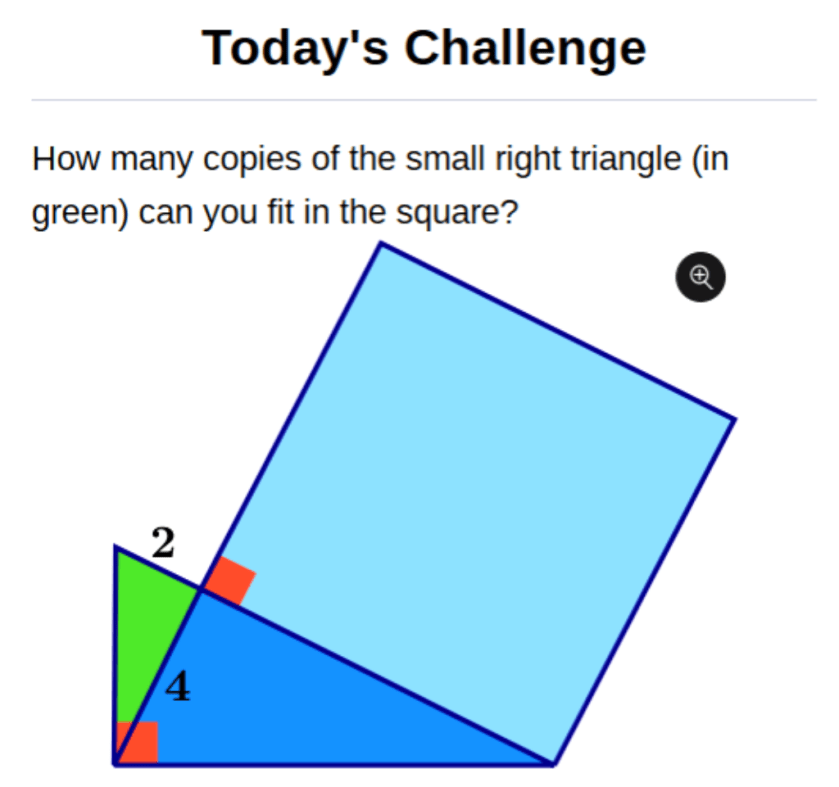
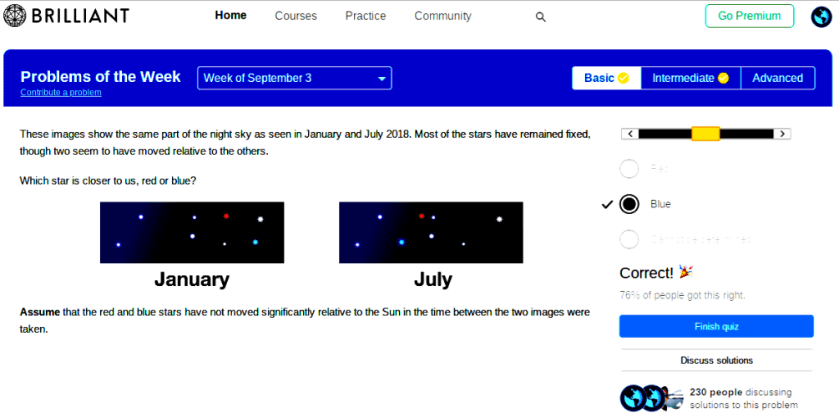
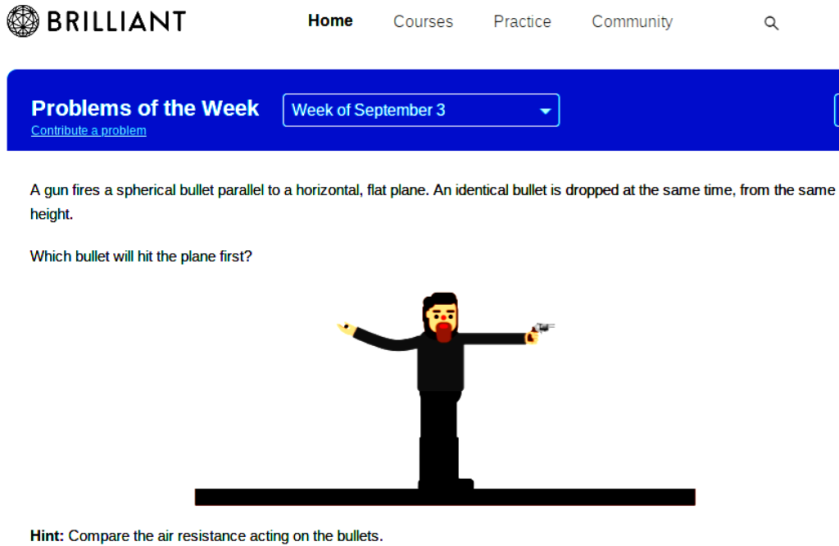
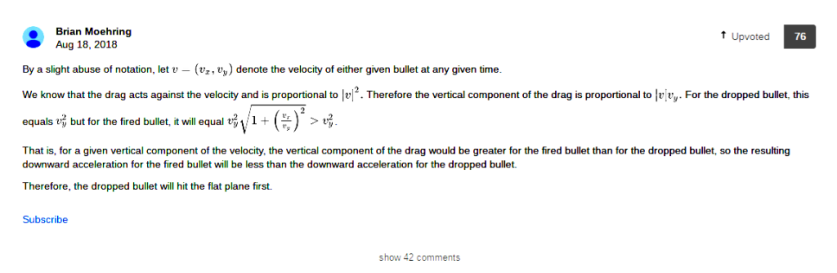
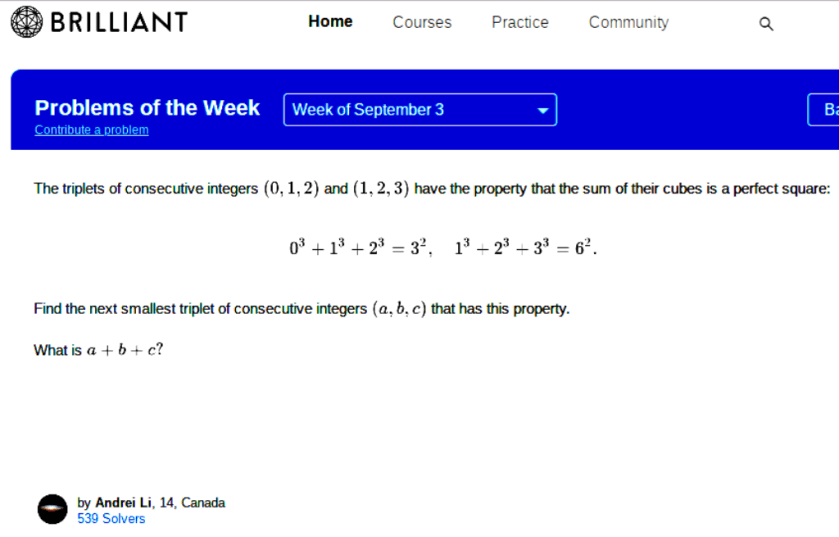
Another one from brilliant.org:

Fish Fiction

Your task is to use the above information to identify the smallest fish – and if you enjoy the task establish a complete ranking order of the five fish.

PHOTOGRAPHS

Today’s teams have put in their appearance, I have served up a couple of bonus cricket links and a mathematical teaser, so I now hand over to you for your comments with my usual sign off…

P1320664 (2)P1320666 (2)

P1320667 (2)
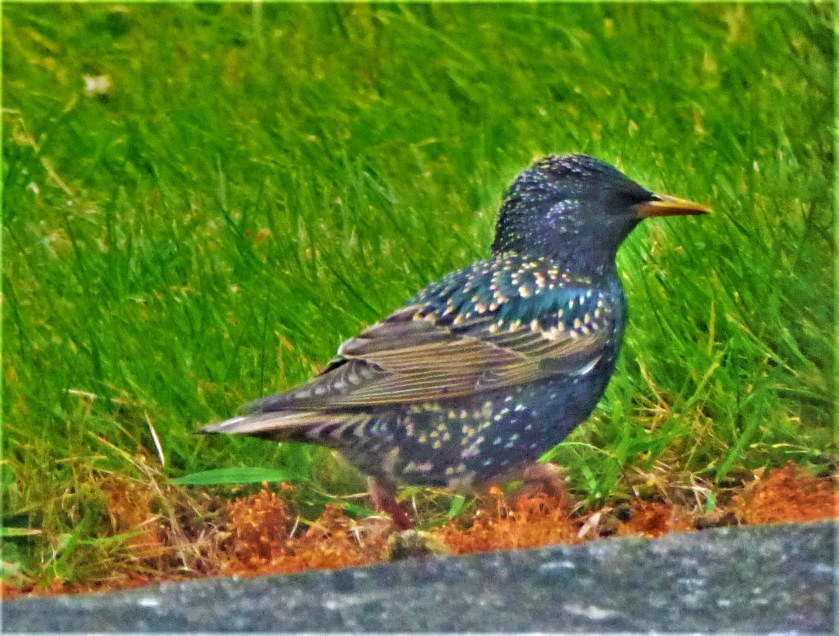
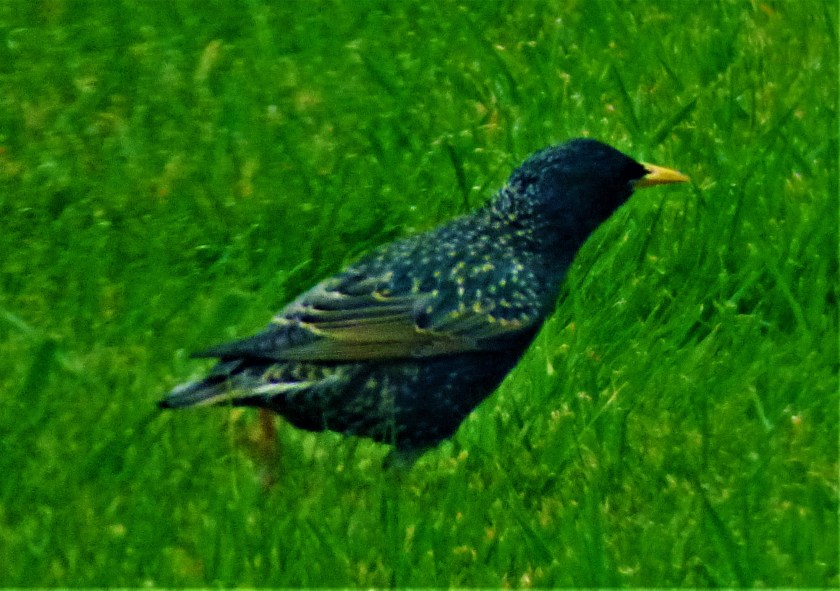
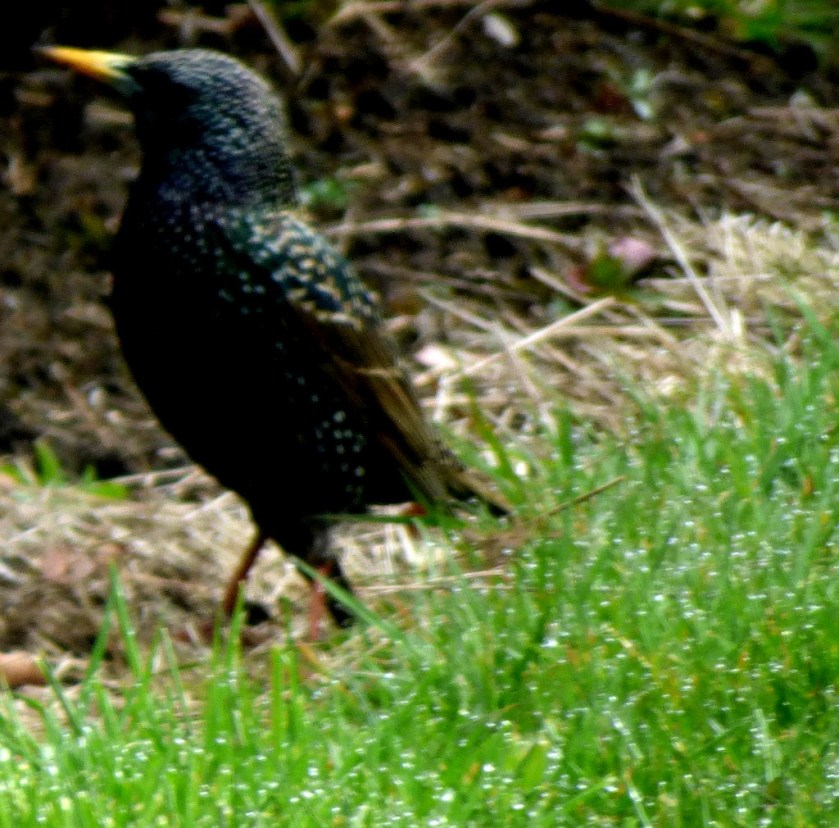
The first of two particularly satsifying starling pics

P1320668 (2)P1320669 (2)P1320670 (2)P1320673 (2)

P1320674 (2)
Mars mapping, from Dava Sobel’s “Planets”

P1320675 (2)P1320676 (2)

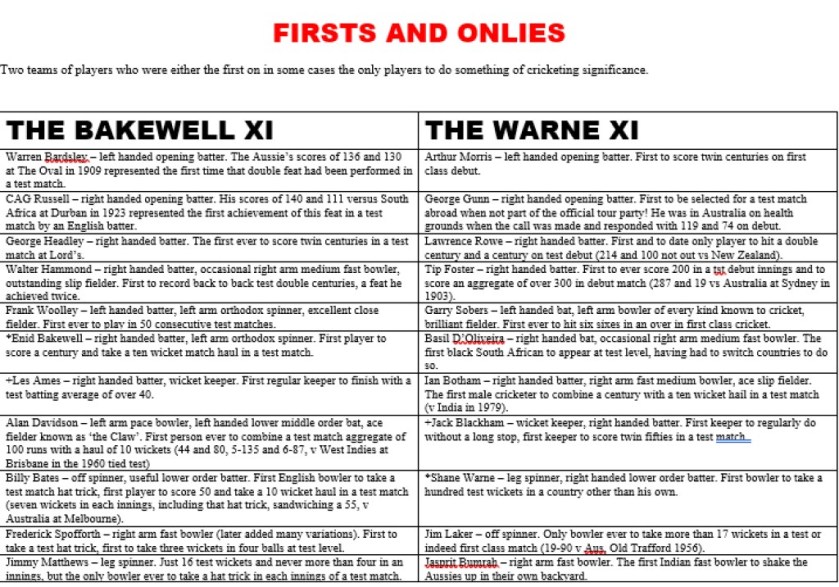
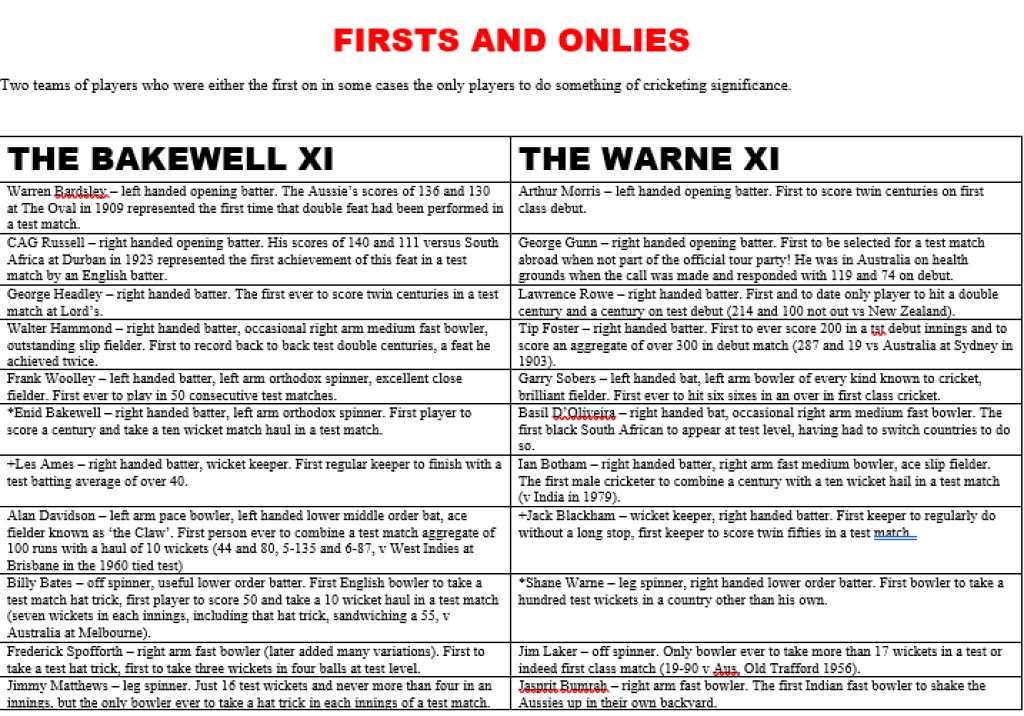
Firsts and Onlies
The teams in tabulated form.


All Time XIs – The CLR James Trophy

A variation on the ‘all time XI’ cricket theme inspired by CLR James’ great question “What do they know of cricket who only cricket know?” – contrives to touch on a huge variety of topics.

INTRODUCTION

Welcome to another variation on the all-time XI theme. This one requires a little preliminary explanation to set the scene, but first before getting into the main body of the post it is time for a…

CORRECTION AND APOLOGY

Some observant readers will have observed, as did one James Carroll on twitter that in yesterday’s post about New Zealand I somehow contrived to leave out Kane Williamson. So, following my usual ‘reverse tabloid’ policy in such matters I take this opportunity to redress the wrong: Williamson replaces Rutherford in the NZ My Time team and if absolutely mandated to do so I could accommodate him in the NZ All Time by dropping Martin Crowe. My thanks to Mr Carroll for being civil about making the correction and my apology to Mr Williamson for an inexcusable oversight.

EXPLAINING THE CLR JAMES TROPHY

The CLR James Trophy gets its name from the question at the heart of that classic cricket book “Beyond a Boundary”, “what do they know of cricket who only cricket know?” I pit two teams against each other of top level cricketers whose names give me non-cricketing links, with brief explanations of those links. I did consider honouring a former cricketer with a famously broad range of interests, Ed Smith and a polymath in Peter Medawar, but decided to stick with the CLR option. It is time to meet the first of our two XIs…

WG GRACE’S XI

  1. *William Gilbert Grace – right handed opening batter, right arm bowler of various types. The scorer of 54,896 first class runs and taker of 2,876 first class wickets, his parents’ eighth child and fourth son was named in honour of William Gilbert, Royal Physician to Queen Elizabeth I. He was among other things a pioneer in the field of magnetism, author of “De Magnete”, and subject of “Latitude” by Stephen Pumfrey. Another Gloucestershire physician, Dr Jessop, named his 11th child Gilbert, because it was WG’s middle name, while ‘The Champion’ had several cricketing cousins surnamed Gilbert as well.
  2. Alec Stewart – right handed opening batter. His average when picked for England in this specific role was 45 per innings. Here he gets in in order to publicize Professor Ian Stewart, author of a stack of books about mathematics, including a series of books of curios “Professor Stewart’s Cabinet of Mathematical Curiosities”, “Professor Stewart’s Hoard of Mathematical Treasurers” and “Professor Stewart’s Casebook of Mathematical Mysteries”, and many others such as “Does God Play Dice?”, “Nature’s Numbers” and “Taming the Infinite”.
  3. Kepler Wessels – left handed batter. The only man to score over 1,000 test runs for each of two different countries. In his case the connection is by way of his given name, to ground breaking astronomer Johannes Kepler.
  4. Bill Bruce – right handed batter. A successful Aussie of the 1890s. His analogue is Colin Bruce, author of “The Strange Case of Mrs Hudson’s Cat” and “Conned Again Watson”. These two books use stories featuring Baker Street’s most famous duo to explore mysteries of science, mathematics and logic.
  5. Merv Wallace – right handed batter. The Kiwi averaged 44 in first class cricket, but his few appearances at test level were not so successful. The non-cricketing link is Alfred Russel Wallace, co-discoverer of the theory of evolution by natural selection. The Wallace line, which runs (among other places) between Lombok and Bali marks the geological and zoological divide between Asia and Australia.
  6. David Hookes – right handed batter. The scorer of the fastest first class hundred by any Australian batter, in just 43 minutes. He is the only one whose name needs altering to create the non-cricketing links – deleting the final s gives Hooke, as in Robert Hooke, the great 17th century scientist, author of Micrographia, and well covered in John Gribbin’s “Science: A History 1543-2001”, while deleting the e from that surname provides a connection to philosopher Bell Hooks, who I learned a little bit about while studying philosophy as one of the modules of my degree.
  7. Franklyn Stephenson – right handed batter, right arm fast medium bowler. Our all rounder, one of only two since the reduction of first class fixtures in 1969 to have done the double of 1,000 runs and 100 wickets in an English season, and appropriately he is doing double duty. George and Robert Stephenson were both eminent engineers, among the pioneers of railway development. The most famous Stephenson design with a railway connection was of course ‘The Rocket’. Robert Louis Stephenson, a relative of the engineers, is famous as a novelist. I have read most of his books, the first one I read being “Kidnapped”, while I studied “Dr Jekyll and Mr Hyde” at degree level.
  8. +Jack Russell – wicket keeper, left handed lower middle order batter. His ‘alter ego’ is philosopher Bertrand Russell, author of many books, and one of the writers featured in “Portable Atheist”, edited by Christopher Hitchens.
  9. Xenophon Balaskas – leg spinner, capable right handed batter. His brief test match career does not look that impressive, but in 75 first class matches he scored 2,696 runs at 28.68 with a best of 206 and took 276 wickets at 24.11 with a best of 8-60. The original Xenophon was an Athenian who went to Sparta when his situation in his home city became untenable, signed up as a mercenary solider there and travelled to Persia as part of an army attempting to overthrow King Artaxerxes and place his brother Cyrus on the throne. After a battle in which Cyrus was killed, Xenophon and his men found themselves in deepest Persia under sentence of death, but managed to escape, and Xenophon eventually returned to Greece, writing up his adventures in a book he called Anabasis. This has been novelized by Conn Iggulden as “Falcon of Sparta”. Much later one Xenophon of Cos served as physician to the Roman Emperor Claudius, being mentioned in Suetonius’ “The Twelve Caesars” and also in the fictional setting of Robert Graves’ “I Claudius” and “Claudius The God”. Finally, to complete Balaskas’ ancient historical links his middle name was Constantine, linking him the first christian Roman Emperor.
  10. George Dennett – left arm orthodox spinner. Over 2,100 first class wickets and no England cap. He claims his place as second spinner by virtue of his surname, shared by philosopher Daniel C Dennett, among whose books are numbered “Darwin’s Dangerous Idea” and “Breaking The Spell”, both of which adorn my shelves.
  11. Danny Morrison – right arm fast medium bowler. He was one of the Kiwis best bowlers of the 1990s and his presence creates two splendid links. Toni Morrison won the Nobel prize for Literature for “Beloved”, and is also the author of a number of other hard hitting books – anything with her name on the cover will be worth reading. Boyd Morrison writes novels that combine action, adventure and elements of science and history – I have a copy of “The Noah’s Ark Quest” and can also recommend “The Tsunami Countdown”.

This team features a good top six, a genuine all rounder in Stephenson, a keeper who can bat, and three varied specialist bowlers. With Grace also worth his place as a bowler the bowling has depth and variety, with Stephenson and Morrison to take the new ball and Dennett, Balaskas and Grace to provide alternatives.

GREVILLE STEVENS XI

  1. Harold Dennis ‘Dickie’ Bird – right handed opening batter. Best known as an umpire, but he was a successful opening bat for Barnsley, and ultimately amassed two first class hundreds, with a best of 181 not out. David Bird is a prolific writer of books about Contract Bridge. He is particularly noted for his humorous stories featuring the monks of St Titus, the nuns of St Hilda’s and latterly staff and pupils alike at Cholmeley and Channing schools, located at opposite ends of the same village.
  2. Alan Melville – right handed opening batter. The South African had a splendid test record, including four successive centuries straddling World War II. His ‘alter ego’ is Herman Melville, author of “Moby Dick”.
  3. Hugh Massie – right handed attacking top order batter. He scored 55 in the original ‘Ashes’ test at The Oval in 1882, made out of 66 in under an hour – and had kicked off that tour with an innings of 206, a record first innings in England for an Aussie until 1930 when Bradman opened his English account with a score of 236. His non-cricketing counterpart is historical novelist Allan Massie, author of a series of Roman history themed books including “Augustus”, “Tiberius”, “Caesar” and “Nero’s Heirs”. “Augustus” features a wonderful spoof foreword taking on the persona of master of Michaelhouse College, Cambridge, one Aeneas Fraser-Graham, and declaring that ‘even a glimpse of a photostat is sufficient to assure one of the authenticity of these memoirs’.
  4. HJH ‘Tup’ Scott – right handed bat. Scott was one of three Aussie centurions at The Oval in 1884. He is not in fact here as an analogue for Captain Scott, although I commend to your attention the books about the ‘Captain Scott Invitational XI’ by Marcus Berkmann (“Rain Men” and tangentially “Zimmer Men”) and Harry Thompson (“Penguins Stopped Play”). No he has two ‘alter egos’ for my purposes, Walter Scott, prolific 19th century novelist and someone from whom Emily Bronte of “Wuthering Heights” fame drew inspiration, and Eugenie Scott of the Freedom From Religion Foundation, who was one of the contributors to “Scientists Confront Creationism”, edited by Andrew Petto and Laurie Godfrey and highly recommended by me.
  5. Colin Munro – left handed big hitting batter. The Kiwi averages over 50 in first class cricket, though he has only played a couple of tests and those unsuccessfully. He owes his place in this XI to Hector Munro, aka ‘Saki’, a master writer of short stories.
  6. *Greville Stevens – right handed batter, leg spinner. 10,376 first class runs at 29.56, 684 wickets at 26.84. At the close of the 1920 season it was he who ensured that the curtain would descend on Plum Warner’s career with an appropriately grand finish, by clean bowling Herbert Strudwick to settle the destiny of that year’s County Championship. He is here as a tribute the detective work of Daisy Wells and Hazel Wong, and the writing of their amanuensis Robin Stevens, who has created the ‘Murder Most Unladylike’ series to chronicle their exploits.
  7. Alonzo Drake – middle order batter, left arm orthodox spinner. The first Yorkshire bowler ever to take all ten wickets in an innings – 10-35 v Somerset in 1914, the outbreak of World War 1 finished his career. Although he is a namesake of Sir Francis Drake who famously played bowls on Plymouth Hoe it is actually another Drake, Frank Drake of SETI fame who gets him into this team. Frank Drake co-authored with Dava Sobel a book titled “Is Anyone Out There?” about the search for extra-terrestrial life. Sobel has a stack of other credits, including “Longitude”, “A More Perfect Heaven”, “The Planets” and “Galileo’s Daughter” all of which I recommend.
  8. +Ian Gould – wicket keeper and right handed lower order batter, later a successful umpire. ‘Gunner’ Gould just about merits his place as a keeper/batter, which makes it possible for me to bring in Stephen Jay Gould, USian scientist, science writer and master essayist. I own a number of his books, including “Questioning The Millennium”, “The Richness of Life”, “Life’s Grandeur”, “Bully for Brontosaurus”, “Ever Since Darwin”, “Dinosaur in a Haystack” and “Urchin in a Storm”. Given the amount of baseball that features in Gould’s oeuvre it seems quite appropriate to find a way a slipping him into a cricket themed post.
  9. Mitchell Johnson – left arm fast bowler, left handed attacking lower order bat. The Aussie’s claims for a place need no further elaboration, and he allows me two connections. Samuel Johnson, author of the first recognized dictionary is one. There was a road not massively far from where I lived as a child in south west London called Dr Johnson Avenue, and it had that name because he used to cycle that way when going to visit his friend Mrs Thrale, who also has a road named in her honour that is even closer to my old family home. I used to walk along Thrale Road very frequently because if one was using either Streatham or Streatham Common stations it was the natural way to go. The second connection is Charles Johnson, an African American writer whose books include “Oxherding Tale” and “Dreamer”, the latter based on the life of Martin Luther King.
  10. Max ‘Tangles’ Walker – right arm fast medium. He was a magnificent third string to Lillee and Thomson in the mid 1970s, gaining big movement in the air and off the pitch on occasions. At Edgbaston in 1975 when Mike Denness put Australia in and they scored 359 Walker matched Lillee’s five wickets in the first England innings with five of his own, before ‘Thommo’ turned chief executioner in the second dig. His ‘alter ego’ for my purposes is Alice Walker, well known as author of “The Color Purple”, and also the author of a collection of what she calls “Womanist Prose”, both of which come highly recommended. She became radicalized by her experiences as a student at Spelman College (although she left that institution and moved north the New York where she studied at Sarah Lawrence College), where she met the historian Howard Zinn, someone any of whose books will be worth reading. There is a quote from her which appears on the back cover of “The Zinn Reader”: “What can I say that will in any way convey the love, respect and admiration that I feel for this unassuming hero who was my teacher and mentor, this radical historian and people-loving ‘troublemaker’, this man who stood with us and suffered with us? Howard Zinn was the best teacher I ever had and the funniest.”
  11. Harry Boyle – right arm medium pacer. FR Spofforth’s regular bowling partner. He earns his place as one half of the first great Australian bowling duo. His ‘alter ego’ is Robert Boyle whose contribution to science is covered on pages 126-42 of John Gribbin’s “Science: A History 1543-2001”.

This team has a decent top five, a couple of genuine all rounders, a keeper who can bat, and three fine and varied bowlers. Johnson, Walker, Boyle, Drake and Stevens is a bowling attack that should not struggle overmuch to take 20 wickets.

THE CONTEST

WG Grace’s XI are the stronger in batting of the two, although no side who can send Johnson in at no9 can be considered deficient in that department. But I suspect that the bowling resources of Greville Stevens’ XI are stronger overall. However countering that is the undeniable fact that WG Grace’s XI have the better keeper. I believe this would be a very close and highly compelling contest, and I cannot pick a winner. Note that the presence of Mr Bird notwithstanding I have not selected players solely on the basis of their names – it is always what they offer as cricketers that comes first.

PHOTOGRAPHS

The correction has been made and due apologies issued, the CLR James Trophy has been introduced and the contending XIs have been put through their paces, so all that now remains is my usual sign off:

P1320469P1320456 (2)P1320457 (2)P1320458 (2)P1320460 (2)P1320461 (2)P1320466 (2)P1320467 (2)P1320468 (2)P1320470 (2)P1320471 (2)P1320473 (2)P1320474 (2)

P1320475 (2)
The best picture I have seen of ‘The Champion’ – this is the first page of the section on Batting in the Badminton Book of Cricket.

P1320476 (2)P1320478 (2)P1320479 (2)P1320479 (3)P1320480 (2)P1320481 (2)P1320482 (2)

P1320483 (2)
At about 11:30AM this muntjac put in a fleeting appearance.

P1320484 (2)P1320485 (2)P1320486 (2)P1320487 (2)P1320488 (2)P1320489 (2)

CLRJT1
Part 1 of publicity sheet
CLRJT2
Part 2
CLRJT
And the whole bolted together ready for public consumption.

All Time XIs – Pioneers v Developers

Some cricket history in today’s twist on the ‘All Time XI’ theme as ‘The Pioneers’ take on the ‘The Developers’, a couple of bonus cricket links, a measure of mathematics, some important stuff about the NHS and of course photographs.

INTRODUCTION

A new month starts today, and in keeping with the theme of beginnings my latest ‘All Time XI’ variation features various milestones from the beginning of cricket’s history. For those of a geological turn of mind it can be thought of spanning the cricketing equivalent of Cambrian to Cretaceous. The scene thus set, we can introduce the teams, beginning with…

THE PIONEERS XI

  1. Jack Brown – right handed opening batter. Brown scored two triple centuries for his native Yorkshire in the course of his career, but his greatest innings came for England. The 1894-5 Ashes saw England leap out of the blocks by winning a thriller in Sydney and then more comfortably in Melbourne (this was the first ever five match Ashes series, and Sydney and Melbourne each got two games, with the middle match being played at Adelaide) before Australia hit back by winning in Adelaide and in the second Melbourne game. In the final match of the series (all tests in Australia at the time were played out until a definite result was gained, so a draw was not a possibility, and in any case England needed to win the series to recapture the Ashes, held by Australia) England were set 297 to win, lost two very early wickets, which brought Brown and Albert Ward together. Brown responded to crisis by reaching 50 in 28 minutes (still the fastest in time times by an Englishman in test cricket), and though he could not main this hectic pace he reached his hundred in a then test record 95 minutes, and his stand with Ward (93) was worth 210. Brown ultimately scored 140 in that innings, falling as victory beckoned, but the Australian resistance had been well and truly broken, and England won by six wickets to win the series and the Ashes. In travelling to Australia without the urn and returning with it England’s captain for that series, Andrew Stoddart, had achieved a feat since duplicated among England captains only by Warner (1903-4), Douglas (1911-2, with a sick Warner masterminding from his sickbed), Jardine (1932-3) and Illingworth (1970-1). In addition to his own role as a stalwart opener, Brown was one half of the game’s first recognized great opening pairs along with…
  2. John Tunnicliffe – right handed opening bat, brilliant slip fielder (667 catches in 408 first class games). Tunnicliffe was the first Pudsey product to open the innings for Yorkshire, and as such a forebear to more illustrious Herbert Sutcliffe and Len Hutton. In 1898, against Derbyshire, he and Brown shared an opening stand of 554, accumulated very rapidly. This was the record first class stand for any wicket until Herbert Sutcliffe and Percy Holmes opened up with a stand of 555 against Essex in 1932. After he had retired from playing Tunnicliffe became a coach, working at among others, Cirencester Grammar School where his charges included a certain Walter Reginald Hammond. Unusually for a long serving Yorkshire opener he never got to play for England.
  3. James Aylward – left handed bat. In 1777, a mere eight years after John Minshull scored the first century recorded at any level of cricket, in a local derby match between Wrotham and Sevenoaks, Aylward playing against an England side racked up 167 in an innings which saw him occupy the crease for two whole days. This score stood as the first class record for 43 years, and the fixture in which William Ward who beat it scored his 278 would not today be regarded as first class.
  4. William ‘Silver Billy’ Beldham – right handed batter. I covered him in detail in my ‘one cap wonders v nontest stars‘ piece earlier in this series. He was the first to be anything approaching a consistently big scorer.
  5. William Lambert – right handed batter, brilliant close fielder and sometimes wicket keeper. In 1817 William Lambert, playing for Sussex, became the first ever to score twin centuries in a match, a feat next achieved by WG Grace over half a century later. His fielding skills are attested to by his partner in more than one double wicket game…
  6. George Osbaldeston – right handed batter, right arm fast bowler (underarm). The first acknowledged great all rounder. In his autobiography, which did not see the light of day until 1926, Osbaldeston describes a couple of matches in which he teamed up with Lambert, and mentions that the latter took catches and executed stumpings off his bowling, the fastest around at the time. In one of these encounters Osbaldeston and Lambert got the better of the decidedly ignoble Lord Frederick Beauclerk, one of the most unsavoury characters from that period of cricket’s history.
  7. +Jack Blackham – wicket keeper, right handed bat.  The Aussie stumper who appeared in the first 17 test matches ever played, before missing a game due to a dispute and then returning to the side for another 10 years, was the first to habitually do without a ‘long stop’ fielder behind him – and he pulled of stumpings of the bowling of Fred ‘The Demon’ Spofforth on occasion. Blackham was also the first keeper to score fifties in both innings of a test, a record that remained solely his for half a century before Dilawar Hussain equalled it.
  8. *William Clarke – right handed (under arm) bowler, captain. Clarke established Trent Bridge (he was landlord of the Trent Bridge inn as well as a cricketer), and also founded the first of the great itinerant XIs who flourished until the mid 1870s. The MCC were sufficiently worried by the travelling elevens that WG Grace was proposed for membership of that club at the age of 21 (by the treasurer, with the secretary seconding) in an effort to secure the game’s biggest drawcard. Grace duly joined the MCC, but also until 1879 captained the United South of England XI, and earned good amounts of money from doing so. Clarke played high level cricket until his mid-fifties, continuing to bag hatfuls of wickets right up to the very end.
  9. William Lillywhite – right arm fast bowler (round arm). ‘The Nonpareil’ featured in my post about nicknames, and is here is the fast half of the first recognized great bowling partnership, along with…
  10. James Broadbridge – right arm fast bowler (round arm). His partnership with Lillywhite as pioneers of the then new craft of round arm bowling enabled Sussex to take on and beat The Rest of England.
  11. David Harris – right arm fast bowler (under arm). The first universally acknowledged master bowler, I included him in my T20 Clash post.

This team features a solid opening pair, a magnificent looking three, four and five, a genuine all rounder, a keeper who can bat and four varied bowlers. Clarke can provide the craft to go with the pace of the others, and the differing angles of attack offered by these bowlers will also pose a problem. Osbaldeston, as the all rounder and a very quick bowler will be used in short bursts as a shock weapon, while the front four will bowl more overs.

THE DEVELOPERS XI

  1. *WG Grace – right handed opening bat, right arm bowler of multiple types, captain. I covered him in my Gloucestershire post.
  2. Victor Trumper – right handed opening bat, fine fielder. The first to score a hundred before lunch on day 1 of a test match, the Aussie opener revolutionized batting in his own country.
  3. Frank Woolley – left handed batter, left arm orthodox spinner. He defined the image of Kent cricket, based on attacking batting and slow bowling, throughout his long career.
  4. Charles Macartney – right handed batter, left arm orthodox spinner. The second batter ever to score a hundred on the first morning of a test match, what made Macartney’s performance even more extraordinary is that he was a blocker in his early years, before becoming more expansive and aggressive in approach as he grew older.
  5. Kumar Shri Ramjitsinhji – right handed batter, occasional right arm slow bowler, slip fielder. I covered him in my Sussex post, and he is in this squad as the pioneer of the leg glance.
  6. Bernard Bosanquet – right handed batter, right arm leg spinner. I covered the inventor of the googly in my Middlesex post.
  7. Gilbert Jessop – right handed batter, right arm fast bowler, brilliant fielder. This man has been in a number of my previous XIs, and he is here for his unique approach to batting, based on “doing everything we are taught not to – with consummate success”.
  8. +Ted Pooley – wicket keeper, right handed bat. Pooley (Surrey) should have been England’s keeper in the first ever test match, except that he was cooling his heels in a Kiwi prison at the time. He had got into a fracas with one Ralph Donkin over a bet. Pooley had bet Donkin at a shilling to a penny that he could nominate the scores for match England were playing in. Donkin took the bet, and Pooley simply wrote a duck against each batters name, which even in a first class match would have seen him a comfortable winner, while in a game against odds, which this one was it was even more of a certainty. Donkin refused to pay, and heated words and ultimately blows were exchanged. There was some sympathy for Pooley on the grounds that “a bet is a bet” and also because Donkin was notorious for being a trouble maker. Pooley set a first class match record while keeping for Surrey that stood unchallenged for over a century when he caught nine and stumped three of the opposition in a single game.
  9. Sydney Barnes – right arm fast medium, right handed bat. Never has a piece of cricket terminology been more unfit for purpose than that standard descriptor of Barnes’ bowling method. The truth is he bowled every type of delivery then known save the googly, and that his special weapon, of his own creation, was a fast-medium leg break. Ian Peebles, in a chapter called ‘Barnes the Pioneer’ which appeared originally in “Talking of Cricket” and reappears in “The Faber Book of Cricket”, where it starts on page 12 and ends on page 15 explains Barnes’ methods in some detail. I have previously covered Barnes in the Lancashire and ‘Staffordshire Born‘ posts in this series.
  10. George Simpson-Hayward – right arm off spin (under arm). I mentioned him, and the possibility of reviving under arm, both slow in his manner and fast in the manner of the likes of Harris and Osbaldeston in my ‘Eccentrics‘ piece. The brief revival of under arm that he was the star of was initiated by Digby Jephson of Surrey who bowled fast under-arm, and must have come close to being picked for England. However, the crafty Simpson-Hayward (Worcestershire) not only did get to play test cricket, he was one of the stars of a series in South Africa (1909-10), when he took 23 wickets at 18 in the five matches, so it is he who I honour with a place in this XI. No one took up the cudgels on behalf of under arm after him.
  11. William Mycroft – left arm fast bowler. The first bowler ever to take 17 wickets in a county game, for Derbyshire v Hampshire in 1876, a game that I featured in my Derbyshire post, he rounds out this XI.

This XI features a power packed and all attacking top five, a fine and innovative all rounder at six, the inimitable Jessop at seven, a class keeper who was no mug with a bat in Pooley and a splendidly varied trio of specialist bowlers in Barnes, Simpson-Hayward and Mycroft. The bowling is equally varied, with left arm speed, the all-purpose maestro Barnes, right arm speed for Jessop, leg spin from Bosanquet, under arm off spin from Simpson-Hayward, two purveyors of left arm orthodox spin in Woolley and Macartney (each had a ten wicket haul in a test match in their day) and the types of bowling pursued by Grace in his day, which included fastish round arm at the start of his career.

THE CONTEST

This contest would be a splendid affair, red blooded in the extreme (Grace and Osbaldeston on opposing sides would guarantee that even of the other 20 players were all anodyne, which they are most certainly not) and featuring a vast range of skills. I cannot even attempt to pick a winner.

A COUPLE OF BONUS CRICKET LINKS

The pinchhitter blog has honoured me not just with a mention, but with the official title of their post this morning – check out their offering here.

The above blog introduced me to cricblog who have a post up analysing the England men’s ODI revival post 2015. I recommend you have a read.

ANOTHER TEASER

I give you another problem from brilliant.org, one which I solved very easily this morning:

Perimeter

In it’s original setting this was a multiple choice question, but I reckon that makes it far too easy.

TWO FINAL LINKS AND PHOTOGRAPHS

Our two teams, dubbed ‘pioneers’ and ‘developers’ have made their appearances, there have been a couple of bonus cricket links, and a mathematical teaser. Before proceding my usual sign off I have a couple of related links to share:

And now, here is my closing flourish:

P1320332 (2)P1320333 (2)P1320335 (2)P1320337 (2)P1320338 (2)P1320339 (2)P1320340 (2)P1320341 (2)P1320342 (2)P1320343 (2)P1320344 (2)P1320345 (2)P1320346 (2)P1320348 (2)P1320350 (2)P1320351 (2)P1320352 (2)P1320353 (2)P1320354 (2)P1320355 (2)P1320356 (2)P1320357 (2)P1320359 (2)P1320360 (2)P1320361 (2)P1320362 (2)P1320363 (2)P1320364 (2)P1320365 (2)P1320366 (2)P1320367 (2)P1320368 (2)

Pioneers v Developers
The two teams, in tabulated form with abridged comments.


All Time XIs – Davids v Goliaths

My latest variation on the ‘all time XI’ theme pits Davids against Goliaths. I also present the answer to yesterday’s teaser, an important post about disease prevention and of course some photographs.

INTRODUCTION

It is time for another variation on the ‘All Time XI‘ theme, this time pitting a team made of players of small stature against a team of some of the tallest of all cricketers. I will also answer yesterday’s mathematical teaser.

THE GOLIATHS XI

  1. Chris Gayle – left handed opening batter, occasional off spinner. He stands 6’5″ tall. His career highlights include two test triple centuries. However, he would be banned from using the DRS because of his record in that department.
  2. Will Jefferson – right handed opening batter, occasional right arm fast medium. At 6’11” the Essex and later Leicestershire opener is one of the tallest of all professional cricketers. He never quite managed to attract the attention of the England selectors, but achieved a very respectable output in first class cricket.
  3. Kevin Pietersen – right handed batter, occasional off spinner. At 6’4″ one of the shorter members of this team. He averaged almost 50 in test cricket, with his highest score 227 at Adelaide. Late in his career he came within two of the highest score ever made for Surrey, with 355. He was not always popular with team mates – his departures from his first two counties, Nottinghamshire and Hampshire were both decidedly acrimonious, but his record speaks for itself.
  4. Tom Moody – right handed batter, occasional medium pacer. The 6’7″ Aussie scored stacks of runs for Warwickshire and Worcestershire over the years and was also a fine fielder. One of the few to have admitted to being embarrassed by making a century due to the circumstances of its making. The innings in question, which saw the normally prized landmark arrive in just 26 minutes, was played against bowlers who were deliberately giving away runs to expedite a declaration was at the time greeted as a new first class record, but wiser counsels have since prevailed and it is now entirely correctly relegated to a footnote. Moody made ample numbers of runs that he had to earn, and his genuine embarrassment at effectively being handed a century speaks volumes for him.
  5. *Clive Lloyd – left handed batter, cover specialist fielder, captain. The 6’5″ bespectacled Guyanese ace featured in my piece about the West Indies. Against Glamorgan he once reached 200 in precisely two hours against genuine bowling. In the inaugural men’s world cup in 1975 (the women played one two years earlier, won by Rachael Heyhoe-Flint’s England) he scored a ton in the final to put West Indies in charge of the contest, a position they never relinquished.
  6. +Clyde Walcott – right handed batter, wicket keeper. Wicket keepers are rarely particularly tall, and Walcott was over six feet tall. I wrote about him in the West Indies piece.
  7. George Bonnor – right handed batter, medium pacer, excellent catcher. Bonnor was one of the first renowned big hitters, with his best test innings being a score of 128 that included sending the ball clean out of the ground four times. He was inclined to attempt to ‘bat properly’, a policy that did not work for him – his best moments came when he realized that he was a big hitter and did not try to play a real innings.
  8. Sulieman Benn – left arm orthodox spinner. At 6’7″ the West Indian is probably the tallest specialist spinner there has ever been, and he did have his moments. When I watched the West Indies play Australia at Adelaide in 2009 he was one of only two of their bowlers, greased lightening quickie Kemar Roach being the other, to cause the Aussie batters genuine apprehension. That match should have been an all-time classic, the West Indies being all out early on the final morning to leave Australia needing 330 off 81 overs on a pitch that was still pretty good for batting. Unfortunately, influenced by being already one up in a three match series, the Aussie skipper ‘Punter’ Ponting declined to live up to his nickname and Australia made no serious attempt to mount a chase that they should have had a fair chance of pulling off.
  9. Mohammad Irfan – left arm fast bowler. The Pakistani paceman at 7’1″ is officially the tallest international cricketer there has ever been.
  10. Joel Garner – right arm fast bowler, excellent boundary fielder. The 6’8″ Barbadian who has one end of his home ground, the Kensington Oval in Bridgetown, named in his honour was a very difficult bowler to score off, and took ana average of just over four wickets per test match. His ODI economy rate of 3.09 is unapproached in that format. He was my chosen overseas player for Somerset.
  11. Bruce Reid – left arm fast bowler. The 6’8″ Aussie had a fine test record for those matches when he was able to play, though he spent a lot of time on treatment tables (his only rival that I can think of in that regard was another Aussie, Damien Fleming).

This team has a good top six, including a serviceable wicket keeper, a big hitter at no 7 and four fine bowlers. It is weak in the spin bowling department, with only the part time tweakers of Gayle and Pietersen to supplement Benn’s left arm spin. That is the suitably Brobdingnagian “Goliaths XI”, and now, slings at the ready, here are their opponents:

THE DAVIDS XI

  1. Bobby Abel – right handed opening bat. The diminutive Surrey opener (officially 5’4″ but perhaps less) was the first to carry his bat through an England innings, finishing on that occasion with 132 not out. He also holds the record for carrying his bat through the highest first class team total to feature such an innings, and in that same innings the highest score ever made for Surrey. In 1899 at Taunton, Surrey scored 811 all out, with Abel batting through for an undefeated 357. Abel and Tom Hayward shared the Surrey record partnership for any wicket, 448 for the 4th. Playing for the Players against the Gentlemen at The Oval Abel scored 247, a score only beaten in that series by his fellow Surreyite Jack Hobbs (266). Abel also formed a contrasting friendship with WG Grace, and was among the pallbearers at the latter’s funeral. There is a biography of him by David Kynaston that I recommend.
  2. Tammy Beaumont – right handed opening bat. She has established a magnificent record at the top of the order in recent years (visit my post of two days ago to see a clip of highlights from one of her innings), and while the women play scandalously little test cricket, her record in ODIs is significantly better than her record in T20s, leading me to take the view that if she got a proper chance in long form cricket she would be highly successful.
  3. *Don Bradman – right handed batter, brilliant outfielder, captain. He was just a little over 5’6″ in height, the second tallest of my chosen XI. A test average of 99.94 renders further comment superfluous. This is his third appearance in this series of posts, after Australia and the Scribes.
  4. Sachin Tendulkar – right handed batter. The Indian maestro, scorer of 100 international hundreds is an automatic selection at four as Bradman was at three.
  5. Gus Logie – right handed batter. The West Indian, one of the smallest players of his era, was not anything like as heavy a scorer as his immediate predecessors in this order, but he tended to score his runs when his side really needed them.
  6. +Mushfiqur Rahim – right handed batter, wicket keeper. The Bangladeshi, one of the smallest players ever seen in the test arena, has two test double centuries to his credit, and averages 36.77 overall with the bat, and he has not all that often had the luxury of being able to build on a strong start by his team. He has also taken 104 catches and executed 15 stumpings in test cricket. Bangladesh has probably during his career only had five players who can genuinely be regarded as top class, opener Tamim Iqbal, all-rounder Shakib Al Hasan (currently suspended), off spinner Mehedi Hasan, fast bowler Mashrafe Bin Mortaza (now a member of the Bangladeshi parliament, and a spent force as a player) and Mushfiqur Rahim himself. In this team he is part of a strong unit, which would be a new experience for him.
  7. Gilbert Jessop – right handed bat, right arm fast bowler, brilliant fielder. At 5’7″ the tallest member of my chosen XI, he is the x-factor all rounder in the side. He featured in yesterday’s post.
  8. Katherine Brunt – right arm fast medium bowler, right handed bat. The Barnsley born Brunt is approximately 5’5″ tall – among her regular England team mates only Beaumont and Danielle Wyatt are noticeably shorter. It is her skiddy bowling that has earned her a place in this XI, but she has also developed her batting to a very considerable degree, and shares with Logie the knack of producing the goods when they are most required – her career best 72 not out got England to a total in excess of 200 when at one stage a prediction of 150 would have been viewed as seriously optimistic.
  9. John Wisden – right arm fast, useful lower order batter. The Sussex pacer, also founder of the United All England XI, a touring XI which played matches against local teams who had a numerical advantage – 18 and 22 were the two most frequent sizes of team for such matches, and sometimes secured the services of professionals, described as ‘given men’, once took all ten in a first class innings, all clean bowled. He stood only 5’4″, probably the shortest specialist fast bowler there has ever been.
  10. Tich Freeman – leg spinner. The 5’2″ Freeman (his actual given names were Alfred Percy) was the second most prolific wicket taker in first class cricket history, with 3,776 (and he played only about half the number of matches that Yorkshire’s Wilfred Rhodes, the no1 in this category, did). He holds all manner of records for large wicket hauls. Even more remarkable by today’s standards is the age at which he achieved these feats – a combination of his being a late developer and World War 1 meant that by the age of 30 the Kent leggie had precisely 29 first class wickets to his credit.
  11. Poonam Yadav – leg spinner. The tiny Indian leg spinner was one the stars of the recent Women’s World T20, again and again confounding opponents with her flight and spin. She is also one of the slowest bowlers of any description to have been seen in top level cricket.

This team has an opening pair who should combine well, a powerhouse combination at three and four, a battler at no six, a wicket keeper batter at six, the most explosive batter the game has ever seen at seven, and four varied bowlers to round out the XI. I regret that both spinners are leg spinners, but I think there is enough difference in their methods that this is not a very serious weakness.

THE CONTEST

This contest for the ‘Sling Trophy’ as I shall call it should be a fine one. However, especially if Wisden, Brunt and Jessop, the pace bowlers for the Davids, concentrate on yorkers, which the Goliaths would find it difficult to get down to, I would still expect this to go the same way as the original David vs Goliath – in favour of the Davids.

SOLUTION TO YESTERDAY’S TEASER

Yesterday I offered up this, from brilliant.org

Measurement

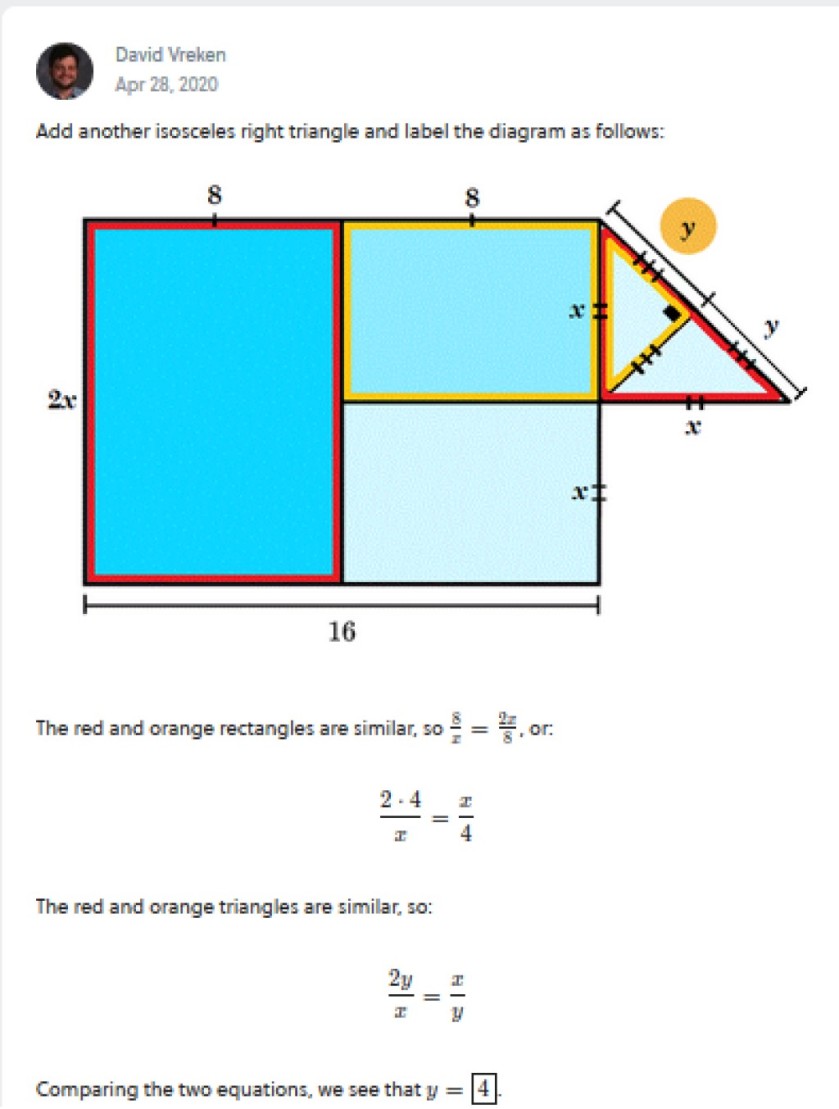
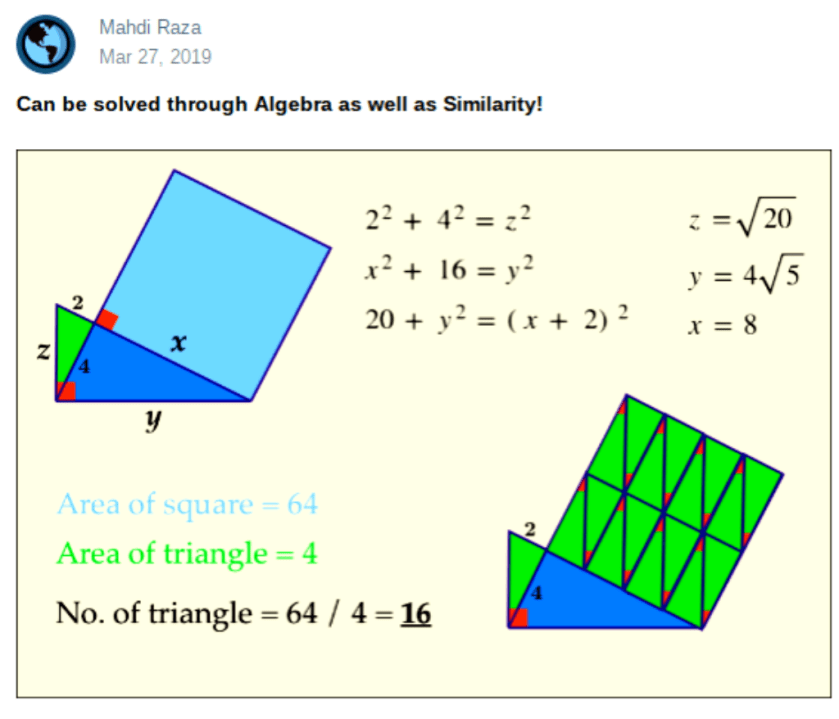
The key lies in that word ‘similar’. All the four rectangles (the big overarching rectangle, with long side 16, the intermediate rectangle that is half the area of that one and the two smaller rectangles all have the same proportions. This means that the key shape, the triangle is an isosceles right angled triangle and its longest side can be calculated from the similarity of the rectangles to equal to 4 x the square root of 2. This squares up to 32, and Pythagoras tells us that the sum of the squares of the other two sides is equal to the square of the longest side (aka hypoteneuse). Since the triangle is isosceles as well as right angled, the square of each remaining side is half of 32, i.e. 16. 16 has two square roots, 4 and -4, and the length of the side of a triangle is a positive number, so the answer is four.

Here is David Vreken’s elegant published solution:

VrekenSol

Just to complete this mini-section, it took me much less long to actually solve this than to type my explanation, and I am a fairly rapid typist.

A FINAL LINK AND PHOTOGRAPHS

The Davids and Goliaths of cricket have been paraded in all their glory, and I have a single link left to share before finishing with my usual sign off. Phoebe MD has hosted a post by Barbara Leonhard titled “Avoiding the Tragedy: A Look into Disease Preventionwhich I consider to be a must-read. My thanks to both Phoebe and Barbara for that piece.

Finally, my usual sign off…

P1320309 (2)P1320310 (2)P1320311 (2)P1320312 (2)P1320313 (2)P1320314 (2)P1320315 (2)P1320316 (2)P1320317 (2)P1320318 (2)P1320319 (2)P1320320 (2)P1320321 (2)P1320323 (2)P1320324 (2)P1320328 (2)P1320329 (2)P1320330 (2)P1320331 (2)

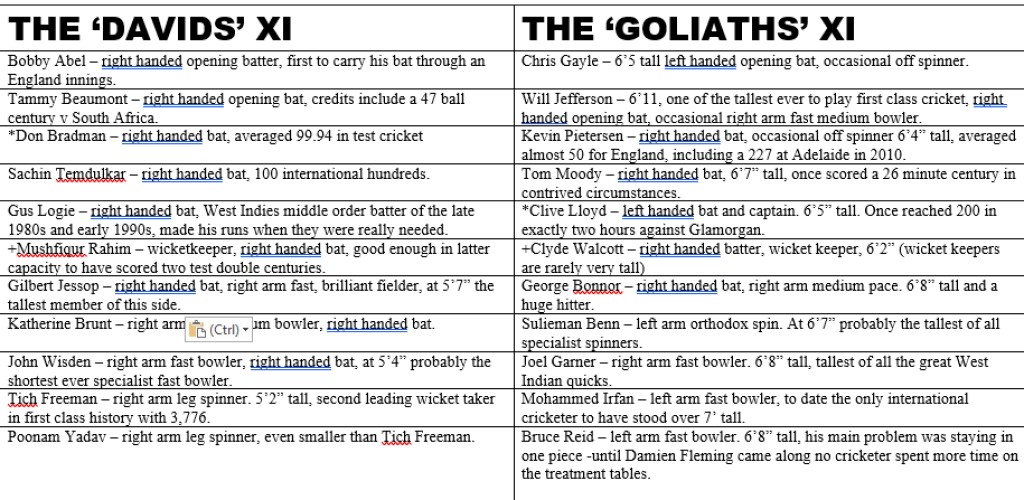
David v Goliath
The teams in tabulated form with abbreviated comments.

All Time XIs: Functional Left Handers v Elegant Right Handers

My latest variation on the ‘All Time XI’ theme, the answer to yesterday’s maths teaser, an important petition, a soupcon of science and nature and some photographs – enjoy!

INTRODUCTION

Another day brings another variation on the ‘All Time XIs‘ theme. Today’s is based on a well known piece of cricket folklore – the belief that left handers are naturally more elegant than their right handed colleagues. Like all good folklore it has a basis in fact, but it is definitely an overstatement of the case. Thus today I challenge it by providing an XI of strictly functional left handers and to oppose it an XI of notably elegant right handers. Note that some the bowlers in the left handers XI  batted with their right hands – it is their bowling for which they are picked, and mutatis mutandis for the right handed batter who bowled with his left. First to parade their skills are…

THE FUNCTIONAL LEFT HANDERS XI

  1. Gary Kirsten – the South African, half brother of Derbyshire’s Peter Kirsten, had seemingly limitless patience and concentration but a decidedly limited range of strokes.
  2. Sir Alastair Cook – the Essex and England man, his country’s all time leading scorer of test runs, was another who cultivated a limited range of strokes but used those he did possess to great effect.
  3. Graeme Smith – the former South African was mighty effective, but an aesthetic disaster (among top order batters named Smith it is an interesting question as to whether he or current Aussie right hander Steve represents the greatest aesthetic outrage).
  4. Shivnarine Chanderpaul – the Guyanese stayer had the oddes batting stance I have ever seen, so open that he was almost at 45 degrees to the bowler as opposed to the recommended side-on position (Austin Matthews who played for Glamorgan many decades ago as a bowler of medium pace and lower middle order batter wrote a coaching manual after his retirement in which he stated “cricket is a sideways game”), and while the method worked for him it was very much ‘one not to watch’.
  5. *Allan Borderthe nuggety NSW, Queensland and Australia middle order man had in the words of Frances Edmonds “not so much a style as a modus operandi”. This quote appears in “Cricket XXXX cricket” her humorous book about the 1986-7 Ashes (she also wrote “Another Bloody Tour”, which somehow managed to be amusing about England’s unqualified disastrous Caribbean excursion of 1985-6. For about the first decade of his long career he pretty much was, in batting terms, Australia’s resistance.
  6. Jimmy Adams – his obdurate approach saw him dubbed ‘Jimmy Padams’.
  7. +Jack Russell – wicket keeper and as a batter just about the ultimate in lower middle order irritants, sometimes very usefully for his country.
  8. Richard IllingworthWorcestershire and England slow left armer (emphatically NOT a spinner – if he ever turned one I never saw it). His economical, reliable but unthreatening methods were often preferred by England selectors of the time to the higher risk Phil Tufnell.
  9. Ryan Sidebottom – the Yorkshire, Nottinghamshire and England fast medium bowler had long run up which his pace never quite seemed to justify.
  10. Doug Bollinger – the NSW and Australia fast medium bowler was another whose run up appeared to promise more pace than he actually proved capable of delivering. I saw him bowl live at Adelaide v the West Indies in 2009, and, the first innings scalp of Gayle not withstanding he looked unimpressive, while his ‘efforts’ at the same ground in the 2010 Ashes match there were of a very low order.
  11. Paul Adams – the left arm wrist spinner’s action was once memorably likened to a frog in a blender. South Africa have not in recent times been overly understanding or supportive of spinners, and Adams probably should have played more test cricket than he actually did.

This line up has a solid top six, though no genuine all rounder, a splendid keeper who could do useful work with the bat and four bowlers of differing left handed types. They would take some digging out and might put up some decent totals because of that, but they would struggle to capture 20 wickets unless Paul Adams found some assistance in the surface. Now we meet their opponents…

THE ELEGANT RIGHT HANDERS

  1. Jack Robertson – the Middlesex man was a highly regarded stylist, and although he only got picked for 11 test matches an average of 46 at that level suggests that he had steel to go with that style.
  2. Reggie Spooner – opener for Lancashire and occasionally England. Noted for grace and poise at the crease. Neville Cardus used to watch Lancashire whenever he could in his schooldays, and later, established through his decades of work for the Manchester Guardian as one of cricket’s finest writers he waxed lyrical about Spooner and his part of what Cardus claimed as a uniquely distinctive top three – MacLaren, Spooner, JT Tyldesley. (the latter an ancestor of Michael Vaughan – can elegant batting be inherited?!). Spooner was the first ever to score 200 in a ‘Roses’ match, and did so in under four hours at the crease – they were not always dour affairs.
  3. *Sir Frank Worrell – the first black captain of the West Indies (yes, as with England and so-called ‘amateur’ skippers the Windies had their own captaincy fetish, in their case a belief that blacks had to be led by someone white skinned), and generally reckoned the most stylish of the ‘Three W’s” who dominated Caribbean batting in the 1950s and early 1960s.
  4. Tom Graveney – another whose grace and elegance at the crease had folk waxing lyrical – and he backed it up with over 47,000 first class runs.
  5. Kenneth Lotherington Hutchings – noted as one of the most attractive batters in a very successful Kent unit (four championships in seven years) that was also noted for playing particularly dazzling cricket. Such was the nature of his driving that for him and him alone George Hirst would retreat a few yards from his usual mid off position.
  6. Keith Miller – whether batting, bowling fast (or his occasional off spin with which he once took a test match seven-for on a rain affected Gabba pitch) or fielding he never failed to cut a dash. Once when playing in a ‘picnic match’ at East Molesey (the opposite bank of the Thames to Hampton Court Palace) he took on a challenge to land a ball on Tagg’s Island, a carry of 140 yards (just over 125 metres), and was only just short of making it.
  7. +Jeff Dujon – wicket keeper who kept with panther like grace to the quick bowlers (given the nature of Caribbean bowling units is his day it is impossible to comment on his keeping to class spinners) and batted attractively in the middle order, scoring four test centuries and averaging 30 at that level.
  8. Ray Lindwall – fast bowler, attacking lower order bat. His run up and bowling action are routinely described as being ‘poetry in motion’, and in addition to the pace he possessed he could swing the ball both ways seemingly at will.
  9. Michael Holding – fast bowler, referred to as ‘Whispering Death’ on account of the silence of his approach to the bowling crease. His opening over to Boycott at Bridgetown in 1981 has become a classic cricketing scare story – the Yorkshireman was beaten by four of the six deliveries, got bat on one and was comprehensively bowled by the sixth. Five years earlier, on a pitch at The Oval from which no one else could even raise a squeak he had recorded match figures of 14-149, the best ever test match figures by a West Indian.
  10. Sydney Barnes – the greatest bowler of them all. Even at Warwickshire in 1894 where he achieved little his bowling action was noted for its beauty, and CLR James, watching a 59 year old Barnes in action in the Lancashire League, noted that his arm remained classically high and straight. Mr James, by the way is the author of that sine qua non of cricket books “Beyond a Boundary’, which takes as its theme the question “what do they know of cricket who only cricket know?”, and my collection also features a book of his writings titled “Cricket”, and he contributed a chapter about Worrell to “Cricket: The Great Captains”, as well as being the author of “Black Jacobins”, a history of the Toussaint l’Ouverture rebellion in what is now Haiti.
  11. David Harris – cricket’s first great bowler (see Phil Edmonds “100 Greatest Bowlers” and John Nyren’s “Cricketers of My Time”) and even if you refuse to permit under arm (he played in the late 18th century when all bowling was under arm) I counter by saying that I reckon he could have mastered over arm had it been legal in his day. See also my Eccentric XI post for my opinion on real under arm, as opposed to Trevor Chappell style grubbers (although Harris was in part responsible for a change in cricket’s approach from relying on balls either rolling or at least shooting through to looking to cause problems by generating extra bounce, which he was an expert at – the very early bats looked more like hockey sticks than today’s cricket bats precisely because they were intended to counter balls at ground level, and it was Harris who was more responsible than any other for the shape of bats changing towards what we now recognize). Late in his career Harris suffered dreadfully from gout, but such was the value of his bowling that his team would bring an armchair on to the field, and when not actually engaged in bowling he would have a sit down. The Hambledon ace, who I felt I could not mention in connection with Hampshire, for all that he lived there, gets his moment in the sun this time round.

This team as a high quality to five, a great all rounder at six, an excellent wicket keeper at seven and four varied bowlers (Barnes, for all his official fast medium designation, can be classed as a spinner, while Harris if his actual bowling style is permitted offers a variation of a different sort, Miller as mentioned had off spin as a variation, and Worrell was a recognized bowler of left arm fast medium who also occasionally turned his hand to left arm spin.

THE CONTEST

I suspect that what I shall provisionally call the Strauss/ Trumper trophy, honouring a functional left hander and a stylish right hander, would go to the Elegant Right Handers, because while the functional left handers would take a lot of dislodging I have no doubts that the right handers could take 20 wickets, whereas the left handers are lacking in that department. The big question for Worrell as captain of the right handers, given that Barnes would not tolerate not being given the new ball is which of Holding or Lindwall does not get it – my reckoning is probably that Lindwall shares the new ball with Barnes and Holding comes on first change when Lindwall needs a rest.

A QUESTION ANSWERED

Yesterday I included a teaser from brilliant.org:

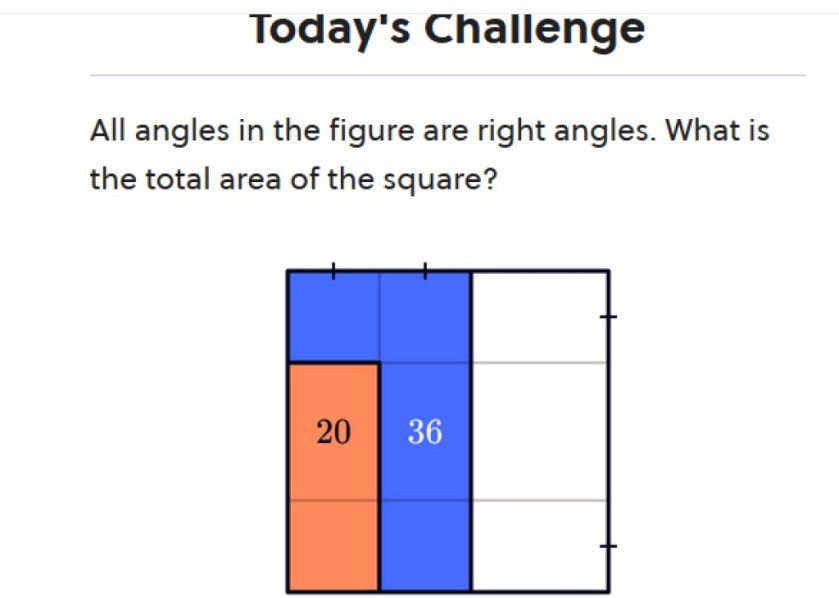
Brilliant Challenge

The four possible answers were 94, 96, 98 or 100.

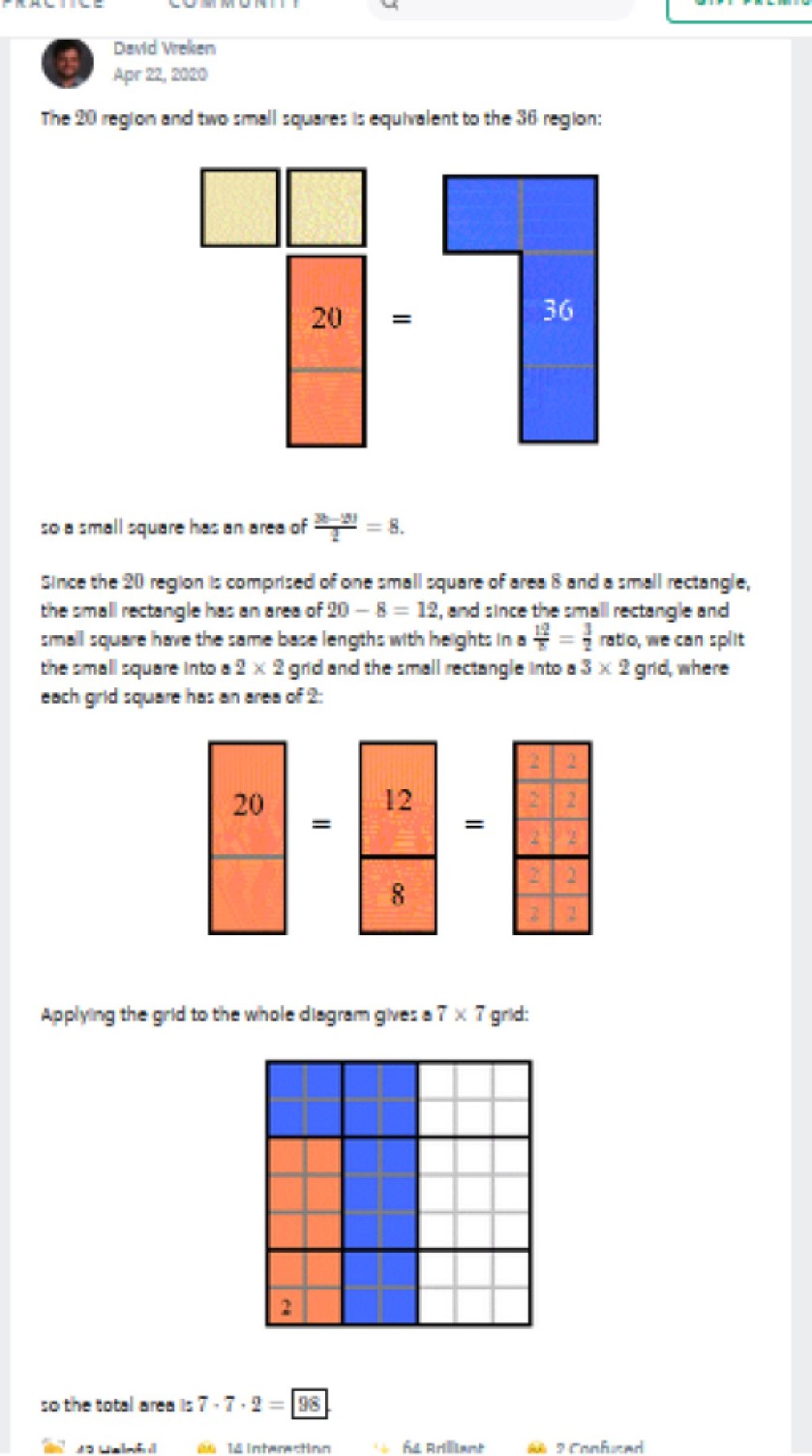
My own method of solving this, a mixture of cheat and punt, was to start by ruling out 100, as that is a square number, and it would therefore be out of keeping with brilliant for it to be the right answer. I then looked at the the areas given and noted that they added up to 56 – could I see a connection between 56 and one of the other answers? Yes, a very appealing one came instantly to mind – both have seven as a factor. A quick mental calculation confirmed that the ratio of 98 to 56 was 1.75, and that was enough for me to take a punt (I had already ensured that my problem solving streak had gone into another day – and it is now equal in days to Bobby Abel’s indvidual Surrey record innings in runs), and I was right.

Here is a more authentic solution courtesy of David Vreken:

DV Sol

LINKS AND PHOTOGRAPHS

As we move towards the conclusion of today’s post I have a few links to share.

  • The pinchhitter have given me an extended mention in today’s offering, and apparently a copy of one of the ‘Chapelli’ books I mentioned in yesterday’s post is en route to pinchhitter HQ. If you have found this blog by way of pinchhitter please comment, and likewise, if anyone has found pinchhittter by way of me why not let them know.
  • A very important petition on change.org, calling for the surcharge that penalises NHS and Care workers from abroad to be scrapped – as someone who owes a huge debt of gratitude to workers in both categories I urge you to sign and share.
  • A science piece from Culture’s Ways about Sagittarius A*, believed to be the location of a supermassive black hole – the picture below is formatted as a link:
    Sagittarius A*, thought to be the location of a supermassive black hole Culture's Ways

And now it is time to sign off with my usual photographic flourish…

P1320093 (2)P1320093 (3)P1320099 (2)

P1320100 (2)
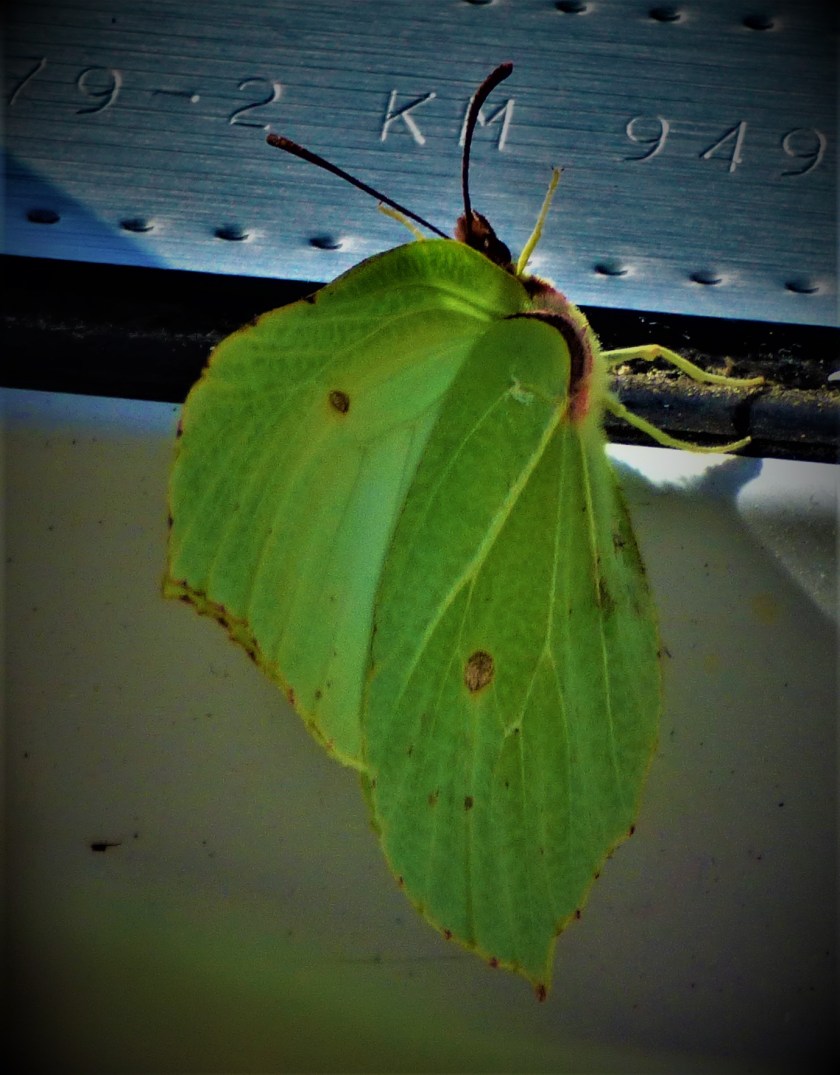
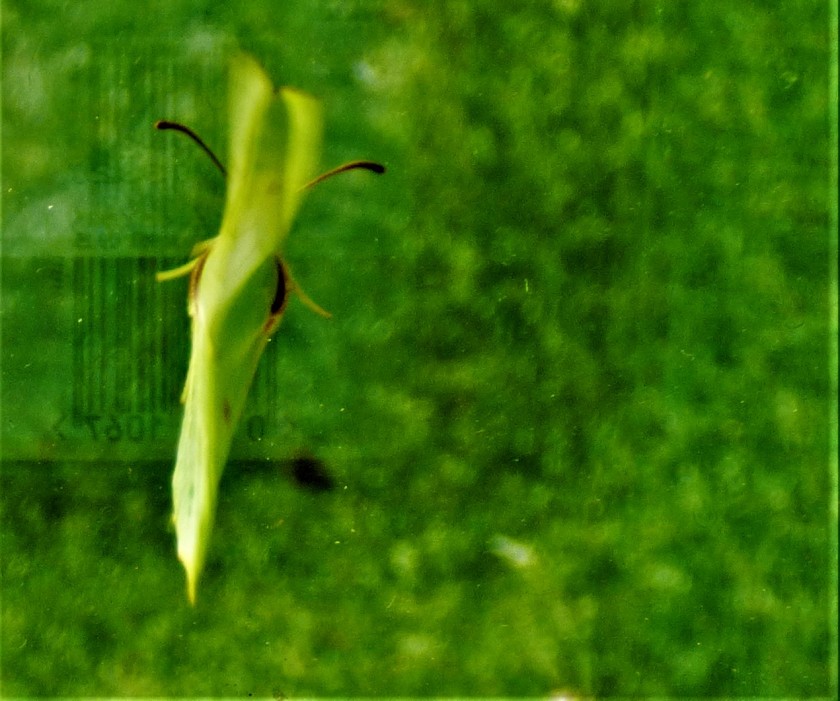
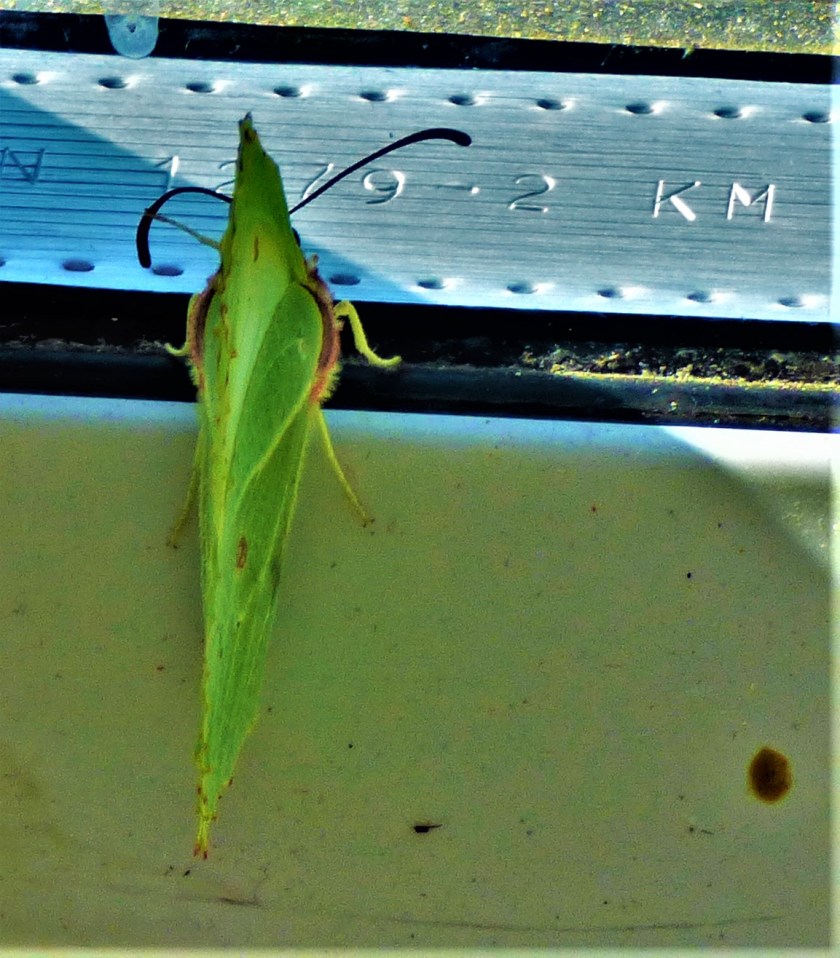
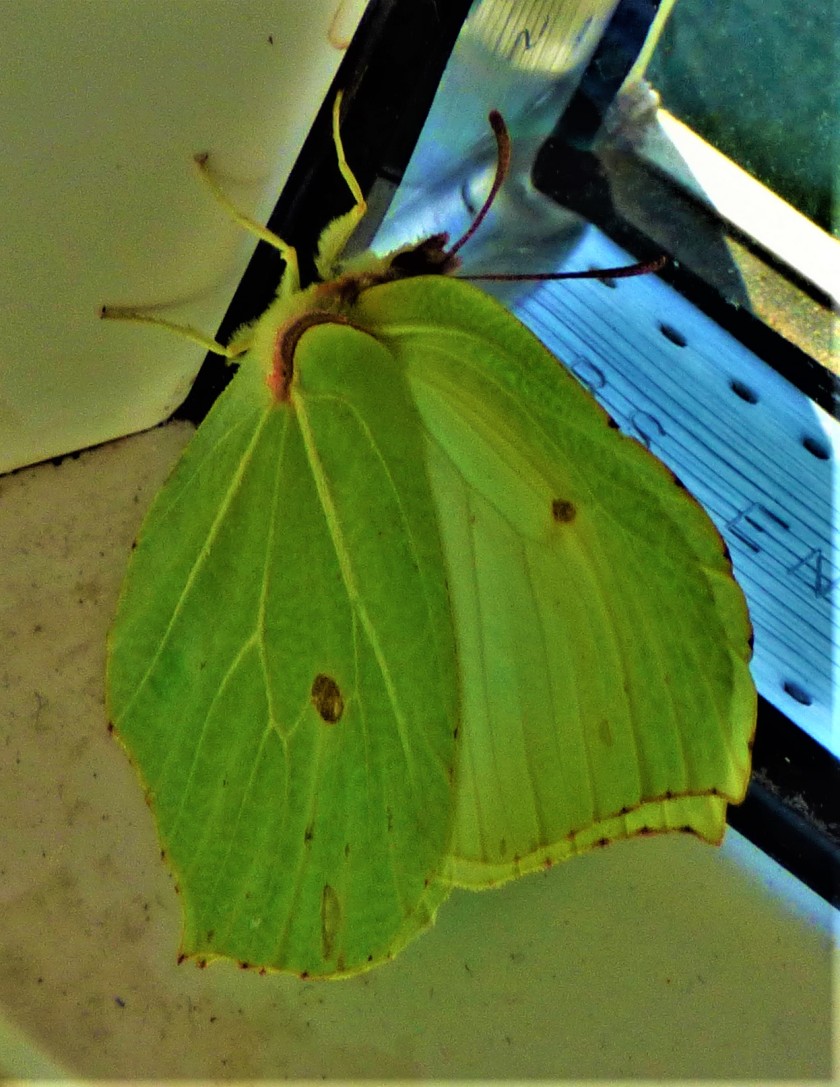
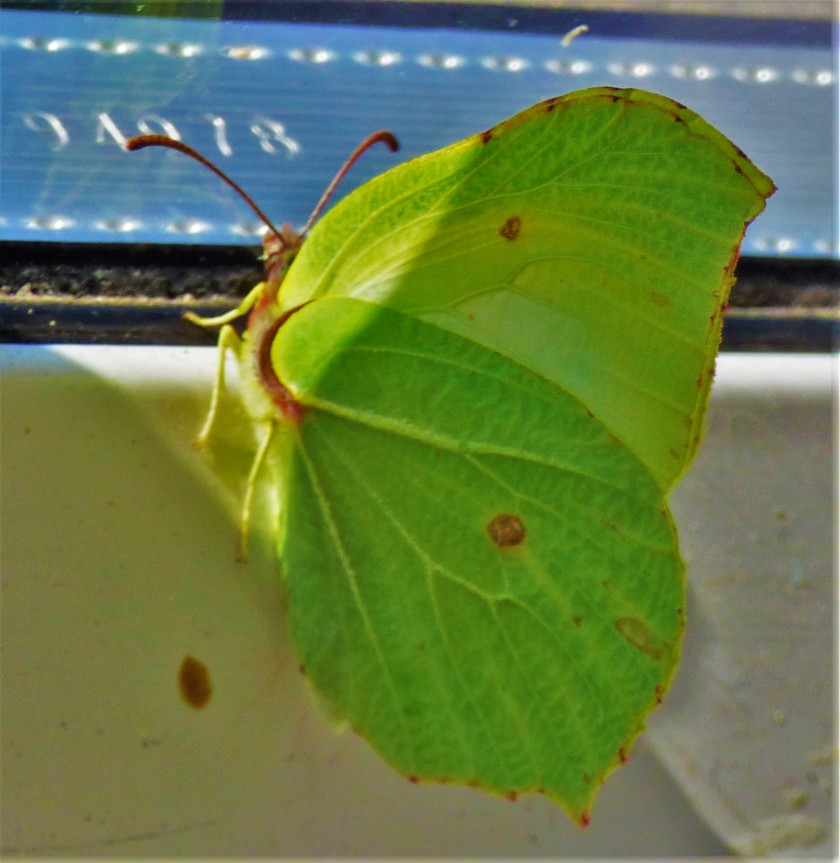
This butterfly, which strayed into my bungalow yesterday, set me a poser – it was not in a my Butterfly book. My sister responded to my twitter inquiry with a reference to butterflyconservation.org and a suggestion of either Brimstone or Clouded Yellow. My own feeling having visited the site and looked at their pictures is that is a Brimstone.

P1320101 (2)P1320102 (2)P1320103 (2)P1320105 (2)P1320107 (2)P1320109 (2)

P1320110 (2)
The combination of the colour and the delicate veining in the wings lends them the appearance of small green leaves – a fine example of mimicry in the natural world.

P1320112 (2)P1320115 (2)P1320116 (2)P1320118 (2)P1320119 (2)P1320120 (2)P1320123 (2)P1320129 (2)P1320131 (2)P1320132 (2)P1320133 (2)P1320134 (2)P1320136 (2)P1320136

The teams
The teams in tabulated form with abridged comments.


All Time XIs – The Scribes Battle

Another variation on the ‘All Time XIs’ theme, this time featuring top cricketers who were or became top cricket writers. Where would your money be on the outcome of the battle for the ‘Cardus-Haigh’ Trophy?

INTRODUCTION

My latest variation on the ‘All Time XIs‘ theme looks at players who turned writer. Before introducing my chosen players I will explain my envisaged scenario to set the scene.

THE SCRIBES BATTLE – THE CONTEST FOR THE CARDUS – HAIGH TROPHY

My teams comprise people who made their names as high level players and who also wrote about the game. In each case I my cricket library contains at least one full book authored or co-authored by the chosen player. The Cardus – Haigh Trophy name honours two of my favourite cricket writers who did not play at a high level – Neville Cardus, a useful off spinner in club cricket, but never a first class cricketer, and Gideon Haigh, a rather less useful club off spinner. Thus, I have two teams to introduce, and I think I can guarantee that this would be a contest not to miss…

THE SCRIBES TEAMS

First up in our contest for the Cardus-Haigh Trophy I give you…

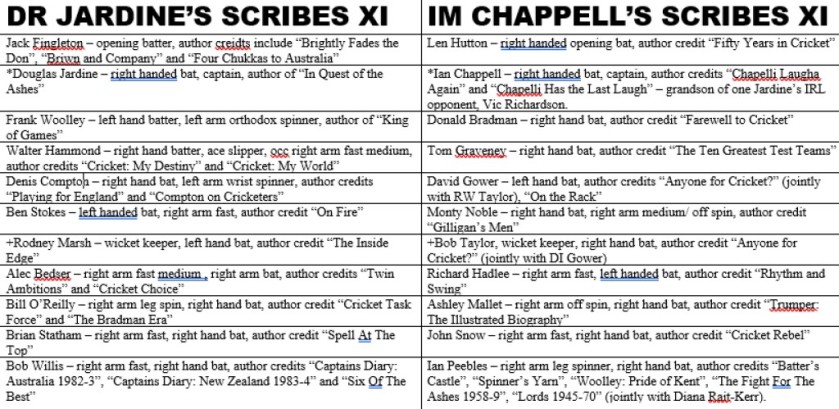
DOUGLAS JARDINE’S XI

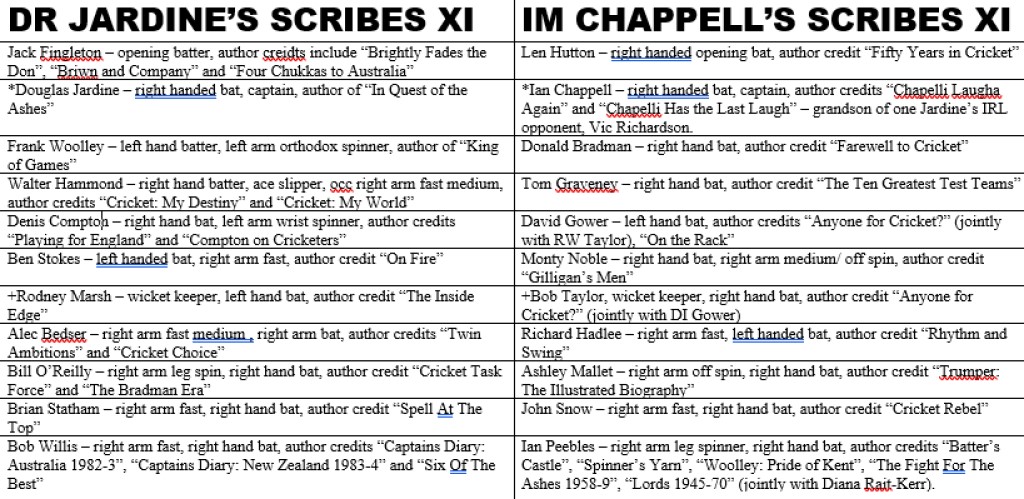
  1. Jack Fingleton – opening batter and excellent writer. His author credits include “Brightly Fades The Don”, “Brown and Company” and “Four Chukkas to Australia” among others. His cricketing achievements included four successive test centuries.
  2. *Douglas Jardine – captain, and although not a regular opening bat, he did do the job at test level on occasions. His writing credit is for “In Quest Of The Ashes”, his own account of the 1932-3 tour of Australia when he was England captain. He was always adamantly of the opinion that runs could be scored against the method he devised, and when in 1933 the West Indies, via Manny Martindale and Learie Constantine, turned his own tactics on him he gave a convincing defence of his own case by scoring his one and only test century (127).
  3. Frank Woolley – left handed bat, left arm orthodox spinner, author of “King of Games”. He has already featured in my Kent all time XI and in my Record Setters XI.
  4. Walter Hammond – right handed bat, slip ace, occasional right arm fast medium and author of two highly entertaining books, “Cricket: My Destiny and “Cricket: My World”. Had he not made an ill-advised test comeback after World War II he would have finished with 6,883 test runs at 61.75, and had the highest average of any England batter to play 20 or more test matches. As it was he became the first to reach the landmark of 7,000 test runs and finished with 7,249 at 58.45.
  5. Denis Compton – right handed bat, left arm wrist spinner, author of “Playing for England” and “Compton on Cricketers”, co-author with Bill Edrich of “Cricket and All That”. He features in my Middlesex and Record Setters XIs.
  6. Ben Stokes – left handed bat, right arm fast bowler, author of “On Fire”. The X-factor all rounder features in my Durham All Time XI. There is no bespectacled left arm spinner for him to bat with in the closing stages this time.
  7. +Rodney Marsh – wicket keeper, left handed bat, author “The Inside Edge”.
  8. Alec Bedser – right arm fast medium, right handed bat, author of “Cricket Choice” and “Twin Ambitions”. He also features in my Surrey All Time XI.
  9. Bill O’Reilly – leg spinner, right handed bat, author of “Cricket Task Force” and “The Bradman Era”. 
  10. Brian Statham – right arm fast bowler, right handed bat, author of “Spell At The Top”. He features in my Lancashire All Time XI, and should be an excellent foil to…
  11. Bob Willis – right arm fast bowler, right handed bat, author “Captai n’s Diary: Australia 1982-3”, “Captain’s Diary: New Zealand 1983-4” and “Six Of The Best”. He features in my All Time Warwickshire XI.

This side has a solid looking opening pair, an excellent trio at 3,4 and 5, all of whom can also contribute with the ball, an x-factor all rounder at six, a brilliant keeper  and four splendid bowlers. It lacks an off spinner, but has every other base covered, and of course has a ruthless skipper at the helm. It is now time to meet their opponents…

IAN CHAPPELL’S XI

  1. Len Hutton – right handed opening bat, author of “Fifty Years In Cricket”. One hald of the opening pair in my Yorkshire All Time XI (with my namesake, Herbert Sutcliffe), and scorer of 6.971 test runs at 56.67.
  2. *Ian Chappell – right handed bat, captain, author of “Chapelli Laughs Again” and “Chapelli Has The Last Laugh”. He usually batted three rather than opening, but I have moved him up one, because as you will see I have a rather stronger claimant to the no3 slot in this XI.
  3. Don Bradman – right handed bat, author of among others “Farewell to Cricket”. Quite simply the greatest batter of all time, and here given an opportunity to match wits once more with the only opposition captain who could claim with any justification to have got the better of him.
  4. Tom Graveney – right handed bat, author of “The Ten Greatest Test Teams”. He features in my Gloucestershire All Time XI, and had I not named there I would have done so for Worcestershire, the other county he played for. The first half of a supremely elegant middle order duo, with…
  5. David Gower – left handed bat, author of “Anyone for Cricket” (jointly with Bob Taylor), “On The Rack”, and an autobiography. 8,231 runs in test cricket at 44.25, he would need to me on his mettle in this contest as Jardine would without doubt keep two gullies in place for him owing to his tendency to fish at balls outside off stump. However I reckon that he would relish the contest. He features in my Leicestershire All Time XI and later played for Hampshire.
  6. Monty Noble – right hand bat, right arm medium and/or off spin, author of “Gilligan’s Men”, an account of the 1924-5 Ashes tour.
  7. +Bob Taylor – wicket keeper, right handed bat and co-author with Gower of “Anyone For Cricket?”. He has previously featured in my Derbyshire All Time XI and in the Staffordshire Born piece.
  8. Richard Hadlee – right arm fast bowler, left handed bat, author of “Rhythm and Swing”. He featured in my Record Setters XI and got an honourable mention in the Nottinghamshire piece.
  9. Ashley Mallett – right arm off spinner, right handed bat, gully specialist fielder, author of “Victor Trumper: The Illustrated Biography”.
  10. John Snow – right arm fast bowler, right handed bat, author of “Cricket Rebel”. He features in my Sussex All Time XI. In 1970-1 he blitzed the Aussies who had Ian Chappell in their ranks (captain for the final match after the deposition of Bill Lawry) in their own backyard. This time ‘Chapelli’ would be captaining Snow.
  11. Ian Peebles – leg spinner, right handed bat, author of “Batters Castle”, “Spinners Yarn”, “Woolley: Pride of Kent” and “The Fight For The Ashes 1958-9”. He featured in my Non-Cricketing Birthplaces XI.

This team has an opening pair who should combine well, the greatest batter of them all at no3, a supremely elegant combo at 4 and 5, a tough all rounder at six, a superb wicket keeper and four excellent bowling options. The presence of Hadlee and Snow gives them means to counter a barrage should Willis, Statham and Stokes provide one, something that the 1932-3 Aussies deprived themselves of (had Fingleton, Chapelli’s grandfather Vic Richardson, or Bill O’Reilly been given HOa say I suspect that at least two out of Laurie Nash, Jack Scott, Eddie Gilbert and ‘Bull’ Alexander would have been picked as part of the Aussie attack, and Jardine would not have had such on overwhelming advantage in fast bowling firepower).

HOW THE CONTEST WOULD WORK AND MY PREDICTION FOR THE OUTCOME

I envisage 10 5-day matches, five in England at Edgbaston, Lord’s, Headingley, Trent Bridge and The Oval, and five in Australia at Brisbane, Adelaide, Perth, Melbourne and Sydney. If after 10 matches the score is level, I would have the teams reconvene for a timeless match to settle the issue, to played at a neutral venue (Cape Town, Kolkata or Bridgetown would all be possibilities). Should that match be tied, then tie splitting option one would be for the trophy to go the team that took most wickets over the 11 matches played, and if that does not split them, then, and only then, would we resort to ‘super overs’ to find a winner (hope you’re still fit by then Mr Stokes!). In addition the main trophy, there would of course be player of the match and player of the series awards, and a special “Grace-Murdoch” medal (named after two of the early Ashes ‘heroes’) along similar lines to the “Compton-Miller” medal.

The umpires would need to be chosen carefully, and the only match referee who would even have a chance of handling this would be Clive Lloyd.

Notwithstanding the presence of Bradman in Ian Chappell’s XI I make Douglas Jardine’s XI slight favourites – and more than slight favourites if it gets so close that all the tie-splitting procedures are needed – assuming Stokes is still fit only one of these sides could win a ‘super over’ contest!

LINKS AND PHOTOGRAPHS

The ‘Cardus-Haigh’ Trophy for the battle of the cricket scribes and the two XIs to compete for it have taken their bows, but before I apply my usual sign off I have a couple of links to share (the honourable mentions are just too numerous to even attempt):

  • The pinchhitter has again honoured me with a mention in today’s offering, which I highly recommend.
  • Van Badham has a piece in The Guardian (Cardus wrote for it in it’s great days as The Manchester Guardian, under the control of legendary owner-editor CP Scott) giving awards to all the worst responders to coronavirus (small but unsurprising spoiler, the overall grand champion currently resides at 1600 Pennsylvania Avenue).
  • Finally, courtesy of brilliant.org, a little mathematical teaser (my current, personal record, problem solving streak there now runs to one day more than Dennis Lillee’s career tally of test wickets) – see screenshot and four available answers below. In my next post I will provide both my own (mathematical equivalent to Grace’s run out of Sammy Jones, as I freely admit) and a more authentic solution in my next post.
    Brilliant Challenge
    The four answers offered by the setter are 94, 96, 98 and 100. Over to you.

Now it is time for my usual sign off:

P1320074 (2)P1320075 (2)P1320076 (2)P1320077 (2)

P1320079 (2)
A couple of illustrations photographed from Hammond’s “Cricket: My World”

P1320080 (2)P1320082 (2)P1320083 (2)P1320086 (2)P1320087 (2)P1320088 (2)P1320089 (2)P1320090 (2)P1320092 (2)

Scribes XIs
The XIs in tabulated form with abridged comments.

100 Cricketers – Bringing Up the Century

The final post in my “100 cricketers” series, with updates from the County Cham;pionship and some of my photographs. Also features a complete listing of the 100 cricketers.

INTRODUCTION

Welcome to the final post in my “100 cricketers series“, which completes the century of cricketers with a player who frequently completed centuries. The introductory post to the series can be found here and the most recent post can be found here. Before the big reveal it is time for a…

COUNTY CHAMPIONSHIP UPDATE

The second round of matches are now into their third day of four, and the situations are:

  • Hampshire v YorkshireYorkshire 554-7D, Hampshire 223-5
    Sam Northeast continues his fine start to the season, currently being on 85 not out, while he is getting support from Liam Dawson (39 not out). Ben Coad has taken two wickets for Yorkshire. If Hampshire reach 405 and avoid the follow-on this game will definitely be drawn. If they do not then Yorkshire should enforce the follow-on and hope to bowl them out a second time – failure to do so would be to accept a secon successive draw.
  • Nottinghamshire v Somerset Nottinghamshire 263 and 111-7, Somerset 403
    Nottinghamshire are in a spin, and it it is looking like a second straight victory for Somerset. Jack Leach, Somerset and England’s slow left-armer has taken 5-22 so far, the other two second innings wickets going to Jack Brooks. Will George Bartlett (one of my Five to Follow) get a chance to deploy his off-spin? Lewis Gregory (another of the five) augmented his first innings 6-68 with a quickfire 50 yesterday, but has not added to his wickets tally in this innings. Joe Clarke (the third of the five to be involved in this game) suffered a second failure, being out for 2 again.
  • Surrey v EssexSurrey 395, Essex 368-6
    A massive fightback by Essex has them almost on terms. Dan Lawrence made 93 and Essex skipper Ryan Ten Doeschate is 124 not out. Tom Curran has three wickets for Surrey and Morne Morkel two. 
  • Kent v WarwickshireKent 504-9 declared, Warwickshire 262-7
    There are two results on the cards – a Kent win if they get Warwickshire out before the total reaches 355 (follow-on avoidance target) and enforce the follow-on and bowl them out a second time, or a draw if Warwickshire get to or beyond 355. Dominic Sibley, opneing the innings, is 128 not out, and Warwickshire’s hopes of escape rest largely on his shoulders. Matt Milnes has three wickets and Harry Podmore and Darren ‘Benjamin Button’ Stevens (he is now 43 years old) have two each.
  • Durham v Sussex Durham 224 and 159-9, Sussex 202
    A nailbiter in the making – Durham have fought back somewhat from 106-7 in their second kinnings. Liam Trevaskis could not follow up on his first innings 50, collecting a blob this time. This means that of my Five to Follow only Philip Salt, who will be batting before too long remains to contribute. David Wiese has five wickets for Sussex.

STOP PRESS! Somerset have made it two from two, beating Nottinghamshire by an innings and 14. Jack Leach took 6-36 and Jack Brooks 4-22, as Nottinghamshire sank for 126. This means two wins out of two as they go into a month’s break in the championship for a one-day tournament. Somerset are looking very strong contenders, although they will need their top order to score a few runs somewhere along the way. This effort in his first bowling spell of the new season has surely confirmed Leach’s place in the England squad. Now back to the regular updates…

  • Glamorgan v NorthamptonshireGlamorgan 570-8 declared, Northamptonshire 403-3
    This one is being capsized by an overload of runs. Vasconcelos (South African) and Newton shared a triple century opening stand for Northamptonshire, the former making 184. The bowlers have had no chance on this pitch, so I will not quote a\ny figures.
  • Gloucestershire v DerbyshireDerbyshire 291, Gloucestershire 350-9
    Gloucestershire’s advantage in this match stems from three significant innings – Wicketkeeper Roderick making 98, Higgins 74 to follow up his bowling efforts and Bracey 65. For Derbyshire Luis Reece has 3-65. 
  • Leicestershire v WorcestershireWorcestershire 553-6 declared, Leicestershire 302 and 10-1 (following on)
    Another one that looks like the pitch is too favourable for batting for its own or the game’s good. Worcestershire have given themselves a chance by bowling Leicestershire out and enforcing the follow-on. Tongue (a 21 year old seamer who came into this match with a bowling average of 24) took 4-46 in the first Leicestershire innings, and was backed up by Barnard (a 23 year old who came into this match averaging 28 with both bat and ball) with 3-40.
  • Middlesex v LancashireMiddlesex 265, Lancashire 333-4
    Yesterday Haseeb Hameed claimed headlines with his 117 (196 balls, 298 minutes), today’s play has been disrupted by the weather. He had had two very quiet years prior to this season and I reckon he needs more than one century to earn a recall to the England side. Jones is currently 82 not out and Vilas 50 not out. If the weather does not win this one then Lancashire will.

Now we are ready for the…

BIG REVEAL

All I have told you about the player who completes the century is that it is somebody who often did just that. So who is it? It is…

CLAIRE TAYLOR

15 Test matches yielded her 1,030 runs in 27 innings, with four centuries (just better than one per seven innings) and an average of 41.20, highest score 177. 126 ODIs produced 4,101 runs at 40.20 with eight centuries and a best of 156 not out. She was also a history maker, being the first English female cricketer to have a professional contract (yes, this distinction was achieved by someone born as late as 1975!). Claire Taylor’s successes blazed a trail for others to follow, and all the top England Women now have professional contracts, as opposed to having to combine playing at the top level with earning a living doing something else, which used to be the case. Her great record would earn her a place of honour in any case, but her historic importance makes the case unassailable. 

A LOOK BACK ON THE SERIES

No two people attempting a project like this would come up with the same answers, and I expect that all the cricket fans among my readers have people in mind who I have omitted and they would have selected. The problem with these exercises is the embarrassment of riches that one faces – I could have selected many more than 100. A number of young players have stood up to be counted in the early stages of this year’s County Championship. 

FOLLOWING ON FROM THIS SERIES

I have a few ideas for following on from this series, which I shall be thinking about while this round of Championship matches heads to its conclusion. I will finish this part of the post by presenting for the first time the whole 100 names in one place:

100 cricketers100 Cricketers Full List

LINKS, PICTURES AND OTHER STUFF

From The Pileus on twitter, a great quote on rail privatisation:


Chakraborty.jpg

Now comes a mathematical teaser from brilliant.org:

trickshot q

We end with my usual sign off…

P1220703P1220704P1220705P1220706P1220707P1220708P1220709P1220710P1220712P1220715P1220716P1220717P1220718P1220720P1220721P1220722

100 Cricketers – The Seventh XI Bowlers and Introducing the Eighth XI

The latest in my “100 cricketers” series, finishing the look at the seventh XI and introducing the eighth XI in batting order. Has some bonus features as well as the usual photographs.

INTRODUCTION

Welcome to the latest post in my “100 cricketers” series, which features the specialist bowlers from the seventh XI and introduces the eighth XI in batting order. There are also a couple of extra features near the end of the post. The introductory post to the whole series can be found here, the post which introduces the seventh XI is here and the previous post in the series is hereWe start our look at the bowlers with…

THE QUICKER BOWLERS

I have two players in this XI who are picked principally as pace bowlers. Anya Shrubsole in this combination would be third seamer, while the new ball would be taken the two genuinely quick bowlers, Imran Khan and…

PAT CUMMINS

The 25 year-old who consistently bowls at speeds of over 90mph has thus far played 20 test matches in which has taken 94 wickets at 22.02, while he has at times also made useful contributions as a lower order batter, with 528 runs at 20.30. He has also been effective in shorter form cricket, with 82 ODI wickets at 26.53 from 48 appearances and 25 T20I wickets at 21.24 from 20 matches. In the 2018 Boxing Day test match at the MCG when Australia as a whole were roundly defeated, confirming India as holders of the Border-Gavaskar trophy, he was the one Aussie to emerge with his reputation enhanced, playing a fighting innings and bagging six cheap second innings wickets after India had declined to enforce the follow-on. He is the only current Australian player I would definitely want to find a space for in the England team were such permissible (Steve Smith, a shoo-in on past performances is as far as I am concerned out on behavioural grounds). As this suggests my reckoning based on recent performances by the two sides is that England are heavy favourites to regain The Ashes this summer, but the presence of a fit, firing Cummins will make their task harder – and I hope that is what we see – I would always want each team to be at full strength. 

ANYA SHRUBSOLE

She has had only five test matches (17 wickets at 24.52), but her records in ODIs (61 matches, 77 wickets at 26.51) and T20Is (63 matches, 86 wickets at 13.96) are splendid. She was the star of the 2017 world cup final, her 6-46 consigning India to defeat after they had looked like winning for most of the match and earning her many accolades, starting with player of the match on the day and also including becoming the first woman to feature on the front cover of Wisden. We now turn to the…

SPIN BOWLERS

Those who have followed this series closely will recall that as well as naming her vice-captain of this XI I made a point of mentioning Heather Knight’s off-spin bowling. In view of the fact that I already had an option, albeit not quite front-line, in that department it was natural for my front-line options to select two spinners who represented different varieties of spin bowling. I went for having a full range and plumped for a legspinner and a left arm orthodox spinner…

DANIEL VETTORI

The Kiwi played 113 test matches, scoring 4,531 runs at 30.00 and taking 362 wickets at a slightly costly 34.36. He also played 295 ODIs scoring 2,253 runs at 17.33 and taking 305 wickets at 31.71. That slightly elevated test bowling average not withstanding I reckon that among New Zealand born spinners only Clarrie Grimmett, who not only had to move countries (to Australia) but was on to his third Aussie state before mkaing the breakthrough was better. I saw him action in 1999, when his fine bowling played a major role in consigning England to the series defeat that plunged them to the bottom of the world test ratings. In the year 2000 two developments, a two-divisional championship and central contracts came into force, and since then England have fared much better on the international stage. In later years his batting became almost as significant for New Zealand as his bowling, and he was also did fairly well captaining the side. 

AMANDA WELLINGTON

This is a pick with the future in mind. The 21 year-old legspinner has only played one test match, has 15 ODI wickets at 31.80 and 10 T20I wickets at 11.20. However, she bowled well in the Womens Big Bash League this year, and had an OD match for South Australia v ACT in which she scored 29 and took 4-35. I expect to hear a lot more of her in future, having been favourably impressed by those bowling performances that I have heard commentary on.

INTRODUCING THE EIGTH XI

Here in batting order is my eighth XI:

  1. Matthew Hayden
  2. Justin Langer
  3. *Michael Vaughan
  4. Dilip Vengsarkar
  5. Shivnarine Chanderpaul
  6. +Andy Flower
  7. Richard Hadlee
  8. Graeme Swann
  9. Stuart Broad
  10. Linsey Smith
  11. Terry Alderman

EXTRAS

This post will end in the usual way, but first a couple of extras.

ANSWER TO MATHEMATICAL PUZZLE FROM YESTERDAY

Here is an official solution to yesterday’s mathematical puzzle, posted by Mahdi Raza:

solution

We also have a bonus feature…

AUTISM PLAN

I was alerted to this via twitter, but the main detail is in a facebook post which you can view by clicking on the graphic below:

Autism Plan

It costs NAS West Norfolk some £15,000 a year to run activities for our members (over 380 families currently signed up). There is a new fundraiser now on just giving for those who can afford to donate, and all money raised will be used by NAS West Norfolk for activities that help autistic people. We finsih of course with…

PHOTOGRAPHS

P1220323P1220324P1220325P1220326P1220327P1220328P1220330P1220331P1220332P1220333P1220334P1220335P1220336P1220337P1220338P1220339P1220340P1220341P1220342P1220343P1220344P1220345P1220346P1220347P1220348


100 Cricketers – The Seventh XI Allrounders

Continuing my “100 cricketers” series with the allrounders from the seventh XI. Also features a few links and as usual some of my photographs.

INTRODUCTION

Welcome to the latest addition to my “100 cricketers” series, which features the allrounders from my seventh XI. The introductory post to the whole series can be seen here, the post in which I introduce the seventh XI here, and the most recent post in the series here. Before getting into the main business of this post there is a bit of news.

SAM CURRAN DESTROYS DELHI CAPITALS

Many eyebrows were raised when young Surrey and England all-rounder Sam Curran fetched a seven figure sum in the IPL auction. Yesterday for Kings XI Punjab Curran who had already scored 20 off 10 balls opening the batting took 4-11 including a hat-trick which settled the match. He had bowled one over for seven when he was brought back into the attack in the closing stages. The Delhi Capitals had looked to be cruising home, but in a collapse to rival anything from 1990s England at their worst lost their last seven wickets for just eight runs. Curran benefitted from old fashioned straight, full bowling – the batters missed and he hit the stumps. A full report can be read here. Now to the main business of the post.

*IMRAN KHAN

88 test matches, 3,807 runs at 37.69 and 362 wickets at 22.81, and 175 ODIs which yielded 3,709 runs at 33.41 and 182 wickets at 26.61. He finished his career well before the launch of T20, but there can be little doubt that as an attacking bat and genuinely fast bowler he would have been a success at that form of the game as well. In 1992 he captained his country to World Cup success. This and many other successes as captain have earned him the captaincy of this XI. Captaincy sometimes adversely affects the performance of players, but this was not the case for Imran, who produced some of his finest efforts while captaining. He is a worthy captain of this XI and has an excellent back up in Heather Knight, who I named as vice-captain.

+MAHENDRA SINGH DHONI

90 test matches, 4,876 runs at 38.09, 256 catches and 38 stumpings. 341 ODI appearances yielded 10,500 runs at 50.72, 314 catches and 120 stumpings. 98 T20Is produced 1714 runs at 37.60, 57 catches and 34 stumpings. The figures show that he was an outstanding wicketkeeping allrounder. The successes in limited overs cricket show that he played an attacking brand of cricket. The fact that six of his nine first class hundreds, including his best of 224, came in test matches show that he relished the big occasion. With him behind the sticks the bowlers (Imran and the four players you will see in my next post in this series, which will also introduce the eigth XI) can be confident that their efforts will not go to waste. 

PHOTOGRAPHS AND LINKS

As well as my standard sign off I have some links to share:

trpirob

NB this is slightly harder than the original as that multiple choice answers.

P1220294P1220295P1220296P1220297P1220298P1220299P1220300P1220301P1220302P1220303P1220304P1220321


India Demonstrate How Not To Polish Off an Innings

Some thoughts on the current test match, some mathematics, some climate change themed links and some photographs from an upcoming militgaria auction.

INTRODUCTION

Although my first and main focus in on the current test match between England and India I also have my usual assortment of other goodies.

SWITCHBACK RIDE AT THE OVAL

When England were 120-1 at one point yesterday it looked like they were making a solid if slow start. India then took control of the game, England finishing the day 198-7, with Jos Buttler looking to marshal the tail in a recovery act (the first time this millennium that an uninterrupted test match day in England has yielded less than 200 runs). When Rashid was out fairly early this morning to make it 214-8 the question was whether the Broad and Anderson could last long enough to see England to 250. Thanks to some crazy Indian tactics the final England wicket did not fall until the total had reached 332, Buttler top scorer with 87 and Broad a useful 38. Buttler was last out when it finally occurred to India that it might not be a good idea to allow him singles at will and set a field that necessitated improvisation if he wanted to farm the strike.

The “tactic” of concentrating all one’s efforts on the tailender and declining to make any effort to pressurise the senior batter is not one I have ever approved of, and today saw one of it’s many ignominious failures. 

Having failed yet again Jennings now surely has one innings left to save his test career. There are seven test matches for England, six overseas and one at home against recently elevated Ireland before the Aussies come calling, and it is those matches which can be used to bed in a new opening pair (it would be a major ask for an opener to make their debut against them) – and I do not see Jennings being one half of that pair. As I was writing this paragraph Stuart Broad picked up the first Indian wicket. Those who read my previous post know that I have my own highly unorthodox solution to the problem of who the new opening pair should be (the driver of the bus I travelled home from work on yesterday, who is a follower of this blog, commented approvingly on the controversial element of this, so I am not alone). 

If, as now seems to be one of two live possibilties (a draw and overall 3-1 being the other) England end this series with the scoreline 4-1 in their favour India will have chucked this match in the first part of day 2. Virat Kohli is a great player but on all available evidence he has precisely no aptitude for captaincy. In thirty years of being an avid cricket follower I cannot recall a finer demonstration of how not to polish off an innings.

TEASERS

First up solutions to the problems I set on Wednesday (all problems in this section come by way of brilliant.org):

WHICH STAR IS CLOSER?

astroproblem

First the answer:

Star answer

The blue star has changed relative position more than the red, hence it must be closer, while all the other stars are so far distant that they have not changed relative position. 

BULLETS

Bullets

The answer:

Bullet answer

Here is Brian Moehring’s solution:

BMbullets

NEW PROBLEMS

31 problem

Here is another problem:

squacubes

LINKS

Three closely related pieces here. 

  1. Richard Murphy brings news of a campaign victory – the BBC has admitted to getting its coverage of climate change wrong and has warned people that it is not necessary to give airtime to climate change deniers for the sake of balance. Here is the end of Murphy’s piece on this:
    Of course I am pleased.

    And massive credit to Rupert Read for achieving this.

    Next the BBC should stop platforming tax deniers.

    And those who will not disclose their funding.

  2. Rise for Climate – this is a new source of information about actions being taken to combat climate change – feel free to visit and sign up for emails as I have.
  3. Anna presents a detailed and very clearly laid out Q & A on the campaign the prevent the building a big new road through Trosa. An English version follows the Swedish.

PHOTOGRAPHS

These pictures all come from our militaria sale that will be happening on September 19th. Disclaimer: one of the items pictured is a relic from one of history’s vilest regimes – I show it because it is a remarkable specimen which has already attracted large amounts of interest.

2
Lot 2 – this dagger is definitely genuine – and will go for a lot of money.

2-a2-b2-d2-e2-f2-g2-h2-c2-i

10
Lot 10, this will be on the front cover of the catalogue.
51
Lot 51

51-a51-b51-c51-e51-f51-g51-d

231
Lot 231
402
Lot 402
406
Lot 406
405
Lot 405

405-d405-c405-b405-a

404-c
Lot 404

404-b404-a404

204
Lot 204

204-a204-b204-c

373
Lot 373
372
Lot 372

372-a372-b372-c372-d372-f372-e

407
Lot 407 – this uniform will bring the cujrtain down on the sale.

407-a407-b407-c