All Time XIs – Detective Fiction

An all time XI of players who have namesakes in detective stories and a photo gallery.

Today I select an XI of players who are namesakes of characters in detective fiction.

  1. Percy Holmes (right handed opening batter, Yorkshire and England). In most eras other than the one he played in he would have been one of the first names on the England team sheet, especially given what a great partnership he formed with Herbert Sutcliffe. As it was he generally missed out due to the presence of Jack Hobbs. His record for Yorkshire was outstanding, and at the time of his retirement included five of the ten highest individual scores made for the county. His fictional alter ego is of course the one and only Sherlock Holmes.
  2. Herbert Sutcliffe (right handed opening batter, Yorkshire and England). One of the greatest opening batters ever to play the game, and shared 69 first class century opening stands with Holmes. He gets in by way of Magda Josza’s “Sherlock Holmes and the Femmes Fatales”, which features among others Lady Elizabeth Sutcliffe and her uncle Sir Vincent Sutcliffe.
  3. Fred Bakewell (right handed top order batter, Northamptonshire and England). By the time a car crash brought his career to a premature close he had done more than enough to establish himself as a great batter. His fictional equivalent is Diana Bakewell, heroine of the Rachel McLean/ Millie Ravensworth series of London cosy mysteries of which I have read three thus far.
  4. Jack Ryder (Australia, right handed batter, right arm medium fast bowler). One of the finer batters of the 1920s, his credits include a test match double century. He was also a useful enough bowler to occasionally be entrusted with the new ball. His namesake is James Ryder, villain in “The Adventure of the Blue Carbuncle”.
  5. *Warwick Armstrong (Australia, right handed batter, leg spinner, captain). A magnificent all rounder, and a ruthlessly effective leader. The eight successive Ashes match victories he presided over (a 5-0 sweep in Australia in 1920-1, and the first three matches of the series in England in 1921) remains an all time record. His alter ego is Superintendent Armstrong from the Museum Detectives series.
  6. Vallance Jupp (Sussex, Northamptonshire, England, right handed batter, off spinner). In the 1920s he achieved the double feat of 1,000+ runs and 100+ wickets in FC matches eight times in consecutive seasons. I have slipped him in by means of a small piece of sleight of hand – one of The Railway Detective, inspector Robert Colbeck’s colleagues is an inspector Vallence, and by altering one letter I got in a link to my favourite of all detective series.
  7. +Adam Gilchrist (Australia, wicket keeper, left handed batter). |One of the all time greats of the game, although his legacy could be considered tarnished by the fact that a number sides nowadays blatantly sacrifice keeping quality for better batting from the keeper. One of the three students in the Holmes story of that title is named Gilchrist.
  8. Gus Atkinson (Surrey, England, right arm fast bowler, right handed batter). He has had a superb start to his England career, though like too many of his team mates he had a poor time on the recent tour of Australia. Gus the cat is a character in the London cosy mysteries that also gave us a Bakewell.
  9. Don Wilson (Yorkshire, England, left arm orthodox spinner, left handed batter). Though his England record was not great he took his first class wickets at 21 a piece. His alter ego is of course Daniel Wilson, one half of the Museum Detectives.
  10. Ted McDonald (Australia, Lancashire, right arm fast bowler, right handed batter). One half of the first great fast bowling pair to operate at test level along with Jack Gregory, he later became one the spearheads of Lancashire’s most successful ever period. Though I have to add a letter to his surname to do it, I have two very different alter egos for him: Alec MacDonald, one of the few Scotland Yarders Holmes actually treats with respect (see “The Valley of Fear”) and Kylie MacDonald, one of the pair of detectives in the elite NYPD Red unit that features in a series of books with that title, the first six by James Patterson and Marshall Karp, and the seventh by Marshall Karp.
  11. William Mycroft (Derbyshire, left arm fast bowler, right handed batter). Took over 800 FC wickets at 12 a piece in his career. With one Holmes brother sharing his name with an opening batter this XI ends with the other, Mycroft, sharing his name with an opening bowler.

This side has a more than adequate batting line up, and a stellar array of bowling talent – McDonald, Mycroft and Atkinson as front line pacers, with Ryder available as fourth seamer if needed, and Wilson, Jupp and Armstrong covering all the spin bases. I will not do honourable mentions for this one – there are a vast range of possibilities. Feel free to comment with your own ideas.

My usual sign off…

Scorchers Win BBL15

A brief account of today’s BBL Final and a photo gallery.

Today saw the final of the 15th edition of the men’s Big Bash League. The match featured the two most successful franchises in the history of the competition, Perth Scorchers and Sydney Sixers, at the former’s home ground since they had won the league stage of the tournament.

Scorchers won the bat flip, put Sixers in to bat and went about things utterly ruthlessly thereafter. Other than Steve Smith early on with 24 from 13 balls none of the Sixers batters really got going against some fine Scorchers bowling. David Payne, an English left arm seamer, was the star with 3-18 from his four overs, and he was a little unlucky those figures weren’t even better – Joel Davies was saved from becoming his fourth victim when a replay indicated that a diving catch in the deep had not in fact been cleanly taken. Sixers had only managed 132-9 from their 20 overs. Scorchers never looked in any danger of not scoring the runs. Although they made slightly heavy weather of finishing the job they still had six wickets and 2.3 overs in hand when Josh Inglis finished things with a six off Ben Dwarshuis, which is a thrashing in anyone’s language. Scorchers have now won six of the 15 editions of this tournament.

My usual sign off…

England Win in Sri Lanka

An account of Sri Lanka v England at Colombo today and a photo gallery.

With a world cup in India approaching England are currently engaged in an away ODI series in Sri Lanka. Today saw the second match of that series.

While both sides were spin heavy (anything else would be ludicrous in Colombo) there was nevertheless a significant difference in the make up of the sides. Sri Lanka had four specialist bowlers, a genuine all rounder and two batting all rounders in their side, while England had only one player selected purely as a bowler (and even that player, Adil Rashid, has a better FC batting average than current test opener Zak Crawley) and a fistful of all rounders – Jamie Overton, Sam Curran, Liam Dawson, Will Jacks, Rehan Ahmed, Jacob Bethell, and a batter who bowls, Joe Root. With Crawley injured Rehan Ahmed was asked to open (his regular county slot is number three) alongside Ben Duckett. Sri Lanka won the toss and batted first.

England bowled very well, with a total of six spin options wheeling down 40.3 overs, a national record for a 50 over innings, between them. Root somewhat bizarrely ended up bowling the final over of the innings, and was gifted two wickets, first Wellalage holing out to Sam Curran for 20, and then number 11 Asitha Fernando taking on a big hit and succeeding only in toe-ending the ball straight back to the bowler. Sri Lanka were all out for 219, which looked a good 20 below par even on that tricky pitch.

Rehan Ahmed did not do terribly well as makeshift opener, though Joe Root had made his way to the middle with less than 2o (the Ahmed/ Duckett opening stand) on the board on many occasions in his illustrious career. It was Root who ensured that no defence of that 219 would be possible. First he and Duckett added 68 for the second wicket, and then after Bethell had gone cheaply he was joined by Harry Brook for a fourth wicket stand that yielded 81 before Root finally fell for a 75 that was easily the equal of any 200 on a flat track. Buttler injected some late speed to proceedings, rattling up 33 not out from 21 balls, and it was Jacks who eventually scored the winning runs, a boundary off seamer Pramod Madushan with 3.4 overs remaining. England had won by five wickets, ending a sequence of 12 ODI away losses. With 2-12, two catches and that splendid 75 Joe Root was the only candidate for Player of the Match.

My usual sign off…

All Time XIs – Not Quite Test Class

A twist on one of my regular themes – Pick an XI of players whose averages suggest that they weren’t quite test class but who were nevertheless very valuable to their side.s.

Today in a twist on my usual theme I select a team of players who by their averages seem to fall short of test class but who were hugely valuable to their respective teams. I have allowed myself one sneaky selection who many would say should be disallowed due to the era in which he played, but the other 10 are bona fide qualifiers on my criteria.

  1. John Wright (New Zealand, left handed opening batter, 5,334 runs at 37.82). A couple of runs per innings short of the usual modern day benchmark for front line test batter, but the gritty left hander was a crucial component of the New Zealand sides of the 1980s.
  2. Tamim Iqbal (Bangladesh, right handed opening batter, 5,134 test runs at 38.89). With a left handed sticker as one opener the ideal counterpart to him would be right hander with more attacking instincts, and the Bangladeshi, probably the classiest batter his country has produced to date fits the bill perfectly.
  3. Mark Butcher (England, left handed batter, very occasional right arm medium pacer, 4,288 runs at 34.58). He had a two-phase career, struggling initially but becoming a very important member of the England sides of his day later on. He was the matchwinner at Headingley in 2001 with a blistering 173* as England chased down over 300 in the fourth innings.
  4. *Nasser Hussain (England, right handed batter, captain, 5,764 runs at 37.18). It was he as captain who began England’s revival from hitting rock bottom in 1999, and he was by then a very highly respected batter. His career highlight came at Edgbaston in 1997, when after Australia were shot out for 118 batting first he scored 207.
  5. Clem Hill (Australia, left handed batter, 3,412 runs at 39.21). The sneaky pick – at the time of his retirement he had scored more test career runs than anyone else, and among those who played 10 or more tests only Ranji, with an average of 45 outranked him on that metric.
  6. Mulvantrai ‘Vinoo’ Mankad (India, right handed batter, left arm orthodox spinner, 2,109 runs at 31.47, 162 wickets at 32.32). Fails to qualify as test class in either department, but for all that he was one of India’s most important ever players. He often had to open the batting because there were few Indians in those days who had the technique to cope with the new ball when it was moving, and he also had to bowl huge numbers of overs because India were short staffed in that department owing to their domestic cricket being played on roads – the only two first class matches ever to produce an aggregate of over 2,000 runs were both played in India, and both during Mankad’s playing days.
  7. +Ben Foakes (England, right handed batter, wicket keeper, 1,107 runs at 29.91, 68 catches and eight stumpings). An all time great of the keeper’s art, but many question his place in the side on grounds of his batting. He bats in the top half of the order for Surrey, and there are few if any real bunnies in the Surrey line up, so he never has to try to shepherd them, as happened in the second innings at Ranchi, when he was stranded with only Bashir and Anderson for company.
  8. Jack Gregory (Australia, right arm fast bowler, left handed batter, 85 wickets at 31.15, 1107 runs at 36.96). Was part of a devastating new ball pairing with Ted McDonald in 1920-1, but once he lost the Tasmanian’s support at the other end when the latter moved to England to play as a Lancashire League pro and ultimately for Lancashire his bowling fell away, with injuries also taking toll – a knee injury terminated his career in the first match of the 1928-9 Ashes.
  9. Phillip DeFreitas (England, right arm fast medium bowler, right handed batter, 140 wickets at 33.57, 934 runs at 14.82). On the face of one of far too many England cricketers of that era whose averages were the wrong way round, but his bowling was often valuable for England, never more so than in 1991, in which season he recorded his best ever innings figures of 7-70. He was also a magnificent outfielder, with safe hands and a very powerful and accurate throw.
  10. Nathan Lyon (Australia, off spinner, 527 wickets at 30.35). Bowling average just the wrong side of 30, but this is an off spinner who has played half his matches or thereabouts in Australia, and the record of visiting off spinners in Australia makes pretty grim reading.
  11. Steve Harmison (right arm fast bowler, 226 wickets at 31.82). When he was first called up for England he was wild and wayward, with most of such wickets as he managed to take being caught at deep third man, but he had a great period in the middle of his career. In the first match of the 2005 Ashes he quite literally left his mark on the Australian top three – all copped bruises from him early in their innings.

This side has a solid looking top five, with a good mix of defence and attack, Mankad having the luxury of being in an all rounder’s best position, a great keeper and a quartet of frontline bowlers capable of great things. Gregory, Harmison and DeFreitas should form an effective pace/ seam/ swing trio and Lyon and Mankad are a contrasting pair of spinners. This side, for all that in theory all 11 of its members fall short of test class should be able to give a good account of itself, especially given that they will be well led by Hussain.

I am not doing an honourable mentions section this time, but there was a challenger for Mankad’s slot – Shakib Al Hasan of Bangladesh who averages 39 with the bat and 31 with the ball. I opted for Mankad on two grounds – firstly there is still time for Shakib to disqualify himself (most likely with the bat if he does manage it) and secondly I believe that Mankad would fare better as an all rounder in this XI than he did when having to virtually carry an ordinary India side on his shoulders. Also, though I do not list this as a reason there is another factor – I wanted to take the opportunity to showcase Mankad as a fine cricketer and not just as guy associated with a form of dismissal that for no good reason tends to generate controversy.

My usual sign off – I have a bumper crop at present, and this gallery could have been bigger had I wanted it to be so…

A Test XI From My Lifetime

A test match XI made up of players some or all of whose prime years were in my lifetime, a few honourable mentions and a photo gallery.

In this post I select an all time XI intended to be perfectly balanced, and made up exclusively of players at least some of whose peak years have been in my lifetime. I also look at some of the players I omitted and explain my reasoning- in an exercise like this the challenge is just who one leaves out.

  1. Graeme Smith (South Africa, left handed opening batter). Over 9,000 test runs at an average of 48.
  2. Sunil Gavaskar (India, right handed opening batter). The first ever to reach the career milestone of 10,000 test runs, and an average of over 50 at that level, and a good record outside Asia as well.
  3. Brian Lara (West Indies, left handed batter). The greatest left hander to have batted in my lifetime, with any number of extraordinary knocks to cite in support of that claim.
  4. Sachin Tendulkar (India, right handed batter). Holder of the records for most test career runs, most test centuries and various others.
  5. Allan Border (Australia, left handed batter). For much of his career he carried a decidedly moderate Australian batting line up – it was only in the last few years of his career that he got to be part of a strong line up.
  6. *Imran Khan (Pakistan, right handed batter, right arm fast bowler). My chosen all rounder, and my chosen captain. Ian Botham was sensational for the firts few years of his career, a producer of occasional sensations for another few years and then tailed off badly as the 1980s wore on, whereas Imran Khan was a much more enduring cricketer.
  7. +Adam Gilchrist (Australia, wicket keeper, left handed batter). The man who revolutionized the role of the wicket keeper, playing many match winning innings from number seven. Unfortunately too many sides since his prime have been dazzled by the batting side of the equation and have given the gauntlets to folk whose keeping is not up to scratch (Gilchrist’s was).
  8. Wasim Akram (Pakistan, left arm fast bowler, left handed batter). While it is possible that peak Mitchell Johnson was even more devastating with the the ball than peak Akram it is certain that Johnson when the force was not with him operated at a lower level than Akram ever did.
  9. Malcolm Marshall (West Indies, right arm fast bowler, right handed batter). The greatest fast bowler of the golden age of West Indies fast bowling and a handy lower order batter.
  10. Shane Warne (Australia, leg spinner, right handed batter). Leg spin was a dying art when he appeared on the scene – Abdul Qadir of Pakistan was the only leg spinner of real quality in the 1980s, and until Warne’s emergence there was no one coming through in the 1990s either.
  11. Muthiah Muralidaran (Sri Lanka, off spinner, right handed batter). Only one bowler has ever taken 800 test wickets in a career, and unless James Anderson somehow continues to defy Father Time for another few years there is no prospect of anyone else reaching that landmark – the rise of franchise leagues around the world makes it likely that few if any of today’s younger players will be looking at having exceptionally long test careers. Murali took those 800 wickets at a rate of six per match, better among those to have played 20 or more test matches than anyone save SF Barnes who claimed 189 wickets in 27 matches for a wicket taking rate of seven per match.

This XI has good balance of left and right handed batters, great depth with everyone down to Akram at eight capable of playing a match winning knock and Marshall and Warne far from being genuine tail enders. The bowling above with three great fast bowlers and two great spinners is ideal for most pitches. If the match were to be played at Perth or Johannesburg I would drop Muralidaran and further strengthen the pace attack by bringing in McGrath, while on an absolute raging Bunsen I would replace Imran Khan with Ravindra Jadeja (India, left handed batter, left arm orthodox spinner) and rely on Akram and Marshall to bowl such pace as would be required. I also take this opportunity to explain the positioning of the captain and wicket keeper in the listed order – Gilchrist always said he never wanted to bat above seven at test level, while Imran Khan was comfortable batting at number six, so although Gilchrist was undoubtedly a finer batter than Imran Khan I have respected the Aussie keeper’s preferences and kept him at number seven.

A full honourable mentions section for a post of this nature would be virtually book length, there being so many potential candidates. So, if I make no mention of your favourite please assume I have my reasons for having not picked them – the listing that follows is not remotely comprehensive.

Left handed openers: Alastair Cook’s sheer longevity deserves a mention, and I would entertain arguments made on behalf of any of Saeed Anwar, Mark Taylor, Matthew Hayden, Justin Langer or Chris Gayle. I would not give the time of day to any arguments on behalf of David Warner – the absence of a single test century in any of seam friendly England/ New Zealand and spin friendly India/ Sri Lanka in my view disqualifies him from being regarded as a genuine great.

Right handed openers: The West Indian pair of Gordon Greenidge and Desmond Haynes come closest in my view to challenging Gavaskar.

Number three: I wanted a left hander in this slot, and I considered Lara’s case to be unanswerable.

Number four: Besides my actual choice there were three serious challengers for the slot – Steve Smith, Virat Kohli and Joe Root, the latter of whom enters the equation because he spent so much of his career carrying a weak England batting line up.

Number five: I opted for the left hander for extra balance. Jacques Kallis was unlucky to be right handed given that he would also have offered an extra bowling option. The other potential candidate had I wanted a right hander would have been Viv Richards. As it was the main challenger to Border was Sangakkara, and I would in no way object to the Sri Lankan’s inclusion in place of the gritty Aussie.

Number six: has been covered in the main part of the post. Had circumstances allowed him to play test cricket Clive Rice (SA) would almost certainly have provided stiff competition for this slot.

Number nine: In a few years time, if he maintains his current standards up to the end of his career Jasprit Bumrah of India will require that I move Warne up one place to this slot and put him in at number 10, but at the moment I am not quite prepared to make such a massive call as dropping Marshall, though I fully acknowledge the Indian’s greatness.

Number ten: Warne at the moment looks unchallengeable, but Rashid Khan (Afghanistan) merits an honourable mention.

Number 11: There are two remotely credible challengers for Murali’s slot – R Ashwin of India, who would make the batting ridiculously deep – he would slot in at nine, with Marshall at ten and Warne at 11, and Nathan Lyon of Australia, who gets extra credit for having succeeded as an off spinner when playing his home matches in Australia (check out the records of English off spinners in Australia for an emphatic illustration of this point).

My usual sign off…

Pizza Making

An illustrated account of a pizza making event to remind folks of my existence, and of course a regular photo gallery. Everything should be back to normal email and internet wise from Monday afternoon.

My internet and email situation will be back to normal on Monday. This Sunday just gone I took part in a pizza making session for autistic adults at the King’s Lynn branch of Pizza Express. The body of this post describes the process.

Pizza making in these sessions does not start absolutely from scratch – we have preprepared dough to work with. When we get to it we have the following starting position…

an ellipsoid lump of very sticky dough surrounded by flour.

The first stage is to dust the dough (which would otherwise be too sticky to work with) with flour. Then one uses fingers to flatten out the edge of the dough, leaving a dome in the middle (at this stage the dough should be about the same size and shape as a fried egg). Next the dome has to be flattened with the palm of the hand, and then the now flat piece of dough needs to be worked on until it is roughly circular and not too different in size from the tray in which it will be cooked. It then needs to be inserted into the tray, and manipulated once in so that it covers the entire base, and there is a small rise up the side of the tray to keep all the toppings in…

The pizza base ready for the addition of the toppings.

The first addition to the base is a ladleful of tomato puree (Pizza Express do not allow for the making of ‘white pizzas’), which has to be spread out evenly using the back of a spoon…

Next come the optional toppings, the first two of which I accepted being mushrooms and olives…

Then came the meat toppings, of which I accepted pepperoni and passed on the rest…

The penultimate addition when all the optional toppings are in place is the cheese, without which of course it would not be a pizza…

Finally, for those who want it comes that classic Mediterranean flavour enhancer, oregano. For those who, like me, opted to accept this, you take it in your non-dominant hand so that you can sprinkle it evenly over your pizza with your dominant hand…

The pizza, now ready for cooking.

A few minutes later the pizza was ready for eating, and it was excellent.

The pizza, cooked and ready to be eaten.

My usual sign off…

All Time XIs – Given Names Begin With H

An all time XI of players whose given names begin with H, a number of honourable mentions and a large photo gallery.

Today I introduce an all time XI of players whose given names begin with the letter H, and sundry honourable mentions. By and large the difficulties with this one were caused by an embarrassment of riches. There is one exception as to this rule of which more later.

  1. Herbie Taylor (South Africa, right handed opening batter). This guy averaged 40 opening the batting in test cricket, with WWI disrupting his career and often having little support from the rest of the order. In the last test series contested prior to WWI, with Sydney Barnes running amok, claiming 49 wickets at 10 a piece in four matches before missing the final match due to a dispute over terms and conditions, Taylor scored 509 runs in the series at 50.90. In one innings that series he made 109 in a total of 182 all out, a performance that inspired a piece that appears in “The Faber Book of Cricket” under the title “Herbie Taylor Masters Barnes”, the last two words constituting a claim never made about any other batter.
  2. Herbert Sutcliffe (England, right handed opening batter). The ultimate in big occasion players, as demonstrated by the progression of his averages – 52.02 in FC cricket, 60.73 in test cricket and 66.85 in the cauldron of The Ashes.
  3. Hashim Amla (South Africa, right handed batter). One of the greatest ever – a team comprising players who have represented his country since its readmission to international cricket in the early 1990s would undoubtedly feature him at number three.
  4. Harry Brook (England, right handed batter). Currently has a sensational test record, averaging 62 at that level to date.
  5. *Herbie Collins (Australia, right handed batter, captain). Had a fine test record with the bat, captained successfully at home in 1924-5 and unsuccessfully away in 1926.
  6. Hardik Pandya (India, right handed batter, right arm medium fast bowler). This one was the problem position, and I have filled with a guy whose limited overs record is better than his long form record, though his averages in test cricket are just the right way round.
  7. Heath Streak (Zimbabwe, right arm fast medium bowler, right handed batter). This is probably one place too high in the order for him, but nevertheless, as you will see this XI can hardly be accused of having a long tail.
  8. Hugh Trumble (Australia, right handed batter, off spinner). His tally of 141 wickets in Anglo-Australian tests stood as a record for such contests for 77 years until Dennis Lillee overhauled it. He was also a useful batter, good enough to achieve the double of 1,000 runs and 100 wickets in first class matches on the 1899 tour of England.
  9. Harold Larwood (England, right arm fast bowler, right handed batter). One of only three English fast bowlers to put the wind up the Aussies in their own backyard, along with Tyson in 1954-5 and Snow in 1970-1, and good enough with the bat that he had Ashes scores of 98 and 70 in the course of his career.
  10. Hedley Verity (England, left arm orthodox spinner, right handed batter). 1,956 first class wickets at 14.90, including the cheapest ever first class all-ten, 10-10 v Nottinghamshire in 1932. 144 test wickets at 24.37 in a decade of doped pitches and Bradman’s batting. He averaged over 20 with the bat at test level and 18 at first class level.
  11. +Herbert Strudwick (wicket keeper, right handed batter). Only two wicket keepers made more first class dismissals than him, Bob Taylor and John Murray.

This XI contains a powerful top five, an all rounder, four high quality bowlers all of whom had some level of competence with the bat and an all time great keeper. A team with Larwood, Streak and Pandya to bowl pace/ seam and Verity and Trumble to bowl spin would have little difficulty in taking 20 opposition wickets.

There is no left handed batter, which is very unusual for me. The trouble is that the best left hander to have a given name beginning with H, Henry Nicholls of New Zealand, averages under 40 at test level, and could only be accommodated by dropping one of my top five, or reducing the bowling options by dropping Pandya.

Besides my chosen pair of openers, whose claims I regard as ironclad, Hanif Mohammad of Pakistan, Herschelle Gibbs of South Africa and Harold Gimblett of England would have their advocates, with Gibbs definitely getting in the limited overs XI. Huw Morris of Glamorgan was a fine county opener, and in common with many associated with that particular county was badly treated by the England selectors of his day. In the middle order Hashan Tillekaratne of Sri Lanka deserves a mention. In a limited overs XI Harmanpreet Kaur of India Women would be a shoo-in for a middle order slot. Heinrich Klaasen is another who would feature in a limited overs XI.

Only two other wicket keepers besides Strudwick merit mentions, Hylton Philipson and Harry Wood both of England. Neither were in the same class as Strudwick.

The biggest miss among the bowlers was Harbhajan Singh of India, an off spinner who might have had the slot I opted to give to Trumble. Hugh Tayfield of South Africa was also in the mix for that slot. Among the seamers who had to miss out were Hasan Ali of Pakistan, Hines Johnson of the West Indies and Harry Boyle of Australia. Herbert’Ranji’ Hordern, Australia’s first regular user of the googly merits an honourable mention. Haris Rauf of Pakistan would merit consideration for a T20 XI, but not even for a 50 over squad would he enter the equation, never mind long form. Harold Butler of Nottinghamshire and England was a fine county seamer, but his test appearances were restricted to two.

We end with my usual sign off…

Developments in the 2023 Womens World T20 Cup

A look at developments in the Womens T20 World Cup and a bumper photo gallery.

Since I last blogged there have been three games in the tournament: Ireland v England, South Africa v New Zealand and Australia v Bangladesh. This post looks at those matches (the first of today’s two matches, between India and West Indies is just getting underway).

IRELAND V ENGLAND

England were heavy favourites, and the match went to form. However Ireland showed a bit of fight. They were 80-2 at one stage but a collapse led to them being all out for 105. Sophia Dunkley made a brutal early assault on this small target, taking just 21 balls to reach 50. However, Ireland never completely gave up, and although England had plenty of time to spare they were six wickets down by the time they crossed the winning line.

SOUTH AFRICA V NEW ZEALAND

This was a must-win game for both sides, as each had lost their opening match of the tournament. New Zealand did reasonably well with the ball, only a fighting 40 from Chloe Tryon getting SA to 132-6 from their 20. However, for the second time in as many matches both Kiwi openers went without scoring, and it was soon 18-4. New Zealand did not improve much from this awful start, eventually being all out for 67 to lose by 65 runs. This total was nine runs fewer than the Kiwis had scraped against Australia in their first match of the tournament.

AUSTRALIA V BANGLADESH

Bangladesh could not score with any speed, although they did at least reach three figures. They bowled better than they had batted, and although defeat for Australia looked a serious possibility it take them until the 19th over to finally reach the target.

PHOTOGRAPHS

I have another big haul of photographs. I plan my walking routes to to ensure that opportunities arise, and also, living as I do on the edge of a very compact town I am able to conduct almost all of my non-working life on foot, and whether I expect the opportunities to arise or not I never venture forth without at least one camera…

England v Pakistan ODI Interestingly Poised

A look at today’s cricket action and a lot of photographs.

INTRODUCTION

Today’s ODI between England and Pakistan is just past the half way stage. There are also fixtures under way in the county championship. This post looks at all the action.

AROUND THE GROUNDS

First the ODI:

England v Pakistan at Bristol – Pakistan 358-9 from 50 overs, Eng 46-0 after 7 overs.
Pakistan have put up a good total, but not one that is by any means out of England’s reach. Imam-ul-Haq with 151 was the principal contributor. Chris Woakes took 4-67, a superb performance in the circumstances. I reckon England will chase these down. 

With the close of play approaching on day 1 this is what is happening in the County Championship:

PHOTOGRAPHS

My usual sign off…
P1230706 (2)P1230709 (2)P1230710 (2)P1230711 (2)P1230712 (2)P1230713 (2)P1230714 (2)P1230715 (2)P1230716 (2)P1230717 (2)P1230718 (2)P1230719 (2)P1230720 (2)P1230721 (2)P1230722 (2)P1230723 (2)P1230724 (2)P1230725 (2)P1230726 (2)P1230727 (2)P1230727P1230728 (2)P1230729 (2)P1230730 (2)P1230731 (2)P1230732 (2)P1230733 (2)P1230734 (2)P1230735 (2)P1230736 (2)P1230737 (2)P1230738 (2)P1230739 (2)P1230740 (2)P1230741 (2)P1230742 (2)P1230743 (2)P1230744 (2)P1230746 (2)P1230747 (2)P1230748 (2)P1230749 (2)P1230750 (4)P1230751 (2)P1230754 (2)P1230755 (2)P1230756 (2)P1230758 (2)P1230759 (2)P1230760 (2)P1230761 (2)P1230762 (2)P1230763 (2)P1230764 (2)P1230765 (2)P1230766 (2)P1230767 (2)P1230768 (2)P1230775 (2)P1230776 (2)P1230777 (2)P1230778 (2)P1230780 (2)P1230781 (2)P1230782 (2)P1230783 (2)P1230784 (2)P1230785 (2)P1230786 (2)P1230787 (2)P1230787P1230788 (2)P1230790 (2)P1230792 (2)P1230793 (2)P1230794 (2)P1230795 (2)P1230796 (2)P1230797 (2)P1230797 (3)P1230797 (4)

P1230797 (5)
There are apparently three Koi Carp in this pond – and according to my informant various people have been trying to catch and keep them. I managed to photograph two of them during this visit.

P1230798 (2)P1230800 (2)P1230801 (2)

Slowly Getting Better

An update on my slowly improving health, some of the recent cricket, a few interesting links and lots of photographs.

INTRODUCTION

This post looks at my slowly but surely improving health and a few other things as well.

CRICKET UPDATE

My last set of predictions did not work out too well. I was right on one, and wrong on two, albeit the second wrong one (Scotland/Afghanistan owing more to a D/L calculation that gave the match to Afghanistan when rain intervened with them needing 57 off 31 balls with seven wickets standing (it was the latter that helped Afghanistan), a target that they would almost certainly not have succeeded in chasing down had the match gone the distance. Had Middlesex started less dreadfully they may have borne out my prediction of a successful chase, since even after slumping to 24-5 they finished up not far short of the target. In the semi-finals, which took place yesterday, Somerset thrashed Nottinghamshire while Hampshire won a closer game against Lancashire. Thus the final will be between Hampshire and Somerset, with the former starting as favourites.

In the first match of their ODI series England beat Pakistan by 12 runs in an extraordinary game which saw 734 runs scored in 100 overs – England 373-3 from 50, with a very rapid century from Jos Buttler, Pakistan 361-9. Left-arm medium pacer David Willey bowled superbly in the closing stages to save England from potential embarrassmAent.

There are County Championship games starting tomorrow, so watch this space!

HEALTH UPDATE

Yesterday I was feeling sufficiently good to venture somewhat further afield than for some time, although still not very far, going as far as the pond opposite Harewood Parade. Today I was again feeling good, and encouraged by the continuing sunshine did the same thing, although I had forgotten that BB Care were due to visit and missed them in my eagerness to get out. There is a long way to go, but things are definitely improving.

LINKS AND PICTURES

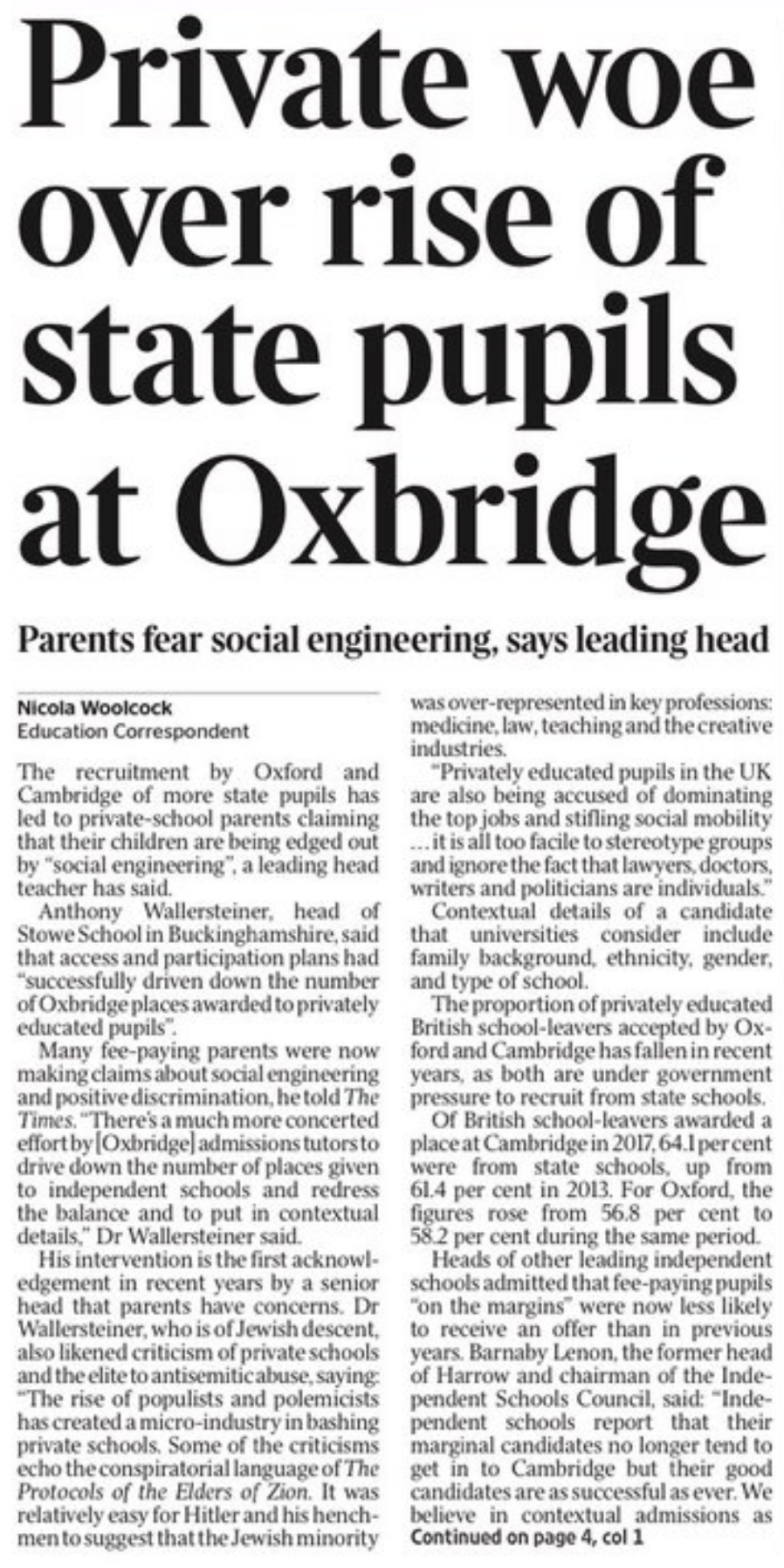
An article appeared in Saturday’s Times in which the head teacher of Stowe School (£38,000 per year to have your children educated there) had the cheek to complain about the fact that slightly more state school students are now getting into Oxbridge. Many have pitched into him, but the best evisceration of both him and the article came from Richard Murphy of Tax Research UK:

The headmaster of Stowe’s comments aren’t just vile: they’re eugenic

https://www.taxresearch.org.uk/Blog/wp-content/uploads/2019/05/Screen-Shot-2019-05-11-at-10.13.13.png

As a non-driver who is deeply concerned about environmental issues I was delighted to see this story from The Guardian:

London to have world-first hydrogen-powered doubledecker buses

Exterior of the Wrightbus doubledecker hydrogen bus prototype.

Here, from the weekend, comes my regular sign off (I have more pictures on my camera, awaiting editing):

P1230618 (2)
The first 49 pictures are from Saturday.

P1230619 (2)P1230620 (2)P1230621 (2)P1230622 (2)P1230624 (2)P1230626 (2)P1230627 (2)P1230628 (2)P1230629 (2)P1230630 (2)P1230633 (2)P1230634 (2)P1230635 (2)P1230636 (2)P1230636 (3)P1230637 (2)P1230638 (2)P1230639 (2)P1230640 (2)P1230642 (4)P1230644 (2)P1230645 (2)P1230646 (2)P1230647 (2)P1230648 (2)P1230649 (5)P1230650 (2)P1230651 (4)P1230652 (3)P1230655 (2)P1230656 (2)P1230657 (4)P1230658 (2)P1230659 (2)P1230659 (3)P1230659 (4)P1230659P1230662 (2)P1230663 (2)P1230664 (3)P1230665 (2)P1230666 (2)P1230667 (2)P1230668 (2)P1230670 (2)P1230671 (2)P1230672 (2)P1230674 (2)P1230675 (2)P1230676 (2)P1230678 (2)P1230679 (2)P1230680 (2)P1230681 (2)P1230683 (2)

P1230684
This is an unedited picture of a sparrow balancing on a wire.

P1230684 (2)
This is the edited version.

P1230685 (2)P1230685P1230686 (2)P1230687 (2)P1230687P1230688 (2)P1230688P1230690 (2)P1230692 (2)P1230693 (2)P1230694 (2)P1230695 (2)P1230696 (2)P1230698 (2)P1230702 (2)P1230702P1230703 (2)